

 Back
Back
Gutting Biden-era protections would help dirty plants run longer in the historically coal-centric state, despite big environmental risks.
Indiana — a state with a long history of coal mining and coal-fired power — has started undergoing a clean energy transition in recent years. It was among the top three states for solar installation last year, and more than a dozen coal plants have closed since 2010.
But the state government’s eager embrace of data centers and the Trump administration’s deregulation efforts might be shifting the needle back toward coal.

Last year, the U.S. Department of Energy issued emergency orders to keep two Indiana coal plants open, despite the grid operator saying it had an adequate supply of power. And now, two rules proposed by the Environmental Protection Agency could make it easier for aging coal plants to keep running.
On April 9, the EPA proposed a major rollback of regulations governing coal ash, which can contain heavy metals such as arsenic, lead, and mercury. The change would affect dozens of sites at more than 20 plants in Indiana, including areas where coal ash was dumped or scattered in decades past, as well as landfills and ponds holding ash.
Then on May 14, the EPA moved to gut Clean Water Act regulations requiring toxins to be removed from wastewater seeping out of coal ash repositories.
The proposals undercut specific Biden-era environmental protections that industry sources had asked the Trump administration to address in January 2025. In both cases, the companies would see their financial responsibilities reduced and find it easier to keep storing coal ash on-site as coal plants continue to run.
More than 100 environmental and consumer groups weighed in to vigorously oppose the proposals during public comment periods this spring and summer. But leaders say they still expect both rules to be finalized without substantial changes in coming weeks or months.
“This EPA is eradicating environmental and health protections and will make Americans sicker [and] poorer, and destroy irreplaceable water resources,” Lisa Evans, senior attorney for the environmental law firm Earthjustice, said in a news release. “And Trump’s EPA is doing this because the coal industry asked them to.”
The EPA wants to change the Effluent Limitation Guidelines under the Clean Water Act to exempt companies from having to treat contaminated wastewater that leaches out of coal ash dumps and into lakes or rivers, which in many cases are sources of drinking water. Such leachate often contains mercury, arsenic, lead, and other hazardous compounds. This undoes protections instituted in 2024 that required plants to retire if they can’t meet the new standards by the end of 2029.
“This has been a longstanding problem,” said Thom Cmar, a deputy managing attorney at Earthjustice. The Biden administration changes were “a huge deal,” he said. “It was finally forcing utilities to reckon with this significant contamination issue that had gone largely unaddressed for decades.”
Under the proposed rule change, only water that is intentionally pumped out of coal ash repositories would need to be treated; fluid that leaches out would go unaddressed.
About a dozen sites in Indiana could have leachate from coal ash that will be exempt from regulation by the proposed rule change, according to an EPA document. That would likely help the bottom line of these coal plants.
“Certainly to the extent that any of these sites are making decisions about how much more to invest and whether to continue to operate, anything that reduces costs is going to affect that decision,” Cmar said.
Mining and power plant industry representatives praised the move, which the EPA says will lower electricity prices and improve grid reliability.
“The AI and data center revolution is creating an electricity and baseload power demand that cannot be met under the overly restrictive policies of past administrations,” EPA Administrator Lee Zeldin said of the proposed rule change.
As Cmar sees it, the agency is prioritizing the development of data centers over its historical mission, which includes protecting drinking water.
“EPA is, under this administration, pulling every possible lever when it comes to every possible environmental rule to try to keep coal plants running for as long as possible,” Cmar said.
While effluent from coal plants has been subject to regulation for decades, the Trump administration’s proposed rule change governing coal ash would significantly alter federal standards that took effect in 2015 and were updated during the Biden administration.
Indra Frank, coal ash adviser for the Hoosier Environmental Council, said the change would mean at least half the coal ash units in Indiana would face no federal regulation at all.
Indiana is believed to have millions of tons of ash that was scattered or dumped on or near coal plant sites with little recordkeeping or oversight.
Such ash repositories — known as “legacy ash” or coal combustion residual management units — were exempt from the 2015 federal coal ash rule, and faced federal oversight only thanks to 2024 updates adopted in response to legal action by environmental groups. An analysis by Earthjustice found more than 70 specific sites at 22 closed or operating power plants in Indiana that potentially have such coal ash.
Frank noted that at the Harding Street Station coal plant in Indianapolis, coal ash is in contact with groundwater in the floodplain of the White River, according to environmental groups’ analysis.
“To remove requirements from those units is just unthinkable,” Frank said.
As she sees it, the proposed rule change “really sets us back” to the days when coal ash was dumped in the state with little accountability or transparency — to the benefit of coal power producers.
In addition to removing oversight of coal ash dumped before the federal rules took effect, the EPA proposal weakens requirements for more recent coal ash repositories. It allows companies to leave coal ash in contact with groundwater, loosens monitoring requirements, and removes restrictions on the use of coal ash as fill material.
Indiana did not join an eight-state effort in June led by neighboring Illinois to oppose the rule changes, and instead asked the EPA for permission to run its own coal ash permitting program.
While states can demand stricter standards than the federal government through their permitting processes, environmental advocates say they are not hopeful Indiana will do so, given its history of favoring industry.
“It’s a total punt to the states because [the EPA is] saying, ‘We’re not mandating anything,’” Cmar said. “There’s a risk a state like Indiana would not require significant cleanup.”
The Town of Pines, on Indiana’s Lake Michigan shore, was declared a Superfund site and underwent a massive, expensive cleanup after the 2002 discovery that ash was causing dangerous pollution in drinking water wells.
A few miles away, about 2 million tons of coal ash are held back by aging metal seawalls that environmental and health advocates fear could eventually fail and release the toxic mixture into Lake Michigan — the source of drinking water for millions of people in the Chicago area. The 2024 updated rule would have forced the utility Northern Indiana Public Service Co., which owns the Michigan City coal plant, to monitor and clean up the ash; the revamped rule would relieve the utility of that responsibility.
The proposal “opens the floodgates for more Town of Pines situations across the country,” said Ashley Williams, executive director of the community organization Just Transition Northwest Indiana and a resident of Michigan City.
“It’s a dagger in the heart on an issue we as JTNWI have worked so hard on. It’s the reason I launched JTNWI, to bring visibility to what we saw as this invisible crisis,” she said.
“It’s just mind-boggling what EPA is proposing with the stroke of a pen,” she added. “That’s how residents have been treated. We’re sacrificed time and time again because corporations see us as disposable, history continuing to repeat itself.”
A just-issued national security ban appears to exclude existing inverters for solar and battery projects — but future models could face restrictions, experts say.
Citing national security concerns, the Trump administration has banned the import and domestic use of new power inverters made outside the United States. The move could throw sand in the gears of gigawatts’ worth of planned solar, wind, and battery installations — projects that make up the vast majority of new electricity being built in the country.
On Tuesday, the Federal Communications Commission announced it had updated its “Covered List” to include “connected power inverters produced in foreign countries.” The list includes equipment and services considered to pose a threat to national security, meaning that these inverters “are generally prohibited from receiving FCC authorization to be imported, marketed, or sold in the U.S.,” the agency stated.
However, the ban currently applies only to future new models of inverters, not those already available in the market or being installed today — a distinction that could limit the immediate impact on the clean energy industry.
The FCC stated that its action was prompted by a “White House-convened Executive Branch interagency body with appropriate national security expertise,” which determined that foreign-made inverters, “regardless of the nationality of origin, “‘pose unacceptable risks to the national security of the United States or the safety and security of United States persons.’”
Inverters — devices that convert direct current electricity into alternating current suitable for transmission over power grids — are an irreplaceable component of utility-scale solar, battery, and wind power projects, home solar and battery systems, electric vehicles chargers, heat pumps, and other electricity systems.
The vast majority of inverters in use today are connected to communications networks, which puts them under FCC regulatory purview. And most inverters used in large-scale solar projects are built outside the U.S. — many of them in China, which has been the primary target of national security concerns.
The FCC’s new restrictions do come with that important caveat, though: They only “apply to new device models.” That qualification appears to exclude foreign inverter models that have previously won FCC approval.
The FCC also specified that the new restriction “does not impact a consumer’s continued use of devices they previously acquired,” or “prevent retailers from continuing to sell, import, or market relevant models approved previously through the FCC’s equipment authorization process.”
Those two statements have tempered some of the more drastic interpretations of the potential impact of the FCC’s announcement among energy industry market participants.
“In our world, investors are currently seeing this as kind of a non-event” due to this interpretation, John Miller, a managing director and energy transition policy analyst at investment bank TD Cowen, told Canary Media in a Wednesday morning email. “If either of those conditions were to change, this becomes a much bigger issue.”
This point was echoed by Julien Dumoulin-Smith, head of equity research for power, utilities, and clean energy at investment firm Jefferies, in a Wednesday morning statement. “[T]his has a minimal impact today. There seems latitude to continue to purchase existing inverter models on the market,” he wrote.
On the other hand, Dumoulin-Smith pointed out that any Trump administration steps to restrict new models of foreign-made inverters could create a “long, gradual shift in market share.”
Threats of the Trump administration targeting foreign inverters were first reported in late June by Reuters, which cited unnamed sources stating that a ban on Chinese-made inverters was in the works.
Last year, Reuters reported that technology experts investigating Chinese inverters had discovered communications devices that could be a security risk, citing anonymous sources. Later in 2025, Republicans in the House of Representatives wrote a letter to Commerce Secretary Howard Lutnick asking him to use the Commerce Department’s authority to “block future imports of Chinese equipment used in critical infrastructure nationwide.”
Chinese companies such as Sungrow and Chint Power Systems provide the majority of inverters for utility-scale clean energy and battery projects in the U.S., while U.S.-based Enphase Energy and Israel-based SolarEdge provide the majority of inverters for residential rooftop solar systems.
The FCC’s update targets any new inverters not made in the U.S., including those that U.S.-based companies produce in other countries. That could encompass inverters from other major providers to the solar market, such as Germany-based SMA Solar Technology and Austria-based Fronius International, as tracked by clean energy consultancy Wood Mackenzie.
If the FCC’s ban were to be expanded to include inverters currently being manufactured and sold for use in the U.S., the impact could be drastic. The U.S. built 50 gigawatts of new wind, solar, and battery capacity in 2025, more than any year prior, making up roughly 92% of new generating capacity. And the U.S. Energy Information Administration forecasts these trends will continue in 2026, with solar set to provide 51% of the new utility-scale electricity capacity, batteries 28%, and wind 14%.
In the immediate future, projects likely won’t have to abandon the inverters they’ve already purchased or plan to install, said Joe Shangraw, a solar research analyst at Wood Mackenzie. But he also cautioned that, as with any other industry, “eventually, currently approved products will become obsolete.”
That means inverter manufacturers will ultimately have to bring new products to market and submit them for FCC approval, at which time they’ll have to contend with the agency’s new rules. At that point, any inverters made outside the U.S. will be barred from sale and use unless they undergo a distinct conditional approval or waiver process, he said.
Shangraw also noted that the need to bring new products to the market could be accelerated if the federal government sets new requirements on cybersecurity, grid functionality, or other inverter capabilities.
“If that would require a significant hardware or software update, that would be something where you’d have to request some permissive change from the FCC, or ask for a totally new FCC ID” designating a new model of device for the agency’s review, he said. “So it’s certainly relevant and impactful — probably not in the next couple of months but in the next year or so.”
This growing uncertainty over the federal government’s classification of foreign-made inverters could increase industry interest in securing domestic inverter supplies, he said. On that front, “the storage space looks a lot healthier,” with companies such as U.S.-based EPC Power and Tesla operating significant domestic manufacturing capacity, and others such as Spain-based Power Electronics scaling up U.S. manufacturing.
Residential solar inverters are “in a good place,” Shangraw said, with SolarEdge, Enphase, and Tesla providing about 80% of the U.S. market needs. But the domestic manufacturing capacity for solar inverters for utility-, commercial-, and industrial-scale projects is less clear, he said, given that Chinese inverter makers hold about 60% of U.S. market share in that sector.
Large-scale solar developers could hope to earn waivers from the FCC on foreign-made inverters from non-Chinese companies such as SMA and Power Electronics, he noted. They could also anticipate expanded domestic manufacturing from U.S.-based Nextpower, which is acquiring the inverter and power conversion business of Spain-based Zigor and its U.S. subsidiary Apex Power; or from GE Vernova, which has opened an inverter factory in Pittsburgh and could expand capacity there, he said.
“The main thing is, we don’t know how impactful this is until we learn a bit more about the timeline for when these actual changes to the requirements” for existing inverters might occur that would “force companies to release new products,” he said. “I’d say if this was a hard deadline, and if there were no new imports allowed, we’d be in trouble.”
Despite Trump’s attacks, renewables are set for big growth over the next few years, a new Rhodium Group study says. Whether it lasts depends on some key variables.
So, how’s that clean energy transition going?
It’s the essential inquiry that drives anyone reporting on climate solutions, and it got considerably more difficult to answer after President Donald Trump returned to the White House. He’s done everything in his power (and some things that legally aren’t) to undercut the propulsive growth of renewables, which had accelerated under his predecessor. But real-world clean energy construction has kept rolling right along, policy setbacks be damned: The U.S. built 50 gigawatts of new wind, solar, and battery capacity in 2025, more than any year prior.
That achievement raises the possibility that the sheer strength of clean power technologies will carry the U.S. forward in its transition away from fossil fuels, despite the Trumpian interventions.
Now, we have a new glimpse into where this mess of positive and negative signals could be heading over the long term. The energy analysts at the Rhodium Group just released their annual “Taking Stock” report, which charts the likely trajectory of the nation’s greenhouse gas emissions on the basis of factors including clean energy buildout, AI demand surge, America’s rise as a global oil and gas exporter, and the repercussions of the ongoing war with Iran.
The good news, for those in the clean energy camp, is that solar, wind, and battery construction is still on track to bust records through the end of the decade. The bad news: After 2030, all bets are off; the spectrum of plausible outcomes runs from clean energy maintaining record installations to new construction nearly drying up in the face of competition from natural gas plants.
Rhodium models a vast range of inputs governing the power sector and the broader U.S. economy, and assembles three distinct future scenarios. The high-emissions scenario reflects a world with higher prices for clean power and electric vehicles, and lower prices for oil and gas, for instance. The low-emissions scenario inputs more aggressive cost declines for low-carbon technologies, and higher fossil fuel prices. The middle option more or less splits the difference.
“Our goal with the scenarios is to form a reasonable bound around where emissions are headed,” said lead author Hannah Kolus, a senior analyst at Rhodium. “But we take no position on where within the range we might be falling.”
By 2030, Rhodium expects total carbon emissions to fall by 26% to 29% below the 2005 baseline; by 2040, the range swells from a 27% reduction (essentially flat emissions through the 2030s) to a 41% reduction.
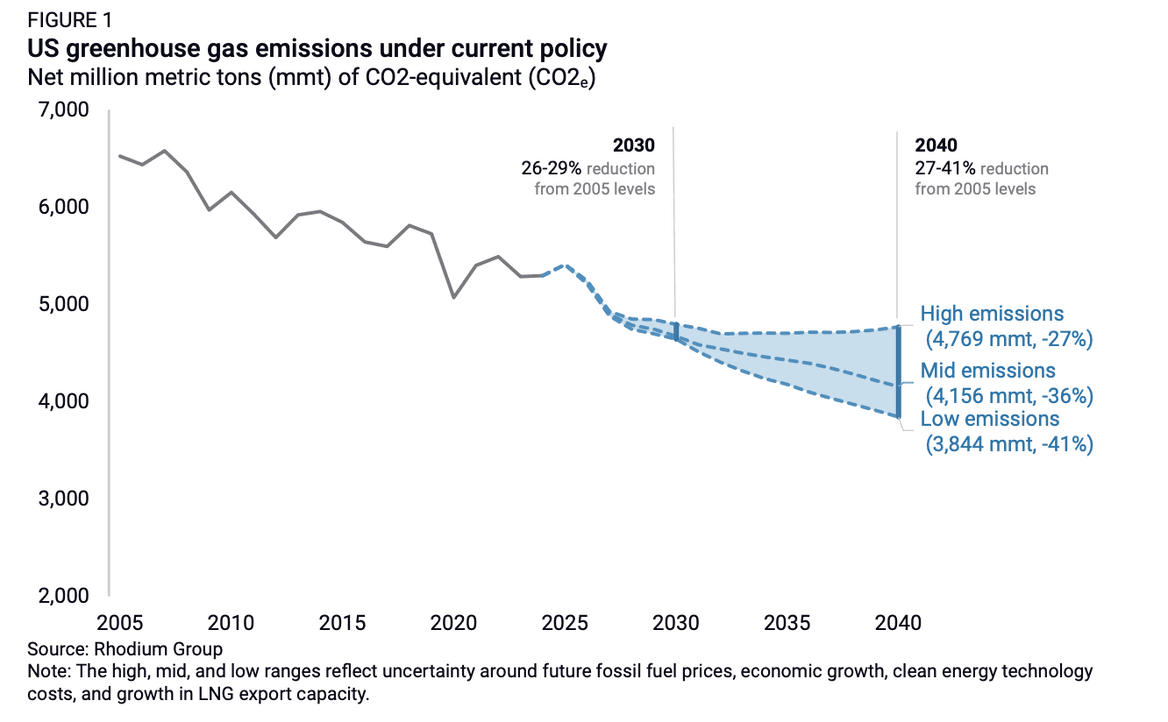
In Rhodium’s 2023 report, which incorporated the effects of President Joe Biden’s recently passed Inflation Reduction Act, analysts predicted emissions would fall by 29% to 42% by 2030. The country could still hit the low end of those expectations even after Trump dismantled many of the policies that made those predictions possible. That’s something of a win, but it’s tempered by the impossibility of hitting Biden’s Paris Agreement pledge of 50% reductions by 2030.
The certainty of renewables growth through the 2020s derives from a tax policy quirk that benefits solar and wind developers.
Although Trump snatched away the solar and wind industry’s beloved tax credits, projects that officially commenced construction by July 4 can still avail themselves of “safe-harbored” tax credits if they wrap up over the next four years. Rhodium expects developers will complete around 50 GW of solar, storage, and wind annually during this time. That outlook holds steady even in the more conservative scenarios, although it’s worth noting the firm’s model might not capture the extent to which the Trump administration’s permitting blockades may thwart development.
Past the bonanza of the late 2020s, those supporting tax credits disappear for wind and solar, and the predictions diverge wildly. The 2030s will come down to a battle for power sector supremacy between renewables-plus-storage and natural gas.
“When you have tax credits, you push up on what’s possible,” Kolus said. “Without them, you let energy markets take over, and then it becomes really a matter of what does clean technology cost and what are natural gas prices — those are the two things that are really driving the divergence in outcomes after 2030.”
In Rhodium’s low-emissions scenario, the low-carbon sources continue to romp, reaching 53 GW of annual installations through 2040 while holding new gas plants to just 5 GW annually. In the high-emissions scenario, the inverted price dynamics elevate gas to 16 GW of annual deployments and suppress clean energy construction to just 3 GW per year. In the middle scenario, renewables fall to an average of 16 GW annually in the first half of the 2030s, then rebound to 45 GW for the second half; annual gas additions meanwhile sit at about 9 GW over the course of the decade.
That high-emissions case would be devastating to the clean energy industry: The plummet from 50 GW of annual construction to 3 GW would decimate the pace of industrial activity, slashing construction jobs, infusions to local tax bases across the country, and new clean power for the states and customers that want it.
Rhodium’s findings square with what I’ve heard while interviewing clean energy professionals: There’s a ton of building to do in the next four years, but anything beyond that is too far off to predict. The energy landscape post-2030 will hinge on who’s in the White House. If that person restores supportive policies, the outlook will shift radically once again.
In the meantime, there are a few reasons to be optimistic that clean energy will avoid the worst-case scenario.
First and foremost, solar, wind, and batteries have a yearslong track record of beating the expert predictions of how cheap they’ll get. Given a range of cost projections, this history would suggest you bet on the low end. That alone could stave off the more dour scenarios described in the report.
Then there’s the changing nature of the U.S. fossil fuel industry. The country has been shipping more and more of its natural gas overseas via liquefied natural gas terminals. So much new export capacity has been approved and entered construction that LNG exports will rise dramatically in any of Rhodium’s scenarios. So far, this growth has had a muted effect on domestic gas prices, because producers have extracted more each year in lockstep with new export demand. But if the industry hit a bust cycle and couldn’t keep pace, basic economics suggests the domestic price would surge as U.S. consumers compete with foreign buyers willing to pay far more. That could weaken the case for gas generation in the 2030s.
Another source of hope for the clean energy contingent is that the modeling may underestimate how fast battery storage will reshape the power sector.
Rhodium notes that storage meaningfully takes off only in its low-emissions case, when lots of new renewables are getting built. But Kolus acknowledged that the analysis focuses on picking the lowest-cost option for new power capacity, whereas developers may build batteries for other reasons. For example, a firm could opt for batteries because they are less polluting than gas combustion turbines, or because they can be built more quickly. Batteries have already appeared in many deals specifically serving demand for data centers, to help tech giants with their climate goals and bring AI computing online faster.
When batteries do arrive in large numbers, they reliably take market share from gas plants. Gas generation in California is plummeting now, because stored solar power is a much cheaper source of nighttime electricity than burning fossil fuels. The broader cleanup of the U.S. power sector, then, will hinge on how quickly other states go the way of California in making batteries a prime source for on-demand energy.
Power stations that recharge from the sun, a car, or a home outlet can keep appliances going in an outage. Some can even help lower electric bills.
When the power goes out, a home battery can keep you going.
Energy storage, often paired with rooftop solar, has taken off in the U.S. in recent years as households look for ways to lower their utility bills and stay comfy during grid blackouts. But professionally installed partial- and whole-home battery systems aren’t right for everyone: They’re not only hardwired into a home — a change renters don’t usually have the authority to make — but also pricey. You should expect to pay at least $15,000 for one of these setups.
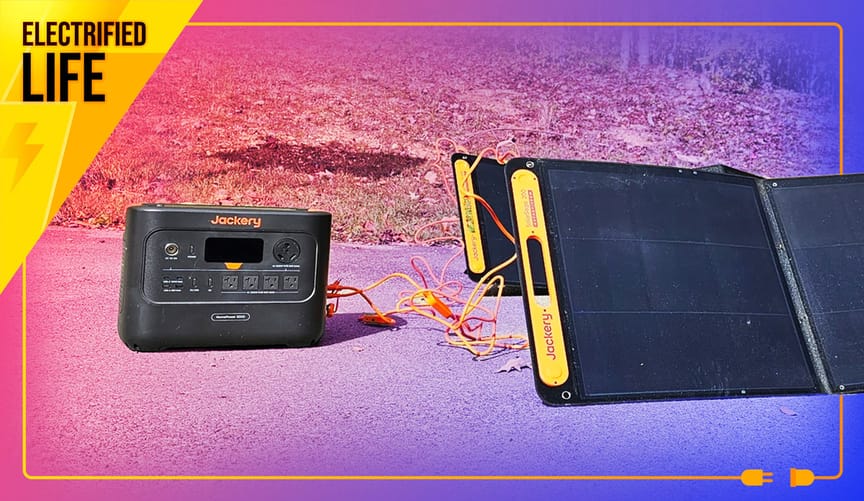
Luckily, there’s another option: portable batteries that can recharge from a standard home or car outlet or from portable solar panels. Although typically much less powerful than their whole-home counterparts, such DIY systems are far cheaper — and don’t require an electrician to set up. The rapid proliferation of the tech, known as portable power stations or solar generators, is democratizing clean, gas-free backup power more than ever.
These plug-and-play batteries, which range from the size of a toaster to a carry-on suitcase, have ports where you can plug in a few devices and appliances. They retail for several hundred to a few thousand dollars, depending on their storage capacity, and are widely available online and at big-box stores like Best Buy, Costco, and Home Depot. Some products, via their apps, can even shave your electric bill by automatically banking grid electricity during off-peak hours when it’s cheap, so you can pull the stored power during high-demand periods when it’s more expensive.
The market for portable batteries “has seen so much growth,” said Brian Essenmacher, North America head of business development for EcoFlow, which has manufactured this type of equipment since 2017. “They’re clean, they’re safe, there’s no maintenance, and they’re emissions-free. They can really be used by anyone to power the critical devices in the home.”
Portable power stations are mid-sized in the backup-battery bestiary. With a storage capacity of about 500 watt-hours to 4,000 watt-hours, these products are larger than power banks (roughly 7.5 Wh to 75 Wh), which can recharge a phone or a laptop, but typically more diminutive than batteries paired with home solar, like the 13,500-Wh Tesla Powerwall 3. Blurring the lines, though, some power stations can be expanded with additional battery packs to grow into 60,000 Wh or larger behemoths.

The portable tech can power a wide array of devices you might need during an outage. At home, that includes phones, computers, refrigerators, window air conditioners, “micro” heat pumps, TVs, fish-tank aerators, CPAP machines, baby monitors, Wi-Fi routers, sump pumps, and power tools. With some creativity, it can even be used to top off an EV.
The tech also enables outdoor activities, like filming, DJing, movie-projecting, camera-charging, water-boiling, and grilling. In recent years, the systems have pulled off a quiet revolution among the van-life and RV communities, who are increasingly picking batteries over polluting gas generators.
Ellen Vig, a semiretired registered nurse whose home base is in Billerica, Massachusetts, loves to boondock her minivan-turned-camper at the beach. And she’s never without her portable power station to keep her in comfort while she’s off-grid.
“It’s so nice to have a refrigerator and be able to use fans and charge your phone,” said Vig, who goes by “Electric Ellen, The Power Lady!” on YouTube and travels to RV and van-life meetups around the country answering people’s questions about portable backup power. “I’m a glamper, not a camper.”
For short-term use, Wirecutter recommends the Jackery Explorer 300 (293 Wh) at $279; for maximum battery life, the EcoFlow Delta 2 Max (2,048 Wh) at $949; and for a system that could be expanded to whole-home backup, the EcoFlow Delta Pro Ultra (6,000 Wh) at $3,999.
These products can be a surprisingly good value on a per-energy-unit basis. A $15,000 Tesla Powerwall 3 is $1,111 per kWh. The EcoFlow Delta 2 Max is $463 per kWh — less than half the Tesla tech.
Which portable power station is right for you? The first step is figuring out what you want to back up and thus how many watt-hours you need. List the devices you plan to power and a few of their attributes: their average and maximum power draws (in watts, and often listed in a label on the product itself or searchable online) and how long you plan to run them on backup power (in hours). Vig put together a handy template worksheet to crunch your total demand. Just copy it to edit.
I tried it — and was flabbergasted at my home’s energy decadence. Backing up just the essentials — window heat pump, fridge, laptop, and Wi-Fi router — for a day would take a whopping 14,000 Wh. A system that big would bust my budget, so I’m thinking something smaller will have to do.
Here are some key features besides size to look for in portable batteries:
Some other things to consider include how many outlets (AC, DC, and USB) the system has, the maximum watts each outlet can handle, how loud its internal fans get, how weatherproof the system is, how fast it charges, and if the company uses proprietary cables for connecting to solar.
The backup tech is rapidly improving. “Power stations are getting lighter, smaller, and more powerful, and they’re charging faster,” Vig said. A 1,024-Wh system would have taken her six or seven hours to recharge in the past, she noted. Now, she has one that charges up in roughly an hour.
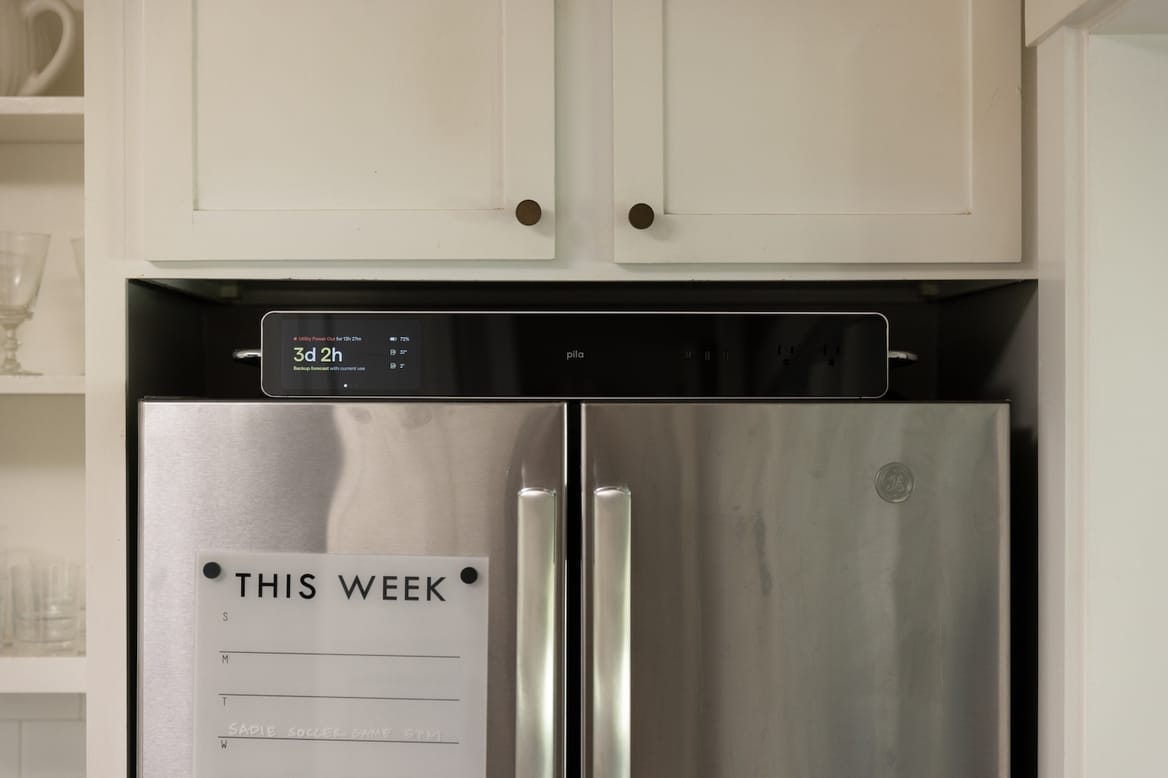
Companies are also rolling out sleek new form factors. In the last few months, Bluetti, Jackery, and Pila Energy began shipping briefcase-size systems that can sit on top of a fridge to conveniently provide the appliance with backup power.
More innovation is on the horizon to get daily use out of portable power stations. Most products available in the U.S. can’t deliver electricity into a building’s outlet; they can only draw power from it. But, as with plug-in solar, plug-in batteries that can push electricity into your home are already available in Europe and are starting to pop up here.
These devices can power appliances plugged into the wall, providing a seamless way to share stored energy across different rooms while taking advantage of favorable electricity rates. It’s important to note that this functionality won’t work during a blackout, though, to prevent any risk of shocking lineworkers; instead you’d need to manually plug appliances into the battery’s AC outlets to keep them going.
Eight states have now passed plug-in solar laws, which allow power to flow into a home outlet, opening the door to plug-in batteries, said Rachel Stotts, senior public relations manager at Jackery. Competitor EcoFlow has begun to sell its plug-in Stream Ultra power station in the U.S., but has so far limited shipping to Utah and Maryland, two of the first states to legalize balcony solar. As of Monday, the product was sold out.
Jackery, which sells these two-way batteries in Europe, plans to bring them to the U.S. market once it decides how to accommodate different state regulations, Stotts said.
The company doesn’t have a release date, she noted. But “we’re hurrying.”
The aim? To expand access to electric vehicles among lower-income residents of Massachusetts, which has big EV dreams as it tries to decarbonize.
Residents in four lower-income Massachusetts neighborhoods now have access to a new, low-cost option for running errands or getting to appointments: a shared, solar-powered electric vehicle.
The innovative pilot program, CommunityEV Carshare, launched Monday and offers eligible drivers discounted prices on hourly EV rentals at locations in Boston, Chelsea, Framingham, and Quincy.
Transportation is responsible for 38% of Massachusetts’ greenhouse gas emissions. Replacing gasoline-burning vehicles with electric options is therefore a major part of the state’s strategy for meeting its goal of net-zero emissions by 2050. And progress is being made: The EV market share has grown steadily in recent years, and as of 2025, roughly 3% of the state’s 5.6 million cars were electric or plug-in hybrids.
EV adoption, however, has largely come from higher-income households, said Lizzi Weyant, executive director of the Metropolitan Area Planning Council, a regional planning organization that is spearheading the pilot.
“It’s really about increasing access,” Weyant said. “If we are going to make EVs a more first-choice vehicle, we need to make them more accessible to lower-income residents.”
The idea for CommunityEV Carshare was first hatched by two of Weyant’s employees. At the same time that they were brainstorming the possibilities, the Massachusetts Clean Energy Center opened up a grant opportunity for projects that aimed to expand access to clean transportation options for historically underserved communities. The EV carshare plan received an award of $1 million to get off the ground.
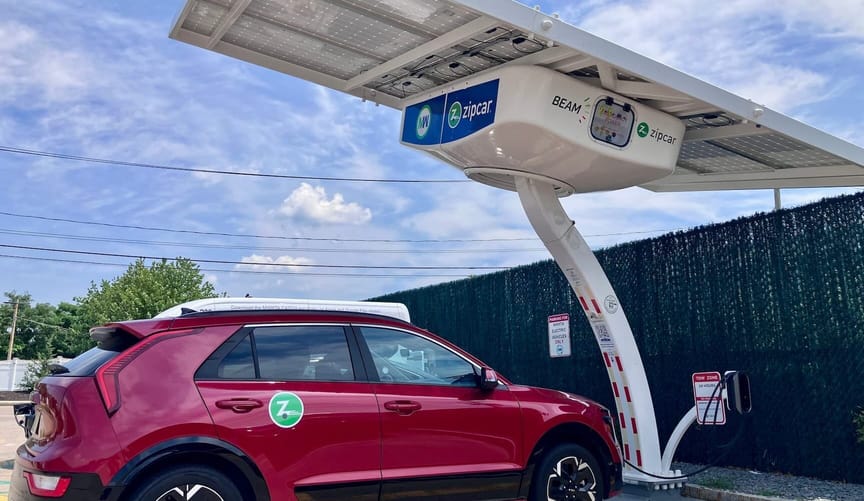
The result is a network of four cars — three Hyundai Konas and a Kia Niro — provided through Zipcar, the formerly Boston-based company that pioneered the carsharing concept. The vehicles are located in public housing developments in Boston and Chelsea, and sites in downtown Framingham and Quincy.
Each vehicle is paired with a solar-powered charger from EV infrastructure company Beam Global. The portable charging stations include a solar canopy held aloft by a large, curved metal arm. The whole thing looks something like “an alien spaceship,” Weyant joked, but the technology has the potential to get more charging capacity deployed more quickly, since it doesn’t require digging trenches, disrupting roads, or going through a grid interconnection process.
“We actually get to understand the impact of bringing something to residents in a faster, more affordable way for our cities and towns,” she said.
To make using the vehicles affordable, Zipcar has agreed to waive its standard $25 application fee and lower the annual membership fee from $90 to $35. Once they’re enrolled, drivers can use the car for an hourly rental rate of $11 on weekdays and $13 on weekends, which includes the cost of insurance and charging. Standard Zipcar fees vary by market, but are generally from $14.50 to $17 per hour.
In Boston and Chelsea, all residents of the public housing complexes where the cars are located are eligible to sign up for the pilot. In Framingham and Quincy, interested drivers must show evidence that they already receive government assistance through programs such as the Supplemental Nutrition Assistance Program or MassHealth, the state’s Medicaid program.
The first participants have already enrolled, and the cars hit the road this week. The organizers will be watching closely to see who is driving the EVs, where, and how often, said Scott Nathan, CEO and founder of charger platform company Alwayz, a partner in the project. They’re hoping to learn more about whether there is demand for such service in the targeted communities, what kind of education or messaging is needed to get drivers behind the wheel, and how many miles users drive per trip.
The goal is to gather information that will help expand EV use, boost businesses in the sector, and drive down emissions, Nathan said.
“We think there are long-term benefits to providing greater access,” he said. “We think that will grow the market of electric vehicles, and ultimately help reduce impacts on climate change.”
Research shows that once drivers try an EV, they stick with them. That’s why these incentives target those who’ve never owned one to maximize the bang for the buck.
California is making a bet: Once you’ve driven an EV, you won’t want to go back to a gas-powered car.
Earlier this month, Gov. Gavin Newsom (D) signed legislation creating the MyFirstEV program. It’s the state’s first big attempt to make up for the loss of federal EV tax credits, and it’s exclusively targeting the key demographic of EV neophytes.
The fine details are still being hashed out in advance of MyFirstEV’s official launch later this summer. But, in broad strokes, the program will offer a $3,500 rebate at the point of sale for a first-time purchase or lease of any new EV that retails for $50,000 or less, and a $1,750 rebate for a used EV selling for $25,000 or less.
The program is funded with $270 million. Half of that will come from the state budget, and the other half — in a rare arrangement — will come from participating automakers, including Ford, General Motors, Honda, Hyundai, Kia, Lucid, Mitsubishi, Nissan, Rivian, Subaru, Tesla, Toyota, and Volvo.
For years, consumers across the nation could get discounts of up to $7,500 for new EVs and up to $4,000 for used EVs. These tax credits were crucial: They could make some new EVs cost-competitive with new fossil-fueled cars.
But the megabill passed by Republicans in Congress last year killed those federal incentives at the end of September 2025, and EV sales have plummeted since.
That poses problems for decarbonization goals held by states like California, as fossil-fueled vehicles are among the largest sources of greenhouse gas emissions in the nation.
The Golden State is not the only one trying to make up for lost tax credits. Programs in Connecticut, Delaware, Illinois, Maine, Massachusetts, New Jersey, New York, Rhode Island, and other states offer incentives and rebates that can reduce the cost of an EV by more than $1,000. Residents of most states can find some form of assistance from government or electric utility programs for vehicles and for home chargers.
California’s new program is notable both because it is by far the nation’s largest EV market and because it’s the first to tie rebates to first-time EV buyers.
That’s according to Rachel Reolfi, senior policy analyst at research firm Atlas Public Policy. She made the case for strategies like MyFirstEV in a December policy paper that argued states will get more “bang for the buck” if they limit incentives to first-time buyers.
As Reolfi told Canary Media, this “pretty novel concept” makes sense because of a simple fact: “When folks buy an EV, they don’t go back to gas cars.”
Survey data supports the point. J.D. Power’s February consumer satisfaction survey shows that 96% of U.S. EV owners would consider purchasing or leasing another EV for their next vehicle. Concerns about range and charging availability also drop significantly once a person starts driving an EV, per analysis from EV-advocacy group Plug In America.
This data helped inform California’s MyFirstEV program, said Dan Krassner, executive director of EVs for All America, a nonprofit research group that commissioned the Atlas report.
By focusing scarce state funds on first-time EV buyers, “each rebate buys a customer rather than a transaction,” Krassner said in an email. American EV Jobs Alliance, his group’s advocacy affiliate, “took that concept into California and made the case for it with lawmakers, the administration, and coalition partners.”
This approach makes sense, according to Corey Cantor, research director at the Zero Emission Transportation Association trade group. “When you leave the early adopters behind and try to hit mass market scale, we know up-front price and charging concerns have been a challenge,” he said. “The people we really need to reach are those that have yet to be convinced to drive electric.”
Restricting rebates to first-time EV buyers does add some complications.
MyFirstEV will require participants to submit a document attesting that they haven’t previously bought an EV, according to John Swanton, a communications specialist at the California Air Resources Board, the agency administering the program.
It’s possible that some applicants may try to game the program by failing to disclose that they’ve bought an EV before, said Scott Shepard, transportation senior director for the Center for Sustainable Energy, a nonprofit group that manages EV rebate programs in multiple states, including the California Vehicle Rebate Program, which ended in 2023. But there are fairly simple ways to police that, he said, like checking records with the state Department of Motor Vehicles to “keep people honest.”
If anything, Shepard said, it’s easier to look up vehicle registration data than it is to enforce the income limits that some other state programs require. MyFirstEV has no income restriction.
Meanwhile, limiting rebates to purchases of new EVs that sell for $50,000 or less helps prioritize people seeking lower-cost alternatives, he said, although the program does waive that limit for vehicles made by companies headquartered in California, which includes Lucid and Rivian.
Including credits for used EVs also helps lower-income buyers, Shepard said. New EVs still cost quite a bit more than their gasoline-fueled counterparts, but used EVs are much cheaper comparatively, particularly as previously leased vehicles start to come back onto the secondary market. “Creating used-vehicle options is a great way to distribute air quality and economic benefits,” he added.
Finally, the program will adopt what’s become a best practice for EV incentives: Allowing customers to instantly receive the discount rather than needing to wait to file their taxes to claim the rebate.
“One of the sticky points early on with EV tax credits was that it was a tax credit and not a point-of-sale rebate — and that adds sand to the gears,” said Andrew Garberson, head of growth and research at Recurrent, a company that aggregates data on EV battery health. “Making it point-of-sale adds grease instead of sand to the gears.”
Targeting first-time EV buyers may be particularly appropriate for a state where EV enthusiasm is recovering more quickly than the U.S. as a whole, noted Cantor of the Zero Emission Transportation Association. New data from the Newsom administration and from the California New Car Dealers Association shows that EV sales have started to climb back after their post–federal tax credit slump.
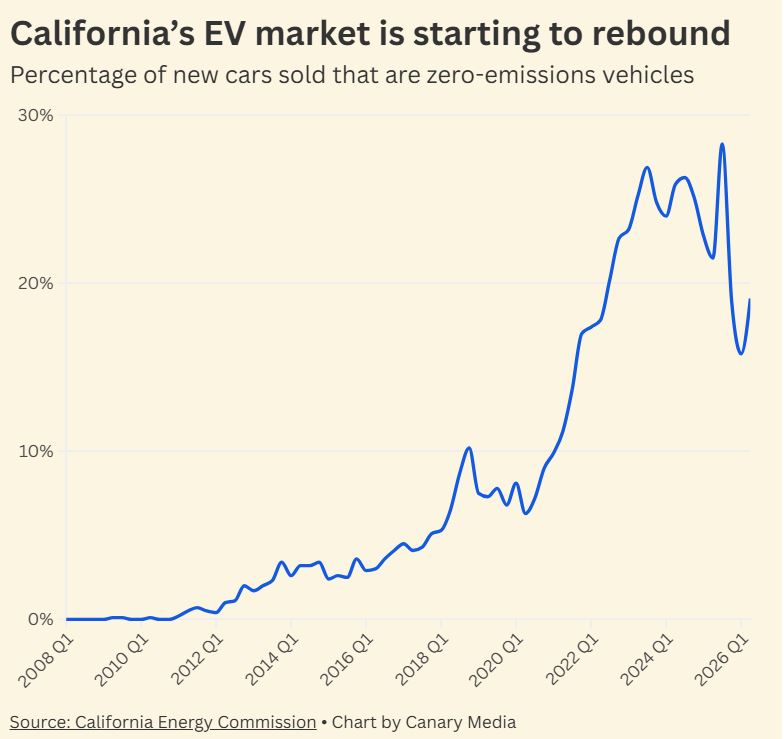
What remains to be seen is whether California and other states can help the U.S. automotive industry recover from the federal government’s pullback, Shepard said. But states are inherently more constrained in how much money they can commit to these kinds of programs, which limits their impact.
According to Shepard’s initial analysis of demand for EV incentives from the California car-buying public, the $270 million for the MyFirstEV program will most likely be depleted within less than a year. States may need to commit to “funding mechanisms that are more reliable, more stable, perhaps more meaningful,” than what they’ve been able to pull together thus far, he said.
Even a state as wealthy and as central to the EV market as California will struggle to make that happen, Atlas’ Reolfi said. “It’s clearly a constrained state budget environment,” she said. “But it’s good to see states sending a message.”
In that light, getting automakers to match the state’s $135 million in funding was something of a coup, Cantor said. German automakers have contributed to that country’s government EV subsidy programs in the past, but “that hasn’t been done in the U.S. before,” he said.
Krassner of EVs for All America said he has promoted prioritizing first-time EV buyers in testimony before the Maryland Mitigation Working Group, a key body under the state’s Commission on Climate Change.
“California just handed every other state a template that works.”
Many manufacturers burn fossil fuels to make snacks, materials, and chemicals. High electricity costs are complicating their efforts to switch to cleaner technologies.
American households are all too familiar with the pain of high electric bills, which are climbing nationwide. The same problem is quietly hindering the country’s factories from cleaning up their operations, too.
Hundreds of thousands of U.S. manufacturing facilities burn fossil fuels to produce the heat they need to make packaged foods, bottled drinks, construction materials, and likely everything in your bathroom cabinet. It’s why the industrial sector accounts for nearly one-third of the country’s carbon dioxide emissions from energy use.
Cleaner technologies like industrial heat pumps, electric boilers, and heat-storing batteries are already commercially available. Yet even companies that are committed to decarbonizing can find it hard to justify making the switch. The underlying problem is that in virtually every state, electricity costs more than natural gas for industrial users.
“We have to have solutions that are at the very least competitive with the existing cost of fuel,” said Neil Brown, a chemical engineer at Tennessee-based Eastman Chemical, which has over a dozen manufacturing sites in the U.S. and more abroad. “In some places where Eastman operates, in parts of the Southeast and Texas, it is very difficult to compete with the low cost of natural gas.”
Brown was speaking on a webinar last month held by the Renewable Thermal Collaborative and Industrial Heat Pump Alliance. The groups looked at electrifying low- to medium-temperature processes, and estimated it would add roughly 250 terawatt-hours to the industrial sector’s annual electricity demand by 2035 — or nearly 25% more power than manufacturers currently use.
On the plus side, deploying clean industrial technologies could generate around $471 billion in total economic output over the next decade, even when accounting for the lost jobs and diminished business activities of gas utilities and equipment makers, according to the groups’ June report.
But reaping those benefits will first require finding ways to drive down the cost of electricity for manufacturers. A growing number of climate and energy experts are studying that challenge and proposing solutions for policymakers and utilities to consider.
One of those strategies could be to build renewable energy projects directly beside factories.
Researchers at the University of California, Berkeley, recently modeled what would happen if factories themselves installed off-grid solar or wind projects on-site and used the clean electricity to power thermal storage systems and heat pumps. The team looked at nearly 3,600 locations across the country, evaluating land availability, solar-power potential, and local natural gas prices for each site.
Renewable-powered heat systems could economically supply up to one-third of the studied industrial heat demand by 2035, they said in an analysis announced last week.
The researchers found that such an approach would make it more cost-effective to run heat pumps than gas boilers for industrial processes below 200 degrees Celsius (392 degrees Fahrenheit) — a broad category that includes beer making, paper production, and textile manufacturing. Meanwhile, thermal batteries would offer “competitive or lower costs” for scorching-hot operations like glass melting and steel manufacturing.

“In states where you have very good solar quality and natural gas prices are high, like in California, it makes economic sense for the industry to do this, because they will save some money on their heating costs,” said Amol Phadke, a co-author of the report and an adjunct associate professor at UC Berkeley’s Goldman School of Public Policy.
However, even states without California’s abundant sunshine can still produce low-cost solar power, thanks to declining solar-panel prices. The vast majority of sites in the study have sufficient buildable land to install solar projects.
Phadke added that building off-grid systems would give factories faster access to renewables, since grid-tied wind and solar farms have to wait in long interconnection queues, which can delay projects for years. Ditching the utility would also let manufacturers avoid paying steep grid-delivery charges and other expenses — and sidestep competition with data center operators for power from an increasingly strained grid.
The new site-level data “is really helpful for project developers and technology developers to know how to prioritize their efforts, in terms of where to go and pitch industries on,” said José Domínguez, the study’s lead author and a research affiliate at the Goldman School.
The fact remains, though, that many factories will continue to rely on the electric grid in the near term. To get these facilities to consider transitioning to cleaner heat, the cost of electricity needs to come down.
The concept of electricity rate reform is gaining traction among decarbonization advocates, state policymakers, and manufacturers like Eastman as a tool for narrowing the gap between electricity and natural gas prices.
In California, Senate Bill 943 would authorize the state’s Public Utilities Commission to fix utility rates and fees to make it more affordable for large industrial and commercial customers to switch from fossil fuels to electric heat. The bill passed the Senate in May and is now headed to the state Assembly’s Appropriations Committee.
In the Upper Midwest, the utility Otter Tail Power recently developed a novel electricity tariff that is designed to boost the bottom line of thermal energy systems and to ensure they benefit everyone on the grid. The first project to take advantage of this new rate is Antora Energy’s 5-gigawatt-hour battery in South Dakota, which turns cheap wind energy into clean industrial steam for Poet’s nearby ethanol-production plant.
“Reforming electric rates is a good way to improve the economics of electrification while taking advantage of our clean electricity generation,” said Lauren Kubiak, a senior scientist for the Natural Resources Defense Council who works on California climate and energy policy.
Kubiak led a new study analyzing how this strategy could improve the costs of operating industrial heat pumps in two major manufacturing states: California and Michigan. While heat pumps are significantly more energy-efficient than gas-fueled boilers, they’re typically not cost-effective to operate in either state, given current electricity prices.
The study examined what would happen if companies paid only “marginal” electricity costs, which reflect the actual cost of generating and transporting an additional unit of electricity. Today, ratepayers also pay “non-marginal” costs that help cover things like grid maintenance and infrastructure upgrades, net-metering programs for rooftop solar, and, in California, wildfire-prevention efforts.
“In California, [marginal-cost] rates enabled heat pumps to become pretty cost-competitive with gas boilers,” Kubiak said. That’s particularly true for major subsectors that require low-temperature heating.
For Michigan manufacturers, the impact is more muted, since the state’s electricity rates are lower than California’s and don’t include as many non-marginal costs. However, charging factories marginal rates would still reduce the size of the electricity-gas cost gap, enough that layering on other industrial policies — such as a tax credit that rewards low-carbon heat production — could bridge that divide almost entirely.
In the report, Kubiak and her co-authors suggest that utilities could offer marginal cost rates only to new heat pumps that displace fossil fuel–generated heat. These rates could also be set to encourage manufacturers to use electricity during times when solar projects are producing excess electricity, or when overall grid demand is low. That should help avoid saddling other ratepayers with the non-marginal costs that these new heat pumps won’t be paying.
“Electric rate reform is a tool in our toolbox that hasn’t been used to its fullest extent just yet,” Kubiak said.
As tech firms look to build their own gas generators, a new report reveals that likely won’t be enough to avoid a hefty power shortfall in the coming years.
It’s no secret that data centers are slated to bring stunning levels of new power demand to the grid in the coming years.
Report after report has tried to put a number on just how much electricity these facilities will actually use, and BloombergNEF joined the chorus this week. Its report projects that U.S. data centers will consume 20% of the country’s power in 2035, up from 5.9% today.
In all, data centers will consume as much as 194 gigawatts of power in 2035, the report estimates. That’s nearly double the amount BloombergNEF forecast back in December, and it’s more than the firm’s analysts expect the power grid to be able to accommodate.
So what’s a data center developer to do? Well, if you’re Elon Musk, you buy a company that’s operating tons of mobile gas and diesel generators that can provide your data centers with power that’s not connected to the grid.
Federal records unearthed last week by Electrek show that in May, the xAI founder bought APR Energy, a Florida company that runs more than a gigawatt of these portable fossil-fueled turbines. These generators can be installed in just a few days, as opposed to a traditional gas plant, which may take years to build.
This isn’t a new avenue for xAI. Since last August, the company has been using diesel generators propped on truck beds to power its Colossus 2 data center project outside Memphis. A lawsuit from the NAACP and its allies alleges the turbines are running without required permits and releasing tons of pollution that harms nearby, majority-Black communities.
Other data center projects are turning to gas, too, or hope to do so in the future. In Ohio, Meta uses modular gas turbines to power servers that, as of June, are stacked up in temporary tents. Some developers want to construct more permanent fossil-fuel solutions: Google, for example, has proposed building its very own utility-scale gas plant alongside a data center in Nebraska.
But experts are casting doubt on just how much off-grid gas power that tech firms will actually be able to build. Among the challenges: Gas turbines are in short supply, and so is the workforce needed to maintain them, as the clean energy industry veteran Jigar Shah noted in an episode of Latitude Media’s Open Circuit podcast.
BloombergNEF projects that even if the grid can accommodate 7 GW of new data center demand each year — the all-time record — and if many hyperscalers install their own gas turbines, the sector will still face a 19-GW shortfall by 2035. For perspective, a standard large-scale nuclear power plant produces about 1 GW of power, and it’s going to be a gigantic undertaking to fulfill the Trump administration’s goal to build 10 of those in the coming years.
Of course, no one knows for sure just how much power data centers will actually end up needing. Data centers could get way more efficient as their processors improve. The AI boom could peter out. Or maybe, just maybe, we’ll unlock the miracle clean power source that is commercial nuclear fusion and use it to meet all our massive electricity needs — but I wouldn’t hold my breath.
Trump’s ill-timed efficiency rollbacks
America’s war with Iran isn’t letting up, and neither is the energy shortage the conflict has brought upon much of the world.
Energy-efficiency measures could provide one salve to the crisis, but in the U.S., they’re getting ever harder to access. Over the past few months, the Trump administration has scaled back a bevy of programs that make home weatherization and other utility-bill-cutting improvements more affordable. Incentives that helped people trade fossil fuel appliances for electric alternatives are dead, for one.
Even free advice hasn’t survived. The Department of Energy’s website used to be full of tips for lowering your power bills, like how to find and plug drafts in your home. But as Grist reports, those guides disappeared by early July — just in time for a grid-straining heat wave to set in across the country.
State legislatures go easier on renewables
Last year, state legislatures had clean energy in their crosshairs. Lawmakers throughout the country introduced more than 300 bills related to renewable energy siting in 2025, and nearly half of them would have made it harder to build solar, wind, and battery storage projects.
Luckily for renewables, just 10 of those restrictive measures actually became law. But this year is shaping up to be brighter, according to the Siting Solutions Project. While lawmakers introduced 86 measures to rein in solar, wind, and battery permitting in 2026, just one has become law. That record is likely to stick, as most state legislative sessions have already concluded for the year.
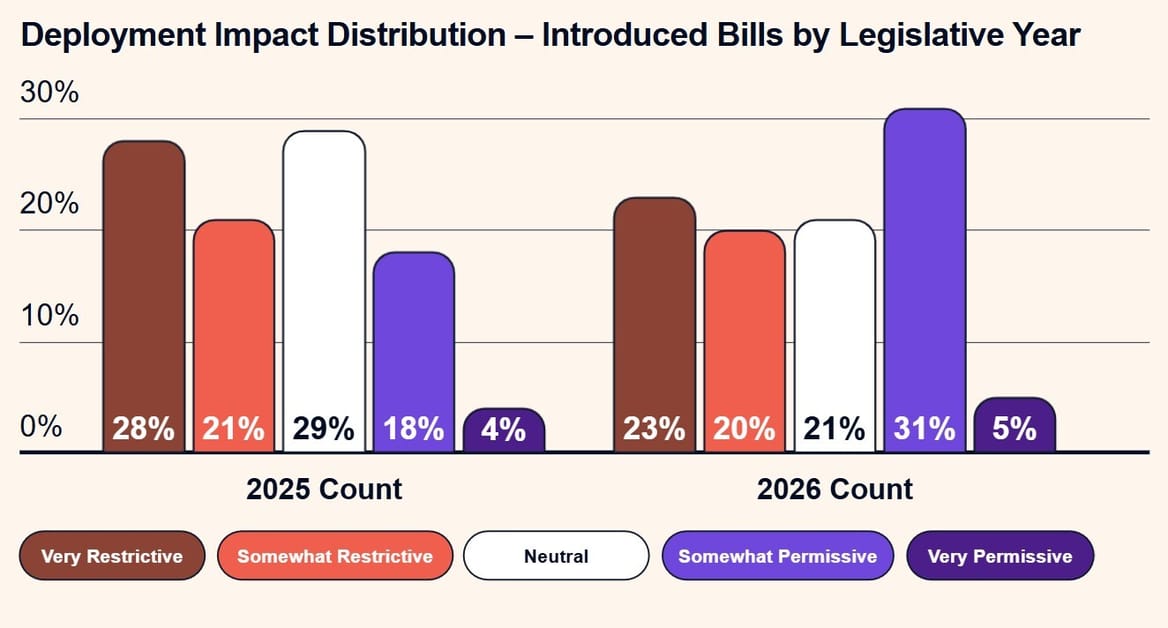
Meanwhile, a handful of pro-renewables permitting and siting policies made it into law this year in both Democratic- and Republican-run state legislatures, reports Canary Media’s Jeff St. John. That includes measures that aim to curb local bans on renewables, speed review processes, and set best practices for cleaning up retired solar and battery projects.
Where to buy balcony solar: A few companies are finding their footing in America’s emerging balcony solar market, with some German firms expanding sales to the States, and U.S. solar manufacturers potentially getting involved soon. (Canary Media)
Iran war strain continues: The world has found ways to adapt without oil from the Strait of Hormuz, but experts predict that fallout from a continued closure could be more severe as countries’ emergency stockpiles near depletion. (Grist)
International nuclear deal: The Trump administration signs a deal with Saudi Arabia that paves the way for nuclear power construction in the country — an arrangement that’s likely to benefit U.S. nuclear developer Westinghouse. (Washington Post, New York Times)
Pumping up iron: Mesabi Metallics sees green steel as a path to revitalize Minnesota’s Iron Range, and it’s rolling out a $2.5 billion plan to mine and produce iron that’s key to lower-emissions steelmaking. (Canary Media)
Coal’s climbing costs: Pushback to the Trump administration’s coal-plant stay-open orders grows, with Wisconsin’s governor saying the costs to utility customers could hit $117 million in coming years, and a Colorado analysis estimating costs over $87 million. (Wisconsin Public Radio, Colorado Sun)
Wind allies unite: A coalition of 18 states and Washington, D.C., looks to join a wind industry lawsuit fighting the Department of Defense’s blockade on onshore wind permitting. (Canary Media)
Digging deeper: Geothermal veteran Ormat Technologies is venturing into the industry’s next generation with projects that can unlock energy where natural geothermal resources don’t exist. (Canary Media)
Trump’s Department of Energy bashes solar panels for not producing 24/7, but the renewable energy source just got Texas through a heat wave.
Yesterday, the Department of Energy took to social media to try and make a scandal out of a well-known fact: Solar panels do not generate power at night.
It’s an old and lazy swipe that critics of renewable energy love to take, even though the people who operate our power grids know that this is the case and plan around the advantages and constraints it presents. That this argument is coming from the cabinet agency overseeing America’s energy system is unnerving but at this point unsurprising. It’s not the first time Energy Secretary Chris Wright has twisted basic facts about renewables.
During the early-July heat wave, “99% of solar power” in the mid-Atlantic “failed after sunset,” according to the graphic Wright’s Energy Department shared on X.
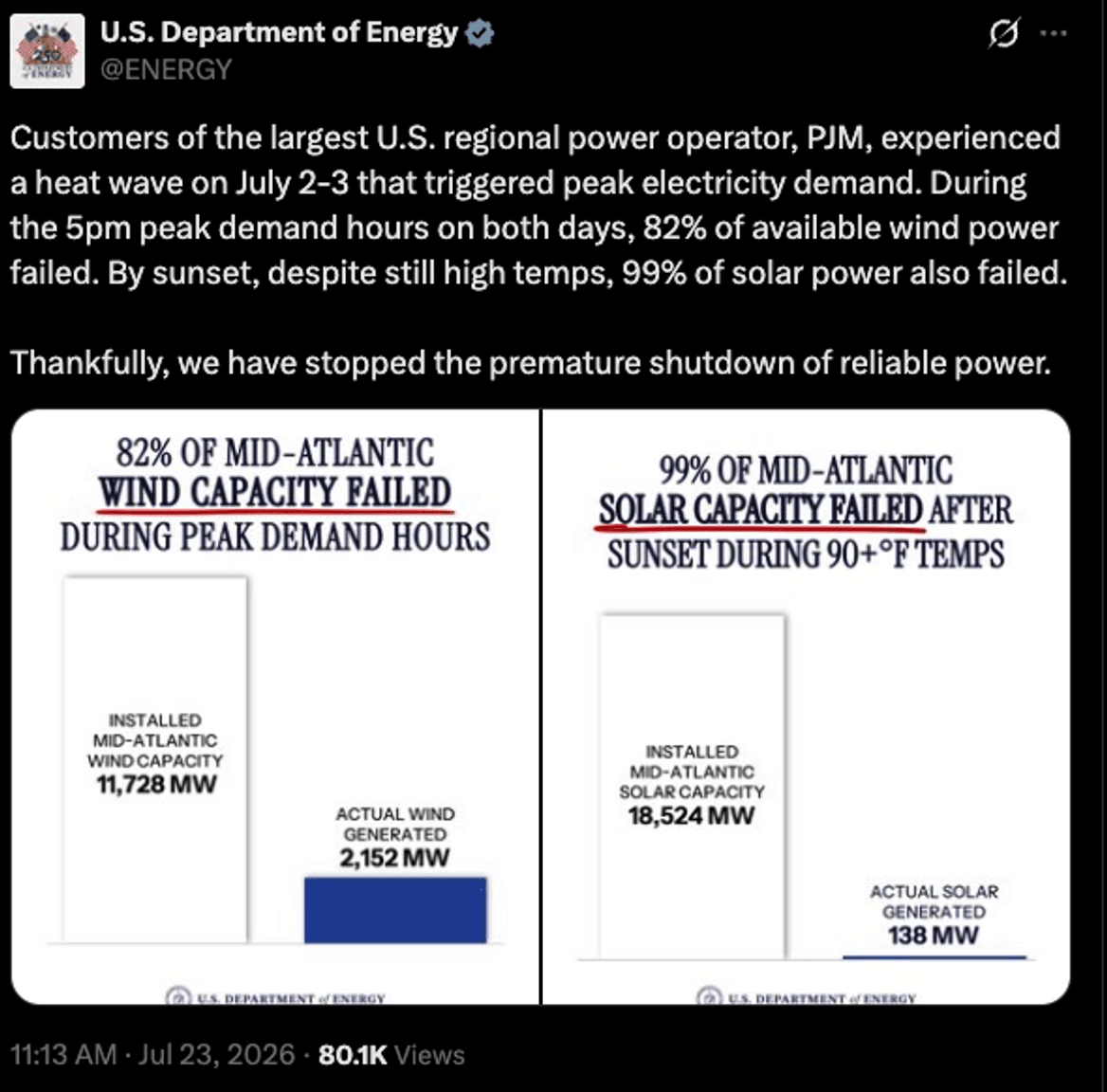
Putting aside the misleading and deceptively provocative language (“failed”? really?), the post completely ignores, you know, the rest of the day. When the sun is shining.
As Wright and others at the DOE well know, solar may not work at night — but it excels in the day. And that matters a lot.
I’ll use one very recent example to make the case. Texas experienced a heat wave this week, and its residents did what you’d expect to get through it: They cranked up their air conditioners. AC is a lifesaver but also an electricity guzzler, and so all that cooling pushed the Texas grid to new highs. On Tuesday the state’s main power grid broke its all-time electricity-demand record. That superlative didn’t stand for long: On Wednesday it set a new record with over 91 gigawatts of peak demand.
Despite this unprecedented strain on the grid, the lights stayed on and the ACs kept humming along. Solar, which Texas has built tons of in recent years, played a major role in that outcome.
On Tuesday, for nearly five hours, solar provided more electricity than natural gas did. On Wednesday, from just before 9 a.m. until just before 5 p.m. — the duration of a full workday — solar provided more than one-third of all electricity in Texas. At times each day, it topped 40% of electricity supply. Solar also helped charge up enough batteries that the Lone Star State set a new record for battery output Wednesday evening when the sun set and demand remained high.
Pretending that solar does nothing to stabilize the grid during periods of extreme stress is disingenuous at best, but it also discounts another key fact. In moments like this past week in Texas, solar can — and did — keep energy prices from spiking.
Perhaps the administration put out this post to troll people like myself. If so, then congrats — consider me trolled and triggered.
I wish we could just categorize it as inane and laugh it off. But it’s coming from a once-authoritative source and cloaked in a faux-authoritative tone and premised on figures that are technically accurate, if completely misleading. And stuff that sounds reasonable and comes from ostensibly trustworthy sources has a way of spreading around online.
Already, Google’s AI overview is promoting this DOE post as a reputable source and pointing out that solar “output dropped significantly by sunset” during the July heat wave in the mid-Atlantic.
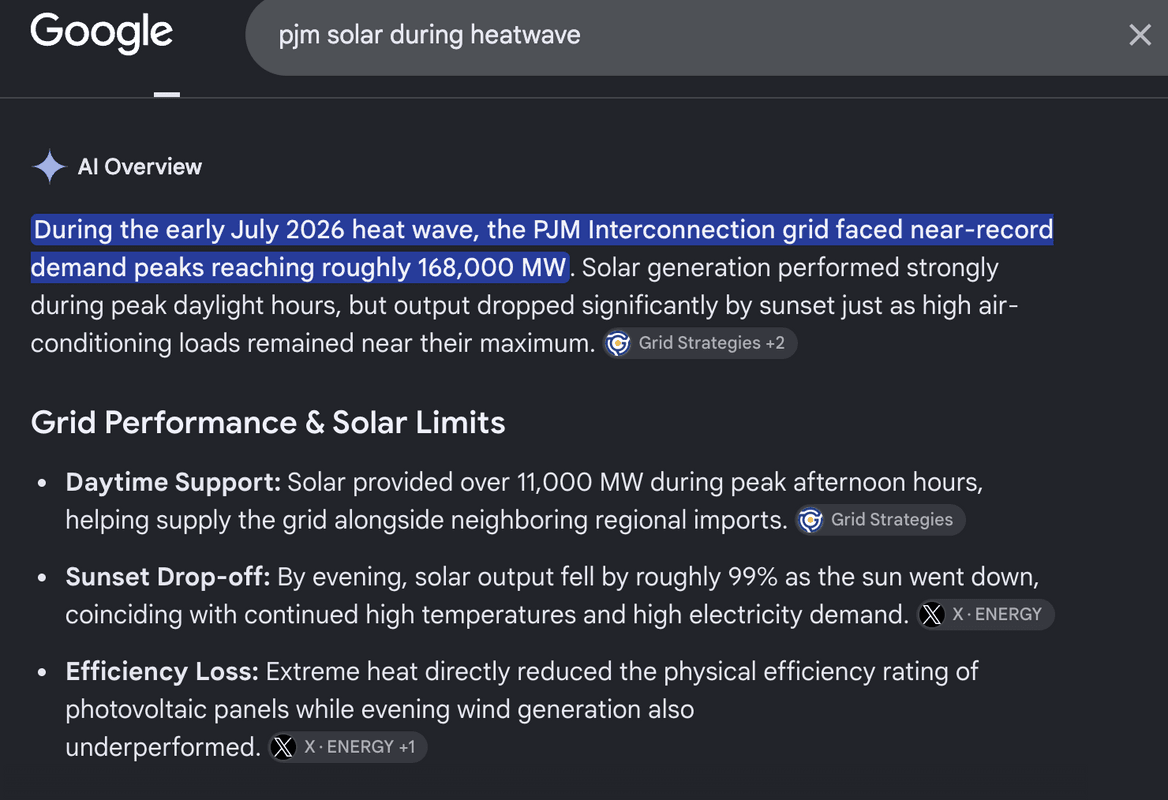
And, of course, the DOE’s message is part of a much more serious and directly damaging trend: The Trump administration’s war on solar and other forms of renewable energy.
Trump has ripped away tax credits for both large-scale solar projects and rooftop installations, crushed a program meant to help low-income Americans afford photovoltaic panels of their own, slow-rolled permitting for projects, and froze a longstanding federal effort to help farmers put solar on their land. I could, unfortunately, keep the examples coming.
But the administration can’t change the fact that solar is the cheapest, cleanest, and easiest form of energy to build — or that we are in the midst of an unprecedented boom in electricity use. People’s utility bills are soaring because supply is lagging behind demand.
It’s undeniable that solar is valuable to our energy system, even if it can’t anchor a grid on its own. Yes, of course, its value is mostly during the daylight hours, though batteries are making it possible to shift more and more of that power to evenings. And in any case, we do not live on a cold, shadowy planet condemned to long, dark days. In New York, where I am writing this, we’ll have 14 hours and 34 minutes of daylight today. If only we had even more solar panels installed here to soak it all up.
It was the EU’s top power source in early summer, generating a record 25% of electricity. The clean energy boom is likely to accelerate further from here.
Europe has had a sunny start to its summer.
Across both May and June, solar was the European Union’s top source of electricity — and provided a record-high 25% of the region’s power last month, per new data from think tank Ember. Several countries, including Spain and Germany, received more than one-third of their electricity from solar in June; in Hungary, it supplied nearly 50%.
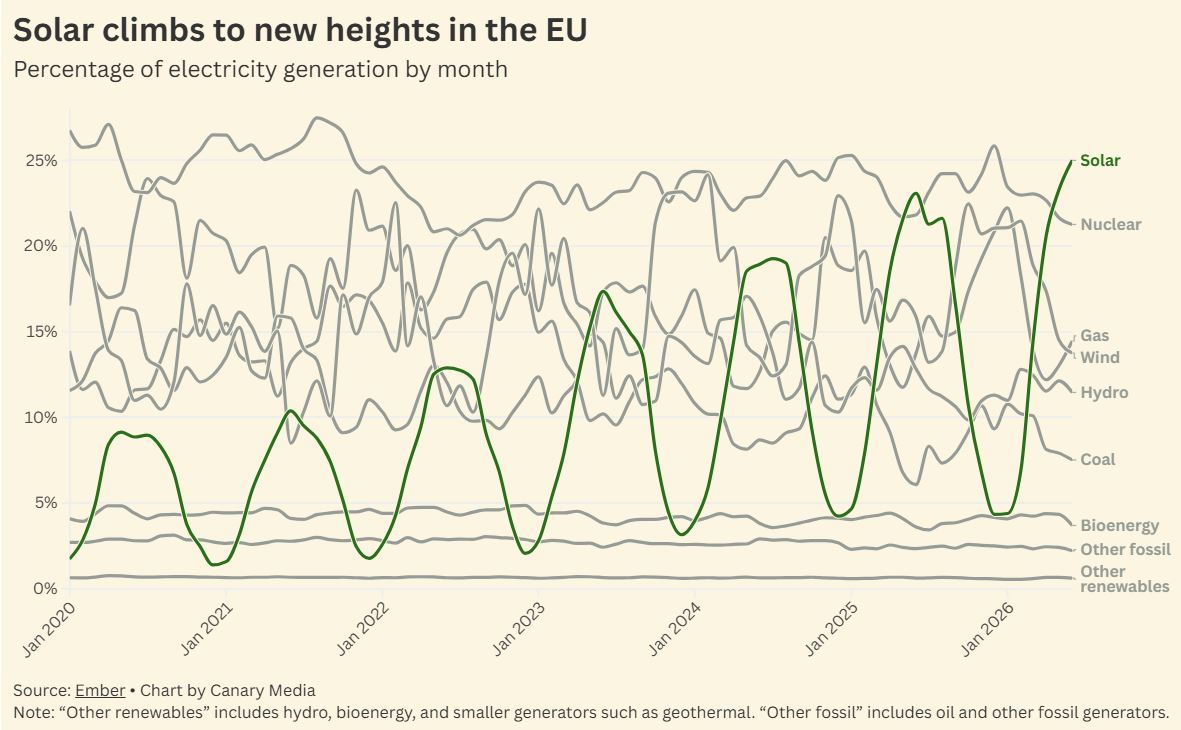
The data highlights Europe’s rapid solar adoption. Five years ago, solar delivered around 10% of the EU’s electricity even in the sunniest months. But Russia’s invasion of Ukraine in 2022 destabilized the region’s gas-dependent electricity system and spurred member states to build out clean energy faster than they had planned to.
More solar has meant less coal and natural gas on the EU grid, which has helped slash planet-warming pollution. Carbon dioxide emissions from the EU electricity sector declined by nearly one-fifth between 2020 and 2025.
Many analysts — including those at Ember — expect the war in Iran and the resulting spike in fossil fuel prices to once again accelerate the EU’s investment in renewables. Shortly after the U.S. and Israel initially attacked Iran, EU energy chief Dan Jørgensen urged the bloc to double down on clean energy. Last week, he unveiled a new Electrification Action Plan that would see the EU double its current rate of electrification.
Jørgensen paired his announcement with a simple statement: “The age of fossil fuels is coming to an end.”


.svg)
