

 Back
Back
A federal appeals court finds the EPA acted improperly in terminating grants to boost clean energy projects. The Trump administration may appeal to the Supreme Court.
A federal appeals court has ruled that the Environmental Protection Agency acted improperly in terminating billions of dollars of “green bank” financing last year, setting up a potential showdown before the U.S. Supreme Court over one of the Trump administration’s earliest attacks on a key Biden-era climate program.
Tuesday’s divided ruling from the U.S. Court of Appeals for the D.C. Circuit is a victory for the nonprofit groups targeted by EPA Administrator Lee Zeldin as part of a broader attack on the Biden administration’s clean energy and climate spending.
In March 2025, the EPA moved to freeze $20 billion in funding under the Greenhouse Gas Reduction Fund (GGRF), which was created by the 2022 Inflation Reduction Act and is commonly known as the federal “green bank” program. The ambitious effort was meant to inject large-scale federal funding into climate and clean-energy lending pioneered by state-level green banks — lending institutions that have successfully enabled $21.8 billion in public-private investment to date.
The idea was to put federal money to work to boost financing for clean energy and climate-oriented projects in communities that have traditionally lacked access to it. That could spur a virtuous cycle that could yield between $150 billion to $250 billion in private-sector investment over the next 10 years, according to an April 2023 analysis by consultancy McKinsey.
That effort has been frozen in its tracks by the current EPA, forcing the nonprofits awarded grants to curtail operations. Those groups argued that the EPA’s actions violated the law by not spending money authorized by Congress.
“Despite efforts to harm the awardees with false allegations and misinformation, there remains no legal basis for terminating our grant award,” a spokesperson for Climate United, a consortium awarded $7 billion in GGRF funds, said in a Tuesday statement.
Before the EPA froze its funds, Climate United had committed hundreds of millions of dollars for solar projects for the University of Arkansas, financing to help small-scale trucking firms buy U.S.-built electric trucks in California, upgrades to shift buildings to clean energy and make them more efficient, and Native American–led clean energy projects. Only a fraction of those funds have been disbursed.
Because it hasn’t received its promised GGRF funding, Climate United — a partnership between investment firm Calvert Impact, multifamily affordable-housing financier Community Preservation Corp., and community-development financial institution Self-Help — has lost its CEO and had to reduce staffing. Meanwhile, plans have been scaled back at a network of state and county green banks and other community-development financing institutions that had counted on using federal funds.
In April 2025, a lawsuit brought by GGRF recipients won an early favorable ruling in federal district court, which the EPA appealed. A three-judge panel at the D.C. Circuit Court ruled 2–1 in the EPA’s favor in September, but the full appeals court decided to take up the case for review, leading to this week’s decision.
That doesn’t mean grant recipients can now get their money, however. The EPA has several days to file an appeal with the U.S. Supreme Court. The EPA did not immediately respond to emails and phone calls seeking comment on Tuesday. But Zeldin has vowed to fight to claw back the $20 billion in GGRF grants.
Another $7 billion in GGRF funds for the federal Solar for All program have also been terminated by the EPA, and legal challenges to that action are underway. The EPA has faced other recent legal defeats as it tries to terminate Biden-era climate funding.
GGRF recipients have continued to undertake smaller-scale financing deals and remain ready to resume projects if their full funding is restored, the Climate United spokesperson told Canary Media. “This program was designed to lower energy costs, create good jobs, and improve public health. We will continue to pursue every legal avenue available to us to unfreeze funds on behalf of the communities we serve.”
A new state law aims to spur agrivoltaics projects where crops or livestock thrive amid solar panels, as AI power demand booms and concerns about farmland loss rise.
As the world’s data center capital, Virginia faces a surge in energy demand that could spike power costs and lead to more polluting fossil fuel plants. At the same time, the state is seeing its farmland disappear at one of the fastest rates in the United States.
The two problems may seem unrelated, but Old Dominion leaders believe they could be mitigated by a common solution: Use the same plot of land for both farming and solar panels. That’s the idea behind a new state law that officially defines “agrivoltaics,” the dual use of land for agriculture and solar photovoltaics.
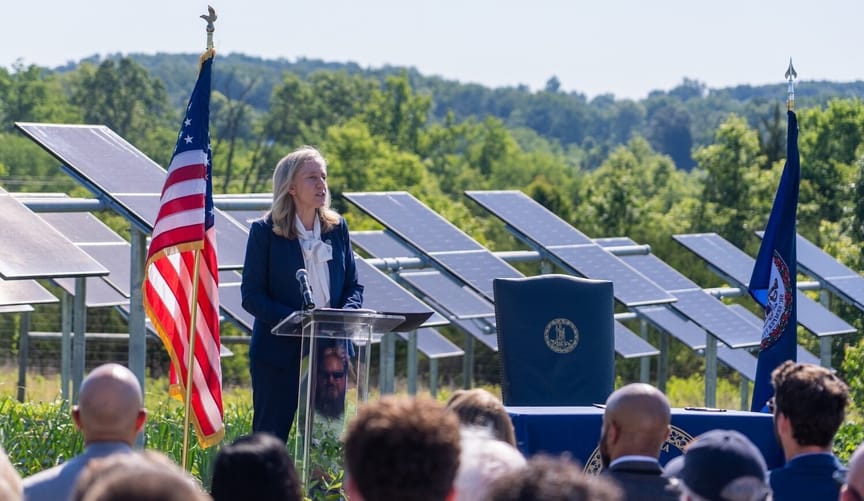
Proponents say the measure will spur more affordable, clean power to meet rising electricity needs while also helping farmers earn a living. Virginia is just the fourth state in the country to pass an agrivoltaics law.
“For years, the conventional wisdom has forced us into a zero-sum game, viewing solar panels as a replacement for crops rather than a partner to them,” said Josephus Allmond, the chief energy officer for Gov. Abigail Spanberger, a Democrat, at a June bill-signing event in Loudoun County. “Today, we are rejecting that false choice. Agrivoltaics moves us from an either-or mindset to a both-and function.”
The new law, which passed the Democratic-led General Assembly early this year with bipartisan support, is taking effect as power-hungry data centers and large-scale solar fields have become flashpoints in Virginia and across the country.
Hundreds of data centers have already set up shop in the state, lured in part by generous tax credits. The giant computer warehouses have polluted the air and threatened to overwhelm the grid. Dominion Energy, the state’s largest utility, estimates that the facilities could make up over half its sales by 2035. Legislators this year debated but failed to adopt incentives or mandates for tech companies to build their own clean energy.
Experts say solar is the cheapest, quickest way to meet the colossal needs of large electric customers like data centers. Plus, a 2020 law requires the state’s two largest utilities to build more than 16 gigawatts of land-based renewable energy, mostly solar, on their way to zero-carbon emissions by midcentury.
But early solar developers who failed to control their sediment pollution, combined with rampant disinformation, have helped tarnish the reputation of large projects. Though studies show that housing developments are bigger culprits, solar has emerged as a popular scapegoat for Virginia’s rapid loss of farmland. As of early this year, nearly two-thirds of Virginia counties outlawed or severely restricted large-scale solar.
There’s no evidence to suggest that solar panels ruin soil, and even without agrivoltaics, many farmers happily lease a portion of their property to renewable developers for extra income to help their businesses pencil out. But there’s no denying that solar panels are changing the state’s landscape: The vast bulk of large-scale solar energy is now on converted forest or farmland, and its footprint could triple to over 3% of former cropland alone by 2035, according to research from Virginia Commonwealth University.
Agrivoltaics, proponents say, can mitigate that expanding footprint. Sheep and other livestock can graze beneath solar panels — helping enrich the soil and stopping it from running off into waterways. Eggplant, kale, and other crops can also grow well under panels — something the Piedmont Environmental Council is demonstrating at its test farm in Loudon County. Some 13 agrivoltaics projects operate in the state today, according to the National Laboratory of the Rockies.

The dual use of agricultural land isn’t just about alleviating the impact — perceived or real — of solar panels. Jess Gray, CEO of Gray’s Lambscaping, says it’s also about creating new opportunities for small-business owners like herself. She and her husband sold their house and started a family farm five years ago in Pittsylvania County, in south-central Virginia. They began raising a variety of animals — sheep, chickens, cattle — hoping the venture would be self-sufficient. “The truth is, it’s hard to be a farmer,” Gray said. “Nobody likes to talk about that.”
They initially used their sheep for meat and for “cleaning up” the ground cover on their farm. But they soon realized they could boost their income by offering grazing to manage vegetation on solar fields. Today, their 1,500-some ewes service about 4,000 acres of solar panels, from their home farm all the way to Chesapeake. “We’ve grazed to the beach and back,” she said. The result is revenue they can reinvest in their farming operation. “We use our sheep to buy our cows,” she said. Very quickly, they went from two cows to 50. “We were on this 10-year plan that happened in two years.”
The Grays’ experience is an example of how agrivoltaics can help restore land to agriculture while also sustaining new farmers, says Lauren Glickman, the Virginia-based vice president of policy and communications for renewables developer Encore Renewable Energy. Production on roughly 150,000 acres of prime cropland across the state stopped between 1986 and 2018 because the economics didn’t work for farmers, she said. “Right now, there is real potential for solar to bring this abandoned farmland back.”
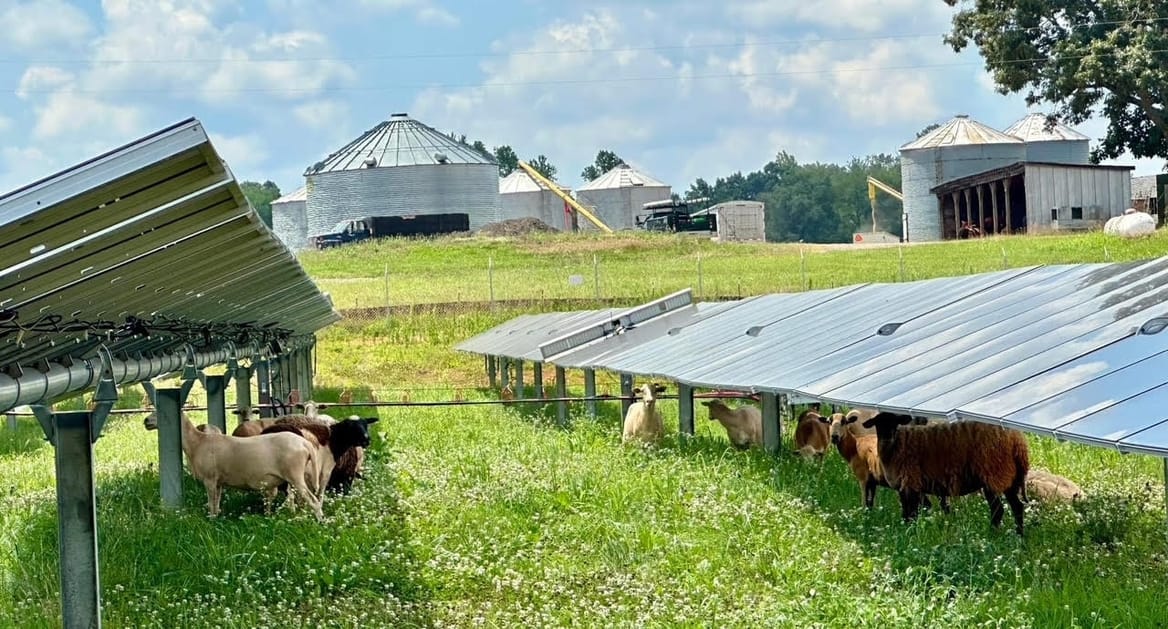
“Agrivoltaics,” according to the state’s new seven-line definition, is the intentional use of land for both farming and solar, is part of an agricultural business, and doesn’t “significantly displace farming activity,” among other provisions.
The verbiage is reinforced in another new law disallowing local solar bans, which prevents blanket and de facto prohibitions on solar while retaining the right of county governments to reject individual projects.
“Counties are going to be able to start using this definition to segment out good projects from bad ones,” said Del. John McAuliff, a Democrat from Loudoun County who helped write the agrivoltaics measure.
Separate from the law, Gov. Spanberger plans to convene an informal committee this year to recommend when, where, and how to advance statewide inducements and requirements for agrivoltaics.
“We can start to create incentives programs, tax credits, grant programs, et cetera,” said McAuliff, who worked in the Biden administration’s U.S. Department of Agriculture before winning his seat in the House of Delegates last year.
The statutory definition could dovetail with a pair of new laws that require state utilities to build more community solar projects — small-scale installations that are subscription-based and designed for customers who, for various reasons, aren’t set up to invest in their own rooftop panels.
“There’s 39,000 farms in Virginia,” said Ashish Kapoor, senior energy and climate advisor at the Piedmont Environmental Council. “Imagine a world in which you put 1 megawatt of solar on each farm with battery backup. You have 39 gigawatts of energy.”
Even a tiny fraction of that would be significant and could be built quickly, he said. “That’s a gas plant — minus the pollution, minus the years of development, minus the fuel cost.”
Gray, of Gray’s Lambscaping, says the key is for Virginia leaders to be as expansive as possible, limiting neither the size nor the type of agrivoltaics projects, so long as it’s the default for new solar fields.
“We should say to folks, ‘We’re not going to build solar unless it’s paired with agriculture,’” Gray said. “It can look in any way. It can be sheep, it can be cows, it could be row crops, it could be flowers. There’s so much opportunity.”
The state’s solar equity program has been in place for nearly a decade, but it wasn’t until recently, after years of grassroots efforts, that participation surged.
Any time, day or night, parents experiencing homelessness, domestic violence, or other emergencies can drop their young kids off at the Crisis Nursery in Urbana, Illinois, and know they’ll be safe and cared for.
Funding is a constant challenge for the 45-year-old nonprofit organization. But it was able to create a bit of financial breathing room by putting solar panels on its roof back in 2020, leading to significant savings on its energy bills.
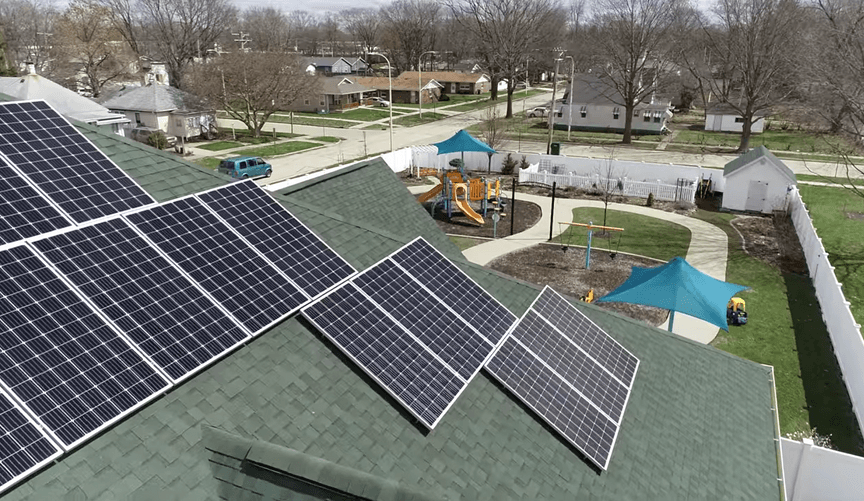
Crisis Nursery was one of the first beneficiaries of Illinois Solar for All, a state program to make the clean energy source accessible to households, nonprofits, and public facilities in lower-income communities and areas facing environmental injustice. Participants receive at least half the value of the energy generated by their solar array, with no up-front costs for buildings with four or fewer units, as well as no or low up-front costs for larger projects.
The program, created by a state law that took effect in 2017, was slow to get off the ground. The available funds went largely unspent for years, despite the savings on offer.
But in recent years, the program has become a success — and a lesson in the importance of long-term commitment and extensive grassroots engagement, as administrators and advocates see it.
During the initiative’s last cycle, from June 2024 to May 2025, more projects were approved than in its first five years combined, according to the Illinois Power Agency, the state entity that oversees the program. Last year, the Illinois Commerce Commission ordered a funding boost of $20 million, and every last dollar went out the door “almost immediately,” the Illinois Power Agency said in its latest annual report.
New application windows for Illinois Solar for All are open through September, for different types of projects, and program administrators expect heavy interest, including from those wait-listed in the last round.
State-level solar programs with an equity focus are especially important now, advocates say, given the Trump administration’s cancellation of the federal Solar for All initiative created by the Inflation Reduction Act. President Donald Trump and congressional Republicans also slashed tax credits for residential and large-scale solar projects with last year’s megabill.
Just as Illinois Solar for All is coming into its own, the loss of federal incentives raises new challenges. Without those dollars, the state funding simply won’t go as far as it once did.
“It’s a big swing,” said Wade Halva, who has long advocated for clean energy in southern Illinois, as a pastor and associate director of programs for Faith in Place, an environmental justice organization. “Does it mean the state program has to change? Can we even do residential at a guaranteed savings rate without federal incentives?”
But Jennifer Schmidt, Illinois Solar for All senior program manager for the Illinois Power Agency, sees a silver lining. “A sense of urgency driven by the sunsetting of federal tax credits,” she said, has helped fuel the recent success of Illinois Solar for All — and she expects the momentum to continue.
At the beginning, Illinois Solar for All had an awareness problem.
Many Illinois residents — particularly those in rural areas where solar adoption was low — had never considered putting panels on their roofs. Others may have liked the idea but felt they didn’t have the bandwidth to manage a complex home upgrade like solar, even if it was low- or no-cost.
And plenty of residents were just plain skeptical of a government program that sounded too good to be true.
“The first hurdle was getting the idea that the program existed out there — that it was real and it wasn’t a scam,” Halva said. “We were targeting people on the residential side who had written off getting solar because there was no way it was affordable.”
Once households decided to move forward, some faced new challenges. One common example: Many applicants had old roofs that needed to be updated before panels could be attached. Last fiscal year alone, Illinois Solar for All funded 88 roof replacements.
Things were a bit different for nonprofits and public facilities. Even if those organizations wanted to take advantage of Solar for All in the early years, the economics weren’t always on their side, because, as tax-exempt organizations, they could not access the federal tax credits for solar. The 2022 Inflation Reduction Act changed that — but it didn’t change the fact that these organizations were not very familiar with solar energy.
“So they hadn’t looked into it,” Halva said. “We ended up doing a lot of baseline solar education because we were reaching out to parties who had no market for it before.”
Crisis Nursery’s participation in the program is an example of this kind of outreach. Illinois Solar for All administrators contacted the nursery staff, encouraging them to participate and arranging a lease agreement with a solar developer in which the nonprofit paid nothing up front.
“We have a 10,000-square-foot building, so every little bit helps, especially during seasons when we are running our utilities” around the clock, said the nursery’s executive director Stephanie Record. “A lot of businesses may be able to alter their temperatures when people aren’t there to conserve energy. We have to be at that constant level of heating and cooling 24/7.”
Nearly 400 Illinois Solar for All projects went online last fiscal year, representing over 700 different building units.
There are now projects in almost every county in the state, unlike in 2023, when they were concentrated in the Chicago area, along with a band across the center of the state. Changes made in the past program year allowed projects for nonprofits and public facilities in census tracts adjacent to income-eligible and environmental justice counties to qualify. The areas designated as environmental justice communities also increased.
“These sorts of things matter a lot in who we can approach,” Halva said.
Illinois Solar for All projects can be developed only by solar companies that have been vetted and approved by the state.
In the program’s early days, few companies went through this process. Solar workforce training and entrepreneurship programs were created and funded by the state’s 2017 clean energy law, but it took a while for administrators to successfully create a system to match developers with trainees.
The workforce is much more robust today. Thirteen companies developed the Illinois Solar for All projects energized or developed last year, and a state website helps dozens of such approved vendors connect with clients.
Another key to the program’s success is its “grassroots educators” — community leaders paid by the state to raise awareness. Last fiscal year, almost $700,000 was awarded to 10 community organizations to hire grassroots educators for one-year stints. Nine of those groups have new funding for the work this year.
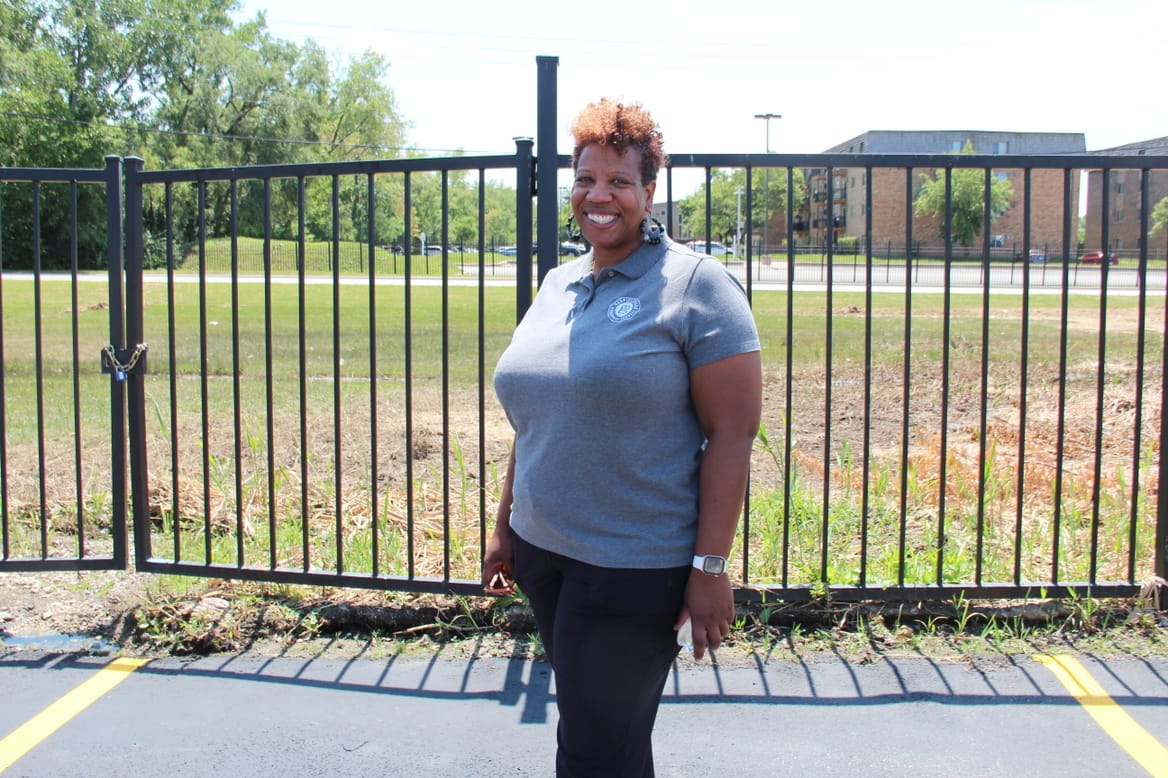
Three years ago, Aretha Berdell became a grassroots educator in the Garfield Park neighborhood on Chicago’s South Side, after she got rooftop solar through a separate state program called Illinois Shines. She often recruits people at events run by the Garfield Park Community Council, where she works as a sustainable housing associate, or by other local groups. It typically takes six or seven conversations before residents feel comfortable moving forward with solar, she said.
“I always tell my story — I haven’t paid [local utility] ComEd since last year,” she said. “We’re getting the word out. Especially if they’re seniors and don’t have access to the computer, I’m just helping them out, moving them along.”
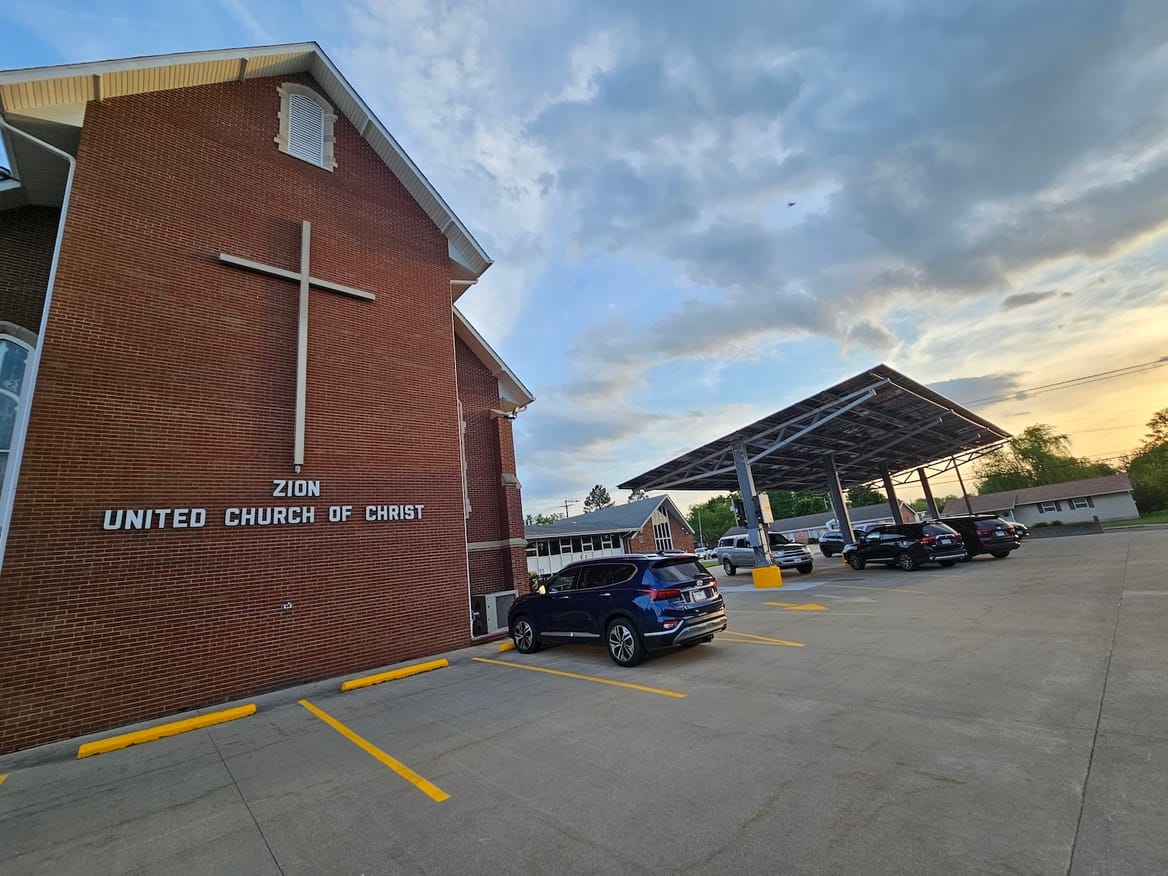
In and around the small southern Illinois city of Marion, the program — and Halva’s work as a grassroots educator — have led to solar arrays on a church, a local fire station, a senior center, a youth center, and a city-owned recreation facility called The Hub. The solar array on Zion United Church of Christ’s carport has saved thousands of dollars, which the church spends on its food pantry, providing hundreds of meals every Sunday and hundreds of bags of food each week.
Ellie Simpson, another grassroots educator, focuses on outreach to houses of worship, on behalf of Eco DioChicago, the Episcopal Diocese of Chicago’s organization for environmental justice and “creation care committee” — responsible for acting as stewards of the Earth. She said multiple church representatives contact her each month, “interested in starting the conversation about what it means to care for creation,” and using solar to reduce their carbon footprint and redirect funds from energy bills to pastoral work.
The personalized guidance that a grassroots educator can offer is crucial in working with faith-based groups, Simpson noted, since they range from organizations with large endowments able to make big investments to small entities with board members cautious of approving any expenditures.
“Some move quickly, some move slower,” she said. “Nonprofits and churches all have their own pace.”
Illinois Solar for All is entering into a new era this fiscal year. It will be the first time that federal incentives are unavailable — and administrators are still figuring out how to adjust, Schmidt said.
One bright spot is that many of the program’s arrays are developed as third-party ownership arrangements, in which solar developers own an array and provide the energy to the resident or organization — and those projects can still access federal tax incentives if they are operational by the end of 2027, or if they started construction before July 4 of this year.
In any case, state law calls for $50 million in funding each year for Illinois Solar for All. With that in mind, Schmidt said the program will be able to adjust to fill some gaps left by federal changes.
“We look at different potential funding pieces of a project, and if things change, we update,” Schmidt said. “Illinois Solar for All is not going anywhere.”
As the White House and viral influencers push misleading info about solar, New York says the facts show the clean energy source and agriculture can thrive together.
In rural areas across the U.S., solar power opponents keep leaning on the argument that utility-scale arrays are gobbling up valuable farmland. But plenty of evidence proves that’s just not true, and now, New York is tackling the misinformation head-on.
After the Trump administration accused the state of fast-tracking solar farms on prime farmland, New York leaders fired back last week, saying that renewables “empower our farmers to keep their land in use and in their family, while avoiding the threat of permanent conversion or abandonment.” That’s because farmers can lease a plot to solar developers and return it to agricultural use at the end of the array’s life, as the state officials explained in their 11-page letter.
“A recent study by Cornell found that the overwhelming majority of farmers who received solar lease payments used that income to continue or even expand farming on their land, not to exit farming or scale back operations,” the leaders wrote. “Discouraging or inhibiting property owners’ ability to independently make choices about what they can and cannot do with their land can cause financial harm and undermine fundamental property rights.”
The New York State Energy Research and Development Authority has more proof that solar and farming can work hand in hand, and outlined all that in a major guidebook it released last year. Sheep and cattle are munching below panels on several New York farms, the guidebook notes, and the state has zoning rules and protections in place to preserve undeveloped land.
New York’s pushback squares with the findings of a recent report from the Solar Energy Industries Association. That study shows solar farms currently take up a mere 0.13% of New York’s roughly 13,000 square miles of federally designated prime farmland, a stat that resonates across the country. Solar covers just 0.07% of all U.S. farmland, according to SEIA. That’s three times less than golf courses and six times less than suburban development.
And yet solar panels, not cul-de-sacs, are the focus of a particularly potent campaign from upstate New York influencer Alexandra Fasulo. Fasulo has amassed more than a million followers across TikTok and other social platforms, where she’s constantly posting videos that inflate solar’s threats to agricultural and undeveloped land. Similar sentiments are being spread on social media by John Rich. He’s one half of the “Save a Horse, Ride a Cowboy” guys, and was recently hired by the White House to advocate for landowners on a national scale.
These and other anti-solar advocates often ignore the good that the clean energy source can do for farmers nationwide. In California’s Central Valley, for example, years of drought have led hundreds of thousands of acres of agricultural land to go fallow. Economics and water availability have driven farmers to stop growing there, but they can still make money and hold on to their land by leasing their plots to solar developers.
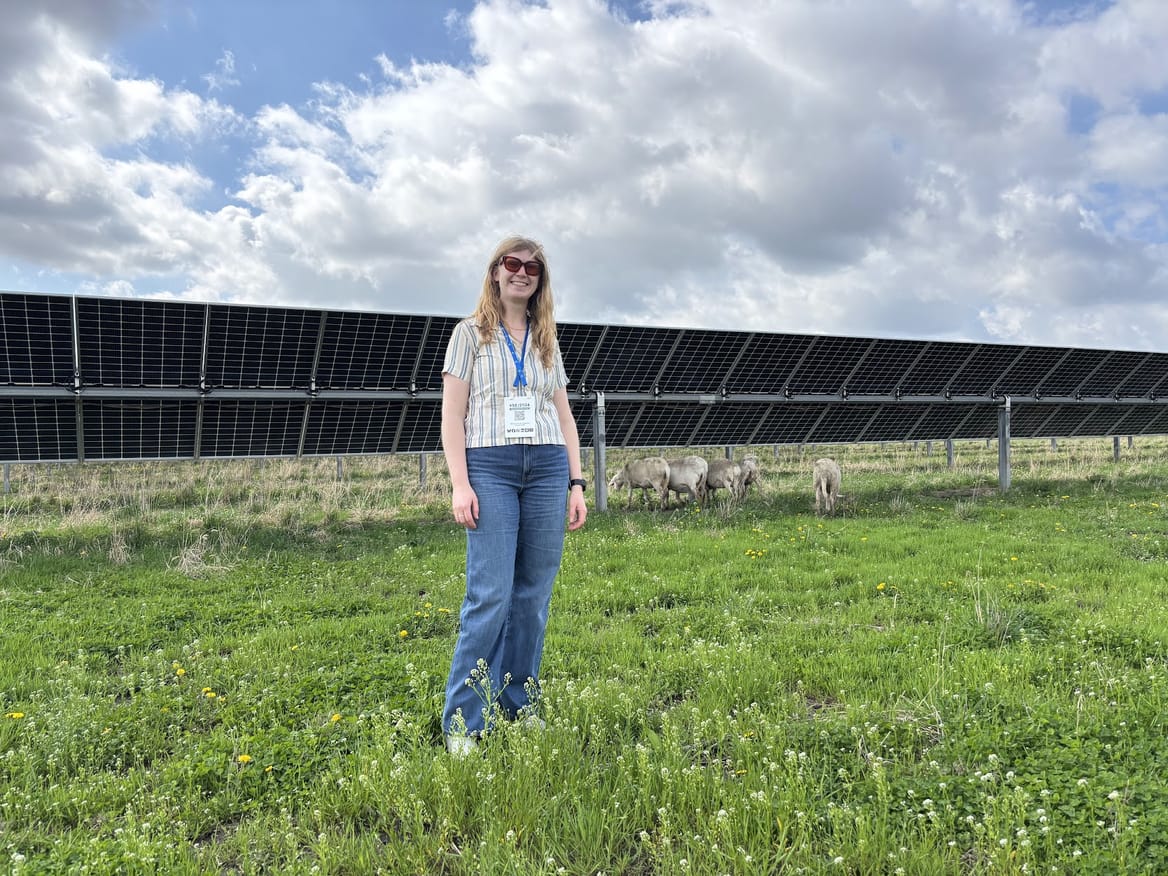
Plus, as New York’s guidebook points out, farming is still happening alongside solar installations. I recently visited an Illinois solar farm where sheep were grazing underneath and around panels — an arrangement that the sheep’s owners love because they don’t have to maintain expansive pastures back at home. Meanwhile, researchers have found that tomatoes, saffron, and other crops can thrive below panels, and so can native plants.
That’s not to mention the climate benefits of ditching planet-warming fossil fuels, which are driving droughts, floods, and other weather disasters that are legitimately threatening farms in the U.S. and beyond.
Trump’s coal crusade has real-world consequences
The Trump administration keeps checking items off the coal industry’s wish list — with dire consequences for Americans’ health and wallets.
Over the past year and a half, the federal government has used its emergency powers to keep coal plants from shutting down and pledged $850 million to prop up existing coal facilities or build new ones, Jeff St. John reports. It’s also weakened regulations meant to protect air and water quality, and paved the way for more coal mining in the U.S.
Americans are already suffering the fallout, as Kari Lydersen reports from Indiana. The Department of Energy has forced two aging coal plants there to stay open — a move that is costing plant owners millions of dollars that could soon be passed on to utility customers. Meanwhile, the rollback of federal regulations around coal ash means the toxic byproduct of coal burning will continue to threaten water supplies in the state and beyond.
More data highlights gas stoves’ dangers
Federal funding clawbacks stopped a group of scientists from fully studying gas stoves’ impacts on people with asthma, but they still produced some pretty profound results.
Back in late 2024, researchers from Case Western Reserve University received $18 million from the U.S. EPA to replace gas stoves with electric models in 1,200 Ohio homes whose residents have asthma. Although the grant was canceled a few months into the Trump administration, some people still got their electric stoves — and their asthma symptoms significantly improved.
Gas stoves are risky even for those without asthma. Mixed in with the methane the stoves burn is the cancer-causing carcinogen benzene, along with other toxic pollutants. Those dangers even prompted Colorado to require that gas stoves come with a health warning label — until a federal judge blocked enforcement of the rule shortly after it was implemented.
Big money for fusion: Commonwealth Fusion Systems raises another $1 billion from investors, bringing its total funds raised to $4 billion as it seeks to commercialize nuclear fusion technology. (Canary Media)
Courtroom confessions: The Trump administration admits in court documents that it canceled $7.6 billion in clean energy for 16 states solely because those states voted for Democrat Kamala Harris in the 2024 presidential election. (Associated Press)
A road map for cleaner factories: It can be hard for factories to justify swapping fossil fuels for more expensive electric power, but a new report suggests that colocating renewable energy generation and reforming electricity rates can help make the case. (Canary Media)
EVs come back around: Global EV sales remained slow in the first three months of the year but rose 35% in the second quarter even amid lackluster growth in China and the U.S., the world’s two biggest EV markets. (International Energy Agency)
Inverters diverted: The Trump administration’s ban on new models of foreign-made inverters, which are critical for connecting renewable power to the grid, won’t impact projects now, but could delay development in the future. (Canary Media)
Electric or bust: California will soon offer hefty rebates to first-time EV buyers, betting on the fact that most drivers who make the switch from gasoline cars don’t turn back. (Canary Media)
Batteries have your back: Small, portable plug-in batteries can help people power critical appliances and devices during outages — and they’re cheaper and more flexible than whole-home systems. (Canary Media)
Restart reservations: A wave of setbacks continues to delay the reopening of Michigan’s Palisades nuclear plant, and suggests similar challenges may befall companies looking to restart other dormant facilities. (New York Times)
No major economy had previously received over half its electricity from solar across an entire month. Thank the mild, sunny spring weather, and batteries.
While the Trump administration is busy pointing out that the sun doesn’t shine at night, solar is breaking records around the world, including in sunny California.
Solar panels produced 51% of California’s electricity in May, the first time the clean energy source surpassed the halfway mark for an entire month. The data counts both large-scale installations and the state’s bounty of rooftop arrays.
This isn’t just a milestone moment for California; it’s a milestone for the entire world. Think tank Ember says the state is the globe’s first major economy to cross the 50% threshold. (Hungary, at 47% in June 2025, is knocking at the door, though it has a far smaller GDP.)
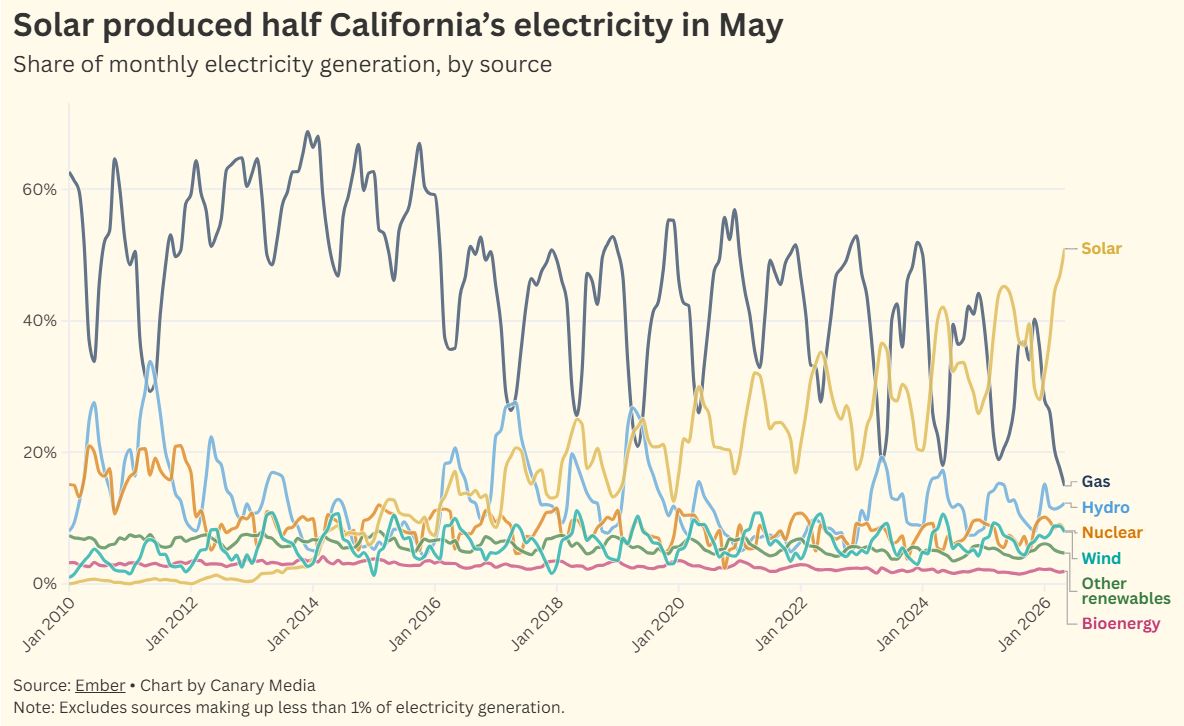
Solar’s rise has helped California cut polluting energy sources out of its power mix. Natural gas is the only fossil fuel that California power plants burn at appreciable levels, and solar is steadily squeezing it out of the system. Case in point: Solar outproduced gas not only during its record month of May but throughout every month in 2026 leading up to it, too.
Solar could not have reached these heights alone. It needed batteries to get here — and California has that crucial energy storage in spades. The California Independent System Operator, which manages most of the state’s grid, now boasts 16 gigawatts of batteries that can shift abundant midday solar production to later in the evening. It’s not uncommon for batteries to meet over one-quarter of the state’s electricity demand for a portion of the night.
All this solar and storage would have been hard to imagine a decade ago. Back then, in its best month — also sunny, mild May — solar accounted for just 17% of electricity. That number is well above the current national average for solar, but a far cry from 51%. CAISO’s battery fleet, meanwhile, was a measly 61 megawatts. So, storage has grown by, uh … 26,129% over the last decade, a number so cartoonishly large that I’m almost hesitant to print it.
Expect California to see more months break the 50% threshold soon. And in the coming years, expect more states and countries to cross the halfway mark, too.
No major economy had previously received over half its electricity from solar across an entire month. Thank the mild, sunny spring weather, and batteries.
While the Trump administration is busy pointing out that the sun doesn’t shine at night, solar is breaking records around the world, including in sunny California.
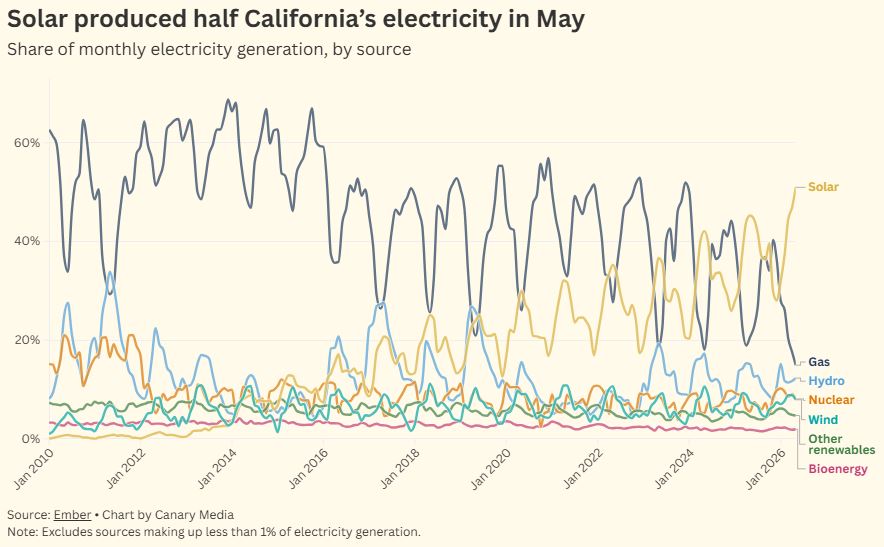
Solar panels produced 51% of California’s electricity in May, the first time the clean energy source surpassed the halfway mark for an entire month. The data counts both large-scale installations and the state’s bounty of rooftop arrays.
This isn’t just a milestone moment for California; it’s a milestone for the entire world. Think tank Ember says the state is the globe’s first major economy to cross the 50% threshold. (Hungary, at 47% in June 2025, is knocking at the door, though it has a far smaller GDP.)
Solar’s rise has helped California cut polluting energy sources out of its power mix. Natural gas is the only fossil fuel that California power plants burn at appreciable levels, and solar is steadily squeezing it out of the system. Case in point: Solar outproduced gas not only during its record month of May but throughout every month in 2026 leading up to it, too.
Solar could not have reached these heights alone. It needed batteries to get here — and California has that crucial energy storage in spades. The California Independent System Operator, which manages most of the state’s grid, now boasts 16 gigawatts of batteries that can shift abundant midday solar production to later in the evening. It’s not uncommon for batteries to meet over one-quarter of the state’s electricity demand for a portion of the night.
All this solar and storage would have been hard to imagine a decade ago. Back then, in its best month — also sunny, mild May — solar accounted for just 17% of electricity. That number is well above the current national average for solar, but a far cry from 51%. CAISO’s battery fleet, meanwhile, was a measly 61 megawatts. So, storage has grown by, uh … 26,129% over the last decade, a number so cartoonishly large that I’m almost hesitant to print it.
Expect California to see more months break the 50% threshold soon. And in the coming years, expect more states and countries to cross the halfway mark, too.
Panamint Capital broke ground on a $1.7 billion solar and storage project at the Calvert coal mine. The mine and an adjacent coal plant will stay online.
Construction is underway on a $1.7 billion solar and battery storage project in Texas that will turn existing coal mining land into a hub of clean energy generation.
Panamint Capital announced last week that it broke ground on the 1.2-gigawatt Big Rooter Power solar farm in Bremond, about halfway between Dallas and Houston. The project will use some of the land and assets from the adjacent Twin Oaks coal-fired power plant and Calvert surface coal mine, both of which will continue operating.
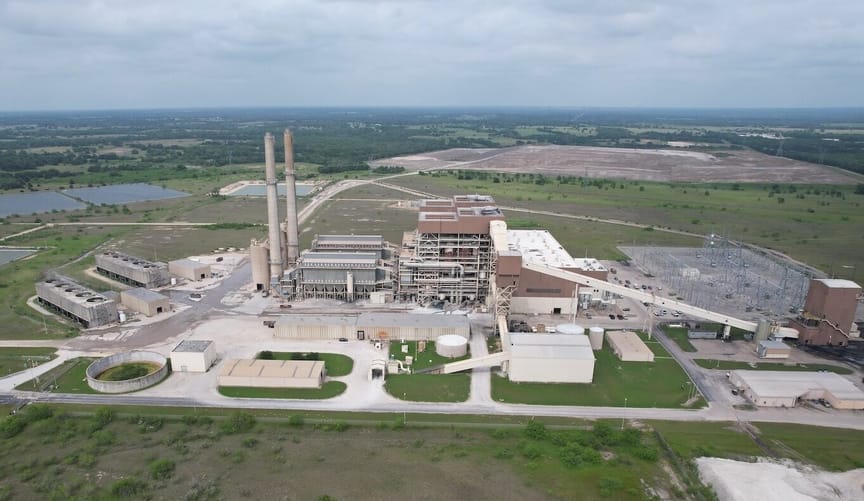
Panamint’s clean energy project will be among the largest in the nation — and, the developer claims, the biggest solar array ever built at a brownfield site in North America.
“We believe deploying new capacity at existing energy sites is the clearest way to benefit communities, ratepayers, and the environment alike,” said Apolka Totth, CEO of Panamint, a Nevada-based investment firm.
The giant installation will further boost Texas’ thriving solar sector, which this year is expected to generate more electricity than coal in the Lone Star State. The renewable resource is helping meet the state’s energy demand from data centers, manufacturing facilities, and rising air-conditioning use amid more frequent and extreme hot weather.
Panamint, which is backed by the private equity firm KKR, launched in 2019 with the goals of squeezing more life out of existing fossil-fuel infrastructure while building lower-emission facilities on the same sites. In 2023, Panamint acquired the 310-MW Twin Oaks coal plant and Calvert mine “with the express intention of leveraging the site’s existing characteristics to massively and rapidly expand generating capability at the lowest possible cost,” Totth said by email.
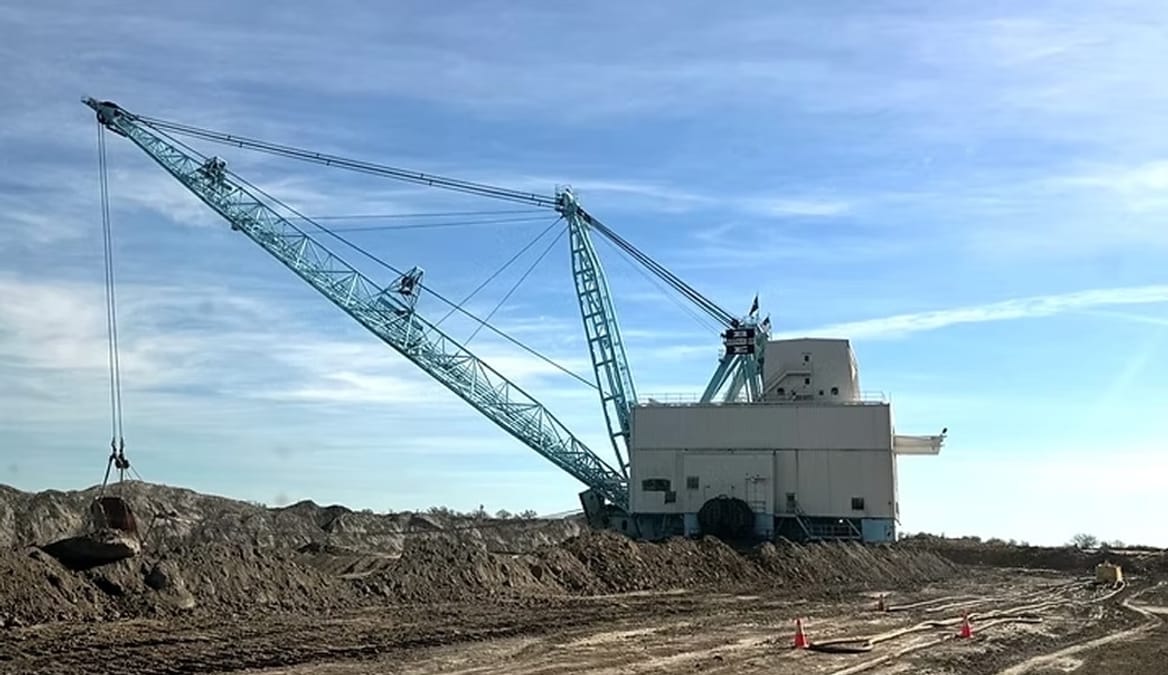
Work has started on the first phase of the solar farm, a 491-MW section that is set to go online in August 2028. Construction will begin in December on the remaining 658 MW, which could start producing power in August 2029.
The 10,000-acre Big Rooter site will also include 1.6 gigawatt-hours of battery storage and 20 miles of new extra-high-voltage transmission lines. The investment firm says it also has the infrastructure and natural gas access needed to build at least 800 MW of gas-fired generation, either for the grid or customers like data center developers.
“Big Rooter is a landmark project that reflects the scale of investment being made in America’s energy future,” George Hershman, CEO of Solv Energy, said in a news release. The contractor is building the site’s solar array, substation, and transmission infrastructure.
Big Rooter’s pairing with active coal operations makes it unique within the nation’s small but growing coal-to-solar subsector, which has mainly focused on putting panels on former mine lands and retired industrial sites.
The largest of these projects is the 186-MW Tilden Solar Project in southern Illinois, followed by the 111-MW Martin County Solar Project in eastern Kentucky, which both went online last year atop abandoned coal mines.
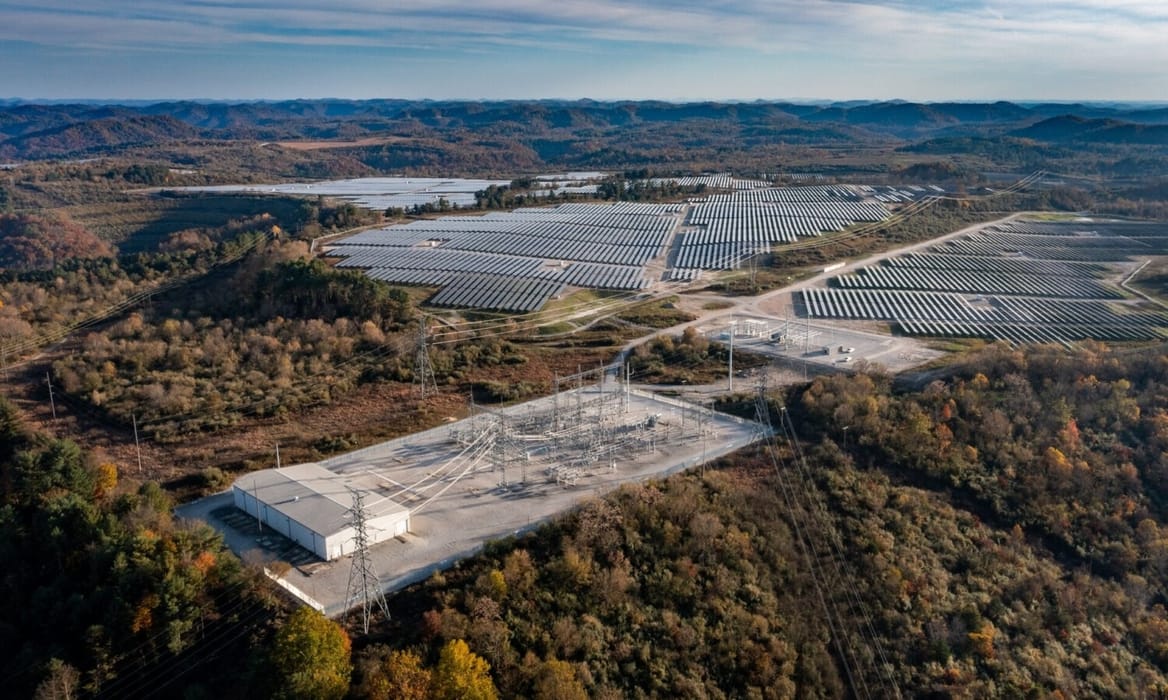
In Louisiana, the 240-MW Dolet Hills Solar Project is now being built on a former coal mine property. And the developer BrightNight is advancing the Starfire installation on remediated mine land in Kentucky.
In 2023, when BrightNight announced the Appalachian project, electric truck startup Rivian signed on as the anchor customer, with a 100-MW power purchase agreement. Starfire was initially envisioned as a roughly 800-MW project, but is now on track for 410 MW, with construction slated for late 2027 and planned operations in 2030.
“Earlier descriptions of a larger project reflected a broader long-term vision for the site, but as development has progressed, BrightNight has focused on the configuration that best aligns with current interconnection, permitting, site, and customer considerations,” a BrightNight spokesperson said by email. “We remain very enthusiastic about Starfire and its importance as a major redevelopment project on former coal mining land in Eastern Kentucky.”
Repurposing old mining sites for solar power has an obvious appeal. As opposition breaks out in rural areas over using prime farmland for solar — concerns stoked by Trump administration officials, including U.S. Agriculture Secretary Brooke Rollins — brownfield projects allow developers to sidestep those conversations and put sullied land to use. Doing so has typically proved more complicated and expensive than placing solar panels on flat or uncontaminated fields.
The 2021 bipartisan infrastructure law and 2022’s Inflation Reduction Act provided incentives to make it easier to finance clean energy installations on mine lands, while a $500 million Department of Energy program allocated funding for projects on current or former mines.
But last year, the Trump administration and Congress added more hurdles by phasing out tax credits for solar and wind energy, effectively ending the tax bonus for brownfield developments. And the administration scrapped at least one DOE mine-land award, for Mineral Basin Solar Power, as part of its sweeping cancellation of $7.6 billion in clean energy grants in the 16 states that voted for Democrat Kamala Harris in the 2024 presidential election.
“The federal policy landscape for developing clean energy on mines has changed, but the opportunity hasn’t,” said Jessica Wilkinson, the North America renewable energy team lead for The Nature Conservancy, a global nonprofit.
“In many parts of the country, wind and solar are the cheapest forms of energy and are succeeding on economics alone,” she added. “And if building on mine lands, brownfields, and landfills has fewer community conflicts, they may be seen as very enticing.”
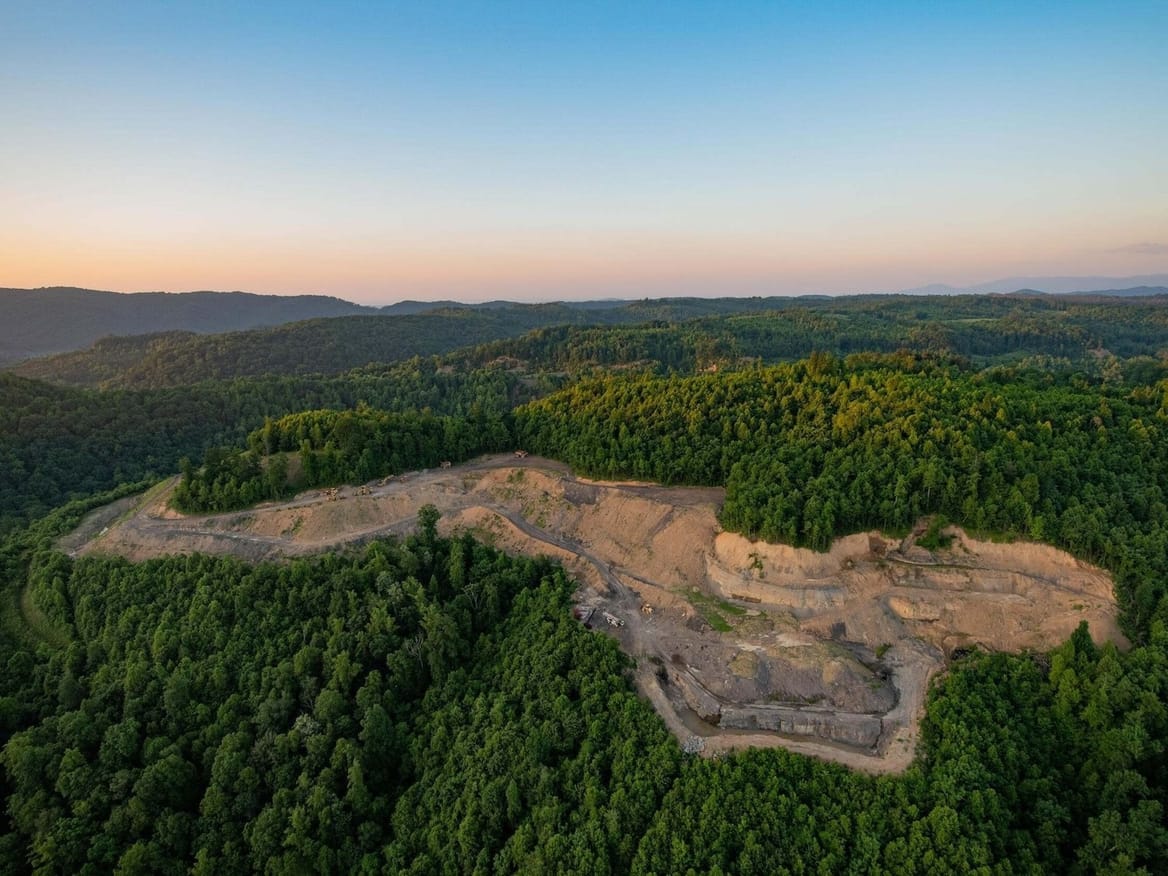
The nonprofit and its partners plan to develop 25 solar and battery storage projects on former mine lands that The Nature Conservancy manages in the Cumberland Forest, which spans parts of Kentucky, Tennessee, and Virginia. The first project, the 10-MW Wildcats Solar in Virginia, is expected to break ground this fall and could start delivering power to the grid next year.
Wilkinson noted that despite the federal pullback, states have continued to show support for what her group calls “mining the sun” projects. For example, Ohio and Colorado passed laws to incentivize renewable energy development on former industrial sites. And a handful of federal programs continue providing financial support for cleaning up coal mining areas — a crucial step for enabling future solar development.
“Communities still want to see these lands become economic engines again,” Wilkinson said.
Panamint, for its part, said it was able to secure clean energy incentives for Big Rooter Power before Trump signed the One Big Beautiful Bill Act on July 4, 2025, repealing large swaths of the Inflation Reduction Act.
“We ordered long-lead time equipment such as transformers and circuit breakers well before last summer’s OBBBA, so we were largely insulated from those impacts,” Totth said.
She noted that Panamint is partnering with U.S. firms First Solar and Nextpower (formerly Nextracker) to procure domestically made solar modules and racks. Big Rooter is also located in an “energy community” — the Department of Energy’s term for brownfield sites and areas affected by coal plant and mine closures. For those reasons, the company says it will receive a federal investment tax credit worth 50% of total project costs.
Yet as Panamint begins installing millions of solar panels in Texas, it has no plans to wind down production at the neighboring Twin Oaks coal plant.
“Twin Oaks is an economically competitive unit that provides low-cost reliability to Texas ratepayers, and we see no reason for an early retirement,” Totth said. She added that the company is also investigating both expanding the Calvert mine area and building a terminal facility to rail in coal for continued operations.
As Totth sees it, the new solar array will produce enough carbon-free power to “negate” the coal plant’s emissions profile on an annual basis.
It’s an example of the all-of-the-above approach to energy in Texas. Despite the massive amounts of solar, storage, and wind the state has built, it continues to cling to fossil fuels.
As the California firm boots up a giant thermal battery system in South Dakota, fresh funds will help it build a second U.S. factory and more large-scale projects.
The startup Antora Energy just raised $550 million to build and deploy more of its heat-storing batteries for powering data centers and cleaning up factories.
On Thursday, San Jose, California–based Antora said it closed a Series C funding round co-led by climatetech investor G2 Venture Partners and the VC firm Eclipse, which backs manufacturing-focused startups. That brings Antora’s total corporate and project financing to around $1 billion, the company says, adding that the latest infusion will enable it to expand domestic production of its thermal batteries and accelerate the buildout of large-scale projects.
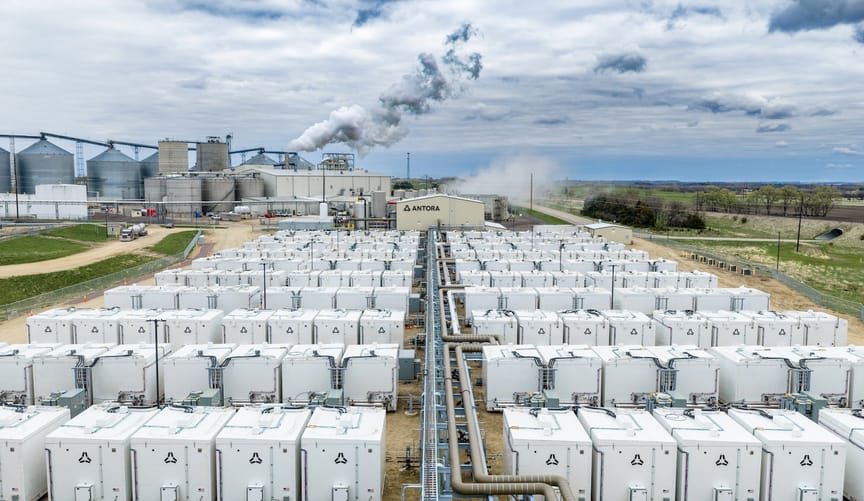
Eight-year-old Antora has likened its technology to an enormous toaster. Electricity runs through a large resistance heater to warm big blocks of solid carbon to extremely high temperatures for days on end. The blocks release controlled blasts of high-intensity light that can be used to either produce power on demand or generate steam for industrial processes.
Just two months ago, Antora began booting up its first commercial-size system: a 5-gigawatt-hour thermal battery at Poet’s biofuels plant near Big Stone City, South Dakota. The project will turn cheap wind energy into steam the plant needs to convert corn into ethanol, displacing some of the facility’s reliance on coal-fueled boilers.
Antora says this system will be one of the largest battery storage projects in the world when it’s fully operating later this year. Meanwhile, its San Jose manufacturing campus ranks among the country’s largest battery factories.
But the firm is hardly alone. Dozens of thermal energy startups in the U.S. and worldwide are developing systems with a variety of heat-trapping materials, including ceramic bricks, crushed rocks, and “stonelike” industrial waste.
The sector is expanding as countries are scrambling to meet power demand from data centers and industrial facilities — and struggling to limit the growing strain on grid infrastructure and household utility bills. In the U.S., high electricity costs have also hindered manufacturers from adopting cleaner, electrified heating technologies.
Energy storage systems in general can address those challenges by charging up when power is cheap and abundant, then dispatching that stored energy when it’s needed, such as by sending electricity to the grid during hours of peak demand. Thermal batteries can also deliver heat directly to factories to keep them from drawing lots of costly peak power.
“From factories to data centers, energy is the bottleneck to industrial growth,” Andrew Ponec, co-founder and CEO of Antora, said in a news release. “Antora has shown we can help break that bottleneck — delivering energy fast, at massive scale, with American innovation.”
The company launched its first pilot project in 2023: a 5-megawatt-hour system installed at a facility owned by the utility Wellhead Electric near Fresno, California. Months later, Antora raised $150 million from corporate and venture investors to scale up thermal-battery production at the San Jose factory, which it has expanded into a three-building manufacturing campus.
Antora built over 200 battery modules for the South Dakota storage system. But the project is notable for more than its technology. Antora is also pioneering an electricity tariff, designed with the local utility Otter Tail Power, that rewards Antora for charging up during periods of surplus local renewable energy production. The idea is to improve the bottom line for thermal energy systems while also ensuring they benefit everyone on the grid. Antora said it’s working with utilities across the country to develop similar rate structures for future projects.
With the $550 million fundraise, Antora said it plans to build a second U.S. manufacturing hub and to start fulfilling its “growing pipeline of signed agreements” with some of the nation’s biggest data center operators and industrial companies, including biofuels and chemical producers and food and beverage manufacturers. The company declined to share more specific details.
“We’re in the process of developing many more projects, very similar to the Big Stone project [with Poet], and those projects span a variety of sectors and are sort of a similar size,” Justin Briggs, Antora’s co-founder and chief operating officer, told Canary Media in a May interview.
“We’re also developing projects in the power sector that would provide the ability for data centers to come online much faster than they otherwise would,” he said, noting that those systems could be anywhere from five to 10 times the scale of its 5-GWh system at the South Dakota ethanol plant.
“Our energy system is at an inflection point, and very few companies can meet soaring power demand,” Jake Tauscher, partner at G2 Venture Partners, said in the news release. “Antora is meeting that demand today. They’re deploying at scale, on budget, and on the rapid timelines customers need.”
Panamint Capital broke ground on a $1.7 billion solar and storage project at the Calvert coal mine. The mine and an adjacent coal plant will stay online.
Construction is underway on a $1.7 billion solar and battery storage project in Texas that will turn existing coal mining land into a hub of clean energy generation.
Panamint Capital announced last week that it broke ground on the 1.2-gigawatt Big Rooter Power solar farm in Bremond, about halfway between Dallas and Houston. The project will use some of the land and assets from the adjacent Twin Oaks coal-fired power plant and Calvert surface coal mine, both of which will continue operating.
Panamint’s clean energy project will be among the largest in the nation — and, the developer claims, the biggest solar array ever built at a brownfield site in North America.
“We believe deploying new capacity at existing energy sites is the clearest way to benefit communities, ratepayers, and the environment alike,” said Apolka Totth, CEO of Panamint, a Nevada-based investment firm.
The giant installation will further boost Texas’ thriving solar sector, which this year is expected to generate more electricity than coal in the Lone Star State. The renewable resource is helping meet the state’s energy demand from data centers, manufacturing facilities, and rising air-conditioning use amid more frequent and extreme hot weather.
Panamint, which is backed by the private equity firm KKR, launched in 2019 with the goals of squeezing more life out of existing fossil-fuel infrastructure while building lower-emission facilities on the same sites. In 2023, Panamint acquired the 310-MW Twin Oaks coal plant and Calvert mine “with the express intention of leveraging the site’s existing characteristics to massively and rapidly expand generating capability at the lowest possible cost,” Totth said by email.
Work has started on the first phase of the solar farm, a 491-MW section that is set to go online in August 2028. Construction will begin in December on the remaining 658 MW, which could start producing power in August 2029.
The 10,000-acre Big Rooter site will also include 1.6 gigawatt-hours of battery storage and 20 miles of new extra-high-voltage transmission lines. The investment firm says it also has the infrastructure and natural gas access needed to build at least 800 MW of gas-fired generation, either for the grid or customers like data center developers.
“Big Rooter is a landmark project that reflects the scale of investment being made in America’s energy future,” George Hershman, CEO of Solv Energy, said in a news release. The contractor is building the site’s solar array, substation, and transmission infrastructure.
Big Rooter’s pairing with active coal operations makes it unique within the nation’s small but growing coal-to-solar subsector, which has mainly focused on putting panels on former mine lands and retired industrial sites.
The largest of these projects is the 186-MW Tilden Solar Project in southern Illinois, followed by the 111-MW Martin County Solar Project in eastern Kentucky, which both went online last year atop abandoned coal mines.
In Louisiana, the 240-MW Dolet Hills Solar Project is now being built on a former coal mine property. And the developer BrightNight is advancing the Starfire installation on remediated mine land in Kentucky.
In 2023, when BrightNight announced the Appalachian project, electric truck startup Rivian signed on as the anchor customer, with a 100-MW power purchase agreement. Starfire was initially envisioned as a roughly 800-MW project, but is now on track for 410 MW, with construction slated for late 2027 and planned operations in 2030.
“Earlier descriptions of a larger project reflected a broader long-term vision for the site, but as development has progressed, BrightNight has focused on the configuration that best aligns with current interconnection, permitting, site, and customer considerations,” a BrightNight spokesperson said by email. “We remain very enthusiastic about Starfire and its importance as a major redevelopment project on former coal mining land in Eastern Kentucky.”
Repurposing old mining sites for solar power has an obvious appeal. As opposition breaks out in rural areas over using prime farmland for solar — concerns stoked by Trump administration officials, including U.S. Agriculture Secretary Brooke Rollins — brownfield projects allow developers to sidestep those conversations and put sullied land to use. Doing so has typically proved more complicated and expensive than placing solar panels on flat or uncontaminated fields.
The 2021 bipartisan infrastructure law and 2022’s Inflation Reduction Act provided incentives to make it easier to finance clean energy installations on mine lands, while a $500 million Department of Energy program allocated funding for projects on current or former mines.
But last year, the Trump administration and Congress added more hurdles by phasing out tax credits for solar and wind energy, effectively ending the tax bonus for brownfield developments. And the administration scrapped at least one DOE mine-land award, for Mineral Basin Solar Power, as part of its sweeping cancellation of $7.6 billion in clean energy grants in the 16 states that voted for Democrat Kamala Harris in the 2024 presidential election.
“The federal policy landscape for developing clean energy on mines has changed, but the opportunity hasn’t,” said Jessica Wilkinson, the North America renewable energy team lead for The Nature Conservancy, a global nonprofit.
“In many parts of the country, wind and solar are the cheapest forms of energy and are succeeding on economics alone,” she added. “And if building on mine lands, brownfields, and landfills has fewer community conflicts, they may be seen as very enticing.”
The nonprofit and its partners plan to develop 25 solar and battery storage projects on former mine lands that The Nature Conservancy manages in the Cumberland Forest, which spans parts of Kentucky, Tennessee, and Virginia. The first project, the 10-MW Wildcats Solar in Virginia, is expected to break ground this fall and could start delivering power to the grid next year.
Wilkinson noted that despite the federal pullback, states have continued to show support for what her group calls “mining the sun” projects. For example, Ohio and Colorado passed laws to incentivize renewable energy development on former industrial sites. And a handful of federal programs continue providing financial support for cleaning up coal mining areas — a crucial step for enabling future solar development.
“Communities still want to see these lands become economic engines again,” Wilkinson said.
Panamint, for its part, said it was able to secure clean energy incentives for Big Rooter Power before Trump signed the One Big Beautiful Bill Act on July 4, 2025, repealing large swaths of the Inflation Reduction Act.
“We ordered long-lead time equipment such as transformers and circuit breakers well before last summer’s OBBBA, so we were largely insulated from those impacts,” Totth said.
She noted that Panamint is partnering with U.S. firms First Solar and Nextpower (formerly Nextracker) to procure domestically made solar modules and racks. Big Rooter is also located in an “energy community” — the Department of Energy’s term for brownfield sites and areas affected by coal plant and mine closures. For those reasons, the company says it will receive a federal investment tax credit worth 50% of total project costs.
Yet as Panamint begins installing millions of solar panels in Texas, it has no plans to wind down production at the neighboring Twin Oaks coal plant.
“Twin Oaks is an economically competitive unit that provides low-cost reliability to Texas ratepayers, and we see no reason for an early retirement,” Totth said. She added that the company is also investigating both expanding the Calvert mine area and building a terminal facility to rail in coal for continued operations.
As Totth sees it, the new solar array will produce enough carbon-free power to “negate” the coal plant’s emissions profile on an annual basis.
It’s an example of the all-of-the-above approach to energy in Texas. Despite the massive amounts of solar, storage, and wind the state has built, it continues to cling to fossil fuels.
The Trump admin is propping up the aging coal fleet despite the financial and environmental costs — and also making far-fetched plans to build new coal plants.
The Trump administration seems to be doing all it can to give the coal industry everything it wants. Those efforts may not succeed, but they could keep the dying industry on life support, and soak U.S. citizens with the financial and environmental costs of doing so — unless legal challenges compel it to change course.
The National Coal Council, an advisory group that includes executives from coal mining companies and major U.S. utilities, met with Trump administration officials last week and delivered 19 recommendations. One of its key requests is for the government to issue grants and loans to build the first new U.S. coal plants in over a decade. But the industry also seeks intervention to keep existing coal plants running, including federal government power purchase agreements and the suspension of environmental protections.
Trump administration officials were on the same page. “There’s no road for a great, prosperous America without saving the coal plants we have and doing everything we can to remove barriers that can open up the possibility to expand our coal fleet,” said Energy Secretary Chris Wright.
Already, Wright’s agency has committed to invest $850 million in existing or new coal facilities and has used emergency authority to force coal plants on the verge of shutting down to keep running indefinitely. The Trump administration has also issued executive orders that free plants from regulations for air pollution and coal ash, lift restrictions on coal mining, and open coal leases on 13 million acres of federal lands.
As EPA Administrator Lee Zeldin told attendees, “Many of the items that were on your wish list are now done.”
Overall, the aim is to halt the coal industry’s ongoing decline in the face of cheaper and cleaner alternatives to provide electricity, said Ted Kelly, director and lead counsel for U.S. clean energy at the nonprofit Environmental Defense Fund. EDF is one of several environmental groups and a handful of state attorneys general challenging the administration’s environmental rollbacks in court.
Coal has fallen from supplying nearly half the country’s electricity in 2011 to just 15% in 2024, but it rose slightly last year amid increased power demand and rising natural gas prices.
The Trump administration is “openly admitting that it’s their goal to increase profits and increase operations of fossil fuel in any way these companies want, without the interests of ratepayers or Americans at large in mind,” Kelly said.
The administration has plenty of tools at its disposal to achieve those goals — particularly when it comes to keeping old coal plants online past their planned closure. But certain other goals, like building new coal plants, will prove much harder to achieve.
New coal plants are the most far-fetched item on the coal industry’s wish list, but that’s not stopping the Trump administration from bankrolling such projects.
In June, the U.S. Department of Energy announced plans to spend about $425 million under the 1950 Defense Production Act to retrofit and support 13 existing coal-fired power plants it deems vital to national security. It also directed about $100 million for the engineering and design of two new coal plants: a 1.2-gigawatt facility in Alaska and a 1.6-gigawatt plant in West Virginia.
But that federal contribution is a drop in the bucket for coal plants of that size. According to reporting from CNN, based on an analysis prepared for the Wyoming Energy Authority, it would cost $10 billion to build the West Virginia plant and $8 billion for the Alaska facility, assuming both use carbon-capture technology as currently planned. Those totals are roughly twice the cost of building equivalent natural gas power plants with carbon capture.
The electricity from those plants would, in turn, likely be far more expensive than competing alternatives such as gas, solar, wind, or batteries, said John Miller, a managing director and energy transition policy analyst at investment bank TD Cowen.
Utilities and independent power generation companies are “very happy to take federal money to extend the life” of aging coal plants, he said. But beyond the projects in Alaska and West Virginia, “nobody’s proposing to build new coal-fired power plants,” he said.
The newest major coal plant in America is the Sandy Creek facility, located in Texas and completed in 2013 — and it’s been offline since 2025 due to “catastrophic failure,” he said. The Texas grid operator reported last year that Sandy Creek is expected to be back online in 2027. Similarly, the Comanche 3 plant in Colorado, which opened more than a decade ago, has been offline since August 2025, and remains idle after missing a projected July restart date.
“It doesn’t seem within the realm of possibility that coal plants will open,” Kelly said. “But money has been allocated to that, and we could see the loss of taxpayer money before we come to that conclusion.”
More money could be wasted in attempting to restart coal plants that were purposefully shut down, he added. DOE last month offered $78 million to AES, the owner of the Warrior Run coal plant in Maryland, which shuttered the facility in 2024 but has recently explored reopening it to meet growing demand for power.
“That’s a plant that was shut down because it was not just uneconomic but extraordinarily uneconomic to run,” Kelly said, citing comments from the independent market monitor for PJM Interconnection, the regional grid operator for 13 states including Maryland, which protested AES’s restart plan.
Subsidizing its reopening “could not only cost a lot of money and increase pollution, but also interfere with the opportunity to have a better, more economic way to improve reliability and address system needs,” he said.
Building or reopening long-shuttered coal plants may be a stretch, Kelly said, but the administration has demonstrated that it is able to keep old, costly, and unreliable coal plants open past their planned closure dates.
Through July, the Trump administration has “preserved more than 13 GW of coal capacity that would have closed by now absent intervention,” according to a new report from the National Coal Council.
That tally includes just under 10 gigawatts of coal plants whose closure dates were voluntarily extended by their owners, as well as roughly 3.2 gigawatts of coal plants forced to keep running past retirement via Department of Energy emergency orders issued under Section 202(c) of the Federal Power Act.
These interventions for coal plants in Colorado, Florida, Indiana, Michigan, and Washington state have slowed the pace of coal-plant closures. Only 2.6 gigawatts of coal-fired capacity shuttered in 2025, the lowest amount in the past 15 years, according to an April report from the U.S. Energy Information Administration.
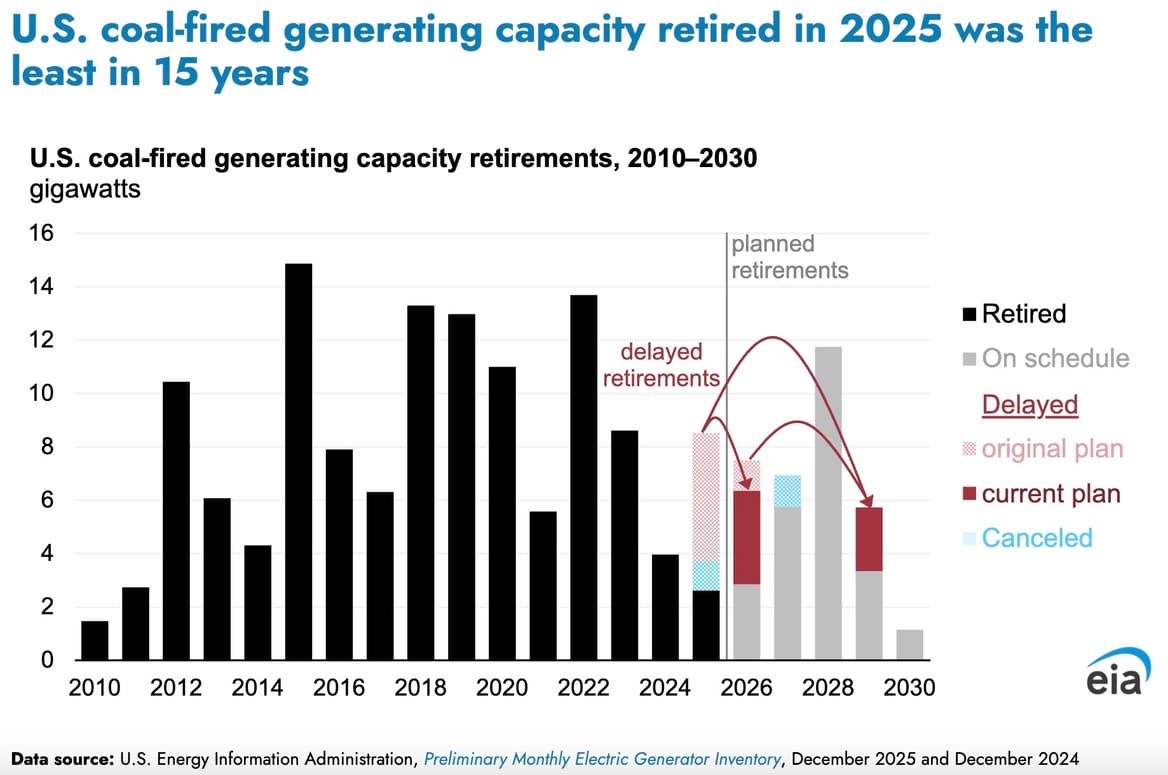
The DOE could force more coal plants to stay online this year. In a February briefing paper, EIA tallied 6.4 gigawatts of coal-fired capacity scheduled to retire in 2026, or about 4% of the U.S. coal fleet. But “renewed or new emergency orders could affect retirements planned for this year as well,” it noted.
Indeed, environmental advocates have little expectation that the DOE will stop issuing stay-open orders.
“The Trump administration is going to continue to renew them until a court stops it,” said Tyson Slocum, director of the energy program at nonprofit watchdog group Public Citizen, citing the legal challenges brought by his group and others.
The first stay-open order to see its day in court will be that concerning the J.H. Campbell power plant in Michigan. Environmental groups and the state itself are seeking to undo the DOE’s orders, arguing that the agency has failed to prove that a true grid emergency exists — and pointing out that the utility Consumers Energy, Michigan regulators, and the regional grid operator have all determined that closing the plant would not threaten reliability.
The U.S. Court of Appeals for the D.C. Circuit heard oral arguments on the case in May, and could issue a ruling as early as next month, Kelly said. “If we get a good decision from the D.C. Circuit, laying out what the standard is for these — and it clearly hasn’t been met in the case of Campbell — that can start to be used to start short-circuiting DOE using these 202(c) orders to keep plants online,” he said.
Meanwhile, the cost of keeping these coal plants open is mounting. The Sierra Club estimates that U.S. utility customers have paid a collective $415 million and counting in excess costs caused by forcing six coal plants and one oil- and gas-fired power plant open under DOE emergency orders. It could balloon further: Consultancy Grid Strategies has estimated that, if unchecked, DOE’s use of 202(c) emergency orders could increase energy costs by nearly $6 billion by 2028.
“It’s very clear this is not doing anything to lower energy costs,” said Patrick Drupp, the Sierra Club’s climate policy director.
In fact, many of the power plants under the DOE’s must-run orders “are not functional and costing lots of money to get functional and back online,” said Michelle Solomon, a policy analyst at think tank Energy Innovation who co-wrote a 2023 report finding that clean energy and batteries are a cheaper alternative to operating 99% of the U.S. coal fleet. “That means they are not contributing to reliability.”


.svg)
