The Carbon Clock is currently unavailable, please try again in a few minutes.
Data: Mercator Research Institute on Global Commons and Climate Change (mcc-berlin.net)
Remaining Carbon Budget
The Intergovernmental Panel on Climate Change (IPCC), established in 1988 by the World Meteorological Organization (WMO) and the United Nations Environmental Programme (UNEP), evaluates scientific data related to climate change, including estimates of the remaining CO2 emissions budget to limit global warming to 1.5°C / 2°C. This data, last updated in the summer of 2021, underlies the MCC Carbon Clock.
IPCC bases the carbon budget on the near-linear relationship between cumulative emissions and temperature rise, considering the lag between CO2 concentration and its temperature impact. With annual emissions from fossil fuels, industrial processes, and land-use change estimated at 42.2 gigatonnes (1,337 tonnes per second), the 1.5°C / 2°C budgets are expected to be exhausted in approximately 3 and 21 years from January 2026, respectively.
Realtime countdown of the remaining carbon dioxide (CO2) emissions budget until global warming reaches a maximum of 1.5°C / 2°C above pre-industrial levels.
The Intergovernmental Panel on Climate Change (IPCC), established in 1988 by the World Meteorological Organization (WMO) and the United Nations Environmental Programme (UNEP), evaluates scientific data related to climate change including estimates of the remaining amount of CO2 that can be released into the atmosphere to limit global warming to a maximum of 1.5°C / 2°C. This data was last updated in summer 2021, and is the basis of the MCC Carbon Clock.
IPCC bases the concept of a carbon budget on a nearly linear relationship between the cumulative emissions and the temperature rise. There is, however, a lag between the concentration of emissions in the atmosphere and their impact on temperature to be taken into account. With the starting point of annual emissions of CO2 from burning fossil fuels, industrial processes and land-use change estimated to be 42.2 gigatonnes per year [or 1,337 tonnes per second], the 1.5°C / 2°C budgets would be expected to be exhausted in approximately 5 and 23 years from August 2024, respectively.
Am I also contributing?
Are we thinking about the emission of greenhouse gasses such as methane and carbon when we do day to day activities like: driving a car, using energy to cook or heating our houses? Probably not. But by doing this we are making our small but constant contribution to the problem of Global Warming. We see from worsening weather disasters around the world that this returns as a boomerang back to our houses and families.
>80%
of all natural disasters were related to climate change
24.29%
USA share of global world cumulative CO₂ emission
100 million
people can be pushed into poverty by 2030 because of climate change impact
The overall trend in global average temperature indicates that warming is occurring in an increasing number of regions. Future Earth warming depends on our greenhouse gas emissions in the coming decades.
At present, approximately 11 billion metric tons of carbon are released into the atmosphere each year. As a result, the level of carbon dioxide in the atmosphere is on the rise every year, as it surpasses the natural capacity for removal.
10
warmest years on historical record have occurred since 2010
>2°F
is the total increase in the Earth's temperature since 1880
>2x
warming rate since 1981
Understanding the ultimate consequences of current trends
Observations from both satellites and the Earth’s surface are indisputable — the planet has warmed rapidly over the past 44 years. As far back as 1850, data from weather stations all over the globe make clear the Earth’s average temperature has been rising.
In recent days, as the Earth has reached its highest average temperatures in recorded history, warmer than any time in the last 125,000 years. Paleoclimatologists, who study the Earth’s climate history, are confident that the current decade is warmer than any period since before the last ice age, about 125,000 years ago.
Clean hydrogen has 3 main uses: energy storage, load balancing, and as feedstock/fuel. Used in all sectors, including steel, chemical, oil refining & heavy transport. Actions to accelerate decarbonization & increase clean hydrogen use include:
Invest in clean hydrogen supply;
Increase hydrogen demand as fuel/feedstock;
Use hydrogen for clean high-temperature heat;
Use hydrogen as low-carbon feedstock for ammonia/fertilizer;
Use hydrogen as clean fuel for heavy transport;
Create policies incentivizing electric power decarbonization;
Utilize hydrogen as a means for storing energy over extended periods;
Improve electrolyser technology & readiness in heavy industry/liquid transport fuels;
Increase use of Methane Pyrolysis & Water Electrolysis for clean hydrogen production;
Increase use of wind and solar in electricity production systems.
Increase the usage of Electricity
Reducing greenhouse gas emissions and achieving carbon neutrality requires widespread renewable energy and a huge increase in vehicles, products, and processes powered by electricity.
Electricity generated from increasingly renewable energy sources is the right way to create a clean energy system. Switching from direct use of fossil fuels to electricity improves air quality by reducing emissions of local pollutants.In order to increase the use of electricity, we can do the following:
Use more electric cars. Compared to traditional combustion engine vehicles, electric cars show a 3-5 times increase in energy efficiency;
Increase your electricity consumption within your household;
Upgrade your home with smart technology. Electrical appliances can be digitized with smart technology;
Use electric heat pump heating. Heat pumps use 4 times less energy than oil or gas boilers;
Electrify industrial processes in order to reduce energy intensity.
As the foremost element in the periodic table, hydrogen holds a unique position in the universe, given its status as the lightest and one of the most ancient and abundant chemical elements.
Never alone
Hydrogen, in its pure form, needs to be extracted since it is usually present in more intricate molecules, such as water or hydrocarbons, on Earth.
Fuel of stars
Hydrogen powers stars through nuclear fusion. This creates energy and all the other chemicals elements which are found on Earth.
Hydrogen is an essential part for manufacturing Ammoniam Nitrate fertilizers. Half of the world's food is grown using hydrogen-based ammonia fertilizer.
Hydrogen fuel cells make electricity from combining hydrogen and oxygen. Power plants are showing increased interest in using hydrogen, and gas turbines can convert from natural gas to hydrogen combustion.
Steelmaking is an industry that is beginning to successfully use hydrogen in two ways to eliminate almost all greenhouse emissions from the steelmaking process. First for Direct Reduced Iron (DRI) replacing coke (from coal) with hydrogen to remove oxygen from iron ore. Second for heat to melt the iron ore into DRI and then into low carbon steel.
Hydrogen is used in production of explosives, fertilizers, and other chemicals; to convert heavier hydrocarbons to lightweight hydrocarbons to produce many value-added chemicals; to hydrogenate organic compounds; and to remove impurities like sulfur, halides, oxygen, metals, and/or nitrogen. It's also in household cleaners like ammonium hydroxide.
Using clean hydrogen makes it possible to reduce emissions while "cracking" heavier petroleum into lightweight hydrocarbons to produce many value-added chemicals.
The World needs MORE hydrogen, to move toward Turquoise and Green hydrogen, and away from Grey hydrogen
Where We are Now
The temperature trend shows the increase can reach 5.9°F (3.28°C) by 2050
High CO2 emissions (7-8 kg CO2 /kg H2)
Only 2% produced with carbon capture (2Mt)
Worldwide 98% Hydrogen production (94 Mt) without carbon capture emits CO2(900 Mt)
62% from methane without carbon capture
Fossil Fuel electricity generation pollutes the environment
Fossil Fuel provides 33-35% efficiency
What We Want to Achieve
By 2030
25% Produced(24Mt) with carbon capture
Stop more climate change limiting warming to 2.4°F (1.3°C) by 2050
Hydrogen for low-carbon industrial heat
100% Hydrogen as a sustainable industrial feedstock
Statistics Source: IEA Global Hydrogen Review 2022
Most Common Hydrogen Sources
These methods now produce 85% of the world's Greenhouse Gas carbon emissions
SMR (Steam Methane Reforming) + WGS (Water Gas Shift)
SMR is a way of producing syngas (Hydrogen and Carbon monoxide) by mixing hydrocarbons (like natural gas) with water. This mixture goes into a special container called a reformer vessel where a high-pressure mixture of steam and methane comes into contact with a nickel catalyst. As a result of the reaction, hydrogen and carbon monoxide are produced.
To make more hydrogen, carbon monoxide from the first reaction is mixed with water through the WGS reaction. As a result, we receive more hydrogen and a gas called carbon dioxide. For each unit of hydrogen produced there are 6 units of carbon dioxide produced and in almost all cases released into the atmosphere. Carbon dioxide is a harmful gas causing climate change.
$863 ($0.86 per kilogram of Hydrogen)
(Electricity = $474 + Methane $383 + Water $6 US EIA May 2024*)
SMR + WGS with Carbon Capture
The SMR method involves combining natural gas with high-temperature steam and a catalyst to generate a blend of hydrogen and carbon monoxide. Then, more water is added to the mixture to make more hydrogen and a gas called carbon dioxide.
For each unit of hydrogen produced there are 6 units of carbon dioxide produced. In a few experimental trials, to help the environment, the carbon dioxide is captured and stored underground using a special technology called CCUS (Carbon Capture, Utilization, and Storage). This leaves almost pure hydrogen.
One of the main problems with carbon capture and storage is that without careful management of storage, the CO2 can flow from these underground reservoirs into the surrounding air and contribute to climate change, or spoil the nearby water supply. Another is the risk of creating earthquake tremors caused by the storage increasing underground pressure, known as human caused seismicity.
$1,253 ($1.25 per kilogram of Hydrogen)
(Electricity $474 + Methane $505 + Water $4 US + CCS $270 EIA May 2024*)
Newer, Clean Hydrogen Sources
Methane Pyrolysis
This technology based on natural gas emits no greenhouse gases as it does not produce CO2. Methane Pyrolysis refers to a method of generating hydrogen by breaking down methane into its basic components, namely hydrogen and solid carbon.
Oxygen is not involved at all within this process (no CO or CO2 is produced). Thus, for the production of hydrogen gas there is no need for an additional of CO or for CO2 separation.
The concept of Green Hydrogen involves generating hydrogen from renewable energy sources by means of electrolysis, a process that splits water into its fundamental constituents, hydrogen and oxygen, using an electric current. This process can be powered by a range of renewable energy sources, such as solar energy, wind power, and hydropower.
The electricity used in the electrolysis process is derived exclusively from renewable sources, ensuring a sustainable and environmentally-friendly production of hydrogen. It generates zero carbon dioxide emissions and, as a result, prevents global warming.
Natural geologic hydrogen refers to hydrogen gas that is naturally present within the Earth's subsurface.
Known as "White" hydrogen, it can be generated through various geological processes. The study of geologic hydrogen and its potential as an energy resource is an active area of research, as it holds promise for renewable energy applications, particularly in the context of hydrogen fuel cells and clean energy production.
It's important to note that the creation of geologic hydrogen is generally a slow and long-term process, occurring over geological timescales. This is because the other methods are human production technology methods and this is creation by a natural phenomena. The availability and abundance of geologic hydrogen can vary significantly depending on the specific geological setting and the interplay of various factors such as rock composition, temperature, pressure, and the presence of suitable reactants.
Here are some of the main sources and mechanisms of geologic hydrogen generation:
01
Serpentinization
Serpentinization is a chemical reaction that occurs when water interacts with certain types of rocks, particularly ultramafic rocks rich in minerals such as olivine and pyroxene. This process results in the formation of serpentine minerals and produces hydrogen gas as a byproduct. Serpentinization typically takes place in environments such as hydrothermal systems, oceanic crust, and certain tectonic settings.
02
Radiolysis
In regions with high concentrations of radioactive elements, such as uranium and thorium, the decay of these elements releases radiation. This radiation can interact with surrounding water or other fluids, splitting the water molecules and generating hydrogen gas through a process called radiolysis. This mechanism is believed to contribute to the production of hydrogen in certain deep geological settings, such as deep groundwater systems and radioactive mineral deposits.
03
Geothermal activity
Geothermal systems, which involve the circulation of hot water or steam through fractured rocks, can generate hydrogen gas as a result of various processes. High-temperature hydrothermal systems can cause the thermal decomposition of hydrocarbons, releasing hydrogen gas. Additionally, the interaction between water and hot rocks in geothermal reservoirs can lead to the production of hydrogen through serpentinization or other geochemical reactions.
04
Abiotic methane cracking
Abiotic methane refers to methane gas that is not directly derived from biological sources, such as microbial activity. In certain geological environments, abiotic methane can be generated through processes like thermal decomposition of organic matter or reactions between carbon dioxide and hydrogen. This methane can subsequently undergo thermal or catalytic cracking, producing hydrogen gas.
Success Stories
Steps Taken by Different Countries to Move Forward to Net Zero Emissions
96
£4 billion
100 MW+
1st place
green hydrogen plants are owned by Australia. It possesses the highest count of establishments globally. Australia is expected to have the lowest costs of green hydrogen production by 2050 due to an abundance of solar and wind resources.
was committed by the UK to hydrogen technology and production facilities by 2030 to cultivate a hydrogen economy and create 9,000 jobs.
green hydrogen production sites are being developed by Canadian company First Hydrogen in Quebec and Manitoba. These plans are being developed in conjunction with Canadian and North American automotive strategies.
in the list of largest hydropower producers in the world belongs to China. It is followed by Brazil, USA and Canada.
By 2047
In 2017
200,000
110 countries
green hydrogen will help India make a quantum leap toward energy independence. The country’s National Hydrogen Mission was launched in 2021.
Japan became the first country to formulate a national hydrogen strategy as part of its ambition to become the world's first "hydrogen society" by deploying this fuel in all sectors.
fuel-cell electric vehicles production by 2025 is the goal stated by South Korea. In 2021, South Korea also approved the Hydrogen Power Economic Development and Safety Control Law, the first in the world to promote hydrogen vehicles, charging stations, and fuel cells.
have legally committed to reach net zero emissions by 2050.
Conclusion
The World needs MORE hydrogen
SMR + WGS
Keep current hydrogen production methods BUT
+
Clean Hydrogen Production Methods
make additional steps to broaden them with cleaner production methods
=
More Hydrogen
And as a result the world will get more vital hydrogen and become one step closer to net zero emission
Сurrent Situation
The market is dominated by grey hydrogen produced from natural gas through a fossil fuel-powered SMR process. Every year, the production of grey hydrogen amounts to approximately 70 to 80 million tons, and it is primarily used in industrial chemistry. More than 80% is used for the synthesis of ammonia and its derivatives (fertilizer for agriculture, 50 perecent of food worldwide) or for oil refining operations. Unfortunately, for every 1 kg of grey hydrogen, almost 6-8 kg of carbon dioxide is emitted into the atmosphere.
More than 95% of the world's hydrogen production is based on fossil fuels with greenhouse gas emissions. Nevertheless, to achieve a more stable future and promote the transition of pure energy, the global goal is to reduce the use of other “colors” of hydrogen and focus on the production of a clean product, such as green or turquoise hydrogen. Reaching the zero carbon footprint will require a gradual transition from grey to green/turquoise hydrogen in the coming years.
It is possible to produce decarbonized hydrogen. An option is to use another feedstock, namely water, and convert it in large electrolyzers into H2 and oxygen (O2), which are returned to the atmosphere. If the electricity used to power the electrolyzers is 100% renewable energy (photovoltaic panels, wind turbines, etc.), then hydrogen becomes green. Currently, it is about 0.1% of the total production of hydrogen, but it is expected that it will increase since the cost of renewable energy continues to fall.
U.S. additions to electric generation capacity from 2000 to 2025. The U.S. Energy Information Administration (EIA) reports that the United States is building power plants at a record pace. As indicated on the chart, nearly all new electric generating capacity either already installed or planned for 2025 is from clean energy sources, while new power plants coming on line 25 years ago, in 2000, were predominantly fueled by natural gas. New wind power plants began to come on line in 2001 and new solar plants, 10 years, later in 2011. Since 2023, the U.S. power industry has built more solar than any other type of power plant. The EIA predicts that clean energy (wind, solar, and battery storage) will deliver 93% of new power-plant capacity in 2025.
Global surface air temperature departures between 1940 and 2024 from the average temperature for the period 1991-2020 (averages below the 11-year average are blue and those above are red). The average in October 2024 was +0.80 degrees Celsius above the reference period average, down from +0.85 degrees Celsius above the reference period average in 2023, which was the warmest October on record.
Founded by a former public-housing resident, the 548 Foundation provides training, stipends, and support to build Black generational wealth through clean energy.
CHICAGO — On a beautiful fall Saturday morning on the South Side of Chicago, the Life Center Church of God in Christ thrummed with excitement. The pews were packed with over a thousand people dressed in their best — including more than a hundred in black graduation caps and gowns.
A graduation celebration for a solar industry training program on Oct. 10. 2026 (Jiovanni Velazquez/548 Foundation)
CHICAGO — On a beautiful fall Saturday morning on the South Side of Chicago, the Life Center Church of God in Christ thrummed with excitement. The pews were packed with over a thousand people dressed in their best — including more than a hundred in black graduation caps and gowns.
Before praying, Pastor Torrey L. Barrett invited the crowd to “turn it up,” so people cheered, danced, and waved hats in the air.
Though the sun streaming in the stained-glass windows was bright, the scene was not what might typically come to mind when one thinks about a solar industry gathering.
Instead of discussions of policy and technology, this was all celebration, music, and joy. And the people in the church were overwhelmingly African American, whereas the solar industry workforce is predominantly white.
But solar was the reason for the celebration. The 548 Foundation was commemorating the fact that its solar industry training program has now served more people than the number in its name, and is on track to reach 700 graduates by the end of the year. Participants are largely from the South and West sides of Chicago, disproportionately lower-income and African American communities whose residents have largely been left out of the clean energy economy.
The foundation was the brainchild of A.J. Patton, who grew up in a public-housing unit numbered 548 in Terre Haute, Indiana. Patton said his commitment to community empowerment and energy justice was sparked by the year — 1999 — that his family spent boiling water on an electric stove for baths, since his mother couldn’t afford a $400 gas bill.
I first met Patton in 2019, soon after he cofounded the startup 548 Capital LLC with his childhood friend from that same housing development, Erica Johnson, who was by then working in construction risk management for New York City’s housing authority. Their goal was to leverage renewable and energy-efficiency incentives to create affordable housing in marginalized Chicago neighborhoods, without contributing to the gentrification and displacement that often coincides with outside investment.
I was struck by Patton’s bold confidence and the large scale of their plans. He had quit a promising career in investment banking to focus on 548, entering a Chicago affordable-housing scene notorious for bureaucracy, cronyism, and challenges like the dilapidated state of buildings in low-income communities.
At the graduation, Patton described his path after launching the startup.
Their company acquired and renovated a six-flat apartment building, and soon more properties followed. They were “cutting folks’ bills,” Patton explained, but the people “swinging the hammers” on the building upgrades and solar panel installations did not reflect the local residents. When he pressed contractors to hire a more diverse workforce, he said he heard things like, “You know your people, they ain’t on time, they ain’t safe.”
That, Patton said, was the genesis of the 548 Foundation, a nonprofit that has now hosted 51 three-month training sessions in solar installation and related electrical and carpentry work, as well as basic life and job skills.
A.J. Patton, founder of the 548 Foundation, with solar job training graduates (Jiovanni Velazquez/548 Foundation)
In 2021 Illinois passed a law focused on driving equity in the clean energy workforce as well as in the deployment of solar arrays. It provided funding for workforce training programs and incentives for solar developers to hire employees meeting equity criteria, including those from low-income neighborhoods and people with histories in foster care or the criminal justice system.
The 548 Foundation began offering trainings through the state workforce-development program in 2023, said Patton, and now the foundation holds multiple sessions each year in Chicago and the suburbs of Aurora, Elgin, and Waukegan, home to large Latino immigrant and African American populations. Another Chicago session will begin this month.
Under the state program, students get a stipend along with support to help them overcome barriers like child care and car trouble. The programs feature not only technical instruction but basic skills from math to resume-writing. Wraparound services help trainees with mental health, housing, and other needs. Across Illinois, these offerings have been crucial to helping people not only acquire skills and certifications but get and keep jobs, according to Patton and other workforce-development leaders.
In August 2024, I attended a job fair that 548 put on for their graduates. There, multiple solar employers did interviews that they said would promptly result in job offers, and instructors revealed some of the secrets to their success. They noted that the supportive services continue after graduation — trainees can keep coming back to 548 staff and affiliates for aid and advice. And the instructors work hard to prepare their charges for all the nuances of the job. For example, they role-play conflict mediation and start hands-on classes at 6 a.m., when work in the field often begins — so the participants can build routines around early-morning child care and other family responsibilities.
At the graduation, Patton touted the program’s results, and how it has dispelled stereotypes about Chicago’s Black communities.
“They said we didn’t want to work. Somehow, we have a 500-person waiting list to get in this program. Then they said we weren’t smart enough to learn this stuff. We have a 70% graduation rate, 700 graduates. Then they said the market wasn’t ready for us. Meanwhile, we have a 68% placement rate. Our students get jobs within 33 days of graduation. They’re averaging $68,000 a year. So while others are talking, we work. That’s what we do.”
He warned graduates to stay focused on their goals and careers despite such prejudice, as well as potential “distractions,” like friends who just want to party or long-lost relatives who suddenly appear to borrow money.
The cautionary notes soon dissolved into applause and music, as it was time for the diplomas. Instructors from different cohorts came to the pulpit to read the names of their trainees. Each graduate shook hands in a long receiving line including Patton and various elected officials, while people cheered loudly from the pews.
“I’m super proud of her!” enthused Natane Brown after dashing into the aisle to embrace her sister, Asia Bell.
After the ceremony the crowd spilled onto the sidewalk, where graduates were showered with flowers and balloons and posed for photos with family and friends.
Graduate Anthony Legorreta hoisted his young nephew in his arms as his relatives crowded. “This was most definitely a life-changing experience,” he said.
Fellow graduate Kelvin Davis said he loved the hands-on installation training, but sees himself “doing something toward desk work” in the solar industry – “not so much the physicality.”
“They were very open to whoever wants to learn. It’s an open door for the community,” said Davis of the program.
Graduate Mikah Allen doesn’t necessarily see himself working in solar at all. He prefers iron work and construction, and the links with trade union apprenticeships embedded in the training should help with that too. The state recently revamped the clean energy curriculum to prepare workers for a wider range of careers, given the current volatility of some clean energy industries.
At the graduation, Pastor Barrett described 548’s classes as part of the quest to build generational wealth in disenfranchised Black communities. He shared how his grandfather came to Chicago from the cotton fields of Mississippi with a third-grade education, and through a labor union job was able to buy a home and raise a family, including Barrett’s father, a renowned gospel singer, pastor, and civil rights activist.
“We come from neighborhoods that people write off,” Barrett said. “But you all have changed the trajectory not only of yourselves but of the community.” He predicted that “the next generation of contractors, the next generation of developers, the next generation of millionaires is sitting right in this room.”
At a time when discussion of the American solar industry often revolves around slashed federal incentives, troubled supply chains, and projects blocked by community opposition, the scene in the church that morning provided an inspiring and refreshing antidote. It was a reminder that even in the face of great challenges, clean energy can help improve not only the climate but individuals’ lives.
“You have people here who have just come home from prison, who have been left off to the side in society,” Patton told me outside the church, between congratulating graduates with caps and diplomas in hand. “Now they’re crossing the threshold. What you saw today was hope. That gets you a long way.”
Before replacing gas service lines, utilities will need to offer customers a financial incentive to electrify instead, thanks to a new law.
When one of the nation’s biggest investor-owned utilities, Pacific Gas and Electric, wanted to replace Merrian Borgeson’s aging gas service line in Berkeley, California, she asked the company not to do it.
Borgeson, who is the California policy director for climate and energy at the nonprofit Natural Resources Defense Council, explained that the repair wasn’t necessary: She was in the process of fully electrifying her home and would be replacing her stove — the only gas appliance left in the house — with an induction version during an upcoming kitchen remodel. At that point, she planned to request that the gas line be shut off.
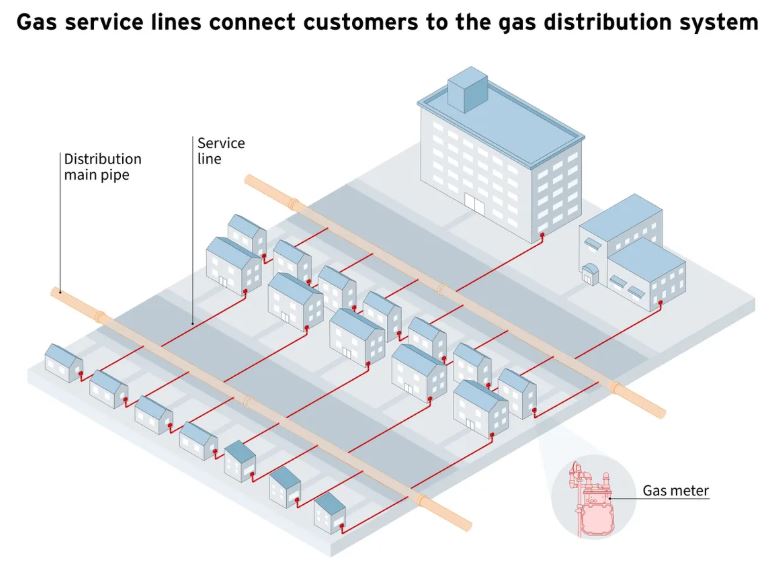
But PG&E told her it couldn’t wait. That week, the utility dug up her yard and swapped in a new pipe to send gas from the distribution main line to her home.
Borgeson wasn’t charged for the service — at least not directly. The upgrade, which in PG&E’s service area typically costs $20,000 to $30,000, plus interest and operation and maintenance costs, gets paid for by all gas customers over the life of the infrastructure.
A few years later, the new pipe sits unused in the ground.
“Now, I have no gas in my house,” Borgeson said. “But the customers all around me are paying for that pipeline for the next 50 years.”
Soon, Californians will have the choice that Borgeson did not.
A new law, the Home Energy Choice Act (Assembly Bill 2313), will require utilities to give households scheduled for a service line replacement the option of getting the new line or taking a financial incentive potentially worth several thousand dollars to get off gas instead. Crucially, the incentive to switch to all-electric equipment such as a heat pump, induction range, and heat-pump water heater, will be less than the cost to replace the line, resulting in savings that will be shared among all gas customers.
The law “sends a very clear message that California is no longer going to invest millions of dollars in gas infrastructure without considering the future,” said Borgeson, who advocated for the bill. “It’s this huge signal of where the state is headed.”
The Natural Resources Defense Council has calculated that PG&E’s gas customers could save a total of $20 million if the utility gave 1,000 households a $17,500 incentive apiece rather than replacing their service lines. For context, PG&E replaces about 15,000 service lines annually.
The policy will help push the state closer to its goal of a carbon-neutral economy by 2045; however, the version that passed was less ambitious than what was introduced, according to Brandon García, California director at industry association Advanced Energy United. Revisions included programs being capped at 1% of a utility’s customers and the law expiring Jan. 1, 2035, though it could be renewed before then.
“AB 2313 was a very difficult bill to get through the Legislature, so I’m very excited that it will soon give Californians the opportunity to decide what energy is powering their home and provide financial support if they choose to transition away from natural gas,” Assemblymember Marc Berman, who authored the bill, said by email. “When homeowners opt to electrify, the utility avoids additional investments in fossil fuel infrastructure that will eventually become a stranded asset, and this saves all ratepayers money long-term.”
Utilities San Diego Gas and Electric and SoCalGas opposed the bill, arguing that it would result in an unfair cost shift: As some customers stop using gas, those remaining could be left bearing outsized costs to maintain the system. While that is an issue writ large for the transition off of fossil fuels, and one the state needs to address, this law “is instead about trying to encourage people to leave at the exact time when they are saving money for everyone else by leaving,” said Kiki Velez, equitable gas transition lead at the Natural Resources Defense Council.
With the new legislation, California becomes the third jurisdiction to authorize the pipeline replacement alternative approach — and the first to do so statewide. In 2024, New York utility Con Edison launched its initiative, the Energy Exchange Program, which offers eligible households up to $20,000 to electrify. Other New York utilities are following suit, Velez said. And in July, the Colorado Public Utilities Commission authorized Xcel Energy to create a similar program, which she expects could launch within a few months.
In California, the next step is for the Public Utilities Commission to create a detailed framework for utilities to follow, including incentive levels, with larger amounts for customers in disadvantaged communities. Then utilities will have until Jan. 1, 2028, for their individual proposed programs to be approved.
One yet-to-be-determined detail is how much notice utilities will give residents whose pipes they want to replace. “I think the worst case is you don’t hear about [the incentive] until the last minute,” Borgeson said. RMI recommends utilities alert residents one to five years ahead — at the point when it is scheduling the service line replacements.
Other states are looking to emulate California with bills of their own, Velez said, pointing to Illinois, Maryland, Minnesota, Oregon, and Washington. “Folks are already reaching out a lot about how they can bring it to their state,” she said.
In California, the bigger electrification incentives for disadvantaged communities will provide a much-needed boost to clean energy equity, García noted. “As someone who grew up in those kinds of neighborhoods as a low-income person, I want to make sure that everyone has access to [all-electric] technology.”
Demand for the climate-friendly HVAC tech has persisted even after Republicans killed incentives, with 2026 set to be another good year for the sector.
America’s demand for heat pumps isn’t going away just because federal incentives did.
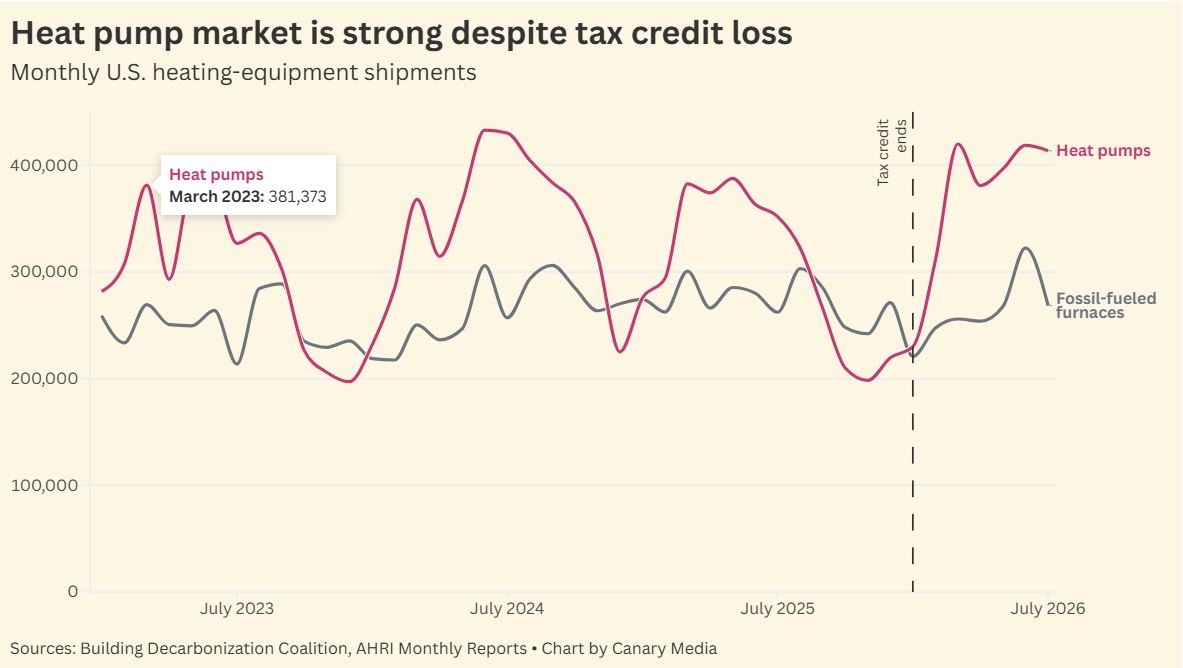
Shipments of heat pumps stayed strong in the first half of 2026, and the tech is on track to match or exceed its best year, according to a recent report from the Building Decarbonization Coalition. The nonprofit relies on data from the Air-Conditioning, Heating, and Refrigeration Institute, a trade group that represents most of the U.S. market.
America’s demand for heat pumps isn’t going away just because federal incentives did.
Shipments of heat pumps stayed strong in the first half of 2026, and the tech is on track to match or exceed its best year, according to a recent report from the Building Decarbonization Coalition. The nonprofit relies on data from the Air-Conditioning, Heating, and Refrigeration Institute, a trade group that represents most of the U.S. market.
This is in spite of the fact that President Donald Trump and Republicans in Congress ripped away tax credits that helped households afford heat pumps — which can both cool and warm homes and wean buildings off polluting gas furnaces — as well as rooftop solar, batteries, and other clean energy tech. The 25C tax credit for heat pumps, which shaved up to $2,000 off the price tag, expired at the end of 2025 — seven years earlier than the Biden administration’s deadline.
So what gives? It could be that the tax credit was never a determining factor for most people getting heat pumps — a hypothesis put forth by Lucas Davis, a business professor at the University of California, Berkeley.
“I suspect most households adopted heat pumps without ever knowing anything about the credit, or didn’t learn about the tax credit until months later when filing their taxes,” he wrote in a blog post earlier this year, noting that previous research shows heat pump adoption in the U.S. is driven by geography, climate, and electricity prices. “It may simply be that these factors are much more important than subsidies for driving adoption behavior.” Contractors repeatedly told ACHR News, an industry publication, that they were usually the ones bringing up the tax credit to customers, not vice versa.
Meanwhile, households in some parts of the U.S. can still access state and utility incentives for heat pumps, and many local governments continue to plow ahead with ordinances that encourage households to ditch fossil fuels. Plus, contractors have gotten more familiar with heat pumps in recent years.
So, heat pumps are a bright spot. Barring a dramatic shift in consumer behavior, 2026 is set to be a very good year for the tech. Keep an eye out for the final tally.





.svg)

