

 Back
Back
An Asheville, North Carolina, group has embraced solar to secure backup power and lower bills. Its efforts go beyond the standard rooftop array.
ASHEVILLE, N.C. — Nearly two years after Hurricane Helene wreaked havoc on western North Carolina’s largest city, many Asheville residents are still rebuilding — and determined to be better prepared for the next weather disaster.
In Emma, a diverse, mostly immigrant neighborhood just northwest of downtown, solar energy is playing a key role in that work, offering not only a backstop for the next grid outage but also lower utility bills year-round.

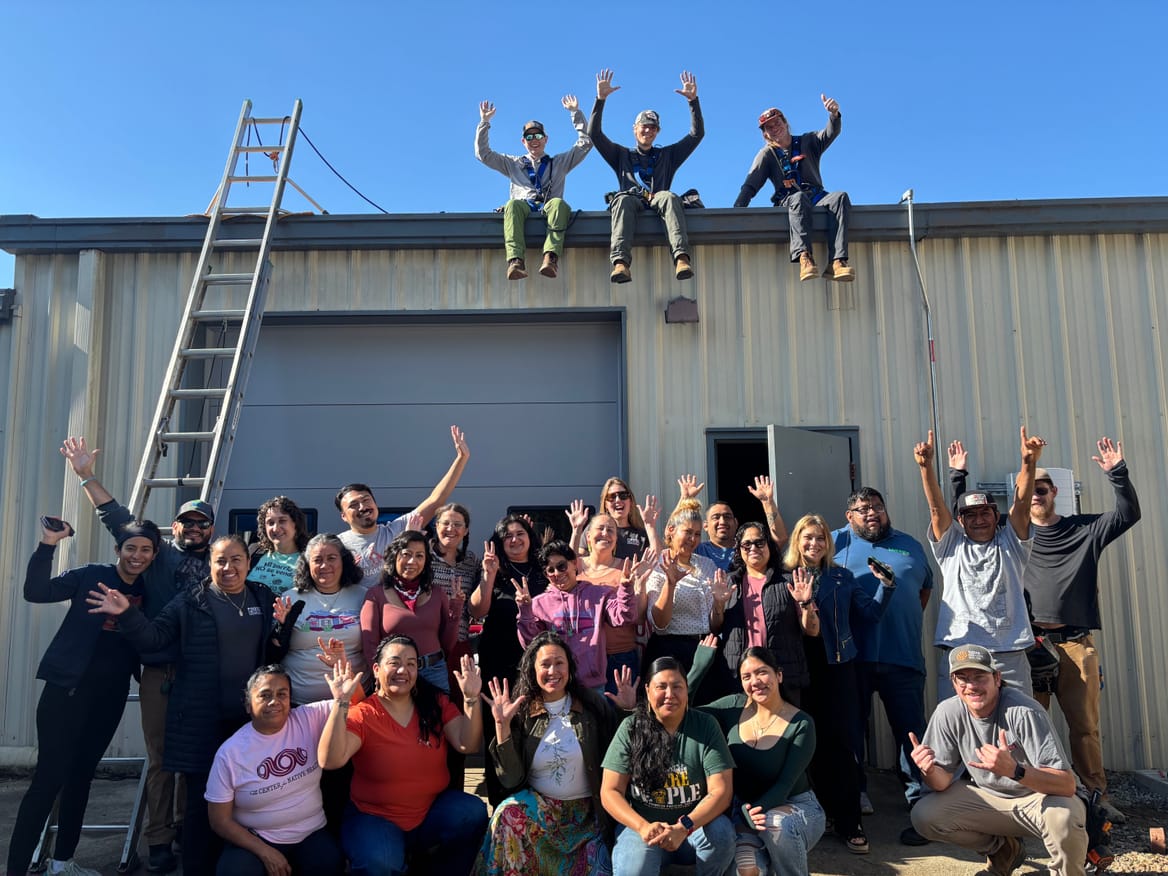
Earlier this month, residents, clean energy workers, and organizers gathered to celebrate the latest addition to Emma’s growing solar capacity: a 46-kilowatt array on the rooftop of the community and cultural center owned by La Esperanza (“the hope” in Spanish), a neighborhood real estate co-op formed in 2019.
La Esperanza is one of many organizations and co-ops within Poder Emma, an alliance that has worked to fight displacement and ensure affordable housing in this low-income community for nearly two decades. The 100-plus panels atop the center — a gathering place for celebrations, workshops, and other functions — will lower electricity bills for Poder (meaning “power”), reducing the amount of energy it draws from the grid.
The project was made possible by a host of partners that contributed time, money, and expertise. Most came together in the immediate aftermath of Helene, when mobile solar-powered charging stations proved vital for Emma’s recovery.
“Suddenly, there was an interest in solar where there hadn’t been before,” said Ingrid Johnson, a project manager at Poder. “The reality is that solar can be for communities that are often left out.”
The panels were donated by the Footprint Project, a New Orleans–based sustainable disaster-relief nonprofit that arrived in the area right after the storm and never left. Sugar Hollow Solar, whose offices are just a few doors down from the sprawling, 20,000-square-foot Poder complex, installed the system. Invest Appalachia, a regional fund for economic development, chipped in with a bridge loan to tide Poder over until the panels pay for themselves and federal rebates are processed.
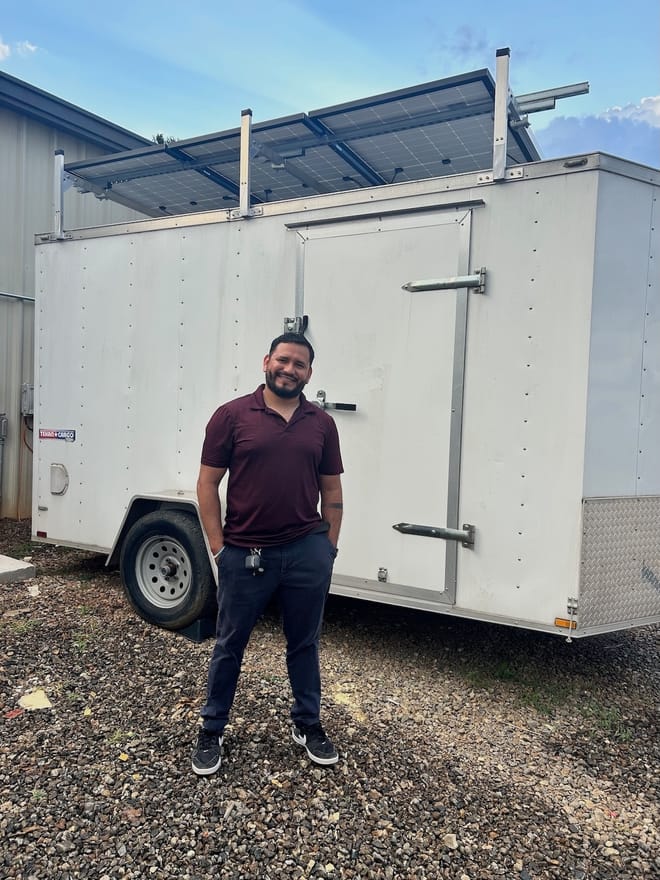
Yet even with that assistance, a typical battery backup system to power essential functions during a grid outage proved too costly. So the partners got creative: They instead have a trailer outfitted with 900 watts of solar panels and a smaller battery to help do the job.
The box on wheels, another Footprint donation, is able to plug into the community center and function as a mini generator for crucial services, including the internet, refrigeration, and the pump for a drinking-water well the collective drilled on-site the winter after Helene destroyed an Asheville water main. The damage left most of the city without clean tap water for nearly two months.
“The climate is going to get more extreme as years go by, unfortunately,” said Kelvin Bonilla, who joined Poder’s staff in early 2025. “So, being able to power the pump from the solar trailer adds that extra layer of resiliency.”
But the solar trailer is more than just an emergency generator. Most of the time, it serves as a mobile outlet and tool-charging station for Poder’s home repair crew, which was formed to address the destruction from Helene and will soon tackle energy-efficiency improvements, too. The team needs its own power source for drills, saws, and other equipment to avoid overwhelming the fuse boxes of the homes they are fixing.
“When we plug into their outlets, we have situations where we trip breakers because it’s such a big load,” said Bonilla, who manages the home repair initiative. “Having the trailer allows us to be more independent and more resilient.”
The solar trailer helps create a sort of microgrid, a self-contained system that can operate when the larger grid goes down. Sustainable microgrids are typically outfitted with a large, stationary battery, but the trailer offers a cheaper, portable option. The approach could inform other resiliency efforts prompted by the storm, staffers at the Footprint Project say, including a $5 million state grant program for 24 microgrids in western North Carolina.
Poder and Sugar Hollow are also experimenting with using solar to help individual households weather the next storm. Mobile homes make up the vast bulk of housing stock in the area, and thanks largely to Poder co-ops, a small number of families own rather than rent theirs. Still, solar has long been out of reach because of poor structural stability in manufactured homes. The solution: Attach a custom-made porch to the home and install panels on its roof.
Sugar Hollow and Poder tested the concept early this year, installing 15 panels on a porch built for a manufactured home in Emma, backed up by a Tesla Powerwall 3 battery. The system benefits the household at no cost, thanks to contributions from Footprint and an initiative Sugar Hollow launched in 2025 to help Helene-impacted groups access renewable energy.
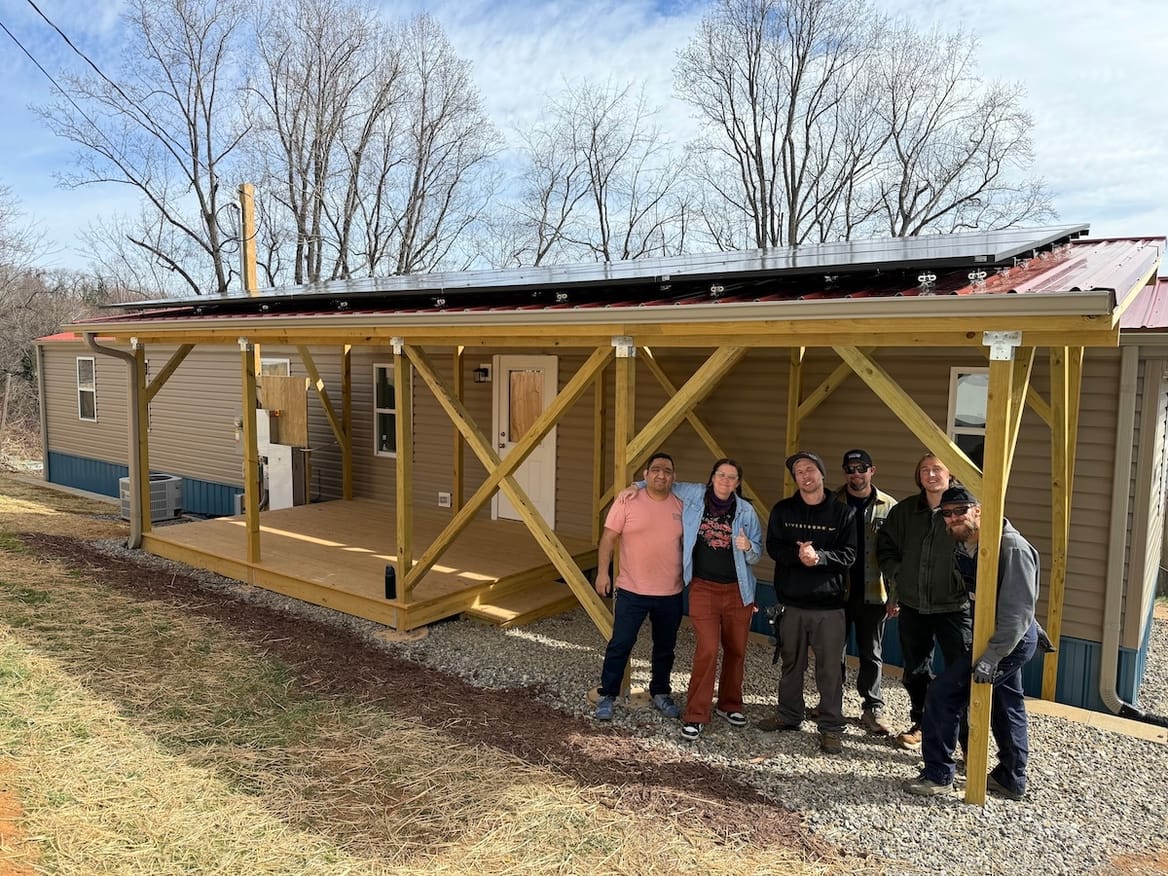
“This was a really great pilot project to understand how we can make solar available for mobile homes,” said Clary Franko, chief operating officer at Sugar Hollow. “The structure is multipurpose — it’s for solar, but also a gathering place for the community.” With additional funding, she hopes to add these solar porches for more households.
Organizers stress that Poder’s members, not its leadership, devised the front-porch model. The same holds true for virtually all the collective’s endeavors — solar and otherwise. That, Bonilla said, is a huge source of pride.
“Typically, a nonprofit is a group of people that sees a problem and goes into a community and says, ‘We’re going to solve all your problems,’” he said. But at Poder, “we listen to the community first before we do anything.”
Mesabi Metallics is opening a mine and processing plant on the Iron Range, spurring job opportunities and a chance to join the global transition to low-carbon steel.
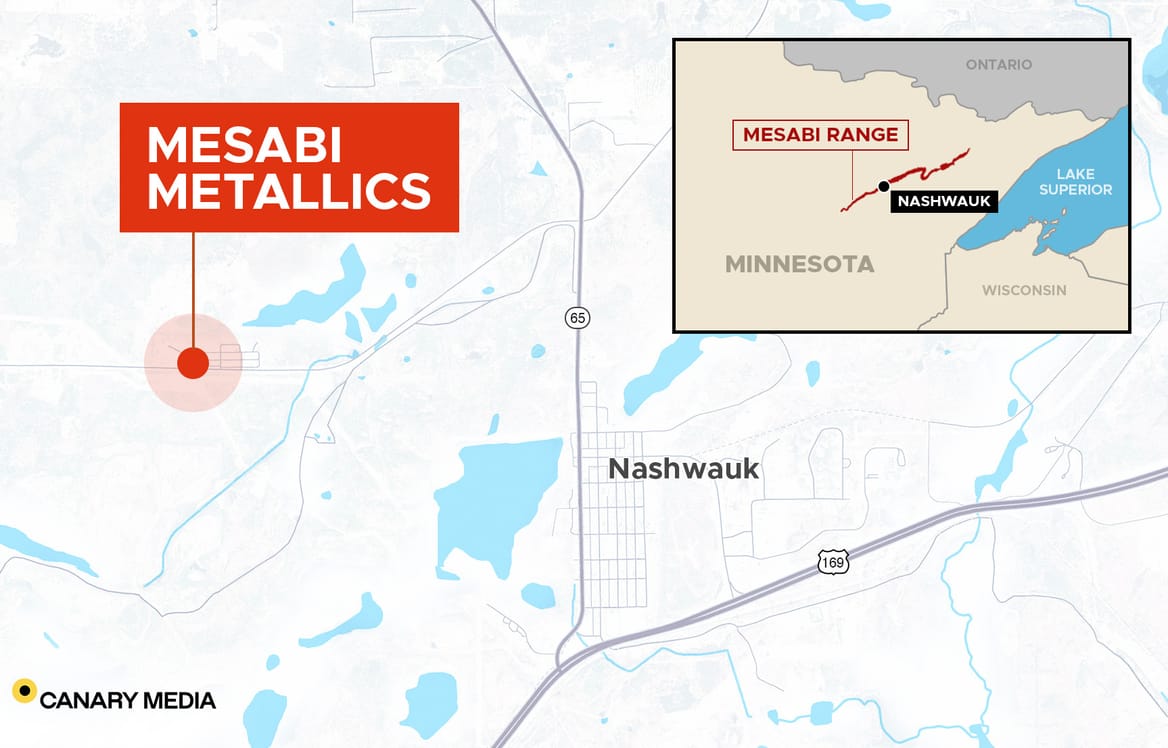
An enormous shed sits on a ridge northeast of Calumet, Minnesota, along the state’s Iron Range, visible for miles to drivers rushing by on Highway 169.
To reach it by car, I exited the highway at Nashwauk (population 950, give or take) and drove down a lonely county road, eventually pulling up to a security building. Inside, I watched a safety video while a guard stood nearby screening a steady stream of hulking work trucks. (“One of those days,” she said.) I still had to go nearly another three miles — past rough parking lots with more work trucks and onto a red-dirt road — before finally arriving at a construction site the size of a small city.
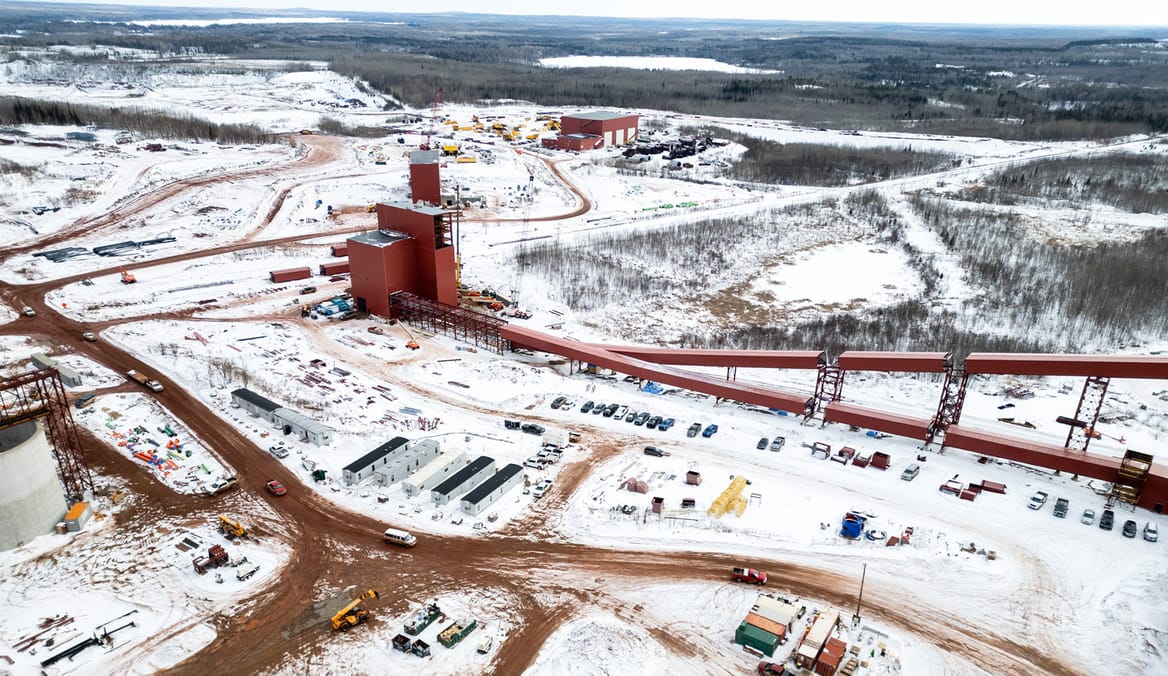
I was in the heart of Mesabi Metallics, an ore mining and processing complex under development by Essar Group, a family-owned industrial conglomerate based in India. The sprawling facility is on track to start producing iron pellets by this September, according to the company’s latest estimates. It will be Minnesota’s first new iron mine in 50 years.
When I visited the site in February, mine officials couldn’t confirm an exact start date, but president and CEO Joe Broking told me that “it’s a matter of when and not if Mesabi Metallics will open for business.”
On July 13, Mesabi blasted its first chunk of iron ore.
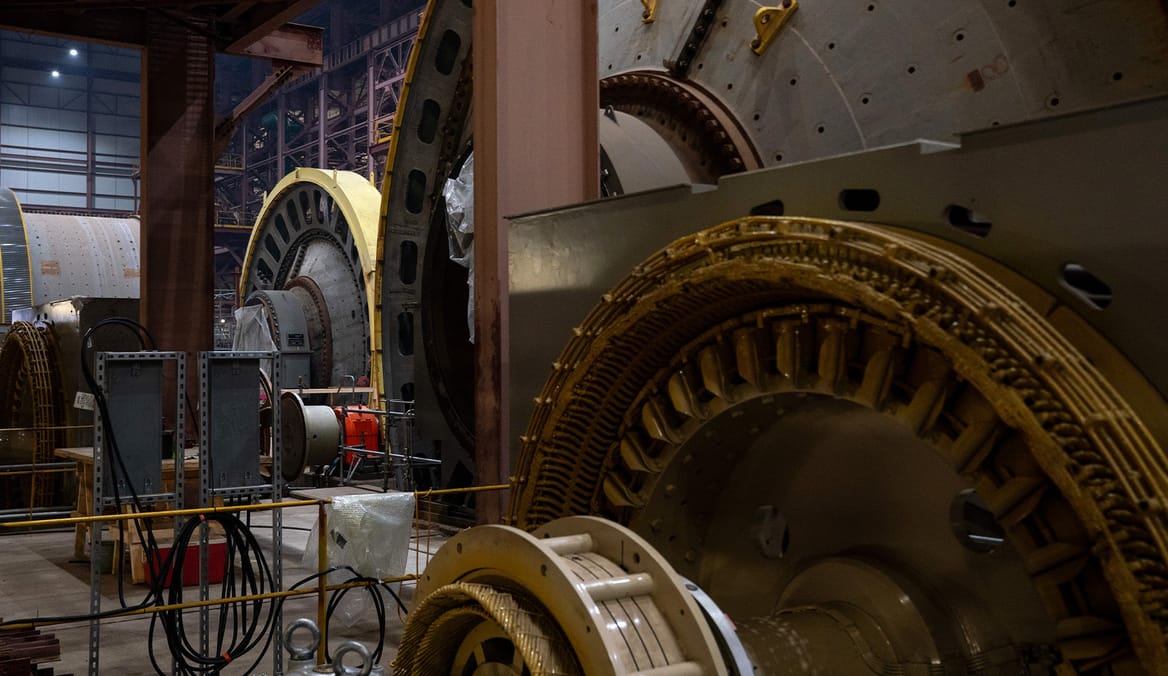
Once the mine is fully operational, huge diggers will extract raw iron ore in an open-pit mine not far from Broking’s office. Then enormous dump trucks will each cart up to 400 tons of the material at a time to a series of machines that will grind it into ever-finer particles. The later stages of the process will take place in one of the site’s biggest buildings — that “shed” I thought I saw from the highway — where giant cylinders will pulverize the ore into particles slimmer than a human hair. Other equipment will mix the powder into a stream of recycled water to create an iron-rich slurry that will be further purified elsewhere in the building. Finally, the mixture will be pumped a couple of miles away to a pelletizing plant to be formed into marble-size balls that great furnaces will sear until hard enough to survive a journey by rail and water to steel mills around the world.
Essar’s $2.5 billion facility has been in the works for decades, through commodity market collapses, corporate restructurings, a global financial crisis, and a yearslong legal battle over mineral leases. Things looked dicey at several points along the way. But by the time Broking came onboard in 2024, “the thing [Essar’s owners] were certain of is that they were going to complete this project,” he said. “And that gave me a lot of confidence.”
Now, Mesabi Metallics has a crucial role to play in the future of steel production and of the region named after its literal bedrock industry. The pelletizing plant will have the capacity to produce 7 million tons each year of concentrated iron pellets for direct reduction, a low-carbon way of turning iron ore into iron ready for steelmaking. The DR-grade pellets will advance one of Essar’s corporate mandates: to clean up an industry that accounts for about 9% of global greenhouse gas emissions.
“We’re going to be the cleanest iron ore mine in North America — in the world, arguably, by quite a long ways. And at the same time, we’ll be extremely competitive” on cost, Broking said. “To be sustainable, our philosophy is we have to do both.”
Mesabi Metallics has some competition on the Iron Range. About an hour away, the Ohio-based steelmaker Cleveland-Cliffs turns iron pulled out of its mines into DR-grade pellets for shipment to its home state. U.S. Steel, now majority-owned by Japan’s Nippon Steel, has its own DR-grade plant nearby that could — eventually — feed a lower-emissions ironmaking facility it’s developing in Arkansas. Two local entrepreneurs are separately pursuing plans to harvest iron ore from mine waste and likewise ship it out of state for use in lower-emissions steelmaking. One of those entrepreneurs expects the global market for DR-grade pellets to quadruple by 2034.

As steelmaking evolves, those investments could keep the Iron Range’s namesake industry relevant for a few decades to come. Experts are skeptical, however, that they’ll do much to reverse the slow demographic decline that began before most of the workers building Essar’s new mine were born. To accomplish that, northeastern Minnesota may need to claim a much bigger piece of the green steel future.
In his office, Broking reiterated the company’s long-term vision for vertically integrated, low-carbon steelmaking at the Nashwauk site. But he added that no investment decisions toward that end have been made.
“Between Mesabi Metallics and Essar … we are committed to taking this to the next step,” he said. “I just can’t responsibly say for certain that that can happen. What I can say is we are continuously evaluating opportunities to grow the business.”
State officials and industry experts, though, say the local economics of “mine to mill” steel are too compelling to overlook. The Iron Range has a capable union workforce, ample renewable-energy potential to power cost-effective hydrogen and electrochemical iron production, an applied research powerhouse backed by the University of Minnesota, and a potential clean energy bonanza trapped in its bedrock. If it’s going to happen anywhere, why not here?
Visible on geologic maps as a 110-mile narrow ribbon of iron-rich bedrock north of Lake Superior, the Mesabi Range is the legacy of what may have been Earth’s first great extinction event.
Oxygen-exhaling microorganisms first emerged around 2.4 billion years ago. Over the next 400 million years, the atmosphere’s methane content fell dramatically, precipitating a global ice age and relegating once-dominant anaerobic life-forms to oxygen-poor environments like the deep ocean.
The Great Oxidation Event also pulled vast quantities of dissolved iron out of the sea and scattered huge formations of ferrous rock throughout the Earth’s crust. In a few lucky places around the world — including northern Minnesota, Wisconsin, and Michigan — these deposits sit close enough to the surface for humans to exploit with relative ease.
The Mesabi Range is the largest of Minnesota’s three major iron ranges and the only one actively mined today. Most non-geologists refer to it as the Iron Range, or just “the Range.” Historically, it has produced upwards of 70% of U.S. iron.
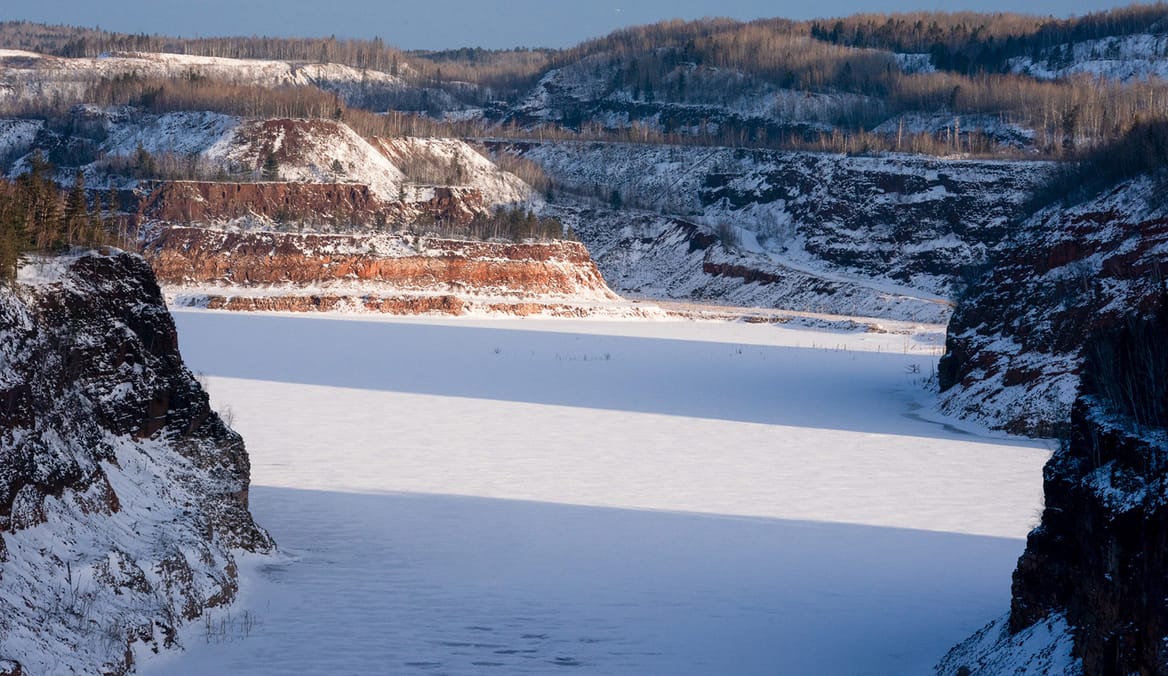
It’s a place of stark beauty hewn by nearly two centuries of human meddling. The dense forests of birch, pine, and spruce are largely secondary growth, a dim echo of the towering white pines clear-cut in the late 19th century. The deepest, clearest lakes, some rimmed by sheer cliffs, are long-abandoned mine pits reclaimed by groundwater. The pretty, rust-colored buttes along Highway 169 west of Hibbing are piles of waste rock and low-grade ore. Twentieth-century miners pushed them out of the way to get at the good stuff.
The Mesabi Range’s first iron mine opened in 1890, followed two years later by a railroad to the port of Superior, Wisconsin. Minnesota iron could now reach the burgeoning steel mills of the lower Great Lakes by ship — still the most cost-effective way to transport heavy cargo.
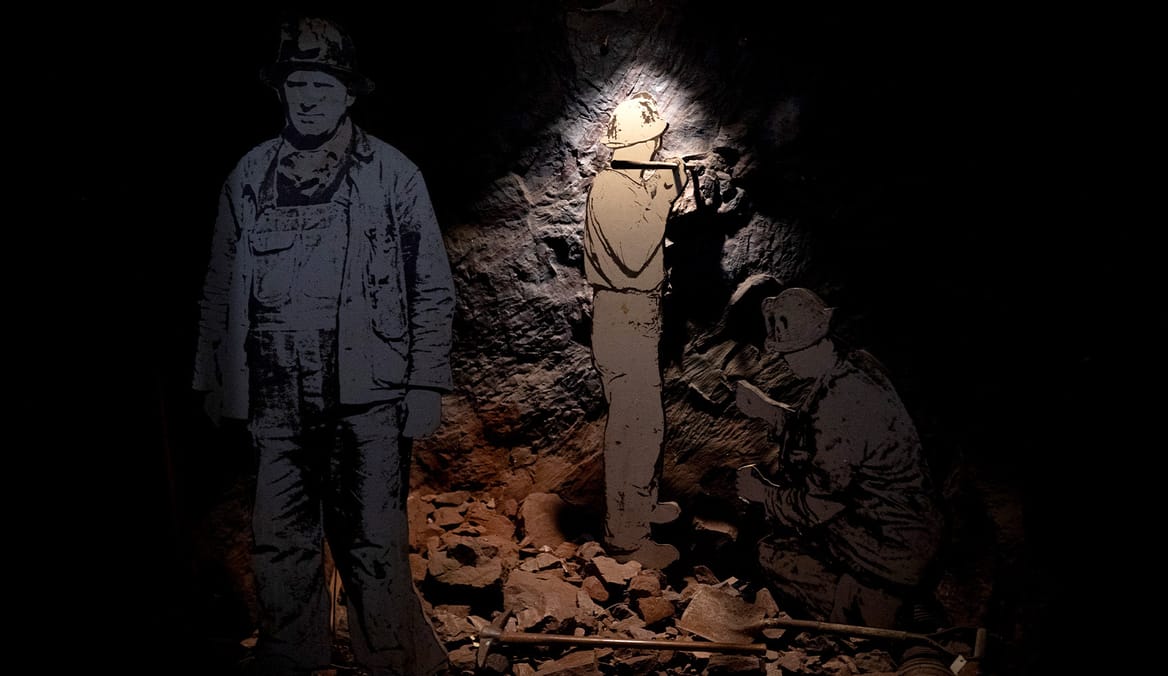
Ten years later, more than 100 mines were operating along the formation. Settlements quickly sprang up along the richest veins, with some, like Hibbing and Virginia, emerging as proper boomtowns. Around the same time, the industrialists John D. Rockefeller, Andrew Carnegie, and Henry Oliver consolidated ore mining, processing, transportation, and steelmaking operations into U.S. Steel, the country’s first billion-dollar corporation.

“Within 20 years, this place transformed from logged-out nothing into a vibrant industrial zone,” said Aaron Brown, a local historian and newspaper columnist.
As Iron Range mining expanded, it drew workers from other parts of the United States and from Europe. Over coffee at Wizard’s Sports Bar and Grill in Nashwauk, Brown said mine work was brutal at first, but a multi-decade push for living wages and union representation paid off. During the first half of the 20th century, the Iron Range and surrounding towns flourished. Iron money built architectural marvels like Hibbing High School — Bob Dylan’s alma mater — and seeded a network of postsecondary institutions that remains “one of the best things we have going for us,” said Ida Rukavina, the state commissioner who oversees economic development efforts across northeastern Minnesota.
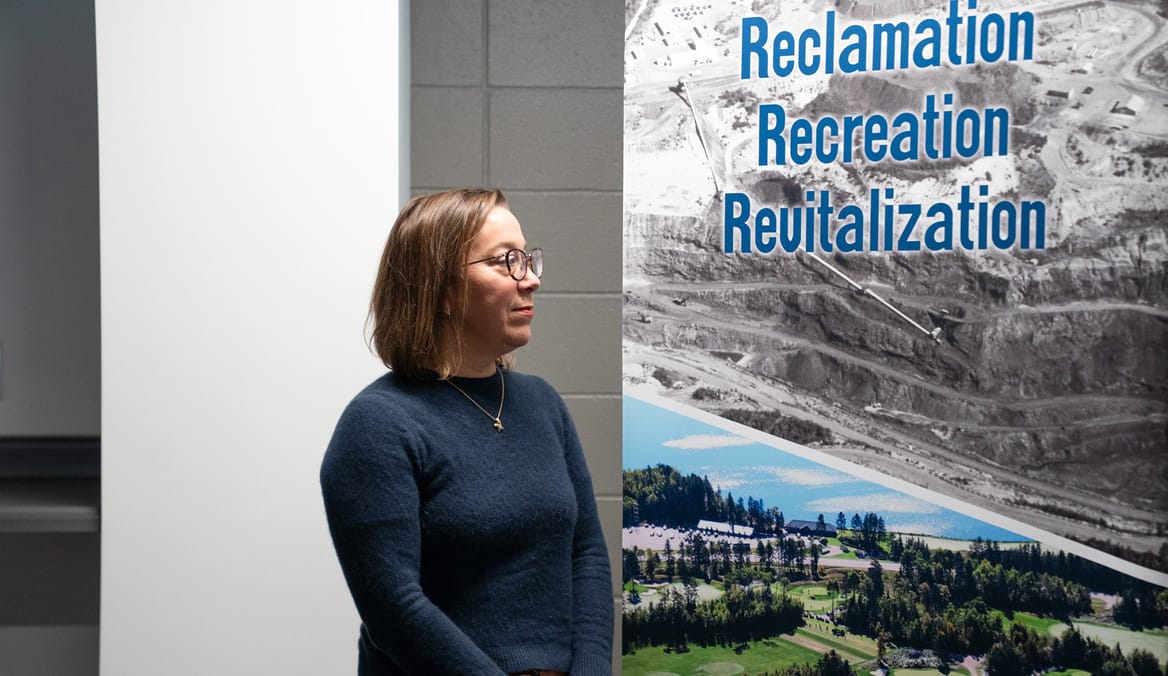
Gradually, though, high-grade natural ore deposits were depleted. In the 1950s, University of Minnesota scientists raced to develop an economical process for pelletizing taconite, a more plentiful but lower-quality soft ore that requires additional processing before it can be shipped and fed into steel furnaces. They succeeded, staving off an extinction-level event for the region’s mines.
But that very success contributed to the region’s eventual downturn. While benefiting the steel companies themselves, the shift to taconite and a host of other technological advances from the 1960s onward led to a steady reduction in the number of workers needed to run the plants.
As the 20th century wore on, the iron industry began shifting to Australia, Brazil, India, and other countries with cheaper production costs due to some combination of higher-quality reserves, looser environmental regulations, and government subsidies. The rise of recycled steelmaking in the U.S. also reduced demand for domestic ore.
The story of the Iron Range over the last 50 years, then, has been one of economic decline.
Nowadays, the Iron Range is dotted with rusting factories. Some once-bustling downtowns have more empty storefronts than occupied ones. Hibbing, the commercial center of the western Iron Range, has lost around a quarter of its population since 1980.
The Range currently has just five active iron mines. As of last August, when there were six, the combined annual production capacity of all U.S. iron mines was 48.9 million tons, according to Global Energy Monitor. That’s paltry in comparison with China’s 470 million tons, India’s 500.8 million tons, and Brazil’s 591.8 million tons. It’s a rounding error next to Australia’s 1.2 billion tons.
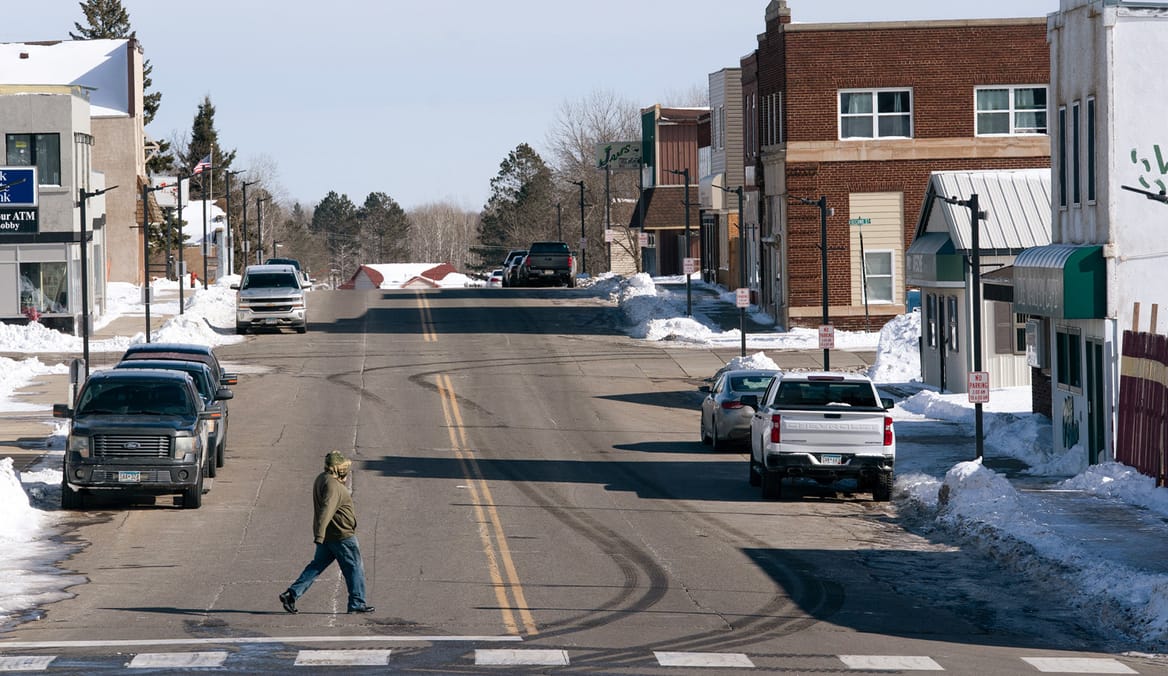
Cleveland-Cliffs, a big producer of automotive steel, has furloughed more than 600 workers at its Minorca and Hibbing Taconite mines in the last year and a half — over 10% of the industry’s local workforce. Minorca is completely shut down, while HibTac has idled two of its three pellet-production lines as its crude ore supply dwindles.
Brown and other locals say it’s an open question whether Cliffs, as most around here call it, will ever reopen Minorca. A Cliffs spokesperson did not respond to voicemails seeking an interview or comment.
John Arbogast, a blunt-talking, Range-based United Steelworkers union representative, said his industry — like so many others — is at the mercy of forces even the bosses can’t control. Slow auto sales are one reason why Cliffs and other producers are sitting on “a glut of pellets,” he said.
“The price of cars went up during Covid and hasn’t come down,” Arbogast said. “Really, you’re gonna pay $90,000 for a new pickup? It’s all part of the whole mess going on in this country, and we’re affected by it.”
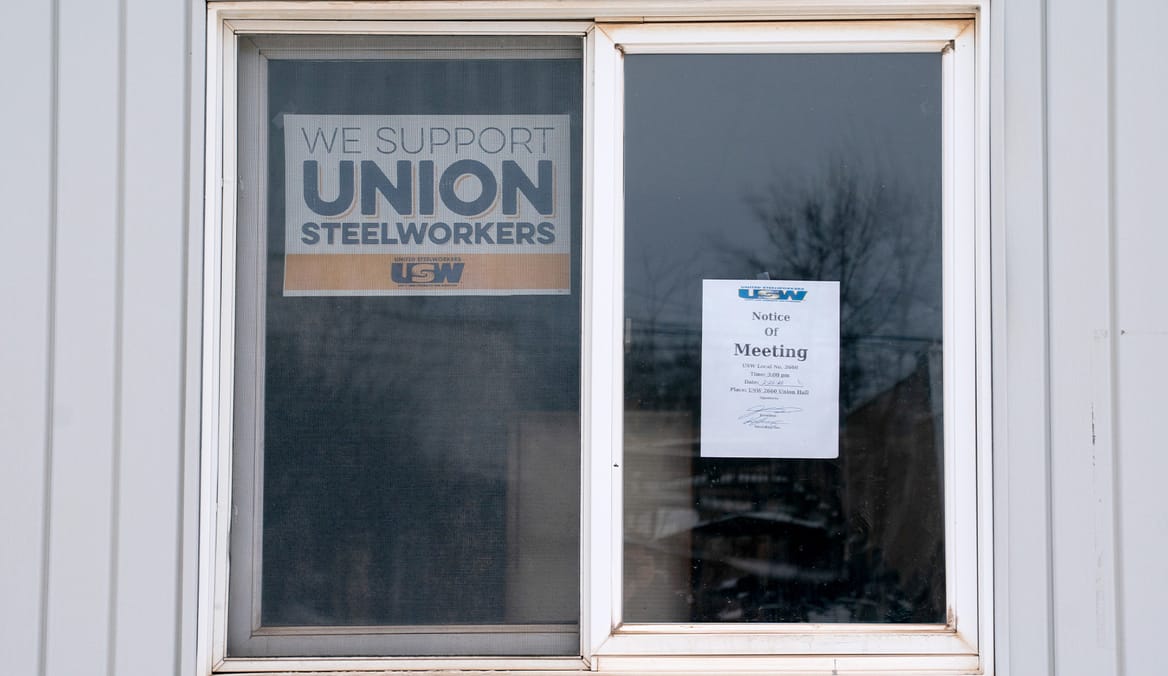
Despite its problems, the taconite industry is still the largest employer offering unionized, family-sustaining jobs on the Iron Range. For furloughed Minorca and HibTac workers, most of whom rolled off the unemployment dole this spring, Arbogast said it’s basically the only option.
“When a company closes in the [Twin Cities] metro, there’s other places you can look for a job. Here, it’s basically mining, tourism, and a little bit of lumber,” he said.
Political and business leaders have long talked up the need to diversify northeastern Minnesota’s economy away from extractive industries like taconite and forestry. But that’s easier said than done. While tourism has room to grow, seasonal employers can’t match the six-figure salaries (with benefits) nor the millions in taxes the steel companies pay every year. It’s unclear whether a controversial Google data center proposed near Duluth is an outlier or the start of a digital gold rush. Also uncertain is whether the trickle of remote workers who’ve moved north since Covid — drawn by the natural beauty and “slower pace of life,” Rukavina said — will be enough to reverse years of demographic decline.
The upshot is that most everyone who cares about the future of the Iron Range eagerly awaits Mesabi Metallics’ opening. That’s certainly true of Rep. Spencer Igo, a Republican who represents the western Iron Range in the Minnesota House of Representatives.
“I remember hearing as a kid that we were going to be mining iron and making hot-rolled steel 10 minutes from the family cabin,” Igo said in a February interview at his St. Paul office. He turned 30 in March.
Mesabi Metallics will need over 350 permanent employees, and locals expect it to snap up furloughed Minorca and HibTac workers. Arbogast said it’s poaching first-rate managers working elsewhere on the Range.
“They’re paying a heck of a lot more, throwing a lot of money around,” he said.
The mine will deploy cutting-edge technologies to turn taconite into iron while using less energy.
“We’ve learned a lot about mining over the last 50 years, and we’ve applied it here,” Larry Sutherland, Mesabi Metallics’ president and COO, told me during my February visit.
On my tour of the mine, Sutherland — who’s celebrating his 51st year in the iron business — showed off North America’s first electrified-hydraulic-shovel, diesel-electric haul trucks, whose 400-ton carrying capacity nearly doubles the industry standard, and a bevy of stationary processing equipment that in days past would have run on diesel. After digging begins in earnest, Mesabi Metallics may add overhead trolley lines that zip the haul trucks up the steep pit roads in all-electric mode, significantly reducing diesel consumption.
But Mesabi Metallics won’t single-handedly solve the region’s employment problems.
Three hundred fifty union jobs is nothing to sneeze at, but Iron Range mining will remain more than 300 good positions short unless and until Cliffs calls workers back to Minorca and HibTac. And that may not happen without a pickup in U.S. automotive sales or building construction.
Longer term, state and local officials hope to expand northeastern Minnesota’s mining industry beyond iron. The region has rich deposits of copper, nickel, cobalt, and possibly helium, a scarce and valuable industrial gas. Each of these resources is a critical input for batteries, electric motors, and other drivers of the clean energy transition.
All this is taking place against the backdrop of a transition within the domestic steel industry itself to lower-carbon production, albeit one that’s happening slowly and with less help from President Donald Trump than from former President Joe Biden.
Most of the steel produced since the Industrial Revolution has come out of blast furnaces — which use coal as fuel and also as a type of additive to remove oxygen and other impurities from iron ore — and basic oxygen furnaces. This two-furnace combination is responsible for nearly half the 2.2 tons of carbon dioxide emitted per ton of finished steel produced worldwide, according to the Institute for Energy Economics and Financial Analysis.
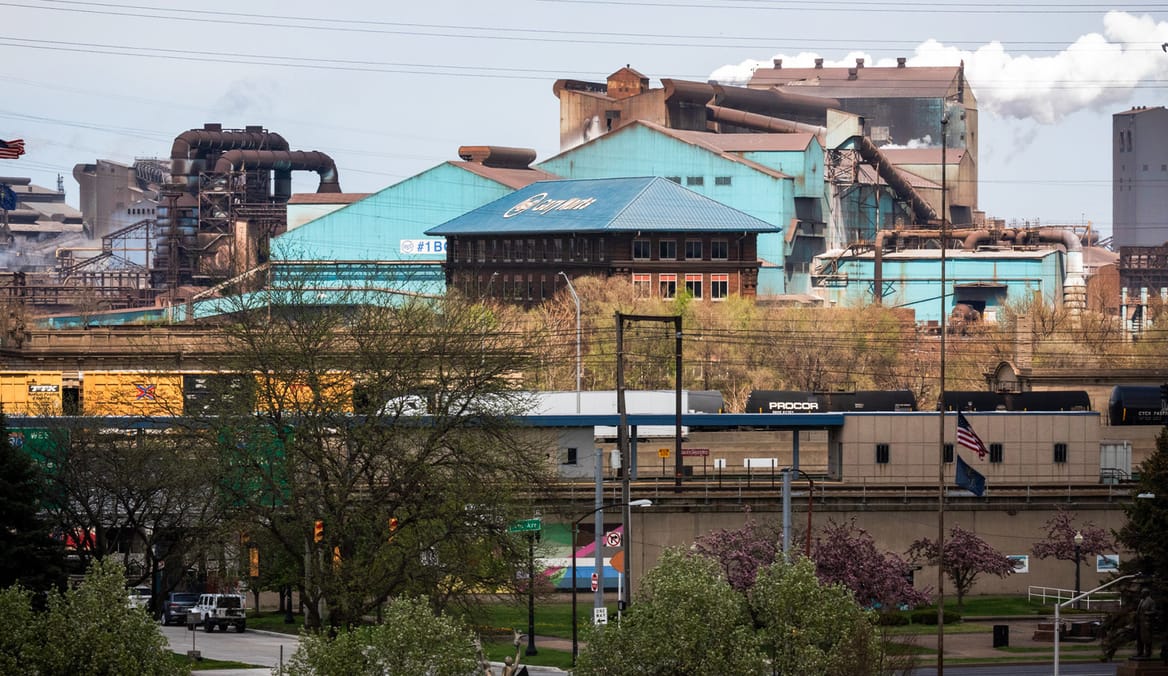
U.S. Steel and Cleveland-Cliffs still make what’s called primary steel this way at massive integrated mills across the lower Great Lakes and Ohio Valley, but about 70% of the steel produced in the U.S. these days is recycled: Scraps of the metal are combined with purified iron and then melted down in an electric arc furnace, or EAF. Supplemental materials like lime and coal are added to create fresh steel.
Since they run on electricity, EAFs create far fewer emissions than traditional furnaces. The catch is that they’re not as good as basic oxygen furnaces at removing impurities in iron. This means their steel — at least right now — is not suitable for manufacturing products that require high-quality stuff, such as automobiles.
So, EAFs are little used in primary steelmaking. To change that — and make real progress on decarbonizing the U.S. steel industry — steelmakers will need to replace blast furnaces with technologies capable of producing higher-grade iron to feed EAFs.
The front-runner for this is direct reduction, a generic term for processes that react iron ore with a “reducing” gas like methane or hydrogen at comparatively low temperatures; the resulting iron is known as direct reduced iron, or DRI. To work effectively, DRI furnaces need that DR-grade feedstock, like the pellets Mesabi Metallics will produce, which will be about 68% pure iron.
The Institute for Energy Economics and Financial Analysis says pairing direct reduction fueled by natural gas with EAFs emits 1.4 tons of CO2 on average per ton of finished steel, nearly 40% less than the conventional blast furnace and basic oxygen combo.
When the reducing gas is hydrogen made from natural gas with carbon capture or renewable electricity, reduction itself emits little or no carbon.
The United States has a few direct-reduction facilities already. Cliffs operates one in Toledo, Ohio. North Carolina–based Nucor and Luxembourg-based ArcelorMittal each have their own on the Gulf Coast.
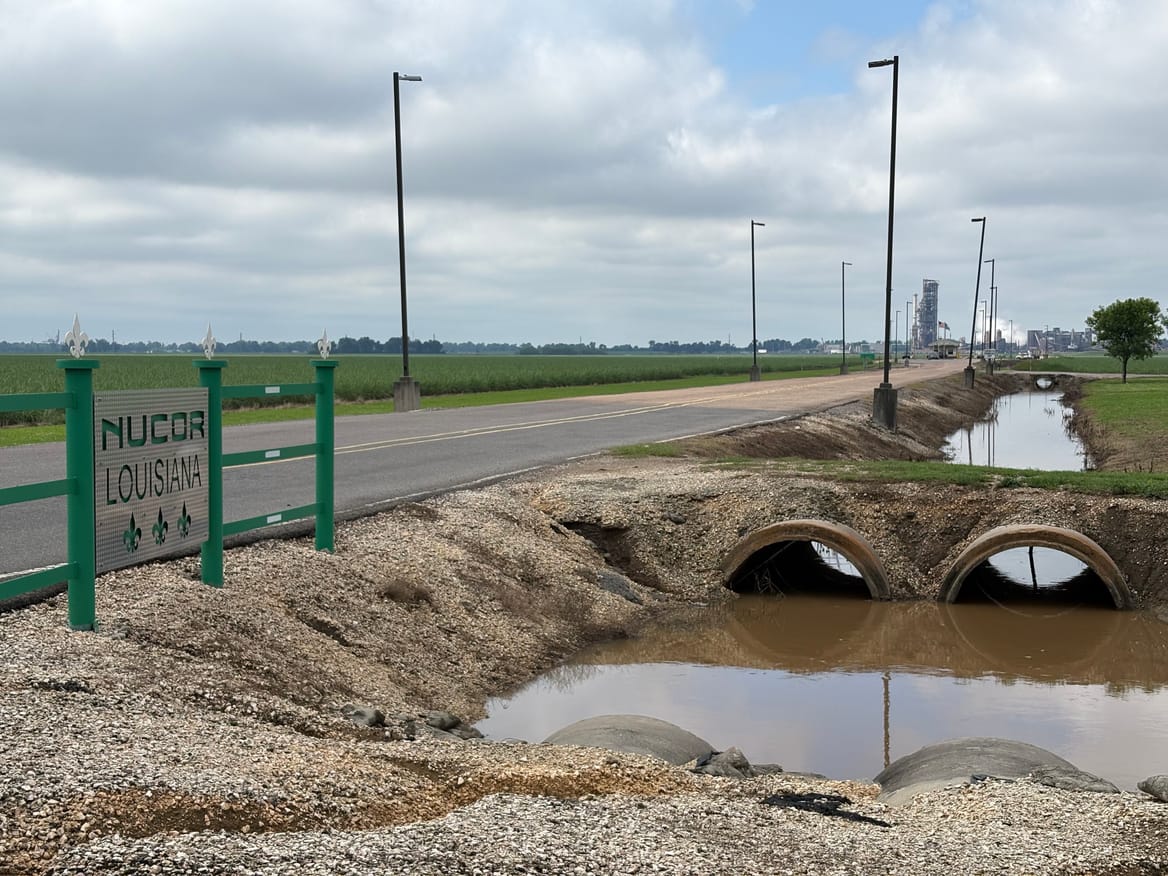
More DRI plants are on the way. The massive steel mill that Hyundai is building in Louisiana will have a DRI component when it powers up in 2029. In April, U.S. Steel announced plans to build a DRI plant at an existing steel mill in Arkansas.
However, while these facilities matter to their host communities and the steel industry’s broader effort to clean up its operations, Cliffs’ Toledo facility is the only one using Iron Range pellets today. Most others source, or plan to source, high-grade iron from abroad.
The Hyundai facility will import 3.6 million tons of iron ore each year, Louisiana’s economic development authority says. It’ll follow the example set by other Gulfside DRI plants, said Elizabeth Boatman, the Minnesota-based lead on decarbonization for 5 Lakes Energy, a think tank specializing in clean energy policy in the Great Lakes region.
“That is not American ore,” Boatman said. Southern mills’ import dependence was apparently a factor in Trump’s decision to exempt Brazilian ore and pig iron from 50% import duties last summer.
For now, most American ore supports aging blast furnaces in the southern Great Lakes and Ohio River Valley. Both U.S. Steel and Cliffs have said they will spend hundreds of millions of dollars to squeeze about 20 more years of life out from their coal-fed facilities. In a move widely seen as a concession to the coal-friendly Trump administration, Cliffs’ decision came at the expense of a previously announced plan to replace its blast furnace in Middletown, Ohio, with a hydrogen-ready DRI plant.
Arbogast said his union members welcome the big steelmakers’ commitments to keep aging blast furnaces now fed by Minnesota taconite in good working order. They also know those facilities are living on borrowed time.
“The blast furnaces are getting older, and they’re never going to build a new one,” he said. “Electric arc furnaces are the inevitable method of making steel.”
Such a future would be good news for Mesabi Metallics, U.S. Steel’s Keetac, Cliffs’ Northshore Mining, and other DR-grade pellet plants planned for the Iron Range. As the outlines of a longer-term shift to integrated, low-carbon steelmaking come into focus, the region as a whole stands to benefit.
Once operational, U.S. Steel’s Arkansas DRI furnace will join Cliffs’ Toledo facility as a major customer for Iron Range pellets. Company spokesperson Andrew Fulton said in an email that planning is “in the very early stages” but confirmed the plant will use ore from Keetac, just up the road from Mesabi Metallics.
Along with the legacy steelmakers, at least two other companies are looking to turn Iron Range ore into DRI elsewhere in the United States.
One of them is Scranton Holding Co., a nascent mining and ironmaking startup run by Jim Bougalis, an Iron Range entrepreneur.
Scranton Holding has two subsidiaries: Calumet Reclamation and North American Iron. Neither responded to my interview requests, but the companies have detailed websites, and Bougalis has spoken openly about his vision with economic development officials and other media outlets.
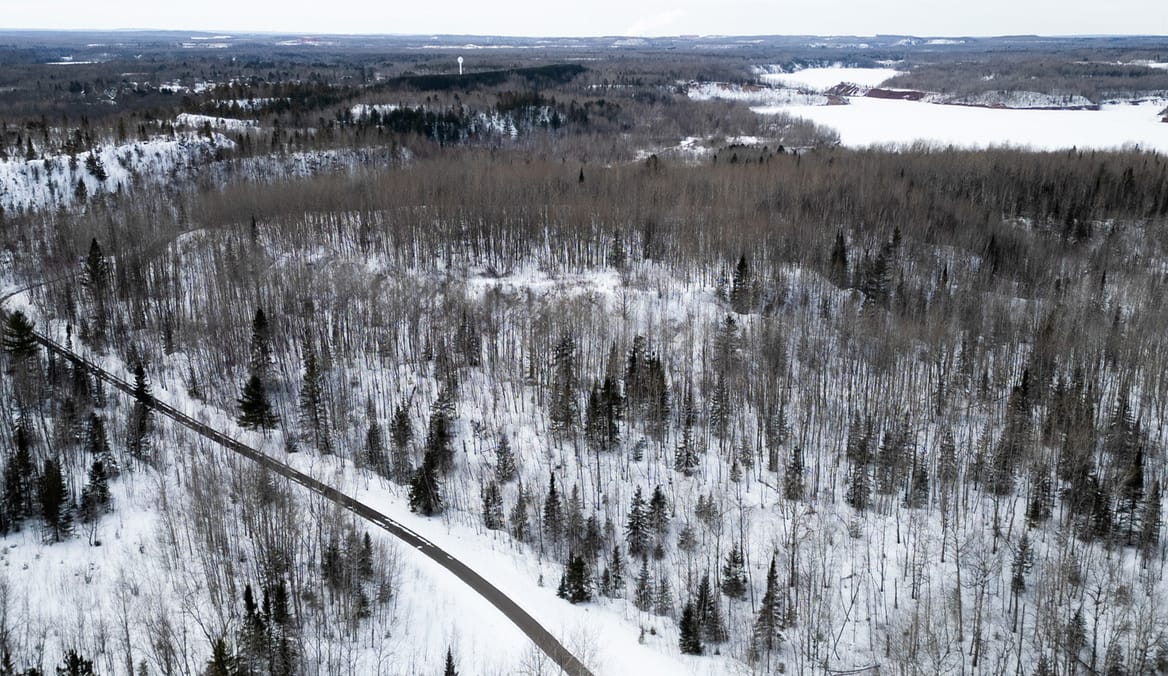
Calumet says it wants to recover millions of tons of ore from 20th-century stockpiles near Nashwauk and ship the material 500 miles west to a $2 billion DRI plant North American Iron is developing near Minot, North Dakota. Calumet says its Iron Range site, a former state park, has at least 15 years’ worth of ore supply.
According to a grant application submitted to the North Dakota Industrial Commission in 2023, North American Iron would use a hydrogen-based iron purification process developed by Tenova, a multinational metallurgy company that touts its “sustainable, innovative and reliable solutions.” In an October interview with Minot-area media outlet The Dakotan, Bougalis likened the process to a “microwave” that reacts hydrogen and iron without combustion.
Mark Lyman, economic development specialist with the Minot Area Chamber Economic Development Corporation, said in the same interview that North American Iron would use “stranded” methane from the nearby Bakken shale formation. A new 80-mile pipeline would collect the gas and transport it eastward to Minot. The reactions in North American Iron’s “microwave” would produce carbon dioxide that can be captured and sequestered in bedrock ideal for long-term carbon storage — or used to pull more oil out of the Bakken.
Another Iron Range entrepreneur, Larry Lehtinen, has a similar vision for a separate stockpile complex about 20 minutes west of Calumet’s proposed operation.
Lehtinen’s company, MagIron, is a leaner successor to his previous venture Magnetation, which employed hundreds of workers across several facilities in Minnesota and Indiana before going belly up in 2015 amid a global commodities downturn.
Magnetation’s Indiana facility used Minnesota ore to produce lower-purity iron pellets that fed traditional blast furnaces operated by AK Steel, a formerly independent steelmaker now owned by Cliffs. MagIron’s approach reflects where the industry is headed: It plans to restart an ore concentrator on the Iron Range and modify the Indiana plant to make DR-grade pellets for EAFs. MagIron says it could eventually add a DRI plant in Indiana, too. Testing late last year provided “critical validation” of MagIron’s reserves and pelletizing process, Lehtinen said at the time. The company says its current mineral leases offer 40 years of ore supply.
Lehtinen did not respond to requests for comment or an interview. Brown, the Iron Range historian, said the industry’s boom-and-bust nature makes at least some of the people behind new ore mining and processing proposals reluctant to speak about them in the press. With iron and steel prices trending downward, even the big steelmakers are nervous, he added.
On the other hand, Brown noted, there’s industry consensus that “the market for DR pellets has nowhere to go but up.” In a feasibility study published earlier this year, MagIron said the DR-grade pellet market could grow 13% annually through 2034. Mesabi Metallics, meanwhile, is in line for up to $10 billion in financing from the U.S. Export-Import Bank to support international sales.
Other, newer technologies for producing DR-grade iron could emerge on the Iron Range as well.
DRI is already economical today. But Rolf Weberg, executive director of the University of Minnesota’s Natural Resources Research Institute, told me that there’s much room for improvement.
“The way they do it now, they put a basket of pellets in the top [of the furnace] and hope they come out the bottom,” he said.
NRRI is a state-chartered research institution with three hubs in northern Minnesota. I visited its Iron Range outpost in the former mining town of Coleraine, some 20 miles down the road from Mesabi Metallics.
There, NRRI is commissioning a first-of-its-kind DRI simulator that can mimic the conditions found in full-size industrial furnaces. Weberg said the machine’s digital modeling capabilities would mark a dramatic leap forward in low-carbon ironmaking research.
It’s just one of around 200 projects underway at NRRI. The institute has dozens of scientists and technicians working to “de-risk” new and/or improved materials, processes, and equipment for commercial clients, including steelmakers.
Weberg and Jamie Alexander, NRRI’s director of external affairs, display infectious enthusiasm for innovations such as a ceramic ore grinder that Weberg said would boost processing efficiency at taconite plants. While Alexander noted that they couldn’t “speak to what clients will see in the field,” an efficiency improvement of any percent “is huge in a production setting as it is the largest operating cost.”
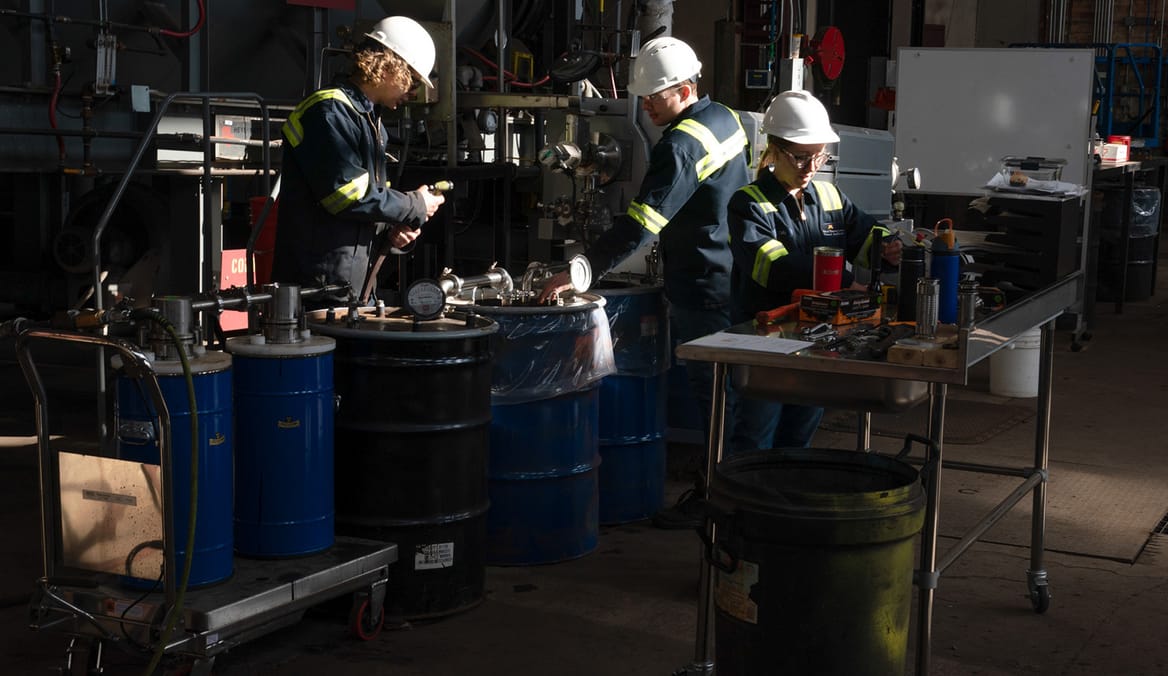
NRRI supports the forestry and agriculture sectors, too, and its domains sometimes overlap. In a century-old maintenance shed for railcars in Coleraine, NRRI staff are working to scale production of a dense form of biochar that could one day sub for supplemental coal in EAFs — making DRI-based steel production even cleaner. Weberg said an NRRI-developed poplar hybrid that can grow 10 feet a year could serve as a regenerative, lower-carbon raw material for the biochar.
All this progress leaves the higher-ups at Mesabi Metallics feeling that the wind is at their backs.
“At this location, we have the opportunity to truly do something unique: to vertically integrate modern steelmaking processes, which will allow us to be the cleanest steel producer in the world [and] one of the lowest-cost producers of steel in the world,” Broking said.
Such a play would align Mesabi Metallics with U.S. Steel, Cleveland-Cliffs, and other global steelmakers like ArcelorMittal. These companies operate sprawling mills that refine iron and a host of finished steel products all in one place.
Historically, steelmakers have sited those mills closer to where they or their suppliers dug coal out of the ground. But as blast furnaces go the way of the steam locomotive, 5 Lakes Energy’s Boatman said it makes more sense to produce purified iron — and maybe even finished steel — closer to the iron mines. The calculus is especially important for the Iron Range operations planning to mine waste piles or tailings, which tend to have lower iron content and require additional work to concentrate, she added.
“One of the push points to moving [purified] iron production here is that around one-third of the pellet is not iron,” Boatman said. “Why would you want to pay for fuel and time to ship non-iron when you could just ship the iron itself?”
It would be a return to form for northeastern Minnesota. U.S. Steel ran a blast furnace at its 1,500-acre Duluth Works from the late 1910s to the early 1970s and continued finished steelmaking there until the late 1980s. Employment peaked around 3,500 and annual output north of 900,000 tons, according to a Mesabi Tribune retrospective published in 2020.
Virtually nothing remains today. The site, a 1,500-acre brownfield just inland from a deepwater port that handles millions of tons of Iron Range pellets every year, would be a natural choice for a DRI-based steelmaking facility. In theory, it could host renewable energy facilities to enable large-scale hydrogen production, which would require hundreds of megawatts of clean power to supply a fully decarbonized shaft furnace.
Boatman said the idea of a DRI plant in Duluth has been studied, but any firm plans remain years off. As for what Rep. Igo enthusiastically calls the “dream” of integrated, DRI-based steelmaking on the Iron Range itself, the $800 million investment U.S. Steel recently said it would make in its existing Minnesota operations is too little to cover the multibillion-dollar cost of an integrated steel plant. And Mesabi Metallics would need to complete additional permitting to get permission to move forward at its own site, Boatman said. Meanwhile, local media outlet Iron Range Today reported on Feb. 24 that Mesabi Metallics is eyeing a potential DRI facility in Kentucky, citing job postings, public filings, and legislative lobbying activity. As of mid-July, the job-posting website ZipRecruiter showed about 20 active listings from Mesabi Metallics there, some mentioning “our DRI and Integrated Steel Plant.”
Broking reiterated Mesabi Metallics’ position that it would begin using hydrogen in its pelletization plant first — as soon as economically feasible. It won’t happen tomorrow, though.
“We should be studying these things,” he said. “But in terms of when that could happen or how it could happen … [We’ll] wait and see.”
State economic development officials and the steel industry itself had high hopes for green hydrogen, the kind produced with 100% renewable power, said Pete Wyckoff, who was deputy commissioner of energy resources for the Minnesota Department of Commerce when I interviewed him earlier this year. In May, he joined the clean energy nonprofit Evergreen Action as vice president of policy.
Since then, persistently high costs for hydrogen electrolyzers, rising power prices, the Trump administration’s suspension or cancellation of billions in hydrogen hub funding, and Washington Republicans’ partial repeal of federal tax credits for the fuel have worsened already-challenging green hydrogen economics. It doesn’t help when deep-pocketed data center companies compete for the same grid interconnections as price-sensitive hydrogen developers, Wyckoff said.
“Everyone is looking at it now with slightly cut-back expectations. … I’m skeptical about the turn to hydrogen happening right away,” Wyckoff said.
Unless. Wyckoff and several others interviewed for this story expressed varying degrees of optimism about the possibility of geologic hydrogen extraction in northern Minnesota. If present and recoverable in sufficient quantities at or near DRI plants, naturally occurring or stimulated hydrogen reserves would solve the vexing problems of transportation and storage. The economics of hydrogen production would almost certainly improve, and with them the economics of ultralow-carbon steel.
At least three companies have asked the state for exploratory drilling permits, including the buzzy Colorado startup Koloma.
“It might not look exactly as we imagine it, but there’s a ‘there’ there,” Wyckoff said.
Igo agrees. He’s the lead author on a bill that would give NRRI $650,000 to investigate Minnesota’s geologic hydrogen potential over the next two years. Minnesota lawmakers are separately working on gas drilling regulations that would govern hydrogen and helium extraction — a novel concept in a state with no significant oil or natural gas reserves.
“If we find this stuff near a taconite mine — wow,” Igo said, “Minnesota will be the epicenter of the iron industry.”
An update was made on July 27, 2026, to include that Mesabi Metallics plans to begin pellet production in September.
The state was No. 3 in solar installations last year — but with more solar has come more local opposition. Experts say genuine community engagement is needed.
When the largest solar farm in Indiana came online in early 2025, nearby residents in rural Jasper County were not exactly excited.
“It will mess up their fields,” said long-time resident Gena Carlson, referring to solar panels on farmers’ land. Carlson’s concerns, which were echoed by other locals, highlight the growing on-the-ground opposition to Indiana’s remarkable boom in solar construction.
Last year, Indiana ranked third among states for the most new solar projects brought online. Only Texas and California — the nation’s clean energy leaders — built more. It’s a new position for Indiana, which ranked 15th for solar additions in 2023 and 10th in 2024. The Solar Energy Industries Association expects Indiana to maintain its momentum, projecting it will have the fourth-highest solar growth over the next five years.
“That’s a pretty notable fact since we don’t have the incentives and policy support for solar that a lot of other solar leaders do,” said Ben Inskeep, program director at the Citizens Action Coalition, the state’s primary consumer watchdog group.
The growth is due in part to the state’s data center boom, with solar developers taking advantage of Indiana’s level land, robust transmission networks, and relatively sunny weather to build clean power that meets tech companies’ sustainability goals. The utility NIPSCO, owner of the Jasper County solar farm, adopted ambitious clean energy goals in 2018 and brought more than a gigawatt of solar online in Indiana last year.
But as solar capacity has increased, so too has local opposition — and clean energy advocates say developers and officials must find common ground with communities in order to keep the solar buildout going.
Like Carlson and her neighbors in Jasper County, residents across the state are protesting that solar will eat up farmland, affect property values, or change the bucolic character of counties in America’s heartland. These claims are not unique to the Hoosier State — similar pushback is spreading around the country as solar grows, even if the tech uses only a sliver of farmland nationwide.
A recent study by researchers at Loyola University Chicago found that local opposition has been a prime reason why county officials in Indiana have denied approvals for solar projects, regardless of the economic benefits and other positives involved.
“There was not nearly as much opposition three to four years ago,” said Brian Flory, associate director of the Indiana program for the national advocacy organization Solar United Neighbors. “The opposition was less intense, we had less misinformation, and there were fewer examples of opposition pushing back against projects and deployable ordinances.”
Thomas Brelage remembers visiting his grandparents near the Clifty Creek coal plant in Jefferson County, Indiana, while he was growing up and seeing “the backdrop of the coal spires right there in town.”
At first he thought little of it, but later he became interested in the clean energy transition, securing an internship with a Chicago-based solar developer and earning his master’s degree at Loyola’s School of Environmental Sustainability.
When he visited his grandparents in 2024, he saw signs saying “Yes Solar” and “No Solar” in nearby fields.
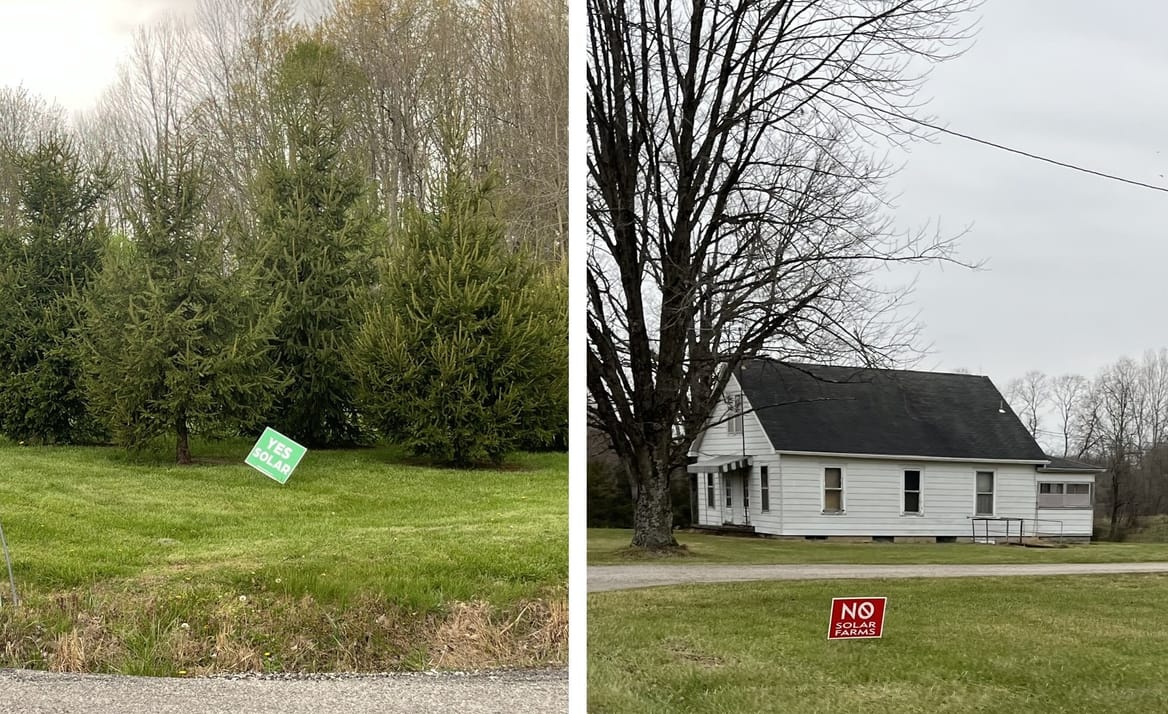
The brewing controversy over solar intrigued him, so he focused on the topic for his master’s thesis, which then became a study, published in May. It involved a survey of 22 local officials, many from counties that had been home to coal plants or mines.
“For a lot of these communities, the coal plant was one of the highest-paying jobs historically, one that anyone could take part in,” said Brelage. “As that industry started shutting down, it left a big hole.”
Some of the officials told Brelage they do not see solar as capable of filling the economic and employment gaps left by the closure of coal facilities. Others mentioned that colleagues lost reelection bids in part because of their support for solar.
Convincing residents that solar provides real financial benefits for communities is key to growing its acceptance, Brelage concluded.
A solar farm itself is never going to create the same type or volume of jobs as a coal plant. But the sector can contribute to the tax base — and it can create jobs in other ways.
The main mechanism is by luring in other businesses that want cheap, clean power, noted Michael J. Hicks, professor of economics and director of the Center for Business and Economic Research at Ball State University. He is lead author of a policy brief on the impact of renewable restrictions in Indiana, released in April by Ball State and Purdue University, and funded by the U.S. Department of Energy.
Such businesses could include factories that need a lot of electricity. Or they could include data centers, which don’t usually create a large number of jobs but can also pump up a county’s tax base.
“If I’m going to open a factory, I’m going to be very cautious about where I open it,” said Hicks, who was previously on the faculty at the Air Force Institute of Technology. “I want to open it in a place where I can hook up to the grid close to a wind or solar plant.” He pointed out that data center developers and their customers often have ambitious net-zero goals, which may drive them to locate facilities where clean energy is abundant.
But increasingly, concerns about farmland and rural character — rather than jobs or tax revenue — are animating local opposition.
Last summer, for example, officials in Vanderburgh County voted 4-3 against a zoning change needed for the 600-acre Bluegrass Creek solar farm proposed by Orion Renewables. The company had pursued the project for at least five years, held multiple community meetings last year, and donated to local programs.
In the end, it still faced strong local opposition that led to its defeat.
“Why does this project need to go here, on farm ground?” asked a resident during a community meeting held by the company. Others raised concerns about property values, water runoff, eventual decommissioning of the solar farm, and the possibility of tornadoes destroying panels and creating debris.
While solar farms may change rural landscapes, advocates and industry groups point out that solar occupies a tiny portion of the state’s agricultural land. In Indiana, farms take up two-thirds of all land — and solar only a 10th of a percent. Golf courses occupy nearly three times as much space in the state.
The fact that local attitudes and regulations vary widely between Indiana counties makes it that much harder for developers to plan.
“I often call it a 92-county game of Whac-a-Mole when it comes to solar siting,” said Flory. “We’re a local-rule state — that means by and large you have 92 distinct and discrete frameworks when it comes to how these types of projects are processed.”
In some cases, county ordinances make it too difficult for solar developers to site projects, Flory noted. Other times, officials vote to deny needed zoning changes or other siting approvals even when proposals comply with local regulations.
Last year, Indiana legislators considered a Republican-backed bill that would have given the state more power over siting decisions, but it died amid opposition from local officials and critics of renewables.
“The challenge is balancing statewide and regional energy goals with local autonomy,” said Gilbert Michaud, assistant professor of environmental policy at Loyola and Brelage’s advisor and coauthor on his study. Michaud has studied opinions toward solar across the Midwest and in Europe.
“Especially in the American context, you’re giving that autonomy down to the smaller layer of government, but they have limited staff capacity and are under political pressure,” he said. “If you do it through the state agency, you might lose that local voice, even if state staff are better equipped.”
A 2022 state law created voluntary siting standards for solar that counties can incorporate into ordinances to become “solar-ready” and streamline the process for considering new projects.
Many counties have some of those standards on their books, which include rules about things like glare minimization and repairing drainage affected by solar panel installation, but few counties have adopted a comprehensive set of standards, advocates say.
Overall, though, United Solar Neighbors found that more Indiana counties discourage solar development than encourage it. The group conducted an analysis and found that 11 counties have outright moratoriums on solar (though a few were scheduled to expire this year), 20 have ordinances that are restrictive, and only 24 are considered favorable to solar.
Those restrictions have taken their toll. Indiana counties with restrictions on utility-scale solar forfeited more than 8,500 potential jobs and $83 million in manufacturing investment between 2001 and 2021, according to Hicks’ brief.
Brelage said county officials told him that the way solar developers interacted with residents and local leaders had a big influence on attitudes toward solar. He noted one official applauding a developer “going above and beyond, showing up at county fairs, county hearings, trying their best to be involved, to not just be this developer you hear from once in a while.”
If developers want permission to build solar, they “need to be intentional with what they’re doing, not just throwing money around,” he concluded. “It’s important to be focused on the educational aspect, so that when it is time for your county hearing, it isn’t the first time you’ve stepped foot in the county.”
Unlike in 2025, almost no states have passed laws that make it harder to permit and site renewables this year, a report finds. What’s driving the shift?
Solar, wind, and batteries are the cheapest, fastest ways to add much-needed electricity to America’s grid. And across the country, more state legislatures are passing laws to streamline renewable development than are enacting policies to prevent clean energy from being built.
That’s the good news from the Siting Solutions Project, a nonprofit that tracks state energy permitting and siting policy. According to its new tally of more than 200 bills put forward in over 40 states in 2026, the results have been “more balanced — and more encouraging — than the surge in restrictive siting bills that defined 2025.”
Both this year and last, a flurry of proposals in Republican-controlled states aimed to make it harder to build clean energy. But while many of those bills passed into law in 2025, similar attempts have largely failed so far in 2026.
In fact, out of the 86 bills that would have hampered solar, wind, and battery siting and permitting this year, just one became law: a relatively scaled-back measure in Utah that limits state tax credits for large-scale solar projects on certain farmland. Only eight states have yet to conclude their legislative sessions for this year, making it unlikely that other restrictive bills will pass in 2026.
Last year, by contrast, 10 restrictive measures passed across Arkansas, Louisiana, Maryland, Montana, Oklahoma, and Texas.
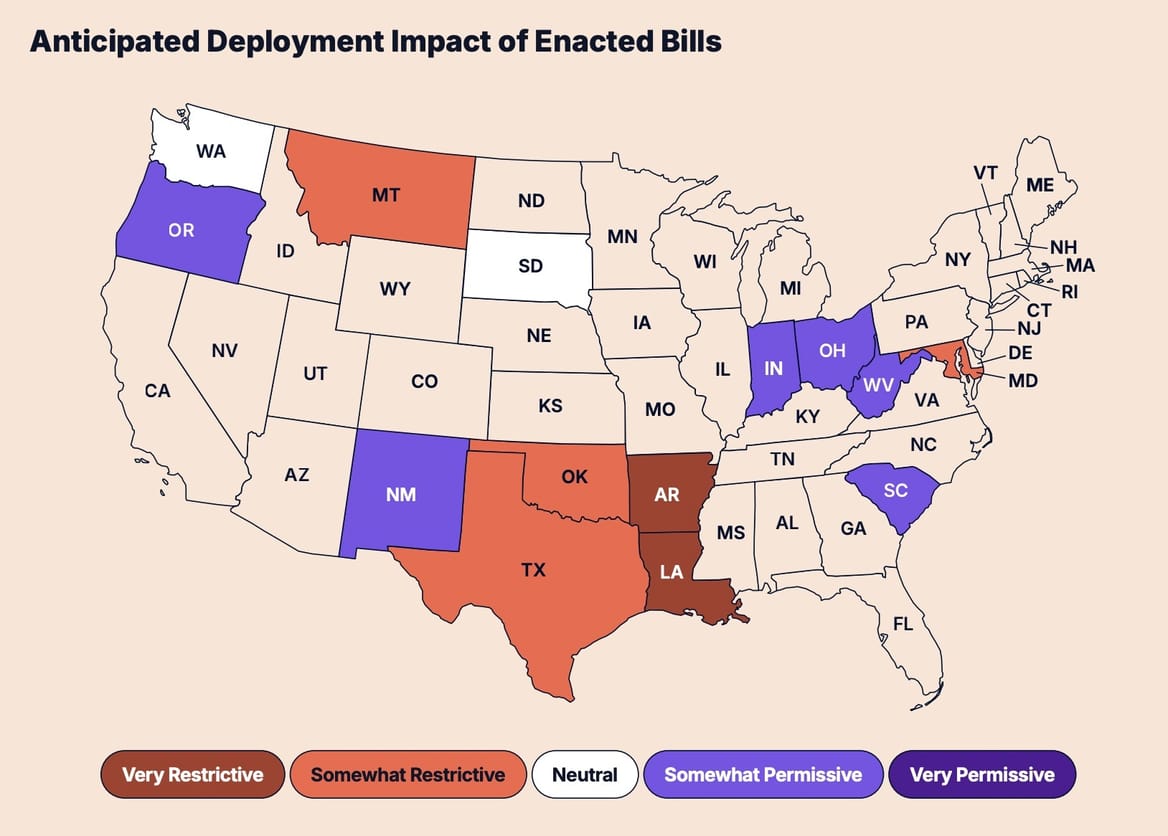
Most of the restrictive bills proposed in 2026 didn’t even make it out of initial hearings, said Nelson Falkenburg, siting policy manager at the Siting Solutions Project and a co-author of the report. Several bills that would have singled out solar, wind, and battery projects for sizable property setbacks and zoning constraints were defeated in floor votes. And one bill that did pass in Oklahoma, which would have rescinded property-tax benefits for solar and battery projects, was pocket-vetoed by Republican Gov. Kevin Stitt.
Today’s energy economics are driving the shift away from measures that stymie renewables, Falkenburg said.
“Energy demand is skyrocketing, driven in large part by AI and the buildout of data centers in a lot of these states,” he said. “At the same time, we’re in an affordability crisis,” with electricity costs rising rapidly in many parts of the country.
While the causes of these energy price spikes differ from region to region, experts agree that adding new, cheap generation to the grid is an effective way to help bring rates down. Solar, wind, and batteries cost less than new gas plants, and can get online years sooner, as the gas industry faces a turbine supply crunch.
“Legislators are responding to constituents, whose electricity prices are through the roof, and trying to provide relief,” Falkenburg said.
The need for electricity has led to what Falkenburg described as “a concerted effort from environmental groups, industry, and business groups, and in some cases folks from agriculture and labor communities, to defend against these restrictive bills and make sure they didn’t pass,” he said.
He pointed to a bill in Alabama that would have put a one-year moratorium on solar projects. The measure faltered in the face of pushback from not just solar developers but also the state’s steel industry, chambers of commerce, and lawmakers representing poorer districts seeking economic development.
Similar broad-based coalitions helped defeat clean-energy restrictions last year in Texas, the nation’s solar and battery leader.
“One of our assumptions is that legislators may be introducing more of these restrictive and punitive bills as signals to their constituents or to the broader politics of the time,” Falkenburg said, nodding to the role that clean energy opposition has taken as part of broader “culture war” politics. “But even in conservative states, legislators and governors’ offices are looking at how to get as much energy on the grid as possible.”
That imperative has driven an impressive showing for what Siting Solutions describes as “permissive” clean-energy siting and permitting policies this legislative season. These provisions include simplifying state permitting processes and setting criteria for how local governments manage project siting.
Siting Solutions chalked up significant wins in Illinois, Oregon, Virginia, and Washington state, as well as moderate policy gains in Maryland and New Jersey — all states controlled by Democrats.
But it also highlighted some positive policies passed in the Republican-controlled states of Alabama, Mississippi, and Oklahoma. For example, Oklahoma approved what Falkenburg described as a “really reasonable” bill that sets best practices for closing down and cleaning up old solar and battery projects without putting unreasonable burdens on developers.
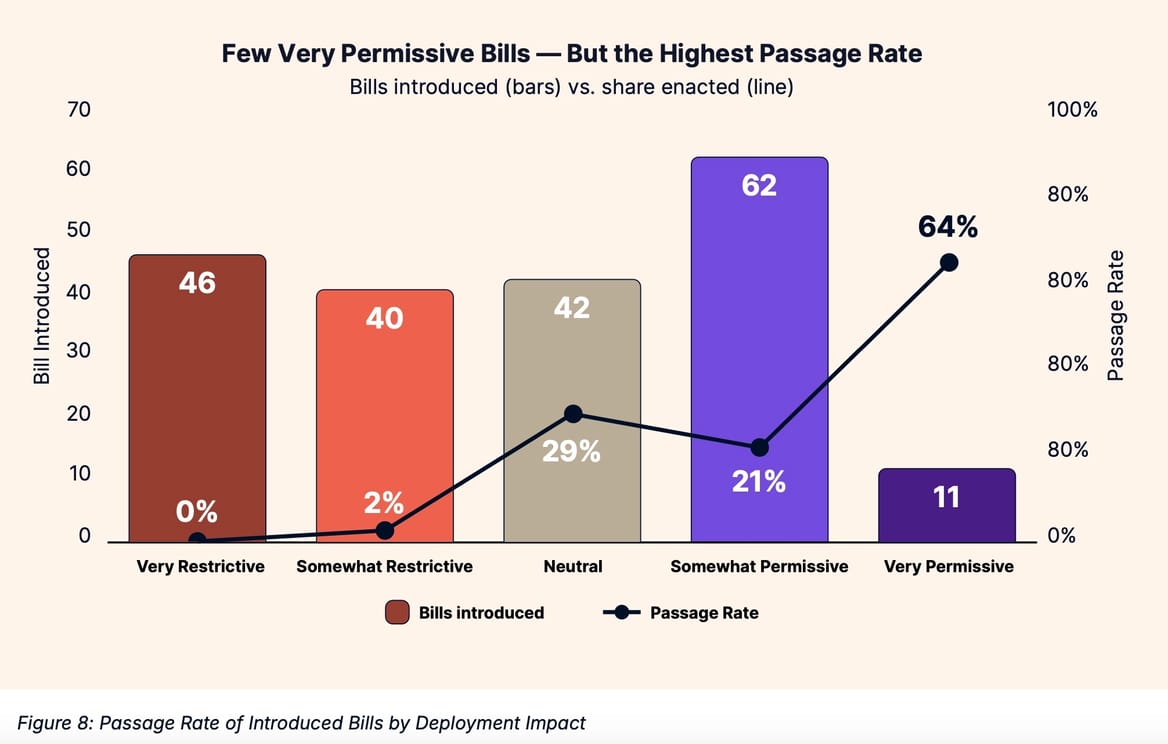
That record of success comes with a caveat, however: The permissive legislation that passed isn’t as heavily tilted in clean energy developers’ favor as the restrictive bills that failed were tilted against it. If anything, the report notes, “Democrats tended to introduce and advance bills that provide minor improvements to the status quo, rather than proposing changes that will substantially move the needle on clean energy deployment.”
One big reason for this is that pro-renewables legislation tends to focus on giving state bodies more control over how local governments manage siting and permitting — and that’s a political challenge. Local opposition has become a primary cause of failure for solar, wind, and battery projects across much of the country. But residents of counties, cities, and townships slated for clean-energy development don’t like having authority taken away from them.
Over the past half decade or so, Democratic-controlled states including Illinois and Michigan have passed laws limiting local governments’ ability to block energy projects on private land. This year, Virginia joined their ranks, passing a law that prevents local governments from instituting community-wide bans on solar projects.
To be clear, Virginia’s law doesn’t bar local governments from denying permits to solar developers. Rather, it prohibits blanket bans on all solar projects, sets statewide guidelines for assessing individual projects, and requires local governments to tell state regulators their reasons for rejecting proposals.
That law was something of a compromise between solar advocates and local officials, said Jim Purekal, a director at Advanced Energy United who heads the trade group’s legislative work in Virginia. “The dealbreaker was taking authority away from localities,” he said. “Once you move off that, I think the bill was structured in a very reasonable fashion. It just said, ‘You don’t have to accept these projects — but this is what a good project looks like, for those who are asking.’”
Illinois took up its own revisions to state versus local control over solar and battery siting in a major energy bill passed in late 2025, which Siting Solutions included in the 2026 roundup because its provisions will go into effect this year. In Pennsylvania, which has a year-round legislative session, a proposal remains in play that would take a state-level standard-setting approach similar to Virginia’s.
The 2026 laws passed in Oregon and Washington aim to streamline slow and cumbersome state permitting processes, Falkenburg said. The intention is to lower costs for clean-energy developers and, in Oregon’s case, allow projects to get done fast enough to earn federal tax credits set to expire under the megabill passed by Republicans in Congress last year.
Clean energy still faces major barriers. Despite the progress tracked by Siting Solutions, lots of jurisdictions still make it very difficult for renewables to get approved. Plus, several states have backslid on clean energy policy in recent months, including New York, which rolled back its emissions-reduction targets, and California, which made major changes to its carbon cap-and-invest program that critics say will threaten the state’s ability to meet its climate goals. Siting Solutions’ report does not account for those measures because it purely focuses on siting and permitting issues.
And then there’s the Trump administration, which has essentially frozen federal permitting for renewables, threatening nearly 100 gigawatts of wind, solar, and battery projects. Those include over 20 gigawatts of projects on public lands, as well as more than 150 wind power projects awaiting a Department of Defense review.
Those barriers highlight the fact that it’s almost always easier to block clean energy projects than it is to craft laws that smooth their way to being built, Falkenburg said.
“Local governments should have some authority over the projects being proposed in their jurisdictions, absolutely,” he said. “At the same time, there’s a need to balance the energy goals of the state, the climate goals of the state if they exist, and the private landowner rights to be able to develop their land as they see fit. … This is a tough nut to crack.”
Utility-scale solar outproduced gas plants on 82% of all days from January through May, with batteries helping to extend solar’s reach into the evening hours.
This year has been full of dramatic rivalries. World Cup matchups, Knicks versus Spurs, One Battle After Another versus Sinners at the Oscars, and now California solar power versus natural gas.
For years, natural gas has dominated electricity production in the climate-conscious Golden State, just as it has nationally. In both cases, this fossil fuel delivered about 40% of annual generation for much of the last decade. But that started to change in California as solar developers and rooftop installers added more and more capacity, and big batteries joined the party, too.
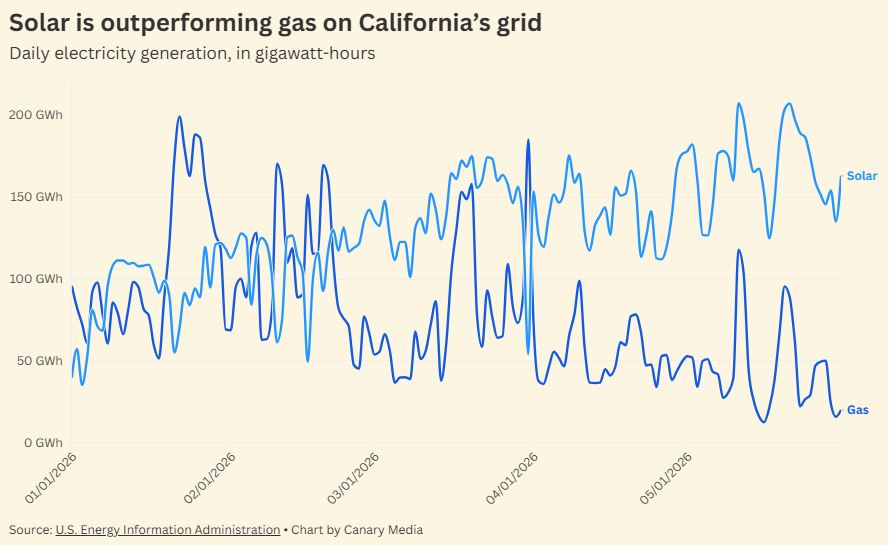
Last year, the competition turned into a Knicks-Spurs–style nail-biter: California generated nearly as much from large-scale solar power as from gas. This year, it’s turning into a Super Bowl LX–style rout, with solar surging ahead of gas generation for the first five months of 2026, per federal data.
In fact, solar outperformed gas on 82% of the days in that five-month stretch in the California Independent System Operator’s wholesale market. That’s all the more striking given that the state still has more installed gas capacity (29 gigawatts) than utility-scale solar capacity (25 gigawatts), and that this larger gas fleet can operate whenever, while solar is constrained to sunny times. Nonetheless, the solar fleet overcame those structural limitations to beat gas overall so far this year.
California’s gas fleet is in free fall: Generation dropped by 60% from the same time period in 2024. Solar generation increased by 21% in that interval.
Solar didn’t beat gas on its own, though. Battery developers have built 16 gigawatts of capacity in CAISO to charge up on solar power and then compete with gas after sundown. This buildup has rapidly altered grid dynamics in the evenings, when batteries regularly become the top source of power for multiple hours. Meanwhile, wind imports recently jumped as the gigantic SunZia project came online, and that takes the fight to gas in the middle of the night, further depressing its output.
There’s one big player missing from the government figures. The U.S. Energy Information Agency does not have a direct line on rooftop solar production, since those units don’t report data the way large power plants do; the EIA makes an estimate based on various data streams but doesn’t include those numbers in its solar-versus-gas comparison.
Empirically, we know that California’s rooftop solar capacity nearly matches its utility-scale capacity, so a complete accounting of solar production would presumably look like more of a blowout. Data firm Ember, for instance, tallied small- and large-scale solar production to show that all California solar nearly beat gas for the full year of 2024, but it hasn’t yet released results for the whole of 2025 on its U.S. Electricity Data Explorer.
What we can say for sure, based on just the EIA data, is that utility-scale solar alone is off to a roaring start. Gas may rally this summer, if heat waves push demand from air conditioners beyond what solar production can feasibly meet. But in recent months, the scoreboard hasn’t even been close, so this is solar’s game to win.
When that happens, it will mean that the world’s fourth-largest economy has swapped out its biggest fossil fuel for solar, making the grid both cleaner and more efficient.
The subscription-based approach aims to make it easier and more affordable to get a backup battery in your home. And it might be catching on.
Haven Energy is the newest company offering home battery service in Massachusetts for a low monthly payment, a model supporters say could accelerate adoption of residential storage.
Starting in four counties in the southeastern part of the state, the company will provide customers with a 15-kilowatt-hour home battery, installed and ready to go, starting at $29 a month, with a 10-year contract. These terms make obtaining a battery significantly more affordable in a market where a home system can easily top $15,000.
“Think of Haven as a low-cost battery backup subscription,” said co-founder and CEO Vinnie Campo.
Haven joins Tesla, which last month launched its own lower-cost monthly payment offering in both Massachusetts and Connecticut, a discounted version of its existing battery-leasing program. The Tesla option saves Massachusetts customers about $30 a month, which could shave nearly a third off the price of a standard monthly lease.
How does the pricing model work? Massachusetts utilities operate a demand-response program called ConnectedSolutions, which pays battery owners to discharge energy to the grid during times of peak demand, like those hot summer days when everyone turns on their air conditioners at once. With lots of batteries working in concert, these actions can reduce the need for the utilities to buy pricey, dirty electricity from peaker power plants. In the long term, the strategy can help delay costly grid upgrades paid for by consumers.
A typical battery could earn $1,375 per year participating in ConnectedSolutions. A new expansion of the program, ConnectedSolutions+, pays even more to battery owners in certain geographical areas where the grid is particularly congested, making the availability of local stored power even more valuable.
Haven and Tesla both retain ownership of the batteries in their programs, and thus earn these and any other available incentives. This revenue stream allows the companies to keep the monthly price low for customers. The model has the added advantage of making it easier for homeowners to get started with battery storage, eliminating the complication of sorting out and applying for incentives, Campo said.
“We take a complicated stack of rebates and incentives, and dramatically simplify that so it’s an easy-to-understand product,” he said.
Customers with solar panels will be able to save even more by charging up their batteries during sunny but low-demand times of day to use in the darker hours, rather than drawing from the grid.
When ConnectedSolutions calls on participating batteries — generally 30 to 60 times a year, always in the summer — Haven will leave at least 20% of the stored power available for its customers. If a major storm that could trigger an outage seems likely, the company puts its batteries in “safety mode,” preventing them from discharging to the grid.
“We are always prioritizing backup power for the customer,” Campo said.
The monthly payment model is not a completely new approach to driving battery adoption. Haven debuted in 2023, in California (a state that also has a robust incentive program for residential batteries), and evolved its business model in 2025 when the One Big Beautiful Bill Act changed the way the federal tax credits work. Vermont’s major utility, Green Mountain Power, has offered leases on two-battery systems for $55 a month since 2017. Today, some 4,600 households are enrolled, and the program continues to grow.
Battery boosters hope the trend continues. As of earlier this year, 26 states and Puerto Rico had programs paying residential battery owners to share their power with the grid, and more will join the list soon, said Todd Olinsky-Paul, senior project director for the nonprofit Clean Energy Group. These initiatives could pave the way for more monthly payment models that will make getting a battery as easy as signing up for any other home service.
“It’s like subscribing to cable or garbage pickup,” Olinsky-Paul said. “I think it’s going to be quite popular.”
As consumer interest surges and state legislators get on board, a few businesses have jumped into the domestic market.
A hands-on form of solar power has electrified the U.S. in the past year. Plug-in solar lets anyone hang a few panels in the sunlight and send the power straight into their wall sockets to partially offset their utility bill. It extends the benefits of clean energy, a little bit at a time, to renters and anyone else who hasn’t been able to access traditional rooftop solar.
This do-it-yourself energy production has operated in a regulatory gray area, though some intrepid customers have experimented with it anyway. But voters are demanding action to lower their soaring energy bills, and state leaders have responded with a wave of legislation to carve out explicit allowances for plugging solar panels into home outlets.
Last year, the Republican-controlled legislature in Utah became the first to legalize plug-in solar. In just the last few months, 10 more states passed plug-in solar laws, and several more are still considering bills.
The plug-in phenomenon originally took off in Germany as “balcony solar” in the late 2010s, and it accelerated when Russia’s invasion of Ukraine in 2022 spiked energy prices in Europe. German households had installed more than 4 million systems as of 2025, by some estimates, though only 1 million were officially registered.
But eager U.S. customers are not able to use the exact products sold across the Atlantic.
“We unfortunately can’t take one of those systems from Germany and bring them here and plug it into the wall, because we just have a different electrical system,” said Cora Stryker, co-founder of Bright Saver, a nonprofit that seeks to expand balcony solar access.
The business ecosystem is racing to catch up to this surge of consumer interest. But vendors looking to stake a claim in the U.S. market need to grapple with state-by-state rules and a shifting regulatory landscape. The venerable safety lab UL Solutions only started testing full plug-in systems in January, and no complete setup has officially cleared its certification yet. The National Electric Code is undergoing a multiyear update that could make plug-in more accessible — when the 2029 edition takes effect.
Given the swirling uncertainties, established rooftop solar providers are hanging back, for now at least, but a handful of new players are already selling to an eager public.
The only companies with direct experience navigating the plug-in solar market got that head start in other countries.
“The goal is to get those big German manufacturers here [in the U.S.] selling their systems, competing against each other, and lowering prices to the consumer,” Stryker said. “That will happen. It’s a question of how fast that will happen.”
CraftStrom launched in Germany in 2019. Its product fits naturally with how most people live in cities, said CEO and co-founder Stephan Scherer: German urbanites typically rent compact apartments that have balconies and that don’t use a ton of energy. They thus have the physical setup for hanging a few panels, and the opportunity to generate enough power to make an appreciable dent in their monthly consumption.
To make its panels easier for people to install, CraftStrom decreased the weight by replacing the typical glass and aluminum framing with special laminations to protect the silicon cells. The company has already gone through three iterations of microinverters and eight iterations of solar panels.
“The good thing about the German market was that we got to play around, test, improve in time for the U.S. market to start,” Scherer said.
CraftStrom has been selling thousands of systems across all 50 states for several years, Scherer said. But it had to change the equipment to match the design parameters of the U.S. grid, and then navigate safety standards that are evolving in real time.
CraftStrom, for instance, built its U.S. products around language in the National Electric Code that allows larger plug-in systems, provided that customers get an electrician to wire them into a dedicated circuit on the breaker box. For regular circuits, customers can buy a CraftStrom power meter that throttles solar production, depending on what else is on the circuit, to stay within National Electric Code stipulations.
These adaptations to U.S. rules add cost and complexity, as opposed to the truly plug-and-play German experience. The country’s plug-in market remains in the early-adopter phase before exponential growth kicks in, Scherer said.
Another major player in Germany’s market, EcoFlow has reengineered its products to sell in the U.S., starting with Utah. The company added software that ensures the equipment stays within the confines of a given state’s legislation, said Ryan Oliver, head of communications for North America. For instance, Utah has a cap on the total wattage a plug-in system can send to the house, which EcoFlow’s software can enforce. EcoFlow also sells integrated batteries to let customers eke out more solar generation without violating the cap.
One of the most enthusiastic evangelists for plug-in solar policy has now become a vendor for unusually low-priced systems.
Earlier this year, Bright Saver started selling plug-in panels on its website: one 180-watt panel for $499 or two for $699. Then last week, the nonprofit slashed its prices to sell the same systems “at cost,” discounting the 180-watt kit to $285.30 and the 360-watt one to $414.17, provided that customers pay a $29 membership fee.
Bright Saver chose this limited wattage for a particular reason: “The technical experts have already decided that 360 watts is the safe level to plug into any outlet,” Stryker said.
She’s referring to a proposed amendment to the National Electric Code concerning the level of solar production that can safely plug into any outlet; Bright Saver chose what system to sell given that analysis.
Bright Saver is not a manufacturer but assembles systems from parts it deems safe — panels and microinverters that have the necessary safety certifications individually. In a June interview with Canary Media, Stryker noted that Bright Saver was losing money on each unit that it sold, given the small volume and the overhead involved. The nonprofit is willing to stomach those losses in the near term, she said, because its mission is to get solar into the hands of more people, so they can lower their energy bills and carbon emissions. The offering quickly sold out. New inventory is expected in late August.
Numerous companies have proved themselves capable of making and selling solar panels for residential rooftops. Others make consumer-oriented off-grid solar panels and batteries for camping, van life, and prepper living. Both sets of businesses could leverage their brands and expertise to corner the plug-in market, but they have yet to commit to that.
Qcells manufactures 8 gigawatts of solar modules in north Georgia, and sells more residential panels than any other company in the U.S. Those qualifications could set the company up for success with a specialized line of made-in-America plug-in panels, but so far, Qcells has not entered the plug-in market.
“The excitement over balcony solar shows people see solar as key to cutting skyrocketing energy bills,” Patrick Sterns, Qcells director of grid services policy, said in an email. “It’s true, renewable energy can deliver lower, stable bills to all kinds of ratepayers, and programs like virtual net energy metering and community solar prove that. The problem is these programs face regulatory bottlenecks around the country at a time when accelerating access is key to delivering these benefits at scale.”
Established players have more to lose if they get caught on the wrong side of the regulatory gray areas. There’s also a scale mismatch: A company that sells gigawatts of panels in a year won’t be as taken by the potential to sell plug-in panels a few hundred watts at a time.
Rooftop-panel manufacturers typically sell to other companies that do the work of customer outreach and installation. The off-grid vendors may have a more natural inclination toward selling plug-in.
“I expect some quick movement from the portable-solar-generator players. Most of them have European products for balconies,” said Luke Bahl, who launched the website Simple Plug-In Solar to collect and share information about the phenomenon. “It’s their bread and butter to sell direct to consumer, with easy setup.”
The camping and off-grid solar businesses can’t immediately sell plug-in solar, because their products don’t have the eponymous plug. They are designed to feed electricity into a battery unit, which the customer connects to electronics to receive the charge. Plugging directly into a wall socket demands specific microinverter controls that the off-grid systems aren’t built for.
EcoFlow sells off-grid products alongside its new U.S. plug-in solar line. Jackery, one of the preeminent suppliers of personal solar-battery backup systems, has “successfully launched” balcony solar products in Europe, a spokesperson said. But the company does not offer a plug-in solar option in the U.S., and does not have an official timeline for bringing that technology to American consumers.
Plug-in solar’s niche is to reduce electricity use and hence utility bills. Off-grid solar is, by definition, designed for customers who aren’t connected to any utility. But it wouldn’t take much to add the right plug and controls to a product line that already gives people direct control over their energy.
Decades-old Ormat is seizing geothermal’s superhot moment by branching into next-generation technology and expanding its traditional plants.
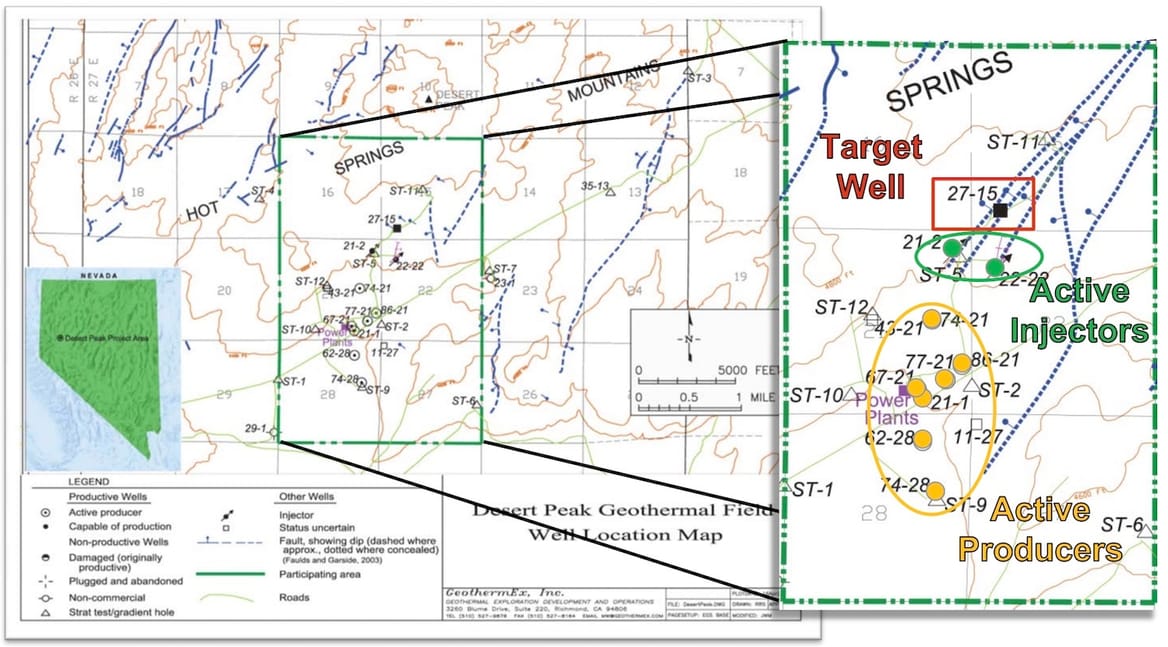
Over two decades ago, Ormat Technologies began a big experiment on a swath of rugged land near the Hot Springs Mountains in western Nevada.
The geothermal company was already producing electricity there, using the heat found naturally in hot water and steam trapped beneath the earth’s surface. But in 2002, Ormat and its research partners decided to deploy an emerging approach to boost output at the Desert Peak power plant. They’d drill deep into hot, dry rocks and pump them full of liquids, creating geothermal resources where nature hadn’t provided.
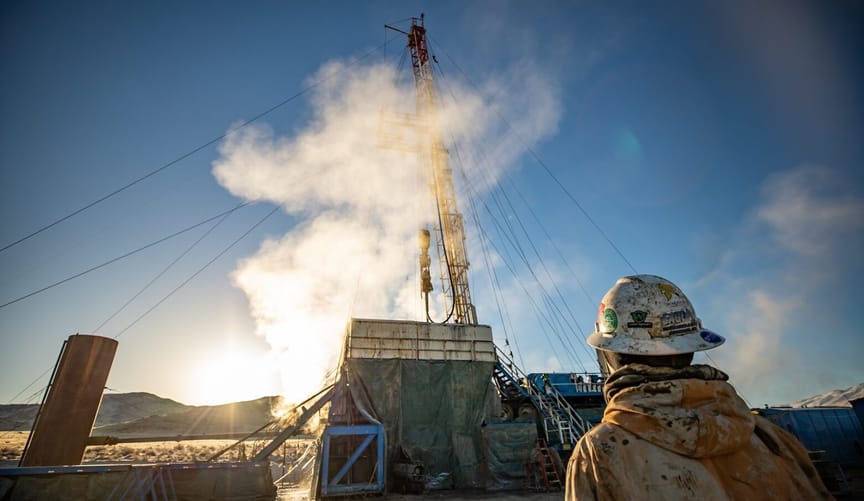
In 2013, the 1.7-megawatt demonstration project connected to the grid, becoming the nation’s first “enhanced geothermal system” to hit that milestone. At the time, though, the industry still lacked the technology innovations and favorable economics needed to support a full-throttle scale-up of enhanced systems, which the U.S. has studied for over 50 years.
Today, that calculus is shifting.
The idea that companies can harvest energy without tapping hot springs or geysers is driving a surge of interest — and billions of dollars of investment — in America’s once-stagnant geothermal industry.
Startups are racing to build next-generation facilities that can supply clean, around-the-clock power to data centers and states with decarbonization mandates. Technology breakthroughs are making it cheaper and faster to develop new wells. Policymakers of all political stripes are working to uphold federal geothermal tax credits and to ease permitting and regulatory challenges that can slow down projects.
And Ormat itself is getting back into the enhanced geothermal game, having focused mainly on its conventional projects in the intervening years.
Ormat, whose headquarters is in Reno, Nevada, is a leading developer and operator of geothermal power plants. The 61-year-old firm owns dozens of clean energy projects globally, including over 1 gigawatt of geothermal capacity, mainly in the western United States. Those facilities all tap into hydrothermal resources, the naturally occurring reservoirs that are typically found near the boundaries of major tectonic plates.
It’s now planning to build a new enhanced pilot project at Desert Peak, together with the oilfield services giant SLB, as the companies work to commercialize the approach.
“We’re going back to where we started the journey, and it feels a bit like closing the loop,” said Daniel Moelk, Ormat’s executive vice president for subsurface, wells, and next-generation geothermal. The companies are gathering new geophysical data at the site to determine where to drill wells, he added, though he couldn’t say when the project might be completed.
Ormat is separately developing an enhanced pilot system with the Houston-based company Sage Geosystems, which will deploy its next-generation technology at one of Ormat’s existing sites in Nevada or Utah. Ormat invested $25 million in Sage in January as part of the startup’s $97 million Series B funding round.
“Opportunities are expanding with new emerging technologies, and we want to be part of it,” Moelk said.
That’s also true for Ormat’s manufacturing operation in Yavne, Israel, where the company was founded. In June, Ormat unveiled designs for power plant equipment that can operate in the higher-temperature and higher-capacity conditions that next-generation systems are expected to achieve. The 100-megawatt power-generation unit is meant to make any developer’s geothermal projects cheaper and more efficient overall by unlocking economies of scale, Ormat said.
Still, the new design reflects the world that the geothermal industry is building toward, not where it stands today.
The United States has just about 4 gigawatts of geothermal power capacity divided among 99 plants, over half of which are in California. Together, they supply a mere 0.4% of the nation’s total electricity generation. But the U.S. Department of Energy predicts geothermal could provide 90 gigawatts of always-on, carbon-free power to America’s grid by 2050 if the industry can significantly accelerate its ongoing cost reductions and enable large-scale enhanced systems to catch on.
Ormat and a growing crop of newcomers are being propelled toward that reality by the soaring energy demand from data centers. In California, Oregon, Washington, and other states, clean-power needs are rising as well, as buildings, factories, and vehicles transition away from fossil fuels and toward electrified solutions.
“There’s growth across the industry driven by the fact that power prices are higher than they’ve ever been,” said Michael O’Connor, director of the Mountain West Geothermal Consortium, a new initiative to accelerate geothermal deployment in the Mountain States.
He noted that, in some markets, developers and utilities are striking long-term agreements for “firm,” or on-demand, power that are two to three times higher than they were in 2021, incentivizing more geothermal companies to pursue new projects.
The recent momentum is also thanks to the geothermal drilling advances that have emerged in the years since Ormat launched its first Desert Peak pilot.
Fervo Energy, for example, uses horizontal drilling techniques and fiber-optic sensing tools from the oil and gas industry to fracture hard, impermeable rocks and create artificial reservoirs. In 2023, the Houston-based startup turned on a first-of-a-kind enhanced geothermal system in Nevada. The 3.5-MW project sends electricity to the grid to help satisfy some of Google’s power appetite in the state.
Simultaneously, Fervo has been developing its 500-MW Cape Station project in Utah, which is set to become the world’s largest enhanced geothermal system when fully completed, potentially by 2028. While developing the project, the company said it reduced drilling times by about 75% and slashed per-foot drilling costs by about 70% between 2022 and 2025, marking a significant achievement for the nascent industry.
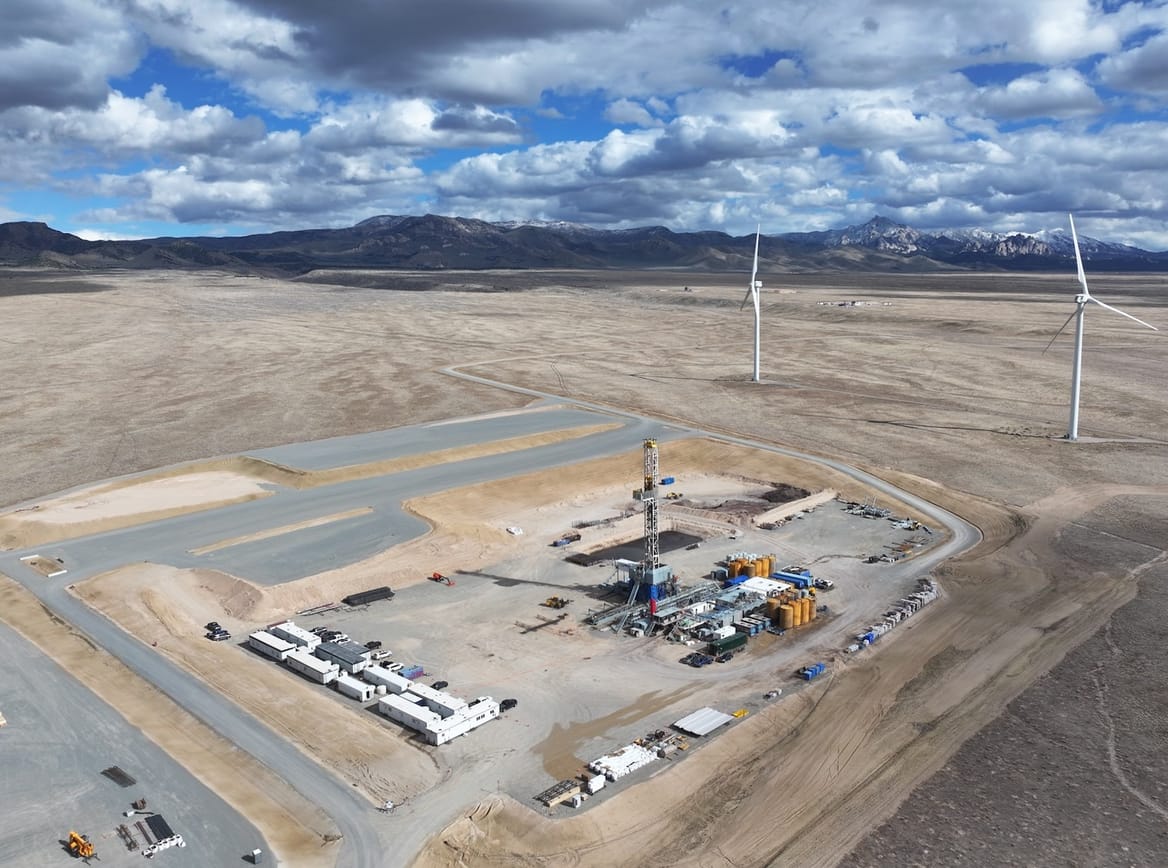
To fund its scale-up, the nine-year-old company in May became the first next-generation geothermal firm to go public, netting about $1.9 billion. (Ormat, which hit almost $1 billion in revenue in 2025, joined the stock exchange back in 2004.)
The startup Quaise Energy recently credited Fervo’s IPO with giving it a fundraising boost. Quaise raised $134 million this month to advance its first superhot geothermal project near an Oregon volcano. The company XGS Energy, which is pursuing a novel closed-loop technology, has been hiring veteran finance executives as it evaluates going public itself.
“Fervo definitely led the way, in terms of showing a path to the public equity markets for pre-revenue development companies like us,” said Richard Chong, who joined XGS in May as the company’s chief financial officer. Chong previously worked at Calpine, where he helped secure over $2 billion in financing to expand The Geysers, a decades-old geothermal development in Sonoma County, California.
The enthusiasm for cutting-edge technologies is spilling over into the conventional geothermal market, which has grown at a tortoise-like pace in recent years.
Hydrothermal resources are generally easier and less expensive to tap, since they don’t require fracking deep underground. But scientists and companies have explored only a tiny fraction of America’s subsurface geothermal resources. For any developer, it can cost tens of millions of dollars just to do the preliminary drilling to locate those resources — and to confirm that they’re good enough to produce electricity for decades. Such an undertaking was harder to justify in the years when U.S. electricity demand was essentially flat.
Now, “the market conditions around electricity demand have driven a lot of developers to rethink their portfolios and their assumptions on if they should develop,” O’Connor said.
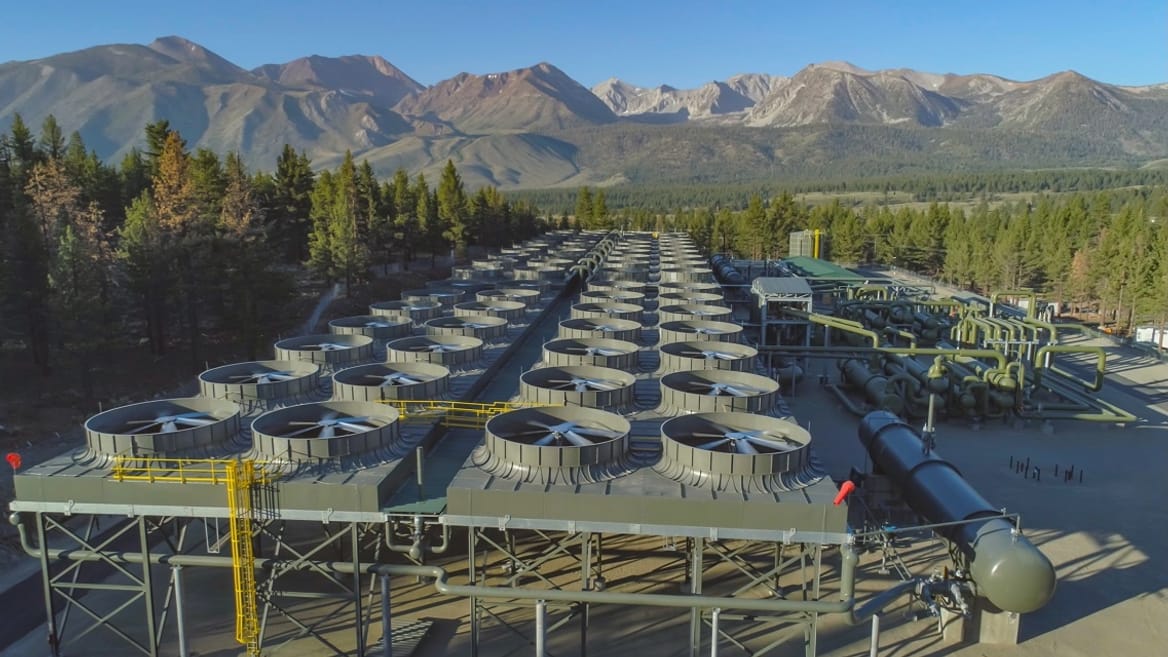
In June, Ormat received expedited approval for environmental permits from the Bureau of Land Management to begin developing the new 60-MW Pearl Geothermal Development Project on public lands in Esmeralda County, Nevada. The approval stems from the Trump administration’s 2025 emergency permitting procedures to accelerate energy development on federally managed lands — on which over 90% of identified U.S. geothermal resources are located.
The bureau has also awarded permits for Ormat’s other initiatives in Nevada, including the 30-MW Crescent Valley plant and the earlier-stage Diamond Flat and Pinto project sites, where the company will study and test for geothermal resources. All told, Ormat holds leases to some 400,000 acres across six states.
“Ormat has gone from a company that was focused on operating the assets it currently has to thinking about expanding, and they are not alone,” O’Connor said.
The startup Zanskar raised $40 million in April to build its first conventional geothermal plant. The company combines artificial intelligence with boots-on-the-ground surveying to identify hidden natural resources in the U.S. West. Last year, Zanskar said it had identified the first “blind” geothermal system — meaning it doesn’t have vents, geysers, or other visible features, or any historical records — for commercial use in more than 30 years.
“They’re taking advantage of the higher demand for the lower-hanging fruit,” O’Connor said of Zanskar’s conventional geothermal play. The startup and other firms “are either acting on leases that people have held for a while and not had motivation to use, or exploring for the first time.”
Ormat, for its part, will continue to rely on its “robust hydrothermal business” while also piloting the next-generation technologies that could enable geothermal to leave behind its niche position in the global energy market, Ormat’s Moelk said.
“Right now, we have what the world needs: renewable, local, baseload energy,” he said. “After 20 years in geothermal, I’ve never seen such a big opportunity.”
The Department of Defense has essentially frozen permitting for new wind installations over the last year, preventing more than 155 projects from moving forward.
A coalition of 18 states and Washington, D.C., has moved to join an industry lawsuit challenging the Department of Defense’s freeze on onshore wind projects in America.
It’s the latest in a nearly yearlong saga during which the Trump administration has obstructed more than 155 land-based wind projects across the country, according to data from the American Clean Power Association.
President Donald Trump has vowed to block the construction of wind farms during his second term, going as far as to claim that his administration would “try and have no windmills built in the United States.”
The administration has done its best to live up to that edict, waging an all-out war on wind farms, which last year generated more than 10% of the country’s electricity. The blockade has occurred against the backdrop of fast-rising utility bills, the product of high electricity demand that can only be met by building more energy capacity.
Trump’s attacks on offshore wind have been the loudest and most brazen, but onshore wind has not been spared. Last July, the Interior Department created a “choke point” for permitting new wind and solar projects on federal lands. One month later, in August 2025, the Defense Department quietly stopped issuing national-security approvals to onshore wind projects — a move that has impacted dozens of gigawatts of wind projects across both public and private land.
In April, a federal judge ordered the Interior Department to lift its blockade while a lawsuit led by industry groups makes its way through court, though the agency appealed the decision in June. In May, industry groups and wind developers filed suit against the Department of Defense’s permitting freeze, arguing that the delays created by the agency may threaten the viability of certain projects by causing them to miss deadlines to lock in expiring federal tax credits or to interconnect to the grid.
Nineteen attorneys general, all Democrats, filed a motion on Thursday to intervene in that suit and join the industry in requesting a court injunction against the DoD freeze. The motion argues that the DoD’s delay tactics could negatively affect grid reliability, energy affordability, climate goals, and jobs — and undermine state sovereignty.
The Trump administration claims the pause is necessary due to national security concerns. It provided a similar justification when halting work on all five in-progress offshore wind farms last year, but the argument was swiftly rebuked by federal judges five different times.
The DoD process is indeed meant to review wind projects for national security risks. Following the review, it is not uncommon for developers to take certain mitigation steps as directed by the military.
“For more than a decade, DoD engaged in a predictable review process and worked with developers to mitigate potential concerns,” according to a news release from the office of Massachusetts Attorney General Andrea Joy Campbell. Now, “wind projects across the country have been frozen at various stages of the review process, including those that had already completed mitigation negotiations and were awaiting only final DoD approval.”
Getting data centers to pay for new generation and batteries could be the best hope for the nation’s biggest power market to finally get a handle on costs.
With the conclusion of its latest capacity auction, PJM Interconnection has once again shown that its process for securing new energy is unable to keep up with the wave of electricity demand from data centers.
But PJM, the grid operator for the country’s biggest energy market, is poised to adopt a new process that could help fix these problems: by pushing data centers to pay directly for the new clean energy, batteries, and fossil-fueled power plants needed to meet their huge electricity demand.
Late last month, PJM stakeholders achieved a rare level of consensus in voting to approve the plan for a new auction, called a reliability backstop procurement.
The measure, which still needs final approval from both PJM and the federal government, represents the grid operator’s most significant step to repair an auction process that has left consumers paying more money for a less reliable grid. PJM’s board of directors is expected to submit the proposal to federal regulators in the coming weeks.
The results of PJM’s Tuesday capacity auction underscore how critical it is for the grid operator to find a solution.
PJM’s capacity auctions, held once or twice each year, are the key process through which it ensures there’s enough capacity to keep its grid up and running during summer heat waves and winter cold snaps. It’s a high-stakes task: 67 million people from Virginia to Illinois depend on PJM for electricity.
For the third time in a row, the capacity auction hit the market’s price cap, in this case, $325 per megawatt-day. Similar caps have been in place since last year, after state governors demanded a limit to the massive cost increases being pushed onto utility customers across the PJM region.
These latest capacity costs reached $16.4 billion, matching the record set last December, and are more than eight times as much as PJM has paid for capacity in prior years. Customers in some PJM states — including Illinois, New Jersey, and Pennsylvania — are already seeing their bills rise by more than 10%, in part because of these soaring costs.
And yet, these maxed-out prices are still not high enough to get energy developers and utilities to build the power plants PJM needs to hit its reliability targets. This week’s auction fell short of PJM’s reliability requirement by over 6.8 gigawatts — the second time in a row that sky-high prices have failed to bring sufficient capacity resources into play.
The upshot is that customers in PJM Interconnection are paying some of the highest rates in the U.S. for grid reliability — even as the grid operator says the system isn’t reliable.
At the root of the problem is an explosion of demand from data centers that utilities and project developers can’t keep up with.
The grid operator forecasts that 30 to 34 gigawatts of data centers will be online in states across its region by the early 2030s. Utilities and developers would struggle to meet that pace under favorable conditions, but PJM’s infamously sluggish interconnection process makes it an impossible task.
While power demand has soared, the capacity being brought online in PJM has stagnated.
Of the 138.3 gigawatts of resources secured in this week’s auction, only 525 megawatts came from new capacity. All told, just under 4 gigawatts of newly built and “uprated” capacity from existing projects have been included in the capacity auctions since 2024, well below the roughly 20 gigawatts of new capacity added in the five prior auctions.
“We’ve got two problems,” said Julia Hoos, who leads coverage of Eastern U.S. power markets for Aurora Energy Research. “One, new capacity is just more expensive than we’re willing to pay for; and two, we haven’t resolved the physical barriers to build. Now, we’re paying for both issues.”
And those problems aren’t going away. Monitoring Analytics, PJM’s independent market monitor, has cited forecasted growth in data center power demand as being responsible for more than $29 billion in additional capacity costs to customers in PJM since 2024. In a May report, the monitor warned that these costs will “continue to grow until the issues associated with the addition of large data center loads are addressed.”
It hasn’t been easy to land on a path forward.
Environmental groups, consumer advocates, and state politicians have been haggling with data center trade groups, utilities, and power plant owners for more than a year over how to manage electricity costs related to data centers.
Some argue that new data centers should be forced to drop offline during grid emergencies, to avoid burdening all other customers with the cost of building power plants to ensure service at those times. Others say data centers should be required to pay directly for the capacity resources needed to mitigate their burdens on overstressed grids.
The plan approved by PJM stakeholders in late June, which was put forward by utilities and the trade group Data Center Coalition, would enable that latter option.
Unlike PJM’s standard capacity auctions, which are aimed at meeting the needs of all the utilities and customers served by its grid, this reliability backstop procurement, or RBP, is meant to be a “one-time process to purchase new supply resources to serve new data centers and other large loads,” PJM explained in announcing the outcome of its stakeholder process.
The proposed backstop procurement auction would come with a price cap of $555 per megawatt-day, much higher than the limit now set on PJM’s broader capacity market. In fact, the amount is pretty close to Aurora Energy Research’s calculation that about $500 to $600 per megawatt-day is what’s needed to finance new capacity resources trying to get built and interconnected to the grid, Hoos said.
This new auction would also structure deals between data centers and project developers under 15-year contracts, which “makes it cheaper to build, because developers have more security,” she said. “In the short term, it may be the only way to build new capacity, because generators need certainty.”
PJM has also showed some signs of life in moving projects through its snarled interconnection queue.
This year, the grid operator finally cleared roughly 53 gigawatts of solar, batteries, wind, and fossil gas power projects to connect to its system. If the RBP is approved by the Federal Energy Regulatory Commission in its current form, it could be “potentially a way to funnel a lot of money to projects that are already in the works,” said Tom Rutigliano, senior advocate for climate and energy at the Natural Resources Defense Council.
But that’s not the only way for new data centers to pay for the resources they need to come online, Rutigliano and Hoos noted. An even bigger channel could emerge in the form of bilateral contracts — agreements between individual data centers and developers of generation, battery storage, and demand-side resources like virtual power plants.
Such bilateral contracting has always been an option for large power customers, Hoos noted. In fact, major corporations have been signing power-purchase agreements with solar and wind projects for more than a decade. But those contracts have been focused on securing clean energy, and not so much on projects that can provide capacity during hours when the grid is under the greatest stress.
That’s a more complicated type of deal to structure, and tech giants like Amazon, Google, Meta, and Microsoft are only in the early stages of combining clean energy, batteries, generators, and demand-side resources or flexible computing that can meet PJM’s capacity needs.
But with states served by PJM demanding that large loads bring their own capacity, these kinds of deals are increasingly seen as necessary to get new data centers built. As part of the same effort, PJM last month also started work on facilitating “bilateral, long-term agreements between large load customers and generation providers” as a way to help these processes along, it also announced.
In fact, the RBP could become a last-resort choice for large loads that can’t strike their own deals, Hoos said. “There’s a lot of value to these bilateral contracting models that move that risk to investors and to the large loads,” she said — not to utility customers at large.
What remains uncertain is whether the RBP and these bilateral deals can enable data centers and new grid resources to come online “without raising rates on everyone else,” Rutigliano said.
PJM was meant to tackle the cost considerations by adopting a “connect and manage” plan, a structure that would require data centers to either bring their own capacity or face being cut off from grid power during emergencies. But PJM stakeholders failed to approve any of the 11 connect-and-manage proposals on hand.
So PJM proposed that state regulators take the lead in setting the rules for how utilities bundle up all the capacity needs of the large loads seeking to come online and submit them to the RBP, Rutigliano said.
This creates a risk that utilities could claim to be representing large loads in future auctions without securing durable commitments from those customers to actually pay for the capacity they commit to buying. If that happens, utility customers would be left holding the bag.
All this is unfolding on a compressed timeframe. Under pressure from the Federal Energy Regulatory Commission and state governors, PJM has agreed to hold its backstop procurement auction in September. That’s not a lot of time to prepare — but Rutigliano thinks PJM needs to work closely with states to ensure that regular customers don’t end up paying for resources that utilities secure for data centers.
“The stakeholder-approved version is that only utilities that affirmatively step up and say ‘we want more capacity’ get put in as buyers,” he said. “States have to make sure that doesn’t get passed on to ordinary ratepayers. They have to make damn sure there’s a data center that pays for it, or [utility] shareholders pay for it.”


.svg)
