

 Back
Back
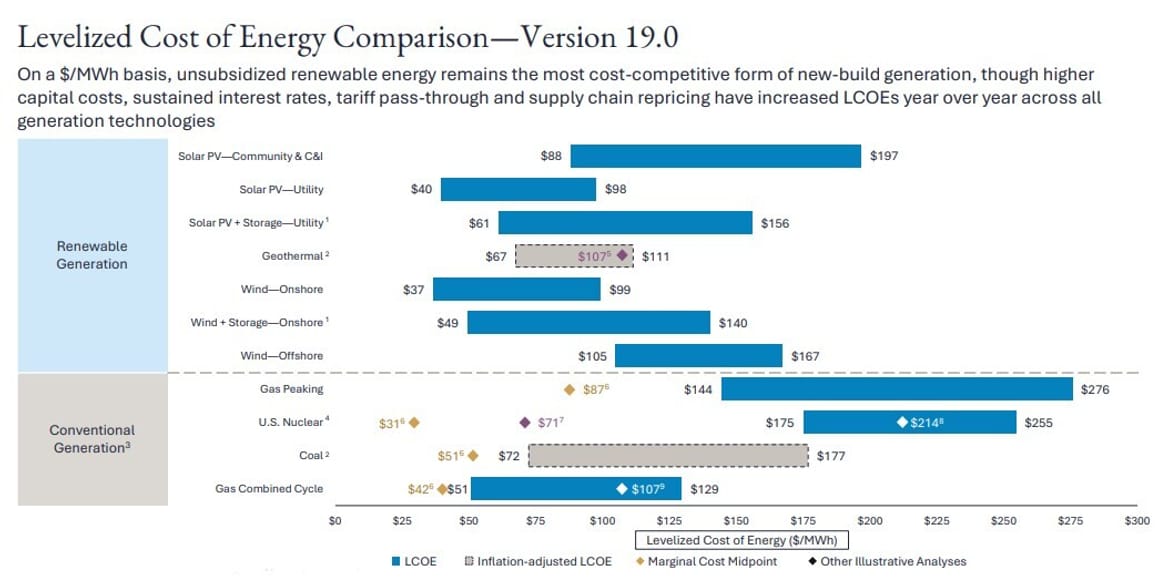
Even as renewables lose federal incentives and face other hurdles, Lazard finds onshore wind and large-scale solar again have the lowest levelized cost of energy.
Pretty much every type of energy is getting more expensive in the U.S., but clean energy is still a better bet than fossil fuels.
That’s the topline from investment bank Lazard’s latest annual report on the levelized cost of energy, or LCOE — a metric widely used to compare how expensive different sources of electricity are. Put simply, it expresses the present-day price of generating a megawatt-hour of electricity from a solar farm, a gas plant, or another power source, all while accounting for that source’s full lifetime operating costs. For example, it takes into consideration that a solar farm’s fuel and operational costs are tinier than a fossil fuel plant’s.
For the last decade, Lazard’s reports have basically reached the same conclusion: Onshore wind and utility-scale solar have a lower LCOE than fossil fuels. While that’s still true this year, the average LCOE of onshore wind and solar did surge by 11% and 18%, respectively, from last year, thanks to the loss of federal renewable energy tax credits, increased tariffs, high interest rates, and other challenges.
But the fossil fuel sector also faced headwinds over the past year, as a supertight market for turbines drove up the cost and timeline of building a gas plant. The LCOE of gas power from modern “combined-cycle plants” — which was already about $20 higher per megawatt-hour than solar’s and onshore wind’s in 2025 — rose by 15%. Still, those higher prices and construction delays haven’t stopped developers from pursuing ambitious gas projects as the AI boom sparks a scramble for on-demand power.
Although LCOE is a pretty handy way of comparing energy costs across sources, it has its limitations, the Clean Air Task Force argued in a report last year. The climate advocacy group says LCOE isn’t a good method for long-term decarbonization planning because it doesn’t account for many real-world concerns, like a power source’s land and health impacts or its ability to generate nonstop electricity.
Even so, plenty of evidence indicates that renewables will retain their cost-competitive edge. For one, they’re not subject to rocky fuel prices like oil and gas are — something that’s been on full display as conflict in the Middle East continues. And while solar and wind power generation remain at the mercy of the weather, batteries are making their fatal flaw of intermittency a thing of the past.
A first-in-the-nation data center ban
New York has become the first state to enact a moratorium on building hyperscale data centers. After a few weeks of will-she-won’t-she uncertainty, Gov. Kathy Hochul (D) signed an executive order barring data center construction for up to a year as the state hammers out regulations.
The move comes as data centers face criticism from both sides of the political aisle over their power use, and especially their potential to drive up electricity costs for residential utility customers. But despite the facilities’ widespread unpopularity, other governors have been reluctant to go as far as Hochul. In April, Maine Gov. Janet Mills (D) vetoed a bill that would have halted construction through November 2027. And just this week, Michigan Gov. Gretchen Whitmer (D) asked data center developers to pledge they wouldn’t raise power costs for state residents, but stopped short of calling for a total ban on construction.
Clean energy beats the heat
This week was another hot one in the Northeast, though temperatures weren’t quite as bad as they were earlier in July, when a major heat wave tested — but didn’t knock out — the power grid.
As I wrote last week, clean energy played a big role in meeting soaring demand while millions of people cranked up their air conditioners. Some New York City households even kept cool without adding to the grid’s burden. Our reporter Maria Gallucci is one of a few hundred New Yorkers participating in a pilot program that provides apartment dwellers with a small battery pack to plug their window AC into, reducing stress on the electric system, helping prevent blackouts, and even earning them a little cash.
Maria stayed on the heat wave beat with a look at how offshore wind tackled spiking power demand in New England. The region had to turn to oil power last year when it faced a similar hot spell, but this year, the emergence of more offshore wind meant the grid didn’t need as much of the dirty fossil fuels.
Endangered again: The Trump administration finalizes a change to how the Endangered Species Act is enforced, opening up critical wildlife habitats to oil and gas drilling and other development. (NPR)
Google’s big clean bet: Cypress Creek Energy breaks ground in Arkansas on what could be the largest solar and storage project in the U.S., with power from its first two phases purchased by Google to offset its data center demand. (Canary Media)
Weatherization win: A federal housing law that recently passed with bipartisan support will require the Trump administration to enact stronger energy conservation standards for manufactured homes, which aren’t subject to local and state building codes and are often inefficient. (Canary Media)
Fast food, fast charge: EV chargers are proliferating especially quickly in the South, including at fast-food chains like Bojangles and convenience stores. (New York Times)
Smoking out solar: The wildfire smoke that turned skies orange and hazy in much of the Northeast this week also caused solar production to plummet in New England. (WBUR)
A balcony solar deal: Nonprofit Bright Saver is selling zero-markup balcony solar packages starting at around $300 as more states pass laws allowing residents to use the plug-in panels. (Canary Media)
Turbines torpedoed: The Trump administration has delayed 155 new wind energy projects across 24 states over allegations that turbines threaten drone detection and national security. (Grist)
The global fleet of nuclear power plants is poised to expand quickly as climate goals, security concerns, and rising demand renew interest in the energy source.
The global nuclear energy industry has been muted since 2011, when the Fukushima Daiichi disaster unfolded in Japan. Some new reactors have been built — especially in China — but a lot of old nuclear power plants have been retired as well.
That means nuclear energy has been “running in place” for well over a decade, as a new report from BloombergNEF puts it. But now, the market is changing — and BNEF’s analysts predict that the sector is poised to break out in a sprint.
BNEF forecasts that global nuclear energy capacity will rise to 535 gigawatts by 2036, a 44% increase from last year’s installed capacity of 372 GW.
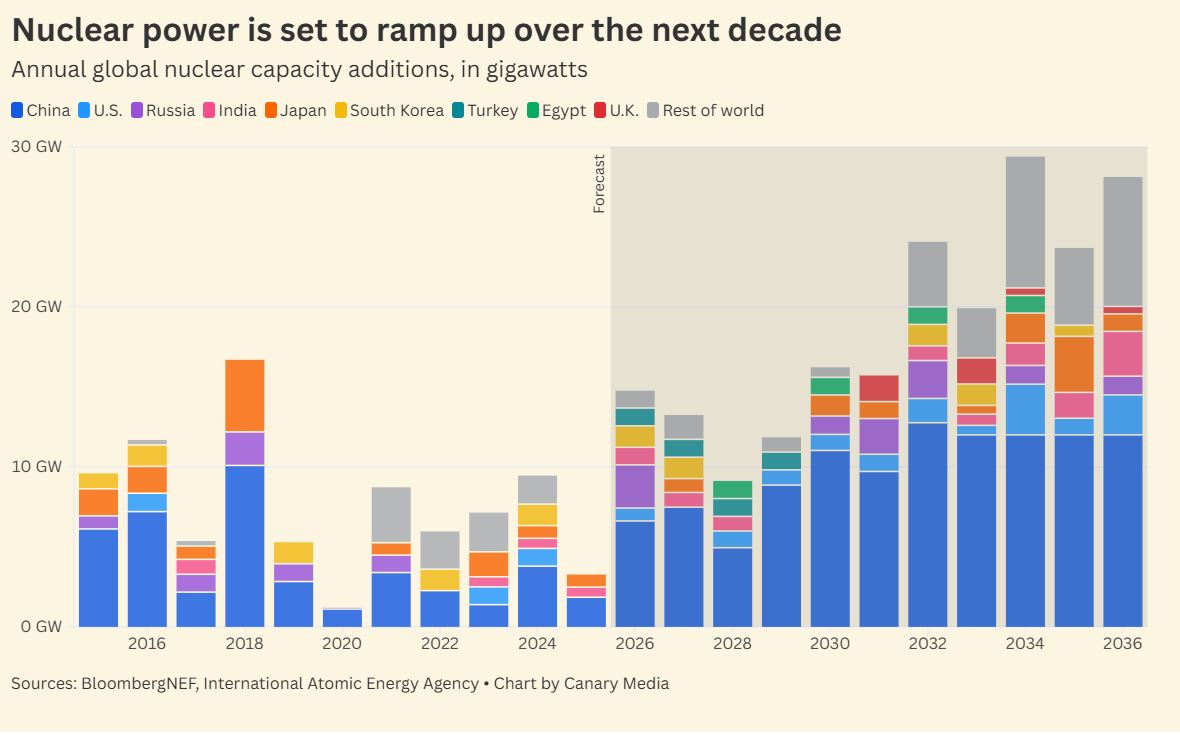
A simple reason for the optimistic forecast is that a lot of reactors are under construction worldwide: 76, according to BNEF, as of the first half of this year. Almost every single one is a conventional large-scale reactor, as opposed to a buzzy new small nuclear reactor. Those units represent 83 GW of new capacity on their own.
Nuclear energy’s turnaround comes as countries look to decarbonize their power grids, as it’s a readily available source of carbon-free electricity. It’s also just a big source of electricity, period — and global demand for power is rising fast. Several countries, including Japan, have also shown renewed interest in nuclear energy in light of the Iran war, which has roiled global oil and gas markets.
China is leading this new nuclear buildout. It’s home to nearly half of all reactors under construction worldwide, and by 2030 it may have more nuclear capacity online than the U.S., the current global leader.
Officials in the U.S., for their part, are talking a big game about reinvigorating the domestic nuclear industry. Construction in the U.S. remains scant compared with China’s dozens of in-progress reactors, but the sector is making some headway. Two smaller, advanced reactors are underway in the U.S. as of this spring, and an 800-megawatt reactor in Michigan may come back online this year after missing a 2025 target.
The things to track now are timing and cost. In certain markets, especially the U.S., nuclear projects have been dogged by extreme cost overruns and blown deadlines — and that combination has held back the sector’s growth. The new wave of interest gives the industry a chance to prove it can finish projects on budget and on time. We’ll see if it delivers.
In a first, the state could speed up data centers’ grid connection if they bankroll energy-saving residential tech like heat pumps and batteries.
New Jersey is offering data centers an unorthodox way to get the power they need: by bankrolling home energy upgrades.
Last week, Gov. Mikie Sherrill (D) signed a bill that will create a first-of-its-kind program to incentivize data centers to secure clean capacity by reducing demand elsewhere on the grid. Data centers will be able to pay for households to replace their energy-hogging electric-resistance space and water heaters with much more efficient electric heat pump appliances — or to install rooftop solar and batteries.
The scheme could lower electricity bills for potentially millions of households statewide by hundreds to thousands of dollars annually. In return, the data centers would get priority in the interconnection queue.
“New Jersey just set a national precedent,” said Ari Matusiak, CEO and co-founder of nonprofit Rewiring America, who served on Sherrill’s transition team. The law, called the Data Center Fair Share Act, “is a blueprint for how policymakers can start to think about households as energy infrastructure.”
Nationwide, utilities propose to spend at least $1.4 trillion on capital expenditures through 2030, according to consumer advocacy nonprofit PowerLines. “A meaningful percentage of that could be directed to households,” Matusiak said.
Rewiring America first championed the approach last September, when it released a report finding that installing heat pumps, solar, and batteries in homes could offset more than 93 gigawatts of anticipated AI-driven demand nationwide. The nonprofit provided input on New Jersey’s bill, but it “very much had its own momentum,” according to spokesperson Alex Amend.
Using what’s known as “voluntary demand-reduction trade programs” established at the utility-level, data centers will be able to hire companies that can aggregate households and other utility customers into a virtual power plant. The utility would then likely work with the aggregator to verify the resulting capacity will be there when the data center is built, according to Amend.
Power-hungry data centers have been pushing up electricity prices in the PJM Interconnection grid region, which includes New Jersey as well as a large swath of the Midwest and mid-Atlantic. And utility customers have been left footing the bill.
New Jersey’s law aims to put the kibosh on that. In addition to the household program, the measure will create a new rate class for data centers, following the lead of Minnesota, Oregon, and Virginia. The move is meant to ensure data centers pay for their own energy use and associated grid infrastructure.
Other states are looking to push data center dollars into home energy upgrades. California, Colorado, Illinois, Pennsylvania, “and likely many others” are considering legislation, said McKenna Beck, policy analyst at the nonprofit Natural Resources Defense Council, which helped create the New Jersey bill’s framework. On Tuesday, New York joined the list: Gov. Kathy Hochul signed an executive order that halts data center development for up to a year and directs regulators to consider requiring data centers to fund distributed energy resources and battery storage.
Hyperscalers are staying mum on New Jersey’s initiative. Microsoft declined to comment, Google did not respond in time, and Amazon told Canary Media that it had no stance.
Still, Big Tech companies are increasingly keen to leverage households as energy assets.
Last month, Google announced a pioneering agreement with the virtual power plant provider Voltus for up to 100 megawatts. Also in June, Tesla, Sunrun, and Renew Home broadcast that they would provide a whopping 16 gigawatts of power across data center hot spots in the U.S. using distributed energy resources. The power will be “ready in months, not years,” according to their website.
In New Jersey, Rewiring America estimates that of about 2 million single-family homes, roughly 85,000 have electric-resistance heating systems and 422,000 have electric-resistance water heaters. “But all households could benefit from home batteries and, in most cases, rooftop solar as well,” Amend said. “So the potential is enormous.”
New Jersey’s public utilities regulator has one year to flesh out the standards of the state initiative for utilities. Utilities then have 180 days to submit proposals for their individual programs.
Enrolled households could start getting data center–funded heat pumps, solar panels, and batteries as soon as mid-2028, Beck noted.
“These resources will directly lower bills for households and communities in which the data centers are built,” Beck said. “It’s incredibly exciting.”
As it pivots from shutting down nuclear plants to building them, Holtec says small modular reactors can cut costs and speed construction. Now it has to prove it.
Nuclear giant Holtec International is betting big that its 300-megawatt small modular reactors are the future of atomic energy.
On Friday, the Florida-headquartered firm filed paperwork with the Securities and Exchange Commission in order to sell shares in the company on the Nasdaq.
Across hundreds of pages, the disclosure document outlines the 40-year-old Holtec’s plans to transform itself from the industry’s undertaker — manufacturing canisters to safely store radioactive spent fuel and decommissioning shuttered nuclear plants — to its midwife, producing and operating new electrical stations. This transition comes as nuclear energy regains popularity in the U.S. as a way to meet booming power demand without creating more planet-warming pollution.
Developers have traditionally offset nuclear’s high up-front costs by building ever-larger reactors to capture the economies of scale. Since the early 2000s, however, a number of companies have proposed building small modular reactors that can be constructed identically and in batches. SMRs could generate about a third of the electricity of conventional large-scale plants, but, proponents argue, would bring down costs through assembly-line repetition rather than physical scale.
That cost reduction has yet to be proven out in the real world with actual plants. But in its S-1 filing, Holtec said, “SMRs will offer scalable, cost-effective solutions for new capacity with enhanced safety features, reduced construction timelines and reduced land and transmission infrastructure needs as compared to traditional, larger-scale reactors.” It noted that a single-unit SMR plant would only need 15 acres of land and take a mere three years to build. By contrast, the big reactors on the grid today can take up hundreds of acres, and construction typically drags on for nearly a decade.
Holtec’s SMR-300, as the pressurized-water reactor is named, “is expected to receive regulatory approval for deployment in 2029” and reach its first deployment “in the early 2030s,” according to the filing.
The company said it expects SMRs to play “a meaningful role in the expansion of nuclear capacity,” noting that they can “complement large-scale nuclear generation through lower upfront costs” and more flexible planning around how much power is needed.
For example, smaller reactors may be better suited for converting some old coal-fired stations into nuclear plants. The DOE has been researching the idea for years, given that nuclear and coal are both thermal resources that operate with similar rates of frequency and therefore use similar equipment to generate electricity from steam — which in nuclear plants is made from the heat created by splitting atoms and in coal plants is made from heat created by burning the black rocks. Converting a 400-MW coal plant into a similar-size nuclear reactor makes more financial sense than using a bigger reactor, which could require costly transmission upgrades and more space.
“We believe that our SMR-300 plant can become a favored nuclear generation source over large reactors because of certain advantages,” the company said in its filing.
The company will also operate at least one conventional reactor, the 800-MW unit it’s currently restoring at its Palisades nuclear station, in western Michigan. That project — the nation’s first effort to return a permanently shuttered nuclear reactor to service — could be completed within months, though its contract to sell power to the local grid won’t kick in until next year.
Holtec hopes to combine its plant-restart strategy with its SMR vision. It’s planning to deploy two SMRs at the Palisades site; if that works out, the company has said it may build SMRs at New Jersey’s Oyster Creek nuclear plant, which it’s been in the process of decommissioning for eight years.
Holtec owns three other defunct nuclear plants — Massachusetts’ Pilgrim, Michigan’s Big Rock Point, and New York’s Indian Point — that it could also try to rebuild. The Trump administration has called for reconstructing Indian Point, but Albany remains opposed to the controversial proposal.
Local opposition isn’t Holtec’s biggest hurdle, however. That would be competition from the nuclear behemoths in Russia and China. Virtually every Western nuclear developer is facing an uphill battle to compete with the Kremlin’s state-owned Rosatom, by far the biggest international vendor of nuclear technology in the world, and China’s two state-owned nuclear companies, which are building more than three dozen reactors at home and are expected to enter the export game soon.
Still, among its domestic rivals, Holtec may be the best positioned to hold its own on a global playing field. It is an established company with profitable enterprises in a dozen countries across four continents, and has experience managing infrastructure so sensitive it’s overseen by a dedicated agency, the U.S. Nuclear Regulatory Commission. The company has facilities with electrical equipment on-site that can be potentially used to deploy SMRs. It also has won significant support from the federal government, both in the form of a $1.52 billion loan the Department of Energy provided to finance the Palisades restart and the $400 million the agency gave the company to support construction of its first SMR-300s.
“We began work in 2011 on a small modular reactor solution, and drawing on our in-house capability to design, license, manufacture, construct, and commission nuclear systems, honed through decades of turnkey supply, we are now uniquely positioned to launch the development of our small nuclear reactor,” Krishna Singh, Holtec’s founder and chief executive, said in a letter to prospective investors.
Developer Cypress Creek has broken ground on the project, which will eventually deliver 2.5 gigawatts of solar production and 2.9 gigawatt-hours of battery storage.
Longtime solar developer Cypress Creek Energy has not only broken ground on what could be the largest solar-plus-storage plant in the country, but also secured a blue-chip customer to pay for the clean power.
Google will buy all the electricity from the first two phases of the forthcoming Steel River Energy Center in Mississippi County, Arkansas, just upriver from Memphis, Tennessee — totaling 1.6 gigawatts of solar capacity and 1.9 gigawatt-hours of battery storage. Once fully online in 2029, its power won’t flow directly to the tech giant but instead onto the grid managed by Entergy Arkansas, which supplies one of the company’s data centers and will serve a future data center planned for West Memphis, a Google spokesperson told Canary Media.
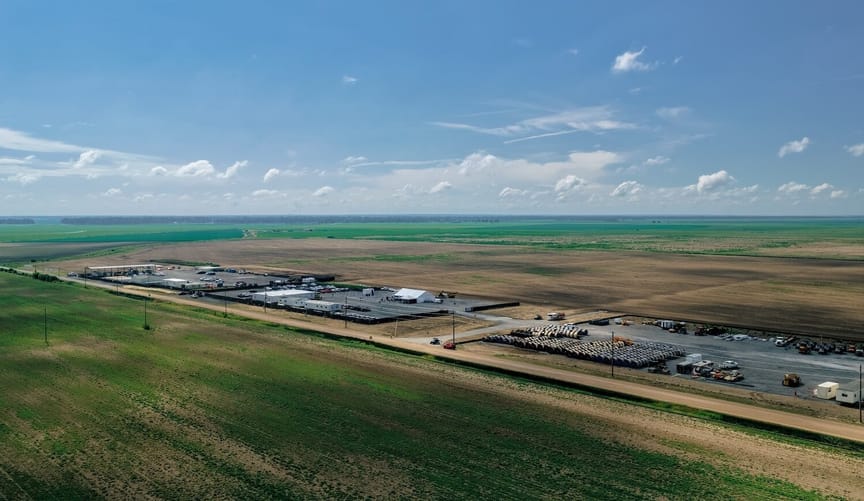
This marks the latest and largest effort by the tech giant to generate clean power for its rapidly expanding data center fleet, and it comes as the AI boom drives a growth spurt in carbon emissions from Google and other tech companies that have adopted voluntary decarbonization targets.
“As one of the nation’s most significant new solar plus storage projects, Steel River helps address growing electricity demand with reliable, cost-effective power, utilizing battery storage systems to strengthen grid dependability while also unlocking new clean capacity,” the Google spokesperson said in an email.
A planned third phase will bring the total capacity on-site to 2.45 gigawatts of solar production and 2.9 gigawatt-hours of battery storage by the end of 2029. Google is not contracted to purchase that power.
This scale places Steel River at the forefront of U.S. solar facilities. While several operating projects have broken the gigawatt barrier in other parts of the world, U.S. developers have only crept up to that threshold. The Edwards & Sanborn plant came online in California’s Mojave Desert in early 2024 with a national-best 875 megawatts of solar and nearly 3.3 gigawatt-hours of storage. Steel River would blast past that solar capacity level, though it won’t store quite as much in its batteries.
“In my view, that’s where we’re headed as a country,” Cypress Creek CEO Kevin Smith said. “Solar right now is the most affordable electricity supply. It’s also fastest to market.”
Cypress Creek secured $3.5 billion in project financing in June to cover the costs of building and operating the first two phases. Lenders for the project include Barclays, BNP Paribas, Santander, and Wells Fargo. The developer and its financiers can move forward knowing that a cash-rich anchor customer will pay an agreed-upon rate for every unit of power the project generates.
The solar industry has endured a series of withering policy blows during the second Trump administration. President Donald Trump’s fluctuating tariff policies raised the costs of key materials unpredictably. Then, just over a year ago, the president’s budget law revoked a lucrative tax credit for solar, and subsequent executive-branch actions stymied development on public lands. (Cypress Creek managed to lock in the project’s tax credits before their July 4 expiration.) Despite all that, solar is still the single largest source of new electricity getting built in the U.S. this year, as it has been for many years running.
The AI surge has stimulated a historic level of demand for electricity, and though solar can’t power data centers 24/7, it can typically deliver the cheapest and quickest new electricity production. Steel River stands as a testament to those qualities. It will generate more instantaneous power than the state’s two nuclear reactors (1.8 gigawatts, taken together), but at a far lower price tag and with a manageable three-year construction effort, instead of the yearslong drift of recent U.S. nuclear construction.
Arkansas has a lot to offer solar developers, Smith said. The state provided good access to transmission and allows power producers to sell into the 15-state wholesale market managed by the Midcontinent Independent System Operator. And Cypress was able to lease 11,000 acres, largely from the Lawrence Group, a major private farm owner based in Nashville, Tennessee.
Notably, Arkansas has no state-level renewable incentives or mandates, said Lauren Waldrip, executive director of the Arkansas Advanced Energy Association, who attended the Steel River groundbreaking Tuesday. Solar projects have to succeed there on a competitive market basis.
“Coal used to hang its hat on being the cheapest. That’s just not the case anymore,” Waldrip said. “We’re seeing that solar is one of the best options, especially when you couple storage with it. We can store this power and dispatch it on demand in a very reliable and affordable way. Those are just the facts.”
Agriculture has long led the state’s economy, but the sector faces a historically turbulent time; indeed, Arkansas led the nation in farm bankruptcies last year. For smaller family farms, solar lease payments can help keep the rest of the farm financially viable; for large landowners like the Lawrence Group, it offers a diversified revenue stream.
“People are realizing the generational impact that these projects can have in these rural communities that so desperately need a shot in the arm,” Waldrip said. The Steel River plant is expected to inject $300 million into the local tax base over its lifetime.
The project also showcases how far the solar industry has come in onshoring its supply chain. In fact, Cypress Creek will source much of its construction materials from the project’s own backyard.

The power plant’s moniker references how Mississippi County produces more steel than any other county in the nation. Cypress Creek will buy an estimated 400,000 piles from Paco Steel, about 30 miles north, in Blytheville, Arkansas. Those piles will be sourced from steel coils produced at U.S. Steel’s Big River Steel in Osceola, Arkansas, roughly 10 miles from the new solar project; and the piles will hold up steel trackers from Nextpower, which has a network of domestic steel factories from Pittsburgh to Memphis to Las Vegas to supply its equipment.
Cypress is buying 3 million domestic panels for the first two phases from First Solar, which opened a 3.5-gigawatt solar factory in Lawrence County, Alabama, in 2024. And the batteries will come from LG Energy Solution Vertech, which has led the charge to onshore grid battery cell production in the U.S. and Canada. That effort is going so well that the U.S. is on track to become self-sufficient in grid battery supply by the end of this year.
In the 1950s, former General Motors CEO Charles Wilson told Congress that “what was good for our country was good for General Motors, and vice versa.” The Steel River project makes an implicit case that the success of the nation’s largest solar project is good for the nation, too.
The Trump administration has a year to issue updated energy conservation standards for the homes, a move that would especially help the rural South.
A sweeping federal housing bill that became law last Saturday contains some big benefits for Americans poised to buy or rent new manufactured homes — the same families who often struggle to make ends meet and can least afford the rising cost of heating fuel and electricity.
The 21st Century ROAD to Housing Act — a rare feat of bipartisanship in Washington, D.C. — gives the Trump administration one year to issue updated minimum energy-efficiency standards for the construction of manufactured homes, which account for about one in 10 new houses across the country and are especially prevalent in the U.S. South.
The provisions on prefabricated housing mark a surprising turnaround on energy policy.
In January, the Republican-led U.S. House of Representatives, with the support of dozens of Democrats, passed a bill to rescind new efficiency codes for manufactured homes — and instead lock in place 30-year-old standards for insulation, window and door sealing, ventilation, and other features. But during months of negotiations on the housing package, the Senate, also controlled by Republicans, fought to preserve the new codes. The final legislation passed the House last month with just 32 “no” votes.
The forthcoming standards — if they’re as strong as energy-efficiency advocates hope — will be crucial for Southern households.
Of the 4.7 million prefab homes delivered nationwide in recent decades, more than half are in 10 Southern states. Texas leads the country, with nearly 600,000 units, and North Carolina is second, with over 330,000, the U.S. Census shows. The “East South Central” region, which spans from Kentucky to Alabama, has the highest concentration of manufactured homes in the country, at 9.3%.
The dwellings are exempt from state and local energy codes, and older models are notoriously energy inefficient, with thin insulation, drafty windows and doors, and often outdated modes of heating and cooling.
“It’s easy to see, with an older … home, a $300 or $400 heating bill in the wintertime,” said Brad Rouse, executive director of the Asheville, North Carolina–based Energy Savers Network, which works to install energy-savings measures for modest-income households in the region.
High monthly costs tend to be especially difficult for manufactured home residents to handle: Their median income is $40,000, less than half that of families living in site-built houses. The Southeast, meanwhile, is the most energy-burdened region in the country, with one in three households struggling to pay their energy bills.
Residents of modular homes often “don’t have money left over,” Rouse said. “To have high winter heating and cooling bills can really hit them pretty hard in the pocketbook.”
The recently passed law includes two major provisions to unleash more manufactured housing across the country, said Mark Kresowik, senior policy director at the American Council for an Energy-Efficient Economy.
One is the reauthorization of a grant program to help families replace older non–site-built houses, including those constructed before the U.S. Department of Housing and Urban Development had any efficiency standards whatsoever.
“If you go from a pre–HUD Code home,” Kresowik said, to a gold-standard version like those being built in Vermont, “you’re talking about potentially a 50% reduction in the energy use inside that home. That’s huge.”
The law also removes a mandate that manufactured houses, once widely called “trailers,” be built on a permanent steel chassis that allows them to be transported. Some 90% of such homes never move after their initial setup.
As housing manufacturers retool their facilities according to the new chassis rule, they also have an opportunity to make adjustments to account for upcoming efficiency requirements, Kresowik said.
“This is the perfect time to also update those factories to deliver lower-cost homes to live in,” he said.
The U.S. Department of Housing and Urban Development last updated standards for manufactured homes in 1994. In 2007, a bipartisan law required the Department of Energy to issue more protective rules, aligned with model standards for site-built homes. In 2022, the Biden administration finally complied, but those criteria never went into effect, and Trump paused them indefinitely last summer.
Last week’s housing law doesn’t repeal the DOE requirement adopted in 2007. But it does specify that only HUD can promulgate and enforce efficiency rules, and says the agency must do so in a year’s time. It also mandates new standards every three years.
Under the 2022 proposal, the average double-wide home was expected to cost $4,222 more up front, a figure that would be offset in less than five years in the form of lower energy bills. For single-wide units, the additional up-front costs were pegged at $660, which households would recoup within one year.
Some half of all manufactured homes are already built well above the minimum code. Yet the industry has long resisted new rules, and the second Trump administration has been hostile to energy efficiency efforts. So advocates like Kresowik have their work cut out for them to push HUD to devise standards that are at least as strong as those proposed four years ago.
“In this moment where voters have clearly communicated that lowering their costs is a top priority, this would be a thing that HUD can do,” Kresowik said. “[Updated standards] should deliver tremendous energy savings and cost savings. They should lower the cost to live inside a manufactured home.”
The region has added dozens of turbines off the East Coast since last summer. They and other clean energy sources cut the need for oil power amid recent hot weather.
America’s offshore wind farms have already shown their ability to keep electricity flowing during brutal winter storms. Now, the clean energy resource has proved it can also bolster the grid during major heat waves.
Earlier this month, as dangerously hot and humid temperatures settled over the eastern United States, two wind projects near New England consistently delivered hundreds of megawatts to the grid as residents cranked up their air conditioners. The influx of wind reduced utilities’ reliance on dirty, expensive oil-burning peaker plants, which operate only when electricity demand is through the roof, according to the data firm Grid Status.
Analysts compared how the regional system performed during the July heat wave and a sweltering stretch in June 2025, before much of the current offshore wind capacity came online. Oil provided nearly 10% of the region’s total power supply during peak-demand conditions on July 2, 2026 — that period’s hottest day — down from nearly 15% at the highest point on June 24, 2025. That’s a drop of more than a gigawatt in oil-fueled generation between those two days.
Part of the decline was due to slightly weaker overall demand during the July 2 peak than during last year’s event. But Grid Status said that stronger generation from the region’s utility-scale offshore wind farms was a key factor. The projects are coming online despite repeated attempts by the Trump administration to block them.
The surge of hydropower delivered via the New England Clean Energy Connect power line, which started carrying electricity from Canada to Maine in January, also reduced peak oil use. Meanwhile, an abundance of rooftop solar installations significantly eased overall electricity demand during the heat wave.
“Even if total demand was in line with last year, we would still be hundreds of megawatts below what the total [peak oil] burn would’ve been,” said Tim Ennis, a Grid Status analyst in Boston. “We didn’t have to turn the oil on as hard at lunchtime because we had the wind and [hydropower line] online as well.”
Ennis noted that offshore wind is often touted by experts for its ability to bolster grid reliability during winter. New England’s power system is becoming increasingly constrained in colder months, owing to the shift to electric space and water heating systems. Ocean winds in the region are at their strongest and steadiest during the season, meaning offshore turbines can help meet some of that growing electricity demand and reduce stress on gas-fueled power plants.
While wind speeds are generally lower during summer, the recent heat wave confirms that the projects still play a meaningful role on the hottest days — more of which are headed for the region this week.
The 806-MW Vineyard Wind, off the coast of Massachusetts, finished construction in March, and its developer had activated 49 of its 62 turbines as of early May. The 704-MW Revolution Wind, near Rhode Island, started sending power to the grid in March and is set to reach full commercial operations by the second half of 2026.
Ennis said data shows that the commissioned offshore turbines relieved grid stress from July 1 to 4, during periods when air-conditioning use was at its peak, offsetting some of utilities’ need to turn on oil plants, a step that adds to customers’ already high utility bills. All told, New England operators produced 42.2 gigawatt-hours of oil-fired power during that four-day heat wave, down 37% from the total oil burned from June 23 to 25, 2025.
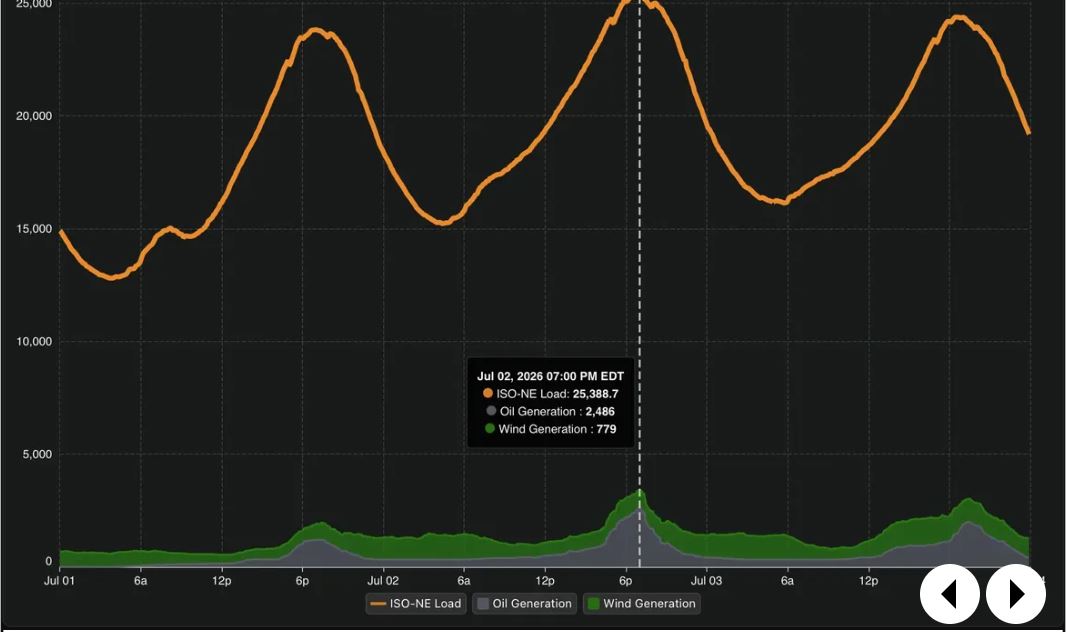

Outside New England, the already completed 132-MW South Fork Wind farm had a strong showing off the coast of New York. The project, which came online in 2024, operated at nearly full capacity on July 2, sending electricity into the heat-stressed grid on Long Island, Mikkel Mæhlisen of Ørsted, which jointly owns South Fork Wind with Skyborn Renewables, recently wrote on LinkedIn.
The Independent System Operator New England has previously stressed the role that offshore wind can play in supporting the grid during extreme heat events. The regional grid operator spoke out last August after the Trump administration halted construction of Revolution Wind, which was then 80% complete.
“Recent heatwaves in New England drove demand for electricity to very high levels and demonstrated that our region needs all generation resources with market obligations to be available to meet demand and maintain required reserves,” ISO New England said in an Aug. 25, 2025, statement, noting that delaying Revolution Wind “will increase risks to reliability.”
A federal judge overturned the stop-work order in September. But its developer Ørsted was forced to hit the brakes again in December after Trump’s Bureau of Ocean Energy Management paused the leases for all five large-scale U.S. offshore wind projects under construction. Though judges later lifted those orders as well, the delays still cost some developers millions of dollars and threatened projects’ viability.
The Trump administration has since adopted a new tactic for kneecapping America’s fledgling offshore wind industry: paying developers to abandon plans for future wind farms, using billions of dollars in taxpayer funding. The strategy makes it highly unlikely that any new projects will be built in the next few years.
However, when all five wind farms are fully up and running, they will add nearly 6 GW in clean capacity to help the East Coast navigate days of bone-chilling cold or life-threatening heat.
“The potential costs and benefits of offshore wind have been debated for decades,” said Fara Courtney, who consults on offshore wind policies and research projects for Outer Harbor Consulting, in Gloucester, Massachusetts. “Now we have the first projects up and producing, [and] the data is clear: Offshore wind is a new American energy sector with a big role to play in meeting this region’s skyrocketing energy demand.”
A new program from startup Every Electric and utility Con Edison lets New Yorkers power their window ACs with home batteries to take stress off the grid.
Earlier this month, as a historic heat dome smothered the U.S. Midwest and Atlantic Coast, New York City Mayor Zohran Mamdani asked residents to set their air conditioners to 78 degrees Fahrenheit to protect the city’s severely strained grid. “Let’s ease demand — and get through the heat — together,” he posted on X ahead of the sweltering July 4 weekend.
Previous NYC leaders and elected officials nationwide have given the same advice ahead of extreme weather events. But Mamdani’s suggestion that everyone pitch in sparked backlash from conservative figures and prompted the Trump administration to remove its thermostat-level recommendations from the Department of Energy’s website.
All the while, in apartments across New York City, hundreds of residents were supporting the electric grid without needing to adjust their AC at all.
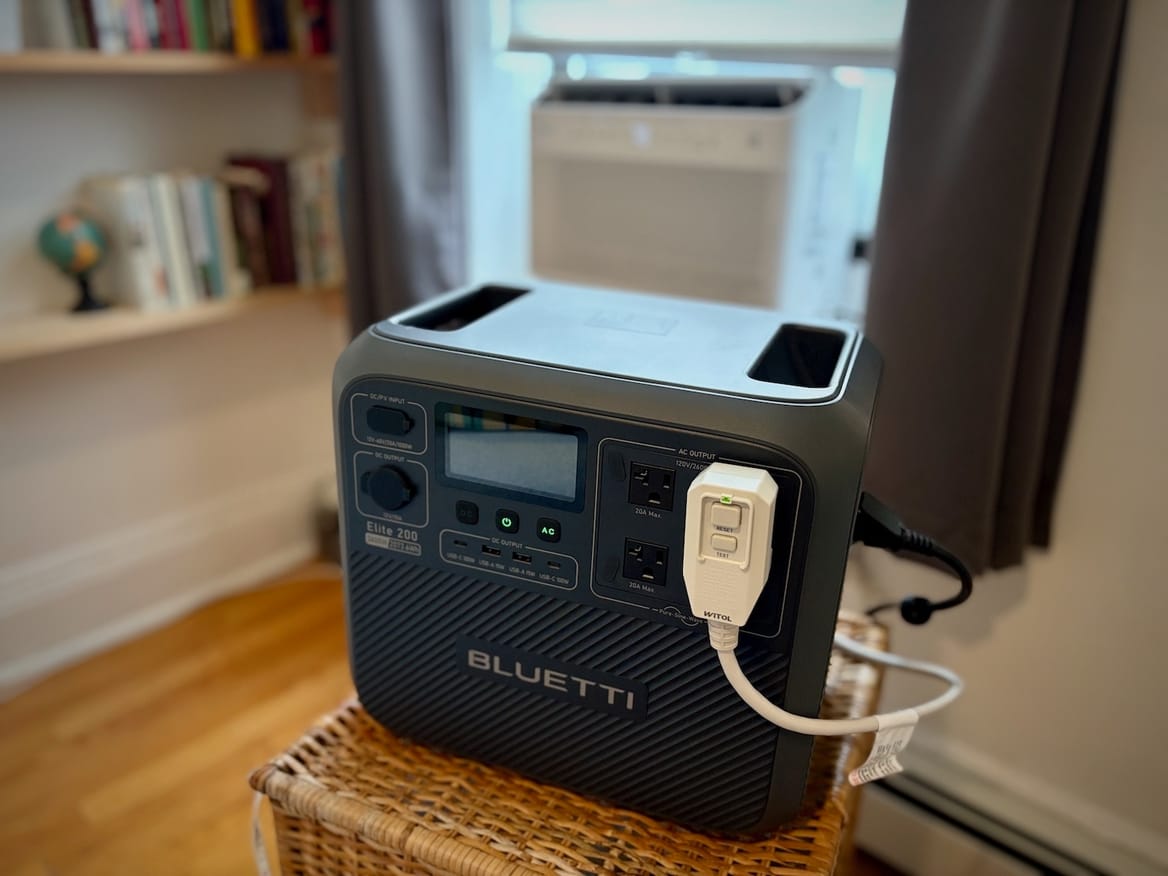
The local startup Every Electric launched a novel pilot program earlier this year with the utility Con Edison that allows participants to plug their window air-conditioning units into a battery pack, which itself is plugged into the wall. The Wi-Fi–connected batteries draw electricity from the grid when conditions are calm, then power ACs with the stored-up energy when demand on the grid is highest.
“The air conditioner can stay on, but we can still reduce load on the grid,” Andrew Wang, the company’s CEO, told me a few days after the heat wave and a subsequent major storm passed over the metropolis.
“And the big thing is, you don’t impact someone’s preferred settings,” he said. In an outage, the batteries can power a typical window unit for about four hours, he added.
Millions of New Yorkers live in older apartment buildings without central air conditioning. Many residents instead use two or more window AC units to keep their homes cool. On blistering, humid days — like July 2, when temperatures hit 104℉ — these appliances can represent about 20% of the entire city’s electricity demand, Wang said. On a household level, it’s more like 75% of total peak energy use.
Every Electric, which ran a small internal pilot last year, has so far delivered over 1,000 batteries to roughly 600 apartments, including mine. It’s free to participate, though I had to pay a $50 refundable deposit for the power bank, which is now shoved against the wall between the window and my bed. (Every Electric’s lithium-iron phosphate devices are different from the beat-up lithium-ion batteries linked to e-bike fires in my Brooklyn neighborhood and citywide.)
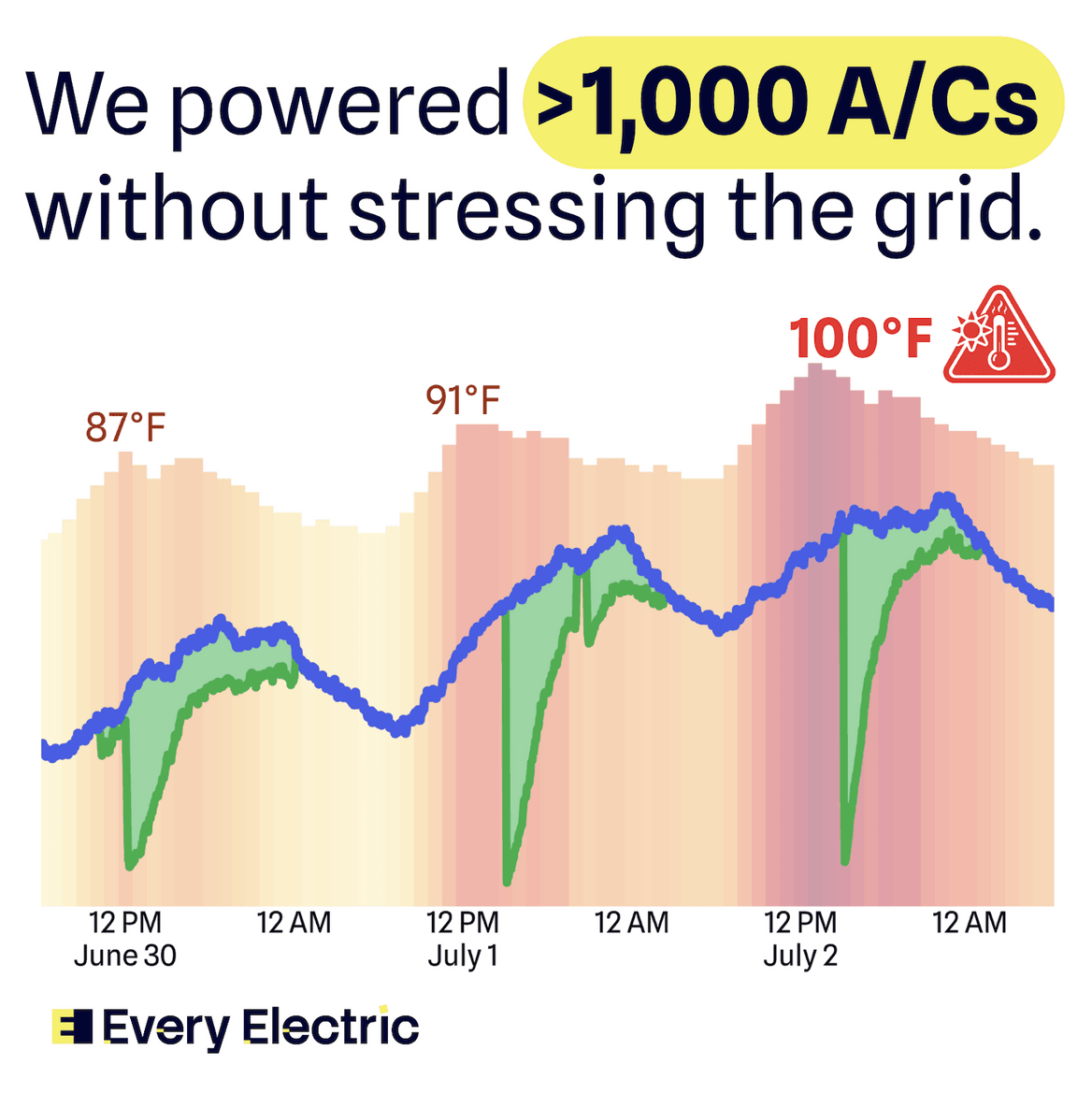
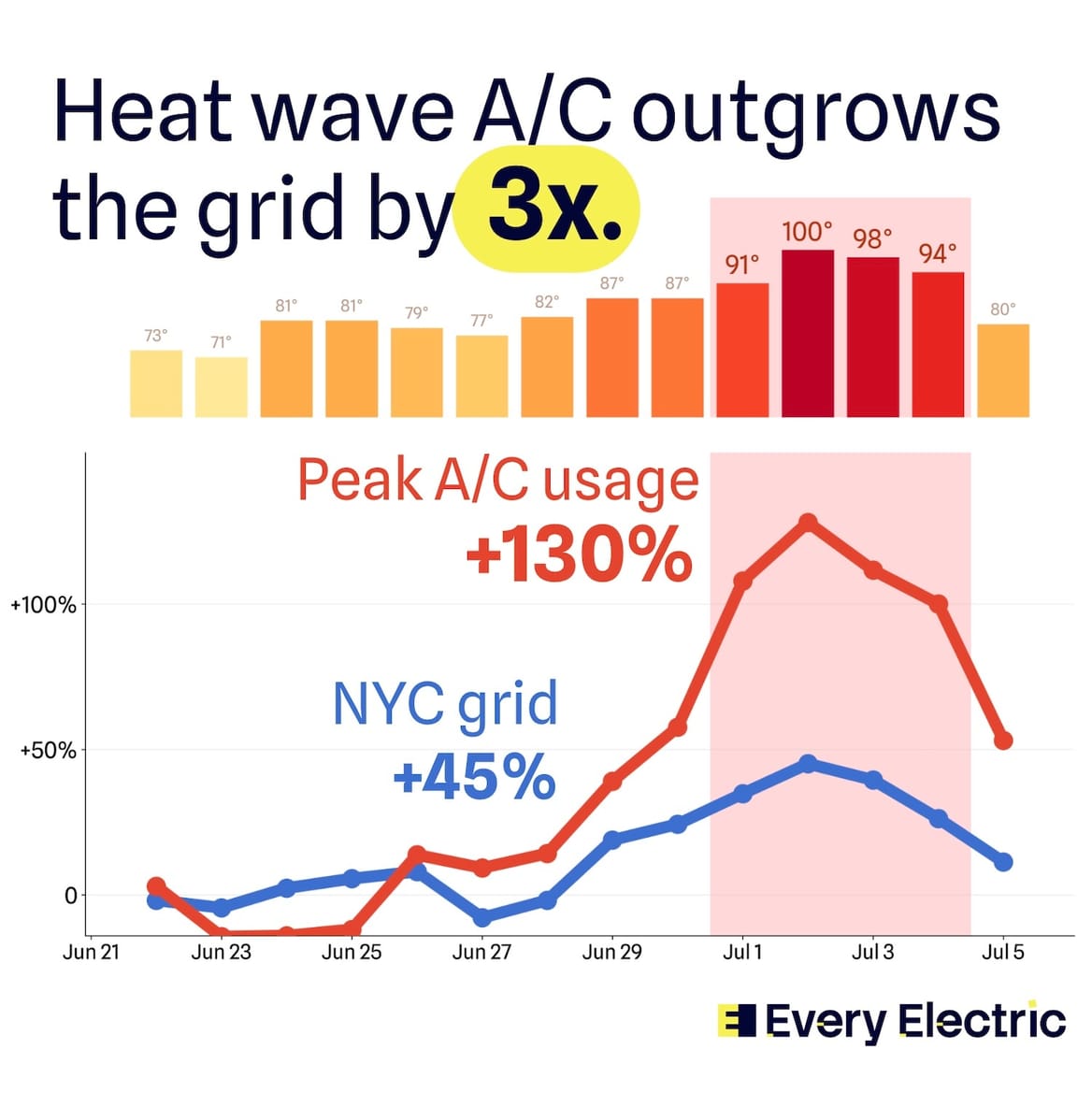
Wang said that heading into the heat wave, New York’s grid operator forecasted a 45% jump in NYC-wide peak demand for July 2. The window ACs in Every Electric’s program used 130% more electricity at their peak that day than they do in a typical week. Yet the company’s batteries met much of that demand, mitigating a source of grid stress and allowing renters to keep cool, even as Con Edison reduced voltages in certain areas to prevent widespread outages.
Collectively, Every Electric’s battery fleet can provide about 2.5 megawatt-hours of distributed energy storage. That’s a teeny sliver of the total power draw from window ACs. But experts say that such programs, when scaled, can play a crucial role in boosting grid reliability, reducing utility costs — and making the overall system more resilient to climate change.
On brutally hot days, utilities often fire up expensive, old fossil-fuel-burning peaker plants to meet the extra demand. Then there are the added maintenance costs and infrastructure upgrades. In May, Con Edison said it was investing a record $3.9 billion to lay more cables and build new transformers and substations to maintain reliable service “as extreme heat becomes more frequent and severe.”
“Distributed energy storage is a resource that [utilities] can leverage to avoid these peak demand spikes, and there’s a clear benefit for them, in terms of deferring their capacity investments,” said Bryan Bollinger, a professor of marketing and economic policy at the Tuck School of Business at Dartmouth, who studies how consumers make energy decisions.
A growing number of states, led by California, are increasingly adopting programs that call upon networks of customer-owned energy devices — like Tesla Powerwalls charged by rooftop solar panels — to support the grid when needed. But these initiatives, also called virtual power plants, primarily serve homeowners who are able to outfit their homes with clean technologies.
Every Electric’s renter-friendly approach “targets a different population completely,” Bollinger said. “You’re getting a bunch of consumers who also want to feel like they’re doing their part, but who don’t have the ability to do things like install solar panels.”
The company’s program also skirts the challenges facing large-scale battery storage systems in New York City. Big batteries can provide even greater relief to the grid, but local developers are ensnared in a regulatory battle with Con Edison related to the cost and effort of connecting to the system. Every Electric’s microwave-sized batteries face no such issues: As the utility sees it, the power bank in my bedroom is no different from a computer or TV.
Participants will be rewarded for our goodwill to the grid, with a payment that reflects each household’s peak summer monthly utility bill, up to $150 per power bank pairing.
The money comes from Con Edison’s Smart Usage Rewards program, under which the utility pays its customers to actively reduce energy use during specific blocks of time, in specific neighborhoods, on the hottest days of the year. Every Electric is enrolled as an “aggregator” that virtually manages all the power banks in its network. Wang’s team distributes a portion of the rewards it receives to its own participants, while keeping the rest to cover its costs and expand the program.
The ability to earn money while staying cool has an obvious appeal: The owners of some 10,000 window ACs units have requested batteries. Every Electric said it’s working to fulfill as many of those orders as possible over the summer.
Con Edison, which serves 3.7 million customers, said over 50,000 electricity users representing 500 megawatts in capacity are enrolled in the utility’s demand-response initiatives. During the past heat wave, the company called on customers to curb energy use 27 times across its networks in NYC and neighboring Westchester County.
A spokesperson said Con Edison doesn’t yet have specific data on how Every Electric’s pilot and other programs performed during the record-breaking heat. But in general, such efforts, combined with infrastructure investments and technological upgrades, have helped limit strain on the grid when it’s needed the most.
Beyond the Con Edison program, Wang declined to get specific about Every Electric’s financials, though he said the six-person startup is supported by a blend of sources. That includes private investors, debt financing from social-impact funds, and grants from the New York State Research and Development Authority.
“We’re excited by how scalable this can be,” Wang said, adding that the utility and state regulators “are telling everyone to look under every rock to find ways to make the grid run a little bit cheaper and more reliable.”
Bollinger, who until recently was a New York City renter himself, said he hopes that programs like Every Electric’s can catch on nationwide — because they can both bolster the grid and benefit more consumers. “It provides access to this kind of technology to non-homeowners as well, which we just haven’t seen with a lot of renewable energy technologies,” he said.
Plug-in panels can lower your bills. To boost the American market for the tech, nonprofit Bright Saver is selling kits with no markup, starting at around $300.
Do you live in the U.S. and want balcony solar? A new initiative could help you get a deal on one of these small but mighty systems that plug into a standard outlet and push clean power into your home.
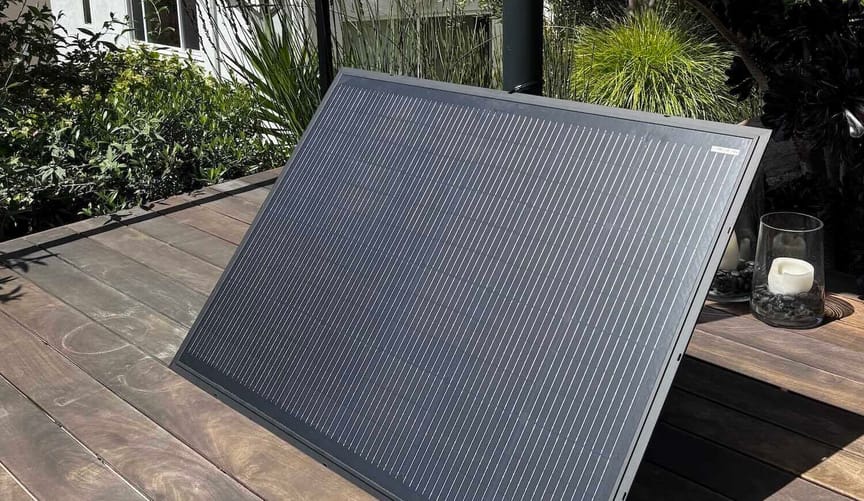
Today, California-based nonprofit Bright Saver announced it’s selling zero-markup DIY solar kits starting at about $300. The move is intended to kick-start the U.S. market for the tech, which is already cheap and widespread in Germany. Residents in 47 states can now pre-order, with shipping expected in August.
“Only a nonprofit like ours will ever give up our margins completely to pass along to consumers the savings from clean energy,” said Cora Stryker, co-founder of Bright Saver. “Someone’s got to do it, or we are up the creek in terms of energy affordability and climate.” The nonprofit has sold balcony solar kits before, but not at cost.
Plug-and-play solar can go in virtually any sunny outdoor spot. That flexibility opens up solar access to the four in 10 U.S. households who can’t, for financial or logistical reasons, put an array on their roof. With every watt generated, the tech lowers household electricity bills and reduces planet-warming emissions.
As spiking energy prices squeeze Americans, balcony solar is becoming wildly popular. Legislatures in more than half of U.S. states have introduced measures to encourage and regulate plug-in solar, and so far eight governors have signed such bills into law. Bright Saver estimates deployed systems number in the thousands nationwide.
But balcony solar in the U.S. has a long way to go to reach the scale seen in Germany. There, plug-in solar installations grew from roughly 40,000 systems in 2017 to as many as 4 million in 2025.
Bright Saver wants the tech to take off faster stateside.
That’s why the nonprofit is selling systems for “what it costs us to purchase in bulk from the manufacturers,” Stryker said. She declined to name those manufacturers, noting that the organization is brand-agnostic and could switch at any time.
Bright Saver sells a 180-watt kit for about $285 and a 360-watt kit for $414. To access these prices, you first have to become a member, which costs $29 annually (with renewal optional). Otherwise, a 180-watt kit is $499, and a 360-watt kit is $699.
The organization aims to be the Costco of clean energy; only members can access the deep discounts. And more product deals are coming. Bright Saver plans to offer plug-in home batteries that work with balcony solar kits as soon as next year.
With the membership, the 180-watt kit works out to $1.74 per watt. The 360-watt system, which is just 5% the size of a typical 7,200-watt rooftop array, is significantly better priced at $1.23 per watt.
That’s a good deal in the U.S. Nationally, the average rooftop system costs $2.60 per watt before local and state incentives, largely because of the high “soft costs” of marketing, permitting, and installation. Balcony solar kits sold domestically by companies such as CraftStrom, APsystems, and EcoFlow hover around $1.50 to $2.50 per watt, although it’s possible to find systems on sale for less.
But even Bright Saver’s 360-watt-kit price is more than three times what Germans can pay. There, balcony solar through Ikea is a stupefying $0.35 per watt. Clean energy really is cheap energy, especially outside the U.S.
A lower up-front price means a faster payback from energy savings. Bright Saver says that if you live in an area with high electricity rates and your home uses all the power as the panels produce it, its kits would save enough on electricity bills to pay for themselves in as little as 2.5 years.
Bentham Paulos, senior research associate for the national nonprofit Clean Energy States Alliance, calculates that with California’s average electricity price at 32 cents per kilowatt-hour, Bright Saver’s 360-watt kit would save a household in the state about $150 per year; that translates to a payback of about three years. The timeline can stretch from seven to 10 years in places like North Dakota, where electricity rates are lower.
You can run the numbers for your situation with Paulos’ payback calculator. Bright Saver also has a tool, which accounts for potential increases in utility rates.
Households could reap savings for decades. Solar panels and inverters can last 25 to 30 years, quietly producing power from sunlight that falls free on everyone on earth.
“The solar revolution is the great sunny hope of our time,” said Bill McKibben, longtime environmental journalist and co-founder of nonprofit advocacy group Third Act. With plug-in systems, “now everyone can participate.”
Bright Saver’s annual membership fee covers some of the nonprofit’s overhead; the group runs mainly on donor funding and says it can keep the discounted sales going for up to six months without more cash. But membership is also a way to rally balcony solar supporters.
“We’re building a constituency,” said Kevin Chou, co-founder of Bright Saver. “Joining a movement that’s actually winning is its own kind of power. Every Bright Saver member makes the case for saving money and fighting climate change a little harder for lawmakers to ignore.”
Regulations to ensure the consumer safety of balcony solar are still evolving in the U.S. But Bright Saver states that its kits are safe to use, as the individual components — the panels and inverters — have been certified by a nationally recognized testing laboratory, even though the system as a whole has not. (No system yet has.)
That limitation impacts where the nonprofit sells its kits. Some states are requiring complete-system certification. Bright Saver said it will block shipping to Maine, New York, and Vermont, which have passed bills with that mandate, according to the nonprofit. Other states, like Utah, which in 2025 became the first to legalize balcony solar, require only that the kits’ individual components are certified.
Still, component-level standards have been a concern to some because balcony solar injects power into a home’s wiring. In a worse-case scenario, a portable solar device could overheat a section of a home circuit if other appliances are drawing power from the system at the same time. If the circuit breaker — the safety mechanism — fails to detect what’s going on, then a fire could break out.
But a technical amendment that experts have proposed adding to the National Electrical Code, rules that all states use to safeguard people from electricity hazards, points out that the electrical wires in U.S. homes have some buffer built in. This margin isn’t enough for a larger 1,200-watt balcony solar setup, but it is sufficient to accommodate Bright Saver’s system.
Plugging 360 watts into a typical 15-amp circuit “can never damage” the 14-gauge copper wires commonly used, per the amendment’s explanatory notes. While the proposal hasn’t been adopted yet, Stryker expects it will be by September 2028, before the next scheduled update to the code is released.
“We designed our systems to be 360 watts because of what the NEC amendment tells us is safe,” Stryker said.
Balcony solar is still a new technology in the U.S., and not everyone is going to feel comfortable with it yet, Stryker said. But sentiment could shift “once we have tens of thousands of these [deployed], demonstrating that there are no house fires, even with the component-level certified systems,” Stryker said.
“And let’s not forget, Utah has had up to 1,200-watt systems in the wild for more than a year now,” she added. “We have no major safety incidents.”
Sodium-ion batteries promise cheaper, more durable energy storage. Peak Energy seeks to kick-start the next-gen battery market by building the first big U.S. plant.
Startup Peak Energy launched in 2023 with a promise to bring the up-and-coming sodium-ion battery chemistry to American shores. Now, it’s building a gigafactory in Sacramento, California, that will be the country’s first to produce sodium-ion battery storage plants for the grid.

If Peak Energy succeeds in its broader mission, it will introduce a new generation of batteries better suited for grid storage than the dominant lithium-ion chemistries, which are effectively hand-me-downs from electric vehicles. These sodium-ion batteries can run safely at a broad range of temperatures, company leaders say, meaning they can operate more cheaply and durably than the lithium-ion phosphate (LFP) cells that have become the go-to for stationary storage.
“We’ve gone from proving the technology out and having really great interest to having contracted business with customers that we have to go deliver on,” said Peak’s CEO and co-founder Landon Mossburg. Chinese battery companies have begun scaling sodium-ion production in recent years, but the technology hasn’t broken into the Western power sector yet. Peak is at the forefront of startups trying to make that happen.
Peak assembled a cohort of interested developers to observe the design and piloting of its storage technology, which it installed at a Colorado testing facility last year. Several power producers signed up for small pilot installations this year, with much bigger orders teed up for 2027. So far, the company has worked with manufacturers in China to supply cells to its specifications and then assembled them into containers at its existing facility in Burlingame, California. That site can produce only 100 megawatt-hours per year — roughly 32 units at 3.1 megawatt-hours each — as a function of its size and reliance on some manual work rather than full automation.
That output won’t suffice in an era when a single battery project may need several times the Burlingame site’s annual production. The Sacramento factory will produce 40 times more, 4 gigawatt-hours per year, when it starts its highly automated production, planned for the first quarter of 2027. Once assembled, the 100,000-pound containers can slip right onto the highway for shipment to customers.
It’s a quick turnaround as far as factory buildouts go, made possible because Peak found a newly built shell to lease in an industrial park near the Sacramento airport, said Mossburg. The site already had power supply from the Sacramento Municipal Utility District, so Peak can drop in its manufacturing equipment with only minor upgrades to the structure and electrical service, he added. It also helps that the factory won’t be doing the highly technical cell fabrication, which takes longer to install.
Peak chose Sacramento after a competitive search around the country, and ended up bucking the conventional wisdom that you can’t build things in California anymore. Mossburg said he wanted to prioritize access to talent, rather than chase the richest state and local incentives or the lowest cost of labor or energy. Operating in California involves spending more in taxes and electricity costs than, say, in Texas, but Sacramento is accessible to the Bay Area and all the electrical engineering expertise of Silicon Valley and the Tesla diaspora. It’s also close to the Burlingame site where Peak has built its first enclosures.
Peak also won $10.5 million in tax credits from the California Competes program, which are tied to hiring milestones, Mossburg said.
Down the road, Peak leadership hopes to find onshore sources for its battery cells, and formed a partnership in June with GM to co-develop that product with the automaker’s Michigan battery labs.
All told, Peak’s strategy could allow for a relatively low-cost and rapid path to large-scale manufacturing. That would be a welcome contrast to the billion-dollar factory expansion pursued by Swedish startup Northvolt, which tried to forge a European battery empire before collapsing into bankruptcy. (Mossburg worked there for a time as president for North America.) But Peak still needs to prove there’s a market for a chemistry that has never been widely deployed in the U.S. grid storage market, which has been notoriously unwelcoming to anything that isn’t lithium-ion.
Peak’s chief strategy officer, Geoff Brown, got in early on the current LFP trend about a decade ago, when he was running pioneering grid-battery firm Powin Energy. His company scoured the Chinese market for the best cells to put into grid storage enclosures, and ultimately picked a form factor that had been designed for electric buses, he recalled. At that point, sodium-ion cells hadn’t made the jump to mass production.
Unlike the chemistries that ruled the grid storage market thus far, sodium-ion was “the first battery really purposely designed” for stationary storage, Brown said.
“You sacrifice some energy density for massive improvements in safety but also very significant economic benefits,” he noted.
A vast global factory base now produces LFP cells, but sodium-ion is already within striking distance of the per-cell manufacturing cost given its cheaper bill of materials, Mossburg said. Peak is pricing its enclosures to match Tesla’s LFP-fueled Megapack, but argues that they cost less on a lifetime basis because the cells are so durable and don’t need energy-sucking temperature-control and fire-suppression equipment.
Still, scale matters, and the Sacramento site is a necessary step for taking on the U.S. storage market with this new battery.


.svg)
