

 Back
Back
So far this year, it has built more battery capacity than any state besides Texas. But political shifts could complicate the long-term growth trajectory.
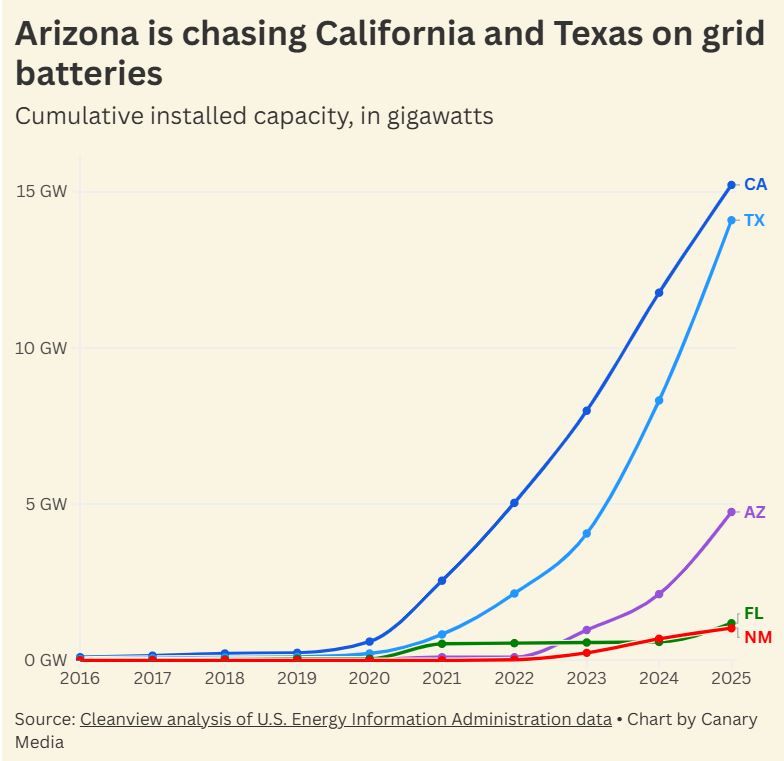
California and Texas have led the charge on America’s grid battery revolution. Now, a third state is racing to catch up: Arizona. The Grand Canyon State installed more battery capacity than every state besides Texas over the first half of 2026, per a Canary Media analysis of U.S. Energy Information Administration data.
It’s the continuation of a trend from last year, when Arizona also edged out California in both storage and utility-scale solar additions. In recent months, Arizona welcomed three new battery projects with 250 megawatts/1 gigawatt-hour of storage each — Beehive, Catclaw, and Pediment — plus several smaller ones.
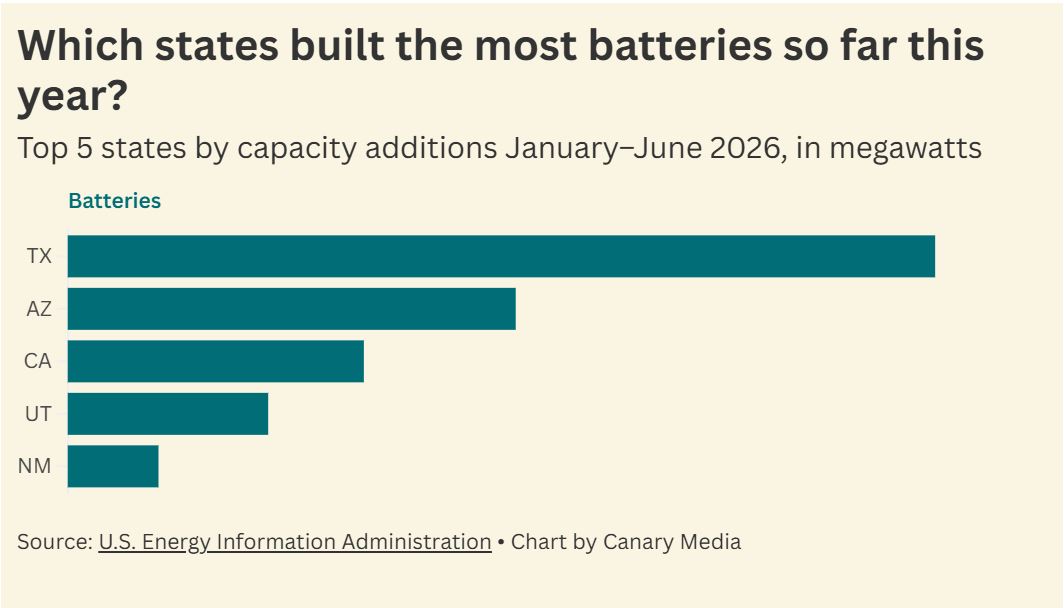
Arizona also effectively tied Florida for the second most solar installations in the first half of this year (again following Texas) and rounded out its portfolio with 300 MW of gas power and 500 MW of wind.
To be clear, Texas and California still have far more solar and storage plugged into their grids. Battery storage has already helped both states avoid grid shortages heading into heat waves or cold snaps, and pushed wholesale prices down by offsetting more costly gas power with cheap solar generation stored from sunnier hours. But Texas and California were the only states that had managed to unlock perennial multi-gigawatt battery construction until now.
Arizona is currently expanding the map of grid storage dynamism — though some renewable energy advocates worry that a recent turn against clean energy in the state could cause the growth to fizzle out.
Texas and California are special cases. Texas lets batteries compete in an open, deregulated market for energy, and investors flooded in when they saw there was good money to be made. California painstakingly funded years of storage policies to complement the state’s grid decarbonization goals, mandating that utilities invest in batteries while making new gas plants nearly impossible to build.
Arizona doesn’t have a Texas-style free market for energy; its customers are served by a handful of vertically integrated monopoly utilities, namely Arizona Public Service (APS), Tucson Electric Power, and the Salt River Project. Nor does the state boast a California-style mandate or policy apparatus. Indeed, the state’s elected board of utility regulators just went out of its way to eliminate the meager renewable-energy target that had been on the books for two decades.
But Arizona does have ample sunshine and clear, dry weather, making solar the obvious winner for cheapest kilowatt-hour of electricity. In such places, a rapid buildout of solar projects leads to diminishing returns — unless you use batteries to store up surplus solar during the sunniest hours of the day.
To properly understand the boom in battery construction today, one must look back to market conditions around five years ago, when the utilities were awarding the contracts for these plants, said Autumn Johnson, executive director of the Arizona branch of the Solar Energy Industries Association.
In 2018, the Arizona Corporation Commission chastised APS for relying too heavily on gas power plants in its long-term planning, prompting the company to take batteries seriously as a cost-effective source of peak power. The Biden administration passed the Inflation Reduction Act in 2022, solidifying a decade’s worth of tax credits for installing solar and batteries. Within a few years, all the state’s major utilities had pledged to decarbonize their fleets by mid-century.
The wave of storage projects built in recent years is the result of contracts the utilities signed in those heady times, Johnson said.
But the political landscape in Arizona and nationally has shifted since then, casting a pall over the future of the state’s solar and storage buildout.
The Trump administration gutted Biden’s climate law last year, though it preserved tax credits for batteries specifically. APS abandoned its own climate goals. The utility regulator is picking performative fights with clean energy instead of pushing the utilities to be more ambitious. The state legislature this year proposed “a record number of terrible energy bills,” Johnson said, including ones to mandate that 85% of electricity capacity come from dispatchable or baseload sources (not intermittent renewables) and to label wind and solar farms a “public nuisance” if they fall within 4 miles of a residential property.
And while the utilities can’t change the fundamental economics of solar and batteries, they can change how they assign contracts, Johnson noted.
APS, the biggest battery builder in the state, said in a July planning session that it was excluding four-hour duration batteries from modeling for its long-term energy plans, limiting the options to those with six to eight hours of duration. Four-hour batteries have in recent years become the standard type of peaker plant getting built in California and Arizona, but now APS seems to be taking them off the table. Adding more hours of energy discharge provides greater coverage for the grid but increases construction costs.
“Given all the changes, will we keep our top spot in five years?” Johnson asked of Arizona’s energy storage leadership. “I’m not sure it will be a long-lived reign at the top.”
At the very least, construction will continue at a rapid clip through 2026, according to the EIA data, anchored by the nearly finished Maricopa Energy Center, which includes a 550-MW/2.2-GWh-hour battery. Seven battery projects are already under construction for 2027 completion, ranging from 100 MW to 300 MW. Utilities will need to be signing new contracts now to keep the momentum going into the 2030s.
The money was mandated by Congress to help manufacturers like Cleveland-Cliffs adopt low-carbon tech. Now it’ll be used to extend the life of a polluting facility.
A $500 million Biden-era grant to decarbonize steelmaking has been refashioned by the Trump administration to upgrade a coal-fueled blast furnace in southern Ohio.
On Friday, Cleveland-Cliffs confirmed that the U.S. Department of Energy had changed the scope of the previously awarded funding for Cliffs’ Middletown steel mill — the longtime economic engine of Vice President JD Vance’s hometown. Vance and Energy Secretary Chris Wright visited the plant on Friday to tout the federal investment.
“The DOE’s support for this project is a testament to the importance of preserving the blast furnace route to produce automotive-exposed grade steels in the U.S.,” Cliffs CEO Lourenco Goncalves said in a statement on Friday. The Middletown plant makes steel used in the exposed parts of cars, trucks, and SUVs.
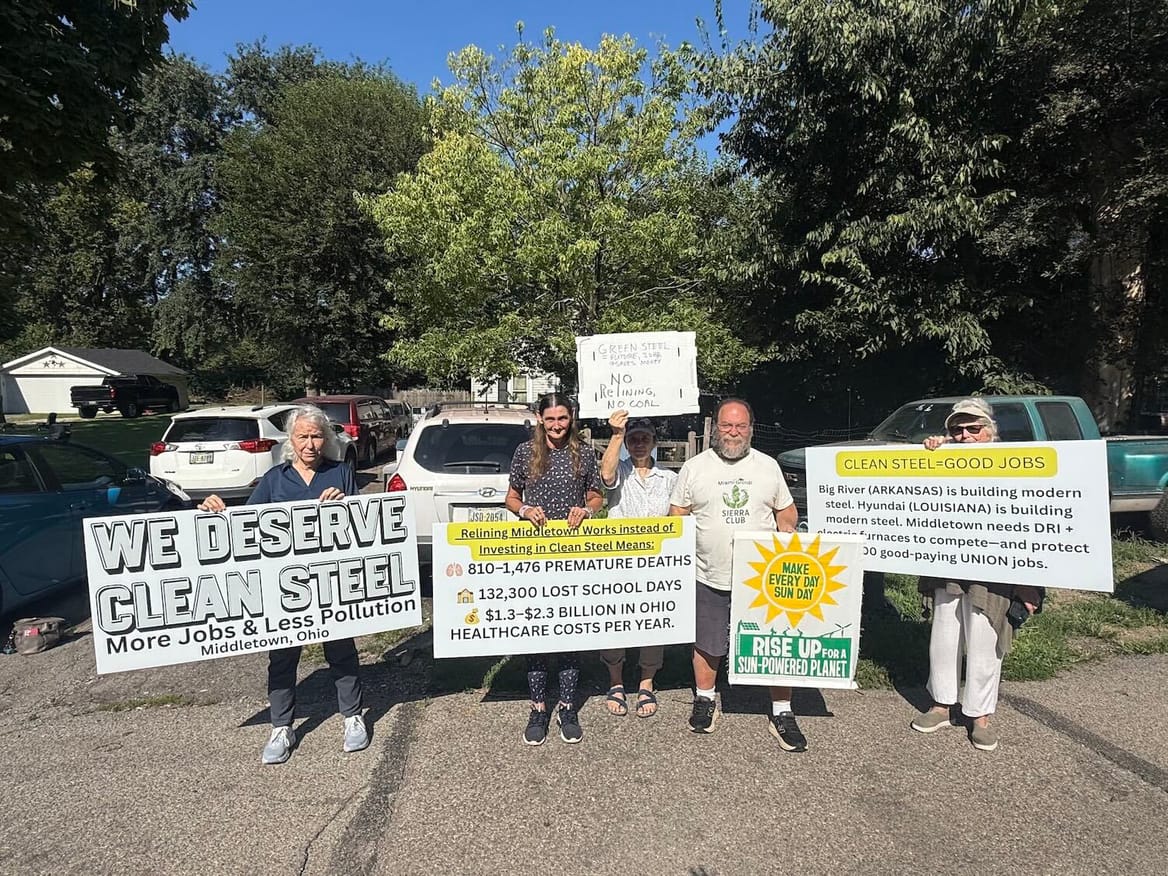
Today’s announcement makes official what Cliffs has been signaling would happen in recent months. The change of plans has drawn pushback from green-steel advocates and some Middletown residents, who say they are dismayed that funding meant to slash industrial emissions could potentially amp up local air pollution instead.
“Cleveland-Cliffs and JD Vance need to get rid of coal and go back to the original project that would clean up the air we breathe and improve our health,” Donna Ballinger, who lives in the shadows of the Middletown steel mill, said Friday in a news release shared by the Sierra Club.
Cliffs initially planned to use its half-billion-dollar award to replace its aging blast furnace with cleaner, hydrogen-ready technology and electric furnaces. In March 2024, the Biden administration’s DOE chose Middletown as the place to unveil its broader, $6.3 billion program for decarbonizing key U.S. manufacturing sectors, which was primarily funded by the 2022 Inflation Reduction Act.
Globally, iron and steel production generates roughly 9% of human-caused CO2 emissions every year, and the vast majority of that pollution comes from using coal in blast furnaces. Replacing the centuries-old technology is considered key to limiting the worst impacts of climate change, and global efforts to clean up steelmaking are advancing, though in fits and starts.
Cliffs’ original project would’ve replaced coal with natural gas — and eventually hydrogen — eliminating roughly 1 million tons of planet-warming emissions. But after President Donald Trump took office in 2025, the Ohio-based steelmaker recommitted itself to using “beautiful coal” at the Middletown steel mill.
Under its current plan, Cliffs says it will refurbish and optimize the 73-year-old blast furnace so that it can run for potentially another two decades. The manufacturer will also install a cogeneration plant that uses waste gases from the blast furnace to generate steam and electricity for the steel mill’s operations. Cliffs said it will invest $500 million of its own money to match DOE’s grant.
Cliffs first outlined the new direction in a February air-permit application submitted to Ohio’s environmental regulator. It wasn’t clear then whether this work would be funded by the DOE, given the nature of the grant program.
However, in July, Goncalves said during an earnings call that the company aimed to redirect the $500 million grant to align with the Trump administration’s priorities. Friday’s announcement cements those plans, with the DOE having “established a framework for Cliffs to finalize negotiations and implementation plans” for the Middletown project, Cliffs said.
In a news release, the DOE said the company “determined that the business case for the original project scope no longer made sense given customers’ unwillingness to pay a ‘green premium’ for steel. Working with the DOE, Cleveland-Cliffs identified a viable alternative that will upgrade and improve the efficiency of its existing coal-fired blast furnace” while also capturing waste gas.
A former DOE official noted that Congress legally mandated that the grant funding be used to, in the words of the Inflation Reduction Act, enable “advanced industrial technology” — defined as something “designed to accelerate greenhouse gas emission reduction progress to net-zero at an eligible facility.”
The Middletown project’s revised scope will move the steel mill away from achieving net-zero emissions, not toward it, the former official said.
As Cliffs sees it, the steelmaker is “going above and beyond a standard blast furnace reline, to include the most advanced technology available,” Goncalves said in Friday’s statement, referring to the cogeneration plant and other planned energy-efficiency improvements.
“Cleveland-Cliffs is making a decisive investment in the future of American steelmaking and manufacturing,” he said.
Lakes Mead and Powell have sunk to unprecedented lows, jeopardizing their generation capabilities — but drought persists in the Northeast, too.
The U.S. depends on hydroelectric power — and ever-worsening drought is threatening its supply.
The western half of the country has faced a water crisis for years, and things have only gotten more dire in 2026. Rocky Mountain states didn’t get much precipitation this past winter, and a steamy spring quickly melted what little snowpack there was.
Now, the Colorado River is suffering the consequences. Lake Mead and Lake Powell — the nation’s two largest reservoirs, held in by the Hoover and Glen Canyon dams, respectively — both reached record-low water levels this month. Those reservoirs hold crucial supplies of water for drinking and farming throughout the West, and when they’re full, can produce more than 3 GW of power.
Current water levels in both Mead and Powell are too low to produce anywhere near that much power. And the Bureau of Reclamation, which manages water levels in both reservoirs, projects there’s a slim but real chance that they could sink too low to produce any power at some point next year.
As big as they are, these two dams provide only a small portion of the Southwest’s total electricity supply. But drought, exacerbated by climate change, is challenging dozens of other hydropower plants throughout the West — and across North America. Hydro provides nearly all the power in Quebec, but the Canadian province is stuck in a yearslong drought that has diminished its generation capacity.
That’s not just a problem for Canada. The Northeastern U.S. brought two huge transmission lines into operation this year to carry Canadian hydropower into New England and New York City. But plagued by outages and drought conditions, those lines have transported far less power than expected into the U.S., casting doubt on whether Canada’s once-abundant hydropower can be the clean energy savior the Northeast hoped it would be.
Trump’s cabinet cheerleads battery projects
The Trump administration may be trying to take down clean energy, but it’s cheering batteries on.
This week, South Korea–based company LG Energy Solution opened a battery manufacturing facility in Lansing, Michigan, and Interior Secretary Doug Burgum was there to celebrate. As Claire Hao reports, the project was originally a joint venture between LG and General Motors, but a waning EV market led GM to pull out. LG now solely owns the facility, and half of the cells it produces will go to storage, while the other half will go to Toyota to put in EVs.
Another battery-boosting event this week also had a special guest from President Donald Trump’s cabinet. Energy Secretary Chris Wright joined Maine Republican leaders to tout the construction of Form Energy’s grid-scale battery storage project on the site of a former paper mill.
Despite slashing funding for other clean energy projects, the White House has largely preserved incentives and money for battery storage.
Pennsylvania wants data centers to bring their own energy
As I wrote last week, pretty much every governor looking to be reelected this fall is cracking down on data centers, and Pennsylvania Gov. Josh Shapiro (D) is no exception.
This week, Shapiro issued an executive order requiring that data centers meet “stringent” energy use, economic, and community engagement standards if they want to secure expedited permits. And as Jeff St. John reports, the announcement explicitly follows through on PJM Interconnection’s call for member states to help the grid operator rein in data center power demand. Under Shapiro’s order, data centers that want an fast-tracked grid connection will either have to secure their own power or face potential curtailment when the grid is stressed.
PJM is struggling to keep up with rising demand in its region, and its power prices are increasing as more and more data centers look to come online. Shapiro’s order is a step toward the bring-your-own-clean-energy policies that grid experts have named as a potential solution to data center demand.
Data center dreaming: OpenAI announces plans to develop a 10-GW data center complex in Ohio, which will be powered by a 9.2-GW gas plant built and owned by the U.S. government — two projects of unprecedented size and questionable feasibility. (Wall Street Journal)
Heat pump high-rises: More than half of apartment buildings constructed in the U.S. last year included ultraefficient heat pumps, and new home construction is close to passing that milestone, too. (Canary Media)
Geothermal road map: A new report lays out how state policies can help next-generation geothermal companies secure the financing they need to take off. (Canary Media)
Homegrown solar: U.S. solar manufacturer Qcells, which recently brought the entire panel production process into its Georgia factory, could benefit from the Trump administration’s latest round of tariffs on polysilicon imports. (Grist)
Clean heat revolution: Three projects in Boston and Cambridge, Massachusetts, aim to tap heat from the ocean and rivers to provide heating and cooling to major institutions and replace natural gas. (Canary Media)
Power hour: Xavier Becerra (D), California’s top gubernatorial candidate, proposes giving residents two hours of free power every day in a move that could shift grid demand to when solar power generation is high. (Canary Media)
Despite Trump’s attacks on renewables, it’s the same old story so far this year: The U.S. is building lots of solar and storage and a little bit of everything else.
It’s a tough time to build renewable energy in the U.S.
In 2026 alone, the Trump administration has phased out tax credits, frozen clean-energy permitting, and issued tariffs certain to raise the cost of solar — while continuing to take lazy and misleading swipes at renewables.
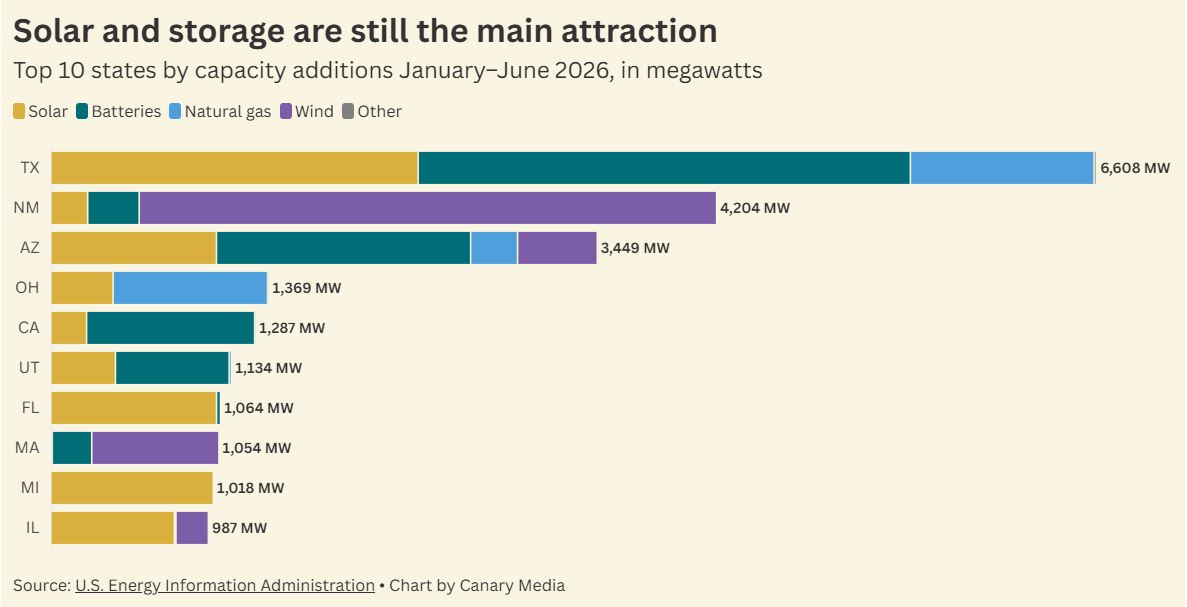
And yet 90% of what was built in the first half of this year is either solar, storage, or wind power, per U.S. Energy Information Administration data.
In fact, solar and batteries alone made up more than two-thirds of all new capacity added to the grid between January and June. As one analyst told Inside Climate News in a story parsing this same data, solar-plus-storage has become the grid’s “workhorse.”
Texas, of course, has led the way in building solar and energy storage — and in overall power plant construction. New Mexico, powered by the gigantic 3.65-gigawatt SunZia wind project that was completed in June, added the next-most overall capacity. (Yes, for those keeping track, that is the largest wind project in America turning on despite President Donald Trump’s vow to block all wind construction during his second term.) Arizona’s continuing solar-plus-storage boom boosted it to the third spot.
It’s no surprise that renewables are leading the way in 2026. It’s a trend that’s persisted for the last few years.
The Trump administration has proved unable to change that, although his tariffs and tax credit cuts have made clean energy more expensive to build. But costlier renewables are still cheaper than fossil fuels, not to mention free of the carbon emissions that are baking the planet.
If bold plans to fuel the AI race with natural gas actually materialize, it’s possible that gas could challenge renewables’ dominance. After all, Amazon and OpenAI plan to build individual gas-fired facilities that could, on their own, eclipse the total amount of gas built across all of the U.S. last year.
But those monster gas plants are far from a done deal. What’s more certain, whatever becomes of the grand plans to build more gas, is that solar and storage will continue to soar.
The climate-friendly appliances are becoming the norm among American home builders. Here are the factors driving the shift.
Heat pumps are a key way to get fossil fuels out of buildings — and the tech recently notched a win in the U.S. housing market.
2025 marked the first year that over half the apartment buildings constructed nationwide came equipped with the überefficient electric appliances, according to U.S. Census Bureau data. Buildings with heat pumps, which can both heat and cool indoor spaces, accounted for 53% of new apartment complexes, up from 46% in 2024.
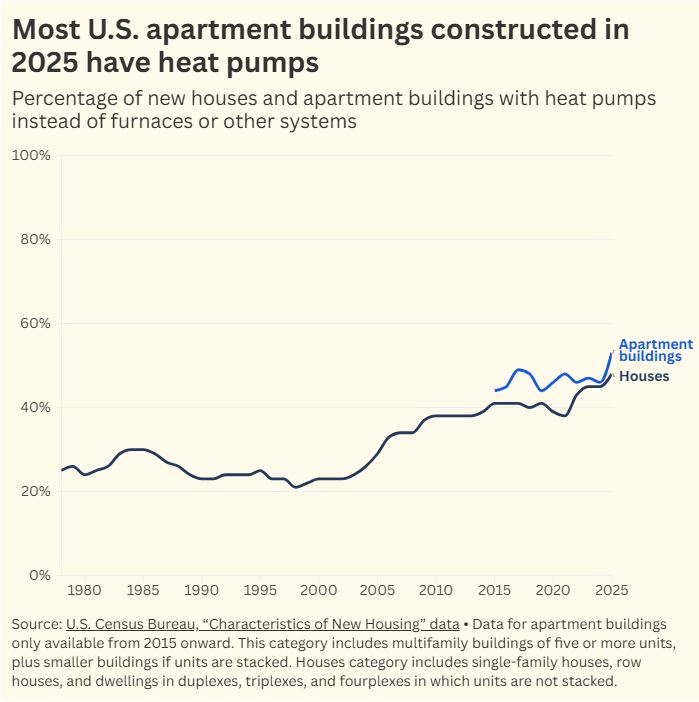
New houses, including row houses and town houses, aren’t far behind: In 2025, 48% were built with heat pumps, up from 45% in 2024.
The stats are the latest evidence that heat pumps are taking over the U.S. residential heating market. For the past four years, these devices have outsold conventional gas-fueled furnaces, which belch pollution that endangers health and warms the planet. The tech’s growing popularity is a positive sign for decarbonization, since burning fossil fuels in buildings contributes nearly a tenth of the nation’s total greenhouse gas emissions.
The data reveals another piece of good news: The majority of all homes built last year — 78% of new apartment units and 56% of new houses — had electric heating in some form, either heat pumps or less-efficient electric-resistance systems.
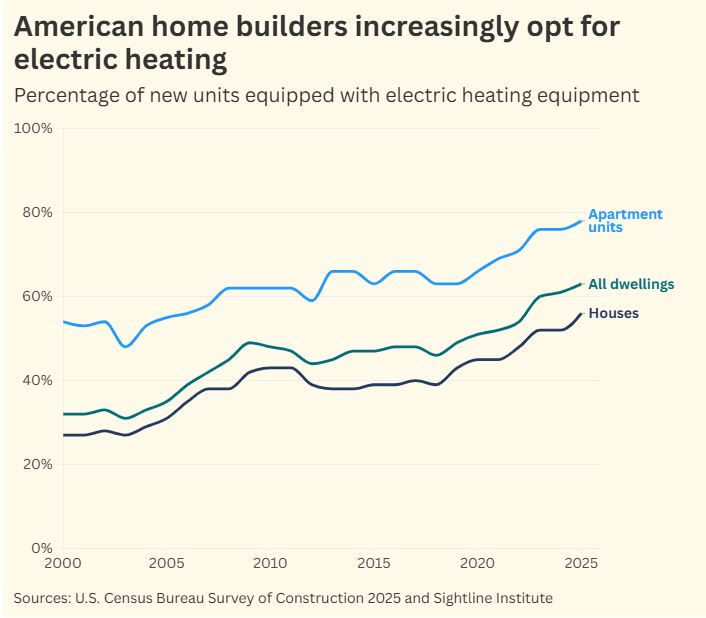
This trend toward electric heating has persisted for over two decades now, across federal administrations, though it varies regionally. For example, in the South, with its milder winters, 96% of new apartments are electrically heated; in the Northeast, it’s just 52%.
Driving the shift to heat pumps is likely a combination of factors, according to Alan Durning, executive director of the Sightline Institute, a sustainability nonprofit in the Northwest. The two that stand out, he said, are improvements to the technology and the increased demand for air conditioning during climate change–fueled heat waves. While heat pumps are pricier up front than gas furnaces, they can be competitive with a gas furnace plus central AC.
A federal tax credit expanded under the 2022 Inflation Reduction Act could have also spurred heat-pump installations. That incentive offered developers up to $5,000 per energy-efficient housing unit. But even though the credit expired last month after being axed by President Donald Trump and Republicans in Congress, developers still stand to profit by ditching gas in new buildings.
All buildings require electrical infrastructure. But hooking up to a gas pipeline on top of that adds complexity, time, and expense. New Mexico land developer John Moscato says that by skipping gas-line construction, his company reduces costs by $3,000 per lot. That adds up fast.
“In our upcoming development of 4,500 lots, we expect the savings of being all-electric to be approximately $13.5 million,” Moscato said.
Some states, like California, Colorado, and Washington, have standards that encourage new construction to go fully electric. But “red states are never going to pass laws requiring a phaseout of gas in new buildings,” Durning said.
Still, he said, policies that simply boost new housing in such states can move the needle toward cleaner buildings, since developers are increasingly likely to opt for electric heating appliances. And unlike gas bans, these laws are politically palatable, he added, pointing to recent pro-housing zoning reforms passed in deep-red Montana and Idaho. “We are getting accidental electrification,” he said.
Some legislators may “say climate change is a hoax, but they want to free the market in their cities to build more housing,” Durning said. “In red states, building more apartments will move us closer to decarbonization.”
American solar manufacturers are navigating shifting federal policies on tariffs and tax credits, all while demand for their product continues to grow.
This story was originally published by Grist. Sign up for Grist’s weekly newsletter here.
Inside the vast Qcells factory in Cartersville, Georgia, workers — and a bevy of robots — move ultrathin slices of polysilicon through a lengthy series of machines and chemical baths to get what are known as cells.
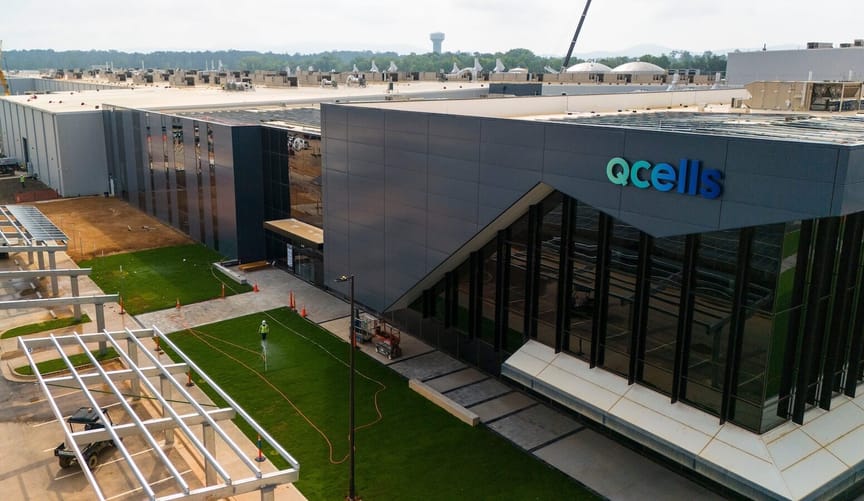
“The $2.5 billion, the 3.5 million gallons of water, the 90 megawatts of power, the 60 tons of chemicals on-site, and all of the football fields’ worth of infrastructure you’ve seen is to arrive at this,” said Scott Bell of Qcells, holding up one of the paper-thin blue cells.
It’s the basic building block of a solar panel.
In June, the plant, about an hour northwest of Atlanta, began its expansion from assembling the major components of solar panels to bringing the whole production process under one roof. It’s a major milestone for the U.S. solar industry. China has dominated solar panel manufacturing since the 2010s, flooding the global market with far cheaper panels than anyone else could make. For a host of reasons — national security, labor practices, job creation — the U.S. is trying to bring back domestic production.
In its latest move, the Trump administration plans to levy new tariffs and impose minimum import prices on polysilicon, the key ingredient for solar cells. The new measures go into effect in December.
“Having the full supply chain is critical,” said solar manufacturing expert Ben Damiani, chief technology officer at Atlanta-based solar developer Cherry Street Energy. Moving that supply chain to the U.S., he said, hasn’t been a smooth road. “Probably the biggest hindrance has been the constant change of our own policies.”
The Biden administration took a carrot approach to attracting solar panel makers: The 2022 Inflation Reduction Act included tax credit bonuses for solar projects that used U.S.-made panels. Qcells, a South Korean firm, has said those incentives were a major reason they built their Cartersville plant.
The Trump administration, by contrast, is taking a stick approach. While last year’s One Big Beautiful Bill Act, or OBBBA, revoked most of the tax credits, it also made solar equipment from certain countries — including China — ineligible for the few tax credits that remain. That, along with the new tariffs, may help a U.S. manufacturer like Qcells compete with Chinese imports, which are now more expensive.
The two policy approaches have the same ultimate goal, according to researcher Coco Zhang of the banking and investment firm ING. But it’s been whiplash for companies.
Following Trump’s latest executive actions, Qcells is still likely able to find a way to be successful, Zhang said. But Qcells has already made a multibillion-dollar investment in its brand-new facility that took more than three years to come online. For other companies with less capital and poorer timing, the supply-side incentives for domestic production may not be enough — especially when the policies could completely change again.
As a part of the OBBBA, the Trump administration closed the IRA loophole that had left room for China-based solar companies to simply set up shop in the U.S., which, according to Zhang, may go further still toward rooting out Chinese competition. In the long run, she’s optimistic that the U.S. solar panel industry can complete its shift to domestic production. But because the rules discouraging foreign ownership cut deeper into the supply chain, those restrictions and the policy back-and-forth could make things harder to navigate in the short term, she said.
The short-term outlook is complicated for those buying solar panels, too. The phaseout of federal clean energy tax credits removed a major incentive to develop new solar projects, and the Trump administration has taken steps to cancel federal funding for clean energy projects and add new hurdles for solar and wind installations on federal land. The courts have blocked or reversed some of those actions, but the delays add costs and uncertainties even for projects that do ultimately move forward.
In the first quarter of this year, clean energy advocacy group E2 tracked nearly $13 billion in abandoned investments in solar, wind, and battery projects. But some $18 billion in new projects were announced as companies scrambled to meet the deadline of the expiring tax credits. While the new tariffs and price controls on polysilicon could help U.S. manufacturers compete to supply the solar developments that remain, they could also drive up costs for developers, Zhang said, and “limited U.S. supply means many will still depend on imports and face higher costs.”
But industry experts maintain that solar isn’t going anywhere. It’s still one of the cheapest sources of electricity at a time when energy demand is growing fast. Solar panels are also readily available, while gas turbines are backordered for years. Solar and storage made up 90% of new power added to the U.S. grid in the first quarter of the year, according to the Solar Energy Industries Association.
“We absolutely should make solar, right? Like it is the fastest deployed, lowest cost foreseeable,” said Damiani. “Solar will be, for the next hundred years, a good portion of our energy.”
The questions, experts agreed, aren’t whether solar development will keep happening, but how quickly, how much it will cost, and who — and where — will make the solar panels.
It’s only the third such project to hook up to the U.S. grid. It comes as surging electricity demand drives interest in the source of around-the-clock clean power.
Sage Geosystems has hit a big milestone out on a rugged tract near San Antonio: The startup is producing power from its first next-generation geothermal plant. The system is just the third of its kind to come online in the U.S. as the sector races to commercialize the source of on-demand clean electricity.
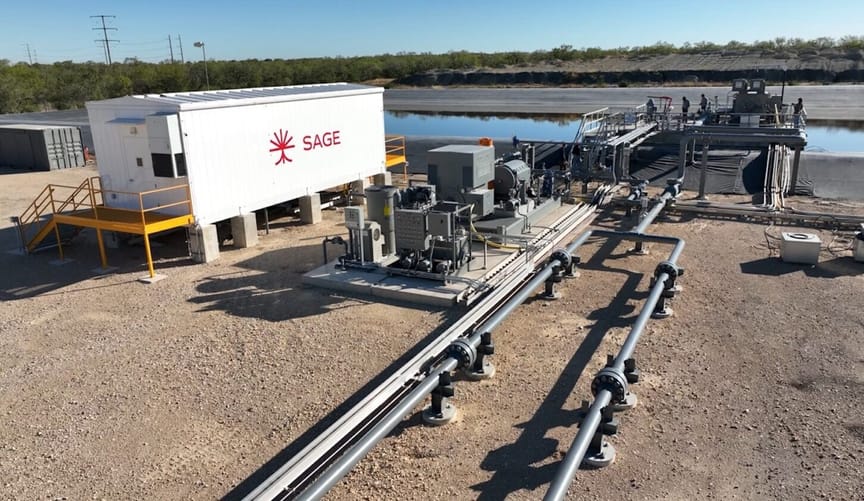
The novel geothermal facility in Texas has been running since April, Sage exclusively shared with Canary Media. The Houston-based firm said the 3-megawatt pilot plant has performed reliably and as predicted after more than 120 days of grid-connected operations.
Cindy Taff, Sage’s CEO, said the results will “directly inform and de-risk” an upcoming collaboration in Nevada with Ormat Technologies, a conventional geothermal leader that is increasingly dipping its toes into next-generation technology. The Nevada project is a necessary precursor to Sage’s deal with Meta to develop 150 MW of geothermal power.
Sage’s enhanced geothermal system is a type of nascent tech that involves drilling deep into hot rocks and fracturing them to create water pockets, then using the heat to generate power. It’s distinct from the decades-old traditional geothermal plants that rely on what Taff called “very unicorn geology” — the few places in the world where a combination of water, heat, and permeable rocks are easily accessible.
For all the buzz around the technology, just two other enhanced systems have connected to the U.S. grid so far.
In 2013, Reno-based Ormat completed a 1.7-MW demonstration project at its conventional Desert Peak facility in western Nevada, before returning its focus to old-school geothermal for a time. That demo is no longer producing power, Ormat confirmed.
A decade later, Fervo Energy began operating a 3.5-MW geothermal plant in northern Nevada in partnership with Google. Building off that project, Fervo is now constructing a 500-MW facility in Utah, which is set to come partially online in October.
Sage likewise expects its early success in Texas to fuel its commercial-scale ambitions.
The startup has been developing the pilot since 2024, when it reached a deal with San Miguel Electric Cooperative to use land near a coal-fired power plant in the town of Christine. Sage built its own substation there and intermittently sells power to the Texas grid.
Taff said that one of the most promising outcomes has been the relatively limited water loss from the underground system. Sage’s approach involves creating a network of fractures, into which it pumps and stores large volumes of water. As hot water pushes up against the rocks around it, mechanical pressure builds, which is released when the crew opens a valve at the top. This is different from other enhanced projects, which use fractures to flow water between two wells without pressure.
In both cases, water can migrate into surrounding rock formations as it moves through the fractures. The more water a project loses along the way, the less efficient it becomes at producing energy.
Sage lost less than 10% of the water that it cycled through the Texas system on multiple occasions, which Taff said bodes well not just for the company but also for the larger universe of enhanced geothermal, if it adopts similar methods.
“The net power output that you can produce from these technologies is going to go up, she said, noting that curbing water loss will enable enhanced systems to scale commercially at a competitive cost.
Initially, Sage planned to use similar geothermal techniques to develop a long-duration energy storage system near the coal plant. But in recent years, Texas has built one of the largest grid-battery fleets in the world, making the timing less ripe for rolling out a novel storage technology. So Sage is now primarily focused on meeting the nation’s growing demand for around-the-clock clean electricity.
To that end, Taff said Sage expects to begin drilling its first well at one of Ormat’s conventional geothermal plants in Nevada later this year. Sage will provide the hot water it produces to Ormat to generate electricity at the existing facility — allowing Sage to demonstrate its technology without going through the costly, lengthy steps of connecting to the grid or building a power plant.
Sage hasn’t yet specified how large this system will be, but does expect to start producing electricity in 2027 and reach full-scale production in 2028. Once that happens, Sage will begin working with Meta to start developing 150 MW of next-gen geothermal power somewhere east of the Rocky Mountains. All told, Sage has lined up about a gigawatt’s worth of projects on paper.
The Texas pilot enables Sage to “actually model and predict how the [reservoir] behavior is going to be going forward,” she said. “And that sets us up very nicely for scaling and building commercial facilities with our approach.”
An update was made on Aug. 19, 2026, to confirm that Ormat’s Desert Peak project is no longer generating power.
Trump officials touted the storage and EV plant as an example of “energy dominance,” underscoring increasing bipartisan acceptance of grid batteries.
LANSING, Mich. — The Trump administration has made clear its disdain for electric vehicles and clean energy. Yet at the grand opening of South Korea–based LG Energy Solution’s latest battery manufacturing facility, Interior Secretary Doug Burgum cheered the factory as a fulfillment of the president’s agenda.
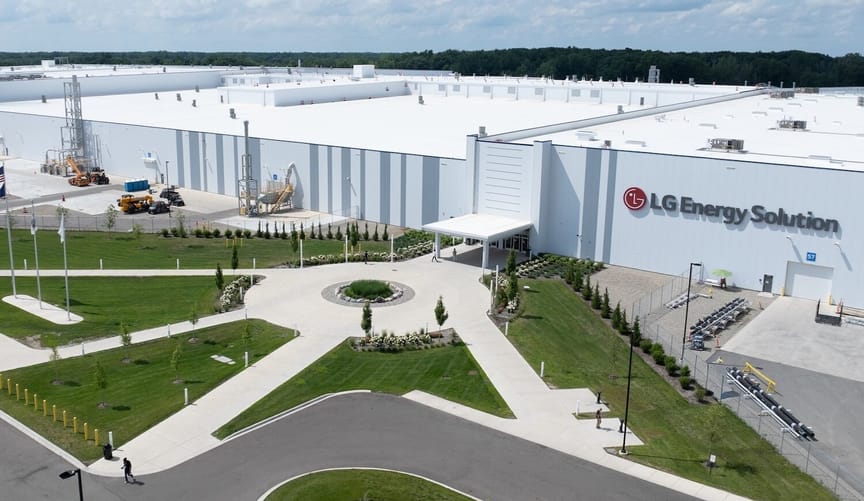
“That’s the American energy dominance in action, which is more jobs, strong allies, secure supply chains — and right here, that’s happening,” Burgum said Tuesday during the Lansing factory’s opening ceremony.
LG executives have framed the plant’s opening in similar terms, echoing the administration’s focus on energy security and the importance of making the tech in the U.S., given that China produces most of the world’s batteries.
And like many of its peers in the industry, LG has adapted wide swaths of its Lansing site, originally meant only for EV batteries, to make what is proving to be a more politically palatable technology: energy storage systems for power grids.
“No matter which side of the aisle you’re on, there’s a desire to have energy independence and to meet load growth,” said Devon Wilson, vice president of sales and marketing for LG’s U.S. energy storage division.
LG invested more than $2 billion into building its new Lansing plant, which currently employs 900 people and plans to hire approximately 800 more.
Once at full capacity next year, the facility is expected to produce more than 35 gigawatt-hours of battery cells annually, according to Anthony O’Donovan, the plant’s operations director. That would make it one of the biggest domestic plants producing cells, which are the individual building blocks of battery systems, LG Energy Solution spokesperson Phil Lienert confirmed.
From Lansing, the cells will go to plants across the country — including both to clients and to one of LG’s own facilities in Holland, Michigan — to be connected together to form battery modules, which are then arranged into battery packs, Lienert said.
This domestic network of battery manufacturing is very new, and arriving just as battery energy storage systems themselves grow at a rapid clip. The U.S. didn’t make any of its own battery cells until 2025, when companies including LG added a total of 20 GWh of manufacturing capacity, according to the U.S. Energy Storage Coalition, an industry group.
By the end of this year, the coalition expects that figure to increase nearly fivefold, to 96 GWh of cell production capacity.
The Lansing facility was first announced in 2022 as part of Ultium Cells, a joint venture between LG and General Motors to source battery cells for the Michigan automaker’s EVs.
By 2024, however, consumer interest in EVs was lagging, and President Donald Trump vowed on the campaign trail to slash federal support for the vehicles. At the end of that year, GM sold its stake in the Lansing factory to LG, making the Korean company the site’s full owner.
The Trump administration has since eliminated the $7,500 tax credit for consumers who purchase EVs and canceled more than $700 million in federal funds for battery and EV manufacturing projects. (It did, however, preserve tax credits for clean energy manufacturing facilities and for the installation of stationary storage systems.)
By the end of 2025, dozens of battery and EV manufacturing projects were canceled nationwide, totaling more than $21 billion in lost investment, according to a report from E2, a clean energy advocacy group. Michigan, which had banked on exactly these types of projects to grow its economy, given its automotive prowess, was hit the hardest.
So, LG leaders decided to embrace a more promising sector: energy storage.
In the last few years, energy demand in the U.S. has surged in part because of the massive data centers being built for the artificial intelligence boom. Battery storage systems are well-positioned not only to swiftly meet tech companies’ demand for power, but also to absorb the sharp dips and spikes in energy usage inherent to AI data centers, Wilson said.
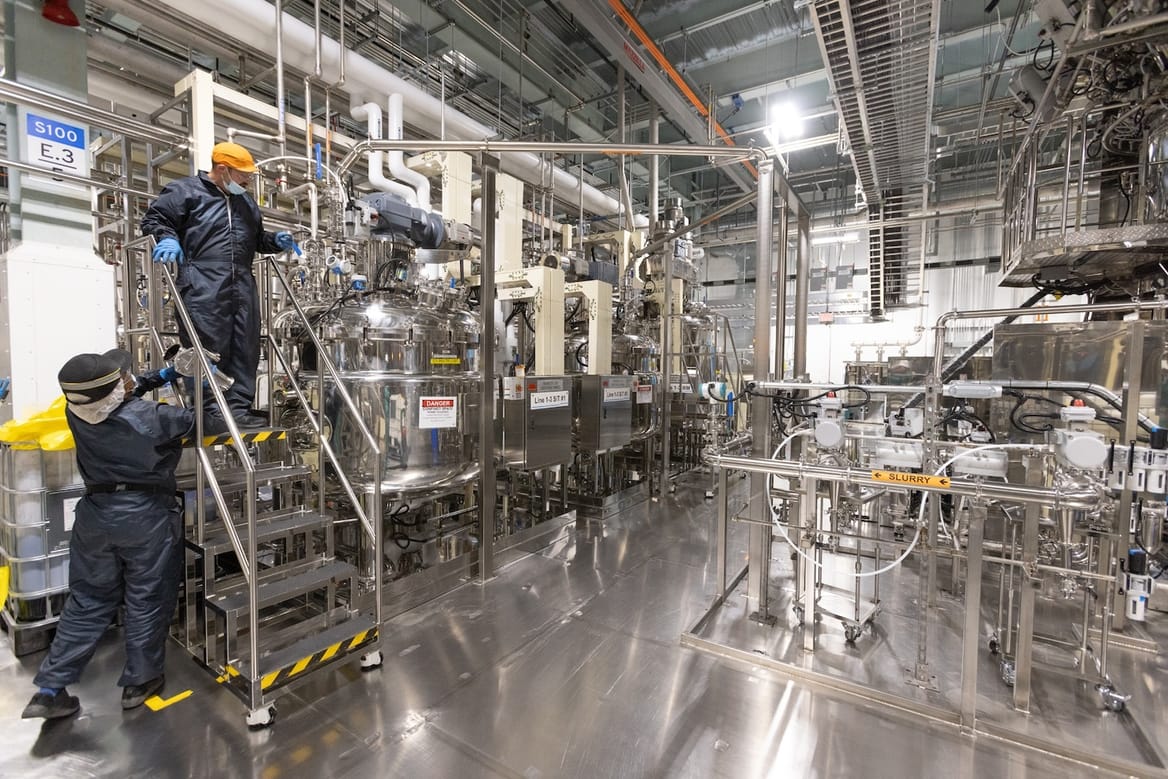
“It’s a great situation for us,” Wilson said. “We’ve seen an explosion in the size of the ESS [energy storage system] market, so we’ve really been able to grow our demand.”
In just four years, the amount of battery storage capacity in the U.S. has increased nearly tenfold, from 4.7 gigawatts in 2021 to 43.6 gigawatts at the end of 2025, according to the U.S. Energy Information Administration.
This year, developers have already built 8.2 gigawatts of battery storage nationwide, according to the EIA — a statistic that Michigan Gov. Gretchen Whitmer, a prominent Democrat, hailed as “amazing” at the opening of LG’s Lansing factory.
She also referenced Michigan’s “historic clean energy law” that requires 2.5 gigawatts of battery storage, which are often installed alongside solar farms to help stretch the carbon-free energy into other times of the day, by 2030.
“Michigan is poised to take advantage of this growth,” Whitmer said.
In line with market shifts, the Lansing plant has diversified so that it will produce roughly half EV battery cells and half energy storage cells, according to Bob Lee, the North American president of LG Energy Solution.
The EV battery cells will no longer go to GM, but to Toyota. And the plant will produce nickel-manganese-cobalt cells, which are more energy-dense, according to LG’s press release.
Meanwhile, the energy storage cells have been contracted by a variety of offtakers, including renewable-project developer Terra-Gen and Korean clean energy manufacturer Qcells, LG spokesperson Lienert said. These cells will be lithium-iron phosphate, which isn’t as energy-dense as other chemistries but has less of a fire risk.
Next year, as the Lansing facility ramps up, it is also expected to supply Tesla’s Megapack 3 factory in Houston, an agreement that Lienert confirmed but would not elaborate on.
First reported by Reuters last summer, the $4.3 billion LG-Tesla deal was officially announced in March — but by the Trump administration as part of its focus on energy security, not by the companies.
Now that it’s up and running, the Lansing facility joins LG’s growing portfolio of cell manufacturing sites. The Korean company still runs two Ultium EV battery plants with GM, one in Tennessee, another in Ohio.
Last year, LG expanded its flagship Michigan site in Holland, which in 2012 became the first in the U.S. to make EV batteries, to also produce energy storage battery cells and packs.
And this March, LG held a grand opening for its facility in Windsor, Ontario — the first commercial-scale battery manufacturing plant in Canada as well as the company’s largest North American plant, Lienert said.
“We’ve almost got a perfect latitudinal line now that extends from Holland through Lansing to Windsor,” Lienert said. “We think of this as being the belt of ESS battery manufacturing for North America.”
California’s Democratic candidate for governor, Xavier Becerra, is borrowing a page from Australia with a new plan to give state residents free electricity during certain parts of the day.
Last week, Becerra unveiled a proposal to offer up to two free hours of electricity per day, starting with low-income families. He estimates it could save households about $1,000 per year.
The idea could find traction with restive voters in the Golden State. Power prices in California have risen by 46% in the last decade, the largest increase in the nation. And energy affordability has become a top issue at the ballot box nationwide.
The program, which he calls “Power Hour,” aims to help Californians soak up more of the state’s copious solar energy.
“We produce so much solar energy … that oftentimes in the afternoon we can’t make use of all of it, and so it essentially goes to waste,” Becerra said at a Politico event last week. Solar power can become so abundant that wholesale electricity prices dip into the negative, meaning that producers will pay others to take the excess off their hands. The state throws away what it can’t consume or store for later with batteries.
Becerra’s plan could send a strong market signal to consumers to take full advantage of the state’s solar riches, he explained to his California audience. “The best way to get you to readapt, to recalibrate, is to tell you the best time for you to use electricity today,” he said, giving as an example a free-power period between 1 p.m. and 3 p.m.
Some energy retailers in Australia started offering free-power plans years ago to take advantage of the solar power flooding the grid.
Thanks to a push from the Aussie federal government, now millions more can access the scheme, known as Solar Sharer. As of last month, households with smart meters in three of the country’s six states can sign up for rate plans that offer free power in the middle of the day. For example, in New South Wales and Queensland, the energy bonanza is from 11 a.m. to 2 p.m.
The no-cost energy is capped at 24 kilowatt-hours per day — enough to cover the energy needs of a household of five, according to the Australian government. Anything beyond that the utility charges for.
While free power sounds like a great deal, it’s important to note that these plans don’t automatically guarantee lower electricity bills. Outside the free-power period, utilities can set higher-than-average rates to recoup costs — sometimes, much higher.
One of the largest retail providers in Australia, AGL, which serves more than 4 million customers, has a free-power plan with a peak rate that’s almost twice what it charges under its standard plan. The federal government provides an online tool to help consumers figure out whether switching to a plan with free power will actually save them money.
People who can shift a lot of their energy demand to the free period or cache the zero-cost power for later will benefit most. The Australian government is making that easier to do by providing a 30% discount on home batteries. (The U.S. had a similar incentive, a federal tax credit, until the Republican-held Congress and President Donald Trump axed it last year.)
More than half a million home batteries have been installed under the Aussie program. And thanks to cheap, high-tech electric vehicles out of China, households increasingly have battery behemoths in their driveways. EVs now make up a quarter of new car sales on the continent.
Existing California programs could give Becerra’s plan a big boost. Qualified households could get a generous home-battery incentive of up to $1,100 per kilowatt-hour. And the state is rolling out a $3,500 EV rebate for first-time buyers.
Some experts doubt a free-power program can be as effective in California as it is shaping up to be in Australia.
“I applaud the intent here to change human behavior,” said Saul Griffith, CEO of Otherlab and founder of electrification advocacy nonprofits Rewiring America, Rewiring Australia, and Rewiring New Zealand. “But unless this [plan] really goes along with more comprehensive electricity market and pricing reform, it may not mean that much.”
Electricity could be far more affordable if Americans unleashed clean, cheap, distributed power, Griffith contends. But to do that, “you have to break the single-utility monopoly model,” he said.
Severin Borenstein, faculty director of the Energy Institute at the University of California, Berkeley’s Haas School of Business, also had a mixed reaction to Becerra’s plan.
“I do think this would be a step in the right direction, making electricity prices more accurately convey the cost of supplying the electricity in a given hour,” Borenstein said in an email. “But it would require making up the revenue shortfall somehow, which I fear would be done by raising prices in other hours.”
The vast majority of what utilities charge customers for is not the electricity itself but fixed system costs, according to Borenstein. “Those costs would still need to be covered,” he noted.
If elected, Becerra can’t implement his plan by fiat. He said he would work with the public utility commission, utilities, and other stakeholders to realize his plan within his first year in office.
Despite the uncertainties, Michael Rochmes, policy and advocacy manager at the nonprofit U.S. Green Building Council California, is excited to see Becerra’s Power Hour take shape.
The prevailing narrative has been that electricity is expensive, and costs are ballooning faster than inflation, he said. But that story leaves out how renewables and battery storage can deliver “long-term energy abundance,” Rochmes noted. “If this idea can break through and get people who aren’t in the energy space to start to understand the benefits of electrification, load shifting, battery storage, and renewable energy, I think this is a huge win.”
Next-generation geothermal projects are underway in the U.S. West, but states will need more targeted policies for the industry to scale, a new report argues.
Next-generation geothermal energy has massive potential in the western United States, but it won’t be realized unless developers can overcome the big economic barriers these novel systems face.
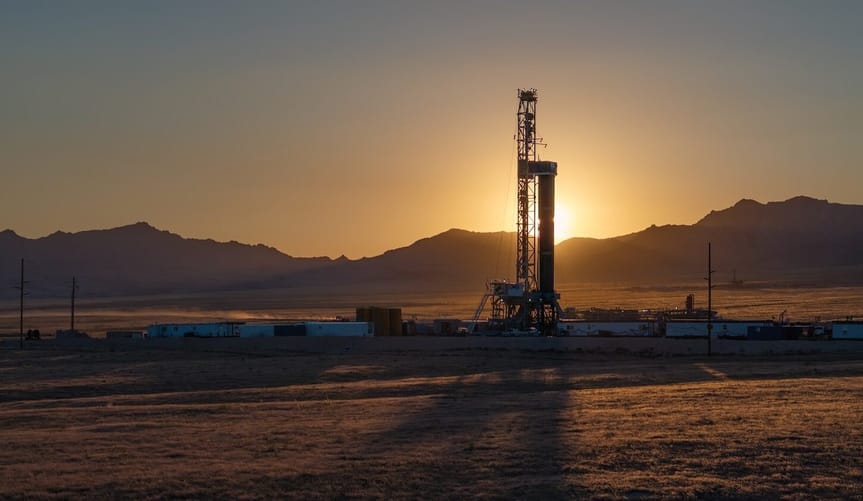
Unlike traditional geothermal plants, next-gen projects use innovative underground techniques to produce power wherever rocks are sufficiently hot, making it possible to harness heat in more locations. The energy source could provide hundreds of gigawatts of clean electricity around the clock, up from just 4 GW nationwide today.
Amid ballooning energy demand from data centers and electrification, western states are increasing their support for the industry, using tools like direct investment and permitting reform. These state-level efforts are supporting a wave of pilot projects and first-of-a-kind systems across the region, where heat is accessible at relatively shallow depths.
Still, states will need to adopt more sweeping and coordinated policies to help companies secure the kind of large-scale financing necessary to scale up next-gen geothermal, said Ann Garth, policy manager for superhot rock geothermal at the nonprofit Clean Air Task Force.
Garth is the lead author of a new report, shared first with Canary Media, that describes how states can “de-risk” geothermal for infrastructure investors, who typically pick up where venture-capital funds and federal research programs leave off.
Geothermal’s high upfront drilling costs, the slow trickle of investment returns, and the uncertainty around project development — like how long permitting will take or how profitable the resource will be — are major stumbling blocks for project financiers. Whereas some investors can stomach any two of the factors, “the three in combination will make financing very difficult,” Garth said.
Many western states have made some policy changes to address these challenges, though none have put all the pieces together yet. In its new report, Clean Air Task Force outlines what the states should focus on and highlights which steps they’re already taking.
Perhaps the most meaningful move that states can make is to create demand for utility-scale geothermal.
Take California, as an example. In 2021, the California Public Utilities Commission adopted a procurement order calling on utilities to add at least 1 GW of “clean firm resources,” such as geothermal, to meet the state’s long-term climate goals and grid reliability requirements. The mandate is largely responsible for the rise in power purchase agreements for next-generation projects — including Fervo Energy’s Cape Station in Utah. Southern California Edison has agreed to buy 320 megawatts of power from the 500-MW project, which is set to come partially online this fall.
“That has been an incredibly important driver of the growth in the geothermal industry,” Garth said. “Seeing those PPAs come in has given a lot of confidence [to investors].”
California itself has installed almost 2.9 gigawatts of conventional geothermal capacity, making it the nation’s leader. Colorado, by contrast, is working to land its first geothermal power plants of any kind.
In June, Colorado’s legislature passed a bipartisan bill that requires investor-owned utilities to solicit proposals for the development of large geothermal projects greater than 25 MW, as well as smaller systems. The state also awarded $494,000 to Fervo to evaluate the potential for developing geothermal power projects in two regions of the state.
New Mexico, meanwhile, is backing the commercial deployment of a novel geothermal system through its $75 billion sovereign wealth fund that draws on oil and gas royalties. Through the fund’s venture-capital investments, the state is supporting the startup XGS Energy as it develops a 150-MW closed-loop system in New Mexico along with Meta.
However, before developers get to the point of proposing projects, they need to scour geologic data to understand what rock formations are like, and how hot they are at certain depths. Many states already have this information from earlier oil and gas development, but the files aren’t easy to access.
Some states are working to make geological records more readily available. North Dakota has scanned and digitized the bulk of its historic data, which it provides to academics for free and to companies for a fee. Earlier this year, Arizona invested $1 million in the state’s geological survey to integrate historic subsurface data with new information, gathered using airborne and laser-based imaging, to bring geothermal development to Arizona.
Washington state, which also doesn’t produce geothermal power, passed a bipartisan law in 2024 that directs the state’s geological survey to compile a public database of subsurface information. It also creates grant programs for companies to do deep exploratory drilling in areas with high geothermal potential.
State permitting agencies, meanwhile, are still wrapping their heads around next-gen geothermal.
As a result, permitting can be a slow and unpredictable process — and a source of anxiety for investors. “The longer you have to wait before you can actually start generating revenue, the more expensive it gets,” Garth said.
Nevada devised a solution to this problem in 2008 to support its conventional geothermal sector. The state’s environmental protection and minerals divisions entered a cooperative agreement to clarify which agency has jurisdiction over certain aspects of drilling and operating geothermal wells, avoiding confusion and delays. Nevada has installed 892 MW of conventional geothermal capacity, making it second to California, and Fervo is developing a 115-MW “enhanced geothermal system” with Google in the state.
Texas, which is home to several test projects but no commercial geothermal, resolved a bureaucratic conundrum that had slowed next-gen development. In 2023, lawmakers passed a law to clarify who owned the geothermal resources on a given property: the surface landowner, not the owner of subsurface oil, gas, and minerals.
Another major barrier to scaling next-generation geothermal is access to transmission lines. This plagues every energy source in the U.S., and it can’t necessarily be tackled by individual states.
Connecting rural geothermal plants over long distances to pockets of demand requires coordinated, long-term efforts within regions, and that work has hardly begun in the West, according to Clean Air Task Force.
The group also recommends creating innovation test beds as a way for states to reduce project risks in specific areas. For example, the federally funded Utah Forge is an underground field laboratory in Beaver County, Utah, that has developed and refined enhanced geothermal using oil and gas techniques. Fervo said it built Cape Station next door so the company could collaborate with researchers who have extensively explored the area’s geology.
So far, states have adopted “an interesting hodgepodge of efforts” to attract geothermal investment, Dan West, senior Western regional policy manager at Clean Air Task Force, said by phone.
But “no state has checked all the boxes and pulled all the policy levers yet,” he said.


.svg)
