

 Back
Back
As the legislative session nears an end, lawmakers push ahead bills that aim to stop AI centers from raising utility costs and spur builders to opt for clean energy.
California, with its sky-high electricity prices, isn’t facing the same influx of data centers that many other states are. But the massive facilities are still being built and proposed in California — and legislators are racing to stop them from pushing up utility rates and pollution.
Two major data center bills passed a key committee last week as California’s legislative session nears its close at the end of this month. Senate Bill 886 aims to prevent data centers from raising utility costs for other consumers, while SB 887 would incentivize developers to invest in clean energy and nearby communities.
Data centers have lawmakers nationwide walking a fine line. Voters are increasingly worried about the facilities’ impacts on energy affordability and the environment, but the industry also promises jobs and economic benefits. State Sen. Steve Padilla, the Democrat who penned both California bills, says his proposals would rein in the sector without stifling it completely.
“People are asserting that it’s a binary choice” on data centers — “you can either ban them all, which is some communities’ reaction, or you can have zero regulation,” said Padilla, whose bills were inspired by a high-profile conflict between a data center developer and residents in a county he represents.
“I think we can walk and chew gum at the same time,” he said. “We can protect consumers and communities, and support infrastructure that supports tech companies and jobs.”
SB 886 takes on the first part of that equation. It would require the California Public Utilities Commission to set rules for data centers of at least 25 megawatts to fully cover the costs they impose on customers of the state’s three major utilities. Data centers would pay for the new power generation and grid upgrades they need, along with a “reasonable share” of the fees utilities collect for wildfire mitigation, environmental programs, and other social initiatives.
This is not a new approach, with many states already enacting similar “large load tariffs.” Along with these requirements, SB 886 would create a mandatory demand-response program that forces data centers to stop pulling power from the grid during supply-demand emergencies. Similar mandates are under consideration in places like Texas and the 13-state region served by grid operator PJM Interconnection.
SB 887, meanwhile, would offer expedited state environmental review for data centers “if they commit to high standards and serving communities,” Padilla said. Data centers seeking this special treatment must get 100% of their hourly electricity consumption from carbon-free resources within five years, 75% of it newly built. And they’ll need to draw from zero-carbon backup power — most likely batteries — when the grid is under stress, rather than using diesel generators, which are installed by almost all data centers. Developers would also have to pay for grid interconnection costs in advance and commit to a community benefits plan.
Although California has yet to see the massive, gigawatt-scale data centers being built in some states, several larger-scale projects are in the works near Silicon Valley. Those include Microsoft’s 48-megawatt data center in San Jose, developer Stack Infrastructure’s 77-megawatt data center in Hayward, and, most recently, Google’s 250-megawatt research and development center in San Jose.
More data centers are coming. Northern California utility Pacific Gas & Electric has 10 gigawatts of demand from data centers in its pipeline over the next 10 years, equivalent to what’s needed to power roughly 7.5 million homes. PG&E says that load growth will create billions of dollars in tax revenue and — more important to its customers — lower electric bills by 10% or more “by spreading fixed costs across more energy usage.”
Environmental and consumer groups are skeptical. The Union of Concerned Scientists warned in a May report that the state “currently has too few protections to ensure data center costs are not passed along to ratepayers.”
“The data center developers don’t really care about costs,” said Matthew Freedman, senior staff attorney with The Utility Reform Network, a consumer advocacy group that supports SB 886 and SB 887. “They’re focused entirely on speed of development, and on proximity to Silicon Valley.” Meanwhile, PG&E and the state’s other investor-owned utilities earn guaranteed profits based on how much money they invest in capital infrastructure, giving them little incentive to control those costs, he said.
Although SB 886 has won the support of utility worker unions, PG&E opposes it. In an email to Canary Media, company spokesperson Paul Moreno said the bill would “introduce rigid, duplicative requirements that conflict with existing regulatory processes, risk higher costs for customers, and delay critical infrastructure needed to serve the state’s growing energy demand. We continue to work with lawmakers to improve the bill, so it better supports affordability, reliability and equitable cost allocation for all customers.” PG&E has taken no position on SB 887.
Both bills face pushback from the Data Center Coalition, a trade group representing major data center developers, natural gas generator company ERock, and business organizations. The groups wrote in a March letter that data centers shouldn’t be “singled out” for different treatment from other big power-using customers. They also fear that SB 886’s demand-response mandate could force them to curtail computing operations relied on for critical health care and government services.
Meanwhile, the coalition argues that SB 887’s clean power requirements are virtually impossible for data centers to meet. “We don’t see it as a streamlining mechanism, because those standards are not attainable,” said Khara Boender, Western government affairs director for the group.
It’s unclear how Gov. Gavin Newsom (D) will respond to bills opposed by politically powerful utilities and tech companies. Last year, Newsom vetoed a bill that would have required data centers to report their water usage. And Padilla said his 2025 proposal to create a new rate class for data centers was watered down to a “study” bill requiring the utility commission to examine and report on their energy cost impacts.
But the politics are shifting. A recent poll commissioned by Net-Zero California, a Sacramento-based environmental policy group that supports SB 886 and SB 887, found that 70% of voters in the state oppose data centers in their communities, and that 74% want to see requirements for data centers to cover their costs and use clean energy. Newsom recently told reporters that “it’s absolutely essential and appropriate that these hyperscalers pay their fair share,” citing Google and Microsoft specifically.
Padilla said he expects SB 886 and SB 887 will pass in the state Senate and Assembly before the end of the legislative session this month. Newsom has until the end of September to sign bills into law.
While solar and EV sales cratered after the Republican Congress eliminated federal tax credits, batteries bucked the trend. Here’s why.
Last fall, as generous federal incentives for consumer cleantech were set to expire, people raced to lock in good deals on EVs and rooftop solar. Then, this year, sales cratered.
But home batteries bucked the trend. Federal tax credits for residential storage expired at the end of last year, prompting record sales in Q4 of 2025 — and then sales climbed even higher in the first quarter of 2026, per a BloombergNEF analysis of U.S. Energy Information Administration data. Homeowners installed a total of 673 megawatts of battery storage in Q1 of this year.
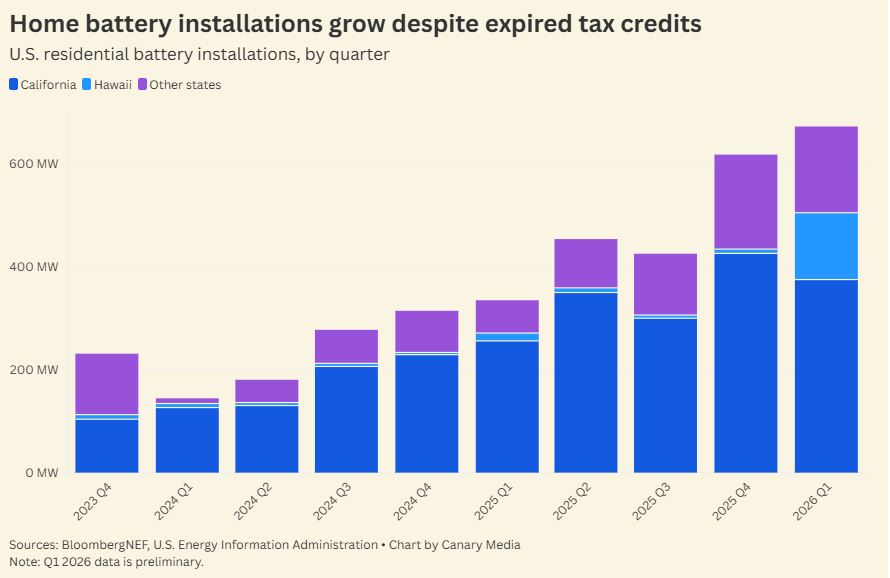
A few factors explain the market’s resilience. There’s the zeitgeisty reason: Across the nation, utility bills are high and rising, and batteries, typically paired with rooftop solar, offer people the ability to radically reduce their reliance on the centralized grid. There’s also the wonky explanation: State policies meant to spur home battery adoption are now doing just that.
Adoption is highest in the states where these factors — high electricity costs and supportive policy — coincide. California has since 2023 incentivized households to pair storage with solar, and in both 2024 and 2025 the state accounted for around three-quarters of home battery installations nationwide. Meanwhile, Hawaii, which has the highest electric bills in the country, created a new storage incentive program last year that resulted in a surge of installations in Q1 of this year, per BNEF.
The rising adoption comes even as the rooftop solar market struggles. Last year’s Republican tax and spending bill, the One Big Beautiful Bill Act, eliminated long-standing tax credits that knocked 30% off the price of both rooftop solar and storage systems. As a result, BNEF expects that this year residential solar installations will fall to their lowest level since 2020.
The stubborn growth of residential energy storage is another reminder that batteries are fast becoming a critical part of the U.S. electricity story. Large-scale batteries, for which Republicans actually preserved tax credits in last year’s law, are being built at a blistering pace. Expect home battery adoption to keep climbing, too.
Swapping your gas car for an electric vehicle is a climate win in almost all cases, says a new study, which even “tipped the scales” against EVs.
A few years ago, environmental scientist Elliot Campbell went around asking people why they would, or would not, switch to an electric vehicle. A surprising number of them asked him a question in return: Because building an EV generates emissions, isn’t it better for the planet just to keep my gas car running for as long as possible?
Campbell, a professor at the University of California, Santa Cruz, didn’t know the answer, so he set out to find it. Turns out the old adage that the greenest car is the one in your driveway is a myth. In fact, his study, published today in the journal Science, finds that swapping even a two-year-old gas car for an EV leads to a lifetime emissions savings of roughly 50 percent.
Not everyone can afford to ditch a nearly new car, of course. It’s simply the most extreme example of the broader point his study revealed: The emissions saved by driving an EV very quickly compensate for the planet-warming gases generated by building it. Campbell said that finding consistently surprises his students, and goes against his own instincts.
“I like to repair things and keep them going,” he said. But, “we found there is a big advantage to retiring the gas vehicles early.”
Campbell designed the study to give internal combustion vehicles every possible advantage. “We really tipped the scales in favor of the gas vehicle,” he said. Most notably, it ignored the emissions that went into making the gas car, treating them instead as a sunk cost. The EV still came out ahead, which suggests that climate-conscious drivers should make the switch as soon as it’s feasible.
“You’re just delaying the benefits longer and longer,” he said, noting that sidelining gas guzzlers off the road can improve air quality as well. This is especially true for cars that were built to less stringent standards, added David Reichmuth, a transportation sustainability expert at the Union of Concerned Scientists. “The magnitude of the benefits for getting an older gasoline vehicle,” he said, “can be much higher in terms of the air pollution.”
Reichmuth was not involved with Campbell’s study, but said it aligns with his own work on the issue. His analysis found that EVs reach an emissions break-even point at around 18,000 miles, which the average driver travels in about 18 months. That, however, depends on where a person lives and the source of their electricity.
The benefit is greatest where the grid is greenest. In upstate New York, which generates a lot of hydroelectric power, getting around in an EV is like driving a gas car that gets 219 mpg. But even in the Rockies, where coal and natural gas are the norm, an EV is better than anything getting less than 68 mpg.
Campbell’s study identified few exceptions to the conclusion that replacing a gas car with an electric one significantly reduces greenhouse gas emissions. Even moving away from high-efficiency vehicles and hybrids, like the Toyota Prius, is a climate win in the long-run. One case where it wouldn’t make sense, Campbell and his co-author found, is with plug-in hybrid electric vehicles, which have larger batteries and travel farther on electric power before switching to an internal combustion engine. Another is low-mileage situations, such as with a second car that doesn’t get used that often.
“To me, this is the biggest factor,” said Moaz Uddin, senior electric vehicle policy specialist at the think tank Great Plains Institute, about mileage. He gave the example of a retiree who only drives their Prius a few thousand miles a year. “It’s good that the study considers that.”
The new research finds that in order to repay the carbon debt of making a new EV, it must be driven 4,400 miles if it’s a car and 6,700 miles each year if it’s a truck. That’s already well below the 12,500 miles the average driver travels in a year, and the benefits to making the switch are likely to grow.
As the United States increasingly relies on renewables, for example, charging an EV becomes even more environmentally appealing. Campbell and his co-author also point to improvements in battery recycling as a way of reducing the emissions involved with making an electric car.
One hole in this latest study is that it doesn’t consider the cost of going electric. While previous research has shown that EVs come with higher upfront costs but lower operating expenses, it’s a thread that Campbell hopes economists pull on. He would also like to see someone better account for the emissions generated while extracting oil and getting gasoline to the pump, rather than simply the burning. But, for now, he believes the study sends a clear message.
“We’re trying to show that there’s not an environmental motivation for extending the lifetime of a gas vehicle,” he said. “Electric vehicles are a very clear winner.”
The most direct policy interpretation of the study would be to give people money to scrap gas cars. There have been some efforts to do this, such as the 2009 federal Car Allowance Rebate System, also known as “cash for clunkers.” That gave people $3,500 to $4,500 if they upgraded to more efficient vehicles, and blew through its $3 billion budget in only a month. Reichmuth, though, says that the issue could be tackled earlier in the process.
“The obvious policy implication is don’t sell the gasoline car to begin with,” he said, with the corollary being that EVs need to be as attractive an alternative as possible. “Make sure there are more options, more support, for people to make that initial choice.”
Firms that enlist homes to reduce energy demand — and costs — have long complained that utility data rules prevent them from helping in PJM. FERC agrees.
A recent ruling from federal regulators will let virtual power plants help meet surging energy demand in the county’s biggest energy market.
Late last month, the Federal Energy Regulatory Commission ordered PJM Interconnection to accept statistical sampling as a valid method for measuring the reliability of programs tapping into demand-response and virtual-power-plant programs, which pay customers to turn down energy use as needed. The decision requires the grid operator to reconsider strict data rules that had prevented providers of this carbon-free resource from participating in PJM’s constrained energy-capacity market.
In its decision, FERC ruled in favor of Voltus, which runs demand-response and virtual-power-plant programs, and the Mission:data Coalition, a nonprofit advocacy group, and against PJM’s desire to preserve its status quo.
FERC agreed with Voltus and Mission:data that, under its current rules, PJM is losing out on at least 4.9 gigawatts of capacity — the equivalent of several large power plants — “at a time when PJM is experiencing unprecedented load growth driven in part by hyperscale data center development, threatening reliability.”
Booming power demand from data centers and bottlenecks in power plant construction are not just threatening reliability in PJM but also driving up energy costs for the 67 million people it serves across 13 states. FERC found it would be “unjust and unreasonable” to allow the current rules to stand.
Last month’s ruling caps a yearslong fight from providers of demand-response and virtual-power-plant services.
“This is a huge win, and we’re really optimistic that it will unlock hundreds of megawatts of residential load over the next several years,” said Marissa Galizia, Voltus’ senior director of partnerships. FERC’s order makes clear that “PJM has the power to change the rules even while utilities aren’t providing the data,” she said.
At issue was PJM’s concern about relying on third-party demand-response aggregators to reduce household electricity demand when needed. PJM insisted that Voltus and other demand-response firms must furnish detailed evidence that participating households actually cut power when prompted to do so. Specifically, PJM required smart-meter data, which is collected in the service territories of most utilities PJM covers.
If firms could not produce that data, PJM would not count on — or pay for — that demand-response capacity to show up during times of peak demand.
But for the most part, demand-response firms could not get their hands on that data. That’s because, as Voltus and Mission:data argued to FERC, most of the major utilities in PJM territory have failed to make that data from their digital smart meters readily available.
It’s a catch-22. And as a result, PJM has missed out on gigawatts of demand-response capacity that could have helped alleviate the reliability and cost crunch it faces — and aggregator firms have been essentially locked out of the lucrative capacity market.
Utilities blame states’ data privacy regulations for their conservative management of smart-meter data. FERC doesn’t get to tell states how to manage those data privacy and data access rules, but it can compel PJM, which it has jurisdiction over, to accept alternative forms of data.
That’s what FERC did in the July decision.
Given the “significant barriers to obtaining interval meter data,” FERC told PJM to allow aggregators to use a statistical sampling method that the grid operator had relied on before smart meters existed. PJM also still allows this method for customers that don’t have smart meters. In light of those facts, FERC found that “statistical sampling is a valid method to approximate load reductions when interval meter data is not reasonably available.”
Both PJM staff and Monitoring Analytics, its independent market monitor, protested that letting demand-response companies use statistical methods could undermine reliability.
Monitoring Analytics argued that allowing statistical sampling would “degrade PJM’s ability to maintain resource adequacy and to correctly determine efficient capacity market prices through supply and demand.”
FERC disagreed, citing evidence presented by Mission:data and Voltus showing that statistical sampling can be as or more accurate than methods that use metered data when applied to large numbers of homes, as opposed to single large customers like factories.
The order won’t take effect immediately. FERC directed PJM to launch a proceeding to work with stakeholders to find a method that parties could agree on, with initial plans due within 45 days of FERC’s order.
“We’re going to be working with our partners to submit answers to the questions and propose what we’d like to see,” Voltus’ Galizia said. “Generally, we’d like to make it as easy as we can while guaranteeing that that process is as accurate as possible.”
FERC’s ruling comes at a tense time for PJM. Over the past year, the Trump administration and state governors have attacked the grid operator for failing to mitigate the huge increase in capacity market prices that are driving up utility rates and driving public anger against utilities and data center developers.
“I hope the decision sends a message to PJM and its stakeholders,” said Ken Schisler, chief legal and regulatory officer at CPower, a demand-response company that brought a similar complaint that FERC rejected in 2024 for lack of evidence. “The message is to stop the nonsense and to remove barriers that are keeping demand response from growing in the market.”
Michael Murray, president of Mission:data, hopes the ruling will also add fuel to his decade-long effort to make utilities and state regulators unblock smart-meter data that technically belongs to customers.
FERC’s order doesn’t address the underlying state-by-state data-access barriers that Mission:data is working on — the agency doesn’t have the jurisdiction to do so even if it wanted to.
Still, Murray hopes it will push state regulators to revisit their data-access policies, since “states may not like the remedies that FERC comes up with in this case or in other cases.”
And more broadly, he said, it’s the first time the agency has acknowledged just how critical this issue is.
“FERC has finally recognized that what I’ll call data blocking is not just an artifact of state privacy laws, and it’s not something to just ignore and say, ‘Oh this is just a state matter,’” he said. “They definitely said that it rises to a Federal Power Act matter.”
Tariffs and rising grid demand are spurring a revival, but high electricity costs and community concerns threaten to stall key new smelter projects.
America’s aluminum sector is growing again after years of decline, spurred by tariffs and a push to revive domestic manufacturing. But the voracious power needs of aluminum smelters and communities’ concerns about pollution still pose major hurdles to scaling up production.
Globally, a deficit in aluminum supply is expected to worsen this year following damage to major Middle Eastern smelters and disruptions in the Strait of Hormuz amid the ongoing U.S.-Iran conflict. At the same time, soaring U.S. power consumption is boosting demand for the versatile metal, as the makers of transformers, cables, and other electrical equipment race to build out the grid.
“There is very little cushion left anywhere in the system,” Jesse Gary, president and CEO of Century Aluminum, said on an earnings call last week. “In a market with no slack, the value of secure domestic units goes up.”
Chicago-based Century recently marked the return to full operations at its Mount Holly aluminum plant in South Carolina — one of only four remaining U.S. smelters. The facility has begun churning out another 50,000 metric tons of virgin, or primary, aluminum, raising total U.S. production by nearly 10%.
Mount Holly is, at the ripe age of 46, the country’s youngest smelter. In 2015, Century partially idled the plant because of high electricity costs — a persistent problem faced by virtually all smelters, which require hundreds of megawatts of continuous power to convert raw materials into metal. Last fall, Century reached a new long-term power agreement for its Mount Holly plant with the utility Santee Cooper. (Over half the utility’s power supply comes from coal-fired power plants, and about a quarter comes from natural gas and oil.)
Other smelter projects advancing in Oklahoma and Missouri are expected to further increase domestic supply, but their success largely hinges on their developers’ ability to access cheap, reliable electricity for the power-hungry operations.
In Oklahoma, Century and its joint-venture partner Emirates Global Aluminium are working to build a giant new smelter that would more than double the nation’s capacity for making primary aluminum. If all goes as planned, Oklahoma Primary Aluminum could break ground by the end of this year and start producing its “first hot metal by the end of 2029,” Gary said on the earnings call.
The proposed smelter is set to receive a $500 million grant from the Department of Energy, which Century landed in 2024 from of a Biden-era program to decarbonize U.S. industries. The project was sited in Inola, Oklahoma, partly because of the state’s abundant natural gas and wind energy resources and solar energy potential. Utility-scale wind and solar represent the fastest and most cost-effective resources for expanding grid capacity — and running a smelter on renewables would sharply reduce the planet-warming gases and toxic pollution associated with aluminum production.
Oklahoma Primary Aluminum has been pushing for more than a year to strike a competitive deal with the local utility, the Public Service Company of Oklahoma. Gary said the developers have “advanced negotiations toward a final energy contract,” which they’ll need to obtain before construction can begin. “Just know that we’re working hard and continue to make progress,” he said.
However, the proposed 750,000-metric-ton smelter is facing growing pushback from state political leaders and Oklahoma residents, who worry that the hulking facility will pollute the air and water and harm cattle and crops in northeastern Oklahoma, including on tribal lands.
In recent weeks, members of the Muscogee (Creek) Nation and Cherokee Nation have raised concerns about the project’s environmental impacts, with Muscogee leaders adopting a bill that opposes building and operating smelters on the reservation. Gentner Drummond, Oklahoma’s attorney general and a Republican gubernatorial candidate, has also opposed the smelter’s foreign ownership and pollution risks. On Aug. 11, he filed a motion to block construction of the smelter while his lawsuit against the project is pending.
Century and Emirates Global Aluminium claim the Inola facility will be significantly cleaner than existing U.S. smelters and will use the latest version of EGA’s smelter technology. “We’re working very closely with the community in Inola and elsewhere in Oklahoma to better understand what their concerns are and to make sure that they have all the facts about our technology and process,” Gary said.
Meanwhile, some 420 miles east of Inola, the company Magnitude 7 Metals is planning to partially reopen its idled aluminum smelter in New Madrid, Missouri, before the end of this year.
The manufacturer shut down operations in 2024 and laid off over 500 workers, after struggling with low aluminum prices and high power costs, Bloomberg reported. The 263,000-metric-ton facility represented about 30% of the nation’s aluminum production capacity at that time — and was Missouri’s single largest consumer of energy.
On July 1, Magnitude 7 Metals said it will restart about 75,000 metric tons of annual production at the facility. The company attributed the comeback to the Trump administration’s Section 232 aluminum tariffs, which raise the costs of importing aluminum for cars, cans, and construction. Last month, the White House also created a related tariff program that’s designed to further incentivize investment in new U.S. primary aluminum capacity.
Whether the tariffs can offset the inescapable challenge of electricity costs remains to be seen.
Annie Sartor, senior campaigns director at Industrious Labs, noted one potential roadblock for the Magnitude 7 Metals restart: Missouri’s “large load” electricity tariffs. The state adopted the policy in 2025 to ensure that major power users help cover the costs of improving grid infrastructure to support their increased demand. But while wealthy tech companies can afford those added expenses, they’ll only add insult to injury for aluminum producers.
“The smelter would face the same electricity cost structure as a data center — even though that same smelter has already curtailed operations twice [in 2016 and 2024] because of skyrocketing power costs,” Sartor said on LinkedIn. “The policy challenge is clear: a framework created to manage data center growth could unintentionally make it harder for manufacturers to operate, create jobs and support local economies.”
It’s also unclear how Magnitude 7 Metals plans to power its partially reopened smelter. The company did not immediately reply to Canary Media’s questions.
The facility was historically powered by the especially dirty New Madrid coal-fired power plant, which emitted the most nitrogen oxides from a power plant in the region and the country in 2020. Residents in southeastern Missouri who support restarting the smelter said they’re nevertheless concerned that it will drive up pollution, unless the smelter moves away from coal and toward clean energy, according to a March survey by Industrious Labs.
“Long-term economic investment will be more likely if this operation is powered by clean energy, especially solar and storage,” Jenn DeRose, Sierra Club’s Beyond Coal campaign strategist in Missouri, said in a July 1 statement. “Powering the smelter with clean energy will help ensure the smelter’s long-term viability by leveraging affordable, fixed-cost energy, and cleaner air for everyone who lives in New Madrid County and beyond.”
ScottishPower’s Whitelee onshore wind farm could double its capacity with far fewer turbines. It’s an example of how much wind technology has improved.
It’s almost an ironclad law: Over time, wind turbines get taller, better, and more cost-effective.
A new proposed project in the U.K. demonstrates that. ScottishPower recently announced its intention to repower the U.K.’s largest onshore wind farm, a process that will involve replacing old turbines with state-of-the-art new ones. Once that is done, the wind farm will produce twice as much power with almost half the number of turbines.
The Whitelee wind facility, near Glasgow, was completed in 2008. The developers installed 140 turbines that stood 360 feet tall at the highest blade tip and could generate 2.3 megawatts each. By 2013, the site had been expanded with 3-MW turbines that stood 459 feet. Since then, Whitelee has produced up to 539 MW from its 215 turbines, storing some of that in a 50-MW battery on-site.
If the forthcoming upgrade gets regulatory signoff, the old turbines will be taken down and in their place will rise 124 new ones, measuring 787 feet tall and producing around 7 MW apiece. Collectively, they will be able to generate more than 1 gigawatt of carbon-free power when the wind blows fiercely.
“Repowering allows SPR [ScottishPower Renewables] to reuse existing site infrastructure and take advantage of new technologies resulting in increased electricity generation and ultimately, increased security of supply,” the company noted in a scoping document.
It’s a striking example of how far this clean energy technology has advanced in recent decades. Modern turbines have pushed to incrementally higher heights and broader wingspans, allowing them to generate far more electricity than their predecessors — and to do so at a cheaper unit price. This evolution supports onshore wind’s position as the cheapest of all the electricity sources on an unsubsidized basis, per the latest analysis by the financial advisory firm Lazard.
Repowerings like Whitelee’s could help the U.K. and the European Union shore up their energy security as the natural gas supply chain remains in war-torn upheaval. And while the U.S. government currently seeks to thwart this affordable energy source, there are signs that repowerings could add significant capacity in the coming years.
The main appeal of repowering is to access the much greater clean power generation — but there are other benefits, too.
“It doesn’t take twice as long to service a turbine that’s twice as big, and you don’t have to do two foundations — you only need to do one,” said Kaj Skov Nielsen, a longtime wind power specialist who helped set up the control system at Whitelee.
Installing a new turbine also gives project owners an easy opportunity to add state-of-the-art sensors, Nielsen said. New sensors can detect birds and bats and slow the blades’ rotation to protect them. Others can spot potential mechanical issues, like debris that could cause problems in the gearbox, before they become catastrophic.
Older turbines have control systems that can stop the blades if they detect a fault. Newer systems can slow the rotation to a safe level based on the specific fault that is happening, Nielsen said, eking out more generation without endangering the equipment — “it’s a totally different game.”
That’s not to say repowering is easy. Larger equipment may exceed the weight limits on the roads and bridges to the project site, or height limits on underpasses along the route, Nielsen noted. Developers need to weigh the cost of upgrading that transportation infrastructure against the alternative of shipping in pieces and assembling them on-site, which adds more work on the back end. A developer also needs to strengthen foundations to support the weight of much larger turbines.
ScottishPower still needs consent from the Scottish ministers for the repowering, so it will go through a detailed assessment for impacts on the community and the environment. The repowering project has two big advantages in that process, compared with a brand-new project: It already secured permission to build many more turbines on the same land, and it would upgrade capacity without expanding into undeveloped countryside.
ScottishPower, for its part, has tried to make Whitelee welcoming to the broader community. The energy company acquired the site after it had been used for commercial logging and has invested in wide-scale restoration of the underlying peatland ecosystem. People can bike or hike around the premises, take guided bus tours, and enjoy the views from a visitor center that touts its “delicious cakes” from local vendors. The power company markets it with the hashtag #MoreThanAWindfarm.
Turbines of the size proposed for Whitelee have just started getting installed around the world, said BloombergNEF wind analyst Harrison Sholler. Chinese manufacturers have been pushing the boundaries of onshore turbine size, but those units are typically shut out of Europe and the U.S. because of geopolitical concerns. Instead, developers in those regions turn to manufacturers including Siemens Gamesa, Vestas, and Nordex, all of which now sell 7-MW onshore wind turbines; or GE, which has onshore models up to 6 MW.
A project in Brazil’s Bahia state installed a new 7-MW turbine last fall, touting it as the largest onshore turbine in the Americas.
“It’s established technology in the sense that they’re not that different from a 6-MW turbine, for example,” Sholler said. “They’re considered by the industry to be proven at scale.”
The U.S. might not have any turbines that big yet, but it does have plenty of installed turbines of the smaller vintage that ScottishPower seeks to replace. The U.S. average onshore wind turbine capacity has steadily ticked up from 0.8 MW in 2000 to 1.8 MW in 2010 to 3.5 MW in 2024, per the most recent accounting by Lawrence Berkeley National Laboratory. The country’s first 6-MW-turbine project came online that year in Oklahoma.
Of the 86 GW of new wind capacity BNEF expects the U.S. to build over the next decade, 10 GW will come from repowering, said Sholler. “Towards the early to mid-2030s, we expect repowering activity to ramp up as some of the larger wind farms are reaching the end of their operational life,” he noted.
BNEF expects the Northwest and Midwest will build the most repowered wind capacity in the next 10 years, with significant capacity popping up in Texas, California, and the mid-Atlantic. In California, repowerings will provide pretty much all new onshore wind capacity in that period, Sholler said, because all the good sites for onshore wind farms got developed decades ago, starting when the state initiated a subsidy in the 1980s.
That said, the largest U.S. repowering on BNEF’s radar for the next decade clocks in at just over 200 MW, a far cry from the projected 1 GW at the refurbished Whitelee.
“I don’t think we’re at the stage of market maturity where we’re starting to see those larger-scale projects start to repower in the U.S.” Sholler said. “But we will get there eventually.”
Illinois community solar incentives spurred plans to put 60 arrays on top of Public Storage facilities in the state. So far, 10 are online.
Krzysztof Wasowicz, mayor of Justice, Illinois, has some concerns about solar: that it takes up farmland and enriches China. But he’s all-in on the community solar array that was recently deployed at a Public Storage facility in his village, a suburb of Chicago.
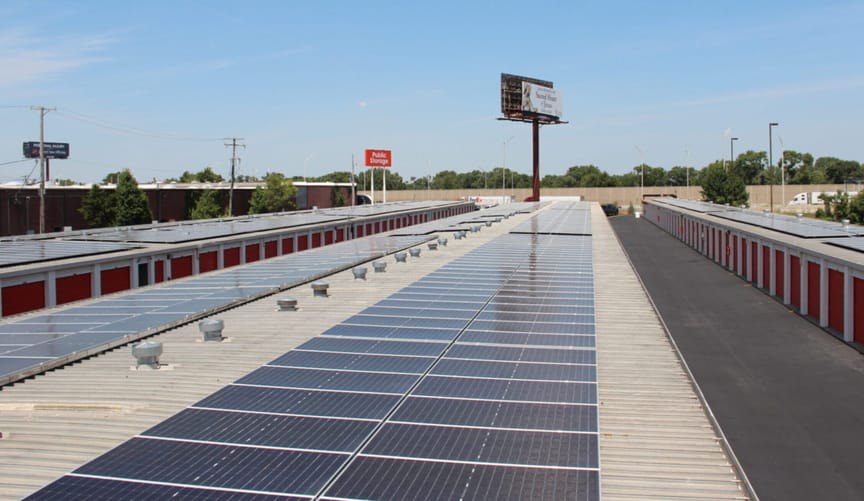
The panels are located on otherwise unused roof space and could provide significant savings for Illinoisans who subscribe to the project, while also helping the state meet its goal of 100% clean power by 2050.
“This creates more opportunities for people, job creation, and revenue that can be taxed by our state,” said Wasowicz, who has been mayor of Justice, home to about 12,000 people, since 2007. “This is going to be an excellent addition to this village.”
The 763-kilowatt array, which went online in March, is one of 60 planned projects for the rooftops of Public Storage facilities in Illinois. Ten such projects are now online, and once completed, the portfolio will cover 5 million square feet of roof space, provide 44 megawatts of solar capacity, deliver $36 million total savings, and create 300 construction jobs, according to Solar Landscape, a leading developer of rooftop community solar sites nationwide.
Only a fraction of industrial and commercial roof space is currently used for solar, because those projects are generally more expensive to build and interconnect than ground-mounted arrays in rural areas. But thanks to new incentives, developers, utilities, and building owners nationwide are increasingly considering the possibilities.
Federal data analyzed by the solar company Lumen Energy found that commercial, industrial, and school rooftops could host enough panels to provide 581 gigawatts of power, nearly enough to meet the entire country’s energy demand. Cook County, Illinois, which includes Justice, is among the metropolitan areas with the greatest potential, that analysis found.
Mark Schottinger, president and chief legal officer of Solar Landscape, said that working with large companies like Public Storage allows his company to deploy rooftop projects quickly at multiple sites.
“The beauty of commercial-industrial real estate is the speed and scalability,” he said, noting that major logistics, storage, and big-box companies “have millions of square feet around the country.”
Community solar allows households, businesses, and organizations to reap savings and support clean energy even if they can’t have their own solar panels. By subscribing to a community solar array, customers get credit on their energy bill for a portion of the solar power generated.
Illinois is among the nation’s leaders in community solar capacity, according to the Solar Energy Industries Association, with more installed than even California. It is among the two dozen states that have laws enabling community solar, which typically leads to more arrays than in states without specific policies.
Illinois’ 2016 clean energy law created generous incentives for community solar, leading to a boom in projects of up to 2 MW each. An energy law passed last fall made the incentives available for projects of up to 10 MW.
Most of the state’s community solar has been built on rural land or industrial brownfields. About a fifth of the arrays are on rooftops, with the rest being ground-mounted. The rooftop arrays are concentrated in the Chicago area, and rooftops are an increasing priority for community solar, according to Paul Kovacs, project execution manager for distributed energy resources for utility ComEd, which serves northern Illinois.

At a July 30 event promoting the Justice project, Melissa Washington, ComEd’s senior vice president for government relations and external affairs, called rooftop community solar “an elegant solution” for deploying clean energy to meet rising demand.
She listed three mandates for the utility: supplying power to businesses and residents, keeping electricity affordable, and addressing climate change — a necessity underscored by violent storms three days earlier that had left many ComEd customers without power.
Rooftop community solar, she said, “checks the box for every single one of those three critical priorities.” The utility plans to have over 400 community solar arrays in service by the end of this year, she added. Kovacs said about 100 of those will be on rooftops.
In a typical setup, a company like Solar Landscape develops and owns the array and collects revenue from incentives and subscribers. Those subscribers get savings on their energy bills, the property owner hosting the panels gets lease payments, and the utility gets credit toward renewable energy mandates. The utility works with the developer to make any upgrades needed to connect the array to the grid, which the developer pays for so that costs are not passed on to ratepayers.
The Public Storage projects are part of Illinois’ Community-Driven Community Solar program, meant to incentivize solar arrays whose subscribers are predominantly local households and small businesses or nonprofits, as opposed to a few large subscribers hogging the savings.
Under state law, owners of community solar can sell renewable energy credits to utilities for revenue that makes the financing equation more favorable for all the partners involved. The incentives are awarded through a highly competitive process, and proposals gain points for being in designated low-income or environmental justice census tracts, having a large proportion of local subscribers, involving the community in design and planning, and hiring through the state’s workforce training programs, among other factors. The community solar credits are also worth $5 more per megawatt-hour for rooftop installations.
The Justice project earned points for making charitable contributions and for hosting a workforce training program in conjunction with the New Jersey–based training and education nonprofit STEP-UP Solar, according to Solar Landscape marketing director Samantha Kanipe.
State incentive programs are critical to facilitating community solar development since the expiration of federal tax credits under the Trump administration’s 2025 spending bill, advocates note. Meanwhile, arrays on industrial and commercial sites, like the Public Storage ones, can still qualify for federal tax credits if they are operational by the end of 2027, or if they started construction by July 4 of this year.
“We began construction on a ton of projects before July 4,” including all the Public Storage ones, said Schottinger of Solar Landscape, noting that his company can build an array like the one in Justice in about six months.
He said his company and other solar developers are still in the “early innings” of using rooftops for community solar. But, “it’s growing exponentially,” he added. “There’s a lot of blank space out there.”
SB 905 would curb returns on wildfire costs, seek new financing, and explore performance metrics to curb sky-high electric rates. Can it overcome utility opposition?
California lawmakers are once again contending with how to curb the state’s high energy costs as they hurtle toward the end of this year’s legislative session on Aug. 31. So what’s on the table for utility rate reform in the final stretch?
Enter Senate Bill 905, a complicated package of proposals that are likely to face intense opposition from utilities, which tend to reflexively resist rules that could crimp their profits. But California voters are demanding reform, according to state Senator Josh Becker, the Democrat who wrote the bill.
Californians rank cost of living as a top concern, and most blame the state’s three big utilities for rising electricity rates that are now roughly twice the U.S. average. And when it comes to California’s climate strategy, “it’s going to be really hard to convince people to install heat pumps and switch to EVs, or get a factory to switch to electricity rather than natural gas, if the price of electricity is too high,” he said.
Becker was speaking at a July 14 webinar hosted by the University of California at Berkeley’s Center for Law, Energy, and Environment (CLEE) to promote its latest research on the causes of the state’s electricity cost crisis. As that report highlights, there are no easy fixes.
Climate change and wildfire risks are forcing Pacific Gas & Electric, Southern California Edison, and San Diego Gas & Electric to invest more in their aging and strained power grids. The California Public Utilities Commission, which regulates those utilities, is loath to rein in spending that expands the grid, brings more clean energy online, and reduces the risk of wildfires.
But the sheer amount of spending planned by utilities threatens to overwhelm the ability of their customers to pay for it. PG&E is seeking state regulator permission to spend $73 billion through 2030, and Southern California Edison has told investors it plans to spend from $38 billion to $41 billion through 2030.
SB 905 seeks to tackle utility spending in three key ways:
“Lowering electricity rates is a hard problem with no silver bullet,” Becker said. “But if we get this right, we can start a virtuous cycle.”
California lawmakers have been trying for years to pass utility reforms. In 2024, most of their efforts failed. But last year, Senate Bill 254, also sponsored by Becker, managed to make it through the legislative gauntlet.
SB 905 represents an important, if somewhat incremental, next step on those efforts, said Matthew Freedman, senior staff attorney at The Utility Reform Network (TURN), one of the state’s most vocal utility ratepayer advocacy groups and a sponsor of the bill. Among the bill’s provisions, a “lower return on equity is a pretty big one,” he said.
Utilities earn guaranteed rates of profit on capital investments, which puts upward pressure on customer rates. Anything that can reduce that rate of “return on equity,” or ROE, could help limit those increases, he said. A number of states are targeting utilities’ ROE to combat rising rates — and utilities are, not surprisingly, fighting back against the idea.
In a nod to the challenging politics, SB 905 proposes assigning a lower ROE only to key categories of utility spending, Freedman said. The biggest category is the tens of billions of dollars utilities are investing in burying and hardening power lines to eliminate the risk of sparking wildfires. SB 905 would also limit ROE for utility capital costs in “balancing” and “memorandum” accounts over which regulators have waived their typical authority for a “reasonableness review” to examine and claw back spending, usually for costs that can’t be predicted in advance of ratemaking proceedings.
Both these types of spending help reduce risk for utilities, which can lower the cost of financing as they go out to Wall Street to raise investment and procure debt, Becker said during the July webinar. That means utilities get “other benefits besides the pure financial return” from those investments, he said — and that justifies reducing how much they get to charge customers to recover those costs.
SB 905 also seeks to curb costs by forcing utilities to borrow money themselves, or rely on state-issued loans, to pay for some of their costs, Freedman said.
The math is fairly simple, he said. Borrowing money to pay for costs via a process known as securitization allows utilities to reduce the amount of money going into the “rate base” of capital investments on which they earn a guaranteed return. Utilities must collect money from customers over time to pay back those loans, but up-front impacts on customer rates are lower.
Tapping into state-backed bonds for utility projects that benefit the state at large — say, building transmission lines to allow more clean energy to be constructed and connected to the grid — could reduce costs even further, since governments can borrow more cheaply than utilities.
Last year’s SB 254 required the state’s big three utilities to securitize the first $6 billion in their ongoing grid wildfire-safety investments and created a state “transmission accelerator” to provide public funding for new transmission projects.
SB 905 would “require the PUC and the utilities to continue evaluating ways like that to lower financing costs,” Becker said, with an end-of-2028 deadline to report to the legislature on findings and recommendations.
It will take time for savings from this shift to borrowing to show up, said Sam Uden, co-founder and managing director of Net-Zero California, a Sacramento-based environmental policy group. He cited the example of the transmission accelerator, whose initial funding awaits final state budget negotiations.
“Then the goal would be for the accelerator to fire up next year, and launch public financing,” he said. “This is a multiyear transition.”
Curbing the return on investment and requiring utilities to borrow more both target the “capex bias” of regulatory structures that reward utilities with guaranteed profits on the capital expenditures. But what if utilities could be financially rewarded more directly for doing a better job on the things their customers and regulators really care about?
For decades, utility regulators and lawmakers have attempted to structure performance-based regulations to accomplish this. Some noteworthy examples include a long-running implementation at Hawaiian Electric and an abortive effort from Connecticut’s former head utility regulator that led to a bitter fight with utilities and her eventual departure from the agency.
SB 905 would set a Jan. 1, 2028, deadline for the California Public Utilities Commission to launch an effort to establish clear performance metrics for tasks such as making the grid more reliable, reducing greenhouse gas emissions, and speeding up the process of connecting new customers and renewable sources. “This will make clear what our expectations are for good performance, and hold utilities accountable for delivering safe, reliable, clean, and affordable power,” Becker said.
To be clear, SB 905 doesn’t authorize the commission to offer any financial incentives for meeting or exceeding whatever metrics it comes up with, Freedman said — at least, not yet. “We’re worried about a performance-based regulatory approach that the utilities can game and earn excessive profits from,” he said, as happened with Illinois utility ComEd over the 2010s.
“Let’s see how it goes for a few years. If we like it, the legislature can change the law and attach some incentives around that,” he added.
One big performance metric that SB 905 would establish, and which Virginia and other states have already implemented, is “grid utilization,” or squeezing more of the power grids that utilities already have. That’s a good way to drive down utility costs, which are based on “dividing the total costs of running the grid by the total amount of energy delivered to customers,” Becker said.
“We need to control the numerator of that equation — the costs. But if we can increase the denominator of the energy sold, then rates will go down,” he said.
California has plenty of load growth coming, whether from data centers, EV charging, or heat pumps and air conditioners for homes and buildings, Becker noted. The right combination of cost controls along with that can “make EVs look cheaper to drive, and make heat pumps look more cost-effective versus gas furnaces,” he said.
Right now, SB 905 is in the state Assembly appropriations committee, where it could undergo a number of amendments that won’t become known to its author until it is released for further consideration via a process known as “suspense.” Similar last-minute amendments gutted key provisions from another of Becker’s bills last year — before it was vetoed by Gov. Gavin Newsom.
Meanwhile, a late-breaking push by Newsom to reform California’s wildfire liability system — one of the state’s key drivers of utility costs — is likely to add more pressure on lawmakers trying to negotiate on a plethora of energy and climate issues, ranging from what to do about data centers to how to manage budget pressures tied to the state’s carbon cap-and-invest program.
Will SB 905 make it into law? “You know, utilities are fighting it fiercely,” Becker said. “But as we learned from last year, big things come down to the final wire, and I hope we’re going to get it through.”
Building trades spent the past five years preparing for an offshore wind boom that went bust, leaving workers to mourn good-paying jobs that may never come back.
This article originally appeared on Inside Climate News, a nonprofit, nonpartisan news organization that covers climate, energy, and the environment. Sign up for their newsletter.
When Gerard Mullin decided to train in offshore wind, he didn’t know what to expect. But on his first long-term project in Massachusetts, he immediately relished the consistency of the work, the good pay, and the novelty of laboring at sea.
“I thought it was the best thing in the world,” he said.
In his first eight weeks working offshore, Mullin made more money than he had saved in the previous five years.
But the industry was on shaky ground. Mullin had his bags packed for five weeks offshore with Empire Wind in New York when President Donald Trump’s stop-work order last year stranded him at home in Boston. Trump — who had railed against the industry in his 2024 election campaign — halted all future permitting last year and canceled 12 offshore wind leases this spring and summer.
Thousands of workers like Mullin who were promised steady, well-paying careers in offshore wind now find themselves racing to secure the few positions left or returning to their prior work. Meanwhile, the supply chain that emerged to support offshore development has been left adrift, including in towns in need of a promised economic boost.
Those are less-discussed consequences of the political turmoil besetting the domestic industry, said Elizabeth Wilson, a professor at Dartmouth College studying offshore wind.
“All of the promises of economic development that offshore wind was supposed to help support have evaporated,” Wilson said.
For Mullin, the change was shocking.
“All of a sudden, the federal government is concerned with my work, and there’s nothing I can do to change how they view it,” Mullin said. “Now there are things completely outside of my control, changing how I make a living.”
Trump has long scorned offshore wind, calling the 2012 project he unsuccessfully opposed near one of his Scottish golf courses “disgusting & inappropriate.” His administration, which has inaccurately described renewables as costly and unreliable as it tries to block them in favor of climate-altering fossil fuels, said his offshore wind policies are good for the economy and workers.
“President Trump has delivered on his popular promise to reverse the Left’s costly Green New Scam to lower prices for families and businesses and strengthen our country’s energy security,” Taylor Rogers, a White House spokeswoman, said in a statement. “By prioritizing the production of reliable, affordable, and secure energy sources, the President has restored U.S. energy dominance — creating thousands of good-paying energy jobs across the country.”
Tim Sullivan, who was CEO of the New Jersey Economic Development Authority until December, said he can’t comprehend the White House’s logic.
“It’s the strangest thing: I’ve spent 15 or so years working in public-sector economic development; I’ve never seen people cheering for job destruction, particularly elected officials,” he said.
As a pile driver, a specialized structural laborer essential to offshore wind projects, Mullin lived and worked on a ship five weeks at a time, followed by five weeks at home with his family. It was a schedule that suited him well.
Mullin joined offshore wind projects across Massachusetts, Virginia, and New York. His employer, an international contractor, even brought him and other members of his union across the Atlantic for a wind project off the coast of Scotland.
Now, Mullin is back to the same type of onshore construction work he did four years ago, before he started with wind.
“The writing was on the wall that this idea that I’m going to go to the same ship, five weeks on, five weeks off, steady — that just isn’t the reality anymore,” Mullin said.
Joshua Grigsby, 42, took his son to Rio de Janeiro, Disney World, and SeaWorld. Natalie MacDonald, 26, stopped living paycheck to paycheck. Others bought homes and started families.
Inside Climate News spoke with over a dozen workers and union leaders who said the financial opportunities from the nascent U.S. offshore wind industry had been unparalleled. They saw long-term careers ahead of them. They feel that opportunity slipping through their fingers.
Anthony Hibbard was on one of the first boats that carried ironworkers to Vineyard Wind, off the coast of Massachusetts. What he found was “financial freedom,” he said, and he worked his way up to become a foreman on Coastal Virginia Offshore Wind.
After the Trump administration’s moves to scuttle the industry, Hibbard returned to local, onshore jobs in Portland, Maine, where he earns just one-fifth of what he did offshore.
“I make enough to get by, but I like to be smart with my money, and I don’t have the scope to continue being smart with it,” Hibbard said. “It’s definitely — you can feel the difference, that’s for sure.”
The loss of offshore wind has had financial consequences for many union workers. While many were paid the same per hour as jobs they could find onshore, they could work more than double the hours, and the company covered many living expenses. Grigsby made double to triple what he did onshore.
When Zaheer Razi, 28, joined the Piledrivers Local 56 union as a commercial diver, he transitioned into offshore wind as soon as he could. The logic was that it could be the anchor for people’s careers, he said — union leaders told workers to “set your roots down,” expecting over a decade of steady work.
He’s still working on Revolution Wind near Rhode Island, but he knows it won’t last.
“I’m probably one of the few guys that’s probably going to be working till mid-August, I believe, and then it’s really going to be silent for the next two or three years,” Razi said. “It is very frustrating, but it’s out of our control. Nobody could have really predicted it, but at this point, we’re just riding it out for what we can.”
Razi’s project is one of the five major U.S. wind farms that appear to remain on track despite the political backlash. But they are nearing completion and the permitting pipeline is all but blocked, meaning construction jobs will soon evaporate, according to multiple experts and union leaders.
Kris Ohleth, director of the Special Initiative on Offshore Wind, a U.S. policy think tank, attributed the lack of employment prospects to the political uncertainty that has stymied investor interest.
“We’ve trained them, we’ve given them this great experience, they’re building their futures for their families, and now they have no projects to work on,” Ohleth said of the offshore wind labor force, “and that’s because of the lack of market confidence.”
At the time of Trump’s election, the market research firm BloombergNEF forecast that the United States would build 39 gigawatts of offshore wind by 2035, enough electricity to power 13 million homes. By the end of last year, the firm had downgraded that prediction to just 6 gigawatts, according to Harrison Sholler, a wind analyst at BNEF.
For Garrison Biel, an offshore wind diver, the industry’s decline has meant there are close to no employment opportunities left.
“They’re more gigs than jobs,” Biel said. “They’re like short hitches, trying to wrap things up, tidy everything up. So I know people that are still working, but it’s not like how it was the first couple of years when it started, where that’s all you needed to do.”
He switched back to commercial diving around eight months ago because “what was available left offshore was slim pickings,” he added.
Biel said the offshore wind industry was supposed to be reliable, with guaranteed time off to make up for the long periods away from home and the weeklong, 12-hour-per-day shifts.
“Now, everybody that’s doing it, they get off the boat after working seven-twelves for a couple of weeks and they go right back to work, because they don’t know if they’re ever going to go back out on a boat again,” he said.
Grigsby was able to buy a house with his money from offshore wind. His union’s business manager, John Dunderdale, said at least a dozen other members of Piledrivers Local 56 did the same.
When these projects disappear, “you’re taking away their means of bringing back into the community,” Dunderdale said.
“Now you have a member sitting home, collecting unemployment, because there’s no work,” he added.
Benjamin Hawkins, who lives in Whitman, Massachusetts, said he made enough to upgrade his parents’ house and enjoy a new degree of “leverage” over his life.
“It’s heartbreaking, because you wonder about what’s going to happen in the future with your money,” Hawkins said.
He added: “Offshore wind was the reason I could improve that life, so to have the president affect my life, just as an average American — it was not on my bingo card.”
Offshore wind first began edging into the U.S. energy market in 2011, decades after it had taken off in Europe. An Obama administration study that year predicted that a vibrant offshore wind industry could help meet the nation’s renewable energy needs while investing in infrastructure and creating “thousands of construction and operational jobs.”
The first U.S. offshore wind farm, Block Island, came online near Rhode Island in 2016, and states began offering financial incentives to drive development. The Biden administration made offshore wind a central priority in 2021, and from there, state and federal agencies geared up for a boom. The federal government sold leases to major international energy companies that began to see the U.S. as an attractive market, centered in the Northeast, Virginia, and California.
Construction and permitting began in force not long before Trump returned to office with a promise to kill offshore wind.
“That’s like somebody working on skyscrapers, and then somebody saying, ‘We’re not allowed to build any skyscrapers,’” Biel said. “It’s just a kind of crazy thing.”
No comprehensive or exact estimate of offshore wind-related jobs exists, but New Jersey’s Economic Development Authority estimated in 2022 that a typical project creates around 1,000 construction jobs per year and 100 lifetime operational jobs.
Dunderdale said shutting down any project at that size and scale is a “huge hit,” both for the workers and their local economies.
Central to the fledgling domestic industry was the growth of training and certification programs, primarily through community colleges and unions.
Millwrights Local 1121, which operates across New England, met with developers in 2021 to start offshore wind job training, which would cost $10,000 to $20,000 per person. It was worth it, said the union’s vice president and business manager, Andy Benedetto, because they had heard there would be “years’ and years’ worth of work.”
“We invested millions of dollars in training, more or less, and lots of hours went into putting all this together, and now that work is dried up for the foreseeable future,” Benedetto said. “We hope not too long, but we built this whole workforce, and we sold this dream to our members that if they get involved and get the training and go on this first project, then they’re going to carry over for the next 10 years.”
His union wasn’t alone. Public and private investments poured in to develop the new workforce. New York, New Jersey, and Massachusetts led the Northeast with millions of dollars in grants to training and research programs.
Ironworkers Local 7, which operates across the Northeast, received $300,000 from Massachusetts in 2022 “to be ready for when the work comes,” said Grant Provost, the union’s Maine business agent. “And the work never really came.”
Dunderdale helped build the only U.S.-based school with heavy-lift training for Piledrivers Local 56. In total, offshore wind training cost the union about $30,000 per person, which he said was “an investment in the member.”
Esther Rosario, executive director of the labor coalition Climate Jobs New York, said unions that spent years preparing for the offshore wind economy have to reassess their plans.
“We’re ready to work, we’re ready to build, we have the trained workforce — we need work,” Rosario said. “You can’t apprentice somebody into a job that doesn’t exist.”
Offshore wind was billed as a boon not just for the building trades but for the entire economy. Manufacturing would move to the United States and locals would fill those jobs. For port cities like Massachusetts’ Salem and New Bedford, or New Jersey’s Paulsboro, the loss has threatened years of expected economic progress.
In August 2025, Trump canceled a $34 million grant to build an offshore wind terminal in Salem, which Frank Callahan Jr., president of the Massachusetts Building Trades Unions, said at the time put 800 construction workers out of a job.
“It means fewer jobs, fewer career opportunities,” Callahan said in a recent interview. As an example of this loss, he pointed to Prysmian Group, an Italian manufacturer, abandoning plans in January 2025 for an offshore wind cable plant near New Bedford.
At one point, Salem County, New Jersey — one of the state’s poorest counties — was poised to gain 1,500 new jobs for its population of 65,000.
“That’s a huge inflection point in that county’s economy that at this point is hard to see materializing anytime soon,” said Sullivan, the former New Jersey official.
The thousands of offshore wind workers aren’t all suddenly unemployed. Most did some trade work before, and unions are used to moving members onto different projects when conditions shift.
Still, Provost, the Ironworkers business agent, said offshore wind is a huge dent in unions’ portfolio of opportunities.
“If we’re not building offshore wind, and we’re not building jobs like that, you got to get in on university- and state-funded projects, and that doesn’t keep everybody busy,” Provost said. “We’ve got a massive amount of unemployed people in Local 7 right now.”
And just because workers can transition doesn’t mean they want to.
If he had a choice, Hawkins said, “I’d never work on land again.”
In addition to the financial opportunity, Razi said offshore wind was a once-in-a-lifetime experience.
“We were meeting people from all over Europe, all over the world, and it was just a great environment to learn as somebody being in their mid-20s,” said Razi, who is finishing up an offshore diving job.
Living and working together consistently for weeks on end, crews became good friends, even vacationing together and learning each other’s languages. Hawkins joked that every rigger knew how to curse in at least three languages.
“It’s like being at the U.N.,” he said.
Benedetto said the millwrights he represents are eager to return to offshore wind, but they feel burned by political headwinds turning against them.
“They did a good job,” he said, “and they’re bummed out that they’re middle-class workers being used as pawns.”
Last November, Mullin’s building in Boston caught on fire, and he lost everything he owned. Six weeks later, he said, he was able to buy a condo near the city.
“That would not have been possible without offshore wind,” he said.
Mullin said he wishes others, especially young people entering the trades for the first time, could have the opportunity he did.
“It’s just too bad because they were good jobs and people were happy with them,” he said. “And it really was just a fair day’s work for a fair day’s pay.”
While the industry has suffered the loss of federal tax credits and other economic hits, leasing and batteries make the panels pencil out for many homeowners.
Stew Miller, who launched his North Carolina rooftop solar company in the 2000s, says there’s “a lot of negativity” in his industry right now — and it’s easy to see why.
A year ago, Republicans passed the One Big Beautiful Bill Act eliminating the 30% federal tax credit for households who buy rooftop panels. That blow came on top of an array of economic headwinds, including tariffs, stubbornly high interest rates, and, in many states, reduced bill credits for the electrons solar customers added to the grid.
After the tax incentives ended last December, the market for new solar panels fell sharply nationwide, and North Carolina was no exception. Between the fourth quarter of last year and the first quarter of 2026, new rooftop solar installations in the state dropped by two-thirds, according to estimates from the North Carolina Sustainable Energy Association.
And yet, despite that grim data point, Miller of Yes Solar Solutions and other installers interviewed for this story stress that they’re doing better than they expected. While the North Carolina Sustainable Energy Association says the number of rooftop companies in the state has shrunk — mostly because of the departure of national outfits — the firms that remain are now seeing sales rise after their initial freefall this winter.
“I would tell you if we were struggling,” said Jesse Solomon, vice president and director of sales at NC Solar Now. “But we just had a record month.”
Driving the current upswing is the fact that home solar is penciling out in surprising new ways. Options for customers to lease panels rather than buy them, incentives for batteries, and rising electric rates all mean that households may be able to install solar with almost no money down and start saving on their electric bills from day one.
“People were scared when we lost the tax credits,” Miller said. “But people are still installing solar systems, the prices of solar have come down dramatically, [and] there are financing programs, with these leases, that allow people to put solar on their homes with little to no cash up front.”
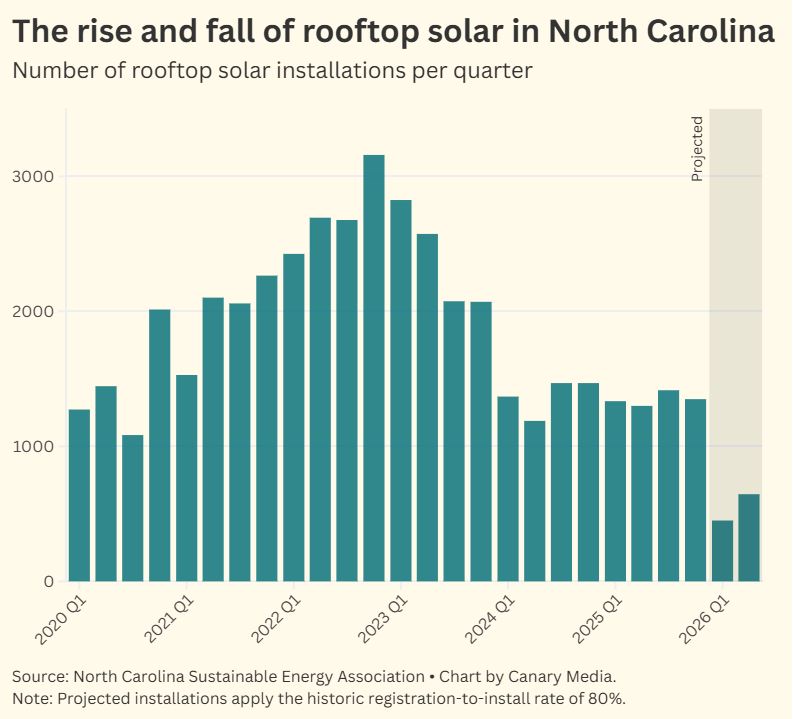
A national leader in large ground-mounted solar projects, North Carolina is just in the middle of the pack when it comes to rooftop solar, with only about 58,000 home arrays in this state of 11 million people.
That’s primarily because it’s long been cheaper for most households to buy from the grid than to produce their own solar power. Duke Energy, the investor-owned utility that covers most of North Carolina, has historically had relatively low rates. State law prevents any party other than Duke from selling electricity, reducing competitive pricing. The company’s rebate program for solar arrays was effective but short-lived, and Duke pays grid-connected customers less for excess solar electrons than it used to.
But now, many of these dynamics are shifting, altering the finances of home solar.
Third parties still can’t sell electrons directly. But under a 2017 state law, they can rent the solar equipment itself to customers in Duke territory — up to a certain cap.
The provision was little used in North Carolina until last fall. But it became crucial after the passage of the GOP budget law, which still offers commercial entities a 30% tax credit for solar arrays through at least the end of next year.
That means installers and other third parties can access the incentive and pass the savings on to residential customers. The models for doing so vary, but rooftop companies say the bottom line is similar across the board: Many solar customers can immediately start paying less each month for their electricity.
“Leasing is now alive and well,” said Clary Franko, chief operating officer of Asheville-based Sugar Hollow Solar, who noted at least half of her customers are going that route. “It’s actually the most cost-effective residential option I’ve seen yet in North Carolina.”
Some installers are offering their own leases. Others are partnering with one or more of the 20-some third-party lessors registered with state regulators, including homegrown companies like Durham’s Enerwealth Solutions.
The deal can be even sweeter for Duke customers who pair solar with battery storage. Through programs called EnergyWise Home and Power Manager, those households get a monthly incentive for allowing the utility to tap their batteries 30 to 36 times per year.
“The average battery that we’re installing is an additional 50 bucks a month,” said Graham Alexander, an owner and solar energy designer at Southern Energy Management, which opened its doors in Raleigh in 2001. “You, as a homeowner, get the money — that’s great. The utility benefits because they get more load stability with being able to deploy those batteries.”
Another key economic driver of solar adoption in Duke territory is rising electricity rates. Residential bills have jumped by over 20% in the last five years, and the company wants to raise them by as much as another 10% over the next two. Households pay 100% of the cost of the fuels in Duke power plants, sending bills even higher.
It all adds up, said Bryce Bruncati, director of residential sales at Raleigh-based 8MSolar. He recently worked with a customer whose Duke Energy bill had jumped to $420 a month. But with a new solar array and two batteries, “he’s swapping that out for a $160 payment. All he had to do was sign for the lease,” Bruncati said. “There’s no down payment, nothing like that.”
Still, installers say not all customers prefer leasing, and the option may not be widely available after next year if state and federal law remain unchanged. What’s more, bill credits for solar households in Duke territory will decrease again on Jan. 1, 2027. And revised state electrical codes could soon add to installation costs.
While few dare to dream about it under current political conditions, the return of the 30% federal tax incentives would certainly make those coming hurdles easier to clear.
“Anybody would really value and appreciate having those back,” said Matt Abele, the executive director of the North Carolina Sustainable Energy Association. “Those tax credits are reinvestments directly into ratepayers’ pockets.”
Despite all the ups and downs, veteran installers say they are feeling optimistic.
“We think that it’s great to be able to help people with a product that’s actually benefiting them — and the world on a large scale,” said Solomon of NC Solar Now. “And there’s just tons of room for growth. My favorite thing is when I fly out of Raleigh or Wilmington, and I look at all the roofs.”


.svg)
