

 Back
Back
This story was originally published by CalMatters. Sign up for their newsletters.
If you’re a California homeowner and you’ve been feeling chilly this winter, there are plenty of reasons to go get a heat pump.
An all-electric, energy-efficient alternative to gas-burning furnaces, heat pumps are widely seen as the climate-friendly home heater of choice.
They can do double duty as both home heaters and AC units and are pretty good at maintaining a constant temperature inside a home without the blast-then-cool-off cycle typical of a furnace.
What about a guaranteed lower monthly utility bill? Not in California.
Call it California’s heat pump conundrum.
On the one hand, California has hyperambitious goals to reduce greenhouse gas emissions in an effort to curb the worst effects of a changing climate. Most experts see the electrification of buildings — swapping furnaces, water heaters, stoves, and ovens that run on burning fossil fuel with appliances plugged into California’s increasingly green electrical grid — as a necessary step toward meeting those goals.
California has built one of the most aggressive heat pump strategies in the country. The state aims to install 6 million heat pumps in homes by 2030. Lawmakers are also moving this year to boost heat pump adoption — proposing to streamline permitting and make it easier to electrify homes.
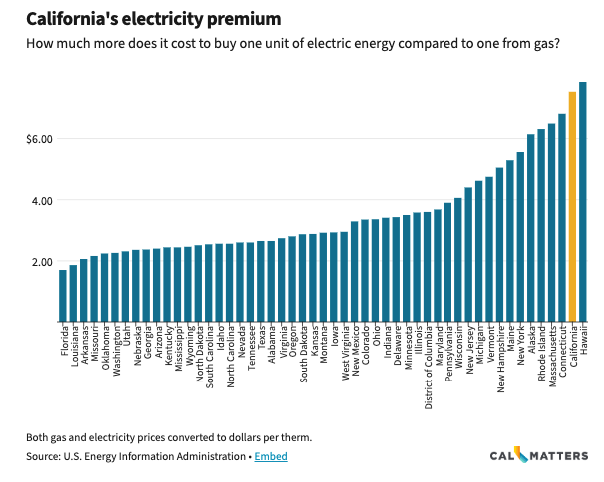
On the other hand, California’s residential electricity prices are among the highest in the country — expensive even compared to its also pricey natural gas. That makes heat pumps a tough sell to many Californians.
A new Harvard University study maps exactly where that reality bites — and tries to explain why some places are more heat-pump friendly than others.
The public is “overwhelmed with these sorts of plans now for decarbonization: ‘This by 2030,’ ‘this by 2050,’” said Roxana Shafiee, an environmental science policy researcher at Harvard University. “But then you scratch the surface a bit more and you look at things like electricity prices.”
Reaching those goals amid such high prices is a tough circle to square, said Shafiee.
By looking at residential energy costs, usage, and winter temperatures in every county in the United States, Shafiee and Harvard environmental science professor Daniel Schrag found in a recent paper that typical households living across the American South and the Pacific Northwest would likely see lower utility bills by making the switch to a heat pump.
Average homes in northern Midwestern states, in contrast, would see their bills increase. That’s partly because heat pumps work by extracting heat from outdoor air, compressing it, and piping it indoors, a thermal magic trick that’s harder to perform in places with subzero winters. It’s also thanks to the region’s relatively cheap gas.
Then there’s California: a surprisingly mixed bag.
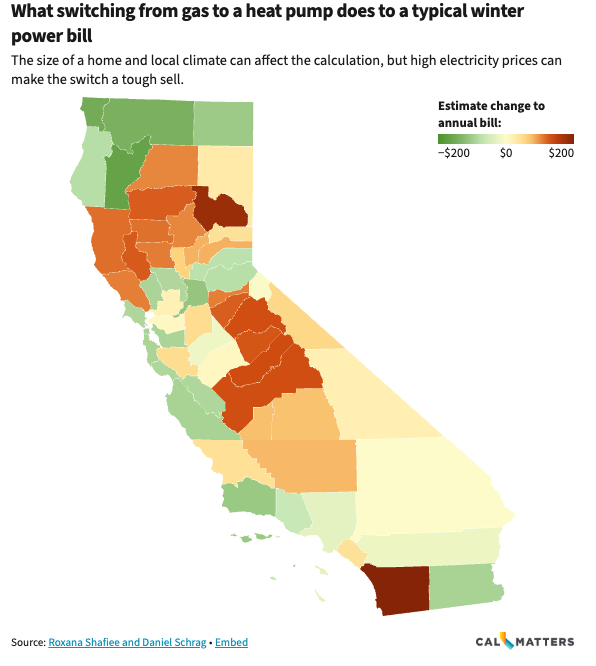
Though the state’s temperate coast is ideal for heat pump adoption, high residential electricity prices can make swapping a gas furnace for a heat pump a pricey proposition. That’s especially true in counties where homes tend to be larger, winters are colder, or electricity is costly.
Quentin Gee, a manager at the California Energy Commission, said the advantage of heat pumps comes down to thermodynamics. Unlike a gas furnace, which burns fuel to create heat, a heat pump compresses and expands a refrigerant, like a refrigerator in reverse. That moves heat from outside into a home — allowing it to deliver several units of heat for every unit of electricity it uses.
Even in Pacific Gas & Electric territory, where electricity rates may be some of the highest in the U.S., Gee said that efficiency can allow heat pumps to compete with — and in some cases beat — gas on operating costs, depending on local rates and home characteristics.
In lower-cost municipal utility regions such as Sacramento’s Sacramento Municipal Utility District, he said heat pumps can be a clear financial win.
“Gas prices have also gone up over time as well — so both are tricky when it comes to heat pumps versus, say, a gas furnace,” Gee said.
Between 2001 and 2024, average retail gas prices have gone up by 80% in California, according to federal data. Retail electricity rates, padded out with wildfire prevention costs and state-mandated social programs, have increased by twice as much.
Even in parts of California where the average home isn’t likely to save with a heat pump, there are plenty of exceptions. Smaller, well-insulated homes can often stay warm with minimal output from a heat pump.
For some homeowners, solar panels have helped bridge the gap. Doug King, a green building consultant in San Jose, installed his first heat pump in 2021 alongside a new rooftop solar system; those panels more or less covered the monthly cost of running the heat pump. A second unit installed last year has pushed his bills higher. “But that’s fine, I don’t mind,” he said. “I was willing to pay a bit of a premium for using electricity over gas anyway.”
Homes that already use old-fashioned electrical baseboard or space heaters are guaranteed to save on monthly costs by switching since that entails swapping an inefficient electrical heating system that uses a ton of energy (“basically like heating your home with a toaster,” said Shafiee) for heat pumps that use up to 60% less.
But for all of California’s reputation as a climate champion, most of its homes don’t rely on electric heat. Nearly two-thirds use natural gas, well above the national average of 51%.
That isn’t surprising, said Lucas Davis, a University of California, Berkeley, energy economist.
Looking at 70 years of home heating data across the country, Davis’ research has found that the best predictor of whether a household uses electricity to stay cozy in the winter is the price of energy.
“To this day, where do we see that electric heating is the most common? Throughout the Southeast,” said Davis. “What do we know about the southeast? Cheap electricity.”

The consequences of costly electricity extend well beyond any individual household’s ambitions for a heat pump or its utility bill. Using fossil fuels to heat up water, warm indoor air, and cook food inside homes and businesses was responsible for 13% of the country’s greenhouse gas emissions in 2022, according to the U.S. Environmental Protection Agency. Gas-powered cars and trucks used for private use make up another 16%.
Heat pumps are a 19th-century invention and started popping up regularly in American homes in the 1960s, but you would be forgiven for thinking they’re a new technology.
Spurred on by concerns over climate change and policies meant to address it, heat pumps have outsold gas furnaces each year since 2021, according to the Rocky Mountain Institute, a clean-energy research nonprofit. Demand saw a particularly sharp spike after 2022 thanks to the Inflation Reduction Act, the Biden-era law that threw rebates and tax credits at homeowners.
Installation costs can reach into the tens of thousands of dollars, which is why most federal and state policies promoting heat pump adoption have focused on defraying them. In California, the push runs through multiple agencies:
This year, state lawmakers are considering bills to speed up the local permitting process for heat pumps and to require gas utilities to offer homeowners cash to electrify their homes in lieu of replacing an old gas line.
Even as the federal supports subsided with President Donald Trump’s return to the White House, installation costs are “pretty competitively priced with traditional units, especially since in most cases, you are installing two appliances for the price of one,” said Madison Vander Klay, a California policy advocate for the Building Decarbonization Coalition, a national nonprofit which represents appliance manufacturers and utilities.
That may not be the case for all homeowners.
Many homes need new wiring, larger breakers, or a full panel replacement, and some require upgrades to the service connection to the grid, said Matthew Freedman of The Utility Reform Network. Costs rise quickly when homeowners electrify more than just heating, he said.
Customers often underestimate how complex and costly that electrical work can be, he said, another uncertainty on top of the potential for long-term rate savings.
Installation costs aside, month-to-month electricity costs remain an obstacle.
Last year, the Legislative Analyst’s Office released a report warning that California’s residential electricity rates are among the highest in the country — nearly double the national average — and rising much faster than inflation.
The report, authored by LAO analyst Helen Kerstein, cautioned that those high rates could undermine the state’s climate strategy by discouraging households from switching to electric cars and appliances like heat pumps from gas-powered ones.
“If I’m a consumer, I’m going to be thinking about — not just, ‘Is this good for the environment?’ That’s certainly one consideration, but also, ‘Is this something I can afford?’” Kerstein said. “Unless folks are saving money on the operating cost, it often doesn’t pencil out.”
Essentially everyone agrees: Americans shouldn’t pay higher electric bills to feed AI data centers’ insatiable demand for power. But what will it actually take to prevent cost spikes?
Lots of states have decided the answer is a “large load tariff” — an unsexy term that basically translates to special utility rates and requirements designed for huge energy users, like data centers.
As of late 2025, more than 65 such tariffs have been proposed or approved in over 30 states, according to data tracked by the Smart Electric Power Alliance and the North Carolina Clean Energy Technology Center.
These efforts are largely trying to solve the same problem: The explosive growth of AI data centers is outpacing utilities’ ability to build power plants and upgrade the grid. If data centers don’t show up and stick around to buy all the power that’s justifying those investments, other customers could be trapped paying them off for decades to come.
This puts enormous pressure on regulators to “hold the line on ensuring that these large-load customers carry the costs that they bring,” said Jay Griffin, executive chair at the Regulatory Assistance Project. The nonprofit last month launched a report series to help regulators and policymakers navigate these complexities.
The trend of states adopting data center–focused large load tariffs began to take off in 2024, led by early movers like Ohio and Indiana. More such tariffs were approved in Kansas, Michigan, and Virginia last year, and now Illinois and Wisconsin are debating their own proposals. With roughly a year and a half of data on how different states have tackled the problem, “there’s enough time and transparency into decision-making that commissioners are able to make appropriate decisions,” Griffin said.
Progress is decidedly mixed, said Louisa Eberle, a senior associate at the Regulatory Assistance Project who co-wrote its first data center report. “Some are just getting started. We haven’t reached full ‘best practices’ anywhere — but we have found better practices.”
Those start with contracts requiring these giant new customers to pay a minimum amount of money for power for a set period — usually 10 to 15 years — whether or not they end up being built or staying open that long. This offers some insurance against data centers pulling out and leaving customers at large holding the bag, although some advocates fear those terms aren’t lengthy enough to cover the cost of power plants and grid investments, which must be paid off over decades.
Some tariffs also lay out what kind of power such massive customers must use — namely, clean energy. These can match up nicely with both state climate targets and the clean energy goals of the tech giants, like Amazon, Google, Meta, and Microsoft, that are driving the AI boom — although plenty of utilities and data center developers are going big into fossil gas–fired power as well.
And on the cutting edge of large load tariff policy, some utility regulators are asking data centers to “bring their own” generation or grid capacity, Eberle said. The idea here is to make developers play a more active role in sourcing and contracting for new energy resources for their computing facilities. That might not be utilities’ favorite option, since it cuts into the profits they earn from investing in power plants and power lines. But it’s an opening for data center developers willing to pay a premium to get onto the grid faster.
These negotiations aren’t easy, Griffin said. Tech companies are asking utilities to invest billions of dollars to serve power demand equal to that of entire cities springing up on their grids over just a few years. The sheer scale and speed of the boom have overwhelmed regulatory processes built for slow and low growth.
And the future is highly uncertain. Tech companies keep upping their AI spending plans, even amid mounting signs that the sector is a bubble about to pop. The Trump administration’s call in recent months for data centers to build their own power plants as a means to protect utility customers from rate increases conflicts with hard limits on how quickly new generation can be built and connected to the grid.
As the former chair of the Hawaii Public Utilities Commission, Griffin knows that regulators are constantly balancing the risk of letting utilities build too much power with the risk of preventing them from building enough. The former threatens to burden customers with unnecessary costs, while the latter can constrain economic growth and even endanger grid reliability.
Right now, public opposition to data centers is squarely focused on the financial and environmental dangers of overbuilding. Laws passed in Minnesota, Oregon, and Texas last year, and bills being debated in states including Florida, Georgia, Illinois, Virginia, Washington, and Wisconsin, propose everything from stripping tax breaks for data centers to imposing full-on construction moratoriums.
However, data centers that cover their costs and finance more-sustainable resources could help in “reducing cost for everyone,” Griffin said, both by increasing utility revenues to cover shared expenses and by pushing “innovation for emerging technologies,” such as virtual power plants and on-demand clean energy resources like geothermal power. Tech giants “have the demand for power and the need for speed to drive those in a way we’re probably not going to see for another generation,” he said.
While no two large load tariffs are exactly alike, many share common characteristics, as think tank RMI highlighted in a November review.
About a third of the 65 large load tariffs on deck as of late 2025 require big customers to make minimum payments over a set period of years, whether or not they remain operational over that time. More than half include some form of collateral requirements or other credit risk protections. And roughly half require large customers to pay fees if they exit their contracts early.
These requirements can help cull the speculative data center proposals now crowding utility interconnection queues, whether from companies with projects that are highly unlikely to win financing or from major developers “shopping” single projects across multiple utility territories. American Electric Power’s Ohio utility, for example, saw its large load pipeline drop from 30 gigawatts to 13 gigawatts after it instituted a large load tariff last year. In that sense, “not only do strong tariffs help protect customers, they also help the utility in forecasting what’s coming,” Eberle said.
But the tariffs might not be sufficient to pay off the cost of power plants and grid investments that last for decades, said Ben Hertz-Shargel, global head of grid edge at research firm Wood Mackenzie. Last year, he ran an analysis that found none of the large load tariffs on the books at that time were sufficient to fully recover the cost of new gas-fired power plants that would need to be built to serve big energy users.
The scale of fossil fuel build-out being contemplated to serve the high side of the AI bubble would be ruinous on both cost and climate terms. The Sierra Club is tracking a startling 248 gigawatts of gas-fired power plants being planned across the U.S. as of the first quarter of 2026, nearly five times the amount planned in 2021. Data center expansion is the primary driver of that increase, including for build-outs planned in Georgia, Louisiana, and North Carolina— states that have yet to impose large load tariffs.
“There are some utilities that are starting to creep up and charge for what it takes to build a new power plant today,” Hertz-Shargel said. “But it’s still uneven.”
Nor can tariffs guarantee that data centers will pay for transmission built to accommodate their impact on regional grid networks, he said, since those costs are allocated via complex structures that make it hard for utilities to force expenses on individual customers. The Illinois attorney general’s office has raised that issue in challenging utility Commonwealth Edison’s proposed transmission service agreements for data centers.
Even tariffs specifically designed to force individual data centers to cover the costs of utility investments expose customers to financial risk, said Jeremy Fisher, principal adviser on climate and energy with the Sierra Club’s Environmental Law Program.
He cited Wisconsin, where utility We Energies has proposed two tariffs meant to isolate the cost of building power plants and transmission grids to the gigawatt-scale data centers being planned in its territory. Those tariffs allow data centers to pay for new solar, wind, and battery storage. But they also offer an option for the facilities to contract for power and capacity from two gas-fired plants that the utility is planning to build. Under that latter option, everyday customers would remain responsible for paying for 25% of the cost of building these plants, as well as for the fuel they burn.
Meanwhile, two of the planned data centers in We Energies’ territory will consume as much power as the utility’s entire residential customer base, Fisher noted. “I don’t know how you quantify the concentration risk of two customers doubling the size of your load,” he said. “We’ve never seen anything like this.”
Hertz-Shargel added that the risk of a handful of customers driving most new demand is compounded by the nature of AI growth. The sector is fueled by hundreds of billions of dollars of debt financing and circular deals that could unravel if one or more major players fail to deliver.
“If the utility is going to have half of its assets caused by and paid for by a small number of customers, you need to be very concerned about that level of business risk,” he said.
That’s why Hertz-Shargel and other clean energy advocates are pushing a solution adopted by only a handful of utilities and regulators so far: requiring data centers to contract for their own clean energy and capacity.
The concept goes by many names — one of the catchiest is BYONCE, for “bring your own new clean energy.” But Hertz-Shargel uses the term “clean transition tariff,” a phrase coined by Google and Nevada utility NV Energy for a tariff approved by state regulators last year. That agreement allows the search giant to directly tap a geothermal plant being built by startup Fervo Energy.
Last week, Google announced a plan with Minnesota utility Xcel Energy that expands on this premise. Like Google’s agreement with NV Energy, it is a one-off deal rather than a tariff that applies to other large-load customers. But under it, Google will pay for the construction of 1,400 megawatts of wind, 200 megawatts of solar, and 300 megawatts of energy storage, and cover the grid infrastructure costs to bring it all online. It will also invest $50 million in the utility’s proposed Capacity*Connect distributed battery program.
“All parties should love it,” Hertz-Shargel said. “Data center companies get to choose the generation technology that supplies them, generation developers can play in new markets, and utilities get to sleeve the agreements between them.”
Utilities that profit from building power plants may not be as enthused, he conceded. But they already have enormous investments to make in distribution and transmission. “Adding on power plants to serve data centers would add additional revenue, but at enormous political cost,” he said.
Utilities can also squeeze more clean capacity out of the existing grid, Eberle noted. That could look like improving energy efficiency, paying customers to use less power when demand is high, and leveraging rooftop solar systems and home batteries to ease strain on the grid. These strategies “can be scaled up quickly and cheaply,” and they “will be useful even if the load doesn’t emerge,” she said.
Data centers could also agree to strategically reduce their own power use when the system is strained or to install batteries that can relieve near-term grid pressures.
How can large load tariffs tap into this kind of clean and flexible capacity? Fisher highlighted last year’s settlement agreement between Kansas utility Evergy, which has some significant data center projects in its territory, and groups including the Sierra Club, the Natural Resources Defense Council, Google, and the Data Center Coalition.
The tariff allows data centers to earn credit for flexibility they contract directly, Fisher said. But it also gives them the option to contract for renewables, energy storage, or efficiency programs in Evergy’s integrated resource plan, the regulator-mandated process to determine the mix of new power plants and programs the utility can invest in.
That’s an important wrinkle on the “bring your own” concept, Eberle said. It allows data centers to “engage with the utility and say, ‘We really like this resource that you identified but didn’t select — we’d like to pay for it.’”
Another option under the tariff would allow Evergy to seek out and directly charge a developer for the capacity needed to allow a data center to come online, she noted.
Griffin highlighted that these kinds of collaborative agreements take more time and require concessions from utilities and data center companies alike. But “you’ll be more successful if you give commissioners and stakeholders time and space to do the vetting — and that should support the more sound business models,” he said.
As for data center developers trying to push their costs onto consumers, Griffin said, “the more you force commissions to stick their neck out — well, you don’t get that pass many times.”
A clarification was made on March 4, 2026: This story has been updated to clarify that the Smart Electric Power Alliance’s data on large load tariffs was compiled in partnership with the North Carolina Clean Energy Technology Center.
An energy-affordability bill approved yesterday by the Massachusetts House of Representatives could speed solar permitting, strengthen protections for many electricity consumers, and boost EV charging infrastructure. It could also pull the rug out from underneath the state’s nation-leading energy-efficiency programming.
The legislation, passed in a late-night session on Thursday, takes a wide-ranging approach to combating rising power bills in the state, which faces some of the highest rates in the U.S. What has drawn the most attention, however, is its proposal to cut $1 billion from the energy-efficiency program Mass Save through 2027 in an attempt to lower the fees customers pay to fund it.
Bill sponsor Rep. Mark Cusack, a Democrat, argues that any cuts would target administration and marketing expenses and that Massachusetts would still be spending more per capita on energy efficiency than any other state. Opponents of the measure, though, say it would undermine job growth and slow progress toward the state’s emissions-reduction goals, while doing little to lower electricity costs now or in the future.
“I have to assume it’s going to mean layoffs in the energy-efficiency industry, and it’s going to mean a whole lot fewer heat pumps,” said Larry Chretien, executive director of the Green Energy Consumers Alliance.
Massachusetts has been grappling with rising energy costs for years, but the issue has taken on increasing urgency in recent months. And even in the Democratic-dominated state, the conversation around this bill reflects debates that are happening throughout the region — and the country — about whether to compromise climate and affordability goals for the possibility of savings.
Last May, Democratic Gov. Maura Healey proposed a sprawling affordability package, which received a hearing in June and proceeded no further. In November, Cusack introduced legislation that included many of the measures from Healey’s bill, but also called for slashing the Mass Save budget by $330 million, reinstating incentives for high-efficiency gas heating systems, and making the state’s 2030 emissions-reduction goals nonbinding.
The reaction from consumer and climate advocates was immediate and fierce: The bill would eviscerate the state’s decarbonization progress and do little to help residents struggling with high bills, they said.
Despite these concerns, the Telecommunications, Utilities, and Energy Committee voted in favor of the bill, sending it to the House Ways and Means Committee for further revision. There, lawmakers removed many of the contested measures from Cusack’s original proposal but tripled the proposed Mass Save funding cut, an escalation that has rankled members of the renewable energy community.
“Legislators are feeling the pressure to deliver immediate savings and are cannibalizing programs that actually function to lower electricity costs over the medium to long term,” said Ben Underwood, co-CEO of Boston-based solar company Resonant Energy.
The bill now moves to the state Senate energy committee, whose vice chair Sen. Michael Barrett, a Democrat, has a track record of assertive climate and clean energy action.
Mass Save is run by the state’s major utilities according to a three-year plan approved by regulators. Its offerings include home energy assessments, low-cost insulation for income-eligible households, rebates on heat pumps and energy-efficient appliances, and no-interest loans for implementing these measures.
The proposed $1 billion cut represents about 22% of the program’s existing three-year, $4.5 billion budget, but the fallout would be more severe than those numbers suggest. The current budget period runs from 2025 through 2027; by the time a bill could be enacted, more than half of the planned programming would likely have been executed. The $1 billion would therefore come out of a much smaller pool of money, and the impact would likely go well beyond the administrative and marketing costs the bill prioritizes, opponents said.
“It would really, absolutely cripple the program,” said Kyle Murray, director of state program implementation at climate nonprofit Acadia Center.
Such a drastic reduction in funding would trade significant long-term financial benefits for short-term savings, he said. Mass Save spent almost $12.4 billion from the beginning of 2010 through the third quarter of 2025, and generated $42 billion in benefits for the state’s residents and businesses. The fees that fund the program make up roughly 7% to 8% of the per-kilowatt-hour charge on the average electricity bill, which would mean a household with a $200 monthly bill would save little if the fee were lowered.
“It seems like I am most likely going to save $12,” said Mary Wambui, a member of the council that drafts Mass Save’s three-year plan, upon analyzing the impact the legislation would likely have on her own monthly electricity costs. “You tell me why a bill should be called ‘energy affordability’ if it doesn’t do anything for my energy bill?”
The funding cut could also result in lost jobs if business slows down for Mass Save’s network of thousands of home energy assessors and heat pump installers.
Despite the alarm bells set off by the Mass Save portions of the legislation, other provisions are receiving more support. Solar, clean energy, and climate groups praised the bill’s passage.
The bill calls for strengthening restrictions on third-party power suppliers, which sell electricity directly to customers who don’t want to get their energy from traditional utilities. These companies routinely charge higher prices than default service, often targeting lower-income households, according to studies by the Massachusetts attorney general’s office. The legislation would allow municipalities to ban third-party suppliers from operating in their city or town, limit suppliers’ ability to offer variable rates, and increase the penalties for regulatory violations.
Solar power would also get a boost. The bill would require the state to establish an online permitting platform to speed up the process of municipal approvals for solar projects. It would also allow residents to install portable solar — do-it-yourself kits that send power into a home through standard outdoor outlets — and would double the limit for how much net-metered solar an individual municipality can own, from 10 megawatts to 20 megawatts.
Other bright spots include support for virtual power plants, geothermal networks, and EV charging infrastructure that lets battery-equipped vehicles both consume power and send it back to the grid. Still, advocates say they will now be focusing on defeating the Mass Save funding cuts as the bill moves to the state Senate for consideration.
“If the Senate can fix that, maybe 2026 won’t be so bad,” Chretien said.
This story was originally published by Grist. Sign up for Grist’s weekly newsletter.
It’s no secret that U.S. electricity prices have been rising over the last few years: The average residential energy bill in 2025 was roughly 30 percent higher than in 2021. This jump is largely in line with the overall inflation Americans have experienced during this period. As the cost of groceries, gas, and housing has increased, so too has the cost of electricity.
But there are big differences from state to state and region to region. Some places — like California and the Northeast — have seen mammoth price increases that outpaced inflation, while costs have held steady in other parts of the country, or even fallen in relative terms. Nearly everywhere, though, rising electricity costs have strained the budgets of low-income households in particular, since they spend a much larger share of their earnings on energy, compared with wealthier Americans.
Higher energy bills have also become a political flashpoint. Over the past year, rising electricity prices have helped push voters to the polls, and politicians have taken note. In Virginia and New Jersey, newly elected governors campaigned heavily on reining in utility bills. In Georgia, incumbent utility regulators were booted out by voters, who elected two Democrats to the positions for the first time in two decades.
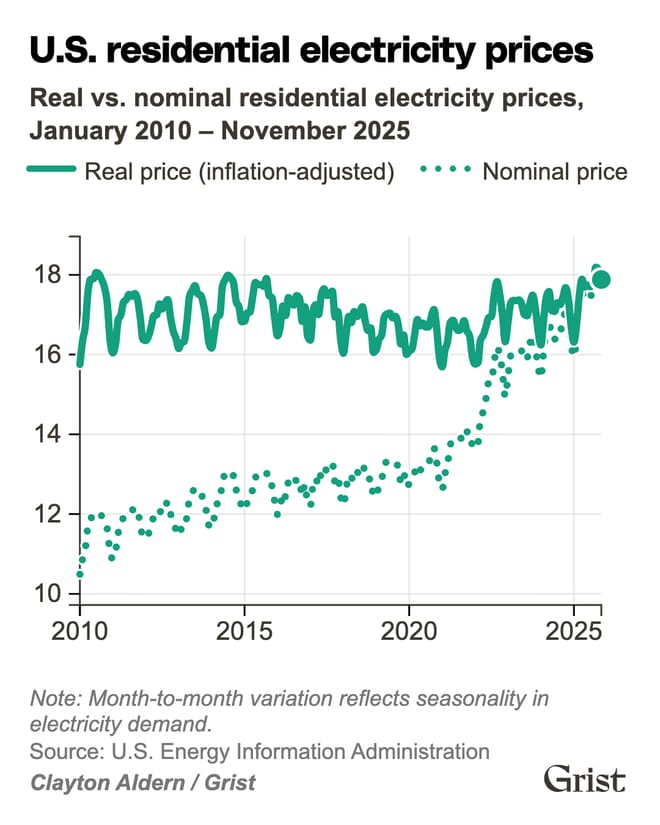
A wide range of culprits have been blamed for the surge in electricity prices, with energy-hungry data centers shouldering much of the criticism. Tariffs, aging power plants, and renewable energy mandates have also come under fire. But the reality is far more nuanced, according to recent research from the Lawrence Berkeley National Laboratory and the latest price data from the federal government’s Energy Information Administration. Electricity prices are shaped by a complex mix of factors, including how utilities are structured, how regulators oversee them, regional divergences in fuel prices, and how often the grid is stressed by heat waves or cold snaps. In many states, the biggest driver is the rising cost of maintaining and upgrading grids to survive more extreme weather — the unglamorous work of replacing old poles and wires.
But the forces driving high bills in California aren’t the same as those affecting households in Connecticut or Arizona. In this piece, we highlight one key driver of recent price trends in each region of the country. (The regions below are organized alphabetically, with individual entries for Alaska, California, Hawaiʻi, the Midwest, the Northeast, the Pacific Northwest, the Southeast/Mid-Atlantic, the Southwest/Mountain West, and Texas.) While the dynamics of every utility bill are different — including those within the same state — recent data demonstrates the many challenges ahead as public officials promise a laser focus on energy affordability.
Key factor: Geographic isolation
Alaska’s electricity prices are among the highest in the country, largely because the state’s power grid operates in isolation. Unlike utilities in the lower 48 states, Alaska’s providers can’t import electricity from neighboring states or Canada when demand spikes or supply runs short. That isolation limits flexibility and drives up costs. Utilities also have to spread the expense of generating and transmitting power across a relatively small customer base. The state’s primary grid, known as the Railbelt, serves about 75 percent of Alaska’s population. Beyond it, more than 200 microgrids power rural communities, many of which rely heavily on diesel generators. These structural challenges contribute to electricity rates that are roughly 40 percent higher than the national average.
Electricity prices have been rising in the state over the past decade, even after adjusting for overall inflation. A study by researchers at the Alaska Center for Energy and Power found that residential rates for Railbelt customers increased by about 23 percent between 2011 and 2019. Rural customers saw a roughly 9 percent increase during the same period.
While more recent data charting electricity prices adjusted for inflation isn’t readily available, energy costs are likely to grow in the state. That’s because Alaska depends on natural gas for electricity generation and heating, and it relies on the Cook Inlet basin for natural gas. With supplies dwindling in that reserve, the state is expected to face a shortage soon. If it chooses to import natural gas, it will be much more easily affected by price swings in the natural gas market. State regulators have also approved a 7.4 percent interim rate increase for the Golden Valley Electric Association, the primary utility that serves the Fairbanks area. A full rate case review is underway, and a final decision on the rate will be made in early 2027.
Key factor: Wildfires
Californians have long paid above-average electricity prices. Since the 1980s, rates in the Golden State have typically been at least 10 percent higher than the national average. For decades, however, those higher per-kilowatt-hour prices were largely offset by lower electricity use as a result of the state’s relatively temperate climate. In other words, electricity in California cost more per unit, but residents consumed far less than households in many other states, keeping average monthly bills relatively low. That began to shift in the mid-2010s when the state began experiencing more frequent and larger wildfires. Since then, electricity prices have outpaced consumption, leading to exorbitantly high energy bills.
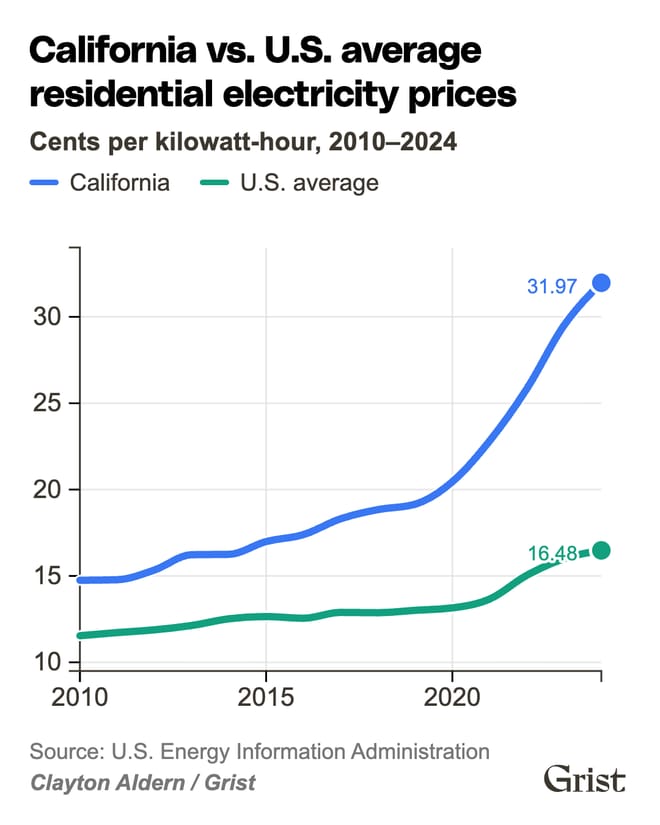
Between 2019 and 2024, California had the largest increase in retail electricity prices of all U.S. states. Monthly energy bills in 2024 averaged $160, roughly 13 percent higher than the national average. Much of that increase has been driven by the soaring cost of infrastructure upgrades aimed at reducing wildfire risk, along with rising wildfire-related insurance and liability costs. After the 2018 Camp Fire, PG&E declared bankruptcy, citing $30 billion in estimated liabilities. Utilities have also poured billions of dollars into replacing aging transmission and distribution lines and expanding the grid to meet growing demand.
California’s high rate of rooftop solar adoption has also played a complicated role in rising prices. As more customers install rooftop solar, they purchase less electricity from the grid. That leaves utilities with the same fixed infrastructure costs — but fewer kilowatt-hours over which to spread them. The result: higher per-unit rates for customers who remain more dependent on grid power. Since renters and low-income Californians are less likely to benefit from residential solar, rising electricity rates hit them harder.
Key factor: Oil dependence
Hawaiʻi has the highest electricity bills in the country. Average residential rates rose by about 8 percent between 2019 and 2024, even after adjusting for overall inflation, and the typical household now pays more than $200 per month for electricity.
Those high costs are rooted in the state’s unique energy system. Hawaiʻi remains heavily dependent on oil to generate power, and many of its oil-fired plants are aging and relatively inefficient. That reliance ties electricity prices directly to global oil markets. Hawaiian Electric, the state’s primary utility, purchases crude oil on the open market and pays to have it refined before it is burned to produce electricity — meaning fluctuations in both crude prices and refining costs show up on customers’ bills.
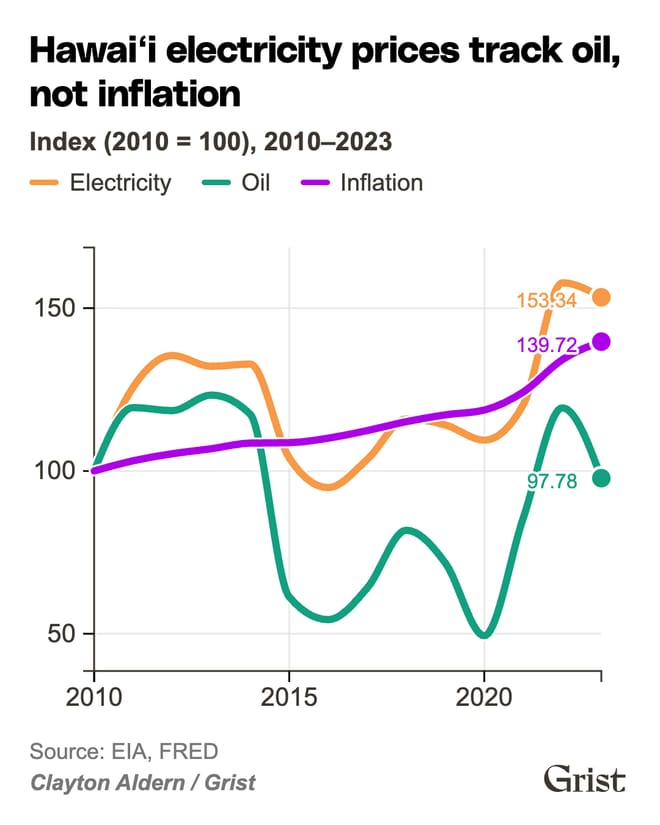
While oil prices have eased in the past couple of years, they spiked sharply in 2022 following Russia’s invasion of Ukraine, driving up fuel costs and, in turn, electricity rates. Refining costs on the islands have also risen in recent years, adding further pressure to household bills. Fuel and equipment must also be shipped thousands of miles from the mainland — and often transported between islands — adding significant logistical costs. Hawaiʻi’s power grids are also small and isolated. Electricity generated on one island cannot easily be transmitted to another, limiting flexibility and preventing the kind of resource sharing common on the continental grid. Together, those structural constraints help keep electricity prices in Hawaiʻi persistently high.
Key factor: Wind energy
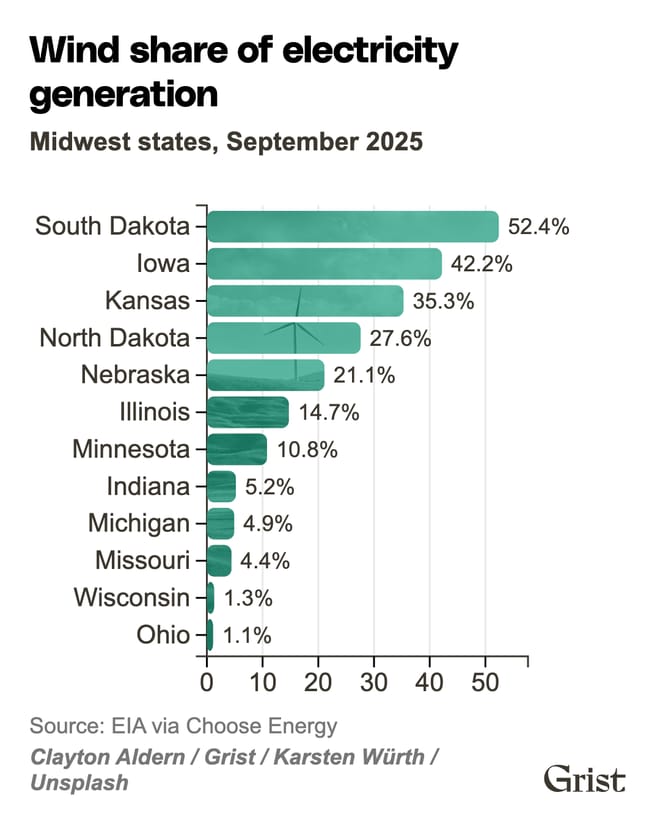
The Midwest and Great Plains states saw only modest changes — and sometimes even declines — in inflation-adjusted retail electricity prices per kilowatt-hour between 2019 and 2024. Average monthly electricity bills typically fall between $110 and $130.
This stability is largely a renewable energy success story: Many Midwestern states are now deeply reliant on wind power. Wind supplies more than 40 percent of electricity in Iowa and South Dakota, and more than 35 percent in Kansas. Investments in utility-scale wind and solar have helped shield consumers from price shocks tied to natural gas volatility, since renewables have no fuel costs and can reduce exposure to sudden spikes in gas prices. Research also shows that these investments can lower wholesale electricity prices by displacing higher-cost generation during periods of high wind and solar output.
Key factor: Natural gas prices
Aside from California and Hawaiʻi, northeastern states experienced some of the steepest increases in retail prices between 2019 and 2024. Prices in New York and Maine rose by more than 10 percent over the last few years. Connecticut residents pay nearly $200 per month for electricity.
The region’s heavy reliance on natural gas as both a home heating fuel and a source of utility-scale electricity is a major driver of high energy bills, especially in winter. When temperatures drop, demand for natural gas surges as homes and businesses burn more fuel for heating. Power plants are then forced to compete with those heating needs for the same constrained supply. (Gas has to be transported to the region via pipelines that stretch as far as Texas.) With no easy way to bring in additional gas, prices spike, and those increases ripple through to power bills.
A combination of forces has worsened natural gas constraints in recent years, pushing electricity prices even higher, particularly during cold snaps. More households in the region are switching to heat pumps and buying EVs, driving up demand for power. International energy policies, like increasing U.S. exports of liquefied natural gas and the global gas crunch caused by Russia’s invasion of Ukraine, are driving up fuel costs stateside. Utilities in the Northeast, like those elsewhere in the country, are also pouring money into infrastructure upgrades, and those investments are being passed on to customers through higher bills.
Key factor: Hydropower
Retail electricity prices in the Pacific Northwest rose only modestly over the last few years, at least compared with the country’s general rise in the cost of living. Inflation-adjusted prices in Washington and Oregon increased by about 5 percent between 2019 and 2024, while Idaho and Montana saw slight declines. In 2024, average monthly energy bills across the four states ranged from about $105 to $130, roughly in line with the national average. (This is not to say that customers haven’t noticed growing totals on their energy bills; the Energy Information Administration estimated that Oregon’s average retail price increased by 30 percent between 2020 and 2024, which is roughly in line with overall inflation over the last several years.)
So why has the region been largely insulated from the inflation-adjusted cost spikes that have struck neighboring areas like California? Hydropower. Abundant, low-cost hydroelectric generation has long kept energy bills in the Pacific Northwest — and the climate impact of the region’s power generation — among the lowest in the country. And while utilities in these states are facing rising costs tied to wildfire mitigation and infrastructure upgrades, cheap and plentiful hydropower has so far helped offset those increases.
Key factor: Extreme weather
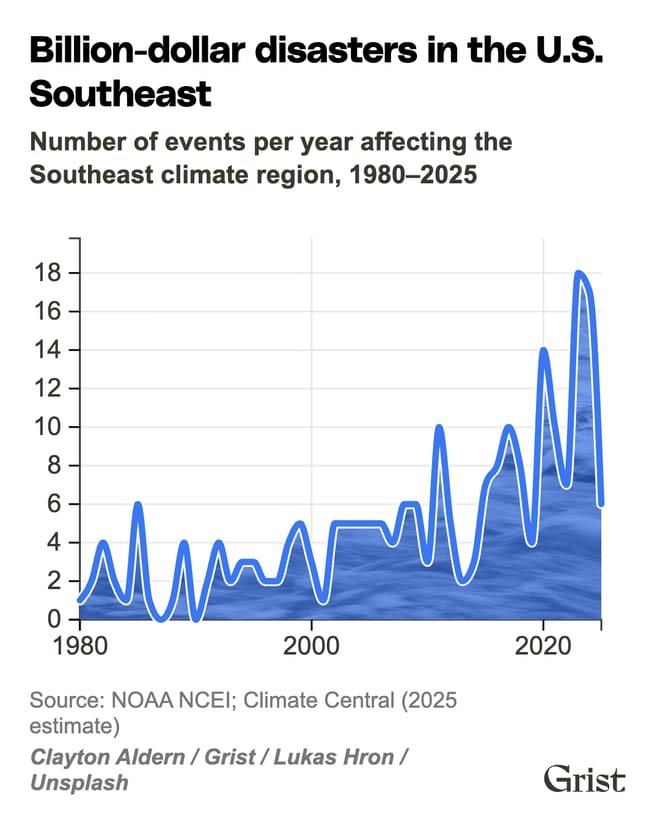
Southeastern states frequently face hurricanes, flooding, and extreme heat. In recent years, the number of billion-dollar disasters in the region has increased, an ominous sign of the havoc that climate change will wreak. Utilities are fronting the costs of both weathering these events and rebuilding in their aftermath — and then they pass them on to their customers.
The cost of distributing electricity — think the power lines that deliver energy to your home — rose significantly in the Southeast over the past few years, driven mostly by capital expenditures to upgrade and build new infrastructure. In Florida, for instance, damage from Hurricanes Debby, Helene, and Milton in 2024 resulted in residential price increases from 9 to 25 percent the following year. Similarly, Entergy Louisiana’s plan to harden its grid costs a whopping $1.9 billion, much of which will be borne by customers through rate increases.
Some states in the region, such as Virginia, have also seen a major influx of data centers, which consume enormous amounts of electricity. In some areas, utilities are upgrading infrastructure to meet that demand, raising concerns that those costs could push electricity prices higher. However, a national study by Lawrence Berkeley National Laboratory found that an increase in demand in states between 2019 and 2024 actually led to lower electricity prices on average. That’s because when there’s more demand for power, the fixed costs of running a utility — such as maintaining the poles and wires that deliver electricity to your home — are spread out over a greater number of customers, leading to lower individual bills.
In Virginia, the world’s largest data center hub, electricity prices rose only modestly between May 2024 and May 2025, despite a rapid build-out of new facilities. But that dynamic could shift as hyperscalers construct ever-larger campuses. Ultimately, prices will hinge on how utilities and regulators choose to plan and pay for that demand.
For now, however, extreme weather remains one of the region’s main drivers of rising costs.
Key factor: Hotter summers
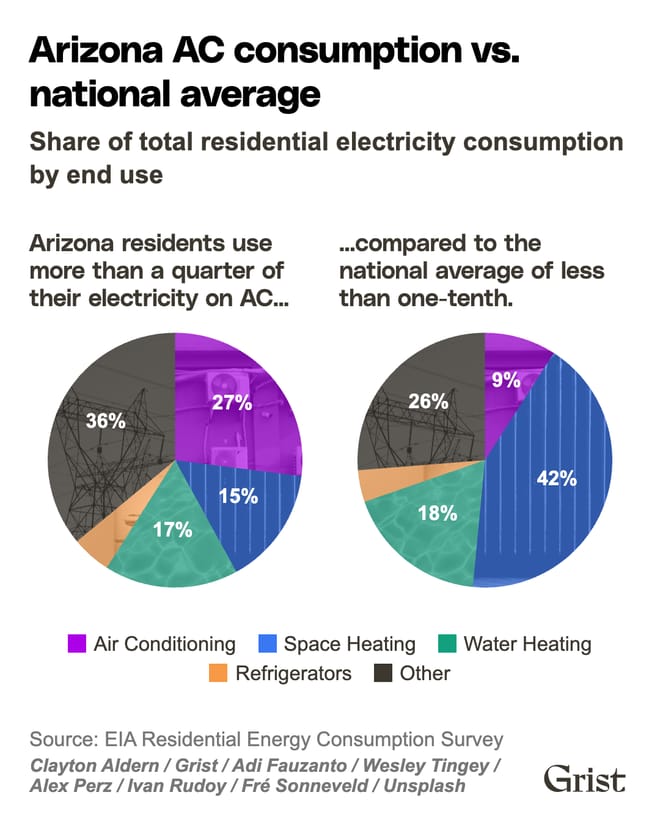
Arizona and New Mexico saw a nominal decrease in retail electricity prices between 2019 and 2024, after adjusting for overall inflation. However, there is a big difference between the states in how much residents pay for energy every month. Energy bills in New Mexico averaged just $90, while in Arizona they were nearly double, at $160.
The main difference between the two states comes down to the fact that a greater share of Arizona residents are exposed to scorching summer temperatures — and therefore more air conditioning usage, especially in population centers like Phoenix. (Average summer highs in Phoenix are about 20 degrees Fahrenheit higher than they are in Albuquerque, New Mexico’s largest city.) As a result, Arizonans use an additional 400 kWh every month, which leads to higher energy costs.
Arizona residents could also see higher prices in the coming years as a result of rate cases that are being considered, which, if approved, will take effect in 2026. Both Arizona Public Service and Tucson Electric Power are asking the state to approve a 14 percent increase in rates, which could translate to an increase of about $200 in average household energy bills per year. Both utilities have justified the increase by citing the need to modernize the grid as well as higher costs of constructing and maintaining infrastructure.
Key factor: Regulatory free-for-all
Texas is a land of contrasts. Though it’s an oil-and-gas stronghold, the Lone Star State generates a significant share of its electricity from wind and solar. And unlike most states, it operates its own power grid and runs a deregulated electricity market in which electricity prices can swing sharply from hour to hour.
In Texas, local utilities compete to buy power from generators — natural gas plants, wind farms, and solar arrays among them — in a wholesale market, and then sell that energy to customers. The system gives consumers a lot of choice in picking utility providers, but it also allows utilities to pass on wild swings in the price of power generation. If the cost of natural gas skyrockets during a particularly cold winter when solar is less available, for instance, wholesale electricity prices jump with it. This can lead to eye-popping energy bills, like those seen during 2021’s Winter Storm Uri. The setup ultimately leaves consumers exposed to price shocks, especially when extreme weather hits.
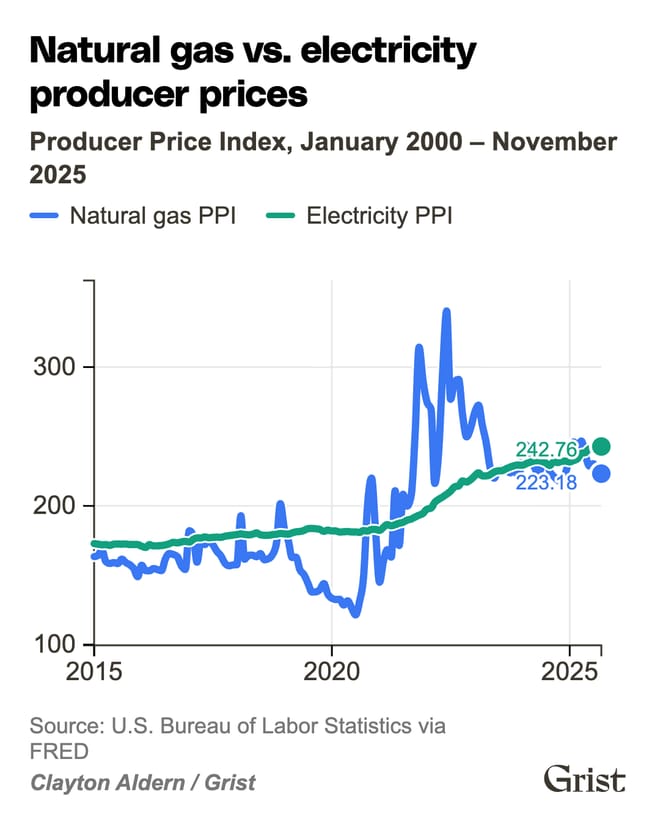
Perhaps as a result, rising electricity costs in Texas are driven by the cost of delivering power — and in particular by swings in natural gas prices, since gas-fired power plants are the state’s primary providers when weather conditions don’t enable wind and solar. While average retail electricity prices fell by a little more than 5 percent between 2019 and 2024, Texans still pay some of the highest energy bills in the country, reflecting surging demand driven by population growth and industrial expansions as well as sharp price spikes during the state’s scorching summers and winter months.
As the state’s population grows, new data centers get built, and more renewable power is brought online, utilities are also having to invest heavily to expand the grid and harden it against extreme weather like Uri, during which at least 246 people died, mostly due to hypothermia. One analysis found that transmission costs grew from $1.5 billion in 2010 to over $5 billion in 2024 and could surpass $12 billion per year by 2033.
Anita Hofschneider contributed reporting to this piece.
The economics of clean energy “just get better and better”, leaving opponents of the transition looking like “King Canute”, says Chris Stark.
Stark is head of the UK government’s “mission” to deliver clean power by 2030, having previously been chief executive of the advisory Climate Change Committee (CCC).
In a wide-ranging interview with Carbon Brief, Stark makes the case for the “radical” clean-power mission, which he says will act as “huge insurance” against future gas-price spikes.
He pushes back on “super daft” calls to abandon the 2030 target, saying he has a “huge disagreement” on this with critics, such as the Tony Blair Institute.
Stark also takes issue with “completely…crazy” attacks on the UK’s Climate Change Act, warns of the “great risk” of Conservative proposals to scrap carbon pricing and stresses – in the face of threats from the climate-sceptic Reform party – the importance of being a country that respects legal contracts.
He says: “The problems and woes of this country, in terms of the cost of energy, are due to fossil fuels, not due to the Climate Change Act.”
The UK should become an “electrostate” built on clean-energy technologies, says Stark, but it needs a “cute” strategy on domestic supply chains and will have to interact with China.
Beyond the UK, despite media misinformation and the US turn against climate action, Stark concludes that the global energy transition is “heading in one direction”:
“You’ve got to see the movie, not the scene. The movie is that things are heading in one direction, towards something cleaner. Good luck if you think you can avoid that.”
Carbon Brief: Thanks very much for joining us today. Chris, you’re in charge of the government’s mission for clean power by 2030. Can you just explain what the point of that mission is?
Chris Stark: Well, we’re trying to do something radical in a short space of time. And maybe if I start with the backstory to that, Ed Miliband, as secretary of state, was looking for a project where he could make a difference quickly. And the reason that we are focused on clean power 2030 is because it is that project. It has all the characteristics of something that you can do quickly, but which has long-term benefits.
What we’re trying to do is to accelerate a process that was already underway of decarbonising the power system, but to do so in a time when we feel it’s essential that we start that journey and move it more quickly, because in the 2030s we’re expecting the demand for electricity to grow. So this is a bit of a sprint to get ourselves prepped for where we think we need to be from 2030 onwards. And it’s also, coming to my role, it’s the job I want to do, because I spent many years advising that you should decarbonise the economy by electrifying – and stage one of that is to finish the job on cleaning up the supply.
So it’s kind of the perfect project, really. And if you want to do clean power by 2030, [the] first thing is to say we’re not going to take an overly purist approach to that. So we admit and are conscious – in fact, find it useful – to have gas in the mix between now and 2030. The challenge is to run it down to, if we can, 5% of the total mix in 2030 and to grow the clean stuff alongside it. So, using gas as a flexible source, and that, we think is a great platform to grow the demand for electricity on the journey, but especially after 2030 – and that’s when the decarbonisation really kicks in.
So it’s a sort of exciting thing to try and do. And if you want to do it, here comes the interesting thing. You need the whole system, all the policies, all the institutions, all the interactions with the private sector, interactions with the consumer, to be lined up in the right way.
So clean power by 2030 is also the best expression of how quickly we want the planning system to work, how much harder we want the energy institutions like NESO [the National Energy System Operator] and energy regulator Ofgem to support it – and how we want to send a message to investors that they should come here to do their investment. Turns out, it’s a great way of advertising all of that and making it happen. And so far, it’s working great.
CB: Thanks. So do you still think it’s achievable? We’re sitting in “mission control”. You’ve got some big screens on the wall. Is there anything on those screens that’s flashing red at the moment?
CS: So, right behind you are the big screens. And it’s tremendously useful to have a room, a physical space, where we can plan this stuff and coordinate this stuff. There’s lots of things that flash red. There’s no question. And it’s an expression of it being a genuine mission. This is not business as usual. So you wouldn’t move as quickly as this, unless you’ve set your North Star around it. And it does frame all the things that, especially this department is doing, but also the rest of government, in terms of the story of where we are.
We’re approaching two years into this mission and – really important to say – if the mission is about constructing infrastructure, it’s in that timeframe that you’ll do most of the work, setting it up so that we get the things that we think we need for 2030 constructed.
We’re already reaching the end of that phase one, and we did that by first of all, going as hard and as fast as we could to establish a plan for 2030, which involved us going first to the energy system operator, NESO, to give us their independent advice. We then turned that into a plan, and the expression of that plan is largely that we need to see construction of new networks, new generation, new storage and a new set of retail models to make all of that stick together well for the consumer.
Phase one was about using that plan to try and go hard at a set of super-ambitious technology ranges for all the clean technologies, so onshore wind, offshore wind, solar [and] also the energy storage technologies. We’ve set a range that we’re trying to hit by 2030 that is right at the top end of what we think is possible. Then we went about constructing the policies to make that happen.
Behind you on the big screens, what we’re often doing is looking at the project pipeline that would deliver that [ambition]. At the heart of it is the idea that if you want to do something quickly by 2030, there is a project pipeline already in development that will deliver that for you, if you can curate it and reorder it to deliver. And therefore, the most important and radical thing that we did – alongside all the reforms to things like contracts for difference and the kind of classic policy support – is this very radical reordering of the connection queue, which allows us to put to the front of the queue the projects that we think will deliver what we need for 2030 – and into the 2030s.
Then, alongside that, the other big thing, and I think this is going to be more of a priority in the second phase of work for us, is the networks themselves. We are trying to essentially build the plane while it flies by contracting the generation whilst also building the networks, and of course, doing this connection queue reform at the same time. That is, again, radical, but the programme of investment in infrastructure and in networks is genuinely once in a generation and we haven’t really done investment at this scale since the coal-fired generation was first planned. We think a lot about 88 – we think – really critical transmission upgrades. We really need them to be on time, because the consumer will see the benefit of each one of those upgrades.
CB: You already talked about electricity demand growing as the economy electrifies. Do you think that there’s a risk that we could hit the clean power 2030 target, but at the same time, perhaps meeting it accidentally, by not electrifying as quickly as we think – and therefore demand not growing as quickly?
CS: So, an unspoken – we need to clearly make this more of a factor – an unspoken factor in the shape of the energy system we have today has been an assumption, for well over 20 years, really, that demand for electricity was always going to pick up. In fact, what we’ve seen is the opposite. So for about a quarter of a century, demand has fallen. Interestingly, the system – the energy system, the electricity system – generally plans for an increase in demand that never arrives. We could have a much longer conversation about why that happened and the institutional framework that led to that. But it is nonetheless the case.
I think we are at the point now where we are starting to see the signal of that demand increase – and it is largely being driven by electric vehicle uptake. The story of net-zero and decarbonisation does rest on electrification at a much bigger scale than just electric cars. So part of what we’re trying to do is prepare for that moment.
But you’re absolutely right, if demand doesn’t increase, the biggest single challenge will be that we’ve got a lot of new fixed costs and a bigger system – on the generation side and the network side – that are being spread over a demand base that’s too small. So, slightly counter-intuitively, because there’s a lot of coverage around the world about the concern about the increase in electricity demand, I want that increase in electricity demand, but I also want it to be of a particular type. So if we can, we want to grow the demand for electricity with flexible demand, as much as possible, that is matching – as best we can – the availability of the supply when the wind blows or the sun shines. That makes the system itself cheaper.
The more electricity demand we see, the more those fixed costs that are in the system – for networks and increasingly for the large renewable projects – the more they are spread over a bigger demand base and the lower the unit costs of electricity, which will be good, in turn, for the uptake of more and more electrification in the future. So there’s this virtuous circle that comes from getting this right. In terms of where we go next with clean power 2030, a big part of that story needs to be electrification. We want to see more electricity demand, again, of the right sort, if we can. More flexible demand and, again, [the] more that that is on the system, the better the system will operate – and the cheaper it will be for the consumer.
CB: So, the UK has among the highest electricity prices of any major economy. Can you just talk through why you think that is – and what we should be doing about it?
CS: Yeah, there’s a story that the Financial Times runs every three months about the cost of electricity – and particularly industrial electricity prices. Every time that happens, we slightly wince here, because it’s largely the product of decades of [decisions] before us.
We do have high electricity prices and we absolutely need to bring them down. For those industrial users, we’ve got a whole package of things that will come on, over the next few months, into next year, that will make a big difference, I think. For those industrial users, [it will] take those energy prices down very significantly, probably below the sort of prices that you’ll see on the continent, and that, I hope, will help.
But we have a bigger plan to try and do something about electricity prices for all consumers. I think it’s worth just dwelling on this: two-thirds of electricity consumption is not households, it’s commercial. So the biggest part of this is the commercial electricity story – and then the rest, the final third, is for households. The politics of this, obviously, is around households.
You’ve seen in the last six months, this government has focused really hard on the cost of living and one of the best tools – if you want to go hard at it, to improve the cost of living – is energy bills. So the budget last year was a really big thing for us. It involved months of work – actually in this room. We commandeered this room to look solely at packages of policy that would reduce household bills quickly and landed on a package that was announced in the budget last year, that will take £150 off household bills from April. That’s tremendous – and it’s the sort of thing that we were advising when I was in the Climate Change Committee – because the core of that is to take policy costs off electricity bills, particularly, and to put them into general taxation, where [you have] slightly more progressive recovery of those costs.
But there’s not another one of those enormous packages still to come. What we’re dealing with, to answer your question, is a set of system costs, as we think of them, that are out there and must be recovered. Now we’ve chosen, in the first instance, to move some of those costs into general taxation. The next phase of this involves us doing the investments that we think we need for 2030, which will add to some of those fixed costs, but doing so because we are going to facilitate a lower wholesale price for electricity, that we think will at least match and probably outweigh those extra costs.
That opens up a further thing, which I think is where we’ll go next with this story, on the consumer side, which is that we want to give the opportunity to more consumers – be they commercial or household – to flexibly use that power when it’s available, and to do so in a way that makes that power cheaper for them.
You most obviously see that in something we published just a few weeks ago, the “warm homes plan”, which, in its DNA, is about giving packages of these technologies to those households that most need them. So solar panels, batteries and eventually heat pumps in the homes that are most requiring of that kind of support, to allow them to access the cheaper energy that’s been available for a while, actually, if you’re rich enough to have those technologies already. That notion of a more flexible tech-enabled future, which gives you access to cheaper electricity, is where I think you will see the further savings that come beyond that £150. So the £150 is a bit like a down payment on all of that, but there’s still a lot more to come on that. And in a sense, it’s enabled by the clean power mission.
You know, we are moving so quickly on this now and maybe the final thing to say is that as we bring more and more renewables under long-term contracts – hopefully at really good value, discovered through an auction – we will be displacing more and more gas. If you look back over the last two auctions, it’s quite staggering, 24 gigawatts [GW] – I think it is maybe more than that – we’ve contracted through two auction rounds. The amount of gas we’re displacing when that stuff comes online is a huge insurance [policy] against the next price spike that [there] will be, inevitably, [at] some point in the future for gas prices. There’s usually one or two of these price spikes every decade. So, when that moment comes, we’re going to be much better insulated from it, because of these – I think – really good-value contracts that we’re signing for renewables.
CB: We’ve seen quite a few public interventions by energy bosses recently – just this week, Chris O’Shea at Centrica, saying that electricity prices by 2030 could be as high as they were in the wake of Russia invading Ukraine. Just as a reminder, at that point, we were paying more than twice as much per unit of electricity as we’re paying now – or we would have been if the government hadn’t stepped in with tens of billions in subsidies. Can I just get your response to those comments from Chris O’Shea?
CS: Well, listen, Chris and I know each other well. In fact, he’s a Celtic fan, he lives around the corner from me in Glasgow and he comes up for Celtic games regularly. So I do occasionally speak to him about these things. I don’t think he’s right on this. To put it as simply as I can, our view is very definitely that as we bring on the projects that we’re contracting in AR6 [auction round six], AR7 and into AR8 and 9, as those projects are connected and start generating, we are going to see lower prices. That doesn’t mean that we’re complacent about this, but we’ve got, I would say, a really well-grounded view of how that would play out over the next few years. And you know, £150 off bills next year is only part one of that story. So I’m much more optimistic than Chris is about how quickly we can bring bills down.
CB: This government was obviously elected on a pledge to cut bills by £300 from 2024 to 2030. Do you think that’s achievable? You talked about £150 pounds. That’s half…
CS: Well if Ed [Miliband, energy secretary] were here, he would remind you it was up to £300. And of course, that matters. But yes, I do think – of course – I think that’s well in scope. I don’t want to gloss over this, though; there are real challenges here. We are entering a period where there’s a lot of investment needed in our energy system and our power system.
I think there’s a hard truth to this, that any government – of any colour – would face the same challenge. You cannot have a system without that investment, unless you are dicing with a future where you’re not able to meet that future demand that we keep referring to. So I think we’re doing a really prudent thing, which is approaching that investment challenge in the right way, to spread the costs in the right way for the consumer – so they don’t see those impacts immediately – and to get us to the to the situation where we’re able to sustain and meet the future demands that this country will have, in common with any other country in the world as it starts to electrify at scale. That’s what we should be talking about.
We have really tried to push that argument, particularly with the offshore wind results, where we were making the counter case, that if you don’t think that offshore wind is the answer for this, then you need to look to gas – and new gas is far more expensive. In a world where you’re having to grow the size of the overall power system, I think it’s very prudent to do what we’re doing. So the network costs, the renewables costs that are coming, these are all part of the story of us getting prepared for the system that we need in the future, at the best possible price for the consumer. But of course, we would like to see a quicker impact here. We’d like to see those bills fall more quickly and I think we still have a few more tools in the box to play.
CB: There’s an argument around that the clean power mission is, in fact, part of the problem, or even the biggest problem, in driving high bills. Do you think that getting rid of the mission would help to cut bills, as the Tony Blair Institute’s been suggesting?
CS: I have a huge disagreement with the Tony Blair Institute on this. I mean, step back from this. The word mission gets bandied around a lot and I am very pleased that this mission continues. Mission government is quite a difficult thing to do and we’re definitely delivering against the objectives that we set ourselves. But it’s interesting just to step back and understand why that’s happening. We deliberately aimed high with this mission because if you are mission-driven, that’s what you should do. You should pitch your ambitions to…the top of where you think you can reach, in the knowledge that you shouldn’t do that at any price. We’ve made that super clear, consistently. This is not clean power at any price. But also in the knowledge that if you aim your ambitions high, in a world where actually most of the work is done by the private sector, they need to see that you mean it – and we mean it.
There’s a feedback loop here that, the more that the industry that does the investment and puts these projects in the ground, the more that they see we mean it, the more confident they are to do the projects, the more we can push them to go even faster. And Ed, in particular, has really stuck to his guns on this, because his view is, the minute you soften that message, the more likely it is [that] the whole thing fails.
So occasionally, you know – our expression of clean power is 95% clean in the year 2030 – occasionally you get people, particularly in the energy industry itself, say, “wow, you know, maybe it’d be better if you said 85%”. The reality is, if you said 85%, you wouldn’t get 85%, you would get 80%, so there’s a need to keep pushing the envelope here, because if we all stick to our guns, we’ll get to where we need to get to.
And that message on price, I have to say that was one of the best things last year, is that Ed Miliband made a really important speech at the Energy UK conference, to say to the industry, we will support offshore wind, but only if it shows the value that we think it needs to show for the consumer. And the industry stepped up and delivered on that. So that’s part of the mission. So that’s a very long way of saying I think it’s daft – like, super daft – to step back from something that’s so clearly working now.
CB: The Conservatives, in opposition, are claiming that we could cut bills by getting rid of carbon pricing and not contracting for any more renewables. They say getting rid of carbon pricing would make gas power cheap. What’s your view on their proposals and what impact would it have if they were followed through?
CS: Well, look, carbon pricing has a much bigger role to play. We absolutely have to have carbon pricing in the system and in this economy, if you want to make progress on our climate objectives. It also has been a very successful tool, actually sending the right message to the industry to invest in the alternatives – the low-carbon alternatives – and that is one of the reasons why this country is doing very well, actually, cleaning up the supply of electricity – quite remarkably so actually, we really stand out. I think it’s a great risk to start playing around with that system.
My main concern, though, is that the interaction with our friends on the continent [in the EU] does depend on us having carbon pricing in place. A lot of the stuff that I read – and not particularly talking about the Conservative proposals here at all, actually – but some of the commentary on this imagines a world where we are acting in isolation. Actually, we need to remember that Europe is erecting – and has erected now – a carbon border around it. Anything that we try to export to that territory, if it doesn’t have appropriate carbon pricing around it, will simply be taxed.
I think we need to remember that we’re in an interconnected world and that carbon pricing is part of that story. In the end, we won’t have a problem if we remove the fossil [fuel] from the system in the first place, that’s causing those costs. I think we’re following the right track on this. In a sense, my strategy isn’t to worry so much about the carbon pricing bit of it. It’s to displace the dirty stuff with clean stuff. That strategy, in the end, is the most effective one of all. It doesn’t matter what the ETS [emissions trading system] is telling you in terms of carbon pricing or what the carbon price floor is, we won’t have to worry at all about that if we have more and more of this clean stuff on the system.
CB: Just in terms of that idea that gas is actually really cheap, if only we could ignore carbon pricing. What do you think about that?
CS: Well, gas prices fluctuate enormously. The stat I always return to, or the fact that was returned to, is that we had single-digits percentage of Russian gas in the British system at the time that Russia invaded Ukraine, but we faced 100% of the impact that that had on the global gas price – and the global gas price spiked to an extraordinary degree after that. I’m afraid that is a pattern that is repeated consistently.
We’ve had oil crises in the past and we’ve had gas crises – and every time we are burned by it. The best possible insulation and insurance from that is to not have that problem in the first place. What we are about is ensuring that when that situation – I say when – that situation arises again, who knows what will drive it in the future? But you cannot steer geopolitics from here in the UK. What you can do is insulate yourself from it the next time it happens.
Clean power is largely about ensuring that in the future, the power price is not going to be so impacted by that spike in prices. Sure, there’s lots of things you could do to make it [electricity] cheaper, but these are pretty marginal things, in terms of the overall mission of getting gas out of the system in the first place.
CB: Another opposition party, Reform, thinks that net-zero is the whole problem with high electricity prices. They’re pledging to, if they get into government, to rip up existing contracts with renewables. To what extent do you think the work that you’re doing now in mission control is locking in progress that will be very difficult to unpick?
CS: Well, it’s important to say that we do not start from the position that we’re trying to lock in something that a future government would find difficult to unwind. I mean, this is just straightforwardly an infrastructure challenge, in terms of what…we would like to see built and need to see built. And yes, I think it will be difficult to unwind that, because these are projects we want to actually have in construction.
We don’t want to find ourselves – ever – in the future, in the kind of circumstance that you might see in the US, where projects are being cancelled so late that actually they end up in the courts. So look, it’s not my job to advise the Reform Party and what their policy is on this. But all I would say is that all this sort of threatening stuff, that is about ripping up existing contracts, has a much bigger impact than just the energy transition. This has always been a country that respects those legacy contracts. I’m happy that it would be very difficult to change those contracts, because we [the government] are not a counterparty to those contracts. The Low Carbon Contracts Company was set up for this purpose. These are private-law contracts between developers and the LCCC. It would be extraordinarily difficult to step into that – you probably would need to take extraordinary measures to do so – and to what end?
I suppose my objective is simply to get stuff built and, in so doing, to demonstrate the value of those things, even if you don’t care about climate change. In the end, we’re bringing all sorts of benefits to the country that go beyond the climate here. The jobs that go with that transition, [the] investment that comes with that and, of course, the energy security that we’re buying ourselves by having all of this domestic supply. It’s hard to argue that that is bad for the country. It seems to me that that, inevitably, will mean that we will lock in those benefits into the future, with the clean power mission.
CB: One of the things that’s been happening in the last few years is that solar continues this kind of onward march of getting cheaper and cheaper over time, but things like offshore wind, in particular – but arguably also gas power [and] other forms of generation – have been getting more expensive, due to supply chain challenges and so on. Do you think that means the UK has taken the wrong bet by putting offshore wind at the heart of its plans?
CS: I mean, latitude matters. It is definitely true that, were we in the sun-belt latitude of the world, solar would be the thing that we’d be pursuing. But we are blessed in having high wind speeds, relatively shallow waters and a pretty important requirement for extra energy when it’s cold over the winter. And all that stuff coincides quite nicely with wind – and in particular, offshore wind. So I think our competitive advantage is to develop that. There are plenty of places, particularly in the northern hemisphere, [but] also potentially places like Japan down in Asia, where wind will be competitive.
The long future of this is, I tend to think, in terms of where we’re heading, we are going to head eventually – ultimately – to a world where the wholesale price of this stuff is going to be negligible, whether it’s solar or wind. Actually, the competitive challenge of it being slightly more expensive to have wind rather than solar is not going to be a major factor for us. But we can’t move the position of this country – and therefore we should exploit the resources that we have. I think it’s also true that there’s room in the mix for more nuclear – and yes, we have solar capacity, particularly in the south of the country, that we want to see exploited as well.
Bring it all together, that idea of a renewables-led system, with nuclear on the horizon, is just so clearly the obvious thing to do. I don’t really know what the alternative would be for us if we weren’t pursuing it. It’s a very obvious thing to do. Solar has this astonishing collapse in price over time. We’re in a period, actually, where [solar’s] going slightly more expensive at the moment because some of the components, like silver, for example, are becoming more expensive. So, a few blips on the way, but the long-term journey is still that it will continue to fall in price.
We want to get wind back on that track. The only way that happens and the only way that we get back on the cost-saving trajectory is by continuing to deploy and seeing deployment in other territories as well. We are a big part of that story. The big auction that we had recently for offshore wind [was a] huge success for us, that’s been noticed in other parts of the world. We had the North Sea summit, for example, in Hamburg.
Just a few weeks ago, we were the talk of the town, because we have, I think, righted the ship on the story of offshore wind. That’s going to give investors confidence. Hopefully, we can get those technologies back on a downward cost curve again and allow into the mix some of the more nascent technologies there, particularly floating offshore wind. We’ve got a big role to do some of that, but it’s all good for this country and any other country that finds itself in a similar latitude.
CB: The UK strategy is – you mentioned this already – it’s increasingly all about electrification. Electrotech, as it’s being called, solar, batteries, EVs, renewables. Do you think that that is genuinely a recipe for energy security, or are we simply trading reliance on imported fossil fuels for reliance on imports that are linked to China?
CS: So there’s a lot in that question. I mean, the first thing to say, I’ve been one of the people that’s been talking about electrostates. Colleagues use the term electrotech interchangeably, essentially, but the electrostates idea is basically about two things. These are the countries of the world that are deploying renewables, because they are cheap, and then deploying electrified technologies that use the renewable power, especially using it flexibly when it’s available. The combination of those two things is what makes an electrostate.
Yes, that’s quite good for the climate – and that’s obviously where I’ve been most interested in it. It’s also extraordinarily good for productivity, because you’re not wasting energy. Fossil fuels bring a huge amount of waste – almost two-thirds, perhaps, of fossil-fuel energy is wasted through the lost heat that comes from burning it. You don’t get that with electrotech. So there’s lots of good, solid productivity and efficiency reasons to want to have an electrostate and a system that is based – an economy that’s based – more on electrotech.
You’ve come now to the most interesting thing, which is inherent in your question, which is, are we trading a dependency on increasingly imported fossil fuels for a dependency on imported tech? And I do think that is something that we should think about. I think underneath that, there are other issues playing out, like, for example, the mineral supply chains that sit in those technologies.
I think we in this country need to accept that some of that will be imported, but we should think very carefully about which bits of that supply chain we want to host and really go at that, as part of this story. So I want us to be an electrostate. I want to see us adopt electrotech. I also want us to own a large part of the supply chain.
Now, offshore wind is an obvious example of that. So we would like to see the blade manufacturing happening here, but also the nacelles and the towers. It’s perfectly legitimate for us to go for that. That’s the story of our ports and our manufacturing facilities. I think it is also true that we should try and bring battery manufacturing to the UK. It’s a sensible thing to have production of batteries in this territory. Yes, we wouldn’t sew up the entire supply chain, but that is something we should be going for.
Then there are other bits to this, including things like control systems and the components that are needed in the power system, where we have real assets and strength, and we want to have those bits of the supply chain here too. So, you know, we’re in a globalised world. I don’t think it’s ever going to be the case that we can, for example, avoid the Chinese interaction. I don’t think that should be our objective at all, but I think it’s really important that our industrial strategy is cute about which bits of that supply chain it wants to see here and that is what you see in our industrial strategy.
So as we get into the next phase of the clean power mission, electrification and the industrial strategy that sits alongside that, I think, probably takes on more and more importance.
CB: I want to pan out a little bit now and you obviously were very focused, in your previous role, on the Climate Change Act. There’s been quite a lot of suggestions – particularly from some opposition politicians – that the Climate Change Act has become a bit of a straitjacket for policymaking. Do you think that there’s any truth in that and is it time for a different approach?
CS: We should always remember what the Climate Change Act is for. It was passed in 2008. It was not, I think, intended to be this sort of originator of the government’s economic plans. It is there to act as a sort of guardrail, within which governments of any colour should make their plans for the economy and for broader society and for industry and for the energy sector and every other sector within it. I think to date, it’s done an extraordinarily good job of that. It points you towards a future. A lot of the criticism of the Climate Change Act, I find completely…crazy. It has not acted as a straitjacket. It has not restricted economic growth. The problems and woes of this country, in terms of the cost of energy, are due to fossil fuels, not due to the Climate Change Act.
But I think it is also true to say that as we get further along the emissions trajectory that we need to follow in the Climate Change Act, it clearly gets harder. And you know, the Act was designed to guide that too. So what it’s saying to us now is that you have to make the preparations for the tougher emissions targets that are coming, and that is largely about getting the infrastructure in place that will guide us to that. If you do that now, it’s actually quite an easy glide path into carbon budgets five and six and seven. If you don’t, it gets harder, and you then need to look to some more exotic stuff to believe that you’re going to hit those targets.
I think we’ve got plenty of scope for the Climate Change Act still to play the role of providing the guardrails, but it doesn’t need to define this government’s industrial policy or economic policy – and neither does it. It should shape it – and I think the other thing to say about the Climate Change Act is it has definitely shown its worth on the international stage. It brings us – obviously – influence in the climate debate. But it has also kept us on the straight and narrow in a host of other areas too, not least the energy sector.
We have shown how it is possible to direct decarbonisation of energy, while seeing the benefits of all that and jobs that go with it, and investment that comes with it, probably more so than any other country, actually. So a Western democracy that’s really going to follow the rules has seen the benefits from it. I want to see that kind of strategy, of course, in the power sector, but I want to see us direct that towards transport, towards buildings and especially towards the industries that we have here. Reshoring industries, because we are a place that’s got this cheap, clean energy, is absolutely the endpoint for all of this.
So I’m not worried about the Climate Change Act, as long as we follow the implications of what it’s there for. You know, we’ve got to get our house in order now and get those infrastructure investments in place and in the spending review just last year, you could see the provision that was made for that – Ed Miliband [was] extraordinarily successful in securing the deal that he needed. This year, of course, we will have to see the next carbon budget legislated. That’s a lot easier when you’ve got plans that point us in the right direction towards those budgets.
CB: I wanted to ask about misinformation, which seems to be an increasingly big feature of the media and social-media environment. Do you think that’s a particular problem for climate change? Any reflections on what’s been happening?
CS: I suppose I don’t know if it’s a particular problem for climate change, but I know that it is a problem for climate change. There may well be similar campaigns and misinformation on other topics. I’m not so familiar with them. But it’s a huge frustration that it’s become as prevalent and as obvious as it is now. I mean, I used to love Twitter. You and I would interact on Twitter. I would interact with other commentators on Twitter and interact with real people on Twitter…But that’s one of the great shames, is that platform has been lost to me now – and one of the reasons for that is it’s been engulfed by this misinformation. It is very difficult to see a way back from that.
Actually, I don’t know quite what leads it to be such a big issue, but I think you have to acknowledge that climate change and probably net-zero have taken on a role in the “culture wars” that they didn’t previously have, or if they did, it wasn’t as prevalent as it is now. That is what feeds a lot of this stuff. It’s quite interesting doing a job like this now [within government], because when we were at the Climate Change Committee, I felt this stuff more acutely. It was quite raw. If someone made a real, you know, crazy assertion about something. Here – maybe it’s the size of the machine around government – it causes you to be slightly more insulated from it.
It’s been good for me, actually, to do that, because it means you just get your head down and get on with it, because you know, at the end of it, you’re doing the right thing. I think in the end, that’s how you win the arguments. Actually, it’s not to shoot down every assertion that you know to be false. It’s just to get on with trying to do this thing, to demonstrate to people that there’s a better way to go about this. That is largely what we’ve been trying to do with the clean-power mission, is try not to be too buffeted by that stuff, but actually spend, especially the last two years – it’s hard graft right – putting in place the right conditions. Hopefully now, we’re in a period where you’re going to start to see the benefits of that.
CB: Final question before you go. Just stepping back to the big picture, how optimistic do you feel – in this world of geopolitical uncertainty – about the UK’s net-zero target and global efforts to avoid dangerous climate change?
CS: I’m going to be very honest with you, it’s been tough, right? There was a different period in the discussion of climate when I was very fortunate to be at the Climate Change Committee and there was huge interest globally – and especially in the UK – on more ambition. It did feel that we were really motoring over that period. Some of the things that have happened in the last few years have been hard to swallow.
[It’s] quite interesting doing what I do now, though, in a government that has stayed committed to what needs to be done in the face of a lot of things – and in particular the Clean Power mission, which has acted as sort of North Star for a lot of this. It’s great – you see the benefit of not overreacting to some of that shift in opinion around you, [which] is that you can really get on with something.
We talked earlier about the industry reaction to what we’re trying to do on clean power. You do see this virtuous circle of government staying close to its commitments and the private sector responding and a good consumer impact, if you collectively do that well. I think the net-zero target implies doing more of that. Yes, in the energy system, but also in the transport system and in the agriculture system and in the built environment. There’s so much more of this still to come.
The net-zero target itself, I think, we are getting beyond a period where net-zero has a slogan value. I think it’s probably moved back to being what it always should have been, really, which is a scientific target – and in this country, a statutory target that guides activity.
But I don’t want to gloss over the geopolitical stuff, because it’s striking how much it’s shifted, not least because of the US and its attitudes towards climate. It is slightly weird then to say that, well, that has happened at a time when every day, almost, the evidence is there that the cleaner alternative is the way that the world is heading.
As we talk today, there’s the emission stats from China, which do seem to indicate that we’re getting close to two years of falls in carbon dioxide emissions from China. That’s happening at a time when their energy demand is increasing and their economy is growing. That points to a change, that we are seeing now the impact of these cleaner technologies [being] rolled out. So I suppose, in that world, that’s what I go back to, in a world where the discussion of climate change is definitely harder right now – no doubt – and the multilateral approach to that has frayed at the edges, with the US departing from the Paris Agreement. I wish that hadn’t happened, but the economics of the cleaner alternative that we’re building just get better and better over time – and it’s obvious that that’s the way you should head.
Pete Betts, who I knew very well, was for a long time, the head of the whole climate effort – when it came to the multilateral discussion on climate. I always remember he said to me – and this was before he was diagnosed and sadly died – he said look, it’s all heading in one direction, this stuff, you’ve just got to keep remembering that. The COP, which is often the kind of touch point for this – I know you go every year, Simon – you know, he said, I always remember Pete said this, “you’ve got to see the movie, not the scene”. The movie is that things are heading in one direction, towards something cleaner. Good luck if you think you can avoid that – King Canute standing, trying to make the waves stop, the waves lapping over him. But the scene is often the thing that we talk about, if it’s the COP or the latest pronouncement from the US on the Paris Agreement. These are disappointing scenes in that movie, but the movie still ends in the right place, it seems to me, so we’ve got to stay focused on that ending.
CB: Brilliant, thanks very much, Chris.
As the Trump administration promotes U.S. natural gas exports, federal analysts warn that shipping massive volumes abroad could raise costs for consumers at home.
The fracking revolution unleashed abundant natural gas in the early 2010s, lowering costs for heating and enabling gas-fired power production to unseat coal as the top electricity source in the United States.
Now, though, homes and power plants compete with a new and growing source of gas consumption: liquefied natural gas (LNG) terminals, gargantuan facilities that compress and ship gas to buyers overseas. Eight terminals currently export gas from U.S. shores, sucking up more than all 74 million households on the domestic gas network do. Counting those terminals and pipelines that carry the fossil fuel to Canada and Mexico, the U.S. exports more than 20% of its gas production.
LNG facilities generate immense revenue for the companies that build and supply them, but they come with considerable environmental and climate impacts. The export infrastructure justifies even more fossil-fuel extraction at a time of record U.S. production, and the energy-intensive process required to liquefy, ship, and regasify the fuel releases far more carbon than simply burning gas. Depending on how much of the gas leaks along the way, the fuel can be as bad as coal in terms of greenhouse gas emissions.
After a few years of just continuing with the status quo on LNG policy — that is, expand, expand, expand — the Biden administration in January 2024 paused approval of new terminals so that it could rethink how the U.S. evaluates their impacts.
President Donald Trump undid that pause right after taking office last year, as part of a wide-ranging assault on federal climate policies. Now, as the U.S. finds itself in the grip of an affordability crisis, it’s not LNG’s climate implications that have taken center stage but its threat of driving up domestic energy prices when utility rates are already reaching record highs.
Last year was clearly an up year for natural gas prices, which jumped by 56% from a record low in 2024, landing at an annual average of $3.52 per million British thermal units at the Henry Hub, which sets the benchmark gas price. The Department of Energy’s Energy Information Administration expects gas prices to stay nearly flat this year but to soar to about $4.60 in 2027. The reason: “because growth in demand — led by expanding liquefied natural gas exports and more natural gas consumption in the electric power sector — will outpace production growth.”
Trump vehemently supports LNG expansion and has pressured foreign leaders to buy more U.S. gas. But even without new approvals, federal regulators from previous administrations have already confirmed enough LNG expansion to double export capacity by 2029. If that trend elevates gas prices, for the reasons the EIA described, it could indeed end up saddling consumers with even higher energy costs.
Over the past year, gas power prices rose enough that coal staged a limited comeback in power markets. This pushed total U.S. carbon emissions up for the year and contributed to electricity bills rising faster than inflation.
“We have exited the era of low natural gas prices and have entered the era of higher gas prices,” said Tyson Slocum, director of the energy program at consumer advocacy group Public Citizen. “The only outcome here is a far more expensive domestic energy bill for Americans.”
Gas advocates, however, reject the view that significantly higher prices are inevitable and argue that LNG exports have grown considerably without a correlated rise in price.
Since 2016, LNG exports have ascended to 15 billion cubic feet per day without a steady year-over-year increase in domestic gas costs. Henry Hub prices rose in 2021 as the economy revived from its Covid-19 torpor and Winter Storm Uri shocked the Texas market. Prices spiked in 2022 after Russia’s invasion of Ukraine and Europe’s subsequent scramble for non-Russian gas. Then U.S. prices fell below $3.
If gas companies boost production in anticipation of next year’s rising demand, the price escalation predicted by the EIA may not materialize, said Richard Meyer, vice president of energy markets, analysis, and standards for the American Gas Association, which represents gas utilities.
“High prices are never a foregone conclusion — it’s all about the market balance,” Meyer said. “The industry is actually being quite responsive to the price signals.”
As a case in point, he noted that the EIA’s short-term outlook throughout 2025 predicted that gas prices would rise in 2026. Now, 2026 is here, and EIA predicts a 2% annual decrease. If the same dynamic unfolds this year, then the expected price hike in 2027 could vanish, too, as producers drill more to meet demand.
Indeed, when companies are spending $10 billion to $15 billion to build an LNG terminal, they typically secure dedicated gas and pipeline capacity, said Jacques Rousseau, managing director for global oil and gas at the independent data firm ClearView Energy Partners.
“They have all the pieces of the puzzle lined up,” Rousseau said. “LNG companies primarily source gas from new pipeline capacity, since it needs to connect directly with their liquefaction facilities.”
Slocum of Public Citizen, for his part, acknowledges that past LNG expansion was met with more domestic production, but that “production will be challenged to keep up” with the impending demand growth.
After all, it’s not hard to imagine a late-2020s scenario in which AI computing prompts a surge in gas power production just as LNG shipments balloon. New gas exploration could be constrained temporarily — if, say, investment funds dry up or pipeline projects get delayed. Wall Street has already been pushing gas companies to focus on “capital discipline and dividends,” putting a damper on investment in new production, Rousseau noted. Should some constellation of those forces align, a gap could open up between gas supply and demand, sparking the kind of price hikes the EIA is warning about.
Electric utilities can protect their customers from soaring gas prices by diversifying to more wind, solar, and battery power. Slocum, meanwhile, wants the federal government to protect people from higher energy bills by more assertively regulating gas exports.
Per the Natural Gas Act of 1938, companies can build LNG terminals only if the DOE confirms that doing so is in the “public interest.” And while the government has exercised its regulatory power before a terminal gets built — after which the terminal can ship its approved capacity for 25 years — Slocum says that the DOE can and should also put guardrails on export volumes to respond to evolving circumstances.
“There needs to be actual regulation, where the Department of Energy says it’s a conditional approval subject to revision if Henry Hub or other key benchmarks exceed a certain price,” Slocum said. The regulation could blunt the impact of a future international crisis that pulls gas supply away from the U.S. and spikes prices for domestic consumers.
The idea has some populist appeal. But then again, Slocum noted, Republicans in Congress have been proposing even less regulation — in fact, they want to eliminate the public-interest determination altogether.
Some members of the oil and gas industry have a less-caveated stance on the whole question. In the Dallas Federal Reserve Bank’s December pulse check on the industry, one executive from an exploration and production firm expressed hopes that the Fed would cut interest rates, thereby boosting the economy.
Then, the respondent commented approvingly, “new pipeline projects will improve takeaway from West Texas, and new LNG plants will help to drive natural gas prices upward.”
California’s power system has an infamous problem. Solar projects produce more electricity than is needed during the day but too little to satisfy demand at night. So the state’s major utilities are developing new electricity rates to encourage their largest customers to shift to using more power during those hours of sunny abundance.
The undertaking is meant to cut utility bills and curb carbon emissions across the grid. But climate advocates say it also could be a crucial tool for tackling another energy challenge in the state: industrial electrification.
Some 36,000 manufacturing facilities operate in California, and many use large amounts of fossil gas to produce everything from cheese, olive oil, and canned fruit to cardboard, medicines, and plastic resins. Switching to electrified processes would significantly and immediately slash emissions from those factories, experts say. Yet industrial firms are generally hesitant to change — and sky-high power bills are a major reason why.
“It’s been a huge barrier to electrification for manufacturers,” said Teresa Cheng, California director at the decarbonization-advocacy group Industrious Labs.
Industrial customers in California pay over 19 cents per kilowatt-hour for electricity, which is more than twice the national average. They also pay demand charges based on their peak power usage during the month. These costs can represent around 30% or more of a facility’s utility bill — effectively penalizing companies for increasing their electricity use, Cheng said. Meanwhile, industries still pay relatively less for fossil gas.
This dynamic threatens to undermine the state’s broader efforts to get factories off fossil fuels, she added. California’s industrial sector uses one-quarter of all the fossil gas burned in the Golden State, and it contributes over 20% of the state’s annual greenhouse gas emissions, along with health-harming pollution.
In recent years, state lawmakers and regional regulators have adopted policies to push manufacturers to electrify their equipment. Last October, Democratic Gov. Gavin Newsom signed a law, Assembly Bill 1280, that expands incentive programs to help manufacturers install industrial heat pumps, thermal storage systems, and other clean technologies. In Southern California, the air-quality district in 2024 passed a landmark rule that’s expected to drive adoption of electric boilers and water heaters in the smog-choked region.
“There’s a very strong climate policy from the top down that recognizes that industrial decarbonization is a big part of California’s success,” said Anna Johnson, state policy manager at the American Council for an Energy-Efficient Economy.
Still, “there hasn’t yet been a really concerted effort to address the operating costs,” she added. “We want to see a clear path for manufacturers both to replace outdated equipment with more efficient, cleaner, and safer equipment, and then also for them to be able to operate economically afterwards.”
Just this week, though, California state Sen. Josh Becker introduced a bill that aims to tackle that missing piece. Senate Bill 943 proposes making changes to electricity rates to help manufacturers and large commercial companies switch to electricity for industrial heat.
Both Johnson and Cheng contributed to a recent report by the American Council for an Energy-Efficient Economy, Industrious Labs, the Sierra Club, and Synapse Energy Economies that outlines strategies for updating industrial rates to accelerate electrification.
Their analysis is meant to inform California’s three biggest utilities as they devise new rate options for large customers. The concepts, however, could apply to other parts of the country that have plenty of intermittent renewables, like Texas and the Midwest “wind belt,” and regions where industrial electricity is far more expensive than fossil gas, such as the Upper Midwest and Northeast, Johnson said.
California is facing both realities.
Last August, the California Public Utilities Commission instructed Pacific Gas & Electric, Southern California Edison, and San Diego Gas & Electric to design dynamic hourly rates that “align electricity prices more closely with grid conditions to promote efficient energy use.” Simply put, the goal is to make it cheaper for large customers to use power when the grid is overloaded with utility-scale solar, which often gets curtailed.
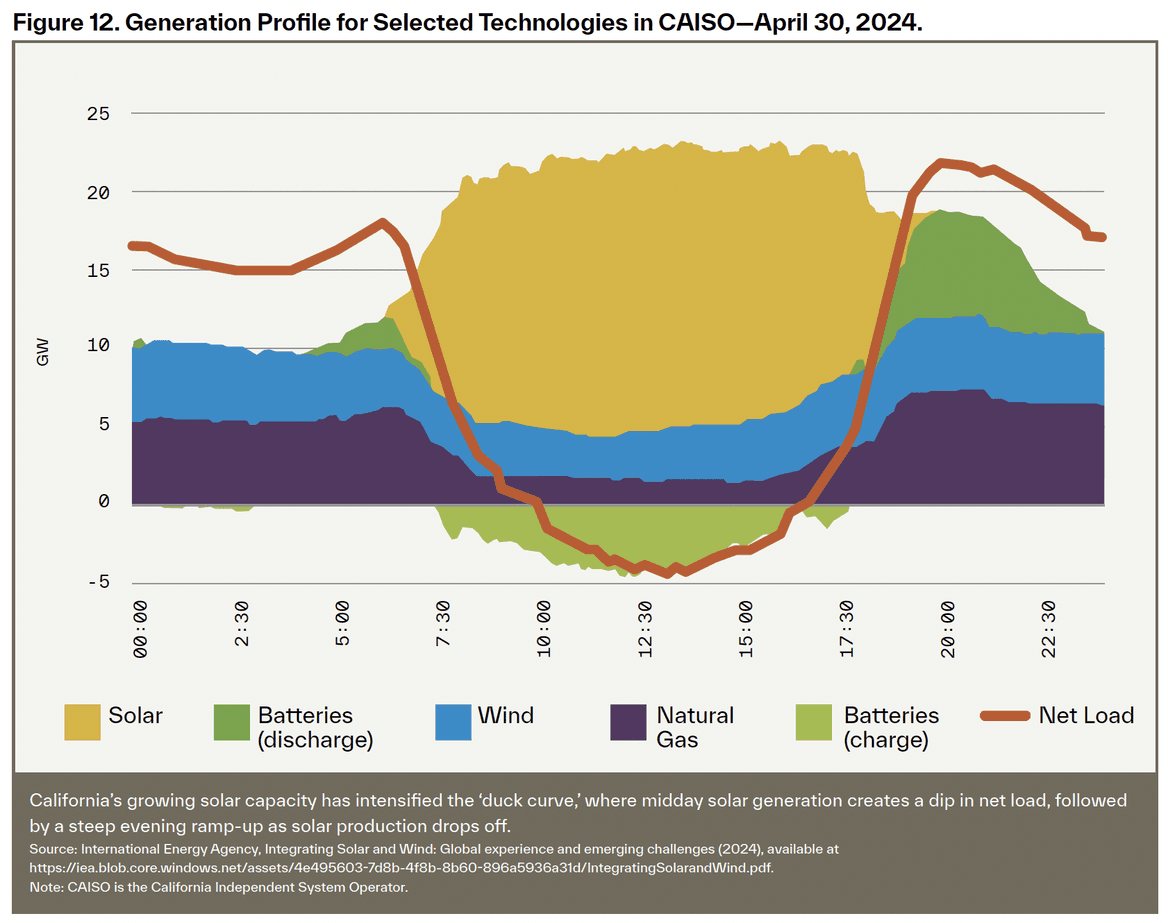
The three investor-owned utilities are required to start offering customers the option of dynamic pricing by 2027, providing a chance to transform how major electricity users pay for power.
One option is to develop granular, real-time rates that allow customers to respond to hourly price signals, which reflect the fluctuations in wholesale market prices or transmission and distribution costs. It would reward companies that, for instance, install thermal energy storage systems to bank electricity when supplies are ample and cheap, then tap the thermal battery when grid power is more expensive or constrained.
Another approach is critical peak pricing, which charges higher electricity rates during a narrow window of peak demand — but also offers lower rates or gives credits to customers that reduce electricity consumption during grid emergencies, helping prevent blackouts. While companies can’t randomly flip their factories off and on, they typically can shift their production times or scale back for a limited period.
Utilities could also eliminate the “non-coincident demand charges” that industrial customers currently pay. As an example, Cheng said, a tomato-canning facility that uses a maximum of 500 kilowatt-hours during the month is charged the same amount whether the plant reaches that peak at 12:30 p.m. in March — a sunny time of day during a mild time of year, when there’s likely a surplus of power — or at 5:30 p.m. during a heat wave, when the grid is overtaxed.
“The way it’s structured is backwards, because it actually punishes electrification and doesn’t reflect the actual cost causation or grid impact of that energy use,” she said.
Encouraging factories to use more off-peak and renewable power should benefit not only manufacturers but also the grid at large, since it reduces the need for utilities to make expensive infrastructure upgrades or add power capacity — costs that all ratepayers shoulder, said Rose Monahan, a staff attorney with the Sierra Club Environmental Law Program, who also contributed to the report.
“Bringing on more electric load and strategically doing that in a way that doesn’t put a huge strain on the grid, and helps use the resources that we already have, should be a win-win for everybody,” she said.
Solving the formidable challenge of electrifying large, energy-intensive operations will require far more than redesigning utility rates — in California and nationwide. Installing new equipment can incur high up-front costs, and fossil gas remains enticingly inexpensive in many regions. Some of the more promising innovations for high-heat industrial processes, like thermal batteries and heat-pump boilers, are only just now hitting the market, meaning companies may be unaware or uncertain of how the cleaner equipment works.
“The [utility] rates on their own won’t do it, and the technologies on their own won’t do it — it’s the combination,” Johnson said. “Being able to have the two of those together in the same place is where you really start to get that market transformation toward these more efficient electric technologies.”
In Massachusetts, many natural gas customers are receiving what they say are the highest utility bills they’ve ever faced.
The reasons for these spiking costs are complex, ranging from volatile gas supply prices to this winter’s unusually frigid weather. Less discussed, however, is the effect of utilities’ Gas System Enhancement Plans, or GSEPs. The state requires these annual plans in an effort to make the gas pipeline system safer, but many lawmakers and climate advocates argue that utilities are taking advantage of the GSEPs to boost profits and build out fossil-fuel infrastructure Massachusetts doesn’t really need as it transitions to clean energy. Most residents likely don’t even know GSEPs exist, but the costs have escalated in the 12 years they have been in effect, and now make up roughly a tenth of gas customers’ monthly bills.
The program was created in 2014 to address growing safety concerns about the dangers posed by leaks in Massachusetts’ natural gas pipes, which are among the oldest in the country: One out of every four miles of pipeline in the state was installed before 1940.
As gas pipes get older, they become more prone to catastrophic breaks that can cause explosions, like the one in San Bruno, California, in 2010. Natural gas leaks also release planet-warming methane and other hazardous compounds, like benzene and xylene, said Jonathan Buonocore, an assistant professor of environmental health at Boston University.
“Many of these are health-damaging pollutants, and some are carcinogenic,” he said.
Massachusetts decided to address the problem by, in short, allowing utilities to make more money, more quickly when they repair or replace leak-prone pipes.
In general, gas utilities’ profits come from the delivery portion of their rates. They invest in pipes, compressor stations, and other infrastructure, then recoup that money — plus a set rate of return — from customers over a span of 20 years or more. They can’t start recovering those costs, however, until they go through a rate case, in which state regulators spend nearly a year scrutinizing utilities’ calculations and determining whether their requested rates are justified. Massachusetts requires a new rate case for gas utilities only every 10 years, though the companies can file a request for rate changes more often.
By contrast, the state lets utilities get that money back faster for GSEP projects. Regulators must approve the plans within six months, and then utilities can start passing costs through to customers soon afterward. The law set an initial annual cap on GSEP spending of 1.5% of a company’s revenue, but utility regulators can — and have — increased that number. In 2019, the state raised the cap to 3%.
The costs of the program have climbed from $291 million in GSEP spending in 2015 to a proposed $880 million in 2025. The costs now account for 8% to 11% of customers’ bills.
Have these mounting expenses made the gas system safer? It’s unclear. Utilities argue that replacing pipes is the best way to achieve safer infrastructure. Skeptics of the program, however, say the lure of a quicker payback has encouraged utilities to replace pipes that could have been repaired or relined at much lower cost without any compromises on safety.
“Utilities are frankly getting sloppy on their risk prioritization,” said Jamie Van Nostrand, the policy director at the nonprofit Future of Heat Initiative and former chair of the Massachusetts Department of Public Utilities. “They responded the way you’d expect them to, and that’s to maximize spending on GSEPs. They have a bias in favor of replacement.”
Climate and consumer advocates are also concerned that the state’s decarbonization goals will lead to stranded costs: that customers will still be paying for this decade’s pipe replacements long after the infrastructure has been taken out of service because of state efforts to transition to clean energy and electrified heating.
Utility regulators issued an order in late 2023 outlining principles for transitioning the state off natural gas. Fully replacing pipes might therefore be unnecessary in many cases, as there’s no need to install — and pay for — equipment that will last 50 years when the system may become obsolete in 20 years, said Audrey Schulman, who founded HEET, a nonprofit that advocates for a transition away from natural gas, and is now executive director of climate-solutions incubator Black Swan Lab.
“Although the intent is to keep us safe, the problem is we probably will not be using gas in the same amount in the future,” Schulman said. “Let’s not keep replacing pipes as though we’re going to keep this system going everywhere, forever. It’s an unwise business choice.”
Some changes are underway. A 2022 law created a working group to assess the GSEP program and ensure the guidelines align with the state’s goal of reaching net-zero carbon emissions by 2050. The panel’s final report, released in early 2024, recommends a more rigorous system for prioritizing leaks and stronger rules for considering alternatives to natural gas, such as electrification or geothermal loops.
Last spring, regulators issued a decision lowering the GSEP revenue cap to 2.5% from 3%, a move celebrated by state Attorney General Andrea Campbell as reining in “fundamentally unfair” spending by gas utilities. And utilities should expect this level of scrutiny from regulators to continue, Van Nostrand said.
“We’re going to be taking a much closer look,” he said. “You need to show your work.”
Last May, the Trump administration proposed eliminating a key federal program that lowers energy bills for low-income households. Now, amid a mounting energy-affordability crisis, that program has officially survived — and even gotten a funding boost.
On Tuesday, President Donald Trump signed a spending bill with more than $4 billion for the Low Income Home Energy Assistance Program. Since 1981, the federal initiative has helped millions of Americans pay their utility bills, undertake energy-related home repairs, and make weatherization upgrades that save them money.
Now, LIHEAP has $20 million more than it had last year. The spending line item was part of a roughly $1.2 trillion package to end the partial government shutdown, which passed 217–214 in the House and 71–29 in the Senate.
“LIHEAP provides a lifeline for families who are having trouble paying their utility bills,” said Xavier Boatright, deputy legislative director at the Sierra Club. “For now, we are glad that Congress has acknowledged that letting families suffer without heating or cooling assistance in the face of extreme weather events is truly cruel.”
The move is a stark reversal in the Trump administration’s war on energy efficiency, which last spring threatened to terminate LIHEAP as well as slash other key programs meant to keep household utility bills in check. But energy costs are soaring across the U.S. and have become a pivotal political issue, helping propel Democrats to victory in several state races last November.
Though the funding is enough to assist about 6 million low-income families with their heating and cooling bills this year, it covers only about 17% of eligible households, according to Mark Wolfe, executive director of the National Energy Assistance Directors’ Association.
And despite the new funding — which is comparable to allocations in recent years — the program did take a major hit last April when the Department of Health and Human Services fired the entire team administering LIHEAP.
Still, the program, which provides block grants that states administer, is limping along, according to Wolfe. “They’re leaning on grant-management staff to process state payments and a very small number of senior [staff at the Office of the Administration for Children and Families] to manage policy.”
However, states are missing out on technical assistance, which could hurt LIHEAP’s efficacy long term, Wolfe said.
LIHEAP isn’t the only energy efficiency program to get a reprieve. In January, the president also signed a separate appropriations package extending the life of two other long-standing initiatives.
One is Energy Star, the Environmental Protection Agency program that bequeaths its bright-blue label to consumer appliances that meet certain efficiency standards.
That initiative is now stronger than ever, with $33 million in funding — slightly more than in fiscal year 2024. Last spring, the EPA said it planned to disband or privatize the high-value program, which has helped Americans save $40 billion on their energy bills each year: For every dollar of benefit, the program cost the government less than a tenth of a penny, according to the nonprofit Institute for Market Transformation.
In the same spending bill, Congress also revived the Weatherization Assistance Program, which for the past half century has aided millions of households in making their homes more resilient to extreme temperatures, with upgrades such as insulation and plugging air leaks. These home improvements save families an average of $372 every year.
Before that piece of legislation landed on the president’s desk in January, the Republican-controlled Congress overwhelmingly approved the package, which passed the House 397–28 and the Senate 82–15.
While advocates celebrated the funding of LIHEAP as a crucial move, Boatright pointed out that the broader cost challenges aren’t going anywhere. After all, he said, many Trump administration policies — like blocking cheap, clean energy — will continue to make affordability problems even worse.
Natural gas, not solar panels and wind turbines, is the primary driver behind soaring power prices in Maine, according to a new report released this week by the state’s energy department.
Mainers pay some of the highest electricity rates in the country — only five states had higher residential prices in November 2025. They also spend a lot to heat their homes, given the prevalence of expensive fuel oil. Possible solutions to the problem of high energy costs are developing clean power, investing in load-flexibility strategies, and continuing to push for home-heating electrification, concludes the report, which was prepared by The Brattle Group.
As Americans grapple with unprecedented utility bills, clean energy has increasingly become a scapegoat, in Maine and beyond.
President Donald Trump has been perhaps the most notable voice, branding solar and wind the “scam of the century,” though concerns about renewable energy and affordability have come from both sides of the aisle. In Maine, Democratic lawmakers voted last June to cut support for community solar as a way to lower energy costs, and some Massachusetts legislators have proposed pulling back on energy efficiency and renewable power initiatives.
The new report is the latest in a growing body of research that challenges these arguments — and demonstrates that the major drivers of high energy costs have nothing to do with solar panels, wind turbines, or heat pumps.
The information comes just as the state launches the process of developing its latest two-year energy plan, which will take effect in 2027. The document outlines goals and lays out strategies for making energy cleaner, less expensive, and more reliable.
“It’s helpful to have the information out there for the general public and policymakers to understand what really is driving energy price volatility here in Maine,” said Dan Burgess, acting commissioner of the state energy department under Democratic Gov. Janet Mills.
Transmission and distribution expenses are partially to blame for the state’s rising bills, thanks to growing equipment and construction costs, the need to replace aging infrastructure, and repairs following storms.
But the factor that most influences power costs in Maine is the volatility of natural gas prices, the report finds. Maine is part of the six-state New England grid, which gets more than half its electricity from gas-burning power plants. Roughly 80% of the time, natural gas is the marginal generation resource — that is, it is the most expensive power source, which sets the price for all the energy flowing onto the grid at that moment.
“Natural gas is almost always what is setting the price here in New England,” Burgess said.
Between 2021 and 2023, electricity supply prices in Maine nearly tripled, rising from 6.4 cents per kilowatt-hour to 17 cents per kilowatt-hour. During that period, natural gas prices spiked in response to three winter storms and the Russian invasion of Ukraine.
Natural gas market trends suggest the fuel is only going to get more expensive, the report finds. As the United States continues to expand its liquefied natural gas export capacity, more competition for the supply is likely to drive up prices. Surging demand for electricity to power data centers — even those built beyond New England — could also increase natural gas prices nationally.
Some, including in the Trump administration, have argued that this issue is further exacerbated by New England’s failure to expand gas supply to keep pace with growing energy demand. Critics of that approach say it is misguided, however, and the Maine report does not suggest pipeline expansion as a solution to the state’s energy-cost problems.
Instead, the analysts propose three main paths toward more affordable energy bills in Maine. The first is accelerating clean energy development so that volatile natural gas prices have less impact — a feat made more difficult by the Trump administration’s vehement opposition to offshore wind, which was meant to be a cornerstone of the New England grid. The second is adopting what the report calls “load flexibility,” which means shifting some demand, like EV charging, to hours when there is less load on the grid.
The third is continuing the electrification of home heating.
Maine has earned headlines for its success in promoting heat pump installations; it hit its goal of 100,000 new heat pumps in 2023, two years before the target date, and is now aiming for a total of 275,000 new installations by 2027. In a state where roughly half of households still use heating oil for warmth, heat pumps offer a more affordable option than the pricey fossil fuel.
“We’re still the most home-heating-oil–reliant state in the country,” Burgess said. “Switching to heat pumps can reduce energy expenses.”


.svg)
