

 Back
Hello, everyone! California Gov.-elect Xavier Becerra’s Power Hour plan is getting a ton of attention right now, so let’s dive into it.
During his campaign, Becerra said that if elected, he would institute a policy offering up to two hours of free electricity in the middle of each day, a move that his administration says could cut utility bills by about $1,000 a year. The proposal has won accolades from clean energy luminaries like former Michigan Gov. and Biden administration Energy Secretary Jennifer Granholm, former California Public Utilities Commissioner Cliff Rechtschaffen, and UC Santa Barbara professor and author Leah Stokes, who explained why it’s so exciting at last week’s Canary Live Bay Area event.
Free midday rates could encourage people to use more electricity at times when solar power is abundant, so much so that it’s being increasingly curtailed, especially during mild spring and autumn days, often driving wholesale power prices into negative territory. That makes free power “actually possible in California,” said Claudine Custodio, regulatory director for the West at nonprofit Vote Solar.
But the devil is in the details, so utility rate design experts have been busy figuring out how it could actually work.
The first step is to “make it as simple and easy to understand as possible,” said Michael Colvin, director of regulatory and legislative affairs at the Environmental Defense Fund. While at the California Public Utilities Commission (CPUC), he helped design the time-of-use rates now used by the state’s big three investor-owned utilities, which charge more for power during the evening, when solar production fades and the state’s grid faces its greatest stress.
That rate switch has been complicated enough for customers, Colvin said. Matching rates to seasonal shifts in those peak power costs “would be a messaging nightmare.”
The same lesson should apply to Power Hour. Even if wholesale power is cheaper in the spring and fall than it is in the winter or summer, the hours of free electricity should stay the same, he said.
That brings up another issue: Just because there’s excess solar power on California’s grid doesn’t make it free to deliver to households. Wholesale power costs make up only about one-third of the typical rates charged by California’s big utilities. The majority of monthly bills goes toward covering fixed costs — mainly those associated with building and maintaining power grids.
Cutting customers’ bills to zero cents per kilowatt-hour for two hours a day will force utilities to increase rates at other times or find alternative ways to make up for income they’d lose during that period. And Becerra has made clear that his plan can’t push total costs higher.
That could be why Becerra has proposed starting by offering free electricity during certain hours only to families eligible for CARE (California Alternate Rates for Energy) and FERA (Family Electric Rate Assistance). Every utility regulated by the CPUC must provide these discount programs for income-qualified households, and the money to pay for those discounts is collected from charges on all other customers’ bills.
It would be smart to avoid a complicated utility rate restructuring so that Power Hour can happen right away, said Rebecca Lee, the director of Western U.S. government affairs for NRG Energy and a former CPUC rate analyst. She noted that current legislation authorizing CARE and FERA may give the CPUC some flexibility to move money around to cover additional Power Hour costs. “You could create a sub-option within CARE where you have more flexibility to use the CARE subsidy in a time-differentiated way,” she said.
Furthermore, to be effective, Power Hour will need to be paired with programs that help customers make the most use of free midday electricity, Lee said — even when they’re not at home.
The CPUC’s Energy Savings Assistance Program already gives CARE customers energy-efficiency assistance, Colvin said. The program could offer free smart thermostats that can be programmed to activate during those free midday hours and precool residences, so when people get home later, they don’t need as much air conditioning. Smart plugs and programmable appliances could also be helpful.
Batteries are a lot more expensive than smart thermostats, but can sock away a lot more free midday power, Custodio said. Expanding virtual power plants like the currently underfunded Demand Side Grid Support program could make batteries more affordable for a broader set of customers, especially in parts of the Central Valley and Southern California, where most of the state’s utility-scale solar is, and where lower-income households face high summer utility bills.
So could allowing customers to use plug-in batteries, much as California has done for balcony solar systems, said Nick Josefowitz, founder and chief executive of energy-affordability nonprofit Permit Power. “Many low-income families don’t use that much power in the middle of the day when Becerra would make it free,” he said.
This to-do list only scratches the surface of what the Becerra administration, California lawmakers, the CPUC, the California Energy Commission, and both investor-owned and publicly owned utilities will need to figure out to make Power Hour a success. Utilities may eventually have to upgrade their rickety billing software systems to support a free rate during those hours, and find workarounds in the meantime, like sending people rebate checks. That could get things up and running while the CPUC works on a more permanent plan, perhaps through individual utility rate proceedings or the commission’s advanced electric rate design rulemaking.
In the long run, if the Becerra administration wants to “spread out demand instead of concentrating it during the traditional peak hours in the late afternoon and evening,” as it states on its Power Hour page, it will want to pursue a wide range of ideas for getting people to use more electricity when it’s both cheap and clean. After all, the broader objective of California energy policy is to, “as a society, use up all the renewables we have,” Lee said.
Two different reports have come out this week with two very different assessments about how on track California is to meeting its emissions-reduction goals.
The “California Green Innovation Index” from Next 10 casts a fairly rosy light on the state’s climate progress to date, pointing to more than 2 million EVs on the road, more than 20 gigawatts of battery storage, and solar power outgenerating fossil gas. All told, California saw a 3.9% drop in greenhouse gas emissions from 2023 to 2024, the year with the most recent data available, marking the largest annual decrease outside the recession years of 2008–09 and 2019–20.
That’s good news. But the state is still falling short on meeting its 2030 goal of cutting greenhouse gas emissions by 40% below 1990 levels by 2030. “The Becerra era begins with real climate momentum, but progress isn’t guaranteed,” said Stephanie Leonard, the group’s director of research.
Meanwhile, a new report from the Environmental Working Group paints a more dire picture, stating that hitting California’s goal of carbon-free energy by 2045 will require adding about 8 GW of clean generating capacity per year.
But California has averaged bringing online only about 3 GW per year of utility-scale renewables and 1.5 GW of rooftop solar, EWG’s analysis finds. Nor do the state’s current buildout plans match the scale of growth required. The answer to this shortfall, according to report author Richard McCann, a founding partner at consultancy M.Cubed, is to dramatically increase rooftop solar.
McCann and other supporters of rooftop solar argue that California’s legacy net-metering programs have been an overall benefit to the state’s utility customers. Utilities and the CPUC’s Public Advocates Office, by contrast, claim that previous rooftop solar programs have just shifted costs to other customers. We’re not going to resolve that fight in this newsletter. But with California lagging in its utility-scale clean energy buildout, it’s hard to see how expanding opportunities for distributed solar would hurt.
The prospect of California leaders quickly taking up a last-minute utility-wildfire-liability-reform package seems to be fading (to get up to speed on the current quagmire, check out my newsletter from a couple of weeks ago).
Outgoing Gov. Gavin Newsom told Politico in an interview at the COP31 annual climate conference in Turkey that he expects “when the Legislature convenes in January, they’ll move very quickly,” implicitly kiboshing utilities’ hopes for a deal in the waning weeks of 2026.
Newsom could call a special session of the state legislature in December, but that would put lawmakers in an awkward position. “We see an uphill battle to striking meaningful alignment with the legislature in December with the lack of incentive from the legislature to effectively ‘front-run’ Governor-elect Becerra’s policy agenda,” Julien Dumoulin-Smith, a power, utilities, and clean energy equity analyst at investment firm Jefferies, wrote in a statement this week.
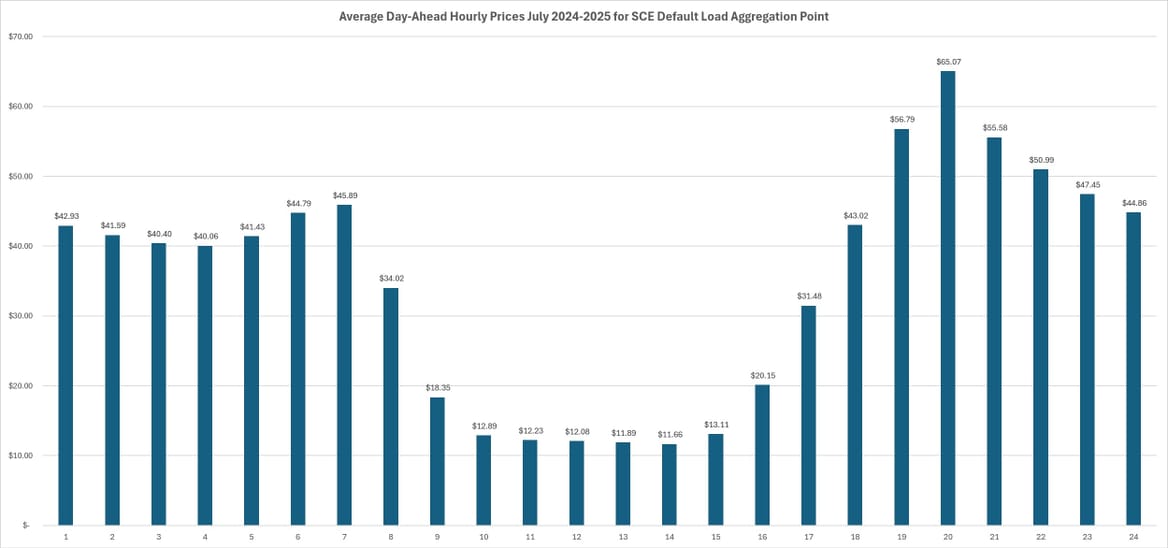
Getting back to Power Hour: NRG Energy’s Lee offered Canary Media a helpful visual aid to illustrate the fact that while the solar power surplus on California’s grid may vary greatly from season to season, it still makes midday grid power a lot cheaper than overnight grid power, no matter what month it is. The chart shows the averaged-out price of power throughout 2024 and 2025 across every hour of the day from a typical pricing node in Southern California Edison territory. According to Lee, this pretty clearly demonstrates that solar power is still cheap enough to be worth offering for free between 10 a.m. and 2 p.m., even if it happens to be cloudy outside.
It’s been raining for days now, so we’re keeping our walks with Lily to a minimum. (If we can get her into her tartan raincoat, I’ll definitely share a photo.) But during a break in the weather, my wife and I did manage to get Lily out to Point Isabel, her happy place, where she at least briefly considered hopping into the slightly choppy waters of the San Francisco Bay before turning around. (Notice the city skyline on the horizon!)
Oh, and a quick note: I’ll be taking next week off for the Thanksgiving holiday. I’m looking forward to spending time with family and friends, and I hope you get to do the same. See you in December!

Leah Stokes joined me at a Canary event to talk about her hopes for Xavier Becerra, school electrification, California climate politics, and more.
Welcome back, everyone! Well, we may have finally caught a break when it comes to making progress on climate and energy. The midterm elections have given Democrats control of Congress and dramatically expanded the party’s power in state legislatures and governors’ mansions. That’s opening up big opportunities for reinvigorated clean — and affordable — energy transition policies and actions across the country.

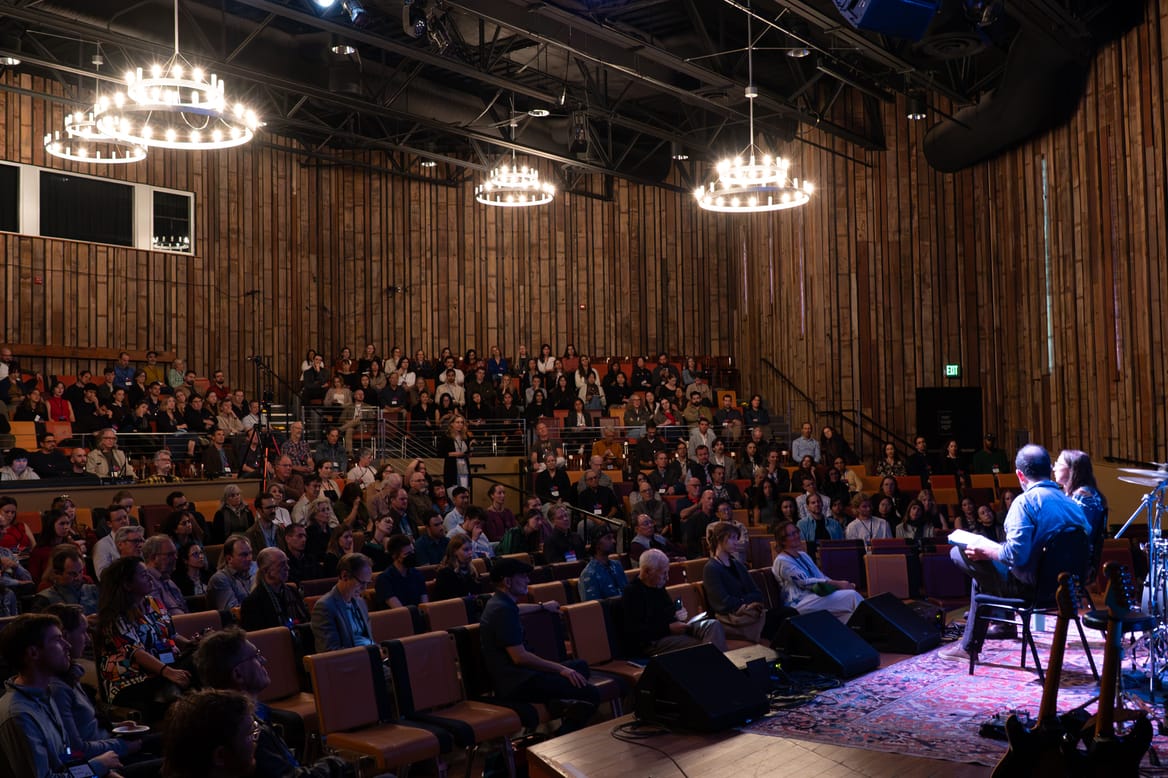
In California, Canary Media just held what amounts to a big party for Golden State climate and energy aficionados: our fourth annual Canary Live Bay Area show, which brought nearly 400 people to The Freight in downtown Berkeley on Tuesday night. The vibe was fantastic — with so much exuberance at the blue wave lifting our common climate ambitions. And onstage and off, there was a whole bunch of gritty, detail-oriented discussion about how to best proceed on all the work ahead.

I was thrilled to share the stage with Leah Stokes, the Anton Vonk Associate Professor of Environmental Politics at the University of California, Santa Barbara; author of top-ranked climate books “Short Circuiting Policy” and the newly released “The Carbon Wave”; writer of the Substack “Notes from the Electric Era”; and one of the chief behind-the-scenes architects of the Biden-era climate triumph, the Inflation Reduction Act. She even created a Carbon Wave Calculator to help people understand how to make climate progress in their communities.
Stokes has a lot to say about outgoing Gov. Gavin Newsom’s climate and environmental justice policy record — much of it not very flattering. She’s particularly angry that Newsom clawed back nearly $200 million in funding for schools to upgrade their heating, air-conditioning, ventilation, and plumbing systems — a move he made right when schools in Santa Barbara were reporting classroom temperatures of 93 degrees Fahrenheit. “Half a million kids were under extreme heat-modified days at the same time that Gov. Newsom gutted that program,” she said.
She’s also critical of the way the Newsom administration has undercut the state’s biggest virtual-power-plant program, Demand Side Grid Support. While Newsom did sign into law a number of bills this year that will tap distributed energy to help solve the state’s rising electricity-cost crisis, his administration has consistently undercut DSGS in budget negotiations. That leaves the program without enough money to pay out would-be participants in 2027 — absent some intervention between now and then. That’s particularly unfortunate since, according to Stokes’ own research, the program offers disproportionate benefits to lower-income participants in the Central Valley and Inland Empire.
She and I eventually turned to Gov.-elect Xavier Becerra’s potential climate agenda. She, for one, is feeling hopeful. “I think that there’s more of a focus on affordability, on holding the utilities accountable, on delivering on environmental justice,” she said. “I think that these are things that actually matter to Becerra.”
In particular, she’s a fan of Becerra’s free “Power Hour” proposal for no-cost utility power when solar is flooding the state’s grid — an idea that’s been pioneered in Australia and floated for California by Stokes herself and a number of other climate thinkers.
For more than a decade, California has been trying to design energy policy to solve for the “duck curve” — excess solar at midday, not enough grid power as the sun goes down. Batteries can soak up that power, obviously. But so can heat pumps and air conditioners that preheat or precool homes and buildings, as can heat-pump water heaters, which store energy in tanks of hot water, she said.
Structuring utility rates to charge customers less when power is cheap and clean will require raising them at times when it’s scarce and dirty, she said. But she sees a way to “either shift the prices up at the peak time in the 4 to 9 [p.m.] period, or keep them flat and use taxpayer funds to backfill that.”
Utilities’ wildfire liability is the most immediate crisis facing the incoming governor. Stokes has ideas for how to tackle that, too. She contends that utility shareholders, not customers, should pay those costs. Or oil companies, whose products are responsible for the climate crisis, could be forced through lawsuits to pay up as well, although she conceded that these solutions haven’t gained any political traction yet.
“But I’d rather be pie in the sky and on the side of everyday people, who should not be paying for wildfire costs in their bills,” she said.
One idea I was particularly excited to get into with Stokes was avenues for replacing that lost funding to finance on-site solar, batteries, electric school buses, and efficient, all-electric HVAC systems for the state’s nearly 10,000 public schools. The way I see it, that’s a public good that goes well beyond climate. With those systems in place, schools could be positioned as resilience centers for communities in the midst of wildfires, heat waves, and other climate change–intensified disasters.
Stokes, who collaborates with the nonprofit UndauntedK12 to find funding streams for projects like these in California schools, proposed the idea of a “children’s climate bond” ballot measure to raise money for this kind of work. “It’s crazy living in like the fourth-largest economy of the world, and yet there’s never any money to do the things that need to get done,” she bemoaned.
During the intermission, I heard another idea of how to cover the cost of school electrification from Lorenzo Kristov, who helped transform the operations of the California Independent System Operator for the renewables age. Kristov is also a luminary in the world of distributed and community energy policy — and, full disclosure, a Canary Media supporter. Kristov told me his plan for transforming California’s schools into solar-and-battery-powered revenue generators and allowing them to sell their excess power to their neighbors.
Unfortunately, the economics of school solar have gotten worse, not better, in recent years. Regulators weakened compensation for shared-solar systems at schools, farms, and apartment buildings back in 2023, and Newsom vetoed a bill meant to restore the old system for schools in 2024. Perhaps Becerra will take a different approach.
My colleague Alison F. Takemura has a story out this week on the state’s latest consequential — yet confusing — step on its long march toward shifting buildings from fossil-fueled to electric-powered heating.
On Nov. 4, the Bay Area Air District board voted on final amendments to a measure setting requirements for new water heaters starting in 2028. It’s an important milestone for the district’s 2023 plan to phase out appliances that emit nitrogen oxides, which have harmful human health and air quality impacts. The regulation will significantly restrict new installations of gas-fueled furnaces and water heaters in the Bay Area.
Last week’s vote doesn’t go as far as initially proposed. Affordability exemptions for low-income households and other buildings that could struggle to find electric options that work for them are likely to apply to about half of the region’s installations in the coming years. Multifamily buildings will have until 2033 to do the upgrade work to make the switch to all-electric heating. And the district has yet to finalize rules on space heating, which makes up a bigger share of emissions than water heating. Still, it’s a big “first” for getting gas out of buildings.
My Canary Media compatriots live all over the country — Asheville, Nashville, Seattle, New York City — so we don’t get to hang out in person nearly as often as we’d like. And like so many modern-day information workers, I spend a lot of my time interacting with people on tiny screens. That’s one of the reasons I look forward to our live events so much — we all get to meet each other, talk face-to-face, and celebrate our common humanity and common purpose. This week’s Canary Live Bay Area event was no exception. Check out our photos from the event!
Lily the corgi normally spends a lot of her time relaxing. But this week has been one of great vicarious excitement for her, vibing to her mom’s and dad’s general enthusiasm about the course of human events. So we can’t blame her for seeking out the comfort of her friends Barbara the stuffed-animal corgi and Henry the monkey for some quiet time in her favorite spot on the Eames chair ottoman by the front door.

As the conflict roils gasoline and diesel markets, the U.S. has seen a higher per-person cost increase than any other country, a new analysis finds.
Donald Trump ran for his second term promising to “make America affordable again.” Two years later, the president’s war with Iran has his constituents paying through the nose for gasoline and diesel.
In fact, per-person fuel costs have risen more in the U.S. than in any other country since the start of the conflict, according to a new analysis from the Finland-based Centre for Research on Energy and Clean Air, or CREA.
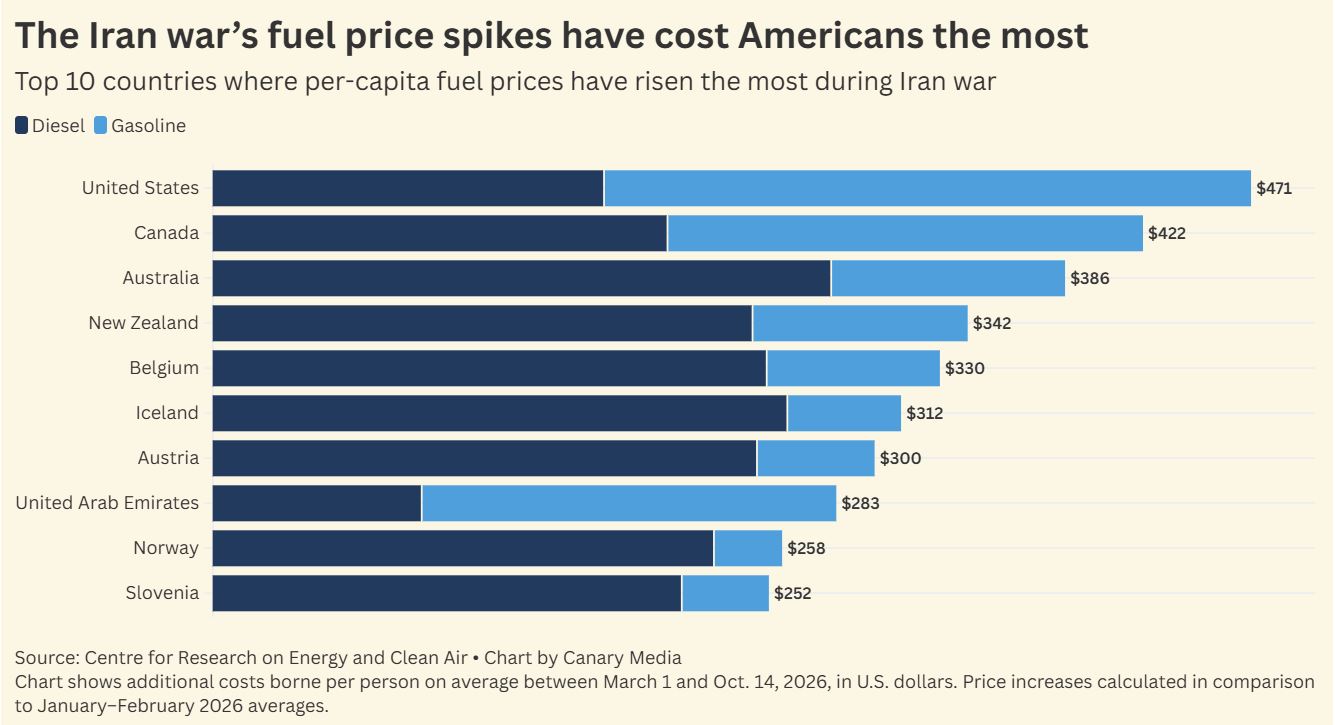
The group calculates that between March 1 — the day after the U.S. and Israel made their initial strikes on Iran — and Oct. 14, gasoline and diesel costs in the U.S. were $160 billion higher than they would have been otherwise. That comes out to an extra $471 per person. CREA used fuel prices from January and February as a baseline to calculate the increases.
Why are Americans paying so much more? It’s not because fuel prices have jumped more here; our price increases are similar to those in other market economies, CREA says. It’s because we guzzle a huge amount of gas in our personal vehicles.
“U.S. consumers … use so much oil, leaving them exposed to price shocks they can’t control,” CREA co-founder Lauri Myllyvirta said in a press release. “The lesson is clear: The best protection against volatile oil prices isn’t pumping more oil, it’s needing less of it.”
That’s where — you guessed it — electric vehicles come into play. Going electric allows drivers to avoid swinging prices at the pump by simply zooming past the gas station altogether. Although electricity bills are also on the rise in much of the U.S., power prices tend to be more stable than gasoline prices. Case in point: The cost of driving a typical gas car 100 miles in the U.S. jumped from $11.23 to $16.69 over the first five months of this year, while the cost of driving an EV the same distance remained around $5.80, according to The New York Times.
Unfortunately for aspiring EV owners, the Trump administration and Republicans in Congress have made it harder to afford the vehicles. Last year, they ripped away federal tax credits that cut the cost of an electric car by thousands of dollars.
That move might not be weighing on the minds of voters as midterm elections loom. But sky-high gasoline prices certainly are — and that could help tip the scales in the direction of Democrats as they look to retake Congress.
A new report finds nearly half of U.S. coal plants benefit from federal handouts and pollution exemptions, harming public health, our wallets, and the climate.
The Trump administration loves coal plants. The rest of us are paying the price in higher electricity bills, poorer health, and worsening climate change.
That’s the takeaway of an analysis out today from the Environmental Defense Fund. It finds the Trump administration is directly or indirectly propping up nearly half the U.S. coal fleet with taxpayer-funded handouts, Clean Air Act exemptions, and emergency orders forcing retiring units to keep running.
These actions represent a thumb on the scale for the country’s least cost-effective and most heavily polluting source of electricity. They also serve as a promise kept: As EPA Administrator Lee Zeldin told coal and mining executives this summer, “Many of the items that were on your wish list are now done.”
“This is a lot of government support and intervention that’s going to benefit an industry much more than it will benefit the American public,” said Surbhi Sarang, EDF’s senior attorney for clean power. “[Coal plants] produce pollution, which will just cost communities more. And they’re an expensive form of energy that will cost communities more.”
EDF’s analysis covers 184 U.S. coal plants that are operating and connected to the grid. Of those, 90 have been “propped up” in one way or another by the administration.
Seventy coal plants have received exemptions from limits on toxic pollution set by the Biden administration under the Clean Air Act. That’s allowed them to continue operating without investing in better controls. The Trump administration invited plant owners to seek these exceptions last spring, telling companies that all they had to do to skirt the regulations was send an email to a special EPA inbox.
The primary rule these plants have evaded would require them to reduce mercury pollution by 70% and emissions of nickel, arsenic, lead, and other toxic metals by two-thirds. Those limits were projected to yield more than $430 million in health and other benefits for communities through 2037, according to a May press release announcing the launch of an investigation by U.S. Sen. Sheldon Whitehouse (D-R.I.) into the exemptions.
“Coal plant pollution, including mercury and other heavy metals, can damage children’s brains and cause a lifetime of devastating illness,” Sarang said in a press release accompanying the report.
Since those exemptions were granted, the EPA has rescinded the Biden-era rule that imposed the pollution restrictions in the first place. But legal challenges could reverse that decision, Sarang said. And while the Trump administration claimed that complying with the rule would have forced plants to close down prematurely, modeling done by the Environmental Protection Agency during the Biden administration “showed that the costs could be absorbed and wouldn’t lead to any retirements,” she said.
EDF’s report also identifies 24 coal plants that are slated to receive a collective $950 million in taxpayer funds from the U.S. Department of Energy. About half of that is the $525 million announced in September 2025 to help refurbish up to 11 plants, according to EDF. The remaining $425 million, unveiled in June, is to “expand and revitalize” 13 more facilities.
Utilities, grid operators, and regulators have even been blocked from shutting down coal plants under the Trump administration’s unprecedented use of emergency authority. Since mid-2025, the DOE has repeatedly used this power to force six coal plants to keep running, despite a lack of evidence that their closure would threaten grid reliability.
In September, a federal court ruled that the DOE acted unlawfully in its first such emergency order in May 2025 to force a Michigan coal plant to stay open. The administration has nonetheless continued issuing stay-open orders for that facility and others.
EDF estimates that keeping these six coal plants running through June 2026 has cost utility customers up to $593 million and caused up to $860 million in health damages.
Coal power has been on its way out for years in the U.S., falling from providing nearly half the country’s electricity generation capacity in 2011 to just 15% in 2024. That drop-off has been driven primarily by the increasingly poor economics of coal plants competing against cheap fossil gas and even cheaper solar, wind, and batteries.
The DOE has stated that its support for coal plants will save the country about $50 billion, since the U.S. won’t have to build new power generation to fill in those gaps. But researchers have found that almost all of the country’s coal plants could be replaced with new clean energy and batteries at a net savings for utility customers.
“If we have taxpayer resources, we should be putting that towards what is a public good, which is renewable energy,” Sarang said. “That will lower energy bills, it will lower medical costs, it will allow people to go to school and work not burdened by illness and respiratory disease.”
Politicians talk about the energy affordability crisis but don’t always grapple with the root causes — or the solutions. Here’s the lowdown.
Election season is heating up, and while fewer candidates are mentioning climate change, everyone seems to be talking about energy affordability.
The topic defined the contests for governor in Virginia and New Jersey, and the usually sleepy election for utility regulators in Georgia. In all those cases, Democrats won.
Since then, the cost of energy has only become more salient. Oil prices are up around 60% since the start of the year, due to disruptions to the flow of Middle Eastern oil stemming from the war with Iran. Diesel prices have risen even further.
Americans are also seeing record-high power bills. Utilities so far this year have asked for more than $18 billion in rate increases, according to a survey by the consumer advocacy group PowerLines, setting up 2026 to potentially beat 2025 for the most utility rate requests on record.
Political candidates this fall have taken note and started talking more about energy costs. But often, they frame the issue in politically expedient terms — blaming the opposing party or data centers — that fail to grapple with the root causes, which are complex and nuanced. To help you navigate election-season talking points, here’s a rundown of the causes of — and some promising solutions to — the energy affordability crisis.
To hear some critics tell it, skyrocketing energy bills begin and end with the man in the White House. The problem with this account is that energy costs have been rising steadily for years in response to structural problems unrelated to the executive branch.
“Frankly, this is an issue that’s been impacting a significant chunk of the American population long before it entered the broader national media and political discourse,” Charles Hua, executive director of PowerLines, said in a recent virtual discussion on the topic hosted by Canary Media and Covering Climate Now.
Key among them, the physical grid infrastructure to deliver electricity needs major upkeep pretty much everywhere. Additionally, Hua noted, natural disasters like fires, hurricanes, and winter storms (many of which are attributable to climate change) are threatening the grid in increasingly devastating ways.
On top of that, the rise in interest rates since the early 2020s has made it more expensive to finance new grid infrastructure. And key pieces of equipment have gotten harder to obtain, like the high-voltage transformers needed for large power plants and transmission upgrades. That drives up construction timelines and costs.
Structural issues aside, the president’s policies do impact energy bills. Let’s start with fuel prices.
Trump’s war with Iran has throttled the flow of oil and gas through the Strait of Hormuz. The average price of a gallon of gasoline has jumped to $4.36 from around $3 at the start of the year. Diesel surged to an all-time high of $6.53 per gallon in late September. This has hit Hawaii particularly hard, because most of that state’s electricity comes from burning oil.
“Something that a lot of folks don’t know is that when fuel prices spike, oftentimes those costs are actually directly passed on to utility customers,” Hua said. “Utility companies don’t make a profit; they don’t make a loss. That just gets straight passed through.”
On the mainland, more power comes from natural gas than any other source, and domestic supplies of that commodity haven’t surged like oil did. On the other hand, oil-derivative heating fuel is on track to financially punish the nearly 5 million households that need it to keep their homes warm once winter arrives.
Before Trump launched the war, his 2025 budget law stripped consumer tax credits that could have helped people avoid higher fuel costs by switching to electric vehicles or electric heat pumps, and to save on their electric bills by installing rooftop solar. The administration also froze billions of dollars previously appropriated by Congress to install clean energy in low-income communities.
Furthermore, the president’s sweeping global tariffs have made numerous materials needed for the U.S. energy system — like copper, steel, and batteries — more expensive.
And by asserting emergency powers, Trump’s Department of Energy has forced seven coal plants to stay open past their planned retirement dates. The orders put the cost of the coal plant extensions onto consumers in the grid regions served by those plants, which in some cases were physically unable to produce power. A court recently ruled that the first of these orders was illegal.
It’s impossible to know how long the Iran war will constrain global energy supplies. But Trump has made several other decisions that will push up domestic energy costs for years to come.
His administration has attempted to block all new offshore wind development and succeeded in paying off several developers to abandon projects on the Atlantic Coast and commit to fossil-fuel plants instead. This executive-branch interference in the energy market will deprive the Eastern Seaboard of significant fuel-free power production for many years to come; that densely populated region has few ready alternatives for large-scale power plant construction.
Onshore wind and solar installers have maintained a healthy cadence thus far into the presidency, reflecting the industry’s strong outlook several years ago. Some 93% of new power plant capacity built this year will come from solar, batteries, and wind.
But the current administration has jeopardized the future pipeline by holding up permits for projects that touch on public lands or require sign-off from the Pentagon. Onshore wind and solar are the cheapest sources of generation on an unsubsidized basis, per an analysis by Lazard, so holding up those projects deprives customers of more affordable sources of electricity.
Strong decarbonization measures don’t always make energy affordable.
Policy researcher Leah Stokes recounted in a recent Atlantic article how carbon pricing, long favored by economists as an elegant way to reduce emissions, “proved to be a political disaster” in nations that enacted it. “Voters turn out not to like policies designed to make energy more expensive,” she noted.
Other policies more effectively tackle climate and affordability. Energy-efficiency measures reduce customer cost and emissions, often with favorable return on investment. But many states fund these with extra charges on utility bills, and even some Democratic-led states have targeted these surcharges to score quick political points.
The clean energy tax credits passed by President Joe Biden avoided bloating energy bills by subsidizing clean energy construction from the federal tax code. But Trump eliminated many of those incentives, and restoring them at the federal level is not realistic for the time being.
The current political environment puts the onus on climate hawk politicians to champion policies that cut carbon and bills at the same time.
Not coincidentally, the most successful climate policy trend this year has been the legalization of plug-in solar, which empowers customers to simply connect their own solar panels to their wall sockets, lowering their utility bills while expanding clean energy production. Nine states enacted laws this year to codify the rules for plug-in solar, up from just Utah last year.
Can plug-in solar decarbonize the whole economy? No. Plug-in installations generally are too small to cover a typical American household’s energy usage. Still, it’s climate policy that lets consumers take tangible action to protect themselves from utility bill inflation.
At the federal level, a bipartisan permitting reform bill could be on the verge of passing — for the umpteenth time. Such a policy could make it faster and cheaper to build transmission lines that carry renewable production from ideal, often remote spots to the places where energy gets consumed.
Americans of all political persuasions are finding common ground in their antipathy to new AI data center construction. Politicians are scrambling to get on the right side of this populist uprising, and one way to do that is by preventing data centers from passing on energy costs to regular consumers.
Typically, when monopoly utilities build wires and power plants, they charge the capital costs to their customers, with an added margin kept for corporate profits. Utilities now have the chance to build a lot more of that infrastructure as data center developers rush to connect to the grid. That alone could pile more costs on consumers, but the AI boom poses a deeper threat: If an AI company walks away early or goes out of business, the general public could be stuck paying for the new power plants built for it.
Some utility leaders handle this tension by negotiating with AI titans in secret, to cut deals without public scrutiny. But there are ways to make sure consumers are protected from extra costs.
Some states and utilities have required that data center companies pay for new clean energy construction before they can hook up to the grid. Oregonian customers are getting a free grid battery from Aligned Data Centers. Minnesotans will receive a vast clean energy portfolio courtesy of Google. Michigan’s largest utility will fulfill its energy-storage target thanks to batteries paid for by Oracle, which is outfitting a massive data center in Saline Township on behalf of the Stargate consortium.
Those investments were designed to ensure new data centers do not overwhelm local grids at times of peak demand. Outside peak hours, the data centers will buy a ton of electricity, paying into the shared infrastructure that has already been built. That dynamic could lead to lower rates for regular customers — indeed, Michigan utility DTE promised a two-year reprieve from rate increases if it gets the revenue it expects from the Stargate project.
A blanket ban on data centers could minimize the costs that they impose on voters. But carefully crafted data center deals could tap the immense spending of the biggest AI companies for grid investment that benefits consumers.
Disclosure: Charles Hua is a member of Canary Media’s board of directors. The board has no influence over Canary Media’s reporting.
The governor has blocked efforts to harness distributed energy to rein in rising utility rates. Bills on his desk could reverse that trend — if he signs them.
I’m launching this newsletter at an intriguing moment in California politics. Democratic Gov. Gavin Newsom — who everyone knows is eyeing a run for the White House — has one last chance to show his true colors on energy and climate change. Rising electricity costs are a major issue in California, and Newsom must decide by the end of this month whether to sign a host of bills that could help cut utility rates while also advancing the state’s clean energy transition. What message does he want to send to Californians and the rest of the country?
Earlier this week, I published an assessment of Newsom’s legacy on climate and clean energy so far. Long story short: While he can legitimately brag about some things, he hasn’t been willing to take on utility interests or to challenge the status quo. That’s especially apparent in how he’s sidelined virtual power plants, vetoing and defunding efforts to harness them to rein in skyrocketing electricity rates for customers of the state’s three major utilities.
But a few bills on his desk now could at least start the long slog of reforms that experts say will help make power more affordable.
Most notable is Senate Bill 905. This year’s big affordability reform package from state Sen. Josh Becker (D) would curb utilities’ profits on wildfire-prevention investments and other spending that reduces their risk exposure. It would also expand on provisions from Becker’s reform bill passed last year that require utilities to finance more grid costs through borrowing, which also helps contain the profits they get to collect from customers.
In addition, SB 905 would encourage utilities to measure how efficiently they’re using their existing grids — a precursor to setting up regulations that could steer them toward prioritizing lower-cost solutions over expensive grid upgrades.
One such solution is tapping into virtual power plants — the customer-owned batteries, EV chargers, smart thermostats, and other devices that can provide hundreds of megawatts of power to the grid. Becker’s SB 913 would create new pathways for VPPs to help lessen reliance on aging fossil-gas-fired peaker plants.
But California’s politically powerful investor-owned utilities have vigorously opposed policies that could reduce their regulated profits. That may be why the Newsom administration has largely taken an alternative tack to save money: slashing public services paid for through utility rates. For example, Newsom backed a 2024 bill that would have cut hundreds of millions of dollars in energy-efficiency and solar programs to instead give customers a small one-time rebate.
That bill didn’t pass, but the administration’s nickel-and-diming approach has continued. In final budget negotiations this year, it successfully pushed to claw back nearly $200 million for a program that helps schools retrofit air conditioning, ventilation, and plumbing. The money will now go back to utilities, which could use it to shave pennies off their customers’ bills — or just pocket it, as pointed out by Leah Stokes, a professor of environmental politics at the University of California, Santa Barbara. As Stokes said in a last-minute social media appeal to Newsom, “Do you really want your legacy to be taking money away from schoolkids during heat waves?”
Let’s not forget that Newsom has had to manage a number of crises beyond his control, from the bankruptcy of Pacific Gas & Electric in 2019 to rolling blackouts in 2020 and 2022 to the current threat of refineries pulling out of the state. His final months in office may well be consumed in negotiating with lawmakers over how to deal with yet another looming utility wildfire-liability crisis. But these emergencies don’t absolve him from taking bold action in the areas where he does have control — like requiring utilities to enlist the state’s nation-leading fleet of distributed solar, batteries, and electric vehicles as cost-cutting tools. He’s got one last opportunity to do that. Let’s hope he takes it.
Meanwhile, I’m tracking a few other climate bills awaiting Newsom’s signature or veto:
Speaking of pipelines and stranded assets: Environmental groups are suing to stop the Los Angeles Department of Water and Power from converting its Scattergood fossil-gas power plant to also burn hydrogen, saying the municipal utility has failed to consider the air pollution harms that project could cause. But also, where’s it supposed to get the hydrogen? State regulators have rejected SoCalGas’s Angeles Link project, a pie-in-the-sky plan to pipe hydrogen made from solar in the desert to the LA Basin. And the Trump administration has pulled the plug on California’s clean hydrogen hub. If you don’t have hydrogen, you don’t have a hydrogen-burning power plant — no matter how well it might fit into some hypothetical decarbonization roadmap.
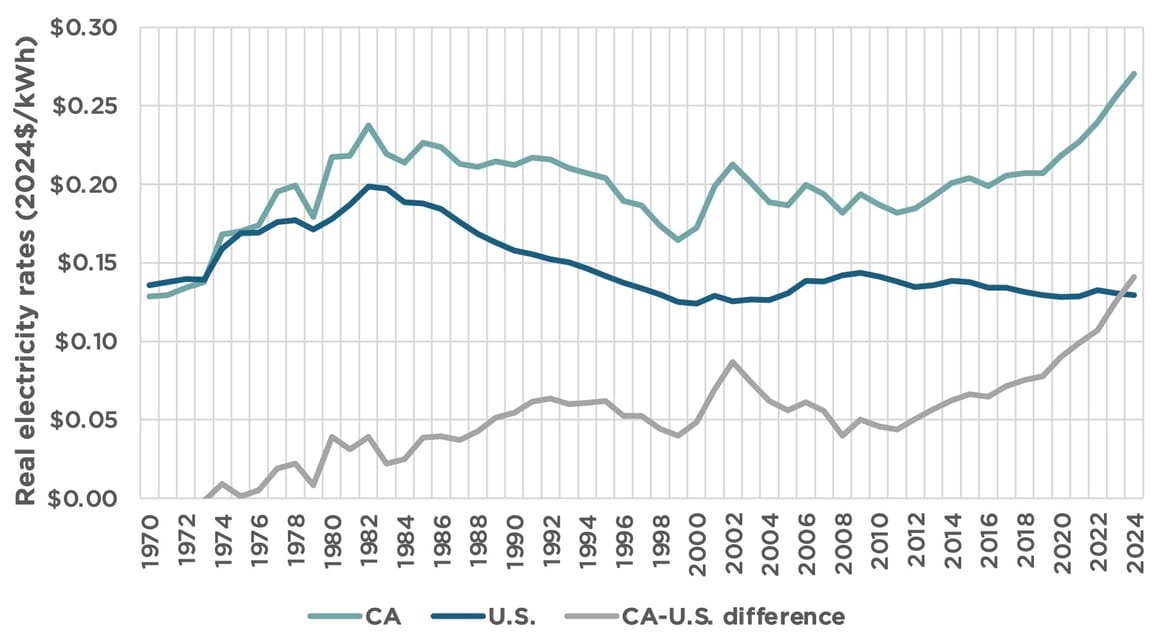
As a new report from a who’s who of California energy experts makes clear, there’s no silver bullet to solving an affordability crisis that has been decades in the making and has pulled California’s energy costs so far out of whack with the U.S. average.
Take a look at how the rates charged by California’s big three investor-owned utilities, already higher than the national average since the late 1970s, have really taken off in recent years. (The main cause of this latest spike is wildfire risk, of course — but that’s a problem from hell that’s better dealt with at book length.)
California and U.S. average real electricity rates and California-U.S. differences, 1970–2024
It’s not all doom and gloom around here! My wife and I — and of course our constant companion, Lily the corgi — had a lovely Labor Day weekend up in the Sierra foothills. Check out this sunset! (I couldn’t help taking a photo with power lines in the background ;-)

A long-awaited court decision finds fault with the DOE’s use of “emergency” powers to force aging, costly, polluting power plants to run past their retirement date.
A federal court has ruled that the Department of Energy acted outside the bounds of its legal authority when it forced a coal plant in Michigan to keep running last year — a decision that could undermine the Trump administration’s push to prevent aging and costly fossil-fueled power plants from closing down.
Under President Donald Trump, the DOE has now used emergency powers granted by Section 202(c) of the 1935 Federal Power Act to force seven fossil-fuel power plants to stay open even though utilities and state regulators have decided it’s prudent and safe to shut them down. It’s a break with the historic use of the powers, which are meant to help the agency manage acute grid emergencies.
In May 2025, the DOE issued its first such emergency order, directing the J.H. Campbell power plant in Michigan to keep operating just days before its planned closure. The agency has since issued six more directives to keep the plant online, as each emergency order lasts only 90 days.
In a unanimous decision on Friday, a three-judge panel of the U.S. Court of Appeals for the D.C. Circuit upheld a challenge from attorneys general representing the states of Michigan, Minnesota, and Illinois and environmental groups against the DOE’s first emergency order to the J.H. Campbell plant.
Energy Secretary Chris Wright has argued that the DOE is justified in halting long-planned power plant retirements to prevent grid reliability emergencies. In a May hearing before the three-judge panel, Robert Stander, deputy assistant attorney general for the Department of Justice, argued the DOE had “sole discretion” over how to use that power.
Energy experts have disputed Wright’s characterization that there is any grid emergency — and the facts on the ground in Michigan bear that out. The plan to retire the J.H. Campbell plant was first launched in 2021 as part of a broader effort to secure lower-cost replacement resources to meet the state’s clean power mandate and was expected to save customers $600 million through 2040. The closure was approved by utilities, regulators, and the regional grid operator.
The D.C. Circuit, for its part, was “unpersuaded by DOE’s sweeping conception of its ‘emergency’ authority.” It also found that “[t]here is no dispute that for almost a century states have exercised authority, preserved by the Federal Power Act, to regulate in-state power plants for the economic and environmental benefit of their citizens.”
“What the court said is that DOE grossly overstepped its authority,” said Michael Lenoff, a senior attorney at nonprofit law firm Earthjustice, one of several environmental groups challenging the must-run order. “Next, DOE should follow the law and rescind its current Campbell order and allow the plant to retire — and it should follow the law in all its usages of emergency authority.”
Friday’s court decision addresses only the May 2025 DOE order issued to keep the J.H. Campbell plant running, not the subsequent orders. Michigan Attorney General Dana Nessel said the order had cost customers of the plant’s owner, the utility Consumers Energy, $180 million through March of this year.
The DOE has also issued similar must-run orders to coal plants in Colorado, Florida, Indiana, and Washington state and to an oil and gas-burning plant in Pennsylvania, all of which were on the verge of closing before the DOE intervened. The Sierra Club has estimated the total cost of the DOE’s must-run orders has risen to nearly $550 million dollars to date.
The DOE did not immediately respond to a request for comment. The agency could ask the full D.C. Circuit Court to rehear the case or appeal to the U.S. Supreme Court, said Sanjay Narayan, the Sierra Club’s chief appellate counsel.
Legal challenges have been brought against the DOE for each of the other power plants it has forced to stay running past retirement, Narayan said. Friday’s decision lends weight to these other efforts, he said.
“All of these plants are different,” he said. But in each case, “there is no shortage that the states aren’t prepared to address.”
“That’s why these coal plants were being shut down — it saves money, and saves kids trips to the emergency room for asthma,” he said. The DOE’s must-run orders “represent an effort to force particular sources of high-polluting, expensive energy down the public’s collective throat.”
Last year, Gov. Newsom vetoed bills promoting home batteries, smart thermostats, and EV chargers to curb energy costs. Will he do the same this year?
Last year, California Gov. Gavin Newsom vetoed a slate of bills meant to expand virtual power plants that could offset the state’s fast-rising electricity costs. Will he do the same this year?
Earlier this month, two virtual power plant bills made it through a key legislative hurdle. Lawmakers must vote on the bills by Aug. 31. Should they pass, Newsom, a Democrat, would have until the end of September to sign or veto them.
Californians pay some of the most expensive electricity rates in the continental U.S., an issue of increasing political salience. Climate advocates, clean energy groups, and supportive lawmakers say the state can curb these costs by tapping into its nation-leading fleet of rooftop solar–charged batteries, remote-controllable EV chargers, and other household devices — in other words, the collective components of virtual power plants.
The bills propose two different approaches for using VPPs to bring down costs: Senate Bill 913 would harness them to blunt the edge of costly grid peaks, while Senate Bill 905 could encourage California’s major utilities — Pacific Gas & Electric, Southern California Edison, and San Diego Gas & Electric — to use VPPs to reduce costly grid investment.
“If we can call on these resources, it is a massive win-win. People get paid, and it also saves everybody in California money,” Sen. Josh Becker, a Democrat who authored both bills, said at a Monday press conference in Sacramento promoting “local, affordable” clean energy policies.
SB 913 would give the California Public Utilities Commission until mid-2028 to craft regulations that allow VPPs to play a role in providing resource adequacy. That’s the term for the increasingly costly services that every utility and community energy provider must secure from gas-fired power plants, battery banks, and other dispatchable resources to keep the grid running when demand for power peaks.
VPPs could cover more than 15% of the state’s peak grid demand and deliver $550 million in annual utility customer savings by 2035, according to a 2024 analysis by consultancy The Brattle Group for GridLab.
“Many of these resources are sitting on the sideline because our rules have not kept up with technology,” said Becker, who also penned one of last year’s vetoed VPP bills.
VPPs face multiple barriers to being counted toward resource adequacy, from measurement protocols that erode their value during heat waves to rules that ban home batteries from getting credit for power they inject back onto the grid.
Meanwhile, Californians are paying roughly $1 billion per year to extend the lives of fossil-fueled “peaker” gas plants needed for only a handful of hours per year, he said. “We can get rid of those if we take better advantage of what’s already in people’s homes.”
SB 913 has won backing from dozens of environmental groups, trade organizations, and companies that manufacture, install, and manage the devices that constitute VPPs. Utilities Pacific Gas & Electric and Southern California Edison withdrew their opposition to the bill after amendments were added to it in late June.
California leads the country in home batteries and electric vehicles, and has millions of homes that could adjust the power usage of smart thermostats, water heaters, and other devices during the handful of hours per year when the grid is under the greatest strain.
Distributed batteries could be a particularly powerful tool. A July 2025 utility test of home batteries delivered more than 500 megawatts of grid relief over a two-hour period corresponding to when California’s grid tends to face its greatest stress during summertime heat waves.
The state currently has 2.5 gigawatts of residential batteries and more than 600 megawatts of batteries at commercial properties, according to the California Energy Commission.
SB 913 could make it more lucrative for households with these “behind-the-meter batteries” to commit their spare power to the grid. That could encourage more participation in VPP programs, said Brandon García, California policy director at trade group Advanced Energy United.
It’s particularly important to create new incentives for households with batteries to participate in VPPs given that California’s largest such program faces the threat of being defunded and disbanded, he said.
That program is called Demand Side Grid Support, and it has grown to one of the largest VPPs in the country, including nearly 75,000 homes with smart thermostats and flexible load devices, and nearly 130,000 homes with batteries. But DSGS is operated by the California Energy Commission using state taxpayer funds — and under a budget proposal from Newsom’s administration, that funding could be cut and the program shut down next year.
Many of the groups supporting SB 913 are also calling on Newsom and lawmakers to extend DSGS for a few more years, to avoid stranding the companies that have invested and the households that have enrolled in it.
“If there’s not a program to keep these resources online with some level of compensation until a resource adequacy pathway is created, those resources will go somewhere else,” García said.
In an echo of debates over rooftop solar in California, the state’s Public Utilities Commission and utilities have argued that it’s unfair to pay households for VPP participation, because it shifts the costs of running the grid onto utility customers who don’t have batteries, EV chargers, or other eligible devices.
García said that allowing VPPs to compete with gas plants, utility-scale batteries, and other providers of resource adequacy could help resolve these concerns. That’s because VPPs competing in those markets “only get enrolled if they’re lowest-cost resources — and we are confident that they will be the lowest-cost resources.”
SB 905, meanwhile, targets an even bigger cost driver in California: utility grid investments.
Among the bill’s wide array of utility affordability measures is a provision that would require the Public Utilities Commission to establish “grid utilization” metrics for the state’s three big utilities. That data could reveal where utilities are using their existing grids more or less efficiently, and potentially encourage them to employ batteries, flexible-load controls, and other VPP-style approaches to smooth out the peaks in electricity demand that drive much of the need for new grid infrastructure.
California’s utilities are planning tens of billions of dollars of investments on their sprawling distribution grids to keep up with growing power demand and mitigate wildfire risks. Using VPPs to reduce peak loads on those circuits and substations could allow them to defer billions of dollars of those investments, reducing upward pressure on rates, Becker said.
“We’re not saying we’re not going to build anything new,” Becker told Canary Media in a Monday interview. “But let’s make the best use of the existing resources that are already out there, that we’ve already paid for, before we go off spending a lot of money on new resources.”
It’s unclear whether Newsom will respond to this year’s VPP policies differently than he did last year’s. The three bills he vetoed in 2025 were passed by large majorities and proposed relatively minor changes in state VPP policy. Newsom’s veto statements cited the risk that they could disrupt existing grid reliability and planning methods.
Those arguments haven’t sat well with lawmakers pushing for VPP reforms. “We should be leaning in a lot more to innovation, especially on clean energy,” state Assemblymember John Harabedian, a Democrat who authored one of the VPP bills vetoed last year, said at an event in Sacramento earlier this month. “How do we utilize the grid in a more efficient way? I think technological innovation will help us do that.”
Becker declined to predict if Newsom would sign his VPP bills. “We’re focused on getting it passed,” he told Canary Media. “Then we’ll focus on the governor’s team and the governor’s reply.”
We’re tracking the seven fossil-fuel plants the Trump admin has required to operate past their retirement dates — and which facilities could be hit next.
It was shocking back in May 2025 when the Trump administration took the unprecedented step of forcing an old coal plant to keep running, mere days before the facility was slated to retire.
And then the orders just kept coming.
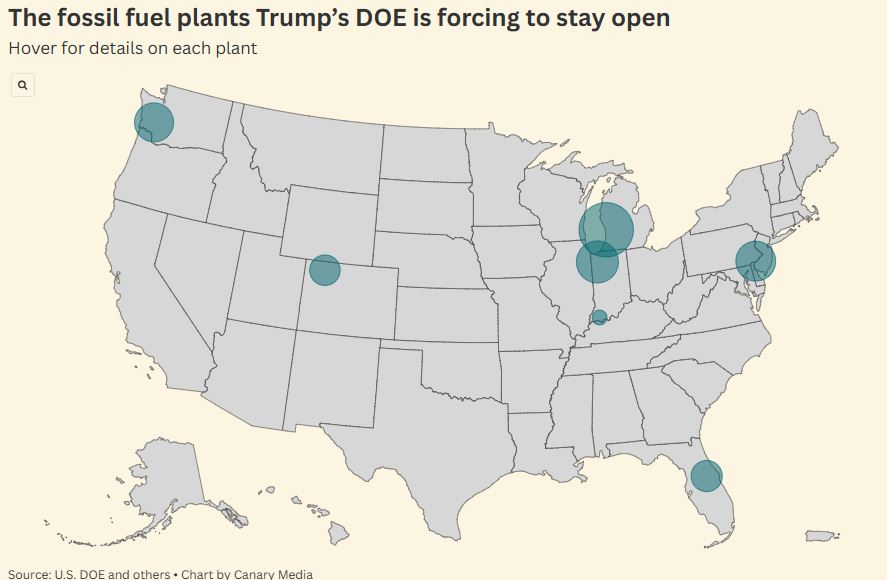
Here’s what you need to know about the plants forced to stay open so far.
J.H. Campbell in Michigan
This more than 60-year-old plant on the banks of Lake Michigan was the first to be hit with a stay-open order by Trump’s Department of Energy in May 2025, a week before the facility was slated to close.
Democratic state attorneys general from Michigan and the nearby states of Minnesota and Illinois, along with environmental groups, have filed legal challenges to try and block the J.H. Campbell order. Oral arguments took place before a federal appeals court in May 2026, and a ruling could occur as soon as August 2026.
Eddystone in Pennsylvania
The second stay-open order, also in May 2025, hit oil- and gas-fired units at Eddystone installed in the late 1960s. Plant owner Constellation Energy says the facility has operated infrequently since last year but has contributed to grid reliability, WEKU reported in July 2026.
Environmental groups have sued the DOE over its stay-open order. In Kentucky, a utility and the state’s Republican attorney general are taking federal energy regulators to court, arguing that customers in the state shouldn’t have to bear the cost of keeping Eddystone online.
R.M. Schahfer in Indiana
By the time the DOE ordered the roughly 50-year-old Schahfer plant to keep running, in December 2025, the facility was already half-broken. Filings from the plant’s owner, Northern Indiana Public Service Co., estimate that repairing the broken unit and continuing to operate the plant could cost more than $1 billion through 2027. The plant went offline for repairs in February 2026, and NIPSCO said in May that it likely wouldn’t run again until fall 2026. In other words, the plant could not help with grid reliability even if it were needed.
The Schahfer stay-open order was also a devastating turn for the neighbors of the plant who hoped to finally be free from the pollution it spews into the air. Environmental groups have filed a legal challenge to the DOE order, as have the Democratic state attorneys general of Minnesota and Illinois.
F.B. Culley in Indiana
CenterPoint Energy, the company that owns Culley Unit 2, has described it as its “smallest and most inefficient coal unit.” But that didn’t stop the Trump administration from ordering it to stay open in December 2025. In February, the company specifically asked the Trump administration not to renew its stay-open order for the plant, describing it as unreliable and unnecessary for grid reliability. The DOE reupped the order anyway.
Environmental groups have filed a legal challenge to the DOE order, as have the Democratic state attorneys general of Minnesota and Illinois.
Centralia in Washington state
The more than 50-year-old plant owned by TransAlta was slated for a retrofit that would turn it into a gas-burning facility before Trump’s stay-open order in December 2025. Although TransAlta says it’s still committed to that plan, it’s also seeking tens of millions of dollars in reimbursement for costs incurred to keep the coal plant online — a move that’s frustrating utilities in the region since the plant has sat idle in the months since the DOE’s order. Electric customers might be on the hook regardless.
Washington state’s Democratic attorney general and environmental groups have legally challenged the DOE’s Centralia orders. Washington’s Democratic governor also signed legislation that would impose hefty costs on TransAlta if Centralia began running again.
Craig in Colorado
Utilities in Colorado had been planning for about a decade to retire Craig Unit 1 at the end of 2025, but the Trump administration forced it to remain online. In February 2026, two cooperative utilities that co-own the plant filed a petition asking the DOE to reconsider its stay-open order, arguing that it will force their members to bear unnecessary costs. The agency has not relented.
Already, the plant’s owners have had to take on the costs of repairing a faulty valve that sent the plant offline in December 2025, and some estimates project that running the plant for a year beyond its retirement date could cost up to $150 million.
Environmental groups and Colorado’s Democratic attorney general have filed legal challenges to the DOE order.
Stanton in Florida
Unit 1 at the Stanton coal plant got its stay-open order in June 2026. The Environmental Defense Fund estimates that propping up the nearly 40-year-old facility could add an average of $21 to monthly electric bills if the costs are solely assigned to customers of the Orlando Utilities Commission, the municipal utility that owns the plant.
Are we missing any of the latest details on Trump’s coal stay-open orders? Let me know at kempe@canarymedia.com.
SB 905 would curb returns on wildfire costs, seek new financing, and explore performance metrics to curb sky-high electric rates. Can it overcome utility opposition?
California lawmakers are once again contending with how to curb the state’s high energy costs as they hurtle toward the end of this year’s legislative session on Aug. 31. So what’s on the table for utility rate reform in the final stretch?
Enter Senate Bill 905, a complicated package of proposals that are likely to face intense opposition from utilities, which tend to reflexively resist rules that could crimp their profits. But California voters are demanding reform, according to state Senator Josh Becker, the Democrat who wrote the bill.
Californians rank cost of living as a top concern, and most blame the state’s three big utilities for rising electricity rates that are now roughly twice the U.S. average. And when it comes to California’s climate strategy, “it’s going to be really hard to convince people to install heat pumps and switch to EVs, or get a factory to switch to electricity rather than natural gas, if the price of electricity is too high,” he said.
Becker was speaking at a July 14 webinar hosted by the University of California at Berkeley’s Center for Law, Energy, and Environment (CLEE) to promote its latest research on the causes of the state’s electricity cost crisis. As that report highlights, there are no easy fixes.
Climate change and wildfire risks are forcing Pacific Gas & Electric, Southern California Edison, and San Diego Gas & Electric to invest more in their aging and strained power grids. The California Public Utilities Commission, which regulates those utilities, is loath to rein in spending that expands the grid, brings more clean energy online, and reduces the risk of wildfires.
But the sheer amount of spending planned by utilities threatens to overwhelm the ability of their customers to pay for it. PG&E is seeking state regulator permission to spend $73 billion through 2030, and Southern California Edison has told investors it plans to spend from $38 billion to $41 billion through 2030.
SB 905 seeks to tackle utility spending in three key ways:
“Lowering electricity rates is a hard problem with no silver bullet,” Becker said. “But if we get this right, we can start a virtuous cycle.”
California lawmakers have been trying for years to pass utility reforms. In 2024, most of their efforts failed. But last year, Senate Bill 254, also sponsored by Becker, managed to make it through the legislative gauntlet.
SB 905 represents an important, if somewhat incremental, next step on those efforts, said Matthew Freedman, senior staff attorney at The Utility Reform Network (TURN), one of the state’s most vocal utility ratepayer advocacy groups and a sponsor of the bill. Among the bill’s provisions, a “lower return on equity is a pretty big one,” he said.
Utilities earn guaranteed rates of profit on capital investments, which puts upward pressure on customer rates. Anything that can reduce that rate of “return on equity,” or ROE, could help limit those increases, he said. A number of states are targeting utilities’ ROE to combat rising rates — and utilities are, not surprisingly, fighting back against the idea.
In a nod to the challenging politics, SB 905 proposes assigning a lower ROE only to key categories of utility spending, Freedman said. The biggest category is the tens of billions of dollars utilities are investing in burying and hardening power lines to eliminate the risk of sparking wildfires. SB 905 would also limit ROE for utility capital costs in “balancing” and “memorandum” accounts over which regulators have waived their typical authority for a “reasonableness review” to examine and claw back spending, usually for costs that can’t be predicted in advance of ratemaking proceedings.
Both these types of spending help reduce risk for utilities, which can lower the cost of financing as they go out to Wall Street to raise investment and procure debt, Becker said during the July webinar. That means utilities get “other benefits besides the pure financial return” from those investments, he said — and that justifies reducing how much they get to charge customers to recover those costs.
SB 905 also seeks to curb costs by forcing utilities to borrow money themselves, or rely on state-issued loans, to pay for some of their costs, Freedman said.
The math is fairly simple, he said. Borrowing money to pay for costs via a process known as securitization allows utilities to reduce the amount of money going into the “rate base” of capital investments on which they earn a guaranteed return. Utilities must collect money from customers over time to pay back those loans, but up-front impacts on customer rates are lower.
Tapping into state-backed bonds for utility projects that benefit the state at large — say, building transmission lines to allow more clean energy to be constructed and connected to the grid — could reduce costs even further, since governments can borrow more cheaply than utilities.
Last year’s SB 254 required the state’s big three utilities to securitize the first $6 billion in their ongoing grid wildfire-safety investments and created a state “transmission accelerator” to provide public funding for new transmission projects.
SB 905 would “require the PUC and the utilities to continue evaluating ways like that to lower financing costs,” Becker said, with an end-of-2028 deadline to report to the legislature on findings and recommendations.
It will take time for savings from this shift to borrowing to show up, said Sam Uden, co-founder and managing director of Net-Zero California, a Sacramento-based environmental policy group. He cited the example of the transmission accelerator, whose initial funding awaits final state budget negotiations.
“Then the goal would be for the accelerator to fire up next year, and launch public financing,” he said. “This is a multiyear transition.”
Curbing the return on investment and requiring utilities to borrow more both target the “capex bias” of regulatory structures that reward utilities with guaranteed profits on the capital expenditures. But what if utilities could be financially rewarded more directly for doing a better job on the things their customers and regulators really care about?
For decades, utility regulators and lawmakers have attempted to structure performance-based regulations to accomplish this. Some noteworthy examples include a long-running implementation at Hawaiian Electric and an abortive effort from Connecticut’s former head utility regulator that led to a bitter fight with utilities and her eventual departure from the agency.
SB 905 would set a Jan. 1, 2028, deadline for the California Public Utilities Commission to launch an effort to establish clear performance metrics for tasks such as making the grid more reliable, reducing greenhouse gas emissions, and speeding up the process of connecting new customers and renewable sources. “This will make clear what our expectations are for good performance, and hold utilities accountable for delivering safe, reliable, clean, and affordable power,” Becker said.
To be clear, SB 905 doesn’t authorize the commission to offer any financial incentives for meeting or exceeding whatever metrics it comes up with, Freedman said — at least, not yet. “We’re worried about a performance-based regulatory approach that the utilities can game and earn excessive profits from,” he said, as happened with Illinois utility ComEd over the 2010s.
“Let’s see how it goes for a few years. If we like it, the legislature can change the law and attach some incentives around that,” he added.
One big performance metric that SB 905 would establish, and which Virginia and other states have already implemented, is “grid utilization,” or squeezing more of the power grids that utilities already have. That’s a good way to drive down utility costs, which are based on “dividing the total costs of running the grid by the total amount of energy delivered to customers,” Becker said.
“We need to control the numerator of that equation — the costs. But if we can increase the denominator of the energy sold, then rates will go down,” he said.
California has plenty of load growth coming, whether from data centers, EV charging, or heat pumps and air conditioners for homes and buildings, Becker noted. The right combination of cost controls along with that can “make EVs look cheaper to drive, and make heat pumps look more cost-effective versus gas furnaces,” he said.
Right now, SB 905 is in the state Assembly appropriations committee, where it could undergo a number of amendments that won’t become known to its author until it is released for further consideration via a process known as “suspense.” Similar last-minute amendments gutted key provisions from another of Becker’s bills last year — before it was vetoed by Gov. Gavin Newsom.
Meanwhile, a late-breaking push by Newsom to reform California’s wildfire liability system — one of the state’s key drivers of utility costs — is likely to add more pressure on lawmakers trying to negotiate on a plethora of energy and climate issues, ranging from what to do about data centers to how to manage budget pressures tied to the state’s carbon cap-and-invest program.
Will SB 905 make it into law? “You know, utilities are fighting it fiercely,” Becker said. “But as we learned from last year, big things come down to the final wire, and I hope we’re going to get it through.”


