

 Back
Back
See more from Canary Media’s “Chart of the Week” column.
Yes, batteries got cheaper again last year. It’s so predictable at this point, it’s almost boring. Almost.
In 2025, the average price of a lithium-ion battery pack was $108 per kilowatt-hour, down 8% from the year prior, according to research firm BloombergNEF’s latest annual survey. It’s the continuation of a long-standing trend: With the exception of 2022, battery prices have declined every single year since 2010, when BNEF began looking at the data.

It’s a crucial metric — something of a skeleton key for the entire energy transition.
Cheaper batteries mean cheaper electric vehicles, and that in turn puts more EVs and fewer gas cars on the road. Cheaper batteries mean you can squeeze more juice out of your solar panels, displacing more planet-warming coal and gas. Cheaper batteries mean cheaper, clean energy — urgently needed in the U.S. as fast-rising utility bills collide with the push to decarbonize our energy system.
You need to look only at battery adoption to understand the impact.
Back in 2016, when batteries were more than triple the cost they are today, electric vehicles accounted for less than 1% of new car sales worldwide. But as the average battery cost per kilowatt-hour plummeted from $365 then to just $108 as of last year, EV sales surged. Last year, more than one-quarter of the new cars sold globally were electric.
Grid storage is a similar story. A decade ago, the sector was marginal, as batteries remained prohibitively expensive to add into the electricity mix. Now, with less expensive batteries available, storage is taking off, and costs are falling especially fast for the segment.
These reductions have largely been driven by China’s massive clean-energy manufacturing apparatus. The country makes a staggering three-quarters of all batteries sold worldwide. Years of churning out head-spinning quantities of lithium-ion batteries have allowed Chinese firms to steadily chip away at costs — and a similar dynamic helps explain the inexorable, essential decline in the cost of solar and wind power, too.
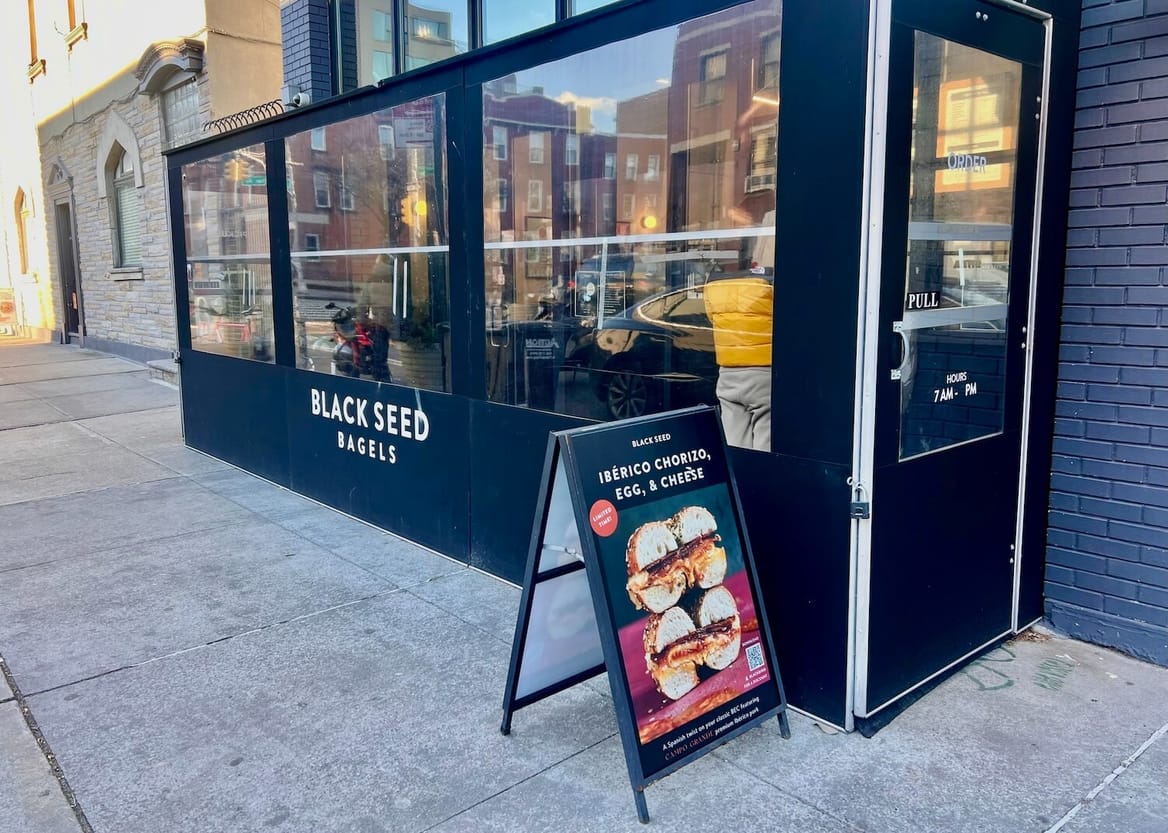
BROOKLYN, N.Y. — In the back of Black Seed Bagels in northern Brooklyn is a giant catering kitchen filled with industrial-size condiments and freezers full of dough. A tall, silver electric oven, named the Baconator, stands in a far corner, cooking thousands of pounds of meat every week to accompany Black Seed’s hand-rolled, wood-fired bagels.
The Baconator is connected to a battery the size of a carry-on suitcase, which is plugged into the wall. While the morning rush is underway, the 2.8-kilowatt-hour battery can directly power the commercial oven to reduce the company’s reliance on the electric grid, Noah Bernamoff, Black Seed’s co-owner, explained recently at the company’s Bushwick shop. Two more batteries are paired with energy-intensive refrigerators in the front.
Businesses like Black Seed often pay hefty demand charges on their utility bills that reflect the maximum amount of power they use during a month — costs that can represent as much as half their total bill, on average. By shifting to battery power during key times, Black Seed aims to lower its peak grid needs and reduce monthly fees from the utility Con Edison in the process.
Black Seed is part of a battery pilot program run by David Energy, a New York–based retail energy provider. The startup supplied the batteries for free last August and, using its software platform, controls exactly when the three appliances draw on backup power. Vivek Bhagwat, David Energy’s head of engineering, said he expects that tapping batteries for the refrigerators — which are always humming — will be especially helpful during the hottest months, when the shop’s air conditioners run around the clock.
“We’re pretty optimistic about our ability to curtail energy in the summer, when it really matters most, through this machine,” he said while standing beside a doorless fridge holding water, juice, and soda.
For Black Seed, even modest benefits from batteries could make a difference if multiplied across the company’s 10 locations in New York City, Bernamoff said. By way of example, he noted that saving $80 at every shop every month could add up to almost $10,000 a year in avoided utility costs.
“We’re in the game of nickels and dimes,” he said of the bagel business. “So we’re always happy to save the money.”
James McGinniss, David Energy’s CEO, thinks this “do-it-yourself battery” strategy has some serious potential to help small businesses combat rising electricity costs, both in New York City and beyond. Along with Black Seed’s Bushwick shop, his company has installed batteries at fast-food restaurants, a day spa, and a dog grooming store, where the battery is cushioning the power draw of a fur-drying machine. As of mid-January, David Energy has signed deals with customers to put plug-in batteries in about 50 locations, adding up to more than 500 kilowatt-hours of energy storage capacity.
The startup’s plug-in battery pilot is building on the growing interest in DIY energy technologies worldwide. McGinniss cited the example of balcony solar systems that can plug into standard household electrical outlets, which are big in Germany but aren’t yet allowed under most current electrical codes in the U.S. — although state lawmakers in New York and elsewhere are pushing legislation to change that.
Backup batteries, however, are ready for market. Portable batteries from companies like Jackery and EcoFlow are increasingly affordable and popular options for households that are looking for backup power during blackouts but can’t, or don’t want to, install fossil fuel–burning generators. A handful of startups like Pila Energy have plug-in batteries meant to operate around the clock to reduce utility bills as well as to keep refrigerators and other critical appliances running through power outages.
As a retail energy provider, David Energy competes with large utilities and other energy retailers to provide customers with cheaper electricity plans. It does so primarily by purchasing electricity from wholesale markets and then reselling it to businesses and households. But the battery pilot is part of the company’s broader long-term goal to “run the grid 24/7 on clean energy,” McGinniss said.

BROOKLYN, N.Y. — In the back of Black Seed Bagels in northern Brooklyn is a giant catering kitchen filled with industrial-size condiments and freezers full of dough. A tall, silver electric oven, named the Baconator, stands in a far corner, cooking thousands of pounds of meat every week to accompany Black Seed’s hand-rolled, wood-fired bagels.
The Baconator is connected to a battery the size of a carry-on suitcase, which is plugged into the wall. While the morning rush is underway, the 2.8-kilowatt-hour battery can directly power the commercial oven to reduce the company’s reliance on the electric grid, Noah Bernamoff, Black Seed’s co-owner, explained recently at the company’s Bushwick shop. Two more batteries are paired with energy-intensive refrigerators in the front.
Businesses like Black Seed often pay hefty demand charges on their utility bills that reflect the maximum amount of power they use during a month — costs that can represent as much as half their total bill, on average. By shifting to battery power during key times, Black Seed aims to lower its peak grid needs and reduce monthly fees from the utility Con Edison in the process.
Black Seed is part of a battery pilot program run by David Energy, a New York–based retail energy provider. The startup supplied the batteries for free last August and, using its software platform, controls exactly when the three appliances draw on backup power. Vivek Bhagwat, David Energy’s head of engineering, said he expects that tapping batteries for the refrigerators — which are always humming — will be especially helpful during the hottest months, when the shop’s air conditioners run around the clock.

“We’re pretty optimistic about our ability to curtail energy in the summer, when it really matters most, through this machine,” he said while standing beside a doorless fridge holding water, juice, and soda.
For Black Seed, even modest benefits from batteries could make a difference if multiplied across the company’s 10 locations in New York City, Bernamoff said. By way of example, he noted that saving $80 at every shop every month could add up to almost $10,000 a year in avoided utility costs.
“We’re in the game of nickels and dimes,” he said of the bagel business. “So we’re always happy to save the money.”
James McGinniss, David Energy’s CEO, thinks this “do-it-yourself battery” strategy has some serious potential to help small businesses combat rising electricity costs, both in New York City and beyond. Along with Black Seed’s Bushwick shop, his company has installed batteries at fast-food restaurants, a day spa, and a dog grooming store, where the battery is cushioning the power draw of a fur-drying machine. As of mid-January, David Energy has signed deals with customers to put plug-in batteries in about 50 locations, adding up to more than 500 kilowatt-hours of energy storage capacity.
The startup’s plug-in battery pilot is building on the growing interest in DIY energy technologies worldwide. McGinniss cited the example of balcony solar systems that can plug into standard household electrical outlets, which are big in Germany but aren’t yet allowed under most current electrical codes in the U.S. — although state lawmakers in New York and elsewhere are pushing legislation to change that.
Backup batteries, however, are ready for market. Portable batteries from companies like Jackery and EcoFlow are increasingly affordable and popular options for households that are looking for backup power during blackouts but can’t, or don’t want to, install fossil fuel–burning generators. A handful of startups like Pila Energy have plug-in batteries meant to operate around the clock to reduce utility bills as well as to keep refrigerators and other critical appliances running through power outages.
As a retail energy provider, David Energy competes with large utilities and other energy retailers to provide customers with cheaper electricity plans. It does so primarily by purchasing electricity from wholesale markets and then reselling it to businesses and households. But the battery pilot is part of the company’s broader long-term goal to “run the grid 24/7 on clean energy,” McGinniss said.
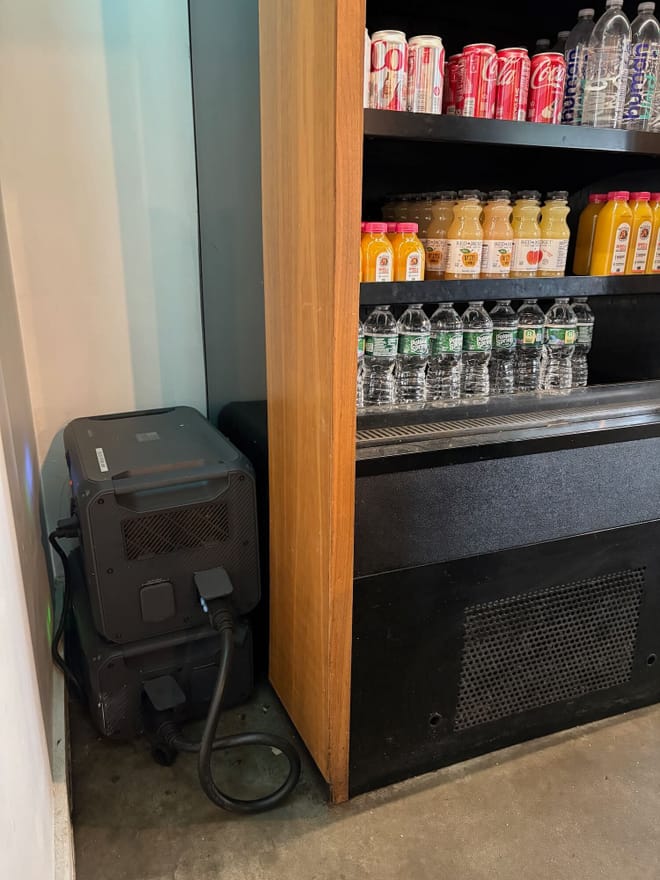
A plug-in battery helps power a doorless fridge in Black Seed’s Bushwick shop. (Maria Gallucci/Canary Media)
As solar and batteries have become “the cheapest electron we can create,” giving customers access to those technologies has become a business priority for David Energy as well — “because people like cheap energy,” he said. Plug-in batteries, in particular, enable the company to “rapidly scale our storage under management, even in the existing regulatory construct,” according to McGinniss.
That last point underscores the challenges that New York City businesses face in installing the type of wired-in and utility-interconnected battery backup systems that are more common in other parts of the country. For years, concerns about fire risks have led the New York City Fire Department to subject stationary lithium-ion battery installations to strict fire-safety regulations that have made them impractical for most building owners.
Last fall, the New York City Buildings Department issued new rules that industry experts say could make these projects more cost-effective. But that still leaves building owners and battery installers with the task of navigating complex and time-consuming utility interconnection processes — steps that simple plug-in batteries can avoid.
Still, how can a retail energy provider recoup the cost of supplying batteries to customers for free? McGinniss didn’t disclose the current financials for David Energy’s no-cost battery program. But he did say that the devices offer money-saving opportunities for customers and money-making ones for his business that can expand over time.
For customers, the fundamental proposition is the opportunity to reduce a big, hard-to-manage portion of their monthly utility bills — the demand charges. Unlike the per-kilowatt-hour “volumetric” charges that most households pay, these particular fees are assessed based on the maximum amount of power a business draws from the grid during any 15-minute period within a month. The structure is designed to incentivize customers to reduce peak electricity use, which drives much of the cost for utilities of building and maintaining grid infrastructure.
For New York City businesses, these demand charges can add up to between 15% and 50% of a typical commercial customer’s monthly bill, McGinniss explained. Using stored battery power for big appliances that tend to need a lot of energy during those times can significantly reduce those peaks, he said, as shown in this sample graph from Black Seed’s Bushwick location on Sept. 17, 2025.
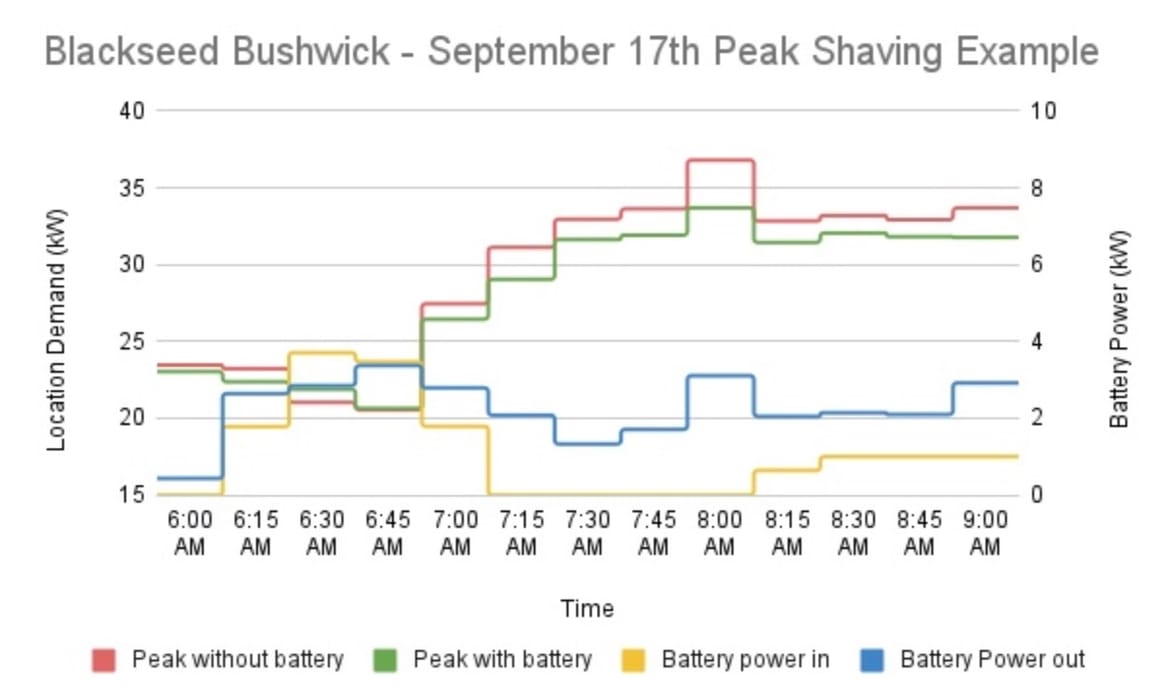
The results can vary greatly from customer to customer, though McGinniss estimated that every kilowatt shaved from that peak could cut about $50 from a monthly bill. That’s a good way for David Energy to entice and retain customers, he said. But the startup can also use the same stored battery power to earn revenues for itself.
One option is participating in so-called demand-response programs, which pay customers to reduce power use during, for instance, hot summer evenings when demand for electricity is putting power plants and grid infrastructure under stress. In New York City, David Energy can participate in programs run by Con Edison and by state grid operator NYISO, McGinniss said.
Retail electricity providers like David Energy can make (or lose) money depending on how cleverly they manage their ever-changing mix of purchases on wholesale energy markets against their commitments to provide their customers with retail power at competitive prices.
In Texas, the country’s most open and competitive electricity market, energy retailers are building gigawatt-scale “virtual power plant” platforms, offering customers free smart thermostats, rooftop solar-and-battery systems, and stand-alone backup batteries. In exchange, these programs ask customers for permission to use those systems to pursue arbitrage opportunities — essentially hedging their wholesale energy-market positions by using batteries to store power when it’s cheaper and avoid pulling it from the grid when it’s more expensive. David Energy is pursuing similar opportunities in Texas as well as in its primary markets in New York and elsewhere in the Northeast.
The economics of this customer-facing arbitrage expand as the scale of deployments grows, McGinniss said. “As you add these things up, it’s a portfolio effect,” he said. “There’s a lot more value to unlock down the road.”
To be clear, relying on systems installed at customers’ homes and businesses puts a lot of risk on the companies fronting the money to install them. These companies need to have technology to communicate with and control the devices to ensure they’re storing and shifting power at times when that’s valuable. And they need contracts that fairly share the savings and revenues with their customers — and build in options for when customers might want to switch to a different energy retailer that comes along with a more attractive offer.
On that last front, portable batteries are a lot less risky than systems that need to be wired into building electrical panels and interconnected under utility rules, McGinniss noted. “If they don’t like the service, we can come pick it up. That’s a remarkable fact about these batteries that changes how you think about financing.”
Even so, Bernamoff at Black Seed Bagels said he’s excited by the longer-term possibility of installing large-scale batteries in the Bushwick store’s basement — particularly as city and state policymakers in New York push to electrify buildings. Today, Black Seed primarily uses fossil-gas appliances and heating systems in its stores. If the company is required to switch to electrified versions, then adding batteries could help it manage its higher electricity bills and limit strain on the local grid, he said.
“The industrial battery side of it all could be really interesting,” Bernamoff said while seated at a café table, beneath a poster advertising the store’s scallion-kimchi cream cheese.
“To the extent that we’d be able to reduce peak power at the service level, instead of piece by piece, now we’re really talking,” he added. “Because then every outlet, every light bulb is being better managed and reduced.”
California lawmakers are considering two bills that would slash red tape for households looking to add certain types of clean tech.
Earlier this month, state Sen. Scott Wiener (D), whose district includes San Francisco, introduced legislation that would make it easier for individuals to adopt all-electric, superefficient heat pumps (SB 222) and plug-in solar panels (SB 868).
“The cost of energy is too high,” Wiener told Canary Media. “We want to lower people’s utility bills; we want people to be able to participate in the clean energy economy; and we want people to be able to take control of their energy future. And that’s what these bills do.”
The proposals come as Americans are in the grip of a worsening cost-of-living crisis — of which energy is a key driver.
Electricity costs have grown at about 2.5 times the pace of persistent inflation, and home heating costs are expected to surge this winter. In California, which has the second-highest electricity rates in the nation, the problem is particularly pressing.
Heat pumps and plug-in solar panels could help.
Heat pumps — air conditioners that also provide all-electric heat — are about two to five times as efficient as gas furnaces without those appliances’ planet-warming and health-harming pollution. Even in California, where gas is relatively inexpensive compared with electricity, a heat pump’s high efficiency can enable households to save on their energy bills, especially when tapping the sun for cheap, abundant power.
Enter portable, plug-and-play solar panels. These modest systems, which users can drape over balcony railings or prop up in backyards, allow renters, apartment dwellers, and others who can’t put panels on their roofs to harvest enough of the sun’s rays to power a fridge or a few small appliances for a fraction of the day. A connected battery can save solar energy for use at night.
The tech is booming in Europe. In Germany, for example, where people can order kits via Ikea, as many as 4 million households have hung up Balkonkraftwerke, or “balcony power plants.” There, households can cover as much as one-fifth of their energy needs using these systems.
In the U.S., an 800-watt unit for $1,099 can save a household as much as $450 annually in states with higher electricity prices like California, according to The Washington Post.
But unlike those in Germany, U.S. households typically need to apply for an interconnection agreement with their utility before they can install these systems — just as they would for adding a rooftop solar array. That process often requires fees, permits, and an inspection, and it can take weeks to months. Only one state allows residents to install plug-in solar without a utility’s permission: deep-red Utah.
Lawmakers elsewhere are now stampeding to make plug-in solar available to their constituents.
Besides Utah and now California, legislatures in more than a dozen states want to unleash the tech: Hawaii, Illinois, Indiana, Maine, Maryland, Missouri, New Hampshire, New Jersey, New York, Pennsylvania, South Carolina, Vermont, Virginia, and Washington have all introduced bills, according to Cora Stryker, co-founder of plug-in solar nonprofit Bright Saver, which has been advising some states on their proposals. Based on conversations the organization has had with state representatives, Stryker said she expects a whopping half of U.S. states to introduce bills this year.
“We should empower people to use this technology,” Wiener said. “And right now, it’s too hard. The idea that you have to get an interconnection agreement with the utility to put … plug-in solar on your balcony — it makes no sense.”
Administrative hurdles are also holding back heat pumps.
“The current permitting process is difficult,” Aaron Gianni, president of Larratt Brothers Plumbing in San Francisco, told state policymakers on Jan. 6. “As a contractor dealing with more than 109 different building departments in the Bay Area, we must navigate the nuances of each: different inspectors, changing paperwork requirements, high fees, and strict setbacks [that] sometimes make installation impossible.”
The situation can be even worse when a customer lives in a unit governed by a homeowners association, Gianni said. “Many HOAs have outright prevented new electric equipment from being installed.”
Wiener, who’s running for U.S. Rep. Nancy Pelosi’s seat and boasts a tongue-in-cheek MAGA fan club, put it bluntly. Permitting in some cities “is way too lengthy and onerous and expensive.”
“The [heat-pump] bill creates a streamlined path to be able to get a quick, automatic permit,” he explained. It would also loosen restrictions on equipment placement, cap permit fees at $200, and make it illegal to ban heat pumps.
Wiener’s heat-pump legislation, which has some industry detractors as well as grassroots supporters, has already passed out of the state Senate’s housing and local-government committees.
The plug-in solar bill has yet to come up for any votes. Still, with energy affordability shaping up to be a decisive issue in the 2026 midterm elections, both proposals “have, I think, a real possibility of passing,” Wiener said.
“These technologies are a win-win-win, and enabling access to them is simply good government.”
Just about everyone in Massachusetts agrees: Energy bills are too damn high.
Natural gas prices in the state rose 70% between 2020 and 2025, according to the U.S. Energy Information Administration, and its residential electricity rates are the third highest in the country, behind only California and Hawaii. Some residents are making hard choices between paying their utility bills and buying food or health care necessities.
It is almost inevitable that the issue of affordability rather than climate change will dominate energy-policy conversations in the state — and throughout the high-priced New England region — this year.
“It’s going to be the focus for both Democrats and Republicans, those kitchen-table, pocketbook issues,” said Dan Dolan, president of trade group the New England Power Generators Association. “Both on the gas and the electric side, utility bill concerns are going to be front-of-mind.”
Massachusetts isn’t alone in this feeling. Across the nation, utility bills are rising far faster than inflation, and energy affordability is becoming a major political issue, propelling Democrats in several states to victory in last November’s elections. But in Massachusetts, sky-high bills are colliding with critical questions about the region’s future energy supply. The Trump administration has waged an unrelenting attack on the offshore wind developments the region was counting on to deliver new electricity, and has worsened the prospects for solar, too, by slashing tax incentives and grant programs.
“It’s supply and demand, and you’re taking away a lot of the supply that was going to be coming online in Massachusetts,” said James Van Nostrand, policy director at nonprofit organization The Future of Heat Initiative and the former chair of the Massachusetts Department of Public Utilities. “How do you solve that?”
While everyone acknowledges the problem, there is far less consensus on what the root causes are or how to fix them. Some on both sides of the aisle blame the cost of building renewable energy and the transmission lines needed to carry it. Others point to volatile natural gas prices and the expense of replacing aging pipes. Third-party electricity suppliers that lure unsophisticated consumers into high-priced power contracts are also exacerbating matters, say many advocates. Utilities’ profit margins are under scrutiny as well.
For elected officials, the timing makes the conversation both more urgent and more complex: All six New England governors’ seats and more than 1,200 state legislator positions across the region will be up for election this fall.
A major part of the challenge is that there are more than two sides to the argument. Almost no one is advocating for a full return to fossil-fueled power plants or for a renewables-only grid. But the spaces in between are filled with permutations and possibilities that are difficult to sum up and sell. “Affordability” is being used to justify widely divergent energy proposals, including plans that opponents say could make the problem worse or which trade off climate goals in the name of bringing down costs.
“The long-term solutions are complicated and nuanced, and don’t lend themselves neatly to those political debates,” Dolan said.
Though Democrats control the Massachusetts legislature by vast margins, not everyone is on the same page about how to tackle the affordability crisis.
In March 2025, Gov. Maura Healey, a Democrat who is up for reelection, unveiled her energy-affordability agenda. It includes plans to create the state’s first discount rate for moderate-income households, expand tiered rates for low-income customers, and help residents access existing programs that could help them trim their bills. Two months later, she introduced a sprawling energy-affordability bill she said would save residents about $10 billion over the next 10 years through measures like reducing bill charges, making sure utilities don’t pass certain expenses on to customers, and removing barriers for nuclear development.
Last month, state utility regulators, at Healey’s request, opened an investigation into electricity and gas delivery costs, with an eye to determining if any charges can be removed, consolidated, or redesigned to save consumers money.
But in November, Democratic state Rep. Mark Cusack, House chair of the Joint Committee on Telecommunications, Utilities, and Energy, countered Healey’s proposal with his own package that included many of the same provisions — alongside several that set off alarm bells in the clean-energy community.
The bill, which was approved by Cusack’s committee on a 7-0 vote, called for making the state’s 2030 emissions target nonbinding, slashing funding for energy-efficiency programming, and limiting climate and clean-energy initiatives that impact customers’ utility bills.
The existence of these provisions signals how far concerns about affordability have shifted the conversation in the state, said Paula García, senior manager of energy justice research and policy for the Union of Concerned Scientists.
“This thing of revisiting the climate commitments that the state has in place was not something that was being discussed at the beginning of last year,” she said.
Cusack’s bill, which is widely expected to be the vehicle for energy legislation this session, is now in the House Ways and Means Committee. The measure will be revised there before potentially advancing to a floor vote that could send it to the Senate.
The bill’s final form will depend in large part on who can come up with a clean, compelling narrative to back their position, said advocates and observers. Some worry that efforts to paint energy efficiency and renewable energy as the culprits behind rising bills have gotten a head start.
“We allowed fossil-fuel interests to drive the narrative that it’s all those clean and green things,” Kyle Murray, director of state program implementation at the nonprofit Acadia Center. “Unfortunately, that’s what’s taken hold.”
The idea has a sort of commonsense allure: After all, energy bills have risen at the same time as Massachusetts has been increasing its focus on renewable energy development and expanding its energy-efficiency programming, so it’s not difficult to imagine a connection between these trends. The flames have been fanned by federal officials like Energy Secretary Chris Wright, who claims wind and solar are driving up costs for the states reliant on them.
Local renewable-energy opponents continue to push this interpretation of the affordability crisis. Last week, nonprofit Always On Energy Research released a report arguing that a switch to renewable power would cost New England up to $700 billion more by 2050 than leaning on natural gas or nuclear power plants. The analysis was sponsored by right-wing organizations, including the Yankee Institute, Fiscal Alliance Foundation, and Americans for Prosperity Foundation.
Murray called the report’s numbers “magical thinking, completely at odds with reality.” Acadia Center is attempting to counter that argument with a new series of explainers outlining its analysis of what is driving volatile energy prices, with a strong emphasis on the cost of natural gas and the benefits of renewables. Other advocates also say they will be working on educating lawmakers about the complex subject and urging them to keep up the push for clean energy.
“So much of the issue is whose message is being received well,” Murray said. “We’re going to make a more concerted effort this year.”
This analysis and news roundup come from the Canary Media Weekly newsletter. Sign up to get it every Friday.
When it comes to state politics, 2026 is already in full swing. As legislators reconvene and new governors are sworn in, it’s becoming clear that leaders will focus on one energy issue in particular this year: affordability.
While last year’s elections didn’t bring any major changes to the White House or Congress, skyrocketing energy prices played an undeniable role in propelling Democrats to victory in state elections across the country.
Take a look at New Jersey, where Democratic Gov. Mikie Sherrill was sworn in this week after campaigning on a promise to lower power prices while building out clean energy. She took her first steps in that direction on Tuesday, signing executive orders to accelerate solar and storage development, consider freezing electricity rate hikes, and expand utility bill credits for customers.
Those credits will be funded in part by the Regional Greenhouse Gas Initiative, an East Coast carbon market that saw good news with the inauguration of Virginia Democratic Gov. Abigail Spanberger this past weekend. Spanberger is already moving to rejoin RGGI, with an assist from the state’s Democratic-controlled legislature, after the previous Republican governor pulled Virginia out of the program back in 2023. On her first day in office, Spanberger also directed state agencies to find ways to curb energy and other household costs.
Affordability is sure to continue to dominate politics this year in Virginia, also known as the data center capital of the world, clean energy advocates recently told Canary Media’s Elizabeth Ouzts.
“Oftentimes, I go into a legislative session sort of just guessing what people are going to care about,” said Kendl Kobbervig of Clean Virginia. Not this year.“No. 1 is affordability, and second is data center reform.”
Massachusetts’ legislature shares that priority, reports Canary Media’s Sarah Shemkus. But even though the statehouse remains firmly in Democratic hands, lawmakers aren’t aligned on how to curb costs in the long term. Some are targeting volatile natural gas prices and the cost of replacing aging pipelines, others say clean energy and transmission construction are to blame, and still others are homing in on utility profit margins.
The reality is that the energy affordability crisis isn’t a problem with just electricity prices or natural gas prices; both are rising at rates higher than inflation across the country. And so it’s going to take strong, and perhaps creative, solutions to keep them in check.
Trump’s year of energy upheaval
It’s been a year since President Donald Trump took office for the second time, and there’s been no shortage of energy-industry shake-ups in the months since.
On his first day in office, Trump called out rising power demand and declared a national emergency on energy, which he has since used to justify keeping aging coal plants open long past their retirement dates.
His signature spending law, the One Big Beautiful Bill Act, gutted tons of clean energy tax incentives. And that’s not to mention the administration’s decarbonization funding clawbacks, its holdup of renewables permitting, and its relentless attacks on the nation’s offshore wind industry.
Trump’s year-two agenda is already starting to take shape. Expect to see his administration order more coal plants to stay open, cancel additional clean energy funding, and throw up hurdles we can’t even imagine yet.
Geothermal is having a moment
As clean energy sources like offshore wind and solar struggle to snag a foothold in the new, post–tax credit world, geothermal proved this week that it still has the juice.
A wave of announcements from pioneering geothermal startups began on Wednesday, with Zanskar announcing it had raised $115 million in a Series C funding round. It’ll use the infusion to expand its AI software, which it used to uncover an untapped, invisible geothermal system in Nevada last year. Also on Wednesday, Sage Geosystems announced a more than $97 million Series B round, which will fund its first commercial-scale power generation project, slated to come online this year.
Fervo Energy completed the trifecta as it quietly filed for an IPO, Axios Pro reported on Thursday. The company hasn’t shared details about the filing, but said in December that it had raised about $1.5 billion so far in its quest to build a massive enhanced geothermal system in Utah.
Back to work: Wind farms off the coasts of New York, Rhode Island, and Virginia have all restarted construction after legal wins last week against the Trump administration’s stop-work order, though two other projects remain paused. (Canary Media)
Solar keeps surging: An Energy Information Administration analysis finds utility-scale solar is the fastest-growing power generation source in the U.S., and will continue to expand through 2027 as the shares of coal and gas in the energy mix decline. (EIA)
Rural resilience: North Carolina towns devastated by 2024’s Hurricane Helene are installing solar panels and batteries at community hubs to prepare for future disasters, with help from a program that could become a national model. (Canary Media)
Clean-steel influencers: A new report shows automakers buy at least 60% of the primary steel made in the U.S., which gives them leverage to push steelmakers to clean up production. (Canary Media)
Batteries at breakfast: A Brooklyn bagel shop is cutting its power bills by using suitcase-size batteries to run its oven and fridges when electricity demand is high. (Canary Media)
Renewables’ European win: Wind and solar generated 30% of the EU’s electricity last year, while fossil fuels provided 29%, marking the first time renewables have beaten coal, oil, and gas. (The Guardian)
Clawback consequences: Some communities that lost federal climate grants last year have sued to reclaim them, while others have had to move on from projects that would’ve helped them curb pollution and adverse health effects. (Grist)


.svg)
