

 Back
Back
Two bills on Gov. Newsom’s desk would reduce hurdles to heat pumps and home solar and batteries, which could reduce fees by $1,000 or more per project.
Californians could soon find it easier and cheaper to install rooftop solar, home batteries, and energy-saving heat pumps and heat-pump water heaters.
Late last month, the state Legislature passed two first-in-the-nation bills that would streamline permitting and inspections for these clean energy home projects. Democratic Gov. Gavin Newsom has until Sept. 30 to sign the bills, the Heat Pump Access Act (Senate Bill 222) and the Remote Virtual Inspection Act (Assembly Bill 1738).
Newsom’s office declined to say which way he’s leaning. If enacted, the bills could save households hundreds of dollars to more than $1,000 in fees per environmentally friendly upgrade, according to independent analyses. The technologies all tend to reduce monthly utility bills, too.
Those savings would go a long way right now, as Californians deal with some of the highest energy costs in the nation and the federal government has clawed back support for such upgrades. President Donald Trump and the Republican-controlled Congress eliminated federal tax credits for home solar, batteries, heat pumps, and heat-pump water heaters last year.
“This is something that touches families’ pocketbooks directly,” said Nick Josefowitz, founder and chief executive of energy-affordability nonprofit Permit Power. “We’re just thrilled that the legislature in California acknowledged how important that is.”
The pieces of legislation could also nudge California closer to its climate targets. By 2030, the state has pledged to reduce planet-heating emissions by 40% from 1990 levels and to deploy 6 million carbon-slashing heat pumps.
Here’s what each bill would deliver.
Californians who want to install a heat pump or a heat-pump water heater need permits from their city or county before a contractor can legally do that work.
But “inconsistent and onerous” permitting regulations inflate project costs. The policy nonprofit San Francisco Bay Area Planning and Urban Research Association (SPUR) found that some jurisdictions require three permits — plumbing, electrical, and structural — for a heat-pump water heater, which can result in $400 in unnecessary fees.
If it becomes law, the Heat Pump Access Act would replace a patchwork of requirements across roughly 600 jurisdictions with a simpler statewide standard.
The bill requires cities of at least 5,000 and counties of at least 150,000 to offer expedited or instant permitting for heat pump projects by July 1, 2028. It also limits jurisdictions to one permit per project; caps permit fees at $150 for a heat-pump water heater and $200 for a heat pump, excepting jurisdictions that show they have higher costs to recoup; and prohibits homeowners associations from imposing their own restrictive rules or outright bans. One HOA delayed a retiree’s heat pump by seven months, causing her to miss out on almost $6,500 in incentives.
SB 222 “is going to make it so much easier for people to install heat pumps,” said state Sen. Scott Wiener (D), who authored the bill. Speeding up that process, which would make air conditioning more accessible, “is how we protect California families from extreme heat and rising energy costs.”
Cities and counties inspect permitted home upgrades to make sure they’re up to code. But doing these routine checks in person takes time and money.
Heating, ventilation, and air-conditioning contractors often find themselves waiting for two to six hours for an inspection that itself takes just five to 15 minutes, according to SPUR. The nonprofit estimates that this inefficiency, along with the inspector’s travel time and coordination work, adds $600 to $1,000 to the cost of a single heat-pump, solar, or battery project — an expense passed on to customers.
AB 1738 aims to streamline the inspection process for these and other select projects by giving homeowners the right to request an established time-saving approach: remote virtual inspections. Because they can be done with a video call on a smartphone, the scheduling is much tighter and more flexible.
For example, a plumber might install a water heater in the morning and book an inspection for that afternoon, said Timothy Wegner, who led the Placer County, California, building department, where he spearheaded its adoption of remote inspections, before retiring earlier this year. At least 19 jurisdictions in California already offer a remote option, including Berkeley, Los Angeles County, and San Diego.
The bill requires cities of more than 50,000 people and counties of at least 150,000 to offer virtual inspections by Jan. 1, 2028. However, it lets authorities require an in-person meeting when necessary. If enacted, the legislation would save Californians more than $500 million in three years based on current permit data, according to SPUR.
“A thousand bad rules and process bottlenecks that nobody ever bothered to fix caused California’s affordability crisis,” Brian Hanlon, CEO of pro-housing nonprofit California YIMBY, said in a statement. “AB 1738 fixes one of them by allowing remote inspections. That’s how you make California affordable again — fixing one dumb bottleneck at a time.”
California has long been a clean energy trailblazer. In 2022, the Golden State became the first in the U.S. to require most cities and counties to automate permitting for rooftop solar. Connecticut, Florida, Maryland, New Jersey, Texas, and Virginia have followed suit with laws streamlining home solar and storage permitting. And Maryland has also adopted one encouraging, though not requiring, jurisdictions to offer remote inspections for such projects.
“All these states are looking at each other,” Josefowitz said. Once one goes first, “it unleashes a torrent of interest.”
Newsom’s 8-year term as California’s governor is drawing to an end. Here’s how he helped — and hindered — the state’s energy transition.
Gavin Newsom’s eight-year run as California’s Democratic governor — and as self-styled U.S. climate change warrior — comes to an end in January. At this pivotal moment for the state’s clean energy transition, it’s worth reflecting on how he’s lived up to his clean energy commitments and what kind of climate legacy he leaves for his successor.
Under Newsom’s leadership, California has built gigawatts of new clean energy to keep up with its mandate to achieve 100% renewable and carbon-free power by 2045. The state has added millions of electric vehicles to its roads, and committed to end the sale of gasoline-fueled cars by 2035. And it has instituted policies aimed at protecting the environment and communities from industrial and fossil fuel pollution.
But Newsom has also taken heat for backsliding on his environmental justice promises, particularly during his second term. Many critics blame this shift on his unwillingness to take on major oil, gas, and utility interests, even as household energy costs — and corporate profits — have soared.
“I’m a hard grader — I’d give him a B,” said Dan Kammen, a noted climate scientist and longtime professor at the University of California, Berkeley, who is now Bloomberg Distinguished Professor of Energy and Climate Justice at Johns Hopkins University.
Kammen faults Newsom for not acting as aggressively as he could have to curb fossil fuel use or raise the cost of emitting carbon dioxide under the state’s cap-and-invest regime. But he thinks those flaws have been counterbalanced by the governor’s successes in shepherding the growth of technologies at the core of the global transition to a clean electric economy.
In particular, California’s “solar and energy storage and EV story is amazing,” Kammen said.
The state has far more electric vehicles, far more utility-scale solar, and a staggeringly larger fleet of batteries now than it did when Newsom took office.
Significantly, California has hit these clean energy marks while growing its economy, proving that clean energy can coexist with prosperity. That, in turn, has strengthened Newsom’s credibility as the de facto U.S. climate representative in the face of the Trump administration’s depredations.
Newsom’s out-front and early opposition to the Trump administration has earned accolades even from those who think his record on climate is weak. “He was the leading Trump critic before anyone,” Kammen said, “and you cannot overstate how important that was.”
Still, Newsom has fallen short on his ambitions. His 2022 “climate commitment” to spend $54 billion over five years has been steadily eroded to cover shortfalls in state revenues. And he dealt with a series of emergencies in ways that strengthened the hand of fossil fuel interests and the states’ biggest utilities.
Under his watch, air regulators responded to oil companies’ threats to close refineries and send prices at the pump soaring by weakening the state’s carbon cap-and-trade program. In addition, California has continued to subsidize biofuels that experts say cannot be scaled up to decarbonize the transportation sector without adding more carbon emissions than they reduce.
If anything, Newsom’s wins have thrown his failures into greater relief, said Barry Vesser, chief program officer at The Climate Center, a California nonprofit think tank.
“He’s such a complicated person in terms of his climate legacy,” Vesser said. “Truly, he’s done some remarkable things, and truly he’s missed some tremendous opportunities.”
Newsom’s failure to embrace small-scale distributed solar and batteries encapsulates one of the biggest missed opportunities. Time after time, his administration has hampered efforts to harness these resources to help the California grid when they threaten the state’s politically powerful utilities.
“On distributed energy, he’s been pretty uniformly bad,” Vesser said. “And this is a place where California is completely poised to demonstrate a model for the rest of the world that can help with affordability, with reliability, with resilience, and with clean supply.”
In 2023, the California Public Utilities Commission, whose five members were appointed by Newsom, gutted the rooftop-solar net-metering regime that over two decades had boosted the state’s rooftop and distributed solar fleet to a nation-leading 20-plus gigawatts. The abrupt cuts to solar compensation for customers of the state’s three major investor-owned utilities — Pacific Gas & Electric, Southern California Edison, and San Diego Gas & Electric — were a huge setback for the rooftop solar industry, although supporters of the subsidy clawback say the market has since recovered.
Many environmentalists and energy economists argued the cuts were both justified and necessary to end incentives that rewarded wealthy homeowners while shifting the cost of maintaining the grid onto everyone else. But the California Public Utilities Commission has increasingly strained this underlying cost-shift logic to undermine solar programs for schools, farms, and apartments, as well as to reject a widely supported plan to boost community-scale solar and battery systems.
Newsom has also personally intervened to block policies that would enlist consumer technologies to mitigate growing stress on utility grids. He has vetoed not just bills to restore rooftop solar credits to schools, but also ones aimed at creating virtual power plants out of the batteries and electric vehicles that Californians lead the country in buying. Those VPPS could help reduce reliance on polluting gas plants whose sole purpose is to provide power in rare moments of peak electricity demand.
Those are puzzling decisions from a governor who “sees himself as so tech-forward,” said Arnab Pal, executive director of Deploy Action, a nonprofit that promotes distributed energy to combat rising electricity costs. “He missed the technological revolutions that are happening in the energy space,” Pal said. Instead, Newsom “listened to utilities and stuck with the traditional approach.”
But that business-as-usual utility model is now faltering under the weight of the costs it is pushing onto Californians. Lawmakers have continued to introduce bills meant to make better use of VPPs, including two that are on Newsom’s desk awaiting signature or veto this month.
Even Severin Borenstein, faculty director of the Energy Institute at UC Berkeley’s Haas School of Business and one of the most prominent proponents of cutting rooftop solar subsidies, recognizes the value of using distributed energy resources to curb the cost of overbuilding grids.
“The grid is only very constrained less than 100 hours a year,” he said. “That’s when you’re imposing a cost by using electricity, but the rest of the time we’re not.”
Finding a way to reduce those costs will be critical, he said. Over the past quarter century, the rates charged by California’s major investor-owned utilities have risen far faster than inflation. The surge accelerated in the past half decade or so, pushing up typical household rates to roughly twice the U.S. average, even as utilities have reported record profits.
Expensive electricity is a major barrier to getting households to switch to electric cars and heat pumps, and getting industries to swap out fossil-fueled furnaces and boilers for cleaner grid-powered alternatives. It’s also a serious burden for the nearly one in five California households struggling to pay their utility bills.
Tamping down utility costs isn’t easy, particularly when demand for electricity is rising. But there’s also no politically viable way to achieve the transition without tackling the problem, Kammen said.
“You’re not going to solve climate without integrating justice. And you’re not going to solve justice without making clean and reliable and affordable energy available to everyone,” he said.
To be clear, California’s electricity affordability crisis isn’t Newsom’s fault, Kammen said. Even his harshest critics concede that he was dealt a tough hand, having to confront one emergency after another during his governorship.
Roughly three weeks after Newsom was sworn into office in January 2019, Pacific Gas & Electric, the state’s biggest utility and a key supporter of his political rise, filed for Chapter 11 bankruptcy protection. The utility had been staggering under the weight of tens of billions of dollars of liabilities after a poorly maintained transmission line sparked the state’s deadliest wildfire.
Newsom ushered through a deal, both unpopular and largely viewed as the best available option at the time, that allowed PG&E to emerge from bankruptcy in July 2020. But it also committed the Newsom administration to a status quo approach to managing the state’s politically powerful utilities, rather than pressing the advantage to institute more radical reforms.
“There were people calling for a statewide publicly owned grid — you’d basically wipe out the regulated monopoly utility model,” said Vesser of The Climate Center. That would have been a truly radical option — “but there was a lot you could do before you got” to a public takeover “to add new reforms,” he said. Instead, “he just passed bills and bailed [the utilities] out.”
Then, close on the heels of PG&E’s restructuring, California underwent another energy emergency: rolling blackouts triggered by heat waves, which strained the grid past its limit. Newsom responded with a series of all-of-the-above emergency actions. He authorized the use of more dirty diesel generators and aging gas peaker plants. He ordered regulators to issue procurements driving a massive expansion of clean energy and batteries. And he launched programs that pay customers with batteries, EV chargers, and other fast-responding devices to earn money for turning their spare capacity to serve grid needs.
But in the years since, the Newsom administration has withdrawn support for the more innovative customer-facing parts of that portfolio. Most notably, it has nearly eliminated funding for the state’s most successful VPP program to date, the Demand Side Grid Support program, which has enlisted more than 500 megawatts of customer-owned, grid-relieving batteries.
Newsom has also sought to retain some of the more questionable parts of the state’s core centralized energy portfolio. He pushed to postpone the long-planned closure of PG&E’s Diablo Canyon nuclear power plant despite significant concerns over the costs and safety risks. And the California Public Utilities Commission delayed closure of the Aliso Canyon underground fossil-gas storage site, despite Newsom’s pledge to shutter it after a massive leak over four months in 2015 and 2016, because it supplies power needed during times of high electricity demand.
To Michael O’Boyle, senior director of policy and strategy at think tank Energy Innovation, these decisions reflect a pattern of reactive policymaking. During the grid emergencies of 2020 and 2022, “there was a collective sense in California that the grid was falling apart,” he said. But as milder weather and rising battery capacity have eased peak grid pressures, Newsom’s interventions have given way to “trying to preserve the existing structure of investor-owned utilities,” he said — even as “public faith in the institution of investor-owned utilities has degraded.”
California regulators have good reason to be leery of obstructing steady increases in utility grid investments, even as utilities’ regulated profits on those investments have boomed. But wildfire threats in particular have become a black hole of utility spending, driving the lion’s share of near-term rate increases.
Ultimately, Newsom may have simply kicked the can down the road — to California’s next governor. The final legislative session of Newsom’s tenure recently ended with lawmakers rejecting a plan to insulate the state’s major utilities from potentially ruinous wildfire liability. The next day, PG&E unveiled a strategic review, meant to reverse a precipitous slide in its share price, that included deferring $2 billion in capital investments for 2027. Such a drastic reduction could crimp its ability to meet grid expansion and clean-energy interconnection goals.
In a sense, PG&E has Newsom over a barrel — just as it did when he first took the reins.
California’s next governor will have no quick fixes for these problems. Xavier Becerra, the Democratic nominee and presumptive frontrunner for the November election, has put forth some politically attractive plans, like offering two hours of free electricity per day supplied by the state’s surplus of afternoon solar power.
A new report compiling input from 20 California energy experts highlights that addressing rising energy costs will likely take longer than any single governor’s tenure. But that hard work is vital if California leaders are to convince skeptics that clean energy progress and affordable power can coexist.
“California rates went up much faster than inflation, and faster than the rest of the country, under Gavin Newsom’s leadership,” said Energy Innovation’s O’Boyle, one of the contributors to the report. That had nothing to do with California’s clean energy transition, however. Renewables and batteries are the cheapest form of new energy available. “California has to get this right to prevent false narratives from waylaying the state’s clean energy goals,” he said.
If California can find a way to use clean technology to meet its climate needs while controlling costs, that could drive a greater global climate impact than whatever the state does to reduce emissions within its own borders, the Energy Institute’s Borenstein said. After all, California is responsible for less than 1% of global emissions, which means “the point is not to hit a particular number. The point is to do something that’s scalable,” he said. “The rest of the world has to see us and say ‘What California has done is doable; that’s something we should look into’ versus ‘That’s what caused the affordability crisis.’”
A long-awaited court decision finds fault with the DOE’s use of “emergency” powers to force aging, costly, polluting power plants to run past their retirement date.
A federal court has ruled that the Department of Energy acted outside the bounds of its legal authority when it forced a coal plant in Michigan to keep running last year — a decision that could undermine the Trump administration’s push to prevent aging and costly fossil-fueled power plants from closing down.
Under President Donald Trump, the DOE has now used emergency powers granted by Section 202(c) of the 1935 Federal Power Act to force seven fossil-fuel power plants to stay open even though utilities and state regulators have decided it’s prudent and safe to shut them down. It’s a break with the historic use of the powers, which are meant to help the agency manage acute grid emergencies.
In May 2025, the DOE issued its first such emergency order, directing the J.H. Campbell power plant in Michigan to keep operating just days before its planned closure. The agency has since issued six more directives to keep the plant online, as each emergency order lasts only 90 days.
In a unanimous decision on Friday, a three-judge panel of the U.S. Court of Appeals for the D.C. Circuit upheld a challenge from attorneys general representing the states of Michigan, Minnesota, and Illinois and environmental groups against the DOE’s first emergency order to the J.H. Campbell plant.
Energy Secretary Chris Wright has argued that the DOE is justified in halting long-planned power plant retirements to prevent grid reliability emergencies. In a May hearing before the three-judge panel, Robert Stander, deputy assistant attorney general for the Department of Justice, argued the DOE had “sole discretion” over how to use that power.
Energy experts have disputed Wright’s characterization that there is any grid emergency — and the facts on the ground in Michigan bear that out. The plan to retire the J.H. Campbell plant was first launched in 2021 as part of a broader effort to secure lower-cost replacement resources to meet the state’s clean power mandate and was expected to save customers $600 million through 2040. The closure was approved by utilities, regulators, and the regional grid operator.
The D.C. Circuit, for its part, was “unpersuaded by DOE’s sweeping conception of its ‘emergency’ authority.” It also found that “[t]here is no dispute that for almost a century states have exercised authority, preserved by the Federal Power Act, to regulate in-state power plants for the economic and environmental benefit of their citizens.”
“What the court said is that DOE grossly overstepped its authority,” said Michael Lenoff, a senior attorney at nonprofit law firm Earthjustice, one of several environmental groups challenging the must-run order. “Next, DOE should follow the law and rescind its current Campbell order and allow the plant to retire — and it should follow the law in all its usages of emergency authority.”
Friday’s court decision addresses only the May 2025 DOE order issued to keep the J.H. Campbell plant running, not the subsequent orders. Michigan Attorney General Dana Nessel said the order had cost customers of the plant’s owner, the utility Consumers Energy, $180 million through March of this year.
The DOE has also issued similar must-run orders to coal plants in Colorado, Florida, Indiana, and Washington state and to an oil and gas-burning plant in Pennsylvania, all of which were on the verge of closing before the DOE intervened. The Sierra Club has estimated the total cost of the DOE’s must-run orders has risen to nearly $550 million dollars to date.
The DOE did not immediately respond to a request for comment. The agency could ask the full D.C. Circuit Court to rehear the case or appeal to the U.S. Supreme Court, said Sanjay Narayan, the Sierra Club’s chief appellate counsel.
Legal challenges have been brought against the DOE for each of the other power plants it has forced to stay running past retirement, Narayan said. Friday’s decision lends weight to these other efforts, he said.
“All of these plants are different,” he said. But in each case, “there is no shortage that the states aren’t prepared to address.”
“That’s why these coal plants were being shut down — it saves money, and saves kids trips to the emergency room for asthma,” he said. The DOE’s must-run orders “represent an effort to force particular sources of high-polluting, expensive energy down the public’s collective throat.”
At the start of 2026, only Utah had legalized plug-in solar. Eight other states have followed suit in an effort to help people lower their sky-high energy bills.
Summer is only just coming to a close, but this year’s top clean energy trendsetter is already clear.
At the start of 2026, you may never have even heard of balcony solar. The panels have long been staples in Germany, where residents quite literally hang them off their balconies and plug them into standard wall outlets, cutting their use of power from the grid and their electric bills. But in the U.S., only one state — Utah — had explicitly legalized use of the tech as of the beginning of this year.
It turns out balcony solar was just waiting for its moment in the sun — a moment that arrived in 2026 as Americans searched for ways to reduce their skyrocketing power bills.
More than two dozen state legislatures had introduced balcony solar bills as of February, and several started legalizing the systems throughout the year. Virginia became the second state to allow plug-in panels in April, and Colorado and states across the Northeast soon followed suit. Today, nine states have balcony solar laws on the books, and three have passed bills that await their governors’ signatures.
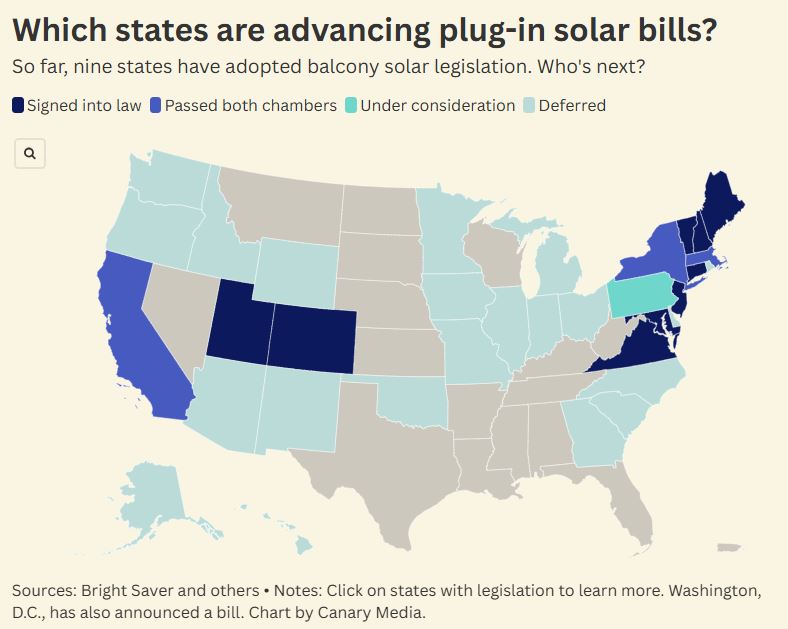
The above map is set to keep changing in the coming months as state legislatures that deferred their measures start new sessions and get back to work.
Still, even if you do live in a balcony solar–supporting state, you can’t simply run out to an Ikea to buy panels like you can in Germany. Just a few vendors are selling plug-in panel kits in the U.S., given the nuances of state and federal electrical codes. Only time will tell if American solar makers decide to get in the game — and which state will be the next to join the plug-in panel crew.
Bipartisan love for a nuclear renaissance
America is coming around on nuclear power. Case in point? Both the Trump administration and Democrats in California are backing the industry’s resurgence.
This week, the Trump administration closed its third loan to help a shuttered nuclear power plant fire back up, offering up to $1.9 billion to NextEra Energy as the firm restarts Iowa’s Duane Arnold Energy Center.
Meanwhile in California, leaders are rethinking the state’s ban on reactor construction and considering whether to stop its only operational nuclear plant from shutting down in the first place. The Diablo Canyon plant was supposed to cease operations in 2025, but California lawmakers already extended its life once, through 2030, and may let it run through 2045. The effort has support from the Trump administration, too, with the DOE awarding utility Pacific Gas & Electric $271 million to help it keep Diablo Canyon operating.
Carbon capture finally moves forward in Europe
Two major carbon capture facilities came online in Europe this week — big steps forward for an industry that has floundered around the world.
The first facility, Europe’s largest of its kind, opened at Yara International’s ammonia plant in the Netherlands. The system will capture and liquefy as much as 800,000 metric tons of carbon dioxide each year, which will be transported and stored beneath the seabed off Norway. A second, smaller carbon capture setup meanwhile opened in Germany. Cool Planet Technologies built the facility at a cement plant owned by materials giant Holcim, where it’ll capture as much as 10,000 metric tons of carbon dioxide annually to be reused in other industries.
Still, despite these wins, carbon capture firms have a long road ahead as they grapple with high costs, environmental and landowner opposition, and doubts about the tech’s viability as a climate solution.
On the bright side: The U.S. solar industry installed 11.4 GW of capacity in the second quarter of the year, up 43% from the previous quarter and 45% from a year earlier as the industry raced to take advantage of soon-to-expire federal incentives. (SEIA)
Clean spending falters: The pace of global investment in cleantech is leveling off after years of steady expansion, with spending dropping 17% in the first half of 2026 compared to the same period last year. (Clean Investment Monitor)
Bad news for batteries: The Trump administration’s vague executive order cracking down on foreign-made grid components could pose problems for the U.S. battery storage industry, which has thrived despite federal clean energy attacks. (Canary Media)
Look who’s back: Global coal demand is on track to rise again this year as war in the Middle East shakes up oil and gas markets and a powerful El Niño increases the need for cooling power. (IEA)
Lost in translation: A new poll finds that 57% of American voters say renewable energy advocates exaggerate just how cheap wind and solar power generation has become — but less than a third cite clean energy as a driver of higher power bills. (Heatmap)
Virginia’s climate choice: While Virginia hasn’t backtracked on its ambitious emissions goals, unlike some other states, a top utility’s plans for a major gas plant could make meeting the targets impossible. (Canary Media)
Company and utility execs called it the nation’s biggest battery, but details are scant. A July satellite image shows 720 Tesla Megapacks at the controversial site.
Elon Musk’s SpaceXAI has built what may be the biggest battery in the U.S. at its controversial Memphis AI computing hub.
The exact size of the battery is unclear. Canary Media counted 720 Tesla Megapack battery containers visible on the grounds of the Colossus 2 data center in satellite imagery dated July 11. That would equate to 2.8 gigawatt-hours and between 720 megawatts and 1,400 MW, depending on which Megapack model they are.
On Aug. 20 in Memphis, SpaceXAI energy and data center developer Riley Trettel called this battery the biggest in the nation in remarks to the board of the Tennessee Valley Authority, the federal utility that produces power for 10 million people across the Southeast, according to audio of the meeting obtained by Canary Media.
Trettel described the facility as having 3.3 GWh of storage, “enough to power all of Memphis for two hours.” He said it was not yet connected to TVA’s grid, but could be later this year if the TVA board granted approval. The board approved a direct hookup to the TVA grid for SpaceXAI later that day.
Then, on Sept. 2, the CEO of the municipal utility Memphis Light, Gas and Water, Doug McGowan, corroborated the “biggest battery” claim at a solar and storage industry conference in Chattanooga. McGowan is in a position to know, as MLGW supplies utilities to the SpaceXAI facility. But he described the installation somewhat differently.
“It’s the world’s largest supercomputer today, but it’s also got the world’s largest grid-connected battery system,” McGowan said. “I think it’s 2,000 MW of batteries behind the meter that they have to help as a backup when they have to curtail.”
The 720 Megapacks installed at the Southaven site as of July 11 would already put the battery among the largest in the nation. If it has grown since — either to the 2 gigawatts of instant discharge capacity noted by McGowan or to the 3.3 GWh cited by Trettel — it would be the largest of its kind in the country.
Currently, the largest known grid battery operating in the U.S. is at the Edwards & Sanborn solar plant in Kern County, California, with more than 1,066 MW and 3,287 MWh.
The Memphis utility’s communications team declined to clarify the official size of the battery its CEO had described, instead referring inquiries to TVA and SpaceXAI. TVA declined to comment on the battery and referred questions to SpaceXAI. SpaceXAI has not responded to requests for comment.
Musk knows energy storage as well as anyone, since his other company, Tesla, builds some of the most popular grid and home battery products on the market.
XAI bought $430 million worth of Megapacks last year, Tesla acknowledged in a January filing with the Securities and Exchange Commission. XAI was acquired by SpaceX in February, and the combined company bought another $405 million worth of Megapacks in the first half of this year.
A new, more powerful Megapack 3 entered production in early August at Tesla’s Texas factory, after the 720 Megapacks visible in satellite imagery were installed. Tesla redesigned this model to speed up deployment timelines, raising the possibility that significantly more battery capacity could have been installed at Colossus 2 over the last month.
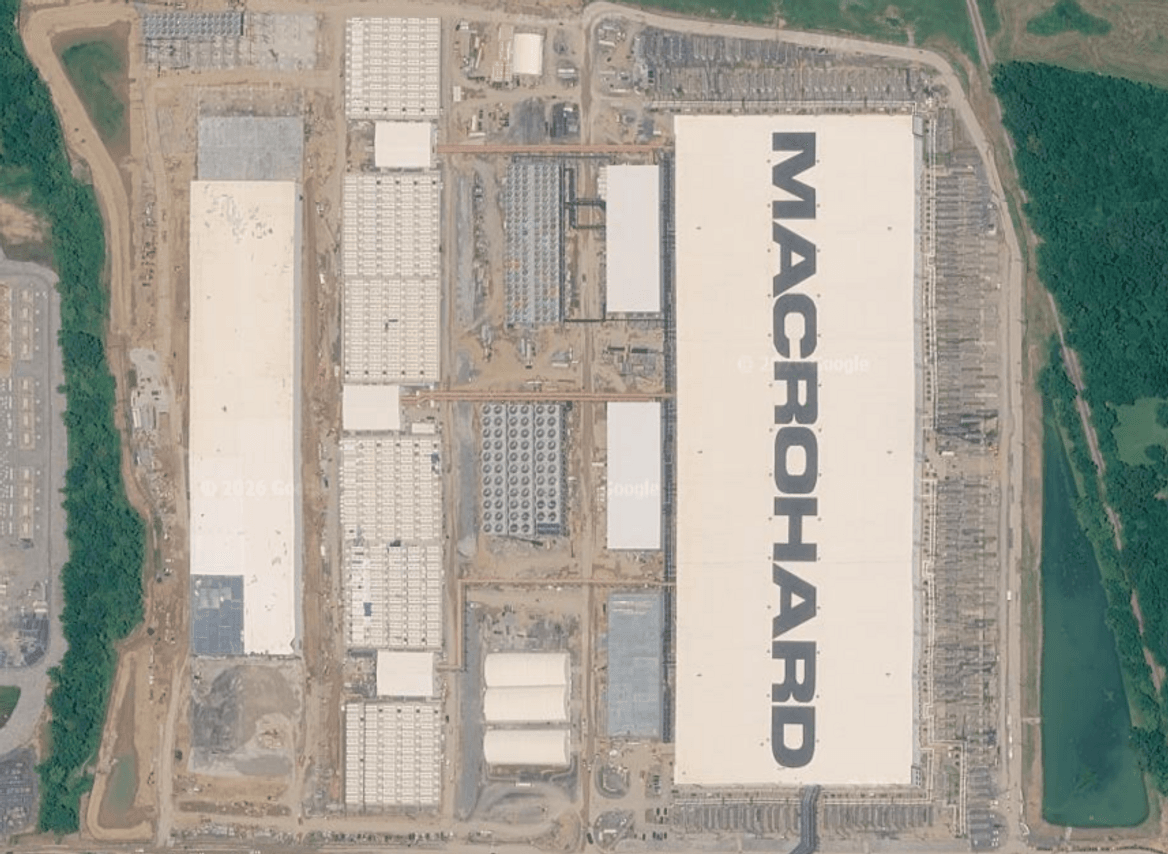
That leaves an unusual vacuum of information surrounding what could well be the largest grid battery installation in the country.
Such projects normally take years to develop, and have to go through a community outreach process to secure permits, not to mention a utility-led contracting process to guarantee revenue for the completed power plant. But SpaceXAI went ahead without any announced utility contract, and regional storage industry leaders heard about the battery for the first time at the August TVA board meeting.
SpaceXAI has demonstrated its willingness to brush aside typical procedures in the headlong rush to “win” the AI arms race. The company previously installed a fleet of mobile gas generators to run its Memphis computing infrastructure before sufficient grid supply became available.
SpaceXAI has been operating temporary gas generators without air permits for Colossus 2, on the grounds that they are mobile; 69 units were active there as of July. These generators, which sit on flatbed trailers but run in the same location day after day, produce harmful air pollutants that especially affect nearby areas, including the predominately Black neighborhood of Whitehaven. The Boxtown neighborhood dealt with this issue earlier as XAI got Colossus 1 up and running.
The Southern Environmental Law Center has sued to stop the unpermitted air pollution on behalf of the community, a lawsuit that is still pending.
Batteries, which are being plugged into the U.S. grid at a record-busting pace, don’t combust fossil fuels; they store electricity when it’s plentiful and deliver it when needed. SpaceXAI may be using them as a kind of filter for the electricity flowing into the computers, so that momentary dips and jumps in AI consumption don’t damage the generators or the local grid system.
But it’s unclear whether the massive battery will lead SpaceXAI to reduce its use of mobile generators. If the batteries don’t have access to sufficient grid power, they also could charge up from the generators in an islanded microgrid setup, which would incur further emissions.
The U.S. grid is struggling to keep up with the expected demand growth from AI computing, and data center developers eager to get online ASAP are increasingly looking to large batteries to help speed up interconnection.
The idea is simple: For most of the year, the power system has ample capacity to meet new demand from data center projects. The problems arise on the days when demand spikes, like during a heat wave or a snowstorm.
Big batteries can help during these demand peaks. When electricity use surges, the facility can tap its batteries for a few hours to alleviate the strain on the grid. That’s part of the plan with SpaceXAI’s battery, which was approved for interconnection through a “power interruption” program run by MLGW, McGowan said at the conference early this month.
“They actually have behind-the-meter … generation and storage that can meet all of their load, so that they can actually successfully come off the grid for four hours in order to curtail, so that nobody else has to,” McGowan said.
This was a precondition for hooking up service to the data center, he said. Other states and grid operators have labored to define new “large load tariffs” in order to silo hyperscalers from other grid customers; some states are looking to curtail power to data centers in moments when the grid is under strain. But in TVA territory, local power companies can swiftly implement solutions to the fast-moving AI demand challenge without waiting for yearslong approvals from state or federal regulatory commissions.
“We kind of proved the model here before the ratepayer protection plan was in place,” McGowan said, referring to the White House–led pact to encourage AI companies to fund their own infrastructure upgrades and avoid pushing costs onto the general public.
Other developers have signed contracts for similar projects. Aligned Data Centers will come online in Oregon several years early by paying the utility to build a battery for peak capacity. Google signed up a whole portfolio of solar, wind, and short- and long-duration batteries to run a Minnesota data center.
SpaceXAI’s massive battery could eventually have a beneficial effect on the broader TVA system. TVA has repeatedly stated its desire for more firm, dispatchable power to meet peak demand for the growing population, manufacturing base, and AI industries. TVA identified battery storage as a growth opportunity in its recently completed long-range energy plan, spokesperson Patrick Cassidy noted; the TVA board approved that plan at its August meeting.
“We’re just beginning to tap the potential of battery storage in the Tennessee Valley,” said Gil Hough, executive director of the Tennessee Solar Energy Industries Association. “A project this large shows what’s possible — and it could be a real catalyst for utilities, solar developers, and other energy companies to think much bigger about how storage can help meet the region’s rapidly growing electricity demand.”
TVA operates a large fleet of nuclear and coal plants, which cannot nimbly ramp up and down in response to demand. They keep producing through the night, when most people are sleeping, creating periods of electrical surplus, in contrast to the energy constraints of afternoons and evenings. Batteries could shift energy between those times, as well as store the region’s growing solar generation for use at high-demand hours.
TVA has begun to seek out batteries to inject power when it’s most needed. In April, it signed a contract with pioneering storage developer Plus Power for a 200-MW/800-MWh battery in Jackson County, Alabama. That project followed the regular order of business, in which the utility signs a contract for its services, and then the developer moves forward with construction, which is expected to wrap up in 2029.
Trettel’s remarks to the TVA board suggest SpaceXAI is open to offering up the massive battery installation as a contracted grid resource — meaning the privately constructed batteries could help deliver peak capacity to the broader TVA network, and get paid for it. Should that offer bear fruit, the unbridled rush of AI infrastructure construction would produce a knock-on effect of vastly accelerating the deployment of batteries on the grid.
Batteries are taking the energy sector by storm, whether to power vehicles or boost the grid. Most are made, and deployed, in China.
Batteries are taking center stage in the energy world.
Battery deployment, both to power electric vehicles and to store electricity for the grid, has skyrocketed in recent years. Last year, more than 1.5 terawatt-hours of batteries were placed into service around the world — about 10 times more than the total in 2020, per a recent International Energy Agency analysis.
It’s astounding growth, made possible in large part because China has scaled up the manufacturing of the tech and driven the price down as a consequence. Lithium-ion batteries in 2025 were 93% cheaper than they were in 2010 and a respectable 36% cheaper than they were even five years earlier, in 2020.
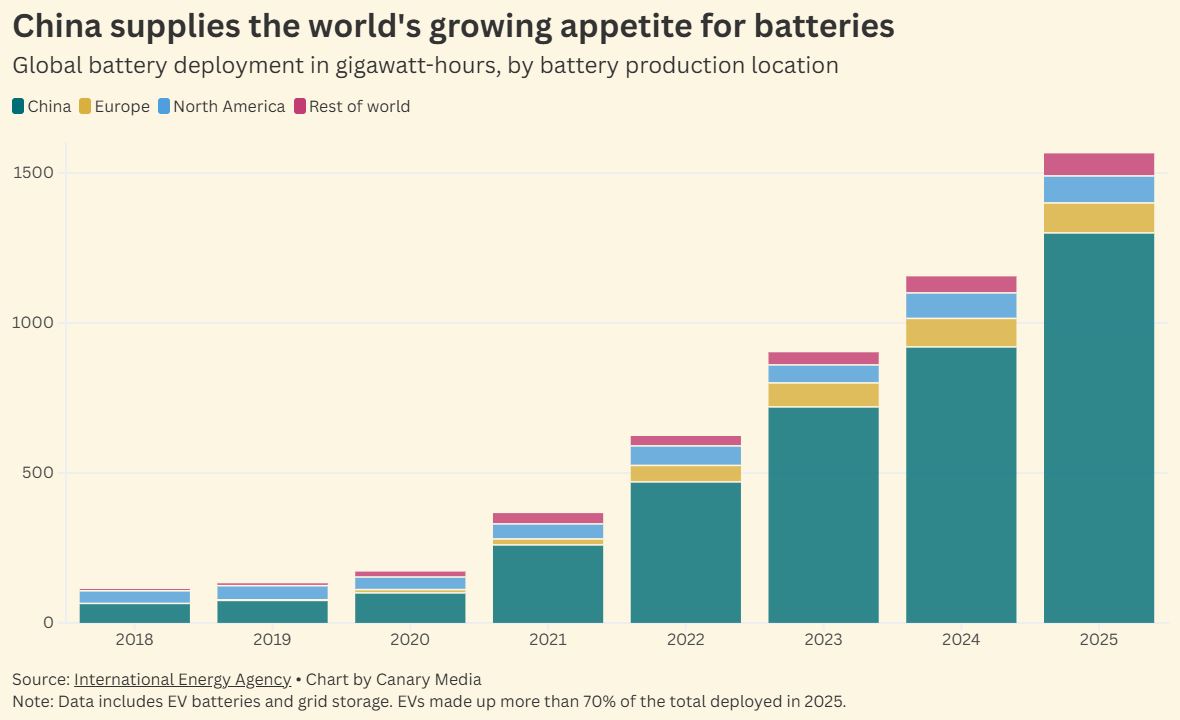
Most of these batteries are deployed within China, and most are used to power electric vehicles. But grid storage is growing particularly fast: Globally, annual deployments grew by a factor of nearly 19 between 2020 and 2025. The trend isn’t stopping; energy research firm BloombergNEF thinks annual deployments will double by the end of the decade.
The fact that China makes such a large percentage of the batteries that increasingly power the cars and grids of the world makes certain governments nervous.
The Inflation Reduction Act tried to mitigate those concerns in the U.S. by incentivizing companies to ramp up home-grown manufacturing, and the domestic batterymaking sector has since begun to flourish. Despite gutting much of that Biden-era climate law, President Donald Trump left incentives for most cleantech manufacturing and for grid storage deployment in place while also making a rash of protectionist moves that could push developers harder toward domestic batteries.
The European Union, perennially concerned about energy security, also wants to shore up its local battery production. It aims to meet 90% of its own domestic battery needs by 2030, but is not on track to hit that target.
Still, it’s hard for either region to compete on price, even with incentives in place. China’s economies of scale — and its accumulated know-how — are potent forces. Plus, the nation plays an outsized role in refining and processing the minerals needed to make batteries.
With that in mind expect two things to remain true: Global battery adoption will keep growing — and China will keep making most of those batteries.
The firm just wrapped work on a heating and cooling system for a Boston office. It says its rig makes drilling cheaper, quieter, and less water-intensive.
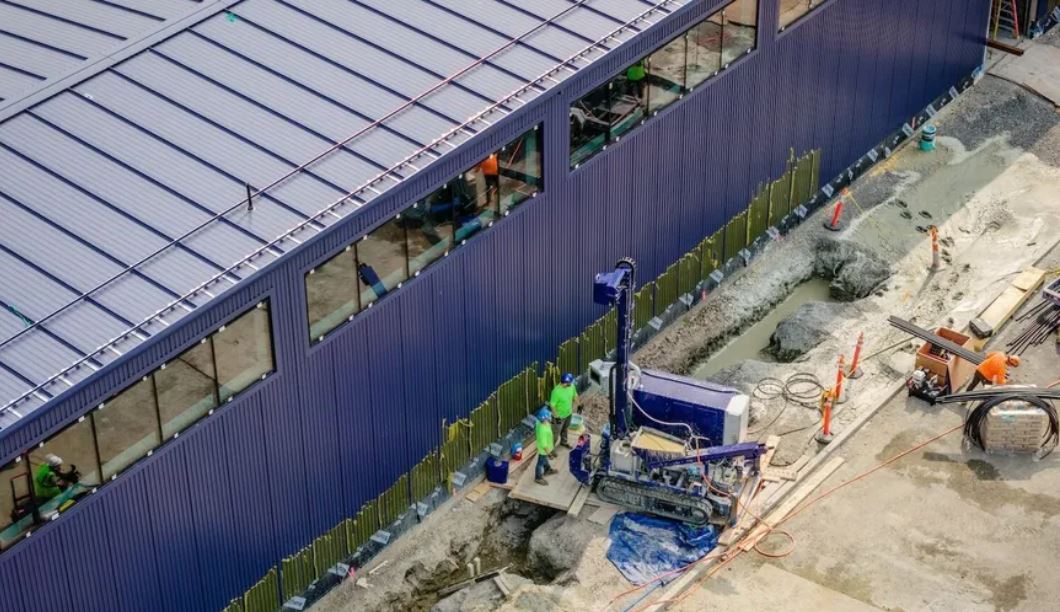
Dig Energy, a startup on a quest to vastly improve geothermal drilling, has completed its first commercial project, digging seven boreholes for a geothermal heating and cooling system at the headquarters of Boston general contracting firm Suffolk Construction.
Dig first stepped into the public eye almost exactly a year ago, when it announced a $5 million funding round after some five years of developing its technology behind the closed doors of a barn in New Hampshire. At the same time, Dig was selected to participate in Boost, an accelerator program run by Suffolk Technologies, the venture capital affiliate of Suffolk Construction.
Dig’s innovation: a rig purpose-built to drill geothermal boreholes with less noise, less water usage, and far lower cost than conventional drilling equipment.
Geothermal systems, which use all-electric heat pumps to tap into thermal energy stored underground, are widely hailed as the most efficient way to warm and cool buildings. However, the upfront price of accessing this clean source of energy can be a major barrier. The expense of installing a geothermal system can be up to five times that of an equivalent air-source heat pump. Only about 1% of buildings in the United States use geothermal systems for heating and cooling, estimated Dig Energy co-founder and CEO Dulcie Madden.
Dig says its technology could upend this math, cutting the cost of drilling by up to 80% as compared to conventional geothermal drilling. The companies declined to share specific numbers, but Dig “put some early proof points out there that, from a cost and schedule perspective, they’re going to be very competitive in the market,” said Parker Mundt, a partner at Suffolk Technologies.
In the standard process, the borehole is drilled first, typically with a metal bit or compressor, and shored up along the way with a casing to prevent collapse before a heat exchange pipe is inserted.
Dig’s system, by contrast, uses a high-pressure nozzle that sprays water at 10,000 pounds per square inch to bore through soil and rock. The approach was explored by the oil and gas industry decades ago, but never gained traction because it didn’t increase productivity in those sectors, Madden said. She and her partners saw an opportunity to adapt the idea for geothermal and spent years honing the technology.
“It’s a known industry practice that’s being adopted in a novel way for the first time,” Madden said.
The team engineered a drill string — the long vertical pieces that connect the surface equipment to the drill tip — that stays in the ground once the hole is complete, becoming the heat exchanger that transfers thermal energy to and from the surrounding earth. The nozzle stays behind as well; it was designed to be cheap enough that it is still economical to use a new one each time.
That innovation means the hole can have a smaller diameter than in conventional geothermal systems, because no extra room is needed for casing and the insertion of the heat exchanger. This process reduces debris and, perhaps counterintuitively, even water usage, because standard drilling uses large amounts of water to lubricate and cool the drill bits, as well as to turn displaced earth into mud that can be more easily removed from the hole.
Drilling at the Boston jobsite last month used one-tenth the water that the conventional drilling would’ve used and created 75% less material to be carted away, Madden said.
The process was also much quieter than standard drilling operations, which Madden likened to a demolition site. Dig’s equipment operated at such a low volume that workers could hold a conversation right near the rig and people in nearby buildings couldn’t hear a thing, she said. Also, the rig’s small size — about the same footprint as a parking spot, Mundt said — made it easy to maneuver in a dense urban environment.
“You can have people working around the rig without any disruption,” Mundt said.
Dig has several more jobs lined up after its inaugural success; the company is booked until mid-summer 2027, Madden said. And work is underway on a new version of the rig that aims to cut down on drilling time, she said.
Already, though, Dig’s performance on its first outing bodes very well for its future, Mundt said.
“The results from this initial commercial project at our headquarters were incredibly exciting for us,” he said.
The solar-plus-storage project faced no opposition despite growing pushback to clean energy in the state — likely because of its brownfield location.
Clean energy scored a rare win in Ohio last month when state regulators unanimously approved a permit for 149 megawatts of solar and 149 MW of battery storage at the Hamden Energy site in Vinton County, located in the southeast quadrant of the state.
In contrast to most of the state’s solar permitting cases, no parties in the case opposed the project, proposed by developer Recurrent Energy, at the Ohio Power Siting Board — largely because it will be built on reclaimed coal mine land.
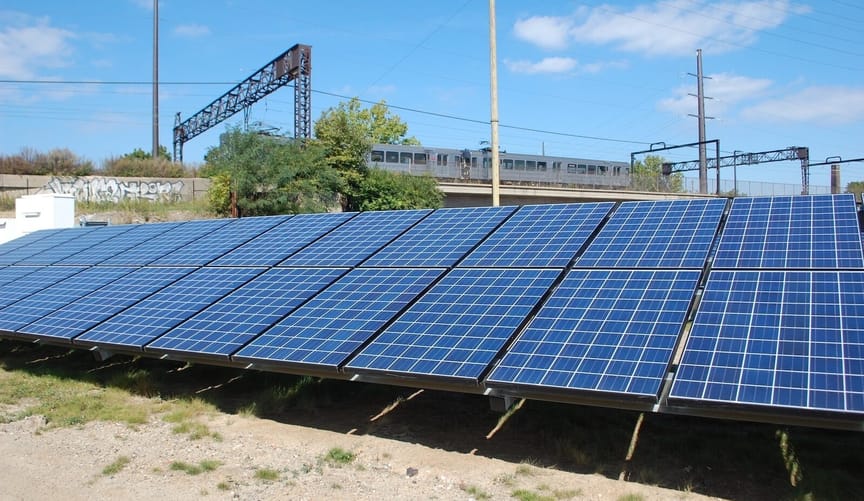
“Developing a solar project on reclaimed land is an excellent opportunity to harvest another one of the area’s abundant resources to power Ohio while providing supplemental tax revenue to support a legacy energy community,” said Ali Trunzo, a senior development manager for Recurrent Energy.
Like much of the rest of Appalachian Ohio, Vinton County has a history of hosting extractive industries — particularly coal, iron, and clay — whose production has plummeted over the last century. Although its economy has grown over the past 20 years, roughly 19% of the county’s residents live in poverty.
The county’s board of commissioners did not block the project, which they could have done under a 2021 law that erected extra hurdles for solar and wind power, but not fossil fuel generation.
Opponents of other solar farms in Ohio have frequently raised concerns about projects taking farmland out of use, although solar occupies less land than golf courses in the state and can coexist with some farming practices.
Projects on former mine lands and industrial brownfields, like Recurrent’s, tend to draw less opposition, although they have their trade-offs. Namely, they can be more expensive to develop than greenfields because of conditions at the location and the need to accommodate remediation, according to RMI, a clean energy think tank.
Trunzo declined to provide cost information about Recurrent’s Hamden Energy project, although she noted that specialized methods and equipment may need to be used to adapt to the site’s soils and terrain.
The roughly 25 people who commented in the case docket or spoke at a June 10 local hearing voiced mixed opinions. The most common concern was whether ongoing reclamation would be finished before construction started on the solar and battery project.
That remediation work is the responsibility of Cheyenne Resources, which holds the surface mining permit for the property, confirmed Andy Chow, a spokesperson for the Ohio Department of Natural Resources. Recurrent Energy has agreed to begin construction only after reclamation is done.
The Recurrent project is not the first coal-to-solar farm greenlit by the state. Regulators approved the Vinton Solar Energy Center in 2018, and the project remains under construction by developer Invenergy. Other states are siting solar at former mine lands as well.
More projects will likely follow in Ohio because of recent policy changes.
Under a 2025 law, House Bill 15, former mine lands and industrial brownfields are eligible for treatment as priority investment areas. Ohio has more than 70,000 acres that might fit that definition, RMI data shows. Rules from the Ohio Department of Development for designating such places took effect two months ago. Agency spokesperson Brian Bohnert told Canary Media the state has started to identify its first areas under the program. One of the two sites designated through late August includes both former coal mine land and an industrial site.
“The reuse of former mining land for new energy production is a win-win for Ohio consumers and the environment,” said Rebecca Mellino, associate director of climate and energy policy for The Nature Conservancy.
The Nature Conservancy’s view, Mellino said, is that HB 15 not only creates priority areas but also lets counties host solar on former mine sites and brownfields despite exclusions that might otherwise apply under Senate Bill 52, the 2021 enactment that added hurdles for renewable energy developments.
In many cases, solar energy is cheaper and can come online quicker than natural gas generation. Yet as projections call for the state’s electricity demand to grow, clean energy developers continue to face bans or project vetoes under SB 52. Beyond the statute’s terms, state regulators have often blocked projects on the basis of unanimous local government opposition, regardless of whether opponents’ arguments were based on opinion or grounded in fact.
A bill passed by the Ohio Senate this spring could make it even harder, if not impossible, for many solar and wind projects to get built. SB 294 is now in the Ohio House of Representatives.
“Projects like Hamden Energy are vital to bringing sustainable, affordable, and dependable energy online,” said Chris Tavenor, general counsel for the Ohio Environmental Council, which was a party in the case.
But, Tavenor cautioned, “without reform to the energy siting process, energy costs will remain high, and we will continue to see energy prices rise along with demand. We acknowledge this win, while also recognizing that we have much more work ahead.”
NextEra Energy is one of three U.S. energy companies to win backing from the Department of Energy to revive shut-down nuclear plants to meet soaring power demand.
A third shuttered U.S. nuclear power plant is set to attempt a comeback with hefty support from the federal government.
On Tuesday, the U.S. Department of Energy said it closed a loan of up to $1.9 billion to NextEra Energy to help finance the restart of the Duane Arnold Energy Center in Iowa, which shut down six years ago. The company aims to begin producing electricity from the 615-megawatt power plant by early 2029.
The loan was finalized by the department’s renamed Office of Energy Dominance Financing, known as the Loan Programs Office under past administrations. The office previously closed a $1 billion loan to restart Constellation Energy’s Crane nuclear plant in Pennsylvania and a $1.52 billion loan to revive Holtec International’s Palisades plant in Michigan.
All three of these decades-old nuclear plants shut down in recent years owing to the high costs of repairing and relicensing the facilities. Competition from natural gas and increasingly low-cost renewable energy also soured operators and utilities on atomic power.
But with electricity demand surging across the U.S., due in large part to the data center boom, power plant owners are looking to give their mothballed facilities a second chance — something that’s never been done before in the U.S.
Holtec’s Palisades plant is poised to become America’s first nuclear restart as early as this year. The firm has hit several snags along the way on the first-of-a-kind project, causing it to miss its original target of early 2026. But in July, it reached a “watershed moment” by completing all major renovations for its reconstruction of the plant’s single 800-MW reactor. Last week, Holtec said it achieved another historic milestone: beginning the process of loading nuclear fuel into the reactor vessel. It faces a contractual deadline to complete the restart by March 2027.
If Holtec is successful in getting Palisades back online, it could help pave the path for reviving the country’s other shuttered reactors.
NextEra Energy, for its part, is still working to secure licensing approvals from the U.S. Nuclear Regulatory Commission to return Iowa’s only nuclear plant to service. Last fall, the company signed a 25-year agreement with Google to supply electricity from Duane Arnold, which will help power the tech giant’s growing cloud-computing and AI infrastructure in the state.
“By bringing new generation online to serve new demand, we can strengthen the grid, create hundreds of good-paying jobs and help ensure Iowa families and businesses are not asked to bear the costs of growth,” John Ketchum, president and CEO of Florida-based NextEra Energy, said in a Tuesday news release.
While federal loans for nuclear restarts began under the Biden administration, the Trump administration has leaned heavily into supporting nuclear, even as it cancels funding and blocks development of other clean energy sources. In June, the Office of Energy Dominance Financing announced a $17.5 billion loan initiative to help energy companies buy nuclear equipment and build 10 new large-scale reactors in the next few years.
The moves come amid growing bipartisan support in the U.S. for nuclear power, which can provide carbon-free electricity around the clock. Several Democratic-led states with moratoriums on nuclear power have in recent months walked back their restrictions as they seek low-emission sources of electricity that can supplement solar and wind and reduce strain on the grid.
The Duane Arnold reboot is expected to supply enough power for nearly 500,000 homes and create nearly 1,500 jobs during construction, while supporting over 400 permanent positions during operations.
“New nuclear development and the restart of Duane Arnold will meet our growing energy demand while also providing hundreds of good-paying jobs throughout the state,” Iowa’s Republican Gov. Kim Reynolds said on Tuesday.
Roanoke City Public Schools is building the state’s first solar-plus-storage systems to keep emergency shelters going during extreme weather and cut down on costs.
As climate change intensifies, communities around the country are looking for ways to better prepare for extreme weather, from ice storms to heat waves. In Roanoke, Virginia, nestled in the Blue Ridge Mountains, that starts with the schools.
For years, the Roanoke City Public Schools district has been installing solar panels to lower electricity bills, minimize its carbon footprint, and teach students about clean tech. Now, the district is set to be the first in the state to invest in storage, with a solar-and-battery-powered microgrid at each of its two high schools, which double as official disaster shelters.
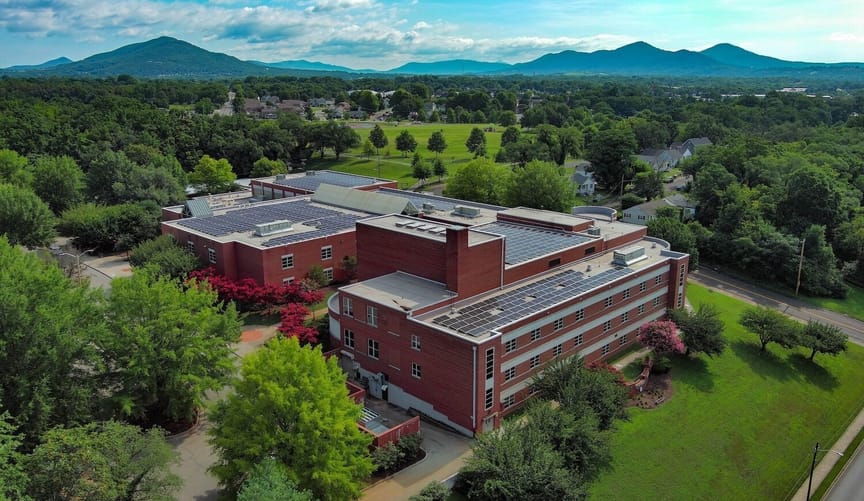
“They’ll run on the battery until such time as it’s discharged,” said Jeff Shawver, senior director of school plants for Roanoke City Public Schools. “Then the diesel generators are cut on. Then, the next day, the sun comes up, and you start charging the battery again. It just keeps the cycle going.”
Due to be installed by the end of the year, the storage systems will be among just a handful of batteries at school buildings around the country, according to Generation180, a national nonprofit headquartered up the interstate in Charlottesville. The dearth of sustainable microgrids at schools is problematic in the wake of natural disaster, since they account for 60% of all FEMA-designated relief shelters in Virginia and half of those nationwide.
“Schools are also the hubs where citizens vote, where groups gather, and now increasingly where neighbors need to huddle or seek shelter during emergencies,” said Tish Tablan, senior program director at the nonprofit and a former teacher. “So they’re just critical parts of our communities.”
The microgrid is funded partially by a grant from the state’s Department of Emergency Management and a donation from commercial solar installer Secure Solar Futures. “The grant has been around for a few years,” Tablan said. “They are the first to utilize it for a solar microgrid instead of diesel.”
The school district’s foray into batteries fits with its track record on solar. Serving some 14,000 students, the district leads the state on solar energy installations among schools, with nearly 9.4 megawatts planned for or already atop 29 rooftops and other sites.
The solar arrays are poised to cover 44% of the schools’ energy needs, cutting the school system’s electric bills by more than $22 million over 35 years. Because many installations come with new roofs, they’ll also help the district avoid $24 million in capital costs.
“We’re going to end up with most of our schools with at least a 25-year warranty on the roofs,” Shawver said. “For any facility manager, trust me: That’s a happy day for that person.”
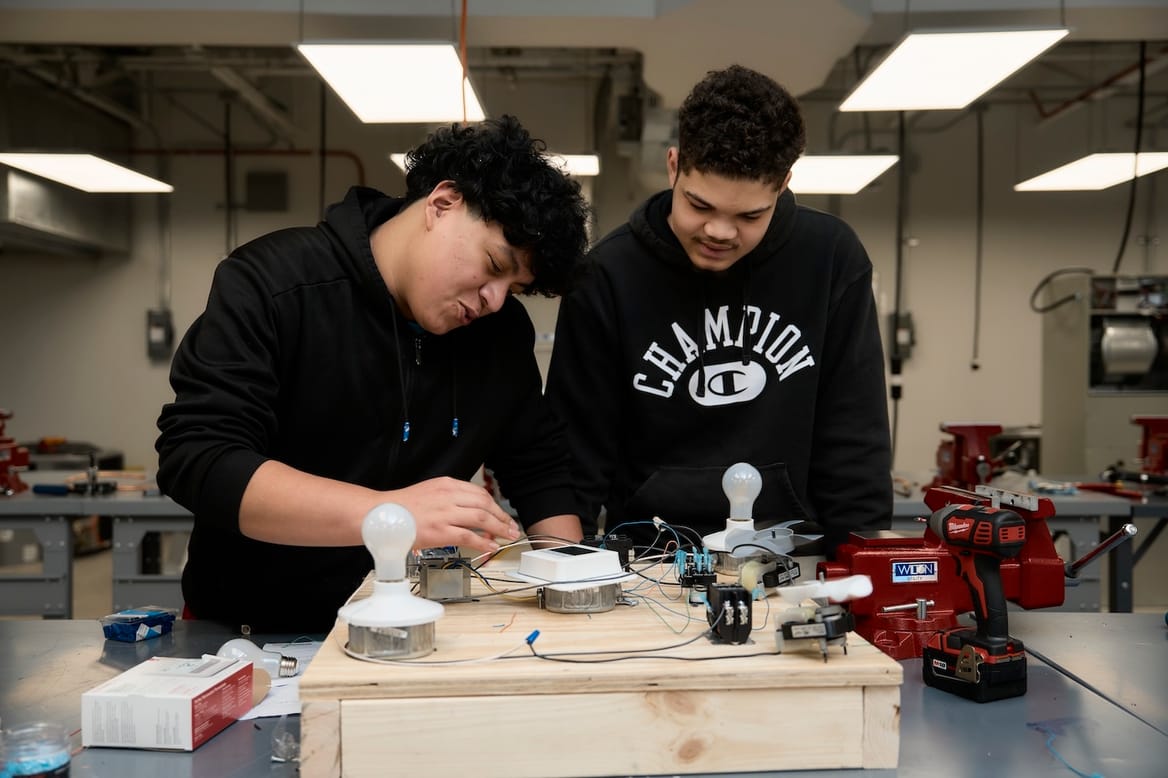
The installations also enable hands-on training for teachers and students in clean energy careers and technical educaton, and help minimize its climate footprint.
“It all works in tandem,” said Claire Mitzel, communications director for Roanoke City Public Schools. “We want our schools to be safe. We want them to be sustainable. We want our students to have access to high-quality learning environments.”
With their vast square footage, ample flat roof space, and relatively low energy needs after the sun goes down, schools are well suited for solar arrays. But installations didn’t really take off in Virginia until this decade, when schools got the ability to buy power from third parties other than investor-owned utilities, as well as the chance to sell excess solar power back to the grid.
“That’s what makes it doable,” said Shawver, who began negotiations with utility Appalachian Power back in 2018. “It’s been a long journey for us.”
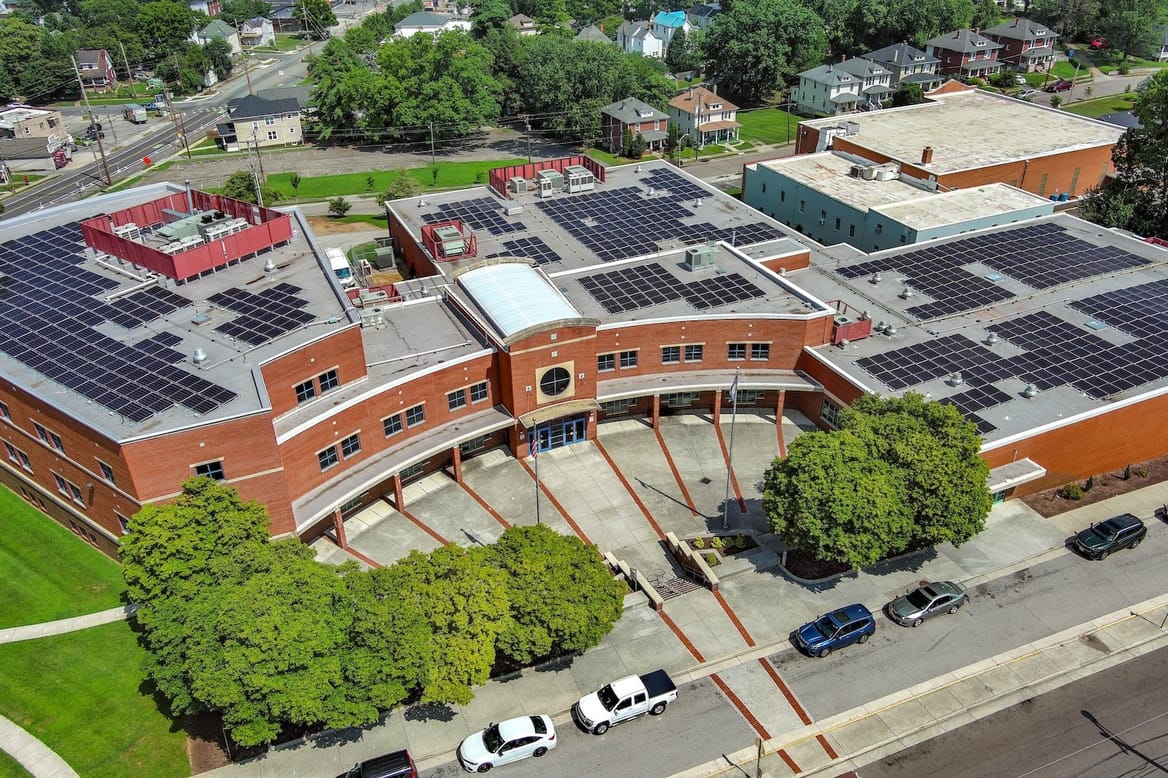
Today, Virginia’s K–12 schools rank 8th in the nation for solar power capacity, according to Generation180, with 83 megawatts on 236 campuses — the vast majority of installations owned by third-party companies. Nearly half the state’s solar-powered schools came online after 2020, when the solar-school-friendly policies were cemented in the Virginia Clean Economy Act.
Still, there’s plenty of room for growth — especially as electricity rates rise in the data center capital of the world. Generation180 data shows that California is far and away the national leader when it comes to solar on schools, with almost 900 megawatts. New Jersey, whose population is similar to Virginia’s, has the second-most school-solar capacity, with over 300 megawatts — three and a half times the amount in Old Dominion.
State leaders could take their cues from California, which requires all new school buildings to be equipped with solar and storage. And they could provide more funds, as Maryland, Massachusetts, and Pennsylvania do, for schools to invest in solar arrays.
But even without such support, Virginia schools have a big opportunity to install more sustainable microgrids. Tablan notes that the state grant program that Roanoke is using to help pay for its storage system is taking applications now.
“They just opened up a new round of funding,” she said. “They have $2.5 million available for fiscal year ’27.”


.svg)
