

 Back
Back
As the U.S. grid strains to meet rising demand, 31 projects across 26 states get federal funds for high-tech cables, sensors, and controls to boost capacity.
For years now, grid experts have been trying to get utilities to deploy advanced transmission technologies that can squeeze more capacity out of overstressed U.S. power grids. On Thursday, the Trump administration put a $1.9 billion down payment on 31 projects that will help greatly scale up these underutilized solutions.
The funding comes from the Department of Energy’s $1.9 billion SPARK grant program, created last year to repurpose money obligated by Congress in the 2021 bipartisan infrastructure law. SPARK represents a rare example of alignment between the Trump and Biden administrations on energy policy, even as Trump appointees have blocked billions of dollars for other Biden-era grants.
But Republicans and Democrats alike want to reform energy permitting and expand and strengthen the nation’s transmission grid. In a Thursday statement, Energy Secretary Chris Wright said the grants will “get more out of the infrastructure we already have, move more electricity across the grid, and help deliver affordable, reliable, and secure power that will fuel American prosperity for decades to come.”
Awardees range from projects that combine technology upgrades with multibillion-dollar grid expansions to ones involving smaller-scale technology deployments. Participating utilities have pledged a collective $3.35 billion in matching funds, bringing total investment to $5.25 billion.
Recipients include major power providers across 26 states such as American Electric Power, CenterPoint Energy, Duke Energy, Eversource Energy, Rocky Mountain Power, and PPL Electric Utilities. Awards were also issued to four public power utilities and rural electric cooperatives in Arizona, New Mexico, and North Carolina.
Many of the projects will use the funds to deploy advanced conductors — newer power cables that are lighter, stronger, and capable of carrying more power than the traditional aluminum-and-steel cables used across most of the grid. Stringing these cables along existing transmission corridors can increase capacity for moving electricity long distances without having to build new towers or tear down and replace old ones.
Another technology many grant recipients will deploy is dynamic line rating — systems that can assess the true capacity of power lines from hour to hour, enabling utilities to push more power through them. This can include devices attached to power lines, sensors on transmission towers that monitor lines via optics and electromagnetics, and software-only approaches.
Taken as a whole, the DOE grants will greatly boost the use of technologies that have already proved their capability in pilot projects, some of which stretch back more than a decade.
“The experience that will be developed through these grants will be phenomenal,” said Julia Selker, executive director of the trade group Working for Advanced Transmission Technologies Coalition. “Not only is each project improving reliability, saving money, and enabling economic development — each will also catalyze innovation across the utility sector.”
Studies from the DOE, utilities, grid research organizations, and clean energy think tanks have found that advanced transmission technologies can deliver benefits far greater than the cost of deploying them. In many cases, given the time and expense of building new grid infrastructure, these technologies are the only near-term solution to grid congestion or the lack of capacity to move power across regions.
Still, adoption has been slow. That’s partly because utilities are leery of new technologies and partly because they’re not incentivized to choose alternatives to making grid investments, on which they earn regulated profits.
At the same time, utilities are under pressure to control rising costs of upgrading and expanding their grids, which are driving up already high customer rates. That’s why federal funding is so helpful, Selker said: “It’s a great deal for utility ratepayers to have the taxpayer split the cost.”
Federal grants also help put to rest arguments over how the cost of new projects should be shared across the multiple utilities and regions that benefit from them, she noted. That’s an important consideration for the biggest projects on the DOE’s grant list: a $1.2 billion project headed by the Colorado Energy Office and an $832 million project by the Oklahoma Office of Management and Enterprise Services. The DOE has awarded a $250 million grant to each project, which are both meant to expand capacity to share power between the Eastern and Western U.S. grids.
Former Minnesota Gov. Tim Pawlenty took the helm of the Solar Energy Industries Association this summer with a mandate to build durable political power.
Tim Pawlenty was a two-term Republican governor of Minnesota and made a run in the 2012 presidential primary, which ultimately went to Mitt Romney. Now, Pawlenty has reemerged on the national political scene as the leading evangelist for solar energy, while the industry seeks to recover from a stinging political defeat.

In June, Pawlenty took over as president and CEO of the Solar Energy Industries Association, the largest solar-specific trade group in the U.S. He steps into the job at a uniquely turbulent moment in the industry’s history. Solar developers had revved up to take advantage of the supportive policies in President Joe Biden’s 2022 Inflation Reduction Act, only to have Republicans win back control of D.C. in 2024 and gut the climate law in last year’s One Big Beautiful Bill Act.
“The current state is relatively bleak,” Pawlenty said of solar’s political clout in Washington. “But … nothing stays the same in politics, and there’s hope in what’s to come in the future.” He was speaking during my onstage interview with him Tuesday at Canary Media’s Climate Week NYC summit on the energy transition in rural America, one of Pawlenty’s first public appearances in his new role.
Despite the setbacks in Congress, solar is far and away the biggest source of electricity getting built in the country right now, and has been for several years. Factor in the “unbelievable exploding demand for energy in our country,” and the business fundamentals for solar and storage have never looked stronger. But, Pawlenty noted, state and federal governments still stand between the sector and what can get built, so the industry has to sharpen its political efforts if it wants to deliver on its enormous potential.
“Eventually, the policymakers catch up to the facts,” he said. “We have really good facts on our side. Some of the old narratives, some of the old spins … are out of date. If you bring policymakers to the current story with current facts, it goes something like this: Solar and storage is the most cost-effective form of energy in the country, without question.”
And while a common Republican critique of the domestic solar industry is that it relies too much on panels imported from China, in fact, the U.S. has nearly eliminated Chinese panels thanks to trade policy and the rapid growth of domestic manufacturing capacity, Pawlenty said.
Besides working to ensure politicians have fresh intel on the state of U.S. energy, Pawlenty wants to push for policies where a strong bipartisan consensus already exists.
“Going forward, we’d like to adopt policies and have politics around solar and storage that are durable,” Pawlenty said. “While it’s very tempting to just say, ‘Let’s roll whenever we can roll,’ I think it’s wise to at least take a half a step back and say, ‘Are we advocating for policies that are likely to survive political turbulence and change?’”
For instance, Pawlenty argued, the industry should push to “turbocharge” domestic manufacturing for clean energy. Indeed, Trump’s budget law kept the Inflation Reduction Act’s domestic manufacturing incentives, even as it cut tax credits for solar installation, and the Trump administration has adopted stricter trade protections on imported solar panels since then. Domestic solar and battery manufacturing has surged in the last four years, but it’s still too early to evaluate the long-term stability of this recent industrial revival.
The solar industry aspires to mass appeal, but its members often get tied in knots of jargon when they try to communicate outside their own ranks. Pawlenty avoids that pitfall by making his case in plain English, and drawing connections between solar and conservative values that don’t typically get floated in climate policy conversations.
“Iran can’t block the sun, and so if you’re into national security, as I am, I like things that Iran can’t block, or North Korea, or China, or Russia, or any of the other folks who want to do us harm,” he said.
Though energy policy gets written in cities, large-scale solar projects get built where there is space. As of last year, 87% of U.S. clean energy generation happened in rural areas of the country, per a Rural Climate Partnership analysis. This buildout has increasingly encountered local resistance in communities concerned about changing uses of legacy farmland, a fear sometimes exacerbated by misinformation that spreads on social media.
As many rural areas consider restrictive rules to limit solar or battery installations, Pawlenty said the solar industry can position itself as a defender of private property rights, supporting policies that allow farmers to develop their own land as they see fit.
“I’m from a farm state — I’ve spent a lot of time in farm areas and with farmers,” he said. “From a conservative standpoint, land rights are pretty important. We want to make sure that those are not lost in the shuffle either, as we talk about what farmers can do with their land as the owners of land.”
Copper’s Charlie 2.0, to be manufactured by appliance giant Miele, comes with a battery that lets homes ditch the fossil fumes without an expensive electric upgrade.
On Thursday, Copper, creator of the first induction stove with a built-in battery, launched the next generation of its superefficient electric range: the Charlie 2.0.
The plug-and-play appliance is designed to make it easier to ditch fossil-fueled cooking, and the Charlie 2.0 is more powerful than its predecessor, making meals quicker to cook, according to the Berkeley, California–based startup. Each of the new version’s four burners can draw 3,000 watts, a 7% improvement, and its oven preheats to 350 degrees Fahrenheit in about four minutes — that’s more than four times quicker than many gas ovens.

Plus, the new model can be plugged into both 120-volt and 240-volt outlets, unlike classic Charlie’s 120-volt limit. The update will make Copper’s product a better fit for a wider range of homes, according to Sam Calisch, the company’s CEO and co-founder.
The 50-employee startup, which has raised $38 million to date, also announced on Thursday that global appliance maker Miele will manufacture the Charlie 2.0 at its first U.S. plant in Opelika, Alabama. The factory already churns out Miele ranges and ovens.
“We love [Miele’s] commitment to quality,” said Mitchell Heinrich, Copper’s vice president of product. The new partnership “gives us the opportunity to really learn from the best out there.”
This is the first time that Miele, established in Germany in 1899 and winner of multiple design awards, has produced another brand’s appliance, according to Copper.
“The US is a strategically important growth market for Miele,” Uwe Brunkhorst, senior vice president of business for its cooking unit, said in a statement. “Our partnership with Copper now adds new technology capabilities … creating opportunities for new products and future business areas.”
Plenty of reasons are motivating households to put fossil gas in the past. Gas stoves pollute the air with toxic carbon monoxide, nitrogen oxides, and carcinogens that harm health, especially kids’. Induction, which heats pans directly with electromagnetism rather than flames, is faster, safer to use, and easier to clean. A growing number of renowned chefs, from Samin Nosrat, author of the award-winning cookbook “Salt, Fat, Acid, Heat” to Christopher Kimball, culinary media magnate of Milk Street, are choosing induction to whip up their mouthwatering dishes.
But switching from gas to conventional electric systems can be costly. Whereas a gas stove typically hooks up to a gas line and plugs into a 120-volt outlet, an electric induction or resistance range usually plugs into a 240-volt socket, because of its higher power needs. Adding the outlet would require an electrician. An induction stove can even trigger an electrical service upgrade — a gut punch of an expense that can cost anywhere from $2,000 to $30,000.
To sidestep that electrification hurdle and help the more than 40 million households cooking with gas make the switch, startups Copper, Impulse Labs, and Electra Research have incorporated batteries into their induction stoves, which can sip power from a 120-volt outlet and provide the bursts of energy needed for cooking. While the Charlie 2.0 starts at $6,799, thousands more than a top-rated non-battery induction stove, its simpler installation can make it the cheaper option. Its 5-kilowatt-hour battery also helps in a power outage; per Copper, it’s got enough energy to scramble more than 300 eggs.
Copper says it has sold thousands of units and has partner installers in several major cities. Earlier this month, the startup launched its first retail partnership with Royal Green Appliance. And last year, New York authorities contracted Copper as part of a $32 million initiative to design, test, and install 10,000 plug-in stoves in New York City public housing, pending a successful 100-unit pilot slated to start next year.
“We’re continuing to install Charlie in homes and multifamily buildings across the country,” Calisch said. “And the new Charlie is purpose-built to meet that growing demand with more power, performance, and flexibility.”
The Amazon-backed firm is aiming to build up to 144 of its novel Xe-100 reactors as the U.S. government seeks to revitalize an industry beset by rising costs.
The federal government has thrown its weight into reviving America’s long-stagnant nuclear industry, and X-energy’s first-of-a-kind reactor project is among the biggest beneficiaries so far.
The U.S. Department of Energy last month said it would award $1 billion to X-energy, an Amazon-backed advanced nuclear startup working to bring four novel 80-megawatt electric reactors online at a Dow Chemical facility in Seadrift, Texas, in the early 2030s.
The award nearly doubles the federal government’s commitment to X-energy, following a $1.2 billion investment in early 2021. Both tranches were structured as 50-50 cost-sharing agreements under the DOE’s Advanced Reactor Demonstration Program, launched in 2020 to commercialize next-generation nuclear technologies.
X-energy’s Seadrift project now enjoys a level of federal funding that rivals any other advanced nuclear development in the nation. The Bill Gates–backed TerraPower’s commercial demonstration project in Wyoming, which broke ground earlier this year, has also been awarded up to $2 billion in cost-sharing funds through the ARDP.
The X-energy project does not yet have a license from the Nuclear Regulatory Commission, though it received a key environmental approval in May and expects the regulator to green-light reactor construction in early 2027. Only TerraPower and the Google-backed startup Kairos Power currently have NRC construction permits.
Nuclear energy has struggled in recent decades in America, but surging energy demand and a desire by some states and companies to secure carbon-free electricity have revitalized the industry. Tens of billions of dollars in public and private funding are now flowing into a crop of startups looking to build advanced reactors — as well as efforts to restart or build new large-scale reactors like the 96 America already has.
For the nuclear renaissance to truly arrive, however, these new projects need to be completed on a reasonable timeline and at a reasonable cost. Blown deadlines and blown budgets have dogged the industry, and in 2023 contributed to the dissolution of the first small-modular reactor project with an NRC-approved design.
In early 2023, before it had fully engaged with Dow or selected Seadrift for its commercial debut, X-energy estimated the cost of completing the full ARDP scope between $4.75 billion and $5.75 billion.
X-energy has not publicly updated its cost estimates since then, though the federal funding of up to $2.1 billion implies at least $4.2 billion will be spent on the project. In securities filings this year, however, it said that it faces the same broad inflationary and trade-related pressures that have pushed up costs for natural gas, renewables, and other types of energy infrastructure.
CEO J. Clay Sell told investors and stock analysts on an Aug. 13 earnings call that he expected the government to contribute more funding as needed.
“I’m confident to the extent more dollars will be required, they will be provided by our partners at the Department of Energy and Commerce,” he said. “We’ll see where the number ends up.”
Andrew Kleiman, an energy transition research analyst with Wood Mackenzie, said there’s no indication yet that X-energy’s final project costs will be substantially higher than its 2023 estimate.
As of June 30, the DOE had reimbursed X-energy for about $546 million in spending under the ARDP agreement.
The agreement covers the design and licensing of the Xe-100, its standard plant; design, licensing, and construction of TX-1, its first commercial fuel-fabrication facility near Oak Ridge National Laboratory in Tennessee; and construction of its first commercial plant at Dow’s Texas site. The company remains on track to open TX-1 in the first half of 2028, it said last month.
Unlike conventional reactors, which use water to control the nuclear reaction and transfer heat for power generation, high-temperature gas reactors like the Xe-100 use graphite to control the reaction and helium or another inert gas to transfer heat. The Xe-100 also uses a special type of uranium-based fuel, called TRISO, that is expensive but designed to withstand the superhot conditions in the reactor core.
The Xe-100’s high operating temperatures and stability make it ideal for providing both heat and power to industrial operations like Dow’s Seadrift petrochemical plant. If built, the Seadrift reactors will replace Dow’s aging steam and power generation assets, reducing the facility’s annual greenhouse gas emissions by approximately 440,000 metric tons.
The chemicals giant is expected to make a final investment decision on the project in 2028 at the earliest.
“Dow’s partnership with X-energy is not purely financially motivated,” Kleiman said in an email, pointing out that the firm aims to reduce its annual emissions by 5 million metric tons from 2020 levels by 2030. Backing out of the project and instead using fossil-fueled alternatives “would require the company to take a step backward in reaching its sustainability goals.”
X-energy’s original ARDP partner was Energy Northwest, a Washington electric utility. In 2023, it backed out of the arrangement as Dow stepped up.
“As an at-cost developer and provider of electricity to public power utilities, Energy Northwest does not have the significant development capital on hand to initiate this project without a committed off-taker, compared to a company such as Dow,” it said at the time.
Energy Northwest eventually found that offtaker in Amazon, which is bankrolling up to 12 Xe-100s at a central Washington site controlled by the utility. That project is at an earlier stage of development than Seadrift.
In total, X-energy’s commitments with Dow, Amazon, and the United Kingdom–based energy company Centrica call for as many as 144 Xe-100 reactors built worldwide, the company said in a securities filing last month.
X-energy’s current cost estimates cover the Seadrift project and the company’s TX-1 fuel facility, making it hard to know exactly how much one reactor would cost and at what price it could deliver power.
Estimates are more readily available for other advanced reactor designs. Wood Mackenzie expects the Tennessee Valley Authority and GE Vernova Hitachi to spend more than $14,000 per kilowatt to bring a 300-MW electric BWRX-300 reactor online in Tennessee early next decade, Kleiman said. (The federal government is chipping in for that project, too, and the NRC is “approaching a decision” on the development.)
Wind and solar developers spent well under $2,000 per kilowatt to bring utility-scale projects online in 2022, according to the U.S. Energy Information Administration, though their costs have risen in recent years.
X-energy’s initial reactor is likely to be more expensive than the BWRX-300. The Xe-100’s underlying high-temperature gas technology has limited operational history and relies on costly TRISO fuel, whereas the BWRX-300 is “an evolution of GE’s conventional [reactor], which makes up one-third of operating U.S. nuclear fleet and utilizes conventional fuel which is already licensed, produced at scale and has an established supply chain,” Kleiman said.
Ontario Power Generation is expected to bring the world’s first BWRX-300 online in 2030.
It’s inevitable that the first commercial advanced nuclear reactors will be more expensive to deploy than more mature power-generation technologies — and costlier than the next iterations of those same reactors.
That’s why Judi Greenwald, president and CEO of the Nuclear Innovation Alliance, said the best way to drive down the cost of nuclear development is to build more of the same design. The second AP-1000 reactor at Georgia Power’s Plant Vogtle cost about 30% less than the first, she noted.
“There is a huge difference between these early-mover projects and what’s going to happen when we get to ‘nth-of-a-kind.’… It’s expected that early-mover projects are going to have higher costs,” she said.
“We have to get to the point where we’re doing order books” for multiple reactors in sequence, Greenwald said.
X-energy has certainly built out a meaningful order book. Now, it needs to deliver on the reactors.
Bus operator First Student and utility Con Edison are advancing a $9 million pilot that offers a cleaner commute for students and a power boost to the urban grid.
NEW YORK CITY — School districts nationwide are grappling with record diesel prices this fall as they resume shuttling students back and forth. But filling up isn’t a problem for some of the newest buses in New York City. That’s because these 10 long, yellow vehicles plug into the electric grid.
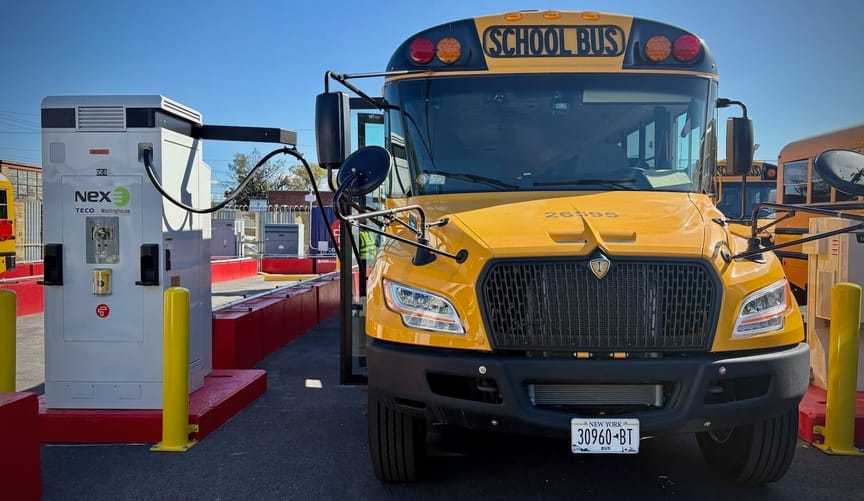
On a clear, sunny morning in mid-September, the gleaming battery-powered buses were parked at a depot in East New York, a residential neighborhood on the outer edges of Brooklyn. First Student, a school services transportation provider, and the utility Con Edison were there to mark the completion of the initial phase of their $9 million pilot project.
The ongoing initiative is meant to show how the city can replace thousands of its polluting diesel buses with cleaner models — and do so in a way that benefits the stressed-out urban grid, not overwhelms it.
“This is about how we’re going to make this cost-effective so that every student in [NYC] can eventually enjoy an emissions-free ride,” Kevin Matthews, First Student’s head of electrification, said at the depot.
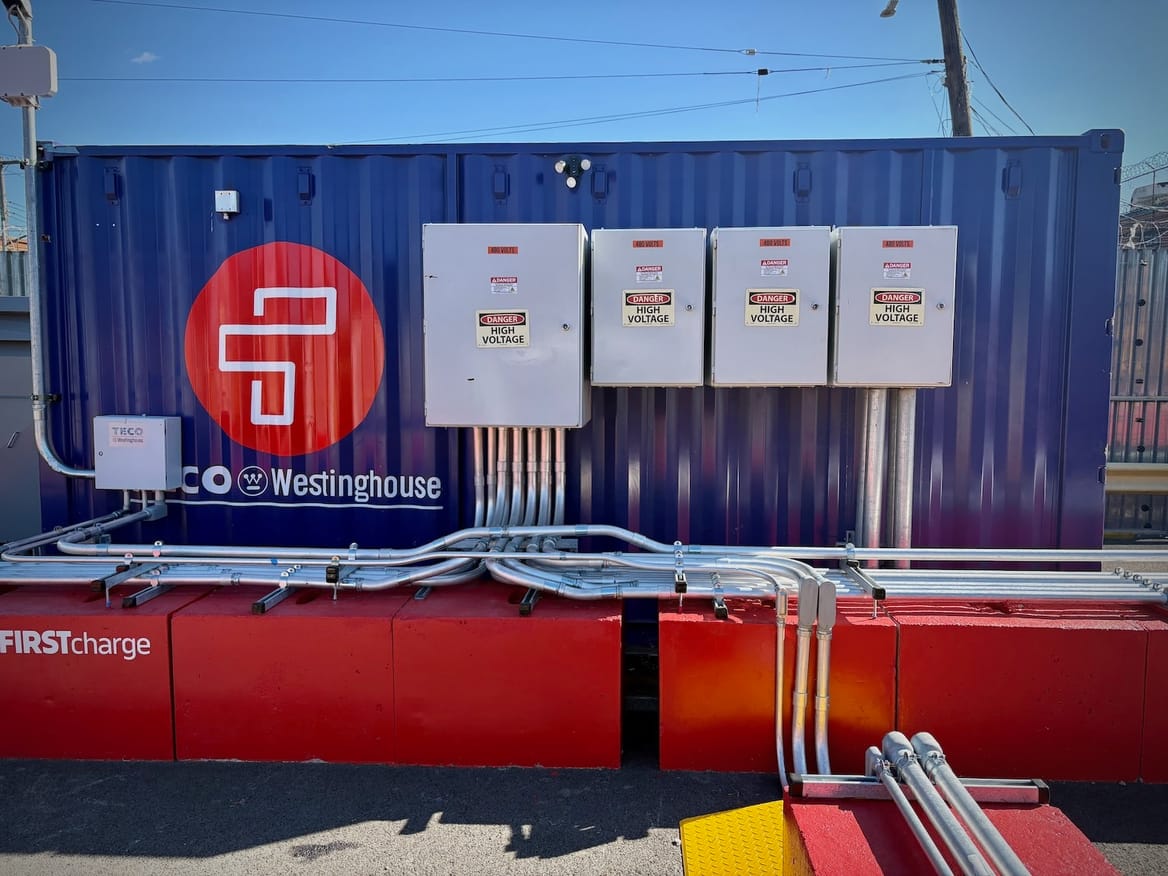
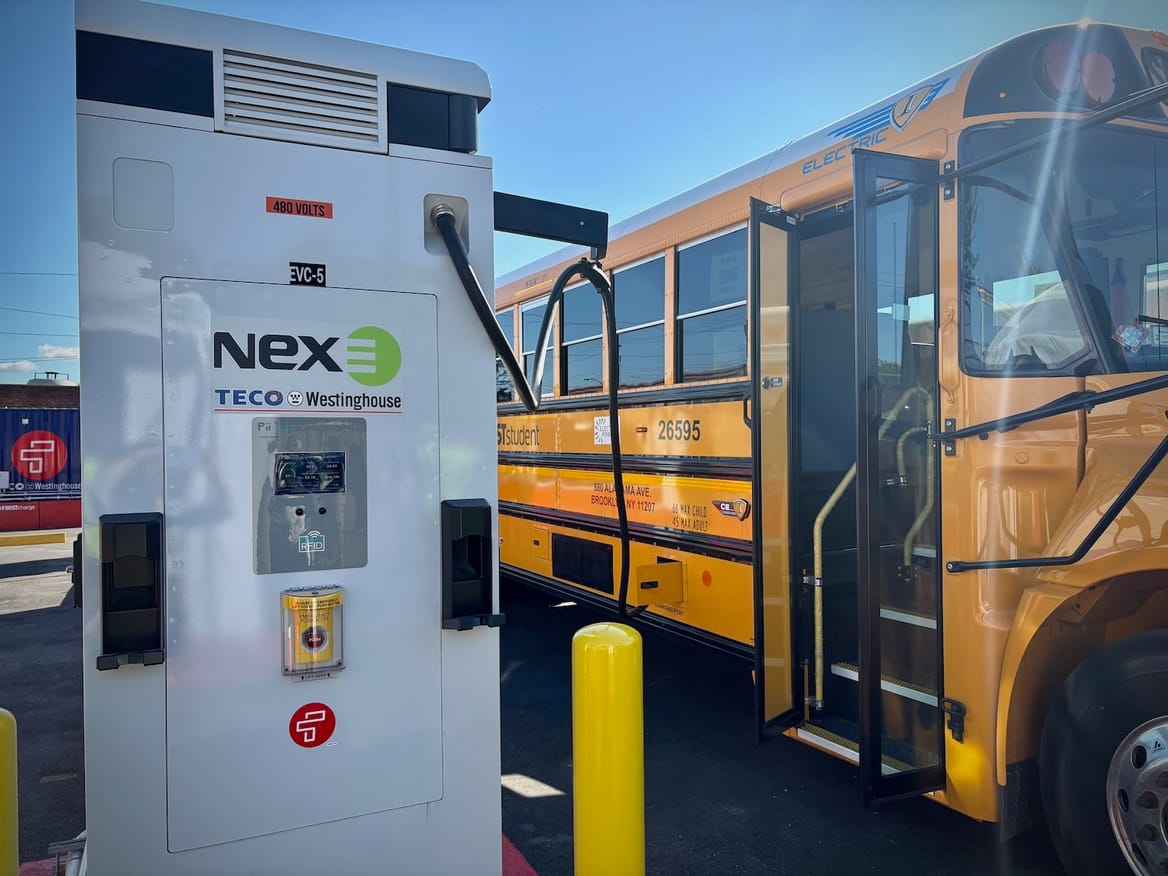
The buses were lined up beside rows of high-powered charging cabinets. Slender silver conduits ran from the chargers along the tops of red concrete barriers, leading to a blue metal container that houses the system’s electrical boards and cabling. Unlike other EV-charging stations, which involve digging trenches to bury electrical equipment, the East New York system is built aboveground.
First Student developed the design out of necessity, Matthews told me. From where we stood, the primary jet-fuel line for the nearby John F. Kennedy International Airport ran right beneath our feet, meaning that digging was out of the question, he said.
But the non-trenching approach turned out to be worth it. The team estimates it saved nearly 20% in project costs and accelerated the project’s timeline by a month, compared to what would’ve been required for installing infrastructure belowground. Matthews likened the system to Lego bricks: Whenever more charging capacity is needed, the company can add more modules.
Forty additional battery-powered buses will be delivered to East New York between now and June, according to First Student. The second phase of its project with Con Ed is also underway, which includes plans for the buses to demonstrate vehicle-to-grid capabilities and send power to the grid in ways that reduce electricity costs and boost reliability.
“That will help make the grid more resilient,” said Vicki Kuo, Con Ed’s senior vice president of customer energy solutions.
“There’s a lot of flexibility in these new tools, whether it’s a vehicle or storage or solar,” she added. “We need everything.”
Con Ed forecasts that electric buses, trucks, and other commercial vehicles will add over 100 megawatts of electricity demand by 2030. Being able to tap their spare battery capacity could be particularly valuable during summer — especially as residents crank up their air conditioners amid the increasingly hot and humid weather. (Meanwhile, larger stand-alone battery projects are struggling to advance in New York, owing to what critics say are Con Ed’s onerous and costly regulations.)
The utility is part of another electric school-bus project in the South Bronx, which now includes 23 dual-port chargers to power 45 new vehicles. In both the South Bronx and East New York, residents have disproportionately high rates of asthma and other respiratory conditions, in large part because of elevated tailpipe pollution in their communities.
At the East New York depot, two of the buses have 3-kilowatt solar arrays on their roofs that can supply power to the bus batteries and the depot’s larger battery unit. First Student is considering outfitting more buses with panels, as well as installing a 500-kW rooftop solar system and a 2-MW battery at the site. The bus chargers are already equipped with hardware and software that allow the company to discharge extra power to Con Ed’s system.
“Our goal is to create additional vehicle-to-grid capability, facility-to-grid capability, up to 10 megawatts over the next couple years,” said John Kenning, CEO and president of Cincinnati-based First Student.
Across the United States, more than 8,500 electric school buses were operating as of June 2026, up 66% from the same time last year, according to the World Resources Institute. The organization attributed the growth to schools’ persistent concerns about the effects of harmful diesel exhaust on vulnerable students, as well as the availability of state and federal funding programs.
Statewide zero-emission vehicle mandates are also a key driver for the nascent electric-bus market, though New York lawmakers recently pushed back deadlines by five years. Local school districts and bus companies now have until 2040 to comply with New York’s all-electric school bus mandate, and until 2032 to ensure that all new school bus purchases are zero-emission.
Lawmakers were responding to concerns from the state’s school transportation associations, which argued that districts needed more time to overcome several major hurdles, including how to pay for electric buses — which still cost more up front than diesel buses, even if battery-powered models are cheaper to operate and maintain in the long run.
First Student, for its part, received about $2 million in funding from the New York State Energy Research and Development Authority’s incentive programs to help pay for six new buses and to retrofit four diesel buses to run on battery power in East New York.
“Purchasing an electric vehicle is only one piece of the puzzle, albeit a very large piece,” Joy Gardner, executive director of the nonprofit Empire Clean Cities, said from the depot. But schools “also have to navigate charging, utility coordination, routes and operations, limited available space, infrastructure costs, and funding applications — all without interrupting the essential services they provide.”
“That’s what makes real-world deployments like this so valuable,” she added. “They create examples that help inform other fleets and projects.”
Google and PG&E will enlist Silicon Valley homes with batteries and other devices to help the grid. But they’re ignoring the data center elephant in the room.
Hi, everyone! Let’s pick up a theme from last week’s newsletter: how California has yet to take full advantage of rooftop solar, backup batteries, and other home devices to create virtual power plants (VPPs) that can help its stressed-out grid — even though it has more of those distributed energy resources than any other state.
Earlier this month, utility Pacific Gas & Electric launched its latest effort to improve on that poor record via an ambitious partnership with friendly neighborhood tech giant Google and pro-electrification nonprofit Rewiring America.
PG&E will recruit more than 20,000 customers with Sunrun or Tesla solar-charged batteries or Renew Home smart thermostats who are willing to let the utility control those resources to help the grid for an as-yet-unspecified reward.
Google and Rewiring America, meanwhile, will work to get new smart devices into people’s homes, with discounts of $5,000 — or $10,000 for the first 25 customers — on Carrier’s new battery-equipped HVAC units.
Importantly, the costs of the program, dubbed Smart Home Assets for Reliability and Efficiency (SHARE), won’t fall on PG&E customers. Instead, Google has pledged to pay for all of it, starting with about $14 million for the first phase, according to Rewiring America.
That’s a big deal for the nonprofit, which has been pushing tech giants to finance VPPs to offset rising energy costs caused by data centers. It’s an approach that Google has taken a lead on in other parts of the country — so it would be logical to assume that Google is doing the same now with PG&E.
Here’s the weird thing, though: Both Google and PG&E insist SHARE has nothing to do with offsetting data center costs, even as both face increasing scrutiny over a 250-megawatt “cloud research and testing facility” that Google plans to build in San Jose. In fact, Google insists it’s not a “data center” at all, although neighbors aren’t convinced.
Google and PG&E have been tussling with the Sierra Club, The Utility Reform Network, and others over how to allocate the cost of connecting that 250-MW “large load” to the utility transmission grid. The big issue? How much of that cost should be borne by PG&E customers at large versus by Google itself.
PG&E says SHARE is about “unlocking additional capacity on the regional electric transmission system.” So you’d think it might acknowledge that it could use this VPP to reduce costs that critics say are tied to Google’s 250-MW project. But maybe the utility would prefer to put those grid upgrades on its own books. That way, it can pass on the costs to customers and keep profiting from its grid-expansion investments.
I don’t mean to sound cynical, but PG&E has a history of trotting out VPP pilot programs and then canceling them. It’s been enabled by the California Public Utilities Commission, which has failed to follow through on state mandates to make utilities do more with these customer-owned resources. That’s all while utilities in Massachusetts, Puerto Rico, Utah, and Vermont have steadily built VPP networks from far more modest starting points.
Jigar Shah, the clean energy investor, Biden-era Energy Department loan office czar, and VPP booster, is likewise skeptical, going so far as to say in a LinkedIn post that the SHARE program is “not a success story” but “an indictment.”
Shah explained to me that he’s not mad at Google, but rather at PG&E. “There are gigawatt-hours’ worth of behind-the-meter batteries in PG&E’s territory,” Shah said. But “none of those gigawatt-hours have a standard way to help their neighbors make the grid more efficient.”
To be fair, PG&E has been upping its efforts lately to test how home batteries, smart electrical panels, EV chargers, and smart meters can defer costly grid investments. “SHARE adds a complementary, near-term pathway” to that work, Trevor Udwin, PG&E’s VPP and grid optimization manager, told Canary Media in an email.
But there’s a big difference between launching another pilot project and building a VPP that actually takes concrete steps to ease grid costs. We’ll have to wait and see if the utility turns Google’s VPP money into something bigger and better than another one-off experiment.
California Gov. Gavin Newsom (D) has signed dozens of bills into law this week and last week. But as of this writing, he hasn’t yet touched the clean energy or utility affordability bills I covered in the first edition of California Wire.
Newsom did sign a slew of bills that take aim at data centers, however — including several measures to set new requirements on large-scale computing facilities like the one Google is planning in San Jose.
Senate Bill 886, from state Sen. Steve Padilla (D), and Assembly Bill 2383, from Assemblymember Rick Chavez Zbur (D), task the California Public Utilities Commission with imposing new cost-recovery rules on data centers of at least 25 MW served by the state’s three major utilities. Data centers will have to pay a “reasonable share” of the grid upgrades and additional generation needs that they trigger, as well as a proportional share of the public services like wildfire mitigation and environmental programs that make up a part of everyday utility bills.
PG&E and the trade group Data Center Coalition opposed these bills. But given the growing public backlash against data centers, most politicians wouldn’t dare take a stand against laws that aim to control their costs. And if data centers want to go above and beyond to make nice with their neighbors, SB 887, also from Padilla, offers them a set of grid and environmental stretch goals that can win them expedited review and permitting.
Like a recurring bad dream, the Moss Landing battery complex, which owner Vistra is in the midst of demolishing after a devastating 2025 fire, burst into flame once again, spurring shelter-in-place orders for the beleaguered nearby communities. Thankfully, as Canary Media’s Julian Spector has exhaustively explained, Moss Landing is obsolete in terms both of battery chemistry and site design — which means its propensity to catch fire isn’t a sound indicator of risk for the country’s rapidly growing grid battery fleet.
Let’s close this newsletter where we started, with more virtual power plant news — in fact, the biggest VPP news yet. Earlier this month, Tesla and Sunrun broke last year’s record for the largest home-battery VPP dispatch in California history: 580 MW of peak power delivered from more than 110,000 home batteries. Unfortunately, one of the programs that has enrolled these batteries is set to be defunded next year — just in time for what’s expected to be among the hottest summers on record. This map pulled from Tesla’s VPP site shows the scale of grid resources the state might be losing out on as a result — unless California can figure out a way to keep these resources in play.
Tesla’s map of California homes with Powerwall batteries available for VPP service

I’m lucky to work from home, which means that I have as a constant companion my fierce guard dog. Behold Lily, the keeper of the front door.

The coastal states announced new legal challenges against the Trump administration’s controversial lease cancellations during Climate Week NYC.
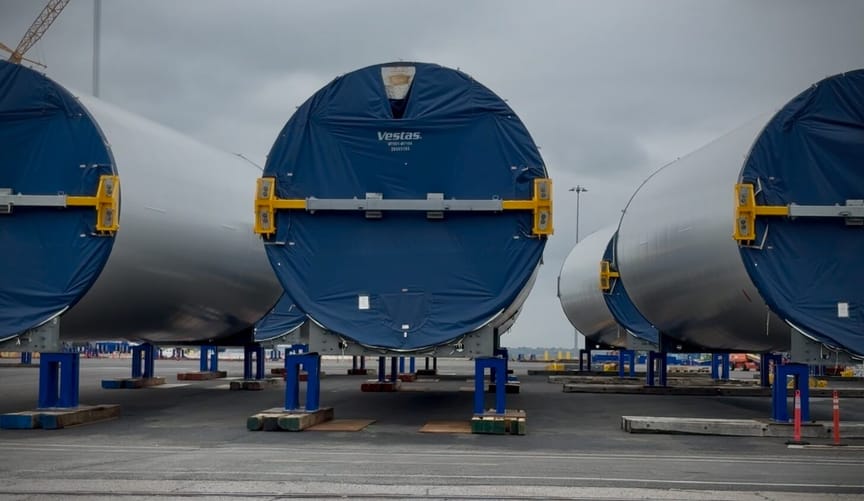
NEW YORK CITY — The enormous blades and hubs of offshore wind turbines are sprawled across a waterfront lot in Brooklyn, as a yellow lifting crane named Big Benny looms overhead. The energy firm Equinor is storing components here before shipping them out to Empire Wind, a 810-megawatt installation that is set to start producing clean electricity next year.
The project will be the third of its kind to spin off the coast of New York, joining Ørsted’s completed South Fork Wind and its in-progress Sunrise Wind. What comes after that remains unclear.
The state was expecting to develop gigawatts of offshore wind to help alleviate the region’s stressed-out grid and bring down rising energy costs. But four proposed New York–area wind farms have vanished from the pipeline, after the Trump administration paid developers to abandon their federal wind leases earlier this year. Companies have similarly walked away from projects off the coasts of California, the Carolinas, Louisiana, and Maine.
But states are increasingly pushing back against the unprecedented payouts.
On Tuesday, while Climate Week NYC was in full swing, New York and seven other eastern states announced they were suing to block two agreements between developers and the U.S. Department of the Interior, while California filed its own lawsuit. The states have previously sued the Trump administration over similar lease cancellations, which they say are illegal maneuvers involving nearly $4 billion in taxpayer money.
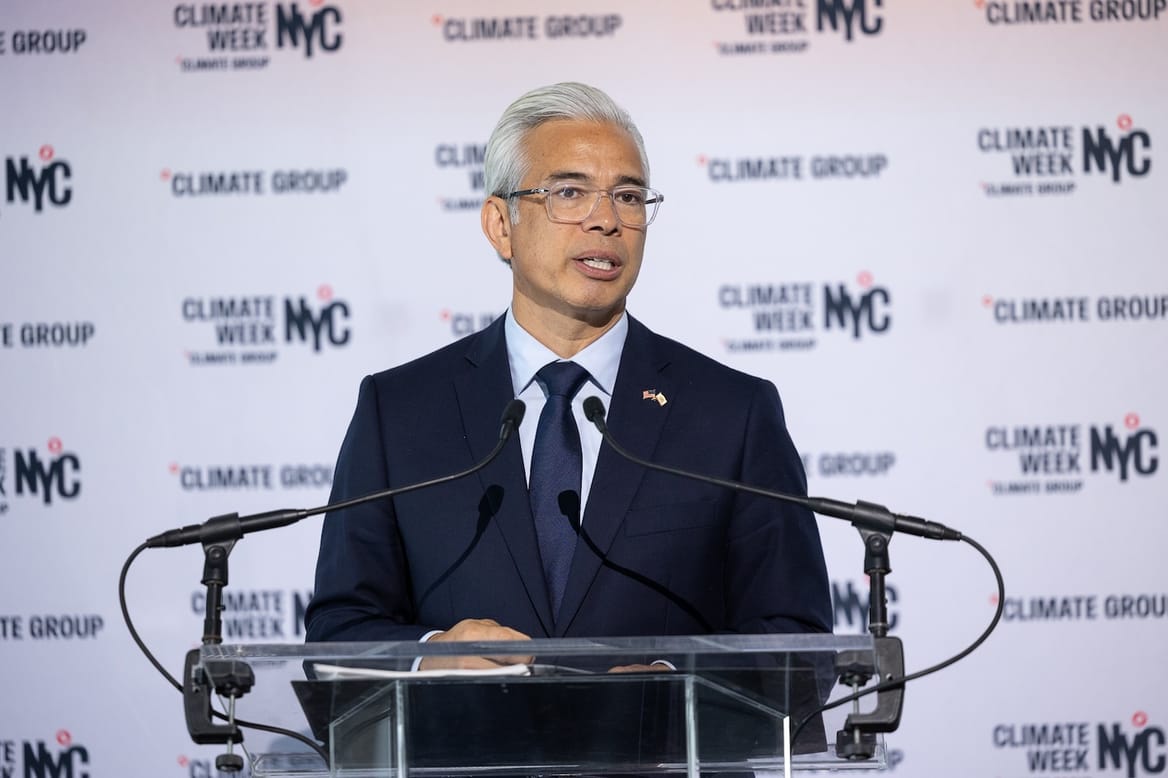
“Our job is to hold this administration accountable and not let it get in the way of our climate action progress by breaking the law,” California Attorney General Rob Bonta said during an event held at the New York City Bar’s office in Manhattan.
The New York–led coalition is suing to stop Interior’s agreement with Bluepoint Wind, a joint venture of Ocean Winds and Global Infrastructure Partners. In 2022, during a record-setting auction, Ocean Winds bid $765 million for a lease area, where it planned to build a 2.4-gigawatt project near New York and New Jersey.
Last April, the Trump administration said it would reimburse the full payment and cancel the lease. In exchange, Global Infrastructure Partners agreed to invest the same amount into a U.S. liquefied natural gas facility. All the other lease-buyout deals involve some kind of commitment to reinvest the funds in fossil fuels and other energy infrastructure.
The second New York–led lawsuit targets Interior’s deals with Invenergy. This summer, the agency paid the Chicago-based developer $653 million and canceled its leases for areas near New York and New Jersey, as well as Maine. Interior also paid Invenergy $111 million to abandon its lease near California’s Central Coast — an agreement that California is now challenging.
Invenergy previously defended its agreements as a way to prevent a protracted legal fight with an administration that will seemingly stop at nothing to end offshore wind development. And the company argues it can use the freed-up funds to invest in energy projects that it believes can be built more quickly, including natural gas and geothermal. (Separately, Invenergy won federal funding this week to study geothermal technologies in Idaho.)
State attorneys general and outside legal experts argue that the lease-cancellation agreements violate several laws, including the Outer Continental Shelf Lands Act, which requires the federal government to consult with states before taking action on offshore energy leases. Critics also claim Interior improperly dipped into the federal Judgment Fund, intended by Congress to be used to settle lawsuits, not for voluntary deals.
From New York’s perspective, a legal victory won’t immediately help fill the gigawatt-sized holes in the state’s clean energy plans, said Doreen Harris, president and CEO of the New York State Energy and Research Development Authority.
Offshore wind projects can take a decade to develop, and the Trump administration’s recent actions — including halting construction, rescinding federal tax credits, and canceling leases — have only exacerbated what were already difficult economic conditions for the fledgling renewable energy sector. As New York faces a looming power-supply crunch and reliability concerns, state leaders are considering repowering existing fossil-fuel plants and investing in new ones, Harris said.
“The reality is, even if we’re successful, the question becomes: Who is going to invest billions of dollars in energy infrastructure if this is the paradigm in which it has to be advanced?” she said at Tuesday’s Climate Week event.
Lemuel Srolovic, who heads the environmental protection bureau at the New York State Attorney General’s office, agreed that “winning a lawsuit doesn’t put offshore power into the grid.” But he said the efforts could still pave the way for future development by signaling to companies that states are willing to step in to defend projects.
“I think everyone would agree that a country that respects the rule of law is a better investment environment than a country that does not, and that’s in big part what these cases are about,” Srolovic said.
The utility says too many battery projects will overwhelm its grid and drive up costs. Battery developers say the utility is trying to protect its profits.
It’s already hard to build grid batteries in New York City. But now, an increasingly hostile dispute between the utility Con Edison and energy-storage developers is making it even harder.
The two sides agree that “community-scale battery projects” — bigger than those that back up a home but smaller than most grid-scale installations — could seriously improve reliability and affordability for New Yorkers.
But they disagree on how those batteries should be managed, and on how the financial rewards for the services they provide to the grid should be parceled out.
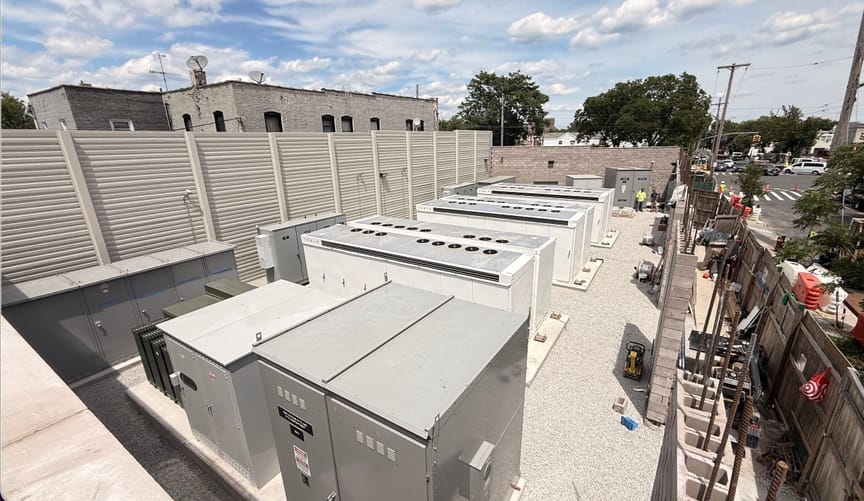
Private energy-storage developers who have been cut off from plugging into Con Ed’s grid for the past year say the utility is unfairly tilting the playing field in its own favor.
In August 2025, Con Ed abruptly changed the rules for nearly 600 megawatts of third-party battery projects seeking to interconnect to its grid. Then in November, the utility issued a new interconnection policy that developers say dramatically raised the costs they would have to pay to interconnect, by as much as fourteenfold in some cases.
That’s according to a petition filed in March with the New York Public Service Commission from the New York Battery and Energy Storage Technology Consortium (NY-BEST) and the New York Solar Energy Industries Association (NYSEIA). The groups say Con Ed’s changes have effectively made it impossible to move ahead with roughly $1.5 billion in battery-project investment. They also accuse the utility of circumventing proper regulatory procedure to impose these restrictions and are asking the commission to force the utility to revert to its former rules.
“It’s just unacceptable for a regulated utility to operate like this,” said New York City Council member James Gennaro, a Democrat who chairs its Committee on Environmental Protection and Waterfronts. “We’re looking to get to the bottom of this because we want battery storage to progress. This is good for the grid, it’s good to reduce our dependence on peaker plants, it’s good for everyone.”
In a March letter, environmental groups and city and state elected officials, including Gennaro, called on the commission to force Con Ed to “roll back these unilateral and unwarranted changes.”
Con Ed says the changes are about preserving grid reliability and preventing a flood of third-party batteries operating outside of utility control from driving up costs to its customers. It is asking regulators to approve a plan that it says will better align the way that these batteries charge and discharge with the needs of its increasingly strained grid.
“We think storage is important for the clean energy transition,” said Raghu Sudhakara, Con Ed’s vice president for distributed resource integration. “But it has to be sited in the right location, it has to come online at the right time, and it has to operate under the right operating conditions.”
The dispute is creating roadblocks just when New York City needs all the resources it can get to meet peak electricity demand during heat waves. In fact, the utility’s latest reliability contingency plan, filed with regulators in July, identified the need for 125 MW of “clean and non-emitting” capacity in New York City by 2033. That plan “named energy storage as a primary resource,” said Claudia Villar-Leeman, NY-BEST’s senior director of policy and regulatory affairs.
Environmental justice groups are also pushing for batteries to help replace fossil-fueled power plants that are polluting low-income neighborhoods. In light of those pressures, Con Ed’s actions to block battery developers are “frustrating, because batteries should be able to avoid the need for these infrastructure upgrades rather than causing them,” she said.
Con Ed argues that its new rules and interconnection charges are needed to prevent third-party batteries from overwhelming its grid. In the past two years, the number of interconnection requests for battery projects of 5 MW or less have increased about threefold, and now add up to nearly 2.5 gigawatts, Sudhakara said.
If all those batteries are allowed to plug in and start charging at once, they could pull more power than sections of Con Ed’s grid can handle, the utility warned. And because it doesn’t directly control these third-party batteries, Con Ed argues that it has no way to prevent that from happening.
But battery developers and trade groups say Con Ed’s argument relies on worst-case scenarios and ignores the flexibility of energy storage systems.
“We have utility planners taking our most flexible resource and treating them as if they’re completely inflexible,” said Noah Ginsburg, NYSEIA’s executive director. “If your starting point is false assumptions about the flexibility of the resource you’re dealing with, you’re not going to get a positive outcome.”
Those assumptions bother Adam Cohen, chief technology officer and co-founder of NineDot Energy, a community battery developer that runs six community battery sites and has more than two dozen others in development in New York City.
Con Ed’s analysis “assumes batteries will charge in an inflexible manner, from midnight to 8 a.m., with no day-by-day variation, and at a fixed charging rate,” Cohen said. If all those batteries did charge that way, they could indeed overload certain parts of the grid, he said.
But batteries can be controlled to avoid these kinds of problems, Cohen said. An April study by analysis firm Danovo Energy Solutions, commissioned by NineDot, found that Con Ed could use technical approaches now available to its grid operators to nearly double hosting capacity.
A similar study published in May from NYSEIA, NY-BEST, and the Electric Power Research Institute, a prominent utility research organization, found that active management could significantly increase capacity for community-scale battery projects on Con Ed’s grid.
These aren’t pie-in-the-sky grid management concepts, said Meghan Nutting, vice president of regulatory reform at the nonprofit Interstate Renewable Energy Council. Utilities are using these “flexible interconnection” approaches to streamline the grid interconnection of electric vehicle charging depots in California and community solar projects in Illinois. In fact, Con Ed itself does this with solar and battery-equipped electric bus charging sites in its service territory.
“The assumption that these are stupid resources that all do the worst things at the same time is uninformed,” she said. “You can put rules around when batteries can draw from the grid or discharge to the grid.”
Though this fine-grained control is possible, Con Ed says current state regulations prevent it from exercising that control.
In New York state, community solar and battery developers are able to connect to utility grids under a “value of distributed energy resources” (VDER) structure, which sets the price that project developers are paid by utilities for the energy they provide to the grid. Under the VDER rules, battery developers choose when they charge and discharge to maximize their revenue — and while their choices may align with what local grids need for reliability at times, they may diverge from those grid needs at others, and perhaps in hard-to-predict ways.
Battery developers in New York are prepared to work with Con Ed to revamp these rules to better match grid needs to VDER values, NYSEIA’s Ginsburg said. But so far, the utility has refused to engage in those efforts, he said.
Specifically, Con Ed and other utilities in the state have declined a request from the New York Public Service Commission to propose revisions to the VDER tariff. Such changes could align third-party battery incentives to being dispatched in ways that could defer the need for costly grid upgrades, he said.
“Our state regulatory agency asked the utilities, ‘Give us tariff language to make these VDER resources more valuable from a reliability perspective.’ And the utilities said, ‘We’re not going to do that,’” he said.
Con Ed and other New York utilities dispute that characterization. In a joint filing with the commission, they argued that the changes to the VDER tariff sought by NYSEIA and other parties representing battery developers could end up costing utility customers more than the traditional grid upgrades that battery storage is meant to avoid.
In the meantime, Con Ed is asking regulators to approve an alternative plan to avoid driving up costs for customers. Its idea is to largely replace VDER compensation for third-party battery projects with a more utility-controlled approach called Reliability Asset Dispatch Rights (RADR).
Under RADR, developers wouldn’t operate their batteries to maximize their moneymaking potential. Instead, Con Ed would enter into long-term contracts to reimburse those batteries for the cost of the energy they pull from the grid and for the cost of grid upgrades to enable their projects.
Con Ed predicts that this utility control could avoid the risk that third-party batteries operating on their own schedules will drive up customer costs without delivering benefits. But importantly, Con Ed is asking to earn a regulated rate of return on those RADR expenses, bringing these batteries more closely into the realm of capital assets like poles and wires. VDER’s third-party tariff structure was designed explicitly as part of New York State’s decade-long utility regulatory reform effort to find alternatives to the utility rate-base model.
NYSEIA has yet to issue an official position on the RADR proposal. But Ginsburg said he believes that Con Ed would better serve its customers and the third-party battery developer community by reforming the system already in place rather than launching a new utility-centric alternative.
Meanwhile, New York utilities are lagging well behind on both the state’s recently watered-down renewable energy targets and its goal of building 6 GW of energy storage by 2030, he said.
It’s important to note that third-party battery developers aren’t necessarily incentivized to operate their batteries in a way that minimizes cost impacts to Con Ed customers. “I appreciate that Con Edison is a business, just like the members of my association are businesses,” Ginsburg said.
Still, “the theoretical risk of overbuilding at some point in the future takes second fiddle to the fact that we need deployment, and we’re not getting it at the scale and pace necessary,” he said. “The question for regulators is, is there a better way to align incentives?”
The utility says too many battery projects will overwhelm its grid and drive up costs. Battery developers say the utility is trying to protect its profits.
It’s already hard to build grid batteries in New York City. But now, an increasingly hostile dispute between the utility Con Edison and energy-storage developers is making it even harder.
The two sides agree that “community-scale battery projects” — bigger than those that back up a home but smaller than most grid-scale installations — could seriously improve reliability and affordability for New Yorkers.
But they disagree on how those batteries should be managed, and on how the financial rewards for the services they provide to the grid should be parceled out.
Private energy-storage developers who have been cut off from plugging into Con Ed’s grid for the past year say the utility is unfairly tilting the playing field in its own favor.
In August 2025, Con Ed abruptly changed the rules for nearly 600 megawatts of third-party battery projects seeking to interconnect to its grid. Then in November, the utility issued a new interconnection policy that developers say dramatically raised the costs they would have to pay to interconnect, by as much as fourteenfold in some cases.
That’s according to a petition filed in March with the New York Public Service Commission from the New York Battery and Energy Storage Technology Consortium (NY-BEST) and the New York Solar Energy Industries Association (NYSEIA). The groups say Con Ed’s changes have effectively made it impossible to move ahead with roughly $1.5 billion in battery-project investment. They also accuse the utility of circumventing proper regulatory procedure to impose these restrictions and are asking the commission to force the utility to revert to its former rules.
“It’s just unacceptable for a regulated utility to operate like this,” said New York City Council member James Gennaro, a Democrat who chairs its Committee on Environmental Protection and Waterfronts. “We’re looking to get to the bottom of this because we want battery storage to progress. This is good for the grid, it’s good to reduce our dependence on peaker plants, it’s good for everyone.”
In a March letter, environmental groups and city and state elected officials, including Gennaro, called on the commission to force Con Ed to “roll back these unilateral and unwarranted changes.”
Con Ed says the changes are about preserving grid reliability and preventing a flood of third-party batteries operating outside of utility control from driving up costs to its customers. It is asking regulators to approve a plan that it says will better align the way that these batteries charge and discharge with the needs of its increasingly strained grid.
“We think storage is important for the clean energy transition,” said Raghu Sudhakara, Con Ed’s vice president for distributed resource integration. “But it has to be sited in the right location, it has to come online at the right time, and it has to operate under the right operating conditions.”
The dispute is creating roadblocks just when New York City needs all the resources it can get to meet peak electricity demand during heat waves. In fact, the utility’s latest reliability contingency plan, filed with regulators in July, identified the need for 125 MW of “clean and non-emitting” capacity in New York City by 2033. That plan “named energy storage as a primary resource,” said Claudia Villar-Leeman, NY-BEST’s senior director of policy and regulatory affairs.
Environmental justice groups are also pushing for batteries to help replace fossil-fueled power plants that are polluting low-income neighborhoods. In light of those pressures, Con Ed’s actions to block battery developers are “frustrating, because batteries should be able to avoid the need for these infrastructure upgrades rather than causing them,” she said.
Con Ed argues that its new rules and interconnection charges are needed to prevent third-party batteries from overwhelming its grid. In the past two years, the number of interconnection requests for battery projects of 5 MW or less have increased about threefold, and now add up to nearly 2.5 gigawatts, Sudhakara said.
If all those batteries are allowed to plug in and start charging at once, they could pull more power than sections of Con Ed’s grid can handle, the utility warned. And because it doesn’t directly control these third-party batteries, Con Ed argues that it has no way to prevent that from happening.
But battery developers and trade groups say Con Ed’s argument relies on worst-case scenarios and ignores the flexibility of energy storage systems.
“We have utility planners taking our most flexible resource and treating them as if they’re completely inflexible,” said Noah Ginsburg, NYSEIA’s executive director. “If your starting point is false assumptions about the flexibility of the resource you’re dealing with, you’re not going to get a positive outcome.”
Those assumptions bother Adam Cohen, chief technology officer and co-founder of NineDot Energy, a community battery developer that runs six community battery sites and has more than two dozen others in development in New York City.
Con Ed’s analysis “assumes batteries will charge in an inflexible manner, from midnight to 8 a.m., with no day-by-day variation, and at a fixed charging rate,” Cohen said. If all those batteries did charge that way, they could indeed overload certain parts of the grid, he said.
But batteries can be controlled to avoid these kinds of problems, Cohen said. An April study by analysis firm Danovo Energy Solutions, commissioned by NineDot, found that Con Ed could use technical approaches now available to its grid operators to nearly double hosting capacity.
A similar study published in May from NYSEIA, NY-BEST, and the Electric Power Research Institute, a prominent utility research organization, found that active management could significantly increase capacity for community-scale battery projects on Con Ed’s grid.
These aren’t pie-in-the-sky grid management concepts, said Meghan Nutting, vice president of regulatory reform at the nonprofit Interstate Renewable Energy Council. Utilities are using these “flexible interconnection” approaches to streamline the grid interconnection of electric vehicle charging depots in California and community solar projects in Illinois. In fact, Con Ed itself does this with solar and battery-equipped electric bus charging sites in its service territory.
“The assumption that these are stupid resources that all do the worst things at the same time is uninformed,” she said. “You can put rules around when batteries can draw from the grid or discharge to the grid.”
Though this fine-grained control is possible, Con Ed says current state regulations prevent it from exercising that control.
In New York state, community solar and battery developers are able to connect to utility grids under a “value of distributed energy resources” (VDER) structure, which sets the price that project developers are paid by utilities for the energy they provide to the grid. Under the VDER rules, battery developers choose when they charge and discharge to maximize their revenue — and while their choices may align with what local grids need for reliability at times, they may diverge from those grid needs at others, and perhaps in hard-to-predict ways.
Battery developers in New York are prepared to work with Con Ed to revamp these rules to better match grid needs to VDER values, NYSEIA’s Ginsburg said. But so far, the utility has refused to engage in those efforts, he said.
Specifically, Con Ed and other utilities in the state have declined a request from the New York Public Service Commission to propose revisions to the VDER tariff. Such changes could align third-party battery incentives to being dispatched in ways that could defer the need for costly grid upgrades, he said.
“Our state regulatory agency asked the utilities, ‘Give us tariff language to make these VDER resources more valuable from a reliability perspective.’ And the utilities said, ‘We’re not going to do that,’” he said.
Con Ed and other New York utilities dispute that characterization. In a joint filing with the commission, they argued that the changes to the VDER tariff sought by NYSEIA and other parties representing battery developers could end up costing utility customers more than the traditional grid upgrades that battery storage is meant to avoid.
In the meantime, Con Ed is asking regulators to approve an alternative plan to avoid driving up costs for customers. Its idea is to largely replace VDER compensation for third-party battery projects with a more utility-controlled approach called Reliability Asset Dispatch Rights (RADR).
Under RADR, developers wouldn’t operate their batteries to maximize their moneymaking potential. Instead, Con Ed would enter into long-term contracts to reimburse those batteries for the cost of the energy they pull from the grid and for the cost of grid upgrades to enable their projects.
Con Ed predicts that this utility control could avoid the risk that third-party batteries operating on their own schedules will drive up customer costs without delivering benefits. But importantly, Con Ed is asking to earn a regulated rate of return on those RADR expenses, bringing these batteries more closely into the realm of capital assets like poles and wires. VDER’s third-party tariff structure was designed explicitly as part of New York State’s decade-long utility regulatory reform effort to find alternatives to the utility rate-base model.
NYSEIA has yet to issue an official position on the RADR proposal. But Ginsburg said he believes that Con Ed would better serve its customers and the third-party battery developer community by reforming the system already in place rather than launching a new utility-centric alternative.
Meanwhile, New York utilities are lagging well behind on both the state’s recently watered-down renewable energy targets and its goal of building 6 GW of energy storage by 2030, he said.
It’s important to note that third-party battery developers aren’t necessarily incentivized to operate their batteries in a way that minimizes cost impacts to Con Ed customers. “I appreciate that Con Edison is a business, just like the members of my association are businesses,” Ginsburg said.
Still, “the theoretical risk of overbuilding at some point in the future takes second fiddle to the fact that we need deployment, and we’re not getting it at the scale and pace necessary,” he said. “The question for regulators is, is there a better way to align incentives?”
Too many utilities are keeping coal plants open, planning new gas plants, and building less renewable energy, the Sierra Club’s latest “Dirty Truth Report” finds.
The biggest U.S. utilities are doing worse on shifting from fossil fuels to clean power than they were at the start of this decade — and more than four in 10 have backtracked on their climate goals since the start of the second Trump administration.
That’s the dire, if predictable, news from the Sierra Club’s latest “Dirty Truth Report,” released Tuesday. For the second year in a row, the environmental organization gave an overall F grade to 76 of the country’s largest electric utilities.
In fact, with a handful of exceptions, the utilities that the Sierra Club collects data on — which collectively operate more than half the country’s coal and fossil-gas generation fleet — are further off course in reducing their carbon emissions than they were when the organization published its first “Dirty Truth Report,” in 2021.
More utilities are opting to keep coal plants running despite the high cost and environmental toll. They’re planning to build enough new fossil gas–fired power plants to generate the equivalent of roughly one-quarter of average U.S. electricity demand, largely to serve AI data centers.
And in a worrying new milestone, this year marked the first time in the report’s six-year history that the volume of new clean energy being planned by utilities decreased from the prior year — a shift that aligns with Trump administration policies promoting fossil fuels over renewable energy.
That means utilities are forgoing cheaper — and faster to deploy — solar, wind, and battery investments even as their own planned generation costs, and their customers’ bills, rise.
“Utilities’ failure to plan, combined with unprecedented load growth, is hitting us,” said Emma Pabst, a Sierra Club Beyond Coal campaign manager and co-author of the report. The results, she said, will be “more extreme weather, higher electric bills, higher insurance premiums, and more disaster costs passed on to families.”
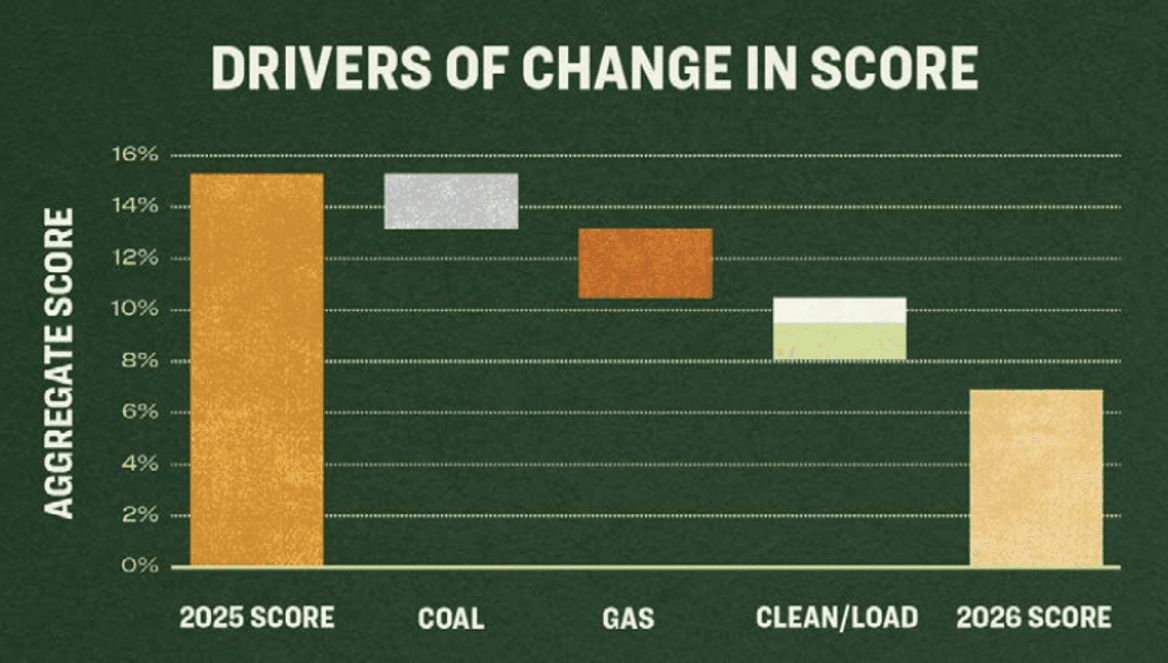
The Sierra Club analyzed utilities’ plans as of mid-2026 and graded them on three factors: closing coal plants, building no new gas plants, and rapidly expanding clean energy to replace fossil fuels and meet growing power demand.
Scores fell across all three criteria.
“Utilities make a lot of money on fossil fuels,” Pabst said. Most are able to earn regulated profits based on the amount of money they invest in new power plants and gas pipelines. And many are able to shield themselves from spiking fuel prices by passing those costs on to their customers.
At the same time, the Trump administration has “been putting up pretty significant barriers against developing more clean energy,” said Noah Ver Beek, a Sierra Club senior energy campaigns analyst and report co-author.
The administration has blocked federal permits for solar and wind projects, canceled a swath of offshore wind leases, and continued to use its authority over airspace to prevent onshore wind farms from being permitted, despite a court order barring that practice.
The Trump administration’s pro–fossil fuel agenda has also given more utilities license to renege on their climate commitments, Ver Beek said. In the past two years, 31 utilities have backslid on those, the report notes, representing 41% of the utilities that the Sierra Club is tracking.
All this comes as households face escalating utility bills; electricity prices increased at twice the rate of inflation last year. While the need to expand power grids and mitigate growing wildfire threats plays a role in those price hikes in some parts of the country, so does the cost of keeping aging coal plants running and increasing reliance on fossil gas.
Utilities still have a chance to reverse course by working more solar, wind, and batteries into their plans, Pabst said. But that will require state policymakers and regulators forcing them to embrace cleaner and cheaper alternatives to “the things they’re used to — which are dirty, polluting fossil fuels.”


.svg)
