

 Back
Back
HYDROGEN: A California transit agency launches the world’s first commercial all-hydrogen fuel cell ferry in the San Francisco Bay. (Canary Media)
CLEAN ENERGY: Rural Nevada counties call on state lawmakers to craft policies requiring federal agencies to coordinate clean energy development planning and decision-making with local governments, saying they are overwhelmed by the flood of new projects. (Nevada Current)
CLIMATE: Portland, Oregon’s city government diverts $7.6 million from its climate action fund to the general budget, marking the first time the money will be used outside its intended purpose. (OPB)
STORAGE:
OIL & GAS:
UTILITIES: Idaho Power offers rebates to commercial and industrial customers for voluntarily reducing power use to ease grid strain during extreme high temperatures. (Boise State Public Radio)
ELECTRIC VEHICLES:
HYDROPOWER: Tribal nations and advocates call on a federal agency to cease hydropower production at eight dams in Oregon, saying they harm fish and are no longer financially viable. (KATU)
EMISSIONS: Washington state implements rules aimed at reducing landfill methane emissions by tightening monitoring requirements and lowering gas collection thresholds. (Seattle Times)
GRID: A fast-moving brush fire damages utility lines in Kauai, Hawaii, forcing evacuations and leaving more than 1,000 households without power. (Honolulu Star-Advertiser)
COMMENTARY:
WIND: Coastal Maine residents concerned about both climate change and ecological preservation are conflicted over the planned location of a facility that advocates say will help launch Maine’s offshore wind industry. (Energy News Network/Grist/Maine Monitor)
COAL: With New England’s last coal plants slated for closure by 2028, the region has “few easy replacements” for the 3 GW of lost baseload power. (E&E News)
GRID:
BIOENERGY: The owner of a Brunswick, Maine, waste-to-energy facility wants to expand the site to increase production, a plan that would help reduce pressure on landfills and increase energy production. (Bangor Daily News)
SOLAR:
CARBON CAPTURE: A bill passed by Pennsylvania lawmakers tells state environmental regulators to draft regulations for underground carbon storage wells, despite concern that there are cheaper and more proven methods of fighting climate change. (Associated Press)
TRANSIT: Construction begins in Maryland’s Montgomery County on what is touted as the country’s largest renewable energy-powered transit depot microgrid, which includes hydrogen energy generation and electric bus charging. (news release)
CLIMATE:
UTILITIES: Rising gas prices, grid infrastructure investments and utility business models that incentivize capital spending are the primary contributors to rising electricity costs, according to a recent report dispelling claims that clean energy is the culprit. (Canary Media)
BATTERIES: A peer-reviewed study finds lithium ion batteries are full of toxic forever chemicals that have contaminated the areas surrounding manufacturing and disposal sites, spurring the need to find alternative energy storage solutions and ramp up recycling efforts. (The Guardian)
GRID:
WIND: Coastal Maine residents concerned about both climate change and ecological preservation are conflicted over the planned location of a facility that advocates say will help launch Maine’s offshore wind industry. (Energy News Network/Grist/Maine Monitor)
ELECTRIC VEHICLES: Some rental car companies are selling off electric vehicle inventories and reducing new orders amid a lack of charging infrastructure, renters’ unfamiliarity with driving EVs, and limited repair options. (New York Times)
COAL:
OIL & GAS: The Biden administration seeks public input on its proposal to expand an area of the National Petroleum Reserve-Alaska with special drilling restrictions. (Alaska Public Media)
NUCLEAR: California startup Oklo looks to build its first small modular nuclear reactor at the Idaho National Laboratory by 2027. (Reuters)
This story was co-published by Energy News Network, the Maine Monitor, and Grist.
Ron Huber rifled through a thick folder full of decades of state environmental records outside a community hall in the tiny coastal Maine town of Searsport. For the longtime local conservation activist, the scene inside was a familiar one: dozens of neighbors, workers and environmentalists mingled over pizza and coffee, discussing the merits of a proposed industrial project that has potential to transform the local economy, but at the expense of a locally beloved natural area.
“We’ve seen these things rise and fall many times,” Huber said outside the event late this past spring. Conservationists have celebrated over the decades as plans for a coal plant and a liquefied natural gas terminal on Sears Island came and went without success.
This latest proposal presents a new kind of conflict. Rather than pitting townspeople against a corporate polluter, this development would support clean energy and be integral to the state’s plan for cutting climate emissions.
In May, the state applied for a $456 million federal grant to build a specially designed port on about 100 acres of Sears Island to support Maine’s nascent floating offshore wind industry. About two-thirds of the 941 acre island is in permanent conservation, and the state retains an easement on the rest, which has been reserved for a potential port for years.
“We’re not optimistic that this one’s going to die under its own weight,” Huber said, noting that the offshore wind port has far more popular support than previous development proposals.
Visits to recent community events like this one show that, unlike the polarized fights over clean energy projects in other parts of the country, Maine’s wind port is creating more personal divides — challenging residents’ values around climate change, conservation and economic factors. It previews what could be coming as wind grows in the Northeast.
“My question is really about why we’re not actually all on the same team,” said Belfast, Maine, resident Julianne Dow inside the community hall, during a question-and-answer period with New England labor organizers. “I’m very pro-union, I’m pro-offshore wind and pro having it here, and for the economic benefits for the region. But I’m also very pro maintaining Sears Island as a precious Midcoast resource.”
Dow and activists like Huber want the port built instead at a Sprague Energy-owned oil and logistics terminal across the water known as Mack Point. It was considered as an alternative in lengthy public processes in recent years, and Sprague and opponents of the Sears Island proposal have continued to urge reconsideration for it so far this summer.
Offshore wind has taken some big steps forward in Maine this year. Federal regulators approved a state research array of floating turbines, which generate power in deep waters far offshore, and are nearing leasing for commercial projects. A new state law calls for Maine to procure three gigawatts of offshore wind by 2040, using union-standard labor to build the projects and a floating wind-focused port.
Formal environmental assessments and site analyses are still pending. But state port authority director Matthew Burns wrote in June that Mack Point’s “physical and logistical constraints, need for significant dredging, and increased costs to taxpayers for land leasing and port construction would result in an expensive and inferior port for Maine compared to a versatile, purpose-built port on Sears Island.”
Still, opponents worry that wetlands and forests on Sears Island could be disrupted by port construction, even if most of the surrounding ecosystem remains intact.
“Because we have to sacrifice something, let’s sacrifice something irreplaceable, instead of cleaning up a dirty old existing port?” Huber said outside the event. “That’s just ridiculous.”
Asked if he saw wind as a climate solution more broadly, Huber began to express doubts about how turbine arrays would affect the ocean ecosystem. Fellow opponent Lou MacGregor of Belfast cut in.
“Right now, what we’re focusing on is protecting Sears Island,” MacGregor said. “We can get to whether we support offshore wind or not after we protect Sears Island.”
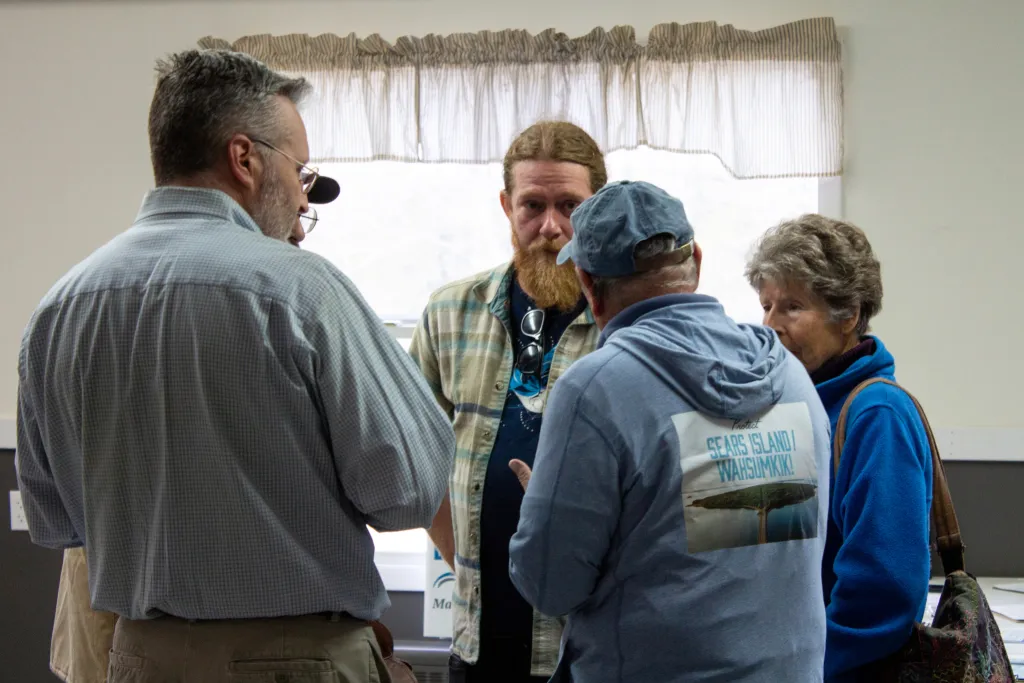
Scott Cuddy, who until recently was policy director of the Maine Labor Climate Council, emphasized at the recent event that his group is agnostic about the port’s location, focusing instead on the benefits it could bring. Under Maine’s wind procurement law, he said, the port’s labor standards will be the same wherever it ends up.
“We desperately want to see this happen, because we need to fight climate change, and we need to do it with good jobs,” Cuddy said.
Cuddy and other labor organizers said state studies indicate that the port project and new wind farms could bring thousands of jobs to coastal Maine towns like Searsport. Local leaders said it could be a boost for shrinking school populations, attracting families to stay in the town long-term.
“I think there’s been a mindset for a long time among kids, especially in rural Maine, like this was the thing I always heard — ‘You got to leave the state if you want to get a good job,'” said Sam Boss, the director of apprenticeships, workforce and equity for the Maine AFL-CIO. “We’ve got to find ways to keep our people here. And if there’s good opportunities, people will stay for them.”
Boss, Cuddy and others answered locals’ questions about plans for training programs for young people to enter the trades, and the family-sustaining wages and benefits promised by the growing wind industry — both in short-term construction positions and into the future.
“These are the skills that pay the bills, and they’re skills that don’t go away. The work might change — you know, we went from nuclear power plants, to now we’re doing offshore wind power development. But the skills are transferable,” said Nicki Kent, a union electrician who came to talk about her experience working on offshore wind in Rhode Island. “We’ve just got to get screwdrivers and wrenches into kids’ hands.”
Belfast resident Daniel Cowan was taking diligent notes on the back of an envelope while his teenage sons listened from the audience. A Navy veteran now pursuing a degree through the GI Bill, Cowan said he was curious about the possibility of wind industry jobs that could help him and his kids stay in Maine.
Cowan empathized with attendees who were opposed to building the port on Sears Island, but said he thought the project’s benefits sounded like they would outweigh the costs.
“You’re going to destroy something no matter what you do. I love Sears Island, I think it’s great, I love walking my dogs out there. But I don’t think that’s going to change,” he said. “The world is coming to an end one way or another, and how fast we get there makes a difference.”
The island itself is connected to the mainland by a long causeway, bisected at its start by rail lines that snake around the coastline toward nearby Mack Point. The causeway juts out into Penobscot Bay, and Sears Island opens up at its end, an oval of land covered in trees and flanked by sandy, seaweedy shores.
On a Saturday morning not long before the Searsport labor dinner, a large group of birders gathered at the gate where the causeway’s pavement continues into the forest. They had come to scout for the tiny, colorful songbirds that rest on the island each year amid long migrations between Canada and the tropics.
Near the edge of the woods, someone had spray-painted the asphalt road with “Wassumkeag,” the indigenous Wabanaki name for the island. Hand-lettered signs with the web address for the advocacy group Alliance for Sears Island read, “Wind power = Good? On Sears Island = Bad!”
The state does not plan to site wind turbines on Sears Island itself. Workers at the proposed port would help build and assemble towers and blades in pieces, towing them far out to sea for final assembly.
Still, anti-wind groups have seized on the proposed project. Lobstermen affiliated with the New England Fishermen’s Stewardship Association (NEFSA), a Maine-based advocacy group founded in 2023 that focuses partly on opposing offshore wind, spoke out against the port at the recent jobs event.
“My concern is only that in trying to affect climate change, that we’re going to cause more damage to the environment than climate change is already causing,” said NEFSA officer Dustin Delano, a commercial fisherman from Friendship, Maine.
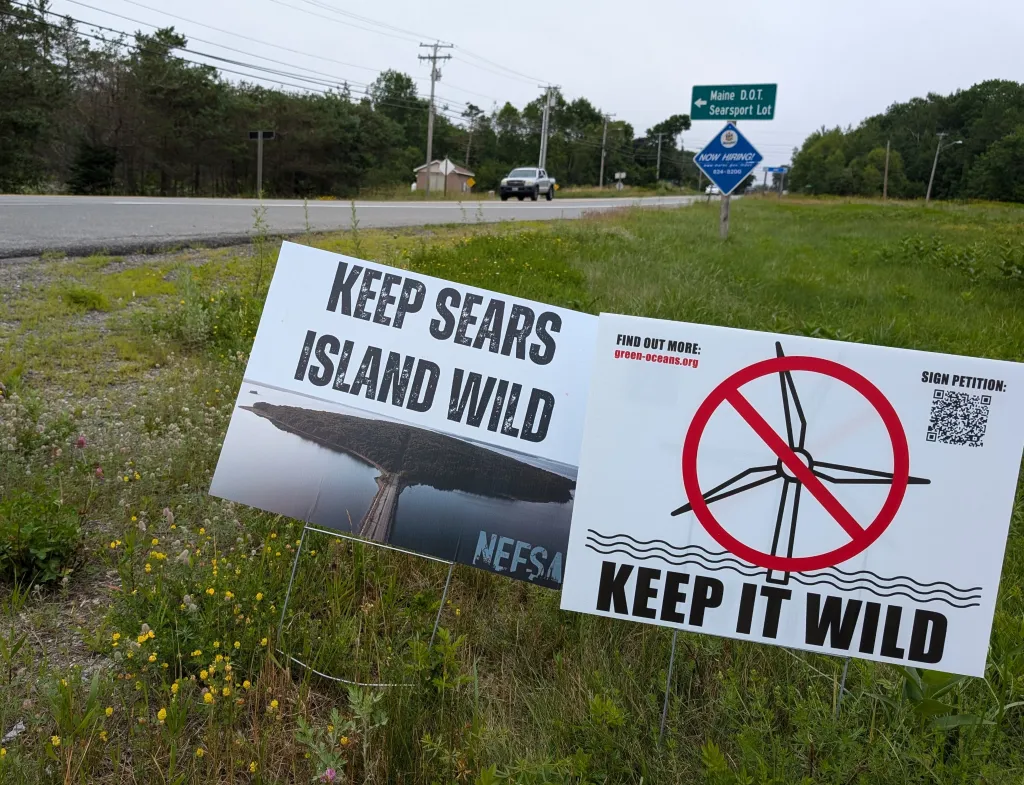
NEFSA has since posted signs where the island causeway intersects with the heavily trafficked Route 1 that read “Keep Sears Island wild.” Similar signs showing a crossed-out wind turbine bore the name of Rhode Island-based Green Oceans. Since its founding in 2022, it has focused mostly on opposing Revolution Wind, currently under construction in waters between Rhode Island and Connecticut.
Many who joined the recent birding trip seemed unaware that Maine’s plans for Sears Island did not involve actually erecting turbines there or close to shore. Others expressed doubts about wind generally. Some did not want to discuss the issue at all, focusing instead on peering through binoculars at the Northern parula, black-throated green warbler or hermit thrush chirping in the trees along the road.
A few people mentioned concerns that wind projects could harm whales. Scientists have found no evidence to support this claim, which has been linked to fossil fuel-funded disinformation campaigns. Green Oceans’ campaigns in Rhode Island have mimicked the delay and disinformation strategies of climate denialist groups like the Texas Public Policy Foundation, according to Brown University research.

The threat of climate change to ecosystems like Sears Island’s, meanwhile, is very real. The Gulf of Maine is one of the fastest-warming water bodies in the world, swelling sea levels, threatening the lobster fishery and leading to more frequent, destructive storms. Maine saw a state-record four federal disaster declarations in 2023 and has received two more already this year.
The warming trend may affect the migratory birds that draw crowds to Sears Island each year. Warming temperatures are reshaping the length and timing of Maine’s seasons, which, combined with declines in insect populations driven by agriculture and other factors, could threaten the birds’ success, studies show.
“If you look at decades and decades of patterns, you’ll see that birds are arriving one to two weeks earlier,” said William Broussard, a Midcoast Audubon board member who led the recent Sears Island trip. “If they get here early, they might not have the insects that they depend on to be out, because maybe the trees aren’t leafing out… and that can be really tough.”
Midcoast Audubon hasn’t taken a position on the wind port issue. It’s a chapter of Maine Audubon, which separately supports the project but is not advocating for one site over the other. Maine Audubon is likewise independent from the National Audubon Society, which advocates for “responsibly sited renewable energy,” including wind, as a climate solution.
Marge Stickler, a birder from Belfast, said she wished the port would be built at Mack Point instead. “I have mixed feelings about what they’re doing here,” she said. “I love coming here… it’s a special place.”
She had read an opinion piece earlier this year by activist Bill McKibben, founder of the climate groups 350 and Third Act, that urged Mainers to support the wind port even on Sears Island. McKibben wrote for Mother Jones last year that solving climate change will require a new “yes in my backyard” mindset.
“McKibben wrote that you have to look at the climate as a whole, and this may be a good thing to have here,” Stickler said. “I’m not sure — why did he write that for Maine, he lives in Vermont, but… he said it’s better to have it and it’s better to have it here, maybe.”
Dave Andrews, a retired engineer from South Bristol, Maine, struck a different tone as he trailed after the other birders. He’d worked on Superfund cleanups and brownfield solar projects in his career, and said he’d often heard “not in my backyard” sentiments from neighbors who were worried about viewshed impacts or a change in a place’s character.
“If it’s a Walmart shopping center, I guess you have a valid statement,” he said. “But when it comes to something like this, this is a different balance.”
Andrews called the port’s siting a “terrible dilemma.” But he felt swayed by the urgency of climate change and the fact that the project would leave much of Sears Island intact. As permitting and siting progress in the coming months, he said he hoped others who love the island would be able to accept the sacrifice.
“I don’t think there is a choice,” he said.
This story has been updated to clarify Maine Audubon’s position on the project and to correct Scott Cuddy’s title.
COURTS: A Baltimore City Circuit Court judge throws out the city’s climate accountability lawsuit against several major oil companies, saying the case sought to go “beyond the limits of Maryland state law.” (Reuters; E&E News, subscription)
BATTERIES:
PIPELINES: A federal court of appeals says Pennsylvania’s Environmental Hearing Board has the authority to review permits to expand a gas pipeline network in that state and New Jersey. (E&E News, subscription)
HYDROPOWER: Rumford, Maine, says it’s “largely supportive” of the license renewal process for the hydroelectric dam operated by Brookfield Renewable Partners on the Androscoggin River. (Sun Journal)
GRID:
SOLAR:
UTILITIES:
WIND: Vineyard Wind says it will hire a carbon-free cement startup in Holyoke, Massachusetts, to provide 2,000 tons of the substance for the Vineyard Wind 2 offshore wind project. (Mass Live)
CLIMATE:
COMMENTARY: A climate advocate and a Harvard Medical School professor write that Massachusetts’ legislature should use building codes to phase out the state’s gas system, citing the “deadly explosions and climate-harming leaks” that threaten residents’ health and community wellness. (Energy News Network)
CLEAN ENERGY: Wisconsin has experienced a “monumental jump” in clean energy development under Gov. Tony Evers as Democrats have focused on its economic benefits rather than climate change. (Inside Climate News)
EMISSIONS: Federal regulators announce a record settlement with Marathon Oil, which will pay $241.5 million in penalties for various Clean Air Act violations in North Dakota. (Inforum)
NUCLEAR: Federal regulators begin the environmental review process as part of a company’s request to reopen a shuttered nuclear plant in southwestern Michigan. (Detroit News)
PIPELINES:
ELECTRIC VEHICLES:
SOLAR:
TRANSPORTATION: An Illinois county transit agency receives a $17.8 million federal grant to replace diesel buses with hybrid and compressed natural gas models. (Journal-Register)
CLIMATE: The Iowa Board of Regents approves a new climate change major at Iowa State University after a discussion about how the syllabus would not stifle students’ “free speech.” (Globe Gazette)
COMMENTARY:
OIL & GAS: A think tank’s report documents how the top U.S. gas lobbying groups and two European counterparts have used the same arguments for more than 50 years to promote the continued use of fossil fuels. (OpenSecrets)
ALSO:
ELECTRIC VEHICLES:
NUCLEAR: The success of a newly signed law boosting small nuclear will depend on the makeup of the Nuclear Regulatory Commission, which hinges on the next president, industry experts say. (E&E News)
HYDROGEN: U.S. Senate Democrats call on the Treasury secretary to relax rules for federal hydrogen industry subsidies, which require the use of only clean energy generated at the same time as the hydrogen fuel. (The Hill)
CLEAN ENERGY:
GRID:
CLIMATE: A Baltimore City Circuit Court judge throws out the city’s climate accountability lawsuit against several major oil companies, saying the case sought to go “beyond the limits of Maryland state law.” (Reuters; E&E News, subscription)
HYDROPOWER: An Oregon university begins construction of the nation’s first utility-scale wave power testing site along the state’s central coast. (KOIN)
Detroit’s City Council again postponed a vote on a fund connected with the proposed solar plan this week. The plan involves building 200 acres of solar fields in six neighborhoods to offset the energy used by municipal buildings.
Councilmembers continue to voice disagreements over the first phase of the plan, which would create 104 acres of solar in the Gratiot-Findlay, State Fair and Van Dyke-Lynch neighborhoods.
Councilmember Angela Whitfield-Calloway has argued that utility-scale solar is wrong for the city and questioned why Detroit hasn’t explored placing solar on municipal buildings or developing arrays outside the city.
However, Councilmembers Fred Durhal III and Coleman A. Young II have said the plan could revitalize neighborhoods and save residents money. Detroit Mayor Mike Duggan has pitched the program as a way to meet city climate goals while reducing blight and illegal dumping in vacant lots.
Homeowners in the footprint of the proposed solar fields would receive twice the fair market value of their homes or $90,000, whichever is higher, while renters will get 18 months of rent to relocate. Homeowners within community benefits areas surrounding the projects will receive $15,000 to $25,000 each for energy efficiency upgrades.
In the five neighborhoods being considered for the second phase of the solar plan, 28 of the 31 homeowners have already signed letters of intent to sell their homes, according to Duggan.
He has proposed using a $4.4 million equity fund derived from the Utility Conversion Fund, which is legally required to be used for energy conservation, to purchase these homes.
City council has twice delayed a vote on the fund so far, with Whitfield Calloway emerging as a strong critic. She said during the July 2 council meeting that the arrays would do little to address blight and crime.
“Solar panels will disrupt and destroy entire neighborhoods. There will be no future affordable housing being built anywhere around a solar farm,” Whitfield Calloway said.
Young responded to Whitfield Calloway, saying the plan would help lower taxes for Detroiters who would otherwise be paying the utility bills for city buildings.
“I, for one, believe the taxes are too damn high,” he said.
One resident who lives near the proposed 40-acre State Fair solar project in Whitfield Calloway’s district spoke out against the plan on Tuesday, calling attention to the infill housing developed by the nonprofit Emmanuel Community House in the area.
“That area could be used again for single-family housing and bringing people back to the city of Detroit,” she said. “I’ve been there since 1980 and want to bring it back.”
Meanwhile, the city council is considering asking for an outside legal opinion on the solar plan. Council President Mary Sheffield has said she has questions about the city’s use of eminent domain and whether it can exempt itself from its own zoning ordinance.
Detroit Corporation Council Conrad Mallet and the council’s Legislative Policy Division have said that the solar sites are exempt because they’re being put to public use.
As city council weighed the equity fund, its Public Health and Safety Standing Committee has been considering a resolution to approve the acquisition of land for the solar plan and the contracts for Lightstar Renewables and DTE Energy, the businesses chosen to develop the solar fields.
Developer representatives and city departments made lengthy presentations touting the potential for solar to improve health outcomes by reducing emissions from fossil fuel power plants and increasing energy reliability as the grid is upgraded to enable solar.
During Monday’s meeting, Whitfield Calloway questioned why Detroit hasn’t explored placing arrays on city buildings or developing solar fields outside the city limits as places like Chicago, Cincinnati and Philadelphia have done.
“Why not put the solar panels on the structures that we’re trying to drive power to?” she asked. “Why do we have to put them in neighborhoods?”
“We really feel that it was the right thing to do to invest in our land here and make sure that residents are able to benefit from it,” Trisha Stein, Detroit’s chief strategy officer, said earlier in the meeting. She said neighborhood groups had drawn up the areas that would host the solar fields and surrounding community benefits areas.
DTE Energy also came in for criticism on Monday, with councilmember James Tate saying he was met with “eyerolls” and “sighs” when he told the Detroit Green Task Force that DTE Energy would be developing some of these projects.
“You have a terrible reputation,” he said, calling out the utility’s opposition to community solar, which allows residents to subscribe to offsite solar arrays and receive bill credits for the energy produced.
The committee will continue deliberating on these contracts next week.
ELECTRIC VEHICLES: The White House announces $1.7 billion in Inflation Reduction Act funding will go to 11 car, motorcycle, truck and bus factories to help them reconfigure to make electric vehicles, provided those companies match the federal investment themselves. (E&E News)
ALSO: Lucid and Fisker recall thousands of electric vehicles over an issue they say could cause a loss of power. (Quartz)
GRID:
EMISSIONS: As the U.S. EPA commits to updating methane emissions standards at landfills, states like California, Maryland, and Washington could provide a blueprint. (Canary Media)
WIND:
ELECTRIFICATION:
NUCLEAR: The shuttered Three Mile Island nuclear plant, which experienced an infamous partial meltdown 45 years ago, is among a growing number of retired U.S. nuclear plants that could be recommissioned as power demand grows. (Washington Post)
OIL & GAS:
CLIMATE:
Duke Energy has been laying the groundwork for a new gas power plant in North Carolina’s Person County for years, touting it as the “next generation” of electricity production and lining up support from local politicians eager to hold on to the utility’s tax dollars.
With acknowledgement from regulators and even some clean energy experts that new gas infrastructure may be needed as Duke shutters its coal fleet, the long-planned gas turbines once seemed like an inevitability.
But now, the 1,360 megawatt combined-cycle facility poised to replace the company’s aging coal smokestacks on Hyco Lake has become a major point of contention. And while the odds still favor Duke, community members and advocates alike say they have cause for hope.
First, there’s the reality of new Biden administration rules on fossil fuel power plants. Beginning in 2032, any new large, combined-cycle plant like that proposed in Person County must either cut its carbon emissions drastically or run 40% of the time or less.
Because North Carolina’s geology isn’t suited to carbon sequestration and emissions-free hydrogen fuel isn’t yet viable, the company would have to limit the plant’s operations — either making it unavailable at key times or requiring costly startups and shutdowns, said Ridge Graham, the North Carolina program manager for Appalachian Voices.
“Either of these options make this combined cycle plant a bad investment and a much more expensive form of electricity generation than clean or renewable energy sources,” Graham told commissioners at a public hearing in Roxboro last month. “This is especially true for Duke customers as the purchase of gas fuel is passed on and has led to multiple rate increases through riders on electricity bills since 2017.”
Bolstering that concern, Public Staff, the state’s ratepayer advocate, notes that Duke lists a proposed new pipeline to transport gas to the plant as an operating cost that would “presumably” be recovered through the fuel rider.
Even if the actual fuel costs were cut in half, engineers for the agency said, “total transportation charges would mostly be unchanged within the ‘Fuel’ category because of the significant pipeline costs that would be necessary to provide natural gas service to the Roxboro site.”
In addition to these charges, ratepayers would also have to pay the full cost of the plant, amortized over 35 years, plus Duke’s regulator-approved profit margin, energy analyst Elizabeth Stanton said in written testimony on behalf of Sierra Club, Southern Alliance for Clean Energy, and the Natural Resources Defense Council.
What’s more, she noted, ratepayers would cover whatever “replacement resources” were needed to meet demand “after the facility’s expected generation was decreased.”
In contrast, Stanton says, Duke’s estimated costs for ratepayers assume the plant will run at over 40% capacity through 2042 — a scenario squarely at odds with the new Biden administration regulation.
“Duke needs to account for the rule in their planning, and they have not done that,” Mikaela Curry, a North Carolina-based campaign manager at the Sierra Club, said in an interview. “Who pays for a gas plant that can only run 40% of the time?”
While Public Staff supports the new plant, it also asserts in testimony that Duke hasn’t developed a plan for how it will comply with the new federal rule.
“We have concerns about the impact and implementation of the recently issued [Clean Air Act] Rule,” engineers Dustin Metz and Evan Lawrence wrote. “We cannot yet identify how [the] proposed Roxboro facility may be impacted and to what extent.”
The agency also hasn’t seen a comprehensive analysis from Duke to justify the location for the combined cycle unit. “The Public Staff cannot say definitively that the proposed Roxboro… project is least cost for [Duke’s] ratepayers,” Metz and Lawrence said in their testimony.
Other critics also question whether the gas plant is Duke’s most economical option, though for different reasons.
In testimony for the environmental groups, Stanton asserts that Duke artificially limits renewables in its carbon-reduction models; assumes clean energy is 60% costlier than industry standards; and, in the plan that most quickly transitions the company away from fossil fuels, makes all resources 20% more expensive. Plus, new generation built before 2030 — which would be mostly solar — gets an 8% penalty.
“Duke’s rationale for requesting the [Hyco Lake plant… is the] selection of gas resources in its least-cost modeling,” Stanton wrote. “That modeling, however, was flawed, including multiple biases for gas resources and against renewable resources.”
Detractors also doubt the company’s plan to convert the gas plant to run on emissions-free hydrogen as late as 2049 – just in time to comply with state law. That “presumption,” said consultant Bill McAleb in testimony on behalf of the Environmental Defense Fund, “is not based on substantive evidence presented in this docket proceeding.”
Detailing an array of challenges, including uncertainty from equipment manufacturers, McAleb concludes a zero-carbon, hydrogen-fueled facility, “is not only speculative but unlikely.”
While advocates wage a legal campaign against the gas plant, activists are reaching out to the people of Person County face-to-face, knocking doors on the roads surrounding the existing coal facility.
Juhi Modi, North Carolina field coordinator for Appalachian Voices, says the canvassing effort so far has identified more opponents than not – surprisingly so.
“Given that it’s a very nuanced topic, and the fact that people appreciate Duke’s economic presence in the county,” Modi said, “it’s been really meaningful to just hear what they think.”
Referencing the yearslong campaign to get Duke to excavate its leaking coal ash pits, Modi added:
“These people were also impacted by coal ash contaminating their well water and were part of a long fight to get their water cleaned up, and still have a lot of skepticism about Duke’s ability to responsibly operate in this community.”
Along an existing pipeline right-of-way, the new pipeline Dominion Energy plans to transport gas to Duke and other customers has also given some in the community pause. Activists say it appears to pass dangerously close to Woodland Elementary School in Semora.
“What would happen if there is an accident? If there is a fire or an explosion?” Modi said. “It’s a real concern for the children, the teachers and the staff that work in the school.”
While cleaner than coal in terms of smog-and soot-forming air pollution, the gas plant’s emissions of methane — a potent greenhouse gas — will negate its climate benefits, said Katie Moore, an air quality researcher who lives in Roxboro.
“Not only do we not have enough time to use [gas] as a ‘bridge fuel,’” she said, but it doesn’t even make sense because the climate impacts are the same, essentially, as coal.”
Moore also believes there’s an incorrect assumption that either Duke replaces its Hyco Lake coal units with gas or the company leaves the county altogether.
“Those are not the only two options,” said Moore, who grew up in neighboring Durham County and moved to slower-paced Person 2.5 years ago. “I don’t want people to be out of jobs and I don’t want to lose 20% of the tax base. But that’s not an inevitability. I think there are lots of ways that we could embrace renewables in this county.”
Still, at an in-person public hearing last month, Moore and other locals against the plant were outnumbered by supporters, who ranged from tourism boosters to local elected officials to the superintendent of Person County Schools, Rodney Peterson.
“A school district like ours could not recover from the loss of our local tax base,” said Peterson, who noted he was appearing in a personal capacity. “I ask you to remember our students, our parents, our teachers in Person County.”
Besides support from many community leaders, many other factors still weigh in Duke’s favor.
Notwithstanding its concerns about the plant’s cost and its compliance with the new Biden administration rules, Public Staff believes the energy it will provide will be vital as the company works to reduce its carbon pollution as required by law.
“There is a need for [combined cycle and combustion turbine] natural gas generation in [Duke’s] service territories,” the engineers wrote in their testimony. Denying the company a permit to build the plant, they asserted, “could delay interim carbon emissions reduction compliance and coal plant retirements set forth in the Carbon Plan Order.”
While solar combined with battery storage could in theory provide similar economic and energy benefits as the gas plant, Person County leaders would have to repeal a 2022 ordinance that effectively bans large-scale solar farms.
Meanwhile, Duke is eschewing an Inflation Reduction Act loan program meant to encourage clean energy investments in communities with retired coal plants.
And even though the commission is dominated by appointments from Gov. Roy Cooper, a Democrat who’s embraced the clean energy economy and criticized fossil fuels, the panel has so far exhibited little resistance to the utility’s gas expansion plans.
“It just makes me feel sad,” said Crystal Cavalier-Keck, the co-founder of the Indigenous activist group Seven Directions of Service, referencing how the panel approved Duke’s last carbon reduction plan with few edits. “It’s disheartening.”
A spokesperson for Duke declined to comment for this story, but the company’s formal responses to Public Staff and clean energy advocates intervening in the case are due later this month. An expert witness hearing is expected as soon as early August.
In the meantime, organizers like Cavalier-Keck say they’ll keep getting the word out. “We’re just going to continue to knock on all the doors,” she said, “and continue to educate people.”


.svg)
