

 Back
Back
Facing new regulations and stiff competition from China, Sweden and other EU countries are racing to decarbonize steel production. It all hinges on green hydrogen.
In 1872, while on a trip to Europe, Andrew Carnegie met with an engineer and inventor named Henry Bessemer. During the Crimean War, Bessemer had accidentally discovered an efficient (for the time) new method of making steel, which involved blowing air through molten iron to remove its impurities. He later developed it into a process that a few small steelworks had already adopted by the time of Carnegie’s visit. Carnegie had been following Bessemer’s invention from the U.S., but none of the steelworks employing it there had really taken off. The future titan of industry was nonetheless wowed by the older man’s presentation, and returned home convinced that steelmaking should be his next venture.
There was no doubt as to where to make such an investment. Manufacturing steel required huge volumes of iron ore and coal, and both were abundant around Pittsburgh. The city also enjoyed an advantageous location for transporting the heavy end product by barge. The Allegheny and Monongahela rivers merge there into the Ohio, down which one can navigate to the Mississippi and the Gulf of Mexico. Plus, Carnegie had a ready customer in the expanding railroad industry and political help in the form of a recently enacted steep tariff on imported rails. So, the Edgar Thomson Steel Works was erected in 1875, 10 miles outside Pittsburgh, in Braddock. (The thing is still running.)
One hundred fifty years later, a similar confluence of circumstances can be found nearly 100 kilometers (62 miles) south of the Arctic Circle, in Luleå, Sweden — one that could lead to the next big innovation in steelmaking. In 1872, no one knew, or cared, that Bessemer’s method was actually carbon manufacture with a side hustle in steel: Even in today’s furnaces, 1.8 metric tons of carbon dioxide are emitted for every ton of steel, give or take. But now, a new, cleaner method of steelmaking exists. It involves using hydrogen instead of coal to produce iron from iron ore in a process called direct reduction, then fashioning that iron into steel in an electric arc furnace.
When renewable electricity powers the hydrogen production and the electric arc furnace, the CO₂ per metric ton of steel in direct and indirect emissions can be reduced to 0.4 metric tons — about 80% less than from the most efficient methods developed since Bessemer’s time.
Hybrit Development, a joint venture of the Swedish companies LKAB (iron ore mining), SSAB (iron and steel production), and Vattenfall (energy), is developing an end-to-end process for steelmaking using hydrogen in Luleå. The group opened a pilot plant in 2020 and is working to build its first commercial-scale plant. Stegra, another Swedish startup, is aiming to do the same thing about 40 kilometers (25 miles) north, in Boden.
Much like the Pittsburgh area in the 1800s, northern Sweden enjoys certain geographical advantages: a surplus of hydropower, enormous iron ore mines 250 kilometers (155 miles) to the north, and a thriving seaport.
Sweden is also getting a nudge from the European Union, which aims to make Europe the first carbon-neutral continent by 2050. Starting this year, the steel industry across the 27 member states has to start paying for its emissions under the EU Emissions Trading System — the allowances initially granted to give it time to adjust are being phased out. The new regulations will sink its business model.
Germany, Norway, and other European countries are making similar efforts to decarbonize steel production, and as with many things concerning the energy transition, China is leaping ahead. The world’s largest ironmaking plant fueled by hydrogen started operating at full capacity late last year in Zhanjiang City, Guangdong. The U.S., meanwhile (as with many things concerning the energy transition), lags behind. The Biden administration sought to spur green hydrogen projects with tax credits and subsidies, but since January 2025, President Donald Trump has killed $12.5 billion in federal funding for clean energy projects — including some in green hydrogen — and threatened to scrap an additional $12.2 billion in existing grants. (SSAB was behind one of those projects, in Mississippi, but — perhaps seeing the writing on the wall — it quit the subsidy award process just before Trump took office and says it has no plans to try again in the U.S.)
With more than 300,000 jobs and 152 billion euros in economic activity tied to the EU’s steel industry, the stakes are high for Europe in the global race to decarbonize steel. And given the industry’s 5% contribution to overall bloc emissions, if it succeeds, the benefit to the climate will be enormous.
The hulking, rusting blast furnace that greets visitors just inside the gate of SSAB’s Luleå facility is a working remnant of traditional steelmaking. A short drive across the 265-hectare (1-square-mile) site follows the route of an elevated conveyor belt connecting the coking plant, where coal is cooked down, to the blast furnace. The road continues on to the building that houses Hybrit’s direct-reduced-iron demonstration plant. At 50 meters (164 feet) high, it’s about as tall as the blast furnace, but the similarities end there. The demonstration plant’s right angles and light-gray aluminum siding stand in stark contrast to the older structure’s tangle of rusted, ashen cylinders and beams.
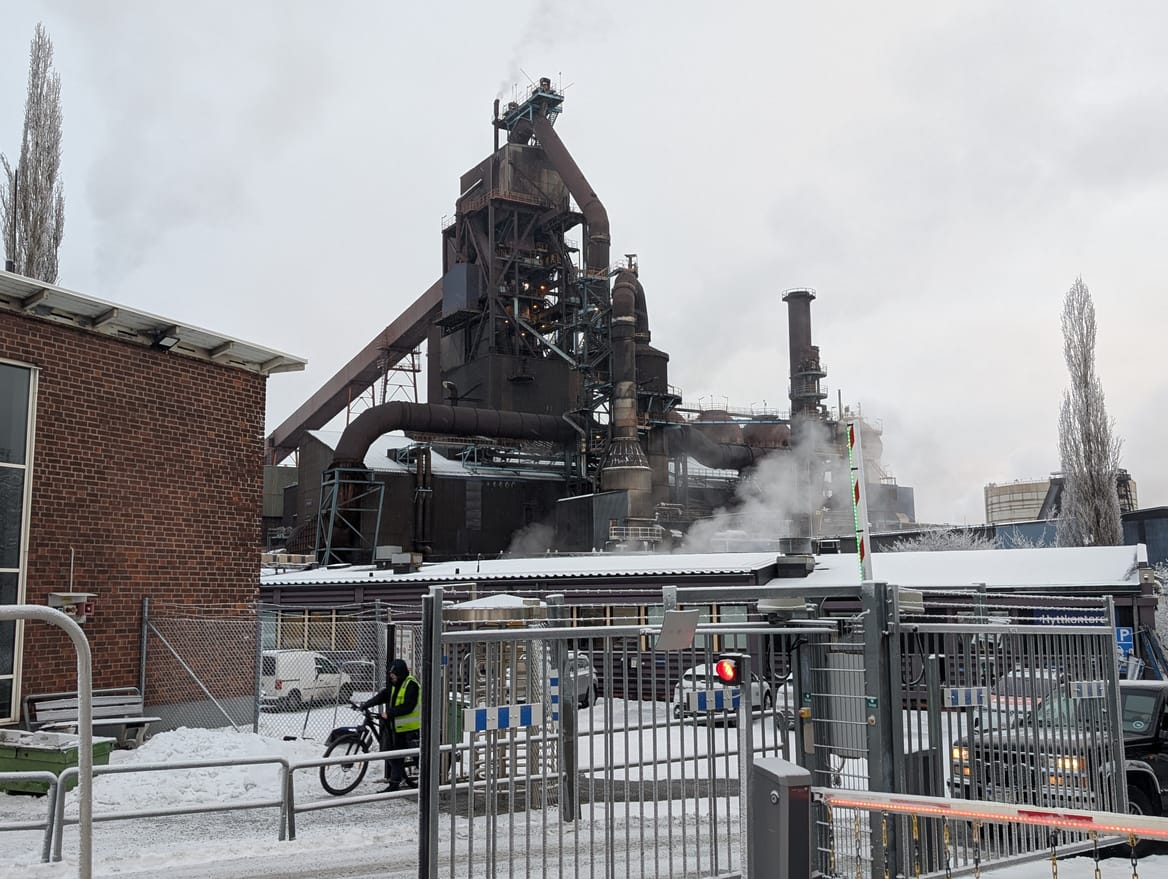
General Manager Gunilla Hyllander met me in the parking lot that divides the demonstration plant from Hybrit’s administration building. Just inside the door to the offices, a loose pile of employees’ shoes dripped snow — though at minus 11 degrees Celsius (12°F), it was almost balmy for January in northern Sweden. We sat down in a large room with samples of iron made in the DRI plant laid out on tables. Though the facility wasn’t in operation that day, Hyllander could see the future starting to take shape.
“Hydrogen reduction in itself is not new,” she said. “People have been thinking about that for years. But in an efficient, safe, and productive manner? That has not been proven before. We think that all the processes from mine to steel could be converted to a fossil-free manner. We’re using all existing technologies and putting it together in a new value chain.”
Steel has been produced on this site since the 1940s, originally by Norrbottens Järnverk. In 1978, Sweden’s government decided to socialize the country’s steel industry by merging Norrbottens and two other struggling companies under state ownership, as Svenskt Stål AB (Swedish Steel Ltd.). SSAB reprivatized in 1992, though the government now owns a 16% share. A major investment in the Luleå operation came in 1998, when the company built the current blast furnace at a cost of 850 million kronor (around $150 million, inflation-adjusted). That timing is significant. A blast furnace requires major maintenance about every 15 years. After relining its facility once, SSAB realized that by 2030 at the latest, it would need to either make that investment again, which would mean producing 7% of the country’s carbon emissions even after the carbon allowances had expired, or figure out a way to do things differently. The company took the second path, banding together with LKAB and Vattenfall to form Hybrit — short for “hydrogen breakthrough ironmaking technology” — in 2016.
SSAB’s decarbonization challenge is a microcosm of the European steel industry’s. It’s going to be a heavy lift. The company’s gigantic share of Sweden’s carbon emissions is no outlier. Globally, the sector produces about 7% to 9% of anthropogenic CO₂ emissions, according to the World Steel Association — about the same as all the world’s passenger vehicles — and accounts for over a quarter of the EU’s industrial emissions. Demand for steel is projected to grow by nearly 20% by 2050, according to BloombergNEF.
The traditional steelmaking process that Carnegie helped popularize primarily emits carbon in two ways: First, coal is burned as fuel to heat blast furnaces to above 1,000°C (1,832°F). Second, a purified form of coal, called “coke,” is heated inside the furnace to induce a necessary chemical reaction that strips oxygen from iron ore (the “reduction”), producing iron and — the second emission — releasing CO₂.

Hydrogen-based direct reduction addresses both problems. Instead of carbon, hydrogen serves as the reducing agent for the iron, combining with oxygen to produce water vapor instead of CO₂. The process operates at lower temperatures than blast furnaces do, requiring less energy. When that energy comes from renewables and the hydrogen is produced from electrolyzers — machines that split hydrogen from water — powered by wind or solar, the result is near-zero emissions. “In the development program, we are close to zero CO₂ emissions per tonne of crude steel — 42 kilograms, instead of 1.6 tonnes,” Hyllander said.
Direct reduction with natural gas has been used in commercial operations for decades, particularly in the Middle East and India, where cheap gas has historically been abundant. What’s changing now is the fuel source. Hybrit started with natural gas to establish a baseline for emissions, but in 2021 it began producing hydrogen with two stacks of electrolyzers. Situated behind the DRI plant, the electrolyzers aren’t much to look at. With their cylindrical shape and multiple rubber tubes, they resemble sewage pipes on life support. But inside is a complex system of wires, tanks, valves, and gaskets that passes an electrical current through an alkaline solution between an anode and cathode, splitting the water into hydrogen on one end and oxygen on the other.
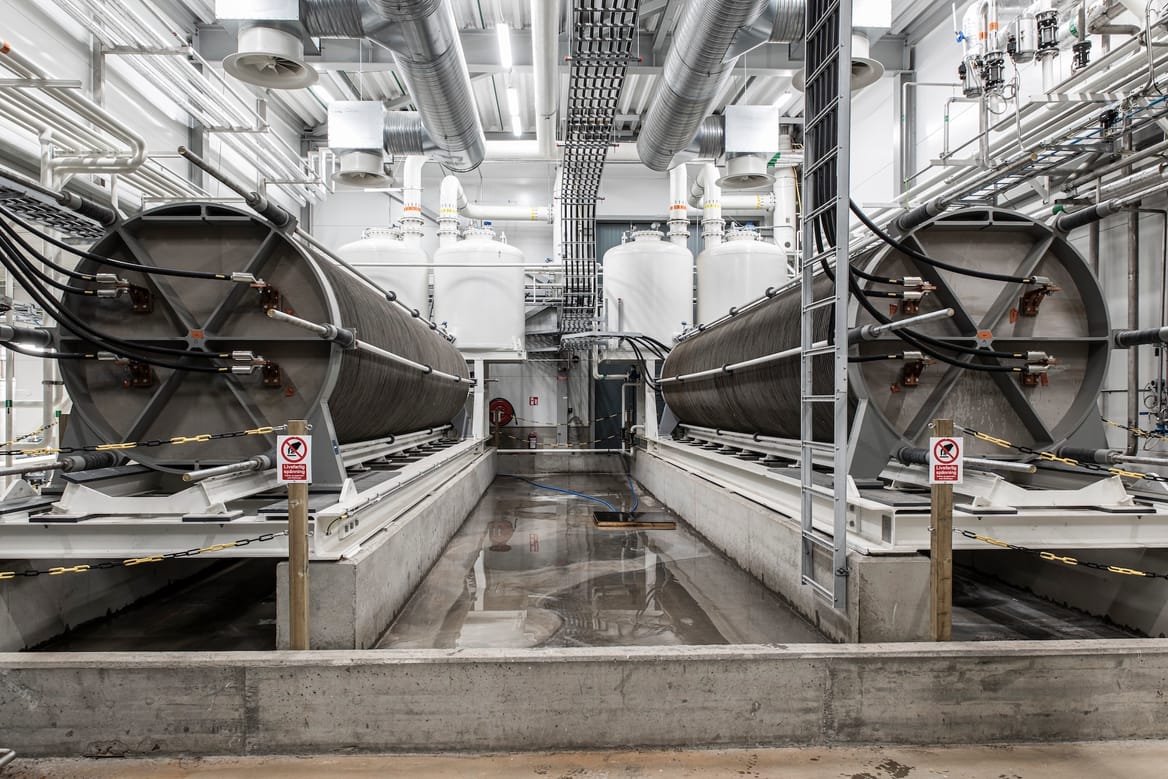
Over the past five years, Hybrit has operated its pilot plant for 61 weeks, producing 5,000 metric tons of fossil-free sponge iron pellets, each about the size of a chocolate-covered almond, which a microscope reveals to have a porous structure. The company has also conducted over 400 trial melts at the research institute Swerim, down the road, which operates its own electric arc furnace. At least one automaker is already using the end product in its vehicles, and Hybrit’s green steel has been incorporated into production lines for heavy machinery and consumer products. The process works. The question is whether it can scale economically.

Europe has positioned itself as the global leader in green steel, and major producers have set ambitious targets. SSAB and Thyssenkrupp aim for carbon neutrality by 2045; ArcelorMittal aims for 2050. Already, more than half the near-zero-emissions steel projects in the global Green Steel Tracker are in the EU. Among them are Hybrit’s neighbor and competitor, Stegra, with a goal of producing 5 million metric tons of green steel annually by 2030 at its Boden plant; and Finland’s Blastr, targeting 2.5 million metric tons by 2026. (In comparison, Edgar Thomson outside Pittsburgh, now part of the Mon Valley Works complex, produces 2.9 million tons annually.) Thyssenkrupp, ArcelorMittal, and Salzgitter have all announced hydrogen-based projects in Germany. The EU has approved nearly 9.3 billion euros in state aid for these ventures. The European Steel Association forecasts emissions reductions of 81.5 million metric tons of CO₂ equivalent per year by 2030 if current projects are completed on schedule.
But progress has stalled. As of August 2024, 80% of announced direct reduction capacity hadn’t moved forward. Only 3% had become operational. Recent setbacks have raised serious doubts about whether hydrogen-based steelmaking can scale up in time to meet the emissions-reductions targets.
Stegra, which, like Hybrit, aims to produce hydrogen on-site, has struggled through at least two seismic funding shortfalls. ArcelorMittal, meanwhile, has scrapped plans to convert two steel plants to green production in Germany because of the high electricity costs of running an electric arc furnace. And Thyssenkrupp announced in March 2025 that it might need to ditch a $3.3 billion conversion project, citing the lack of affordable green hydrogen needed to supply its steel mill.
Steel producers such as Thyssenkrupp that plan to outsource their hydrogen face a classic chicken-and-egg problem. They need confidence there will be a hydrogen supply before they’ll commit to building. But hydrogen producers need committed offtake before they’ll invest in production, and pipeline operators need both before they’ll convert networks to use H2. Nobody wants to move first.
“Companies are not going to invest if they don’t know the pipeline is going to be ready on time and that the offtake is there,” said Leif Christian Kröger, Thyssenkrupp’s head of public affairs.
In 2022, European leaders tried to address the lack of supply by setting an ambitious target of 10 million metric tons of domestic green hydrogen production and 10 million metric tons imported by 2030. Hydrogen conferences sprouted up in Rotterdam and Düsseldorf, replete with optimistic projections of when green hydrogen would meet price parity with “gray hydrogen” (produced using natural gas) and “blue hydrogen” (natural gas with carbon capture). But then the reality hit of how much renewable electricity would be required to meet the targets. With estimates running to the equivalent of almost twice the entire United Kingdom’s consumption in 2020 (a pandemic year), it’s not surprising that progress so far has been an underwhelming 1% of the goal. “They need to show a lot of progress in the next 12 to 18 months” to get there, Daniyal Sheikh, hydrogen market analyst at ICIS, a commodities research service in London, told me in October.
Nima Pegemanyfar is executive vice president of customer operations at Quest One in Hamburg, Germany. His company was making 1-megawatt electrolyzer stacks as far back as 1997 (as H-TEC Hydrogen Energy Systems) and in 2023 launched a 10-MW-to-100-MW modular plant. “Capacity was the restraint a few years ago, so we built that up as an industry,” he said. “Now, demand is what’s lagging.” This isn’t just the self-interested complaint of an electrolyzer manufacturer. Christine Falken-Großer, of Germany’s Ministry of Economic Affairs and Climate Action, agreed that “demand is the essential element right now to unlock growth” in green hydrogen production.
But the economics are punishing to buyers. Green hydrogen costs at least twice as much as its fossil-based alternative. Though natural gas prices have spiked with the closure of the Strait of Hormuz, futures contracts indicate the market believes this will be a temporary disruption that will be resolved before green hydrogen scales up enough to compete on price.
“Producer costs are higher than the price, and customers are not willing to pay the premium,” said Camilla Montemurro, a policy adviser at the trade association Eurogas. BloombergNEF doesn’t expect green hydrogen to reach price competitiveness before 2030, leaving scant time before the carbon allowances expire to achieve what it took Hybrit a decade to do.
Electricity costs in Germany — Europe’s leader in steel production — are a significant hurdle. “The green steel industry doesn’t want to decarbonize as fast as planned, because of the high cost of renewable electricity,” Pegemanyfar said. A million-metric-tons-per-year direct reduction plant running fully on hydrogen requires about 70,000 metric tons of hydrogen annually. That amounts to roughly 800 MW to 900 MW of electrolyzer capacity with around 1 gigawatt of electrical transformer capacity — a capital expenditure of 350 million euros to 700 million euros before you’ve bought any iron ore.
Infrastructure gaps compound the cost hurdle. Europe envisions several “hydrogen backbones” — networks of converted natural gas pipelines carrying hydrogen from ports or production sites to industrial (and perhaps commercial and residential) users. But the chicken-and-egg problem persists. “Pipeline operators won’t invest without offtake, and users won’t buy without infrastructure,” said Dirk Niemeier, director and Clean Hydrogen Solutions lead at PwC in Munich.
The backbone is only the half of it. Just as electricity requires tall transmission towers to move large volumes of power long distances and smaller wires to distribute it to users from central hubs, hydrogen requires both thick pipes (the backbone) and skinny pipes (for delivery to the end customers). Barbara Jinks, director of Ready4H2, an industry group that promotes using gas distribution grids to deliver hydrogen, described the scale of the undertaking: “More than half the gas won’t get to the end user with current infrastructure. Anything more than 3 kilometers [1.8 miles] from the backbone needs a distribution line.” The gas industry would rather sell capacity in the pipelines in which it has already invested billions to hydrogen producers than see this asset stranded as the world switches to running on electricity.
But “hydrogen has rather unique effects on materials, and many of them are not good,” noted P. Chris Pistorius, co-director of the Center for Iron and Steelmaking Research at Carnegie Mellon University in Pittsburgh. The pipeline networks can be converted, but that takes money and time.
Storage presents its own conundrum. Daniel Mercer, managing director of Storengy, a subsidiary of French energy giant Engie, hopes to provide “the hydrogen battery for all of Europe” by storing the gas in underground geologic formations near Hamburg, Germany. But funding is scarce. “We are the only part of the hydrogen system not supported by the government, yet we’re the part that takes the longest to develop,” he said. “Finding funding is the toughest part of my job right now. I need somebody to give me 1 billion euros and be OK with not making any money for eight years” while the underground H2 storage project is built out.
Importing hydrogen instead of producing it in Europe wouldn’t really help. Several European ports are developing terminals to import ammonia, which contains hydrogen molecules and is easier, cheaper, and safer to ship than pure H2. But converting hydrogen to ammonia and back again loses about half the energy contained in the original batch. So when the buyer collects a shipment “in Rotterdam or Hamburg, the price is suddenly double,” said Alexander Fleischanderl, chief technology officer of the London-based Primetals Technologies, which developed a proprietary technology called Hyfor for making green steel. “This is by far not competitive anymore.”
Like Hybrit, Primetals Technologies gets around problems with importing hydrogen by attaching production to its green-steel manufacturing process. It hopes to offer green steelmaking as a kind of service and secure contracts to build plants for companies shutting down their blast furnaces.
Amid these converging pressures, European policymakers and industry leaders must confront tricky questions about the continent’s industrial future. Can Europe keep steel production at today’s levels while ratcheting down emissions through the necessary conversion? Can the current political environment withstand losing jobs to countries where steel can be produced at lower cost?
“I would bet that at least some capacity will move away from Europe to more competitive regions,” Fleischanderl said. The logic is straightforward. With steelmaking, 80% of the energy and just 20% of the jobs are in converting iron ore to iron. Turning that iron into steel takes 20% of the energy and 80% of the jobs. “Why should we transport hydrogen if we could use the hydrogen locally” in producing iron? Fleischanderl asked. Most of the world’s iron ore is in places with ample opportunity for renewable energy — Australia, Brazil, Canada — and thus relatively cheap hydrogen. Decoupling the two processes geographically — producing the iron overseas and then shipping it to Europe, where it can be made into steel in an electric arc furnace running on renewable energy — would sacrifice relatively few jobs to gain a lot in savings on green hydrogen.
Pistorius also thinks that the less labor-intensive part of the steelmaking process could move overseas, where renewables are cheaper. “There’s a lot going for that argument,” he said. “Shipping iron is a relatively good way to [move] the energy around rather than trying to ship ammonia and regenerate it to hydrogen at the destination.”
But Germany’s 79,000 steel jobs hold an outsize place in the country’s identity. Next door in the Netherlands, farmers representing 1% of jobs and 1% of GDP almost brought down the government when it threatened to tighten pollution regulations. Germany’s ascendant populist forces, at least, are likely to resist sacrificing even 20% of steel jobs on the altar of green energy.
Either way, strategic considerations argue for maintaining at least some domestic production. Steel is essential for defense, infrastructure, and the energy transition itself — wind turbines and transmission towers are largely steel. The current energy crisis spurred by the war in Iran has driven home once again the risks of long supply chains, and the EU’s Carbon Border Adjustment Mechanism, which functions as a tariff on high-carbon imports, aims to protect European producers that invest in decarbonization.
Additional policy changes could further accelerate progress. The EU’s Renewable Energy Directive (RED 3) imposes strict requirements on what qualifies as green hydrogen — requirements that many argue are too stringent. “EU needs to relax RED 3,” Niemeier said. “That would bring down the cost.”
“You can’t have a free market at the beginning of this,” said Ad van Wijk, professor of future energy systems at Delft University of Technology in the Netherlands. “There will be buildup to a market, but you need some organization at the beginning. Are we able in the EU to organize all this, with all the politics that are behind the different fuels?”
Falken-Großer has learned from experience that “‘quickly’ is not a word that is known in Brussels.”
Julia Metz of Agora Industry, a clean industry research institution, suggests public procurement requirements and state-funded infrastructure projects to provide the nascent industry with guaranteed offtake. “Lead markets [created] through binding requirements in public procurement” would build “secure demand for green steel,” she said in an interview with Clean Energy Wire. The European Commission’s proposed Industrial Accelerator Act, part of the Clean Industrial Deal, aims to support domestic clean industries through public procurement.
Even without these nudges, 510 green hydrogen projects have reached final investment decisions, including 83 since May 2024, and customer commitments for green steel are emerging. BloombergNEF in 2025 tallied up almost 200 supply agreements for low-carbon steel. SSAB has announced deals with Volvo for green steel sourced from Hybrit; Mercedes also has an offtake agreement. The automotive industry — which accounts for significant steel demand — increasingly wants to claim carbon neutrality, said Martin Gidlund, SSAB’s transformation communication manager. “For 2040, they want to be able to say ‘made with green steel.’”
In Luleå, the scale of what’s being attempted becomes tangible. Within view of the current coking plant, SSAB broke ground in September 2025 on a building that is 1.5 kilometers (1 mile) long and about a half kilometer (quarter mile) wide and that will integrate two electric arc furnaces, continuous casting, hot rolling, and cold mill operations. The new plant will be able to run on either scrap steel or sponge iron from direct reduction using green hydrogen, or any mix of gas. Initially, the facility will use scrap, like SSAB’s existing U.S. electric arc furnace operations do in Montpelier, Iowa. At peak construction, up to 3,000 workers will be on-site. In a preview of Fleischanderl’s notion that ironmaking and steelmaking can be geographically separated, the iron ore will be reduced next to LKAB’s mining site and transported by rail to be turned into steel in Luleå. After some delays with the grid connection, startup is now targeted for late 2029. The environmental permit allows only two years of parallel production, so once the new facility starts, the blast furnace must shut down by 2032. Sweden’s single largest CO₂ emitter will be no more.

The business case rests on multiple factors. The existing blast furnace, built in 2000, will need relining soon — a significant investment. The coking plant, built in the 1970s and operating continuously since, is aging; renovation is not an option. “We cannot turn it off, because if we do, it will fall apart,” Gidlund said. The bricks inside the ovens will just shatter as they compress when the heat dies down.
Under the EU Emissions Trading System, continuing with coal-based production would cost SSAB more than 10 billion euros a year in carbon credits, the company has determined. “Either we invest a lot of money in old technology, or invest more money but in new technology,” Gidlund said. “We’re calculating that building the new one is using our capital more efficiently and also setting up for a system that will make us more competitive in the long run.”
It’s a dilemma that steelmakers worldwide need to face eventually — around 70% of blast furnaces need relining or other major maintenance by 2030. In the EU, over half will by 2035. If they’re relined — extending coal-based production — Europe will miss its climate targets and lock in 435 million metric tons of CO₂ over the next 20 years, according to industry estimates. China’s blast furnaces were installed more recently, so their owners can put off the decision for a few more years. But major steelworks in the U.S. are already investing in the past, opting for relining over going green. U.S. Steel is set to start relining its Gary Works blast furnace in Indiana this month; Cleveland-Cliffs plans to do the same at its Burns Harbor plant in Indiana next year.
Whether Europe’s bet on green steel succeeds depends less on technology than on coordination. Hybrit and Primetals Technologies have solved the technical issues. Quest One and other manufacturers can build electrolyzers at scale. Storengy understands how to bottle the hydrogen. Pipeline operators have the know-how to convert networks.
What’s missing is the choreography — getting all these pieces to develop simultaneously at the pace and scale required. “You have to build production and infrastructure and storage and the offtake side at the same time,” van Wijk said. “You have to replace blast furnaces with DRI, and that has to be done in the same volume by all kinds of different companies. If governments don’t have a certain commitment, it won’t happen.”
The pressure is building. The atmosphere doesn’t care who gets there first, but European steelmakers are facing overseas competition from China, which is curbing blast furnace approvals and scaling up hydrogen-fueled ironmaking output, and from the Middle East and North Africa, whose abundant cheap, renewable energy potential could position the regions as future suppliers of both green hydrogen and reduced iron (as long as, in the case of Qatar and United Arab Emirates, Iran keeps the Strait of Hormuz open). If European buyers who want green steel can’t get it in Europe, they will have other options.
“We’re in the lead on technology, and if we are too hesitant, China will drive by us,” warned Pegemanyfar at Quest One. “Already some German [electrolyzer] manufacturing is moving to China because there’s not enough demand here. If the price doesn’t come down, China will flood our market as it did with solar, and we’ll risk losing out on another key technology for the energy transition.”
Those that have opted to produce their own hydrogen, like Hybrit and Stegra, have a head start. Britain’s ITM Power sells a self-standing 50-MW hydrogen plant for the bargain price of 50 million euros. Thyssenkrupp, ArcelorMittal, and Salzgitter can turn to Primetals Technologies’ plants when its Hyfor tech is ready for market in 2028, but they may find that the hydrogen backbones and Ready4H2-promoted projects aren’t built up enough, or that the bottlenecks aren’t resolved soon enough, to prevent their drowning in red ink from the rapidly approaching carbon fees. “Very likely there will not be sufficient hydrogen in three years,” Fleischanderl said. “It takes plus or minus three years to build a hydrogen plant from commitment to production.”
Considering the widely distributed climate risks of business as usual, and the known health impacts to Europeans of burning coal, losing 20% of the continent’s jobs in steel — 300,000 total, or 0.1% of the jobs in Europe — would be a small price to pay for accelerating the transition to green steel. Germany already lost 115,000 jobs in photovoltaic manufacturing between 2011 and 2015 because of cheap imports from China and nobody blinked an eye. The question before Europe now is whether it will do what it takes to bring green steel to price parity with the dirty kind — either by subsidizing it or letting some production move overseas — or allow a tiny constituency to decide that no one must pay a few euros extra for a car and everyone will be forced to suffer the consequences of steel’s current 2.6 billion metric tons of annual emissions.
“Sometimes in Europe we can be too good,” Falken-Großer said.


.svg)
