

 Back
Back
Twenty-one years ago, the University of Minnesota, Morris, became the first U.S. public university to draw power from an on-site, industrial-scale wind turbine. It added a second one in 2011. Today, the pair — affectionately known as Bert and Ernie — produce more power each year than the semirural campus consumes.
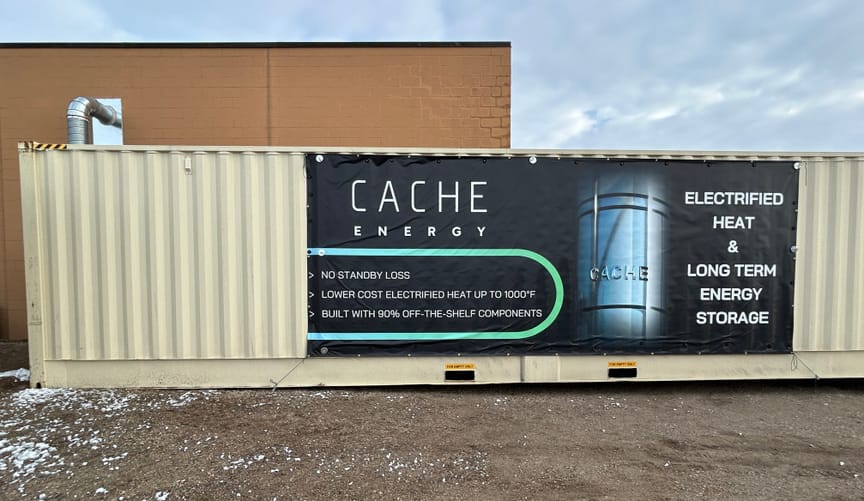
Cache Energy installed its thermal battery at the University of Minnesota, Morris, where it stores energy from the campus’ two wind turbines and releases it to heat a carpentry workshop. (University of Minnesota, Morris)
Twenty-one years ago, the University of Minnesota, Morris, became the first U.S. public university to draw power from an on-site, industrial-scale wind turbine. It added a second one in 2011. Today, the pair — affectionately known as Bert and Ernie — produce more power each year than the semirural campus consumes.
“It’s windy year-round here in western Minnesota,” said Troy Goodnough, the school’s sustainability director.
Together, Bert and Ernie crank out 10 million kilowatt-hours of electricity annually. According to Goodnough, UMN Morris consumes about half the output and sells the rest to the Otter Tail Power Co., the local investor-owned utility. Now, a first-of-its-kind thermal battery pilot is underway that, if scaled up, could help the campus use more of that juice while reducing the environmental impact of the sprawling methane-powered steam-heat loops that keep it cozy through Minnesota’s bitter winters.
Late last month, technicians from Illinois-based Cache Energy arrived on campus to install the battery unit, which transforms electricity into intense heat. Its outlet temperature can reach 1,000 degrees Fahrenheit — more than hot enough to efficiently run a steam heating system.
It took two hours to position the shipping container that houses the unit next to the school’s carpentry shop, and then another few hours to connect the unit to the building’s electrical and duct systems. It powered up on March 24 and hasn’t stopped providing heat since, Goodnough said. Its task is not small, he added: The “warehouse-like” shop has high ceilings and several thousand square feet of floor space.
“The cool thing is it’s doing what it’s supposed to be doing,” he said. “It’s working great.”
The battery unit contains limestone-derived pellets coated in a proprietary binder that keeps them intact throughout their 30-plus-year operating life, according to Cache. When exposed to a stream of moist air, the pellets get so hot they “can be used to make hot air or even vaporize water to make steam,” Goodnough wrote last month. To recharge, the system uses electricity to dry out (and cool down) the pellets.
Ideally, that electricity is cheap, clean, and otherwise at risk of curtailment, said Sydnie Lieb, an assistant commissioner for regulatory analysis with the Minnesota Department of Commerce. Lieb’s agency helps fund Minnesota Energy Alley, a public-private partnership that supports the Cache project and other cleantech demonstrations in the North Star State.
“The most cost-effective place for thermal batteries is going to be where you have a lot of excess energy being produced where you don’t have a lot of transmission or [customer] load,” Lieb said.
Western Minnesota certainly fits the bill. The wind farms that dot the open, rolling landscape here and in neighboring North and South Dakota routinely produce more energy than the grid can handle. The Midcontinent Independent System Operator, the nonprofit that manages Minnesota’s grid, throttled hourly wind generation by an average of 508 megawatts in 2023, according to the U.S. Energy Information Administration. That’s the equivalent of what’s produced by about 160 newish onshore wind turbines. The Southwest Power Pool, which manages the grid for the wind-rich region stretching from North Dakota to the Texas Panhandle, curtailed wind output by an average of 1,097 MW that same year.
Arpit Dwivedi, Cache’s founder and CEO, said low-cost electricity helps make the economic case for customers to invest in thermal batteries rather than stick with equipment that runs on natural gas, which is also plentiful in the United States’ midsection.
“We know gas is cheap,” he said, and that’s a problem for tech developers looking to electrify heat.
Another issue for big energy users, like UMN Morris, is that switching from gas to electric heat means replacing massive, long-lived boilers — likely fully paid for — with new equipment that needs to be leased or financed.
That shift is necessary if the university is going to meet its aggressive climate goals of reducing greenhouse gas emissions by 87% by 2035 and reaching carbon neutrality by 2050, but it could incur a considerable balance-sheet burden. So from the outset, Dwivedi and his team were intent on reducing Cache units’ upfront cost, he noted.
“We knew that if we did not have a low-capex system, we would not have an economic advantage,” he said.
Like other emerging thermal battery designs, Cache’s uses low-cost — if heavy — materials that are widely available in the United States. The primary inputs are steel, lime, and water, all of which Cache sources domestically, Dwivedi said. The proprietary binder that keeps the lime granules stable is by far the most expensive input, so the company focused on keeping that cost in check. Its secret ingredients are available domestically, too, Dwivedi added.
Cache offers its battery as a lease product that it says bundles the battery unit, delivery, installation, maintenance, guaranteed uptime, and takedown “without capital burden.” Just as an automaker leases a passenger vehicle, Cache retains ownership of the battery unit during the lease term, after which the customer has the option to buy it or send it back.
Cache launched in 2022. For its first few years, space heating was a sideshow. Dwivedi and his team were more focused on the technology’s potential to electrify low- and medium-temperature process heat for food, chemicals, and other types of industrial production. To that end, Cache recently conducted a pilot at a Duke Energy testing facility in North Carolina that “[hosts] several interested industrial companies,” the company said last month in a news release.
Cache still works on industrial heat, but it’s also leaning into relationships with large space heating customers, particularly those with existing hot-water or steam infrastructure such as UMN Morris. That includes the U.S. Army, which is interested in the thermal battery’s ability to provide reliable backup for military installations at risk of extended power outages.
Cache was one of nine finalists in a demonstration cohort fielded last year by Grid Catalyst, a Minnesota-based clean energy accelerator that also supports Minnesota Energy Alley.
“Decarbonizing our heating in Minnesota stood out as a value proposition,” said Nina Axelson, Grid Catalyst’s president and founder. Cache’s technology, she noted, “is simple, less costly, and really effective on thermal storage and dispatch.”
Axelson said Grid Catalyst acted as a sort of “energy matchmaker” on the UMN Morris project, connecting university leadership with the Cache team. Front-end engineering and feasibility work required some time, she said, but once the university decided to move forward, it only took a couple of weeks to get the project up and running.
“It’s about as plug-and-plug as you get for thermal storage,” she said.
Dwivedi said that while the Morris system has been charging and discharging five or six times a day, the underlying technology can actually cost-effectively store energy for months on end. That’s a big selling point for customers serious about electrifying space and process heat.
Cache is fresh off a demonstration at an Alaskan industrial site, owned by oil and gas services firm Halliburton, that validated its batteries’ ability to hold heat for a long time in temperatures as cold as minus 40 degrees, Dwivedi said. That’s a critical proof point because the price of electricity — particularly on grids rich in renewables — tends to fluctuate throughout the year, he said. A Cache system could, for example, charge up on cheap power during a sunny, windy period in October, then wait to fully discharge until a dark, still spell in December, when local power prices are likely to be higher.
With a capacity of “several hundred kilowatts,” according to Dwivedi, the unit at UMN Morris is smaller than the industrial-scale ones that Cache hopes to sell at volume in the years ahead. The startup makes units as large as 5 MW and could deliver one to Minnesota in a few months if the university decides to expand the pilot, he added.
“We see this university project as a demonstration of one of the applications of this technology, and we can scale from there,” Dwivedi said.
A scaled-up, multiunit configuration could serve dozens of campus structures with a variety of uses. Some buildings have labs, swimming pools, and dehumidification systems that require heat even in the warm months, Axelson said.
In theory, Cache units could replace gas boilers on the campus steam system and complement a future hot-water loop powered by ground-source heat pumps — an increasingly popular cold-climate heating technology that Grid Catalyst is familiar with through Flow Environmental Systems, another 2025 cohort member that produces commercial-grade systems using low-impact refrigerant. A hybrid system could more efficiently distribute thermal energy between buildings and optimize campus heating in the depths of winter, “when you need all the heat you can get,” Axelson said.
“We are looking at using this as a showcase project so that our utility, industrial, and campus partners can see it in operation,” she said. “It’s hard for folks to be first, but when you do take that first project, you really open the gates.”
As UMN Morris undertakes a comprehensive review of its energy usage, Cache’s thermal batteries are among several technologies that could factor into a “Swiss Army knife solution” for sustainable heating, cooling, and power, Goodnough said.
On paper, it looks daunting to fully decarbonize a campus whose gas-fueled heat network uses three to four times more energy than all its electrical equipment put together, Goodnough said. But the university has steadily added on-site renewable capacity, including a 500-kW solar array that “we think is the largest agrivoltaic field in the Upper Midwest,” he said.
In the not-too-distant future, it could have far more homegrown electricity to play with.
“It’s not inconceivable that Bert” — the older windmill — “could be replaced by a 5-MW turbine,” Goodnough said. If Ernie meets the same fate, UMN Morris would roughly triple its on-site wind capacity. Goodnough believes that would be a tremendous opportunity not only for the university but also for rural communities nearby.
“Out here in rural Minnesota, you see storage everywhere: grain elevators, propane tanks, fertilizer bins,” he said. “The energy transition will demand lots of different kinds of storage. It’s a natural fit for us.”


.svg)
