

 Back
Back
A yearslong project has finally started producing ammonia with wind power. If the process can be scaled up, it could help ensure farmers have cheap, reliable fertilizer.
In the shadow of a wind turbine on a low rise just outside the western Minnesota town of Morris, a cluster of tanks, pipes, and sheds holds what some believe is the key to a more self-sufficient future for the region’s agriculture and heavy industry.
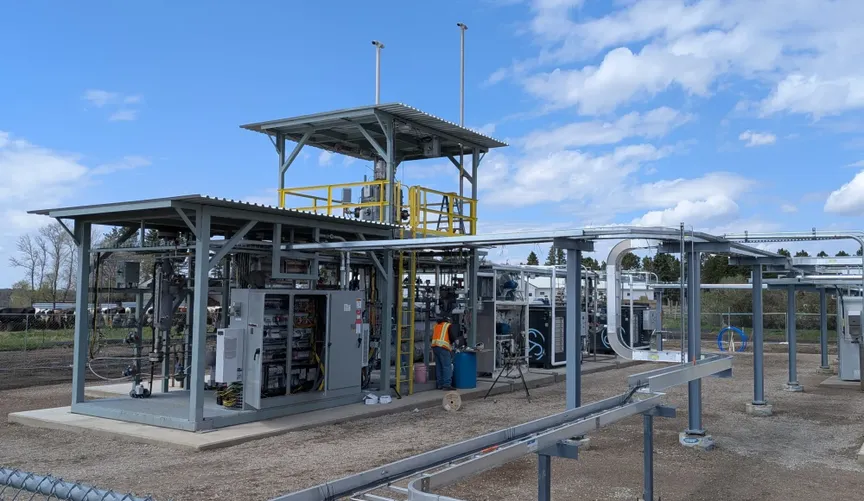
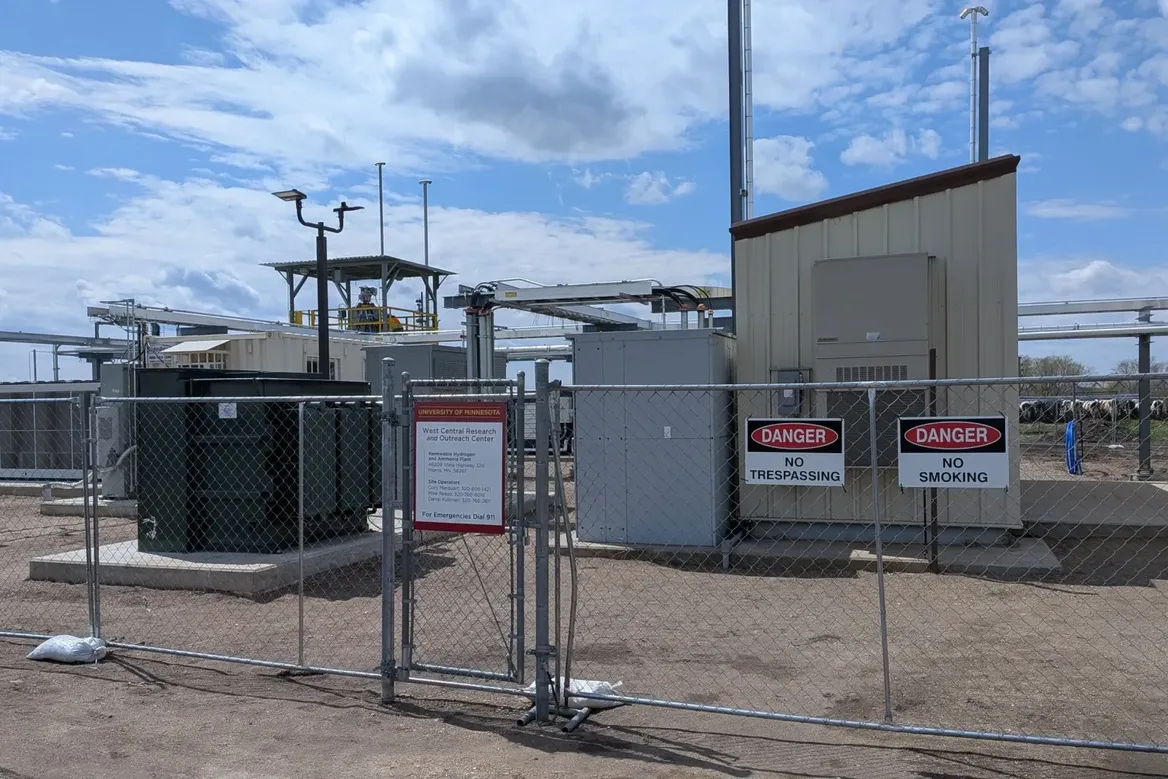
When the wind is blowing — and it often is, out here — the turbine powers two electrolyzers that cleave hydrogen from water, another system that separates nitrogen out of the air, and a third that binds the two elements to form anhydrous ammonia, a critical input for corn farming. The University of Minnesota West Central Research and Outreach Center commissioned the plant earlier this spring and can produce hundreds of kilograms of homegrown ammonia daily.
As a stable, efficient carrier of hydrogen, the homegrown ammonia could eventually supply raw material for other types of fertilizers, transportation fuels, and high-temperature industrial processes like ironmaking.
“It’s about 100 times cheaper to store and transport ammonia than hydrogen … so this is a gateway for other hydrogen-based industries,” Michael Reese, green ammonia research lead at WCROC, said on a tour of the facility this spring.
“Gateway” is the operative word here. Reese said WCROC plans to add a third electrolyzer to the project in a “future phase,” bringing daily production capacity to about 1 metric ton and annual production between 300 and 400 tons. That sounds impressive, but it’s a rounding error in a highly consolidated industry that produces around 250 million tons of ammonia annually. Minnesota alone imports up to 900,000 tons per year.
That’s a minimum $500 million annual transfer from Minnesota farmers to out-of-state fertilizer suppliers, most of which synthesize the stuff from cheap natural gas at sprawling facilities on the U.S. Gulf Coast, Brandon Isakson, managing director for industry with the St. Paul–based environmental nonprofit Fresh Energy, said in an interview. When prices are high, as they are this year, the outlay can exceed $1 billion, he said.
Anhydrous ammonia and its chemical cousin, ammonium (NH4), join nitrate (NO3) and urea (CO(NH2)2) as the three main nitrogen-derived fertilizers used in modern agriculture — often in combination. All three, along with nonnitrogenous fertilizers like potash and phosphate, are produced in massive “world-scale” plants that put out hundreds to thousands of metric tons daily. They depend on complex global supply chains to reach end users.
Right now, those supply chains are under intense pressure due to the U.S.-Israeli conflict with Iran. About one-third of the world’s urea and one-fifth of its ammonia pass through the Strait of Hormuz, which has been effectively closed to cargo traffic since the beginning of March. While the U.S. has plenty of domestic production capacity, U.S. Department of Agriculture data shows it still imported nearly 40 million tons of various fertilizers in 2025, including nearly 8 million tons of solid and blended urea. Prices for imported urea spiked when the shooting started earlier this year, underscoring domestic farmers’ tenuous relationship with global commodities markets.
Though WCROC has plans to grow the Morris facility, production likely won’t expand there in time to matter for the Hormuz crisis. Nor would it reach the kind of scale that could make a meaningful difference for Minnesota farmers, let alone other hydrogen-hungry industries.
“You’d like to be at 50,000 tons per year to be cost-effective,” Reese said.
But Reese added that he’s optimistic about a not-too-distant future where scaled-up ammonia production facilities dot the Minnesota countryside.
So are others involved with the project. Sameer Parvathikar, senior director of sustainable energy solutions at RTI International, an independent research institute that collaborated with WCROC, said at an April event celebrating the Morris system’s commissioning that it was an important milestone in a multiyear effort to stand up a new, cost-competitive industry from scratch.
“For those of us trying to push this forward from a technology perspective, you realize we have done stuff that actually matters,” he said, noting turnout that included higher-ups in the University of Minnesota system and a North Carolina–based developer looking at commercial applications for an ammonia production pathway that uses clean electricity instead of fossil gas.
At least some farmers here and elsewhere across the Corn Belt see the potential in local ammonia production, too.
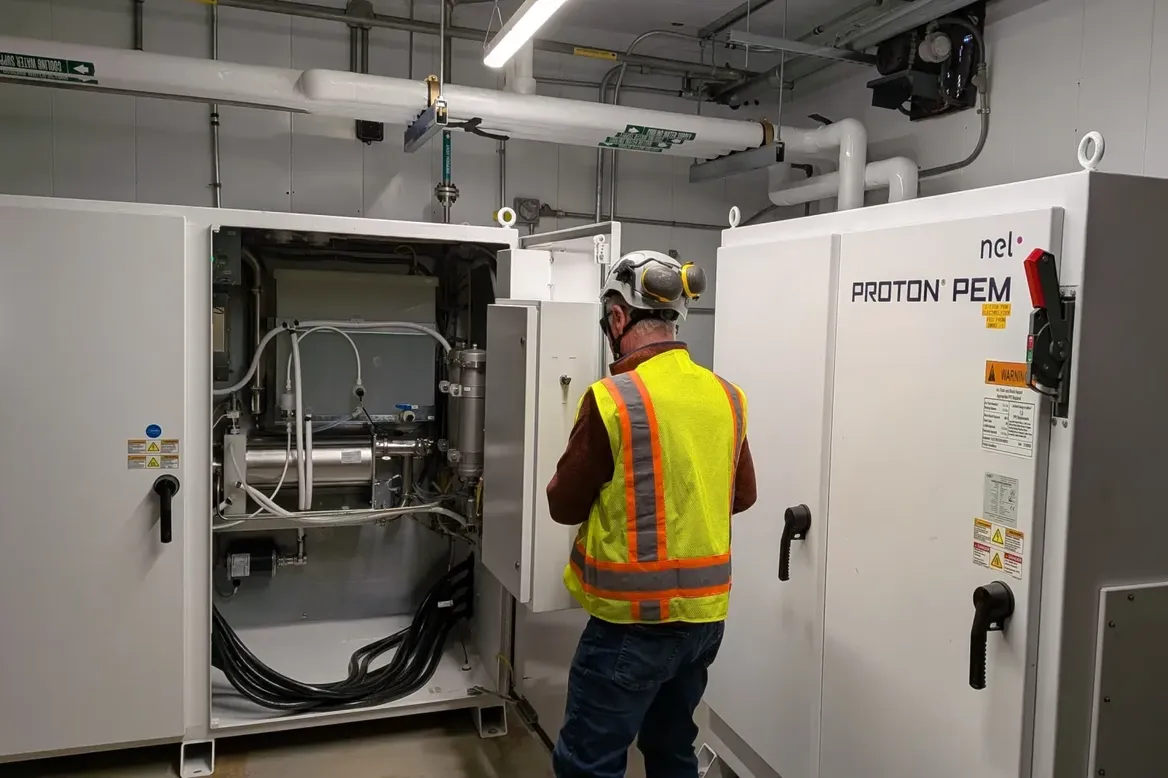
In March, a southern Minnesota farming cooperative said it would partner with a Texas-based infrastructure company, a Minneapolis-based carbon credits registry, and the local power and water utility on a project that could produce most of the ammonia its farmers need within a few years. Located in Blue Earth County, the modular plants could pump out as much as 12,000 tons of ammonia annually, the companies said.
It would be one of the first larger-scale deployments of a “modular, green ammonia system that makes the local production and distribution of a critical raw material cost-competitive and more reliable,” according to Talusag, the company behind the technology.
Talusag says its approach lowers ammonia costs by up to 50% by freeing production from fragile global supply chains and using no raw materials other than abundant sun, air, and water. In theory, its plants can locate anywhere with an adequate power supply, whether that’s the middle of farm country or a remote mine site.
KC Graner, president and CEO of Truman-based Central Farm Service, agrees. He told AgWeek in March that farm prices have fluctuated by more than 300% in recent years. Prices can swing several hundred dollars per ton in a single season.
“Local production gives our member-owners a level of control and predictability they’ve never had before,” he said.
Talusag, Central Farm Service, and CleanCounts — the Minneapolis clean energy credits registry — are among more than a dozen members of the Minnesota Made Ammonia Coalition, which pushes for “policy and practical steps” to leverage the work being done at WCROC into commercial-scale green ammonia production.
The coalition’s top priority this year was securing an $8 million legislative grant that the Blue Earth County project’s backers said was needed to move forward. That didn’t happen, leaving its near-term fate uncertain. Tristan Peitz, Talusag’s head of business development, told the House Finance and Policy Committee in April that the facility would have ammonia ready for use in 2028 if it began construction in 2027.
Talusag already operates one green ammonia facility in the Upper Midwest, near the central Iowa town of Boone. Commissioned last spring in partnership with Iowa-based farming cooperative Landus and capable of producing 1 to 2 tons daily, it’s North America’s first “commercial, modular” green ammonia plant, Talusag cofounder and CEO Hiro Iwanaga said at the time. The company is building a plant in Eagle Creek, Iowa, about 50 miles north, that can put out 20 tons daily.
The Boone facility is registered with CleanCounts, which issues a bit more than 40 percent of all renewable energy certificates in North America, chief commercial officer Rob Davis said in an interview. Each certificate, or REC, equals 1 megawatt-hour of electricity, roughly what a typical Minnesota home consumes each month.
To qualify for the federal clean hydrogen tax credit today, producers have to prove that they procured enough renewable power to offset their energy consumption each year. Beginning in 2030, they’ll need to show the power was generated in the same hour it was consumed — a much stricter standard.
“You need a tech-forward registry to be able to meet these requirements,” Davis said.
CleanCounts has dozens of software developers working on a system that can accurately match hour-by-hour output from solar and wind farms across “the vast majority of corn country” by later this year, Davis said.
It’s a big job that’s worth the effort for CleanCounts, which Davis said earns 1 cent when a REC is created and another cent when it’s retired, or claimed by the end user. For cooperatives like Landus and Central Farm Service, the RECs themselves are worth buying because they lower the carbon intensity score, or CI, of their harvests. Biofuels produced from low-CI feedstocks have an easier time qualifying for the federal clean fuels tax credit, state incentives like Minnesota’s sustainable aviation fuel tax credit, and state blending mandates like California’s low-carbon fuel standard.
Lower CI is the impetus for other emissions-reducing investments across the agriculture sector, from pipelines to divert carbon dioxide captured during biofuels production to thermal batteries to replace gas- or coal-powered equipment at ethanol plants. In May, a POET ethanol plant on the Minnesota–South Dakota border commissioned a thermal battery system that charges off the area’s wind-rich power grid, significantly reducing the plant’s reliance on fossil fuels.
Like POET’s battery, and unlike traditional fossil-fueled ammonia factories, green ammonia plants easily flex their output to match variable wind and solar production on the power grid. The WCROC plant can go from 10% to 100% production in about two hours, according to Reese.
Flexible sources of demand on the grid could help Minnesota and surrounding states use renewable power more efficiently. Federal data shows the region’s grid operator curtailed nearly 6 gigawatts of wind power on blustery days — equivalent to six large nuclear reactors — for lack of local demand and transmission capacity.
Minnesota alone would need about 5 gigawatts to produce all its ammonia locally with current technology, according to a 2024 analysis by RMI, an environmental nonprofit. That’s a lot, but maybe not too much. Davis said some projections have curtailment doubling across the region by 2035.
Beth Soholt, executive director for Clean Grid Alliance, a Minneapolis-based nonprofit advocating for clean energy development across the Midwest, said that’s one reason why the region’s policymakers, electric utility leaders, and economic development boosters were enthusiastic about localized green ammonia production just a few years ago.
“Ammonia was the low-hanging fruit, people thought … and you hear every day how expensive the farming inputs are,” Soholt said.
Former President Joe Biden signed legislation authorizing generous tax credits for clean hydrogen production and approved seven regional “hydrogen hubs” to scale and match supply and demand for the stuff. Minnesota was one of several states in the Heartland Hub, where the administration saw abundant wind power supporting a thriving low-carbon fertilizer industry.
The Trump administration has been much less supportive. It ultimately spared the Heartland Hub and four others after earlier moving to dismantle the program, albeit with a shift in focus toward fossil-based production methods. In the meantime, green ammonia boosters’ enthusiasm has been tempered by what Soholt said were “sticky” questions about the cost of electricity and other inputs.
“It just comes down to economics — do these [facilities] pencil out?” she said. “But people have done a lot of work on them.”
For many rural communities and the electric utilities serving them, hope for a green ammonia boom has been replaced by hype around another seemingly endless source of power demand: data centers. Huge computing facilities like the ones Google has proposed near Rochester and Duluth can consume hundreds of megawatts of electricity, many times more than the WCROC and Talusag ammonia plants draw.
Data center loads are less flexible than ammonia plants, however, and they’re attracting increasingly stiff pushback from rural residents concerned about noise, air pollution and other quality-of-life impacts. In addition to being better at soaking up excess renewable power, ammonia plants may be better neighbors, Davis said.
“People are beginning to realize it’s a lot harder to build data centers near wind farms … but there are a lot of farmers growing a lot of corn out near wind turbines, and they definitely need fertilizer,” he said.
While farmers will claim the first batches of homegrown Minnesota ammonia, they’re not the only potential customers. At scale, the industry could provide secure, local supply of a critical input for advanced steelmaking.
Today, most steel plants in the United States use high-grade coal to purify iron in giant, superhot blast furnaces. But those facilities are aging, and eye-watering construction costs mean the U.S. is unlikely to build a new one. So steelmakers are looking ahead to direct reduction, a newer, more flexible process that doesn’t require coal. Most present-day direction reduction plants use natural gas as the reducing agent, but experts say the process can be adapted to run on pure hydrogen.
That could happen here in Minnesota — eventually. Mesabi Metallics, the company behind Minnesota’s first new iron mine in 50 years, says making direct-reduced iron is part of its long-term vision for integrated “green” steelmaking. It’s focused on getting its Iron Range mine open later this year and hasn’t given a firm timeline for a direct-reduction plant, but the prospect is tantalizing for Iron Range boosters hoping to keep the region’s primary industry competitive well into the future.
Reese said that would mark a more sustainable return to form for a state whose early economy was closely tied to the land.
“We have an opportunity here in Minnesota to follow the model we followed in the late 1800s — to take these natural resources and transform these industries,” he said.
Editor’s note: This story is the second in a four-part series on clean energy innovations within Minnesota’s industrial sector. The series is underwritten by Fresh Energy, which like all MinnPost funders does not weigh in on editorial decisions.
Editor’s note: This story was updated on June 9, 2026, to clarify the service provided by CleanCounts, which issues and tracks energy attribute certificates such as renewable energy credits.
This article first appeared on MinnPost and is republished here under a Creative Commons Attribution-NoDerivatives 4.0 International License.
It’s the first time that’s happened across an entire month, and it comes despite the Trump administration’s efforts to reinvigorate coal and hamper solar.
The U.S. just hit a big milestone: It got more power from solar panels than from coal plants in May.
It’s the first time that has ever happened across an entire month, and all the more notable given the Trump administration’s all-out push to revive the moribund U.S. coal industry.
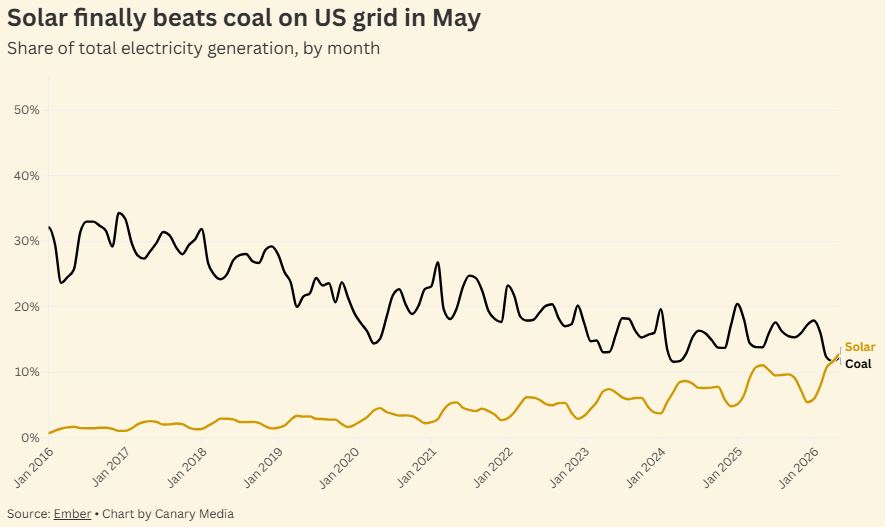
Solar produced 12.8% of the nation’s electricity in May, a sun-soaked month that’s often among the best-performing for the clean energy source, per new data from think tank Ember. Coal power made up just 12.2%, a near all-time low, while natural gas dominated the mix at 37%.
For years, the power sector was the single biggest source of planet-warming pollution in the U.S., which is itself responsible for more historical greenhouse gas emissions than any other nation. America’s heavy reliance on coal, an especially dirty fossil fuel, drove those dubious distinctions.
In the late 2000s, facing hotter competition from increasingly abundant natural gas and a burgeoning renewable energy sector, coal-fired electricity output peaked in the U.S. It’s been all downhill from there for coal, which slipped from providing nearly half the country’s electricity needs two decades ago to just 17% last year. Emissions from the power sector have fallen accordingly, and now it’s the second-largest source in the U.S., after transportation.
President Donald Trump, who has insisted that the words “beautiful, clean” precede “coal” in all instances, is trying his best to stem the sector’s terminal decline. His administration has issued a slew of controversial emergency orders requiring aging coal plants to stay online — even those that are broken or otherwise unable to run. Earlier this month, it announced it would plow $700 million into the industry, both to patch up old plants and to build two new ones.
Coal actually did produce a bit more electricity last year than in 2024, but mostly because a combination of high power demand and elevated natural gas prices made the fuel momentarily more attractive.
Still, that doesn’t reverse the long-term trend. Every year, gigawatts of new clean energy come online in the U.S., because it’s cheap and comparatively easy to build. For several years running, over 90% of new electricity capacity built in the U.S. has been in the form of solar, wind, or batteries.
Meanwhile, the last new coal plant in the U.S. was completed back in 2013.
Take those two facts together, and it’s clear that solar is going to outperform coal many more times in the near future, and by wider and wider margins each time.
A worker shortage threatens to hold up America’s buildout of geothermal networks. These groups have a plan to address the problem, starting in Massachusetts.
Geothermal networks are taking off across the U.S., with roughly 30 such projects in various stages in Massachusetts, Colorado, and elsewhere.
These systems — which use electric heat pumps and thermal energy from underground to warm and cool buildings — are key to weaning communities off polluting fossil-fueled appliances and reining in home utility bills, supporters say.
But the buildout faces a major roadblock: There just aren’t enough qualified workers to drill the thousands of boreholes needed for the anticipated networks. The United States now has about 19,500 professional drillers working outside the oil and gas industry, according to the federal Bureau of Labor Statistics. This workforce would need to triple in size to meet the U.S. Department of Energy’s target, announced in 2022 under the Biden administration, of installing 17,500 geothermal networks by 2050, said Brock Yordy, president and co-founder of the Geothermal Drillers Association.
“This work is absolutely essential in New England and anywhere there are legacy heating systems that are fossil-fueled,” said Lawrence McKenna, chair of the Department of Environment, Society, and Sustainability at Framingham State University in Massachusetts. “But we don’t have the personnel to man the equipment.”
An initiative led by the nonprofit Home Energy Efficiency Team, or HEET, and the Geothermal Drillers Association aims to turn this obstacle into an opportunity. As many states attempt to reduce their carbon emissions, the natural gas industry is likely to slow down, leaving many experienced workers unemployed. At the same time, young people are entering a job market that, well, “sucks,” said McKenna. The anticipated growth of geothermal networks could create jobs that repurpose gas workers’ existing skills, pay well, and lead to career paths that can’t be undone by AI.
The vision is to create a nationwide network of Geothermal Drilling Centers of Excellence that will conduct training and research to develop the geothermal drilling workforce. Each center would offer programming tailored to meet the location’s specific needs.
“It’s a huge advantage to have something like this exist regionally, so you can pace the workforce development with the market development in a more cost-effective, reasonable way,” said Zeyneb Magavi, HEET’s executive director.
The first center is set to launch later this year in Framingham, Massachusetts, home of the country’s first utility-owned, neighborhood-scale thermal network. The training will build on the Geothermal Drillers Association’s existing two-week pre-apprenticeship program, which provides the groundwork for understanding the field, including the basics of geothermal science, the fundamentals of drilling boreholes, the differences between various drilling disciplines, and workplace safety and protocols.
This training provides a valuable on-ramp into the industry, but so far has been missing a major component: real-world drilling practice. Buying a drill rig was not in the budget, and leasing one proved difficult. After two days of safety training, students visit jobsites and observe work, but are not allowed to operate the drilling equipment.
“Right now, we can do the classroom work, and we go into the field and visit projects,” Yordy said. “But you can’t get the practical piece.”
The Framingham Center of Excellence will solve that problem. In April, the Massachusetts Clean Energy Center, an economic development agency, awarded the program $1.2 million in grants that will allow the initiative to buy a drilling rig and mobile classroom. This equipment will allow students to do hands-on drilling.
At the same time, Framingham State plans to launch a more intensive offering: a yearlong, six-course certificate program in geothermal science and engineering. Currently, the only comparable training operates out of a college in Canada, Magavi said. The Massachusetts program will delve into all the trigonometry and thermodynamics needed to understand how the systems work, and include several lab classes. The program will work with the Geothermal Drillers Association to give students access to hands-on training.
“They’re out doing the very work they’re going to do when they finish, with real equipment and real professionals in the field,” McKenna said.
Organizers are still figuring out exactly what the first Center for Excellence will look like. They’re reviewing possible sites for training and drilling practice within Framingham and nailing down the specifics of the partnership with Framingham State.
“This Center of Excellence is very much being collaboratively bootstrapped into existence, moving from our collective imaginations into reality,” Magavi said.
If the vision is realized, the benefits will reach beyond just the individuals entering new careers and the residents getting cleaner, more affordable heating and cooling, supporters say. A thriving geothermal workforce can lead to more widespread economic development.
“It’s not just about the jobs,” Magavi said. “Building the energy infrastructure of the future is an extraordinary development action.”
Corrections were made on June 11, 2026. The story misstated the access that students in pre-apprenticeship training have to jobsites and the topics to be covered in the Framingham State University certificate program.
The state’s Republican attorney general — a gubernatorial candidate — sued to stop the new Trump-backed smelter, which would double America’s aluminum output.
A power-hungry aluminum smelter planned in Oklahoma is facing a new legal challenge that aims to stop the massive project in its tracks.
Last week, Oklahoma’s attorney general sued to block Emirates Global Aluminium (EGA) and Century Aluminum from building the $4 billion facility, which is slated to more than double the nation’s capacity for producing aluminum from scratch.
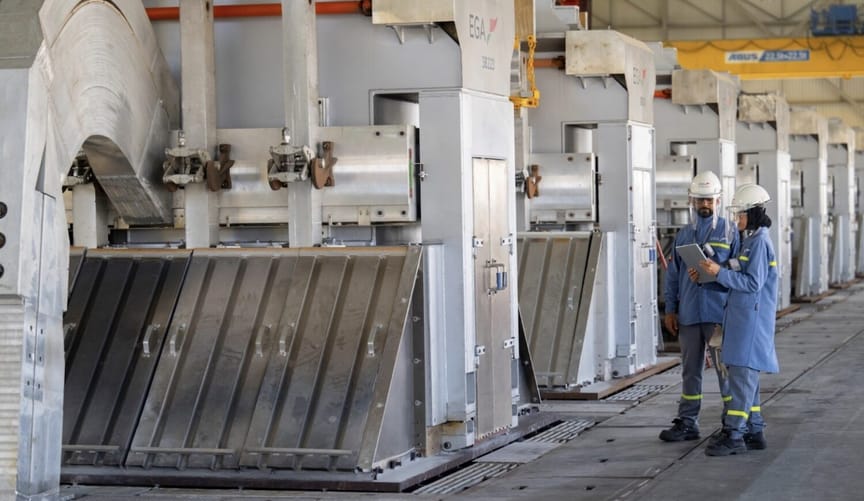
Gentner Drummond, the state’s attorney general, said he took action to protect Oklahomans from the “anticipated public nuisance” he claims the smelter represents. Drummond is running to be the Republican candidate for Oklahoma governor, and the lawsuit has intensified debate about the project in what is becoming an increasingly heated primary race.
Drummond raised concerns that the facility would pollute the air and water and harm cattle and crops in Inola, the rural town in northeastern Oklahoma that is set to host the plant. Residents in Inola share those environmental worries, and local opposition to the smelter — which would be America’s largest if built — is mounting as developers get closer to starting construction this year.
The lawsuit also flagged the smelter’s enormous electricity appetite. The new facility is expected to require over 1 gigawatt of continuous electricity to operate — enough to power a city the size of Boston or Nashville annually. The attorney general claimed that this level of consumption will place “extraordinary strain on the regional grid” and threaten “the reliability and affordability of electricity for Oklahoma ratepayers.”
The developers are currently pushing to finalize a crucial long-term power contract for the smelter, which could draw from Oklahoma’s abundant natural gas and wind energy resources and solar energy potential.
Drummond further objected to the foreign involvement in the project: EGA, a state-owned enterprise of the United Arab Emirates, has a 60% stake in the smelter, while Chicago-based Century owns 40%.
However, the timing of Drummond’s June 2 filing has raised questions about his motivations, and it’s unclear how big a threat the legal action poses to the smelter’s prospects.
Drummond filed his lawsuit four days after President Donald Trump — who has championed the smelter — endorsed Drummond’s rival, former state Sen. Mike Mazzei, for the June 16 gubernatorial primary election.
Mazzei himself had strongly opposed the aluminum plant until very recently, criticizing the hundreds of millions of dollars in tax incentives the project is expected to receive from the state of Oklahoma, including power discounts. The project has also been awarded a $500 million grant from the U.S. Department of Energy.
On May 29, just hours before Trump endorsed him, Mazzei publicly reversed course. He announced on social media that he would strongly support the smelter as governor and would “work with the Trump administration to bring more projects like it to Oklahoma.”
Oklahoma’s outgoing Republican governor, Kevin Stitt, accused Drummond of “weaponizing” the attorney general’s office to retaliate against Trump. In a video message on Facebook, he framed the smelter as key to protecting America’s national security interests, given that China accounts for about 60% of the world’s annual output. Aluminum is used to make not only household products and construction materials but also fighter jets, warships, helicopters, and ammunition.
Drummond, for his part, has denied any ulterior motives. He said he filed his lawsuit in response to the developers’ air-quality permit application, which they submitted on May 19, the news site Oklahoma Watch reported.
“A primary aluminum smelter does not belong in a community’s backyard, and its emissions do not respect property lines,” Drummond said in his initial statement, adding that winds could carry pollutants into the surrounding northeastern Oklahoma communities.
Putting aside the messy governor’s race, the aluminum smelter will undoubtedly change the landscape in Inola, which hails itself as the world’s “hay capital” and is home to many thousands of heads of cattle. The industrial facility is set to span 350 acres along the Verdigris River, where every year it will convert raw materials into 750,000 metric tons of aluminum, not far from schools, homes, and farms.
Last fall, the climate advocacy group Industrious Labs conducted a statewide survey to gauge Oklahomans’ views on the proposed smelter. Some 62% of respondents said they supported the project. But proponents, opponents, and skeptics all said they had at least some environmental worries about bringing heavy industry like aluminum smelting to the state.
“We’ve seen bipartisan support for reshoring domestic manufacturing, and specifically aluminum — both the Biden and Trump administrations are prioritizing this,” said Annie Sartor, senior campaigns director at Industrious Labs. “But concern around local air and water pollution is also bipartisan. People are concerned about dirty industry coming into their neighborhoods.”
Traditionally, America’s smelters have spewed significant amounts of pollution, including fluoride and mercury, which can damage crops and livestock. They also release perfluorochemicals — potent and long-lasting greenhouse gases — and emit sulfur dioxide, which can harm people’s respiratory systems and damage vegetation. Smelters have discharged wastewater into rivers and streams, and they generate toxic waste as the lining in the smelting tanks breaks down.
EGA and Century claim the Inola facility will be significantly cleaner than existing U.S. smelters — the last of which was built in 1980. The companies are building the project through a joint venture named Oklahoma Primary Aluminum, which will use the latest version of technologies that EGA has been developing over decades.
“This facility is designed to be the most modern aluminum plant in the world,” Oklahoma Primary Aluminum said in a statement to Canary Media. On their website, the developers say the smelter will be “highly controlled, with multiple environmental safeguards in place,” including for filtering and monitoring pollution and reducing emissions and energy use.
Oklahoma Primary Aluminum also nodded to questions about the smelter’s enormous draw on the region’s grid. Developers have been negotiating a power agreement for more than a year with Public Service Company of Oklahoma, a subsidiary of the utility giant AEP. Any deal will need to be reviewed through a regulatory process overseen by Oklahoma’s public utilities commission.
“A key purpose of that process is to assess and minimize potential impacts on residential and commercial customers,” the developers said in response to the lawsuit. They added that EGA’s modern smelting technology can reduce electricity use by about a third for every ton of aluminum produced, compared with America’s remaining fleet of aging smelters.
Most U.S. grid operators already use OATI’s software. Now the firm wants to tap AI and data to boost transmission capacity — and it’s asking the DOE for funding.
A major grid-tech company is asking the Trump administration to fund a project it says could significantly boost the nation’s ability to move power around — without building a single new transmission tower or line.
Open Access Technology International (OATI) is a Minneapolis-based firm whose software is used by nearly every North American transmission grid operator to manage the flow of electrons. Now, it envisions developing new features for that software. Huge amounts of data, parsed by artificial intelligence, would be used to more accurately calculate how much power can run along power lines — providing both real-time estimates and forecasts days and weeks into the future. That intel would be automatically shared among neighboring grid operators, allowing them to make better decisions about how to run their networks.
If all goes to plan, OATI says the facelift could accomplish a 10% to 20% increase in capacity across participating systems by 2030.
OATI unveiled its scheme in a May proposal for an undisclosed amount of money from the Department of Energy’s $1.9 billion SPARK grant program. The program uses money from the 2021 bipartisan infrastructure law, in a somewhat rare example of Biden-era energy funding spared from the Trump administration’s clawbacks.
The company’s proposal is a kind of “grid-enhancing technology,” a family of hardware and software that could squeeze more capacity out of the nation’s increasingly congested grid. These solutions have the potential to save the nation billions of dollars in excess power costs by unclogging transmission bottlenecks that prevent cheap electricity, much of it from wind and solar farms, from reaching places that need it. That could help curb skyrocketing utility bills for households and businesses.
The problem in the U.S. today is that these tools are almost exclusively deployed as pilot projects on one power line at a time. To achieve the big savings, multiple utilities and grid operators will need to use this tech in a coordinated way across the country’s region-spanning transmission networks.
OATI — with its decades of data and vast existing connections across the power industry — thinks it can catalyze that sort of large-scale deployment. It’s already enlisted a sizable group of partner organizations that have agreed to implement the new software add-ons, among them the grid operators California Independent System Operator, New York Independent System Operator, and Southwest Power Pool; the utilities Dominion Energy, Duke Energy, NextEra’s Florida Power & Light, PacifiCorp, and Portland General Electric; and the electricity cooperatives Great River Energy and Lakeland Electric.
John Engel, OATI’s associate vice president of strategic marketing, noted the company would bring significant matching funds to the table to deploy its software.
“What we can do is across 95% of North America,” Engel said. “There’s a speed and scale there that’s unique — and the [Trump] administration has said they want fast, durable, and cost-effective solutions.”
One of the key goals of OATI’s proposal is to deploy a version of a technology called dynamic line rating, or DLR. Over the past 20 years, DLR has evolved from devices that clip onto power lines, to sensors on transmission towers that monitor lines via optics and electromagnetics, to software-only approaches — like OATI’s — that use weather and grid data.
All these different methods have a common purpose: to determine the constantly changing true capacity of high-voltage power lines.
Quite often, that true capacity is greater than the traditional “static” ratings assigned to power lines, which don’t take weather and wind speed into account. For example, breezy conditions can cool lines, allowing them to safely carry more electrons at the same time that wind farms are generating the most energy.
Armed with this knowledge, operators can dispatch higher levels of power flows across parts of the grid they’d otherwise have to curtail. In a 2024 report, the DOE estimated that widely deployed DLR could increase existing grid capacity by roughly 80 gigawatts, saving billions of dollars in transmission infrastructure costs.
DLR in the U.S. has been hindered by a fractured regulatory landscape and the fact that transmission-owning utilities earn money by investing in new infrastructure, not by installing technology that makes their existing grids operate more efficiently. But players in Europe have been using the tech in a systematic way for more than a decade. Belgian grid operator Elia has achieved an average 30% increase on its transmission grid using DLR.
OATI, for its part, already has some experience tweaking line ratings based on weather, said Kevin Sarkinen, the company’s chief operations officer.
Back in 2021, federal regulators ordered all transmission operators to start using ambient adjusted ratings — essentially, hourly ratings based on daily temperature forecasts — by July 2025. OATI’s platform has already integrated those ratings into its transmission capacity calculations. “Now we’re adding in the capability for the DLRs,” Sarkinen said. That will bring in additional real-time data, like cloud cover, heating from the sun, and, most importantly, wind speed and direction, which have a huge impact on power line capacity.
The U.S. hasn’t been standing still on DLR. Deployments in Indiana, Minnesota, New York, Ohio, Pennsylvania, Texas, Virginia, and other states have shown the technology can significantly increase capacity on individual power lines.
But getting more headroom on one line only gets you so far on a networked grid that must operate as a unified whole. As a 2019 DOE report put it, “DLR has the potential to expand the Nation’s power highway system, but the exits and intersections must be capable of using that new capability for it to be worthwhile.”
OATI wants to leverage its broad customer base to make such an integration possible, Sarkinen noted. It will work the real-time DLR data into its software suite, which 95% of North American transmission operators use to share information about their available capacity and to manage the flow of power across networks.
The firm also plans to leverage its AI-informed Genie platform to boost the usefulness of all these figures. It’s been deploying that tech with California’s grid operator over the past two years, Engel said, processing large amounts of data to quickly decide how to safely reconfigure systems when power plants go offline or individual transmission lines are overloaded.
In this new use case, OATI’s Genie platform “looks at the modeling and coordination of these grid operators, and applies some AI technology to these coordination processes to increase the accuracy of the grid,” Sarkinen said. The AI applications allow for “constant assessment of how accurate your calculations were” as well as forecasting “if you want to make capacity available tomorrow or next week.”
OATI and its partners hope to start turning these technology deployments into real-world grid capacity improvements by the third and fourth years of their joint project, Sarkinen said. That’s practically light speed in the world of transmission, where construction of a single line can sometimes take decades.
All this is easier said than done.
OATI may not get the DOE funding, although company executives said they plan to move forward with the initiative regardless.
And the project could face unforeseen technical hurdles and delays. The new features are still works in progress, and even though they are based on lots of data, dynamic line ratings are still just estimates. Utilities and grid operators will need to learn to trust the data for both real-time decisions and forecasts, since these organizations make commitments to transport energy hours, days, or even weeks in advance.
“We can’t perfectly predict the weather, and we have to integrate that uncertainty into how we operate the grid,” said Aidan Tuohy, director of R&D for transmission operations and planning at the Electric Power Research Institute, a nonprofit utility research organization that’s working on a range of grid-enhancing technology projects with partners including OATI. But the latest advances in AI are increasingly useful in “using past data to predict what’s going to happen,” he said, by cross-checking ongoing forecasts against historical data from grids operating under similar conditions.
A lack of confidence in these weather-based predictions is one of the main barriers to making the most out of DLR, said Georg Rute, CEO of Gridraven, a startup that’s deployed its technology across Finland’s national grid and relocated to Texas last year to support plans to expand in the U.S.
“What I hear from the engineers, who have a veto right at transmission companies to turn on DLR, is that they don’t have the confidence that the forecasts work,” he said. “That is the real blocker. It’s not so much the incentives or the regulation.”
But although sticking with the status quo may be simpler, all U.S. utilities and grid operators are under federal mandate to integrate grid-enhancing technologies into how they bring new power generation online and make long-term plans for expanding their grids — and to find near-term ways to manage strains caused by power demand from data centers.
Meanwhile, utilities are struggling to manage a “more complex grid, with more exchanges between regions, more data centers, more variable and distributed resources,” Tuohy said. “Having the data to make decisions is going to become increasingly important.”
A correction was made on June 10, 2026: This story originally misstated that OATI executives declined to comment on whether they would move forward with their grid-enhancing tech project without DOE funding. Executives have clarified they plan to move forward with the initiative regardless of whether it secures the federal funding.
The company’s Cartersville, Georgia, factory is the largest of its kind in the nation — and it just started producing the key solar panel component.
Qcells has officially begun commercial production of silicon solar cells at its factory in Cartersville, Georgia, the company said Tuesday. That factory is the largest of its kind in the country — and a long-awaited boost to the U.S. solar supply chain.
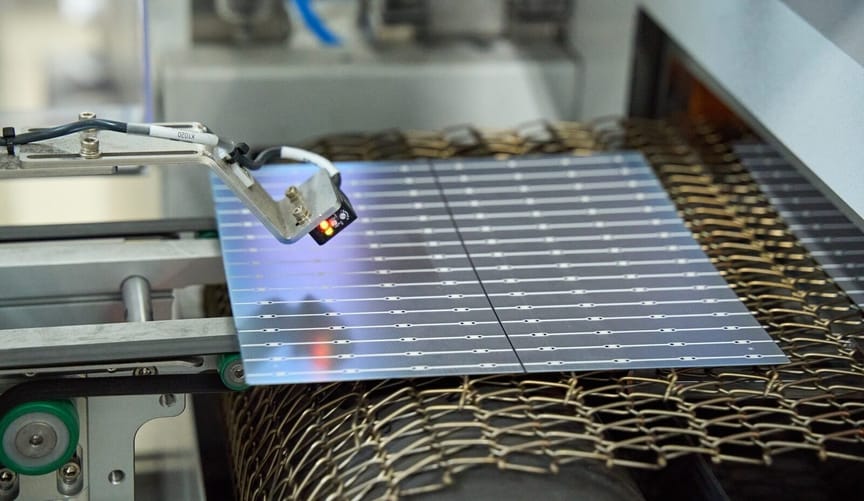
For five years straight, the U.S. power sector has built more solar farms than any other kind of power plant. In 2022, the Biden administration crafted industrial policy to ensure as many of those solar panels as possible were made in America. Previously, the U.S. solar manufacturing base had withered in the face of stiff competition from China — but the industrial revival effort worked. In just a few years, the U.S. has opened up enough factories to assemble nearly 70 gigawatts of finished solar panels, according to the Solar Energy Industries Association.
That’s well beyond what the U.S. installs in a year, but production of the cell — the high-value component that converts sunlight into electricity — has lagged far behind.
Previously, just three other companies made the component in the U.S.: Suniva can produce 1 gigawatt at its cell factory in Georgia, and ES Foundry and Silfab each can make 1 gigawatt in South Carolina. In a few months, Qcells will be able to manufacture 3.3 gigawatts at its cell factory, which would more than double the current operational U.S. solar-cell capacity.
“It’s a great achievement for an industry that had zero active cell capacity in the last couple of years,” said Scott Moskowitz, vice president of market strategy and public affairs at Qcells.
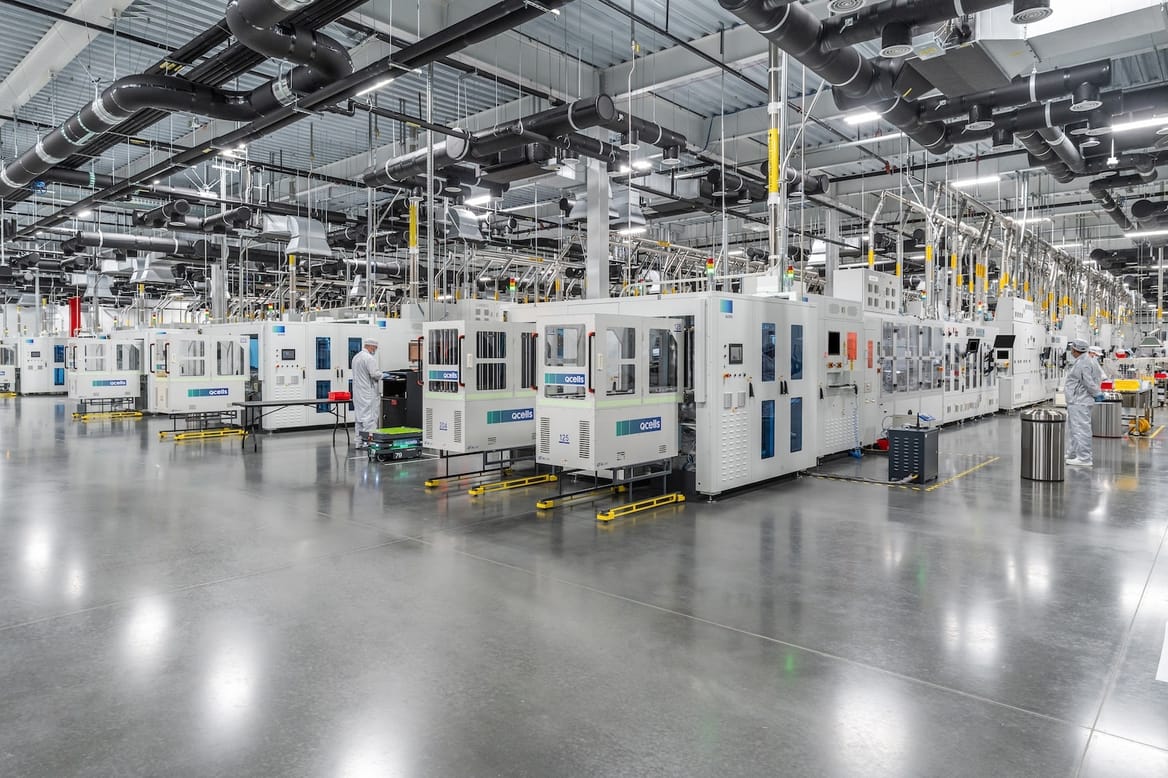
Qcells, once a German solar-cell maker and now a subsidiary of Korean industrial giant Hanwha Group, first announced the Cartersville project in early 2023, pledging to colocate production of four components of the solar supply chain: silicon ingots, wafers, cells, and modules. The module lines went live in 2024. The full facility was originally supposed to open that year, but it took longer to calibrate those more complicated processes. Currently, the full 3.3-gigawatt production of the four solar components is slated for the third quarter.
Another 22 gigawatts of cell capacity is under construction across the U.S., per the Solar Energy Industries Association, though that figure is constantly evolving. On Monday, Japan-headquartered Toyo said it would spend $357 million to add 1.5 gigawatts of cell production at its Houston module-assembly plant. ES Foundry is working to expand its factory to 3 gigawatts by year’s end. T1 Energy is building a cell fab outside Austin. Additionally, First Solar’s U.S. factories produce up to 14 gigawatts of cadmium-telluride thin-film panels, which generate electricity without needing silicon-based cells.
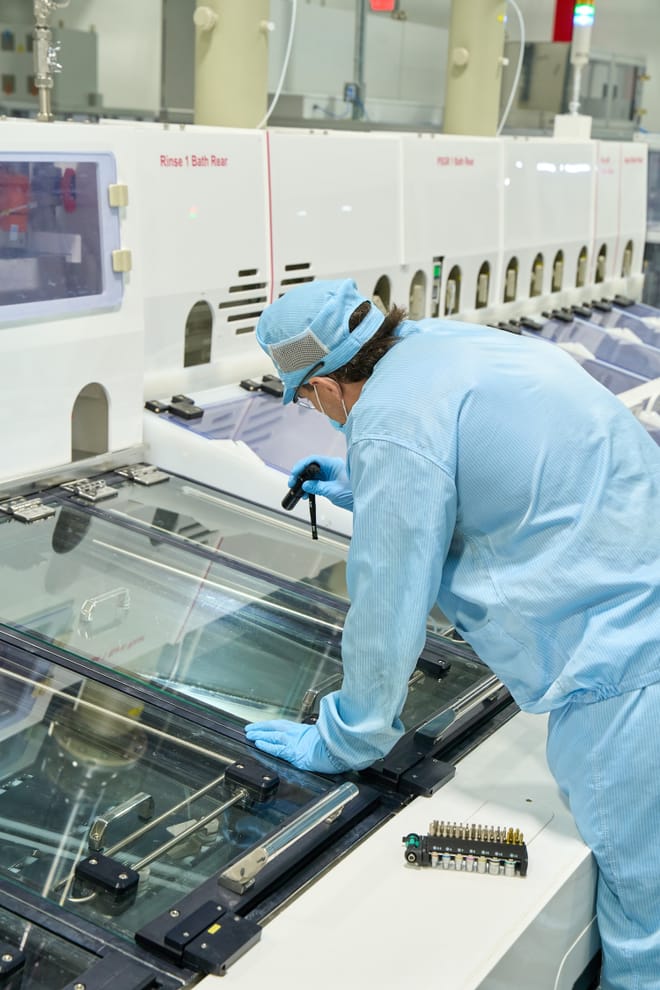
Crucially, potential manufacturing capacity does not equate to production. Silfab, for instance, temporarily closed its cell factory after it accidentally released potassium hydroxide and hydrofluoric acid in rapid succession in March. (State authorities found no impact to the surrounding community, including a nearby elementary school.) Compared with the largely mechanical work of robotically assembling all the pieces into a finished panel, etching silicon wafers into cells is heavy industrial work that involves potent chemicals and other cleanup concerns.
“You’re leveraging complicated science to create a solar cell that generates electricity,” Moskowitz said. “There are more steps to the process, and the steps are more intensive.”
The giant, L-shaped Cartersville site houses “four factories in one,” he noted. At one end, polysilicon gets melted into ingots, and the pieces move sequentially through the discrete steps until complete panels roll off the line at the other end of the building. Between this factory and the module assembly operation about 30 miles north in Dalton, Georgia, Qcells expects to employ 3,800 people in the region doing high-tech, robot-assisted manufacturing.
Developers who use domestically produced cells can more easily qualify for the domestic-content tax credit bonus. Qcells also earns a higher manufacturing tax credit for each cell that it makes. These policies arose in the Biden-era Inflation Reduction Act, which was intended to spur a U.S. manufacturing renaissance for clean energy. The Trump administration subsequently phased out the credit for installing solar projects after July 4, but projects can still claim the credits for four years under “safe harbor” rules.
Once the safe-harbored projects get built or fall through, developers will lose the major financial incentive to buy American cells and panels rather than look for the cheapest imports that can get past the U.S. tariff regime. Domestic production does, however, offer a potentially winning story for developers to tell to skeptical communities or political leaders. It also insulates their project timelines from disruptions in foreign trade, as seen during Covid, or the current surge in shipping costs linked to the U.S. war with Iran.
The future is hard to predict, but for now, demand for electricity production is higher than it has been in a generation. The tech giants building AI have become obsessed with “speed to power,” and it’s hard to imagine a faster way to achieve that than to order solar panels that arrive on a truck straight from the factory.
Can electric vehicles finally start working as backup batteries for homes and the grid? This 120-home pilot project in California is working out the kinks.
At first glance, Frances Bell’s home in Oakland, California, doesn’t look like a postcard from the EV-powered future. But if a new program takes off, it could be a harbinger of what’s possible for homes across the state and the country.

Sure, there’s a shiny new Kia EV9 in the driveway and a black charging cord that runs from the car to an EV charger on the side of her house. But that’s a pretty standard setup in California, the nation’s leader in electrical vehicle adoption.
What makes this EV and the charger special is that they don’t just draw power — they also send it back to both Bell’s home and the grid.
As the CEO of Bidirectional Energy, Bell is outfitting homes across California with the same Wallbox Quasar 2 bidirectional direct-current charger that’s mounted to her house. This year, Bidirectional Energy and Wallbox are installing the equipment at about 120 homes as part of a state-funded pilot program that offers participants rebates for two-way chargers. Bell’s household was among the earlist to enroll, primarily to test the technology firsthand.
Their goal: to establish rules of the road for city and county permitting inspectors and utility interconnection engineers to handle these installations, similar to the standards for regular one-way EV chargers and backup batteries.
“From my perspective, a DC bidirectional charger is essentially the same technology as a solar or battery inverter,” Bell said. And those technologies are straightforward for a household to install.
Bidirectional systems are not anywhere near as simple to adopt. Pilot projects have been going on for decades, and federal and state governments have been working with automakers, charging manufacturers, and utilities to standardize the underlying technologies. Nevertheless, no large-scale programs exist today to allow customers to send power from their EVs to the grid or their homes.
If companies like Bidirectional Energy and Wallbox can crack the code on broader adoption, it could unlock serious benefits to the grid and consumers. Vehicle-to-grid (V2G) applications can turn cars into cheap energy storage for the electricity system and vehicle-to-home applications (V2H) can turn their cars into batteries that can power their house, saving them money.
Bell is convinced that the larger scale of this California program will help push the technology out of pilot purgatory and into the mainstream.
“Previous bidirectional demonstrations were in the ones and twos,” Bell said. “When you get to 100 or more, you start to get to more standard processes. That’s how you start to scale.”
On a sunny May afternoon, Bell showed off her bidirectional charging system — and the benefits it provides.
The combination of Wallbox’s hardware and Bidirectional Energy’s software can actively draw power from the battery of a Kia EV9 to reduce a household’s costly utility bills, to send power to the grid to prevent rolling blackouts, or to power a home during an outage. The system isn’t available for use with other EVs yet, though the companies are in discussions with undisclosed automakers.
“If the grid goes down, this will just kick in. You don’t have to walk out here and switch it,” Bell said. Then she flipped a switch in the Wallbox power recovery unit, which connects the Quasar 2 to Bell’s electrical meter and the grid beyond, to mimic a power outage.
With a click, Bell’s home was being powered by the Kia EV9’s battery, which stores about 99 kilowatt-hours of energy. That’s as much as seven Tesla Powerwall batteries, and enough to keep a typical home powered for about three days, Bell said.
Next, Jessica Kwong, Bidirectional Energy’s senior software engineer, sent instructions from her laptop to the company’s software platform to curb grid power use to avoid high time-of-use rates. Bell opened the Bidirectional Energy app on her iPhone to track the shift in home power coming from the EV battery. Then she toggled to a screen that showed the money she’s saving on her utility bill.
“Every day, when I plug in my car, this number ticks up,” Bell said.
Finally, Kwong mimicked a demand-response event, when utility customers are asked to either send stored energy back to the grid or simply use less energy when the grid is under stress. The EV’s battery started delivering 12.5 kilowatts of steady power back to the grid — and earning money for the grid relief it was providing.
None of this is particularly groundbreaking from a technical perspective, said Bell, who’s worked at battery companies including Tesla and Fluence and as a grid planner for Northern California utility Pacific Gas & Electric. And after years of work from automakers, charger manufacturers, and software companies, a lot of progress has been made on setting the technology standards for bidirectional charging, she said.
That’s why this Bidirectional Energy and Wallbox project, funded by the California Energy Commission, is focused on more than simply proving the technology works, she said.
“We’re training some of the first installers, we’re getting the first interconnection processes established, and hoping to take that to other geographies.”
Bidirectional charging is an intuitive idea: Most cars spend most of their lives parked, which means that EVs are often sitting there with unused battery capacity that could be helping the grid, making money, or providing emergency backup services.
Lots of utilities are working on managed-charging programs, which ask customers to shift when their EVs pull power from the grid, whether to mitigate their contribution to peak power demand or to avoid overloading local circuits and transformers. That’s important, but it ignores EV batteries that could actively bolster the grid, not just reduce strain on it.
In California, the value of that latent EV capacity could be “an order of magnitude larger” than simply throttling EV charging, according to a 2021 study by University of California, Irvine, professor Brian Tarroja and Rochester Institute of Technology professor Eric Hittinger. It could also provide EV owners with thousands of dollars per year in utility bill savings and demand-response revenue, the report found.
Still, the approach has remained elusive — something of a holy grail for the EV industry.
Automakers have promoted these kinds of uses for years, from the earliest Nissan Leaf EVs to the now-discontinued Ford F-150 Lightning. Some automakers have designed their own vehicle-to-home connectors, as with the PowerShift charger from General Motors’ GM Energy business and Tesla’s Backup Switch for enabling Cybertruck Powershare mode. A growing number of EV-charger manufacturers make bidirectional-capable chargers that have been certified for use in California and in other states.
Many other states are pushing utilities to explore the concept, too, whether it’s using electric school buses as grid batteries or enabling homes to rely on plugged-in EVs for grid relief.
But California has set a goal of having 8 million light-duty EVs on its roads by 2030, making it ground zero for development via utility trials, state-funded pilot programs, and regulatory guidelines for streamlining bidirectional charger interconnections.
Wallbox, a Spanish company that does a lot of business in Europe, has seen a big uptick in North American sales in recent years, “especially when we talk about V2G,” said Oliver Waterhouse, the company’s director of strategic partnerships.
But injecting power from EV batteries to the grid “requires collaboration with utilities and grid operators,” he said — and while customers are eager to set up their EVs as backup batteries, “a lot of demand falls off when it takes 6 to 9 months to get an interconnection complete.”
Wallbox initially launched the Quasar 2 in partnership with Kia as a home backup system, he said. “Then Bidirectional Energy came in and said, ‘Let’s make it V2G as well.’”
One of the trickier tasks for the two companies has been getting the components of the bidirectional system to feel like a single streamlined experience for the customer, Bell said. To achieve this, the companies have been establishing the linkages between onboard EV-battery management systems, the controls embedded in the chargers, and the inverters within those chargers, which deliver power to the home and the grid, Bell said.
Industry groups and certification organizations have settled on a plethora of technology standards for handling those tasks. But every automaker and charger manufacturer may implement them slightly differently, which means each combination has to go through its own round of testing.
Automakers also need to make sure cars are charged when drivers need them to be. “First and foremost, you want your car to be a car,” Bell said. Bidirectional Energy’s software allows customers to set what time in the morning they want to be fully charged and establish limits on how much power can be pulled from their EV batteries, she said.
Getting utilities to trust that these underlying controls can safely send power back to the grid has been the next challenge, Waterhouse said. Wallbox has gone through these processes with all three of California’s major utilities, he said, “but when you submit interconnection applications, they all have different questions.”
This is where doing hundreds of installations, as is the plan for the second phase of the Wallbox and Bidirectional Energy pilot, can start to smooth things out, Bell said. Utilities have sent engineers to pore over every detail of the first installations done by Wallbox and Bidirectional Energy, she said. That’s pretty similar to how utilities used to treat conventional home batteries, she noted.
“For solar and batteries today, there’s no engineer that gets sent to the house,” Bell said. “Getting these first 120 right will be really key for the next hundred or thousand — or million.”
A correction was made on June 9, 2026. The story misstated that bidirectional charging systems can export EV battery power to the grid during an outage.
The Tumbleweed installation just went online in Kern County. It can store clean energy and discharge it for eight hours straight, a harbinger of what’s to come.
On June 1, the Tumbleweed project in California’s Kern County became the first major battery installation in the U.S. that can discharge power for up to eight hours at a time — twice as long as typical energy-storage facilities.
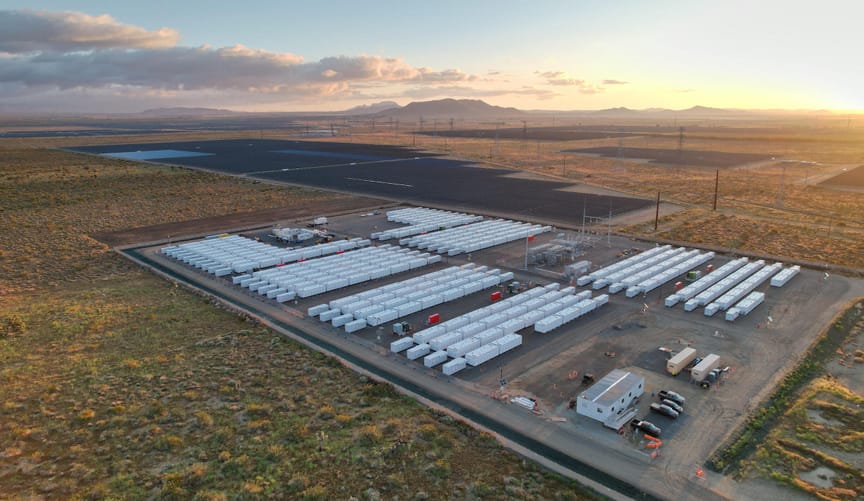
The U.S. power sector now builds more battery storage capacity than any other form of on-demand power, like gas, nuclear, or geothermal. But battery developers typically design their projects to discharge at maximum capacity for four hours before running out of juice; that’s what has made sense, so far, given equipment costs and market opportunities. Analysts have concluded that longer-duration storage is needed to cost effectively power the grid with clean energy 24/7.
Consequently, California regulators in 2021 ordered power companies to procure longer-duration storage as part of the state’s planned transition to zero-carbon energy. California Community Power, a consortium of local nonprofit power providers, issued a contract for Tumbleweed back in 2022 to fulfill this obligation.
“This was one of our first eight-hour contracts in the country for batteries, and now it’s one of the first projects online, and it’s a complex deal with a bunch of members coming together,” said Alex Morris, general manager of California Community Power. “It’s designed to be part of the clean energy mix, helping capture the solar and discharge that later when they need it.”
Granted, the system’s 125 megawatts of instantaneous capacity are modest compared with the multi-hundred-megawatt batteries getting built elsewhere in the West. But Tumbleweed is far bigger than the 6-megawatt, eight-hour battery installed in Nantucket in 2019 for a special-case island power role, and larger than the 50-megawatt, eight-hour battery that went live in Australia in May. Tumbleweed has finally delivered eight-hour storage at a meaningful scale to test what this emerging resource means for the grid.
The patch of inland Southern California that surrounds Tumbleweed resembles Texas, said Cody Hill, who leads storage development for Rev Renewables, which built the project. It’s a flat, scrubby desert that’s hosted ample oil production for decades and more recently turned into a hot spot for wind turbines, vast solar arrays, and batteries. Rev picked up a parcel there that was too small to fit serious solar capacity but just right for an energy-dense battery installation.
Rev built the site in two phases, first activating 125 megawatts with four hours of duration back in the summer of 2024. Ava Community Energy, the locally governed nonprofit that secures electricity for customers in Alameda and San Joaquin counties, paid for 50 megawatts to serve its capacity obligations. For two years, Rev used the rest of the available capacity as a merchant power plant, bidding into the markets run by the California Independent System Operator.
To convert this very regular four-hour battery into a groundbreaking eight-hour battery, Rev “literally doubled the number of battery boxes on the site,” Hill said. “Technology-wise, the differences are pretty trivial.”
Rev hired the same construction firm, Mortenson, to build both phases sequentially, so lessons learned during the first stage ensured that “the expansion went really smoothly,” Hill added. Now, Ava controls 50 megawatts with eight hours’ duration, and California Community Power can use 75 megawatts with eight hours’ duration.
Any grid needs power 24/7, and by law, California is working to provide that without burning fossil fuels by 2045. At the highest level, the state’s strategy is to build as much solar power as possible and add enough storage to spread that throughout the day (and then hope that a major floating offshore wind complex materializes sometime in the 2030s, but that’s another story).
At this time of year, California gets strong solar generation from around 8 a.m. to 6 p.m.; Tumbleweed can fill up on that very cheaply, given its proximity to the sun-drenched solar fields, and then push that clean energy back onto the wires for another eight hours, say from 6 p.m. to 2 a.m. That leaves six low-demand hours while most people are sleeping; California currently serves the 2 a.m. to 8 a.m. period with a mix of wind, nuclear, geothermal, hydropower, and some fossil gas. If this eight-hour battery format takes off, California would have a clear path to serving clean electricity for nearly all of a typical 24-hour cycle.
That’s the theory, anyway. California Community Power and Ava are deciding exactly how to operate their portions of Tumbleweed in California’s wholesale markets in order to fulfill their capacity obligations and maybe even generate savings for their customers. The real run-time data will tell the full story.
People generally agree that at some point between now and a 100% clean grid, renewables will produce such an abundance that they’ll effectively require longer-duration bulk storage to distribute that power through the day and night. But experts and grid planners have not formed a consensus on when exactly that tipping point will hit.
Regulators at the California Public Utilities Commission originally mandated the state’s utilities to start obtaining some long-duration storage by 2026, to figure out what it takes to build this new kind of project. Later, the commission punted its own deadline to 2031. This happens sometimes when investor-owned utilities, armed with vast capital budgets and legions of in-house experts, fail to deliver on deadlines they’ve known about for years. The scrappy teams at Ava and California Community Power plowed ahead with the project even as state officials took their feet off the pedal.
So now the eight-hour battery is online even though it no longer technically has to be.
The project wouldn’t make financial sense without the anchor contracts spurred by California’s long-duration procurement policy, Hill noted. In other words, the additional merchant market revenue from doubling the size of the battery wouldn’t justify the additional costs on its own. But the goal of the mandate was to start building things the grid will need soon, so the state doesn’t have to scramble to keep pace with a rapidly changing market.
“This is proactive and not driven by the short-term energy markets,” he said.
With the battery fully operational, though, the customers are going to make the most of the opportunity. California is already tapping batteries as the biggest power source for two- to three-hour stretches after sunset. Tumbleweed can keep that discharge going into the night. Batteries are very inexpensive to run, since their fuel can be low-priced midday solar power, and they have few moving pieces. As long as more-expensive gas-powered plants are setting the market price through the night, Tumbleweed can displace them with its cheaper, cleaner power.
Scores of entrepreneurs have raised billions of dollars from venture capitalists on the presumption that lithium-ion batteries — the kind used at Tumbleweed and nearly every other existing battery facility — cannot meet the needs of shifting renewables to round-the-clock energy delivery. In the last decade or two of trying to come up with an alternative, though, this long-duration startup sector has delivered a raft of bankruptcies and hardly any utility-scale projects.
Tumbleweed, by its very existence, suggests that all this investment in novel technologies may have been a massive waste — at least for the ones purporting to reach up to eight hours.
Hill said he takes calls from startups pitching new storage devices, but he chose lithium-ion phosphate cells from Chinese energy giant BYD as a bankable technology that was already in high-volume production. Lithium-ion, he added, keeps getting better.
“It improves along every metric, and it gets cheaper,” Hill said. “It is totally ready to be deployed at infrastructure scale today.”
That doesn’t preclude the potential for alternative devices to serve multiday storage, like Form Energy’s iron-air batteries and Noon Energy’s carbon-based system. At the 100-hour level, the material costs of lithium-ion look prohibitively expensive. But many startups launched to beat 2010-era projections for lithium pricing at four-, six-, or eight-hour durations, and they’ve now been overtaken before they ever got to scale.
If Tumbleweed can do eight-hour grid storage today, lithium-ion won’t stop there. It forces the question of how much further this tech can push with additional cost declines and improvements, if more regions realize a need for longer-lasting storage.
Bulk buying is a tried-and-true way to get discounts on rooftop solar. Now programs aimed at heat pumps are popping up too, helping people save thousands of dollars.
Last year, Marie Tai needed a better way to keep her condo cool. Her window air-conditioning units were borderline ineffective, even running at full blast. Summers have been getting more intense in Tai’s Boston neighborhood because of a rapidly warming climate, and she had just adopted a 16-year-old cat named Mittens, who was still recovering from being hit by a car.
Tai had already been considering a heat pump, an all-electric appliance that heats and cools spaces and lets homeowners ditch polluting fossil fuels. But three contractors had quoted her prices ranging from about $28,000 to $40,000. Tai, who heads finance and administration at Harvard University’s Project Zero, thought those estimates seemed excessive for her 1,000-square-foot, two-bedroom place. So she had hit pause on the project.
But with Mittens’ well-being front of mind, Tai renewed her heat pump search last spring. Through Facebook, she found an opportunity to participate in a program that aggregates demand, organized by Laminar Collective, a local startup that does research on the tech and coordinates installations.
These heat pump group-buy initiatives let installers purchase equipment in bulk and spend less time chasing leads, accruing savings that they can pass on to customers. Tai, tantalized by Laminar’s menu of low prices for a heat-pump setup, decided to give it a shot.
After a representative from the startup visited her home to check what heat pump size and configuration would fit her needs, Tai signed up for a ductless minisplit system for $20,000 — thousands less than even her lowest initial quote. She then also took advantage of an additional $8,500 state rebate and eight-year financing with 0% interest.
The new equipment has been life-changing, Tai said.
She no longer has to buy fuel oil for heating in the winter, and the heat pump is so efficient that last year she saved roughly $1,300 on her energy bills. In contrast to the old, noisy window ACs, the new system’s wall-mounted, air-filtering indoor units “are so quiet,” she said. Her allergy symptoms have improved. And Mittens is comfortable and doing well, she noted. “I couldn’t be happier.”

Like Tai, homeowners in communities across the U.S. are signing up for an unusual way of buying heat pumps: together. Companies, nonprofits, and local governments are increasingly offering programs that coordinate consumer demand to secure meaningful discounts of around 10% to 20%, which can translate to roughly $3,000 to $6,000 per installation. It’s like a group buying a pack of muffins at Costco rather than each buying a muffin at Starbucks.
The bulk-buy approach is taking off as the Trump administration demolishes electrification incentives. Last year, the Republican-led Congress eliminated a $2,000 federal tax credit for home heat pumps. Late last month, the administration said that it won’t allow home energy-efficiency rebates to be used by people looking to get off gas.
While heat pumps reduce pollution and typically cut owners’ energy bills, they can be a pricey proposition up front. Whole-home installations typically range from $17,000 to $30,000, depending on the property size, insulation, climate, and many other factors, according to electrification advocacy nonprofit Rewiring America.
“Even though homeowners often save significantly over time, the first quotes can bring real sticker shock,” said Cole Merrick, founder and CEO of VoltHub, an online heat-pump installation marketplace.
VoltHub and heat-pump general contractor Vayu organized a California group-buy program this spring to serve the counties of Los Angeles and Orange and the greater San Francisco Bay Area. They’re offering another one this summer.
Most heating, ventilation, and air-conditioning replacements are emergencies, and these jobs will continue to make up the majority of Vayu’s business, said founder and CEO Shreyas Sudhakar. But for households that can hold off on getting a heat pump installed, group buys are ideal, he noted.
The process entails a waiting period, which can be several weeks to about six months, as the slots fill up and the installer determines the final pricing. The installer then confirms individual quotes with customers — who can decide not to move forward without penalty — and schedules the work.
Heat pump group buys come in different forms. They can be organized at the grassroots level, offered by a contractor, or run by a third party that aggregates demand over a limited time window. Through a competitive bidding process, the third party vets qualified installers and chooses one or more to carry out the jobs.
The collective bargaining approach has succeeded in the past. Nonprofit Solar United Neighbors has led similar group buys for rooftop solar since 2007, helping thousands of households net deals on installations.
Now, the organization is partnering with iChoosr, an international company that helps households electrify, in order to get group deals for heat pumps, too. Using iChoosr’s Switch Together platform, people in select areas can sign up to unlock group discounts for the all-electric appliance, as well as solar and batteries. Since 2023, more than 5,100 U.S. homeowners have gotten their solar panels or batteries via iChoosr, which earns a fee from participating vetted installers for jobs they get through the platform, said Fred Wu, a director of community engagement for the company.
iChoosr was already running successful bulk-purchasing programs for heat pumps in the U.K. and the Netherlands, and launched its first offerings in the U.S. last year with Solar United Neighbors. They opened one program in the Colorado Front Range and another in the Washington, D.C., area in July, closed those lists in September, and finished up the installations — for about 90 households — by the end of the year.
On the heels of that success, iChoosr reran group buys in both regions this spring. More than 1,000 households have signed up expressing interest so far.
This year, the company will also launch new programs in the metro areas of Houston and Dallas, Chicagoland, and northern Arizona around Flagstaff, partnering with nonprofits and local governments at no cost to them, Wu said.
For contractors, these bulk-buy initiatives are a boon.
They cut down on the installers’ sales and marketing costs, thanks to word of mouth and publicity from third parties like iChoosr. Home electrification contractor Elephant Energy, which is working with iChoosr to deploy the Colorado heat-pump installations, saves about $300 per project, said CEO and co-founder DR Richardson. Elephant has also run its own community bulk buys across its California, Colorado, and Massachusetts markets, he noted.
Group-buy initiatives smooth out demand by allowing for planned installations when business naturally slumps. Heating, ventilation, and air-conditioning work is highly seasonal, with most people calling an HVAC technician during the first heat wave or cold snap.
“For a lot of businesses, two months will make up 70% to 80% of the revenue for the year,” said Sudhakar of Vayu. “So to be able to have some guaranteed revenue that is on the books and [can] fill downtime is really valuable.”
But heat pump group-buying programs aren’t ubiquitous yet. Wu of iChoosr recommends that homeowners who are interested but not in a rush contact city and county leaders to let them know that they’d like to get a bulk deal going in their area.
“We’re continuously trying to expand the program,” Wu said. “The first thing we need … is a local government that wants to bring this to their constituents.” These partnerships lend credibility and visibility to the group initiatives, since local governments help promote them.
Tai in Boston was grateful to be part of Laminar Collective’s heat-pump bulk buy. It not only helped her save money but also provided her time to get her questions answered without the sales pressure she felt from one-on-one solicitations. “It’s empowering,” she said. After she told her neighbor about her experience, they got their heat pump that way, too.
Despite the state’s political embrace of EVs, it has built zero chargers nearly four years after receiving federal funds from the Biden administration.
For all the concern about lost federal funding courtesy of the Republican trifecta in Washington, Massachusetts still has not deployed a single electric vehicle charger through a Biden-era program that President Donald Trump has left intact.

The Bay State is sitting on the roughly $64 million it was awarded through the National Electric Vehicle Infrastructure (NEVI) program, a $5 billion federal initiative authorized through the 2021 bipartisan infrastructure law meant to strategically dot the nation’s major highways with charging infrastructure that would make it easier for EV drivers to reliably travel greater distances.
Two years ago, Massachusetts selected three vendors to identify locations for NEVI charging stations and then build and maintain them. Only contracts with two of those companies, however — Applegreen and Global Partners — are signed, the state’s Department of Transportation confirmed to CommonWealth Beacon, leaving open questions about the viability of the third vendor, Weston & Sampson.
Now, nearly four years after receiving federal approvals, no EV chargers on Massachusetts’s major roadways through NEVI are up and running, MassDOT also confirmed.
It’s not clear what exactly is causing the holdup. CommonWealth Beacon filed a public records request to view the contracts with the two companies to ascertain whether there are deadlines associated with charger installations, but MassDOT did not provide those contracts in time for publication.
“The slowness of adoption here is mystifying,” said Jim Aloisi, a former state transportation secretary who now lectures at the Massachusetts Institute of Technology and serves on the board of the advocacy group TransitMatters. “If your approach to transportation sector decarbonization is largely about the transition to EVs, then you should be spending a fair amount of effort accelerating the process of getting people to adopt EVs, and one way to do that is obviously to roll out the NEVI initiative. That’s the disconnect.”
MassDOT didn’t respond to questions about why the pace of NEVI work has been so slow. The department’s “conservative” projections in 2022 found that NEVI funding would be sufficient for building 92 charging ports.
Some officials serving on the state’s Electric Vehicle Infrastructure Coordinating Council, which was established in 2022 to help create an equitable and reliable charging network, also appear to be in the dark. Eric Bourassa, who is a member of the group and serves as the director of transportation for the Metropolitan Area Planning Council, said that he’s “not privy to the details of what’s holding it up,” but that “everyone would agree that the pace of NEVI deployment in Massachusetts has been disappointing.”
So far, the two signed NEVI vendors have spent close to $4 million, according to Marshall Hook, a MassDOT spokesperson, all of which are for “development-focused” activities like engineering, permitting, and procurement.
There have been signs of progress. Applegreen has placed an order for EV charging equipment for locations in Greenfield and Newburyport and is targeting late July to begin construction, Hook said. Global Partners, meanwhile, has been approved to place orders on equipment and is finalizing plans to install chargers in Lancaster, Wrentham, and Raynham.
James Cater, senior director for sustainability strategy and innovation at Global Partners, said in a statement that the company is “happy” to be working on Massachusetts’s NEVI program and is beginning the procurement process for contractors for their initial charging sites “soon.”
Applegreen and Weston & Sampson did not respond to requests for comment.
Yet the slow adoption rate through NEVI continues to bewilder transit advocates given the state’s relatively small size and political embrace of EVs. Neighboring states like Rhode Island, New York, and Vermont boast a significant stock of NEVI chargers, in addition to more sprawling red states like Utah and Ohio.
“We should be capitalizing on every opportunity that we have available to us,” said Anna Vanderspek, electric vehicle program director at the Green Energy Consumers Alliance. “MassDOT should explain why it’s taken so long and what timetable we can expect now.”
The uptake on NEVI has been slow nationwide: Just 19 states have at least one operating EV charger funded through the program, according to the National Association of State Energy Officials. Adie Tomer, a senior fellow at Brookings Metro who specializes in infrastructure policy, said that poor capacity more broadly across states has stifled their ability to quickly implement the program as they wrangle procurement processes, permitting, and electrical grid transmission complications.
“There were plenty of ingredients here to have paralysis by analysis,” Tomer said. “Government officials are naturally going to be risk averse, especially with newer programs, and officials needed to learn on the fly. NEVI hits all those sweet spots, so it’s not terribly surprising that deployments are coming along slower than initially hoped.”
The data around Massachusetts’s EV push offers a mixed bag. On one hand, the state’s slow crawl on NEVI is contrasted by its relative success deploying EV chargers in general. State data show the Commonwealth ranking fourth in the country for charging ports per capita after a sharp increase in installments over the past few years.
Yet, Massachusetts still has about 2,000 charging ports less than what it estimates it needs, according to the most recent state climate report card.
The state also remains significantly behind its targets for registered electric cars and trucks as it races to cut its greenhouse gas emissions in half compared to 1990 levels by 2030. There are just 735 medium-and-heavy-duty EVs on the road, a sliver of the 3,200 called for by the end of 2025.
On light-duty EVs and plug-in hybrids, Massachusetts has about 166,000 such cars, short of the 200,000 needed by last year. Last year, the Healey administration also delayed an EV sales requirement.
Part of convincing consumers to purchase generally more expensive electric cars involves easing “range anxiety,” the worry of EV drivers about whether they’ll make it to their destination or the next charging station — one of the core functions of the NEVI program.
Notably, Massachusetts has also placed its NEVI bet on two companies that have been at intense odds with each other in the past year.
Applegreen and Global Partners — the two vendors with signed contracts with the state for NEVI work — have been at the center of a bitter dispute over the state’s efforts to redevelop 18 highway service plazas. MassDOT awarded Applegreen that major contract last year, but the company backed out after losing bidder Global Partners sued the state and fought to block the deal over allegations that the process was unfair.
MassDOT is now preparing to rebid the whole project, and the state inspector general ridiculed the agency for having “too many flaws” in its process that has attracted the ire of Beacon Hill.
The bad blood between Applegreen and Global Partners may not spill over into how fast the companies can deploy chargers on the state’s major highways since they will be responsible for separate individual sites, minimizing the necessity for direct collaboration.
But the situation speaks to the challenges of complicated procurements and the fragility of the private market to perform this sort of work, when a small pool of companies competes for similar supplies and subcontractors and could be vulnerable to price spikes.
“The word ‘irony’ is a good one,” Aloisi said. “It may be that there’s just not a lot of good competition in this area. What does that landscape look like, and who wants to play in that sandbox? And it may be that the unfortunate answer is not too many players, so you’re stuck with the same.”
This article first appeared on CommonWealth Beacon and is republished here under a Creative Commons Attribution-NoDerivatives 4.0 International License.


.svg)
