

 Back
Back
POWER PLANTS: As economic growth drives new electricity demand, utilities such as Georgia Power look to natural gas as a quick fix, but customers and clean energy advocates say the strategy lacks ambition and ignores the giant pool of federal money currently available for cleaner alternatives. (Grist/WABE)
ALSO: A new report urges state regulators to be skeptical about “a panicked rush” to build new gas plants and says utilities could mitigate near-term load growth with a myriad of tech and policy solutions. (Latitude Media)
GRID: Software and smart meters are unlocking new potential for price-based demand response — using variable rates to change customer behavior — with Georgia Power and Entergy Louisiana among the utilities exploring the concept as a way to manage loads. (Utility Dive)
ELECTRIC VEHICLES: The shift to electric vehicles in North Carolina is happening faster than state officials anticipated, with electric vehicle registrations surpassing a state goal two years ahead of schedule with more than 80,000 on the road. (WRAL)
SOLAR: The developer of a Virginia solar project informs county officials that it is withdrawing its application for a special use permit. (Farmville Herald)
COAL:
CLIMATE: Indoor farming offers producers steady growing conditions amid increasingly unpredictable weather, but their energy consumption represents a potential threat that could worsen climate change. (Washington Post)
COMMENTARY: Duke Energy’s proposed carbon plan in North Carolina ignores a 2030 emissions target, doubles down on fossil fuels, and leans too heavily on expensive, unproven technology, an advocacy group writes. (SELC)
CLEAN ENERGY: A new report ranks Illinois best in the country for state policy that supports community ownership of clean energy, while most states earn failing grades. (Canary Media)
PIPELINES:
COAL: A federal judge criticizes Ameren for drawn-out legal proceedings involving remedies for a Missouri coal plant that repeatedly violated the Clean Air Act. (St. Louis Post-Dispatch)
RENEWABLES:
OIL & GAS: An Ohio agency has investigated 26 oil and gas incidents over the past five years in a single county, and more than 1,500 incidents statewide over the same period. (Athens County Independent)
ELECTRIC VEHICLES:
BIOFUELS: Minnesota biofuel advocates are still waiting on the Biden administration’s analysis of which fuel stocks could capture lucrative tax credits to produce sustainable jet fuel. (Star Tribune)
EFFICIENCY: At a stop in Madison, Wisconsin, Energy Secretary Jennifer Granholm and residents tout the benefits of energy efficiency and federal clean energy investments. (Wisconsin Examiner)
COMMENTARY: Former Ohio U.S. Senate candidate Tim Ryan abandons his populist brand as a spokesperson for big oil and gas companies that are opposed to halting liquefied natural gas exports, a Sierra Club leader writes. (Columbus Dispatch)
TRANSPORTATION: The Biden administration announces a new rule that aims to ensure 25% of all new long-haul trucks and 40% of medium-duty trucks are zero-emission by 2032, earning praise from environmental groups but concern from truck and engine manufacturers. (New York Times, NPR)
ALSO:
POWER PLANTS:
CLIMATE:
CLEAN ENERGY: A new report ranks Illinois best in the country for state policy that supports community ownership of clean energy, while most states earn failing grades. (Canary Media)
GRID: Software and smart meters are unlocking new potential for price-based demand response, using variable rates to change customer behavior. (Utility Dive)
OIL & GAS: Hundreds of people attend a public hearing in Colorado to debate proposed legislation to ban oil and gas drilling in the state by 2030. (CBS News)
NUCLEAR: A court vacates a company’s license to develop an interim spent nuclear reactor fuel repository in southeastern New Mexico, saying federal regulators lacked authority to issue the permit. (Carlsbad Current-Argus)
OFFSHORE WIND:
The Maine House rejected a bill Wednesday that would direct regulators to explore performance-based ratemaking for Central Maine Power and Versant, which last year beat back a referendum to replace the companies with a consumer-owned model.
The House voted 75-67 against LD 2172, sponsored by Rep. Gerry Runte (D-York). Republicans largely opposed the legislation but a handful of Democrats also voted against it. The proposal then moved to the Senate on Thursday, where it was tabled, meaning it will be taken up at a later date.
Runte’s bill would require the Public Utilities Commission (PUC) to examine performance-based metrics that could be implemented for utilities and conduct that examination every three years thereafter. Generally speaking, performance-based ratemaking (PBR) creates specific benchmarks for utilities to meet. The utilities could then get rewarded if they meet the targets or be penalized if they don’t.
The performance of Maine’s primary investor-owned utilities, CMP and Versant, has been a frequent topic of discussion in recent years. The companies’ relative unpopularity with Mainers, frustration with their quality of service and concerns about their for-profit business model spurred the referendum last fall to replace CMP and Versant with a nonprofit, consumer-owned utility. However, Mainers voted down the measure amid a deluge of spending against the proposal.
During Wednesday’s debate in the House, Rep. Sophia Warren, a Democrat from Scarborough, argued there isn’t sufficient evidence that LD 2172 would benefit ratepayers and improve the utility system.
“We cannot with any guarantee know the outcome of this legislation, and I believe that is a potentially quite harmful consequence we must take seriously,” said Warren, adding that she would support a targeted study on PBR policies in Maine.
Warren — a critic of CMP and Versant who supported the referendum to replace the companies — also pushed back against proponents who have argued that the bill will hasten Maine’s clean energy transition. She said nothing in the legislation ties a utility’s performance to making the grid more sustainable.
Republican Rep. Steven Foster of Dexter also expressed opposition to the bill. Among other issues, Foster argued that some parts of the proposal are duplicative of a 2022 bill that requires the PUC to adopt rules for CMP and Versant. Specifically, the PUC was tasked under that law with creating quantitative metrics around service quality along with coming up with a report card to evaluate utilities.
Runte said LD 2172 is meant to build on that previous measure. And he added that if the state wants CMP and Versant to perform better, it needs to create rules that incentivize the companies to further Maine’s grid-related policy goals — which he argued is currently lacking.
“LD 2172 attempts to solve this problem by directing the PUC to begin a process to define how we want our utilities to perform in the 21st century, as well as consider modern models of utility regulation that better align a utility’s performance with these new goals,” he said.
Under Runte’s proposal, the PUC would have to establish goals and evaluate options for creating metrics to determine how well utilities meet certain criteria. In creating those goals, PUC would have to keep in mind the following: benefit to ratepayers, promotion of cost efficiency and affordability, increased planning for extreme weather and climate hazards, a comprehensive response to outages, and support of renewable resource and greenhouse gas reduction goals. The goals would also have to be consistent with the state’s climate action plan.
Runte said the process for coming up with goals for utilities to meet and metrics to evaluate them is kept deliberately flexible in the bill, giving appropriate latitude to the PUC to determine what will work best for Maine and to adjust policies as needed.
The bill would further require that the commission get input from various stakeholders, mandate that the PUC provide a summary of its performance-based ratemaking actions, task the organization with coming up with recommendations for forming a regulatory policy group within the commission, and require the PUC to implement emerging reforms if such changes better align with state goals.
Runte pointed out that 17 states have approved similar reforms, although Warren noted that just two states have moved to extensively implement PBR policies, and she argued the experience of one of those states — Connecticut — has not been positive.
But Rep. Valli Geiger (D-Rockland) said that although Mainers voted down the November referendum to replace CMP and Versant, that doesn’t mean they are happy with the service provided by the companies. She said implementing PBR would provide the state the tools to bring the utilities into alignment with important goals, particularly when it comes to the clean energy transition.
Both CMP and Versant have been tepid about the bill. During a committee hearing earlier this year, a representative from Versant said the company is willing to take initial steps toward performance-based ratemaking but called for the goals established by the PUC to be brought back to lawmakers for review. And CMP argued the time isn’t right for Runte’s bill because lawmakers should first see how recent regulations, like the 2022 bill, work out.
Burning all the oil and gas from new discoveries and newly approved projects since 2021 would emit at least 14.1bn tonnes of carbon dioxide (GtCO2), according to Carbon Brief analysis of Global Energy Monitor (GEM) data.
This would be equivalent to more than an entire year’s worth of China’s emissions.
It includes 8GtCO2 from new oil and gas reserves discovered in 2022-23 and another 6GtCO2 from projects that were approved for development over the same period.
These have all gone ahead since the International Energy Agency (IEA) concluded, in 2021, that “no new oil and gas fields” would be required if the world were to limit global warming to 1.5C .
Since then, world leaders gathering at the COP28 summit at the end of 2023 have also agreed to “transition away from fossil fuels”.
Despite this, nations such as Guyana and Namibia are emerging as entirely new hotspots for oil and gas development. At the same time, major historic fossil-fuel producers, such as the US and Iran, are still going ahead with large new projects.
Additionally, oil majors such as TotalEnergies and Shell that have made public commitments to climate action, are among the biggest players investing in new oil and gas extraction around the world.
In 2021, the IEA issued its first “net-zero roadmap”, setting out a pathway for the world to limit warming to 1.5C. The influential agency concluded that:
“Beyond projects already committed as of 2021, there are no new oil-and-gas fields approved for development in our pathway.”
This statement has become a rallying cry for campaigners and leaders pushing for a phase out of fossil fuels.
The IEA has since clarified that there would be no need for new oil and gas developments if the world gets on track for 1.5C. It has also slightly softened its language, by allowing for new oil and gas projects with a “short-lead time” within its 1.5C scenario.
Yet it has also warned of the risk of “overinvestment” in new developments, noting that current spending is “almost double” what would be needed under its 1.5C pathway.
In any case, the IEA’s message has been widely ignored by oil and gas companies, which have continued to search for new extraction opportunities.
In its new global oil and gas extraction tracker, GEM identifies 50 new sites discovered in 2022 and 2023, after the IEA issued its initial net-zero roadmap. The oil and gas reserves from these projects amount to 20.3m barrels of oil equivalent (Mboe).
The tracker also identified a further 45 projects that have reached “final investment decision” (FID) since the IEA’s roadmap, with an extra 16Mboe of reserves. FID is the point at which companies decide to move ahead with a project’s construction and development.
If all the oil and gas in the newly discovered reserves is burned in the coming years, an extra 8GtCO2 would be released into the atmosphere, according to Carbon Brief analysis. Adding the reserves discovered between 2022-23 brings this total to 14.1GtCO2.
This is equivalent to more than one-third of the CO2 emissions from global energy use in 2022, or all the emissions from burning oil that year, as shown in the chart below.

These findings are in line with mounting evidence that both company and government plans for fossil fuels are not aligned with their own climate goals.
According to the most recent UN Environment Programme “production gap” report, companies are planning for gas and oil production that is 82% and 29% higher, respectively, than would be needed in a 1.5C pathway.
The remaining “carbon budget” of emissions that can be released while retaining a 50% chance of limiting warming to 1.5C is just 275GtCO2, according to the Global Carbon Budget consortium of scientists. Burning all of the contents of the new oil and gas schemes identified by GEM would use up 5% of this remaining budget.
Moreover, the GEM report points out that new projects take, on average, 11 years to start producing significant amounts of oil and gas. This means that most will not enter production until the 2030s.
By this point, according to the IEA, fossil-fuel demand would have fallen by “more than 25%” if the world gets on to a 1.5C-compliant pathway.
GEM also notes that its analysis likely underestimates the scale of new fossil fuel developments. It excludes smaller sites and those where the size has not been publicly announced, such as new gas fields discovered in Saudi Arabia in 2022.
The IEA updated its net-zero scenario in 2023 to reflect the continued expansion of fossil-fuel projects since its previous report. It stated that:
“No new long lead time conventional oil and gas projects need to be approved for development.”
It added that falling demand for fossil fuels “may also mean that a number of high cost projects come to an end before they reach the end of their technical lifetimes”, again if the world gets onto a 1.5C pathway.
To reflect the IEA’s new language around avoiding “long lead time” and “conventional” projects, GEM excludes expansions of existing projects and “unconventional” sites from its analysis. The report notes that including them would roughly quadruple the size of the reserves that reached a FID in 2022-23.
Many oil companies have made it clear that they do not intend to wind down their fossil-fuel operations in the near future.
This is true even for those that have made commitments to climate action, such as Shell and TotalEnergies. (Some oil majors have also watered down their pledges in recent months.)
As the chart below shows, many of the companies with the largest share of new oil and gas schemes have also announced net-zero targets.
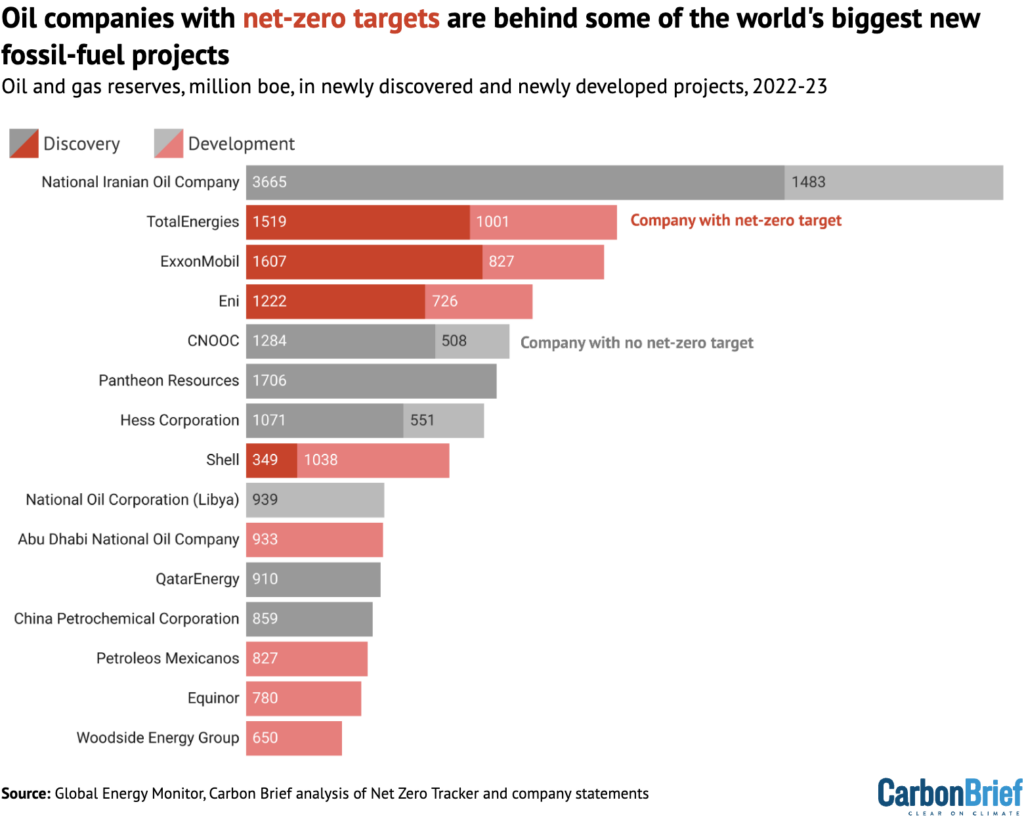
The top rankings are dominated by publicly traded oil majors, such as ExxonMobil, and national companies, such as the Abu Dhabi National Oil Company (ADNOC) – which is led by COP28 president Sultan Al Jaber. Saudi Aramco, the world’s largest oil company, is missing from the GEM tracker, likely due to the lack of data from Saudi Arabia.
The emissions that could result from new gas fields run by the state-owned National Iranian Oil Company alone amount to 1,700MtCO2, according to Carbon Brief analysis. This is higher than the annual carbon footprint of Brazil.
Meanwhile, oil and gas in new projects being developed by TotalEnergies and ExxonMobil could generate roughly 1,000MtCO2 – equivalent to Japan’s annual total – for each company.
At the recent CERAWeek industry conference, many oil and gas industry leaders argued against a transition to cleaner forms of energy. For example, Saudi Aramco chief executive Amin Nasser told attendees: “We should abandon the fantasy of phasing out oil and gas.”
As companies continue searching for more oil and gas, executives have consistently emphasised that demand for fossil fuels, rather than production, is the problem.
Most recently, in an interview with Fortune, ExxonMobil chief executive Darren Woods placed the blame on the public, who he said “aren’t willing to spend the money” on low-carbon alternatives.
New nations, mainly in the global south, are opening up as “global hotspots” for oil and gas projects, according to GEM.
Notably, Guyana is set to have the highest oil production growth through to 2035. Over the past two years, it has already been the site of more new oil and gas discoveries than any other country. Namibia has also opened up as a major new frontier in fossil-fuel extraction.
The chart below shows how nations that have recently been targeted for oil and gas exploration, now make up a large portion of new discoveries and developments.
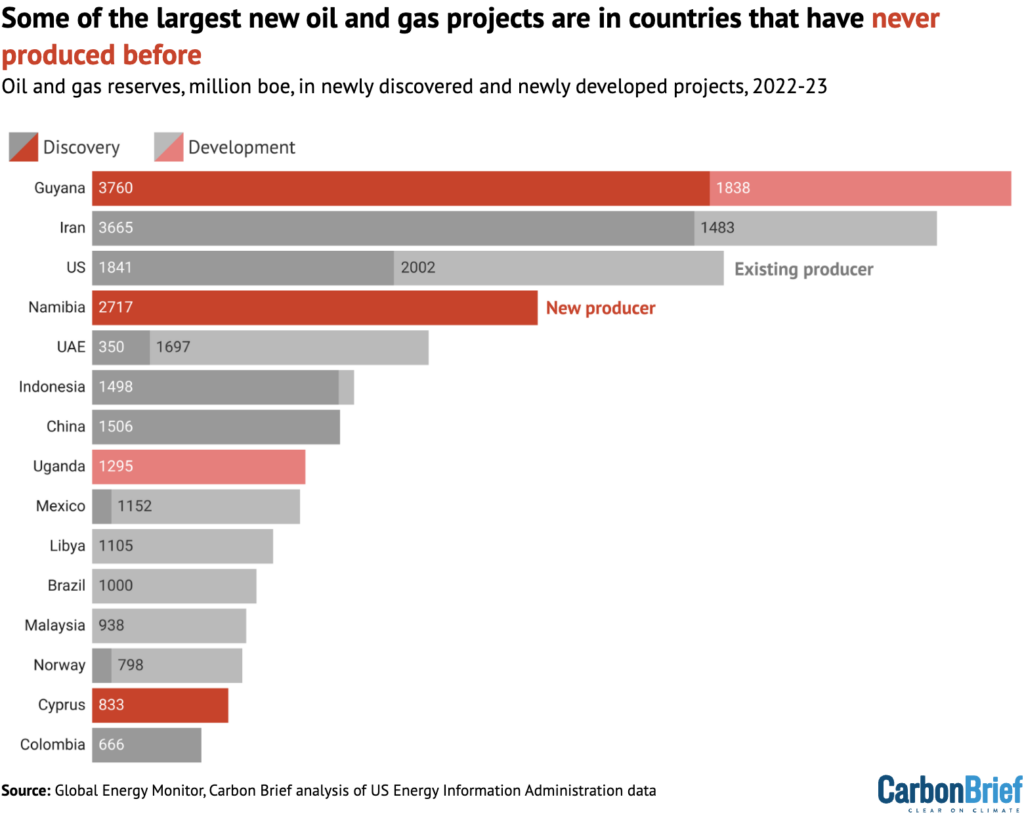
The expansion of oil and gas production in the global south is a highly politicised topic.
Many African leaders, in particular, argue that their countries are entitled to exploit their natural resources in order to bring benefits to their people, as global-north countries have done. At COP28, African Group chair Collins Nzovu stated that oil and gas were “crucial for Africa’s development”.
(It is worth noting that, according to GEM’s analysis, companies based in the global north such as ExxonMobil, Hess Corporation and TotalEnergies own most of the reserves in the new global-south projects.)
Meanwhile, wealthy oil producers such as the US, Norway and the UAE justify their continued fossil-fuel extraction by saying their production emissions are relatively low. Others, such as the UK, argue that they need to exploit domestic reserves to preserve their energy security.
Even in a 1.5C scenario, the IEA still includes a significantly reduced amount of oil and gas use in 2050. Most of it goes towards making petrochemicals and producing hydrogen fuel.
However, in last year’s report on the position of the oil and gas industry in the net-zero transition, the agency also emphasises that this does not mean everyone can continue producing.
“Many producers say they will be the ones to keep producing throughout transitions and beyond. They cannot all be right,” it concludes.
COAL: New Hampshire’s Granite Shore Power will shut down its last coal-fired power plants in 2025 and 2028, replacing them with solar, battery storage, and other clean energy and marking the end of coal in New England. (New Hampshire Bulletin)
OFFSHORE WIND:
UTILITIES: Hundreds of Massachusetts residents say they’ve unknowingly or mistakenly signed up to receive power from a competitive energy supplier after being promised rate savings, only to receive shockingly high bills months later. (Boston Globe/WBUR)
TRANSPORTATION: The New York City MTA board grants final approval to a congestion pricing plan aimed at curbing emissions and encouraging public transit use. (Gothamist)
SOLAR:
BIOFUEL: A $91 million contract to supply New York City’s heavy-duty vehicles with renewable diesel went to a company whose CEO has donated to the mayor’s campaign, despite never having secured more than a $7 million contract before, and other questionable business practices. (The City)
BUILDINGS: Amherst, Massachusetts, breaks ground on a new elementary school that will be equipped with heat pumps, solar panels and efficiency measures, making it the town’s first net-zero building. (Amherst Indy)
COMMENTARY: A Maine bill would give regulators the power to make sure utility profits line up with their performance and alignment with renewable power goals, a clean energy advocate writes. (National Resources Council of Maine)
POLITICS: The Biden administration’s pattern of proposing tougher climate and emissions rules than it ends up implementing are a side effect of President Biden’s re-election bid, observers say. (E&E News)
OIL & GAS:
SOLAR: Solar generation is expected to briefly plunge in parts of the country during next month’s solar eclipse, but grid operators and electric utilities say they’re prepared with alternate energy sources to keep power flowing. (New York Times)
COAL: New Hampshire’s Granite Shore Power will shut down its last coal-fired power plants in 2025 and 2028, replacing them with solar, battery storage, and other clean energy and marking the end of coal in New England. (New Hampshire Bulletin)
OFFSHORE WIND: Four developers bid to build offshore wind projects off the Connecticut, Massachusetts, and Rhode Island coasts, including two bids from Avangrid and SouthCoast Wind that are essentially rebids of recently retracted projects. (CT Mirror, Rhode Island Current)
NUCLEAR:
EMISSIONS: The U.S. EPA begins taking public comments on how it should regulate carbon emissions from existing gas plants and best practices for carbon capture technology. (E&E News, subscription)
TRANSPORTATION: California environmental justice advocates push back on proposed changes to the state’s low carbon fuel standard, saying it might lead to higher gas prices that disproportionately burden low-income communities. (Inside Climate News)
PIPELINES:
ELECTRIC VEHICLES: Ford plans to cut roughly two-thirds of its hourly workers at a Michigan plant building its electric F-150 as volume expectations drop. (Detroit Free Press)
OIL & GAS: The federal Bureau of Land Management finalizes its rule aimed at reducing methane emissions from oil and gas facilities on public and tribal lands by requiring operators to limit flaring and venting and detect and repair leaks. (Washington Post)
ALSO: Wyoming Gov. Mark Gordon criticizes the U.S. EPA’s proposal to establish a fee on methane emissions from oil and gas facilities, saying it would economically harm the state. (Buckrail)
UTILITIES: California regulators propose a flat monthly utility fee for all electricity bills in an effort to reduce rates for low-income residents and to encourage electrification. (E&E News, subscription)
SOLAR:
TRANSPORTATION: California environmental justice advocates push back on proposed changes to the state’s low carbon fuel standard, saying it might lead to higher gas prices that disproportionately burden low-income communities. (Inside Climate News)
NUCLEAR: Washington state environmentalists and tribal leaders urge Gov. Jay Inslee to veto a budget earmark allocating $25 million to expedite advanced nuclear reactor deployment, saying the funds should go toward clean energy development. (Washington State Standard)
ELECTRIC VEHICLES:
CLIMATE: Climate advocates protest Amazon’s plans to connect its Oregon data centers to a natural gas pipeline slated for expansion, saying the use of fossil fuels adds to the company’s “carbon problems.” (Common Dreams)
ENERGY STORAGE: The first phase of a 680 MW battery energy storage facility in southern California is expected to go online this summer. (Patch)
HYDROPOWER: Federal lawmakers from Western states introduce legislation that would allocate $45 million to repair and upgrade Hoover Dam and its hydropower plant in Nevada. (Las Vegas Review-Journal)
MINING: Protesters who disrupted work at the Thacker Pass lithium mine in Nevada claim their action was necessary to save lives as they’re sued by the project’s developer. (KOLO)
TRANSITION:
OFFSHORE WIND: The Biden administration approves the 924 MW Sunrise wind project, slated to be built off Long Island, marking the administration’s seventh major wind project approval. (Associated Press)
ALSO:
UTILITIES: A New York state audit finds PSEG Long Island is inadequately managing the Long Island Power Authority, and that its deficient renewable energy and efficiency programs jeopardize its ability to meet state clean energy goals. (Newsday)
ELECTRIC VEHICLES: New Jersey’s governor signs into law a new $250 annual registration fee for electric vehicles to patch a projected downturn in gas tax revenues. (New Jersey Monitor)
GRID:
STORAGE: Maine is on track to meet its goal of installing 300 MW of energy storage capacity by 2025, according to a report from state regulators. (Utility Dive)
COAL: The bridge collapse in Baltimore is blocking access to the U.S.’s second-largest port for coal exports and will likely disrupt the industry for at least six weeks. (E&E News)
SOLAR: A New York state senator introduces a bill that would increase the tax credit for homeowners to install rooftop solar to $10,000. (Spectrum News)
CLIMATE: Massachusetts’ climate chief discusses the state’s progress on installing heat pumps, and how rising temperatures are already affecting farming and other industries. (Berkshire Eagle)
LITHIUM: A Maine scientist argues a proposed rule change is adequate to allow lithium mining in the state, but environmental and health groups argue more safety considerations are needed. (Maine Morning Star)
HYDROPOWER: A western New York board game maker is awarded low-cost hydropower to support a $6.5 million expansion. (Buffalo News)
COMMENTARY:
SOLAR: West Virginia Gov. Jim Justice vetoes a bill that would have extended electric utilities’ ability to buy or build solar projects beyond 2025, calling the legislation a threat to the state’s coal industry. (Dominion Post)
ALSO:
STORAGE: A company seeking to build pumped-hydro energy storage on old coal mining sites received $81 million in federal funding last week to develop a project in Kentucky that could deliver 287 MW of power for up to 8 hours. (Canary Media)
OFFSHORE WIND: A coalition led by a climate-denial think tank files a lawsuit seeking to stop construction of a Virginia offshore wind project, under the guise of protecting endangered whales. (Public Radio East)
OIL & GAS:
PIPELINES: Virginia regulators fine the Mountain Valley Pipeline $34,000 for another round of environmental violations, including damaging a wetland and dumping blast debris into a stream. (Roanoke Times)
ELECTRIC VEHICLES:
NUCLEAR: Texas Gov. Greg Abbott wants to explore the potential of small nuclear reactors to provide on-demand power to the state’s grid. (Texas Tribune)
COAL:
COMMENTARY: A former South Carolina utility regulator says he resigned this month to speak out about pending legislation that would drastically change oversight of investor-owned utilities by green-lighting a proposed natural gas plant despite many unanswered questions. (Post and Courier)


.svg)
