

 Back
Back
Few places in California are as unforgiving for driving an electric car as the remote and sparsely populated Imperial Valley.
Only four fast-charging public stations are spread across the valley’s vast 4,500 square miles just north of the US-Mexico border, according to the U.S. Department of Energy. That means if you’re Greg Gelman — one of only about 1,200 Imperial County residents who own an electric car — traveling almost anywhere is a maddening logistical challenge.
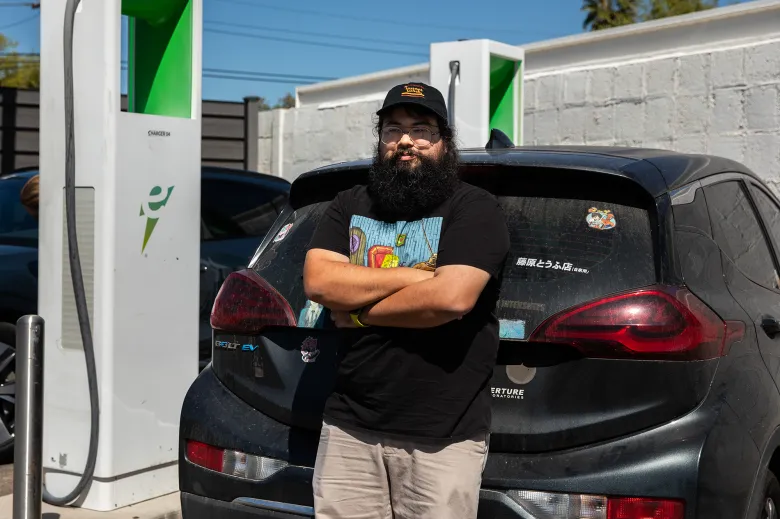
“It’s been, I won’t say a nightmare, but it’s been very, very, very inconvenient,” Gelman said on a recent afternoon as he charged his all-electric Mercedes-Benz at a charging station in a Bank of America parking lot in El Centro. “Would I do it again? No.”
California’s electric charging “deserts” like the Imperial Valley pose one of the biggest obstacles to the state’s efforts to combat climate change and air pollution by electrifying cars and trucks.
Experts say the slow installation of chargers in California’s remote regions could jeopardize the state’s phaseout of new gas-powered cars. Under the state’s mandate, 35% of sales of 2026 models must be zero-emissions, ramping up to 68% in 2030 and 100% in 2035.
Nestled in the desert in California’s far southeast corner, Imperial County ranks dead last in electric car ownership among California counties with populations of 100,000 or more, according to a CalMatters analysis of 2023 data. Only 7 out of every 1,000 cars are battery-powered there, compared with 51 out of every 1,000 statewide.
High poverty and unemployment are a major factor in the region’s slow transition to electric cars, but its lack of public chargers are a big drawback, too.
People living in rural, low-income regions like the Imperial Valley have the least access to electric car chargers, according to a state Energy Commission analysis. More than two-thirds of California’s low-income residents are a 10-minute drive or longer from a publicly available fast charger.
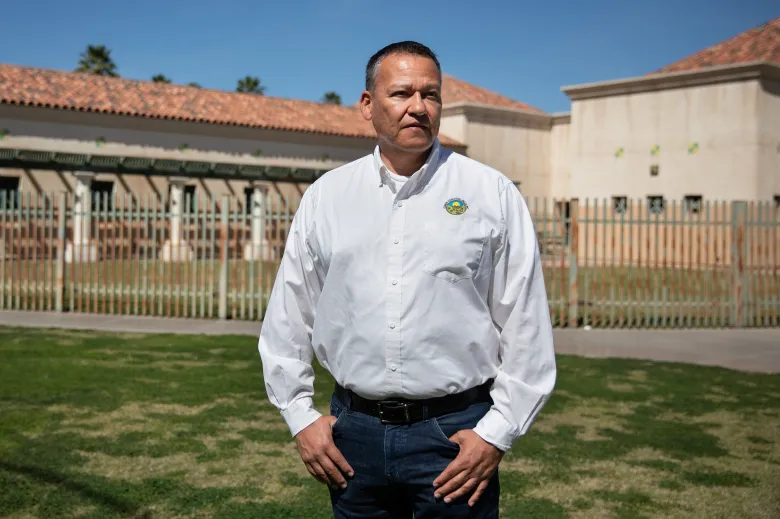
Luis Olmedo, executive director of El Comite Civico del Valle, a nonprofit advocating for environmental justice, has battled for years against the Imperial Valley’s unhealthy air. Now he is making a bid to become its go-to supplier of charging stations for zero-emissions cars.
Olmedo isn’t waiting for businesses or the state to make chargers a reality in Imperial County. Instead, his group has embarked on a $5-million, high-stakes crusade to build a network of 40 fast chargers at various locations. It’s an open question whether his somewhat quixotic endeavor will succeed.
Electric car chargers “are an opportunity for us to be able to breathe cleaner air,” Olmedo said. “It’s about equity. It’s about justice. It’s about making sure that everybody has chargers.”
Esther Conrad, a researcher at Stanford University who focuses on environmental sustainability, said getting chargers in places like Imperial County is critical to California’s effort to transition to electric vehicles in an equitable way. Apartment dwellers and others who don’t have charging at home need nearby and reliable places to charge.
“When you have a rural community that’s low-income and distant from other locations, it’s incredibly important to enable people to get places where they need to go,” Conrad said.
A car is essential for traversing Imperial County, which is the most sparsely populated county in Southern California.
Its neighborhoods are vast distances from urban centers that provide the services that residents need: El Centro — its biggest town, home to about 44,000 people — is much closer to Mexicali, Mexico, than it is to San Diego, which is about a two-hour drive away, or Riverside, nearly three hours. Its highways and roads cross boundless fields of lettuce and other crops that give way to strip malls, apartments and suburban tracts — and then even more crops and open desert.
If you drive an electric car the 109 miles from El Centro to Palm Springs, your route takes you through farmland, desert and around California’s largest lake, the Salton Sea, which is also one of its biggest environmental calamities.
The Salton Sea has been receding in recent years, causing toxic dust to blow into Imperial Valley towns. The region’s air quality is among the worst in the state, with dust storms and a brown haze emanating from agricultural burning and factories in the valley or from across the border in Mexicali, a city of a million people.
About 16% of Imperial County’s 179,000 residents have asthma, higher than the state average. The air violates national health standards for both fine particles, or soot, as well as ozone, the main ingredient of smog; both pollutants can trigger asthma attacks and other respiratory diseases.
More than 85% of Imperial County’s residents are Latino, and Spanish is widely spoken here. Agriculture is a major employer, and many businesses are dependent on cross-border trade and traffic from Mexico. The county’s median household income is $53,847, much lower than the statewide median, and 21% of people live in poverty.

Now the discovery of lithium, used to manufacture EV batteries, at the Salton Sea has the potential to transform the region’s economy. State officials say the deposit could produce 600,000 tons a year, valued at $7.2 billion, and assist the U.S. as it tries to foster a domestic electric car industry that rivals China’s.
But Olmedo worries that when the mineral is removed from the valley, it won’t meaningfully change people’s livelihoods or their health. He points to examples in the developing world where local people have been left behind as extractive industries take what they need.
“We’re about to extract, perhaps, the world’s supply of lithium here, yet we don’t even have the simplest, the lowest of offerings, which is: Let’s build you chargers,” Olmedo said.
Last year, electric cars were only 5% of all new cars sold in Imperial County, compared with 25% statewide. Getting chargers into low-income and rural places will become more and more important as California struggles to meet its ambitious climate targets.
The Energy Commission estimates that California will need 1.01 million chargers outside of private homes by 2030 and 2.11 million by 2035, when more than 15 million electric cars are expected on the roads. So far the state has only about 105,000 nonprivate chargers.
Nick Nigro, founder of Atlas Public Policy, which researches the electric car market, said charging companies won’t locate chargers in regions with few electric vehicles.
“You need revenue, and if the EVs aren’t there, then your customers aren’t necessarily there, so you do have a legitimate chicken and egg problem,” Nigro said. “We have to look to public policy to help that market failure.”
The Biden administration will invest $384 million in California’s electric car infrastructure over five years. And state officials are investing almost $2 billion in grants for funding zero-emission vehicle chargers over the next four years, including some special grants in rural, inland areas for up to $80,000 per charger. Olmedo says the funding has been insufficient so he’s had to turn to donations and other sources of funding.
Patty Monahan, one of five members of the California Energy Commission, said “it’s particularly important that we see chargers” in the Imperial Valley and other low-income counties with poor air quality.
Imperial Valley has only four fast-charging stations open for public use, where chargers are capable of juicing batteries up to 80% in under an hour, according to the U.S. Department of Energy. Three are in El Centro, with one exclusively for Teslas; another is in the border town of Calexico and was recently installed by El Comite. Six other stations offer only slower chargers.
Olmedo envisions a network of 40 publicly accessible chargers throughout the valley. El Comite is expecting funding from the California Energy Commission, and has received donations from Waverley Streets Foundation, the United Auto Workers and General Motors. The group is seeking more state funding.
Olmedo acknowledged that he is facing a slew of challenges with his project, including some local opposition and the high cost of installation and maintenance.
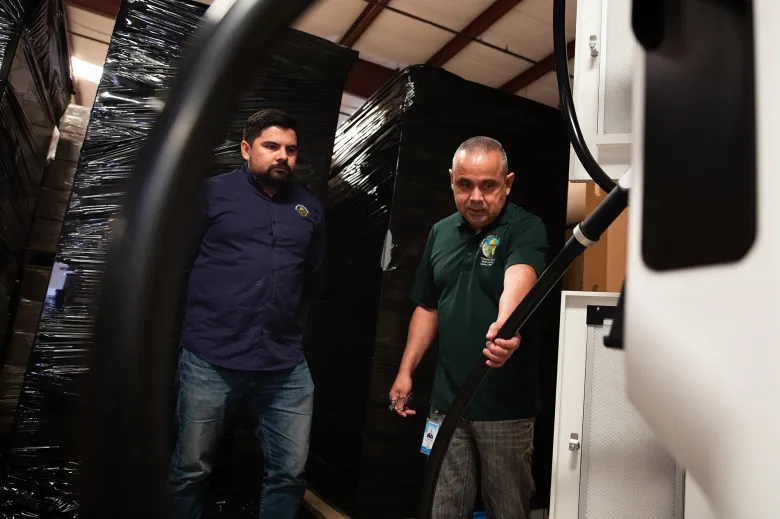
At a warehouse in the city of Imperial where El Comite stores the chargers, Jose Flores, project manager for the group’s charging initiative, said he and three colleagues spent four days in Santa Ana, about 200 miles north, at a facility managed by BTC, the company that makes the chargers that El Comite is installing.
They received training on installation and maintenance techniques, and discussed how not all chargers can be used by all electric vehicles. He learned about payment and cooling systems, and that the chargers might need more frequent maintenance because of Imperial Valley’s harsh desert conditions.
“We’re like a testing ground because we have poor air quality here due to the Salton Sea and being in a desert,” he said.
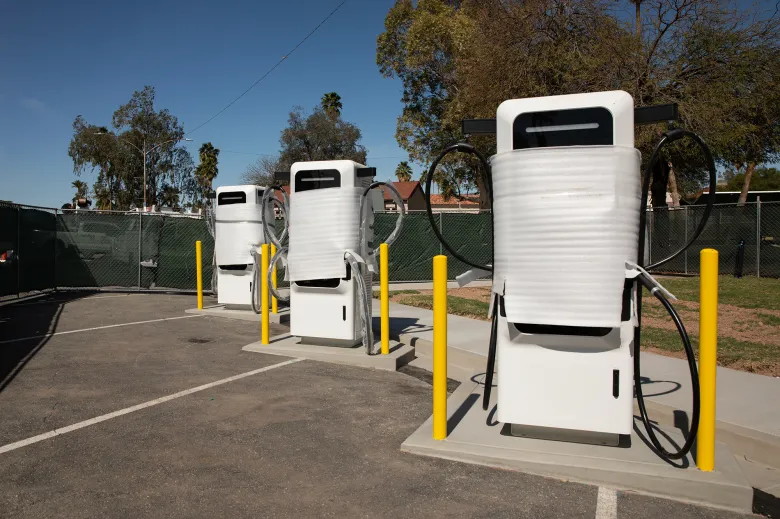
El Comite installed its first charger at its Brawley headquarters in 2022. Last December, El Civico pressed ahead with a more ambitious project: Four of their fast chargers are now operating in a park in the border town of Calexico.
Chris Aldaz, 35, a U.S. Postal Service worker who lives in Calexico, charges at home, but at times uses chargers at the group’s Brawley headquarters that people can use for free. It is a Level 2, which can take several hours to charge.
“The reason why I wanted to get an EV was that it was cheaper,” Aldaz told CalMatters. “I don’t want to be spending all this money on gas, and on maintenance, and it was better for the environment.”
Nevertheless, Olmedo’s electric car chargers have become a local political issue.
Maritza Hurtado, Calexico’s ex-mayor, and coordinator of a City Council recall campaign, said it was inappropriate for El Comite to have built four electric car chargers in a downtown park. The chargers were a distraction “from our police needs and our actual community infrastructure needs,” Hurtado said at a public hearing at the county’s utility, the Imperial Irrigation District, in January. She declined to speak to CalMatters.
“We had no idea they were going to take our parkland,” Hurtado said at the hearing. “It is very upsetting and disrespectful to our community for Comite Civico to come to Calexico and take our land.”
Olmedo hopes that the chargers ultimately will be something the county’s Latino community takes pride in.
“Put this in perspective: It’s a farmworker-founded organization, an environmental justice organization, that is building the infrastructure. It’s not the lithium industry. It’s us, building it for ourselves.”
Data journalist Erica Yee contributed to this report.
For all of the mobility they offer, cars, in general, spend most of their time sitting still. The average American spends around an hour a day driving, according to AAA, and in a country with roughly one vehicle per person, that’s a lot of cars just sitting around doing nothing.
Electric vehicles create an opportunity to put that downtime to use. While EVs can already serve as a backup battery for homes, engineers have long been pursuing technology to tie all of those batteries to the grid, serving as a massive virtual power plant to help manage fluctuations in electricity production and demand.
This fall, Oakland, California’s school district is making that vision a reality.
The district recently announced it is replacing all of its diesel buses with electric ones equipped with vehicle-to-grid (V2G) technology that will allow the buses to serve as a resource for utility Pacific Gas & Electric.
As Matt Simon of Wired explains, the buses provide an ideal platform. They operate on a predictable schedule, can charge during the day when solar power peaks and at night when demand is low, and are usually sitting idle during the evening, when solar generation plummets and the need for stored energy is highest.
For school districts, that also provides a new source of revenue, helping to offset the much higher cost of the buses.
So what about those millions of cars? That’s a little more complicated.
Willett Kempton, a University of Delaware professor, has been working on that problem for decades. While the concept is simple, a vast array of vehicles, charging configurations, and usage times can create a lot of uncertainty for utilities.
“When something’s pushing power onto the grid, they want to know what that is,” Kempton told Canary Media in February. “They don’t want to be like, ‘We’re 95 percent sure which car it is.’”
Kempton reached a significant breakthrough this year in developing a V2G standard that was recently adopted by SAE International, which provides guidance on universal standards for automakers on everything from tires to oil viscosity.
Major car companies are now rushing to produce models with V2G capability.
“This is a real thing,” an executive from a British V2G company told Reuters. “It’s no longer a theoretical, academic discussion.”
🚗 Speaking of electric vehicles: The Biden administration last week announced a 100% tariff on Chinese EVs, which some critics say could jeopardize climate goals; an editorial board says U.S. automakers have only themselves to blame for not being globally competitive. (E&E News, Los Angeles Times)
🔧 When getting there isn’t half the fun: As the Biden administration offers billions to ramp up hydrogen production, the fuel is dangerous and costly to transport and there are no clear rules for pipeline siting. (E&E News)
☀️ Solar’s staggering growth: The U.S. has surpassed 5 million solar installations, with more than half of those coming online since 2020, according to a new industry report. (Power Magazine)
🏭 Rust belt revival: Midwest states have received nearly $30 billion in private investments to boost clean energy manufacturing since Congress passed the Inflation Reduction Act in late 2022. (Inside Climate News)
👷 Green jobs: Community colleges around the country are offering training programs in clean energy technology, in response to a surge in job demand since the passage of federal climate legislation. (Associated Press)
🛢️ Questionable commitments: In separate reports, advocacy groups this week have called efforts to decarbonize air travel a “huge greenwashing exercise,” and said “there is no evidence that big oil and gas companies are acting seriously to be part of the energy transition.” (The Guardian)
⚖️ Energy justice: Advocates say Minnesota regulators should reinstate a moratorium on utility shutoffs after researchers found racial disparities in disconnections by Xcel Energy, even after accounting for income and other factors. (Energy News Network)
SOLAR: The first publicly available community solar project in New Hampshire hopes to pave the way for more such developments in a state where low net metering rates have made them challenging to complete. (Energy News Network)
ALSO:
NATURAL GAS: Massachusetts utility officials approve contracts between a liquefied natural gas terminal and three gas utilities that extend the facility’s life by at least six years. (Boston Globe)
COURTS: A Maryland circuit court judge dismisses complaints in a wider climate accountability lawsuit against the American Petroleum Institute but gives the city of Annapolis and Anne Arundel County 30 days to prove the trade group engaged in conspiracy. (E&E News, subscription)
GRID:
RENEWABLE ENERGY: Dozens of companies have responded to a call from the New York Power Authority to help the agency develop more renewable energy via public-private partnerships. (Times Union)
CLIMATE: Facing an unprecedented number of declared disasters since taking office, Maine’s governor plans to create a new commission to understand climate threats and mitigate potential impacts. (Portland Press Herald)
UTILITIES: New England utilities Avangrid and Central Maine Power may soon be taken private by the Spanish utility Iberdrola, which is already the utilities’ main stockholder, pending regulatory approvals. (Mainebiz)
BUILDINGS:
TRANSIT: Pittsburgh’s regional transit agency decides to permanently adopt a pilot program that automatically extended fare discounts to people receiving food assistance. (Pennsylvania Capital-Star)
ELECTRIC VEHICLES:
OIL & GAS: People who live near the Tennessee Valley Authority’s eight planned natural gas-fired power plants will likely face higher cancer rates and other health impacts from the facilities, experts say. (WPLN)
ALSO:
PIPELINES:
SOLAR:
WIND: Dominion Energy begins a new phase of construction at a Virginia facility where it will bring power onshore from its planned offshore wind farm. (WTKR)
ELECTRIC VEHICLES:
GRID: A Kentucky bill to add new hurdles for utilities to retire fossil fuel-fired power plants leads to a new high for lobbying costs as utilities and electric cooperatives spend big. (Kentucky Lantern)
RENEWABLE GAS: A North Carolina county signs a contract with a company to build a facility to produce renewable natural gas at a waste storage site. (Biomass Magazine)
NUCLEAR: A Tennessee university and community college use state grants to add programs to train workers for the nuclear power industry. (Knoxville News Sentinel)
COMMENTARY:
SOLAR: Analysts say most solar projects awaiting connection to the Western grid are hybrid installations paired with battery storage or wind facilities as California’s solar “duck curve” grows more pronounced. (Utility Dive)
ALSO:
CLEAN ENERGY: A New Mexico nonprofit launches a climate investment bank designed to finance clean energy projects benefiting low-income, disadvantaged and tribal communities. (Albuquerque Journal)
OIL & GAS:
COAL:
UTILITIES:
CRITICAL MATERIALS: Utah researchers find elevated recoverable concentrations of rare earth elements in active coal mines in Colorado and Utah. (news release)
GRID: California’s grid operator proposes raising the soft limit on power providers’ energy bids to better account for costs. (RTO Insider, subscription)
HYDROPOWER: Northwest tribal nations and federal agencies move forward on a plan aimed at restoring salmon runs decimated by hydropower dams on the Columbia River and its tributaries. (Idaho Capital Sun)
The first publicly available community solar project in New Hampshire hopes to pave the way for more such developments in a state where energy policies have made them challenging to complete.
The small southern New Hampshire town of Jaffrey is working with ReVision Energy to develop the array atop a former municipal landfill, with the goal of coming online in 2025. The town will receive annual lease payments for use of the land, and residents and others in the Eversource utility territory will be able to buy shares of the project, lowering their electricity bills and supporting the environmental benefits of renewable energy.
“It’s the perfect use of land that can’t do anything else,” said Jaffrey town manager Jon Frederick.
At the same time, planners hope the project helps demonstrate the potential for community solar in New Hampshire and spark policy changes that would make the concept more financially feasible in the future.
New Hampshire authorized the development of community solar in 2013, but only small-scale projects serving specific communities or neighborhoods have ever been built. The state’s energy policies have made larger, publicly available projects financially unworkable, even as other New England states have actively incentivized such projects by lowering logistical barriers and offering financial subsidies, said developers and clean energy advocates.
“The problem with community solar in New Hampshire is that the rate of reimbursement is much lower than the rate in all the surrounding states,” said Sam Evans-Brown, executive director of advocacy group Clean Energy New Hampshire.
At the heart of the problem are the state’s net metering rules. Net metering is a system that lets consumers offset the cost of power drawn from the grid by generating their own energy, often using solar panels. In New Hampshire, a solar system smaller than 100 kilowatts receives a credit worth 100% of the cost of transmission and the electricity itself and 25% of the cost of distribution. Systems between 100 kilowatts and 1 megawatt receive credit only for the power itself. Only municipal users can claim any credit for projects over 1 megawatt.
At the same time, community solar projects have higher administrative costs, as they need to track and reconcile the use of dozens or even hundreds of consumers. Traditionally, the net metering rates have not been high enough for community solar projects to make financial sense.
The lack of predictability is also a barrier: Electricity supply from Eversource in New Hampshire, for example, is currently priced at 8.29 cents per kilowatt-hour, down from 20 cents per kilowatt-hour over the same period last year. And the number changes every six months as the utilities update their rates.
“It is so volatile,” Evans-Brown said. “When you try to do the financial models, you’re kind of taking a bet.”
In Jaffrey, ReVision is taking advantage of evolving policies and using several strategies it hopes will overcome these obstacles.
In 2019, state legislation pushed by ReVision simplified the billing process for community solar customers. Previously, these consumers would receive a bill from the utility for their full month’s electricity use, as well as a payment from the solar operator for their share of the power generated. The new rules combined the processes, crediting the solar generation directly to a customer’s electricity bill. That streamlining was just enough to get things moving in Jaffrey, said Dan Weeks, ReVision’s vice president of business development.
“That was a big barrier in the past,” he said. “With that administrative progress we felt we were far enough to take this big step.”
The project deals with the size limit on net metered projects by keeping its AC capacity just below the 1 megawatt mark, so it remains eligible.
The company decided to sell shares in the development rather than opening it up to subscribers, a choice that creates more value for consumers, who get to own all the power produced and the associated tax credits. The idea is that consumers will receive low- or no-cost power even as retail electricity power prices increase, creating savings that will pay for the initial investment, and then some.
Historically, however, it was difficult to make those numbers pencil out because of the combination of low net metering rates and frequently changing power prices. Indeed, the current supply price of 8.29 cents per kilowatt-hour would not be enough to keep the project afloat. ReVision is banking on U.S. Energy Information Administration projections that power prices will go up in coming years, creating greater savings for shareholders.
“There will definitely be a different rate at the time it is turned on,” Weeks said. “We feel pretty confident that individuals will save regardless.”
An ongoing difficulty remains, however: State law requires the total consumption of the community solar group members be equal to or greater than production of the solar farm. However, many shareholders are interested in buying a stake that is larger than their consumption so the solar credits will offset their entire energy bill — the delivery of the power as well as the electricity itself. That leaves ReVision with an unbalanced equation.
This dilemma is likely an unintended side effect of the way net metering rules have evolved in the state, Weeks said. ReVision is in talks with legislators about how they might be able to change the law to remove this obstacle, a move that would benefit both the Jaffrey project and future community solar plans.
“We have willing legislators who want to address it, so the program can realize its intended goal,” Weeks said.
If a change in law does not come through, ReVision will look into partnering with nonprofit groups or municipalities that might be interested in buying smaller amounts of power to offset some, but not all, of their consumption, which would help rebalance the legally required equation.
As the plan comes together, others in the New England solar space will be watching, Evans-Brown said.
“The thing that’s exciting about ReVision doing this is it’s kind of a trial to see if we can make this work,” he said.
GRID: ISO New England’s recent energy demand forecasts show the pace of the energy transition is faster than expected, and is weighing several changes to address potential future shortfalls. (Concord Monitor, Utility Dive)
WIND:
HYDROELECTRIC:
POLICY:
NUCLEAR: New York’s governor is reportedly wondering about the feasibility of bringing small modular nuclear reactors to the state. (E&E News, subscription)
FOSSIL FUELS:
ELECTRIC VEHICLES:
TRANSPORTATION: A federal judge presiding over one of the lawsuits against the Manhattan traffic congestion pricing plan questions the argument that the tolls are just a cash grab. (Gothamist)
SOLAR: Multiple states are developing plans to address workforce shortages ahead of billions of dollars of federal investment in solar power. (Bloomberg)
ALSO: Puerto Rico’s rooftop solar boom is in jeopardy as a territorial agency weighs repeal of a new law extending net metering policies. (Canary Media)
CLIMATE:
UTILITIES: Energy justice advocates say Minnesota regulators should reinstate a moratorium on utility shutoffs after researchers found racial disparities in disconnections by Xcel Energy, even after accounting for income and other factors. (Energy News Network)
ELECTRIC VEHICLES:
GRID:
OIL & GAS:
WIND: Eight New Jersey towns have filed lawsuits in the past week to stop offshore wind development along the state’s coast. (Asbury Park Press)
A coalition of energy equity and justice advocates says Minnesota regulators should consider reinstating a utility shutoff moratorium after a recent academic study revealed racial disparities in disconnections by the state’s largest utility.
Xcel Energy customers in communities of color were more than three times as likely to have their electricity involuntarily disconnected between 2017 and 2021 compared to those in predominantly White neighborhoods, according to the analysis by the University of Minnesota’s Center for Science, Technology and Environmental Policy.
Those racial disparities persisted even after researchers controlled for other factors such as income, ownership status and housing age.
“We still find consistently that homes that are disconnected are predominantly” in communities of color, said Bhavin Pradhan, a postdoctoral associate and study co-author.
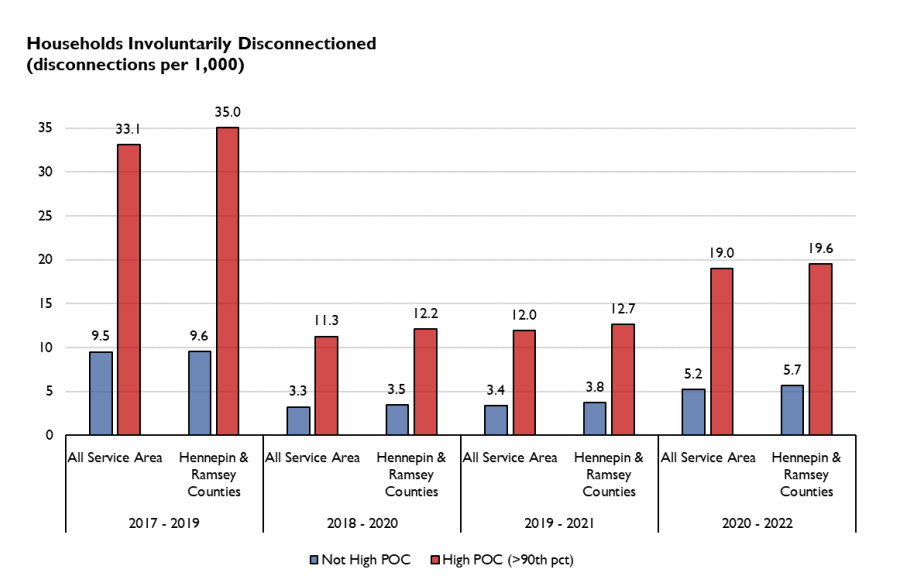
The study’s findings are at at the center of recent comments filed by advocacy groups including the Cooperative Energy Futures, Environmental Law & Policy Center, Sierra Club, and Vote Solar, which asked the Minnesota Public Utilities Commission last month to order a study of the costs and benefits of reinstating the state’s pandemic-era moratorium on utility shutoffs.
“(We) recommend that the Commission order this study now and then rely on it to inform Commission action to consider a moratorium on disconnections until Xcel can develop a more robust set of measures to eliminate racial disparities in disconnections,” the groups wrote in April 12 reply comments (MN 23-452).
Xcel Energy, which had already hired a consultant to review the issues raised in the study, in a March 22 response attributed the racial disparities to “deeply entrenched economic and social reasons that are not driven by the energy system,” including the age of housing stock. It suggested targeting energy efficiency programs at low-income neighborhoods as part of the solution.
The study by Pradhan and Associate Professor Gabriel Chan looked at utility shutoffs, power outages, and the grid’s capacity for distributed energy by Census block across Xcel Energy’s Minnesota service territory. It also relied on data from the Council on Environmental Quality’s Climate and Economic Justice Screening Tool, which maps disadvantaged communities as defined by federal law.
Xcel’s interactive service quality map allowed researchers to overlay various data at a granular level. “We could link this (data) with a lot of other variables,” Chan said.
In addition to utility shutoffs, the researchers found disparities in reliability, with communities of color almost 50% more likely to experience prolonged power outages than predominantly White areas.
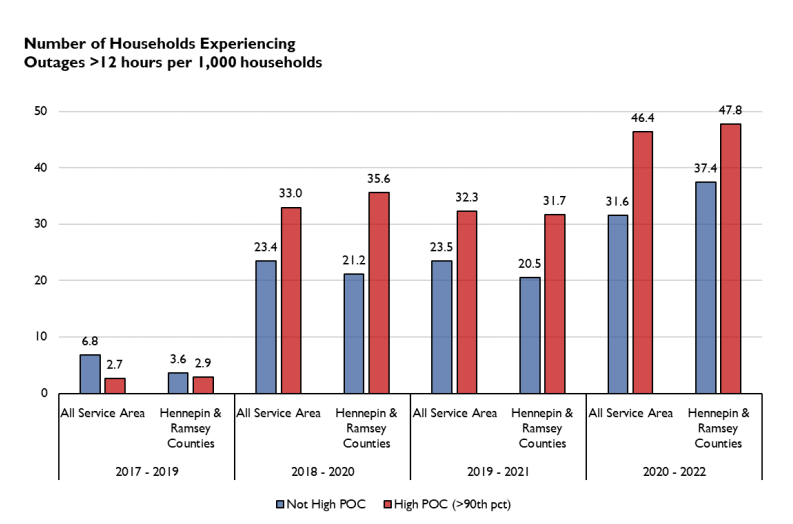
“Across a battery of regression models, we find that living in poorer neighborhoods with a greater concentration of people of color is associated with a statistically and practically significant difference in the likelihood of disconnection from service due to nonpayment and the experience of extended power outages,” the report concludes.
Chan said the research does not necessarily suggest grid planners were intentionally racist. “But we do think that there’s a real opportunity here to think about how to affirmatively plan the distribution grid to address racial disparities that are caused by many other racialized systems.”
The research echoes inequities that have been found for everything from air quality and bike lanes to infant mortality and drownings, in which gaps similarly persist even after controlling for poverty.
“It would be almost surprising if there weren’t racial disparities” in utility service, Chan said.
Will Kenworthy, Midwest regulatory director for Vote Solar, said the type of racial disparities identified in the study are not unique to Minnesota.
“What we’re finding in Xcel service territory for reliability is consistent with what we’re seeing in Michigan and Illinois to varying degrees,” Kenworthy said.
The paper’s conclusion says the findings don’t necessarily imply deliberate racial bias but do highlight an “urgent need for policy interventions to protect low-income customers from disconnections, invest in marginalized communities, and equitably expand distributed energy resources such as solar and batteries.”
The energy equity and justice advocates, intervening as Grid Equity Commenters, attached the study with comments submitted in March as part of an Xcel Energy integrated resource planning docket. They argued that the disparities, and equity in general, needs to be part of any discussion about the utility’s system planning.
“Racial disparities in shutoffs have been repeatedly shown and the commission needs to do something about it,” said Erica S. McConnell, staff attorney for the Environmental Law & Policy Center.
Minnesota had a moratorium on utility shutoffs during the Covid-19 pandemic from early 2020 through August 2021. In addition to a study looking at the implications of reinstating that moratorium until racial disparities have been eliminated, the groups’ recommendations include proactive investments in grid reliability and distributed energy in disadvantaged areas.
Fresh Energy, a nonprofit policy advocacy group that also publishes the Energy News Network, separately filed comments on April 12 recommending that the commission require Xcel to track and report additional data regarding shutoffs and reliability in disadvantaged areas.
Utility shutoffs and outages can be scary, costly and “dramatic” for lower-income customers, said George Shardlow, executive director of the Energy CENTs Coalition, which works with Xcel Energy to help connect customers with energy assistance and conservation programs. Energy CENTs is not among the groups intervening in the Xcel planning docket.
Shardlow said targeting all customers in areas of high poverty with assistance programs, even for a limited time, could help reduce disconnections and energy burdens. That approach is in line with a proposed Xcel pilot program to offer automatic bill credits to all customers living within targeted, low-income areas where energy burdens exceed 4% of household incomes.
Xcel Energy’s comments framed the disconnection disparities as an issue of poverty. It says it has improved its efforts to avoid disconnections, contacting customers via phone and email for nine weeks to help connect them with assistance programs and offer long-term payment plans before shutting off service.
The company said its own analysis did not find a strong relationship between long-duration outages and the racial composition of the neighborhood. The frequency of long outages is so small, affecting less than 5% of households, and largely reflect the random paths of storms, it said.
“We recognize that even if the likelihood of extended or multiple outages remains small, the impacts of an electrical outage could be greater in disadvantaged neighborhoods that are disproportionately vulnerable to such emergencies,” the company said.
While equity and environmental justice are priorities for the company, Xcel said, it also pushed back on the discussions’ inclusion in the integrated resource planning docket, arguing that would duplicate conversations already happening elsewhere.
One surprising finding in the study could also point to potential solutions. In parts of Xcel’s territory, interconnecting distributed energy resources such as solar or batteries has become challenging due to congestion.
“This doesn’t look like an issue for low-income” areas, Pradhan said. “That’s a good point for energy poverty and energy equity” as solar installations could help reduce utility bills and stabilize the grid to reduce outages.
Minnesota Public Utilities Commission staff has tentatively scheduled a meeting to discuss Xcel Energy’s equity analysis with stakeholders in July.
CLEAN ENERGY: Midwest states have received nearly $30 billion in private investments to boost clean energy manufacturing since Congress passed the Inflation Reduction Act in late 2022. (Inside Climate News)
UTILITIES:
POLITICS: Ohio’s HB 6 scandal remains politically fraught for GOP Attorney General Dave Yost, who helped to prosecute four people involved but has ignored questions about his name surfacing in a federal trial and remained silent about the law itself. (Ohio Capital Journal)
OIL AND GAS: North Dakota’s top oil and gas regulator, Gov. Doug Burgum and former President Trump during an oil and gas event Thursday railed against government regulations’ potential to hold back the industry. (North Dakota Monitor)
SOLAR:
TRANSPORTATION: The influx of electric bikes in Minnesota and elsewhere are challenging cities and transit agencies to improve bike parking, bus bike racks and more. (MinnPost)
ENVIRONMENTAL JUSTICE: Michigan officials announce $12 million more in funding to improve local health, monitor pollution and improve indoor air quality in low-income neighborhoods and communities of color. (Michigan Advance)
ELECTRIC VEHICLES: Ohio Gov. Mike DeWine announces nearly $16 million more for electric vehicle charging stations that moves the state closer to a goal of having public stations available every 50 miles. (WLWT)
WIND: The supervisor of a northwestern Iowa airport raises concerns about a proposed wind farm’s potential to disrupt helicopter ambulances and other flights. (Radio Iowa)
STORAGE: Ohio regulators approve plans for an 85 MW battery storage facility outside Dayton. (Daily News)
NUCLEAR: The company working to reopen a shuttered southwestern Michigan nuclear plant has hired about 150 people since the effort began and now employs more than 360 people at the site. (WOOD-TV8)
COMMENTARY: An Ohio clean energy advocate says utility-scale solar projects can play a vital role in helping the state meet a forecasted spike in electricity demand. (Columbus Dispatch)


.svg)
