

 Back
Back
The U.S. transmission grid isn’t growing fast enough to meet surging electricity demand. Fast-tracking transmission upgrades could change that.
The U.S. Senate energy permitting bill unveiled Wednesday could streamline the buildout of high-voltage power lines across the country, potentially delivering billions of dollars in electricity cost savings and dramatically improving the power system’s reliability over the coming decade — if Congress manages to pass it into law.
So say grid experts digging into the transmission grid policy directives contained in the text of the long-awaited bipartisan reform package. The bill would order the country’s regional grid operators and utilities to streamline how power lines are planned and permitted. It would require the use of advanced transmission technologies that can expand the capacity of new and existing grids.
It would give state and federal regulators tighter oversight over less efficient local transmission planning. And it would require grid operators and utilities to coordinate grid buildouts to enable more new power plants, solar and wind farms, batteries, and other resources to serve growing demand for electricity.
“If Congress wanted to expand and de-congest the nation’s transmission grid, these are the policy changes that can get that done,” said Rob Gramlich, president of consultancy Grid Strategies and a longtime proponent of transmission grid reform. “It is very likely that this bill, if passed, would reduce consumer utility bills over time as the transmission system expands and access to low-cost generation improves.”
That view is backed up by analysis commissioned by the Center for Climate and Energy Solutions, a nonprofit research organization, which studied the impact of the bill’s reforms on four major grid regions — from the mid-Atlantic coast to the California border — that provide electricity to more than half the country.
The analysis found that by 2035, the reforms in the bill could enable a grid buildout that would reduce the cost of delivering electricity by roughly $7 billion, compared with a business-as-usual scenario — a net savings after accounting for $1.9 billion in new transmission investment. That, in turn, could reduce residential electricity bills by about $1.1 billion.
“Really simply, we need to build more energy infrastructure in this country,” Nathaniel Keohane, the group’s president, said in a Wednesday press conference. “We need to do that faster, and these reforms will help.”
Many of the transmission provisions in the new legislation were previously proposed under a 2024 bill, Keohane said. And other parts of the bill would essentially strengthen previously mandated grid interconnection and transmission planning reforms.
But the new bill also adds reforms that will “make it more predictable, easier for new energy generation to connect to the grid,” he said. “That’s really important.” Across the country, transmission bottlenecks are preventing hundreds of gigawatts of solar, wind, and battery projects from being connected to the grid.
Ashna Aggarwal, director of analysis at Greenline Insights, which conducted the study for C2ES, said the modeling her group used indicated the reforms in the bill could enable almost 100 gigawatts more wind, solar, and battery storage, as well as nearly 40 GW of increased interregional transmission capacity that can carry power to far-off regions suffering from extreme weather events.
It’s unclear how the Senate package will fare in the House of Representatives, which has been adjourned by House Speaker Mike Johnson (R) until after the November midterm elections. Republicans and Democrats have squabbled over proposed reforms to environmental regulations, with Republicans pushing for changes that favor the fossil fuel industry, and Democrats demanding the Trump administration halt its attacks on clean energy.
Some environmental groups oppose reforms that would limit the time and scope of challenges to energy projects under federal environmental regulations, saying that such streamlining will unleash a harmful expansion of fossil fuel infrastructure.
But clean energy groups including Advanced Energy United, the American Clean Power Association, and the Solar Energy Industries Association are backing the bill. The reforms, the groups say, are vital to unblocking bottlenecks that are preventing all but a fraction of the country’s potential clean energy from being built to serve fast-growing demand for power from data centers, electric vehicles, and broader economic growth.
“Across categories, this tries to rein in delays and uncertainties that add time and cost to building new infrastructure in this country,” Caitlin Marquis, Advanced Energy United’s managing director, said in a Wednesday interview.
To be clear, the reforms in the Senate bill will also ease permitting and interconnection for the massive amounts of new fossil gas power plants being proposed across the country. “This is not a world in which natural gas disappears completely,” Aggarwal said. “It does remain the largest source of electricity generation in 2035.”
The Electric Power Supply Association, a trade group representing power plant operators with a preponderance of fossil-gas power plants in their portfolios, expressed support for the Senate bill. “Demand for electricity is rising, and the energy infrastructure, including power plants, transmission lines, and natural gas pipelines, required to supply that demand needs a more efficient and predictable path for investment,” the association’s CEO Todd Snitchler said in a Wednesday statement.
But clean energy groups argue that solar, batteries, and wind power are cheaper and faster to build than fossil-fuel power plants, giving them an advantage if the grid can accommodate new additions.
Conversely, if the grid can’t grow quickly enough, data centers may press on with plans to build tens of gigawatts of “behind-the-meter” gas-fired power plants, despite the costs and the climate and environmental harms, Keohane said.
“We all see the enormous booming energy demand that’s happening right now. That demand is going to be met,” he said. “Whether it’s met with clean energy that can compete on the economics on a level playing field, or whether it’s met behind the meter with all sorts of other kinds of technologies that don’t serve the communities they’re in, that’s really what’s at issue.”
As the U.S. grid strains to meet rising demand, 31 projects across 26 states get federal funds for high-tech cables, sensors, and controls to boost capacity.
For years now, grid experts have been trying to get utilities to deploy advanced transmission technologies that can squeeze more capacity out of overstressed U.S. power grids. On Thursday, the Trump administration put a $1.9 billion down payment on 31 projects that will help greatly scale up these underutilized solutions.
The funding comes from the Department of Energy’s $1.9 billion SPARK grant program, created last year to repurpose money obligated by Congress in the 2021 bipartisan infrastructure law. SPARK represents a rare example of alignment between the Trump and Biden administrations on energy policy, even as Trump appointees have blocked billions of dollars for other Biden-era grants.
But Republicans and Democrats alike want to reform energy permitting and expand and strengthen the nation’s transmission grid. In a Thursday statement, Energy Secretary Chris Wright said the grants will “get more out of the infrastructure we already have, move more electricity across the grid, and help deliver affordable, reliable, and secure power that will fuel American prosperity for decades to come.”
Awardees range from projects that combine technology upgrades with multibillion-dollar grid expansions to ones involving smaller-scale technology deployments. Participating utilities have pledged a collective $3.35 billion in matching funds, bringing total investment to $5.25 billion.
Recipients include major power providers across 26 states such as American Electric Power, CenterPoint Energy, Duke Energy, Eversource Energy, Rocky Mountain Power, and PPL Electric Utilities. Awards were also issued to four public power utilities and rural electric cooperatives in Arizona, New Mexico, and North Carolina.
Many of the projects will use the funds to deploy advanced conductors — newer power cables that are lighter, stronger, and capable of carrying more power than the traditional aluminum-and-steel cables used across most of the grid. Stringing these cables along existing transmission corridors can increase capacity for moving electricity long distances without having to build new towers or tear down and replace old ones.
Another technology many grant recipients will deploy is dynamic line rating — systems that can assess the true capacity of power lines from hour to hour, enabling utilities to push more power through them. This can include devices attached to power lines, sensors on transmission towers that monitor lines via optics and electromagnetics, and software-only approaches.
Taken as a whole, the DOE grants will greatly boost the use of technologies that have already proved their capability in pilot projects, some of which stretch back more than a decade.
“The experience that will be developed through these grants will be phenomenal,” said Julia Selker, executive director of the trade group Working for Advanced Transmission Technologies Coalition. “Not only is each project improving reliability, saving money, and enabling economic development — each will also catalyze innovation across the utility sector.”
Studies from the DOE, utilities, grid research organizations, and clean energy think tanks have found that advanced transmission technologies can deliver benefits far greater than the cost of deploying them. In many cases, given the time and expense of building new grid infrastructure, these technologies are the only near-term solution to grid congestion or the lack of capacity to move power across regions.
Still, adoption has been slow. That’s partly because utilities are leery of new technologies and partly because they’re not incentivized to choose alternatives to making grid investments, on which they earn regulated profits.
At the same time, utilities are under pressure to control rising costs of upgrading and expanding their grids, which are driving up already high customer rates. That’s why federal funding is so helpful, Selker said: “It’s a great deal for utility ratepayers to have the taxpayer split the cost.”
Federal grants also help put to rest arguments over how the cost of new projects should be shared across the multiple utilities and regions that benefit from them, she noted. That’s an important consideration for the biggest projects on the DOE’s grant list: a $1.2 billion project headed by the Colorado Energy Office and an $832 million project by the Oklahoma Office of Management and Enterprise Services. The DOE has awarded a $250 million grant to each project, which are both meant to expand capacity to share power between the Eastern and Western U.S. grids.
Google and PG&E will enlist Silicon Valley homes with batteries and other devices to help the grid. But they’re ignoring the data center elephant in the room.
Hi, everyone! Let’s pick up a theme from last week’s newsletter: how California has yet to take full advantage of rooftop solar, backup batteries, and other home devices to create virtual power plants (VPPs) that can help its stressed-out grid — even though it has more of those distributed energy resources than any other state.
Earlier this month, utility Pacific Gas & Electric launched its latest effort to improve on that poor record via an ambitious partnership with friendly neighborhood tech giant Google and pro-electrification nonprofit Rewiring America.
PG&E will recruit more than 20,000 customers with Sunrun or Tesla solar-charged batteries or Renew Home smart thermostats who are willing to let the utility control those resources to help the grid for an as-yet-unspecified reward.
Google and Rewiring America, meanwhile, will work to get new smart devices into people’s homes, with discounts of $5,000 — or $10,000 for the first 25 customers — on Carrier’s new battery-equipped HVAC units.
Importantly, the costs of the program, dubbed Smart Home Assets for Reliability and Efficiency (SHARE), won’t fall on PG&E customers. Instead, Google has pledged to pay for all of it, starting with about $14 million for the first phase, according to Rewiring America.
That’s a big deal for the nonprofit, which has been pushing tech giants to finance VPPs to offset rising energy costs caused by data centers. It’s an approach that Google has taken a lead on in other parts of the country — so it would be logical to assume that Google is doing the same now with PG&E.
Here’s the weird thing, though: Both Google and PG&E insist SHARE has nothing to do with offsetting data center costs, even as both face increasing scrutiny over a 250-megawatt “cloud research and testing facility” that Google plans to build in San Jose. In fact, Google insists it’s not a “data center” at all, although neighbors aren’t convinced.
Google and PG&E have been tussling with the Sierra Club, The Utility Reform Network, and others over how to allocate the cost of connecting that 250-MW “large load” to the utility transmission grid. The big issue? How much of that cost should be borne by PG&E customers at large versus by Google itself.
PG&E says SHARE is about “unlocking additional capacity on the regional electric transmission system.” So you’d think it might acknowledge that it could use this VPP to reduce costs that critics say are tied to Google’s 250-MW project. But maybe the utility would prefer to put those grid upgrades on its own books. That way, it can pass on the costs to customers and keep profiting from its grid-expansion investments.
I don’t mean to sound cynical, but PG&E has a history of trotting out VPP pilot programs and then canceling them. It’s been enabled by the California Public Utilities Commission, which has failed to follow through on state mandates to make utilities do more with these customer-owned resources. That’s all while utilities in Massachusetts, Puerto Rico, Utah, and Vermont have steadily built VPP networks from far more modest starting points.
Jigar Shah, the clean energy investor, Biden-era Energy Department loan office czar, and VPP booster, is likewise skeptical, going so far as to say in a LinkedIn post that the SHARE program is “not a success story” but “an indictment.”
Shah explained to me that he’s not mad at Google, but rather at PG&E. “There are gigawatt-hours’ worth of behind-the-meter batteries in PG&E’s territory,” Shah said. But “none of those gigawatt-hours have a standard way to help their neighbors make the grid more efficient.”
To be fair, PG&E has been upping its efforts lately to test how home batteries, smart electrical panels, EV chargers, and smart meters can defer costly grid investments. “SHARE adds a complementary, near-term pathway” to that work, Trevor Udwin, PG&E’s VPP and grid optimization manager, told Canary Media in an email.
But there’s a big difference between launching another pilot project and building a VPP that actually takes concrete steps to ease grid costs. We’ll have to wait and see if the utility turns Google’s VPP money into something bigger and better than another one-off experiment.
California Gov. Gavin Newsom (D) has signed dozens of bills into law this week and last week. But as of this writing, he hasn’t yet touched the clean energy or utility affordability bills I covered in the first edition of California Wire.
Newsom did sign a slew of bills that take aim at data centers, however — including several measures to set new requirements on large-scale computing facilities like the one Google is planning in San Jose.
Senate Bill 886, from state Sen. Steve Padilla (D), and Assembly Bill 2383, from Assemblymember Rick Chavez Zbur (D), task the California Public Utilities Commission with imposing new cost-recovery rules on data centers of at least 25 MW served by the state’s three major utilities. Data centers will have to pay a “reasonable share” of the grid upgrades and additional generation needs that they trigger, as well as a proportional share of the public services like wildfire mitigation and environmental programs that make up a part of everyday utility bills.
PG&E and the trade group Data Center Coalition opposed these bills. But given the growing public backlash against data centers, most politicians wouldn’t dare take a stand against laws that aim to control their costs. And if data centers want to go above and beyond to make nice with their neighbors, SB 887, also from Padilla, offers them a set of grid and environmental stretch goals that can win them expedited review and permitting.
Like a recurring bad dream, the Moss Landing battery complex, which owner Vistra is in the midst of demolishing after a devastating 2025 fire, burst into flame once again, spurring shelter-in-place orders for the beleaguered nearby communities. Thankfully, as Canary Media’s Julian Spector has exhaustively explained, Moss Landing is obsolete in terms both of battery chemistry and site design — which means its propensity to catch fire isn’t a sound indicator of risk for the country’s rapidly growing grid battery fleet.
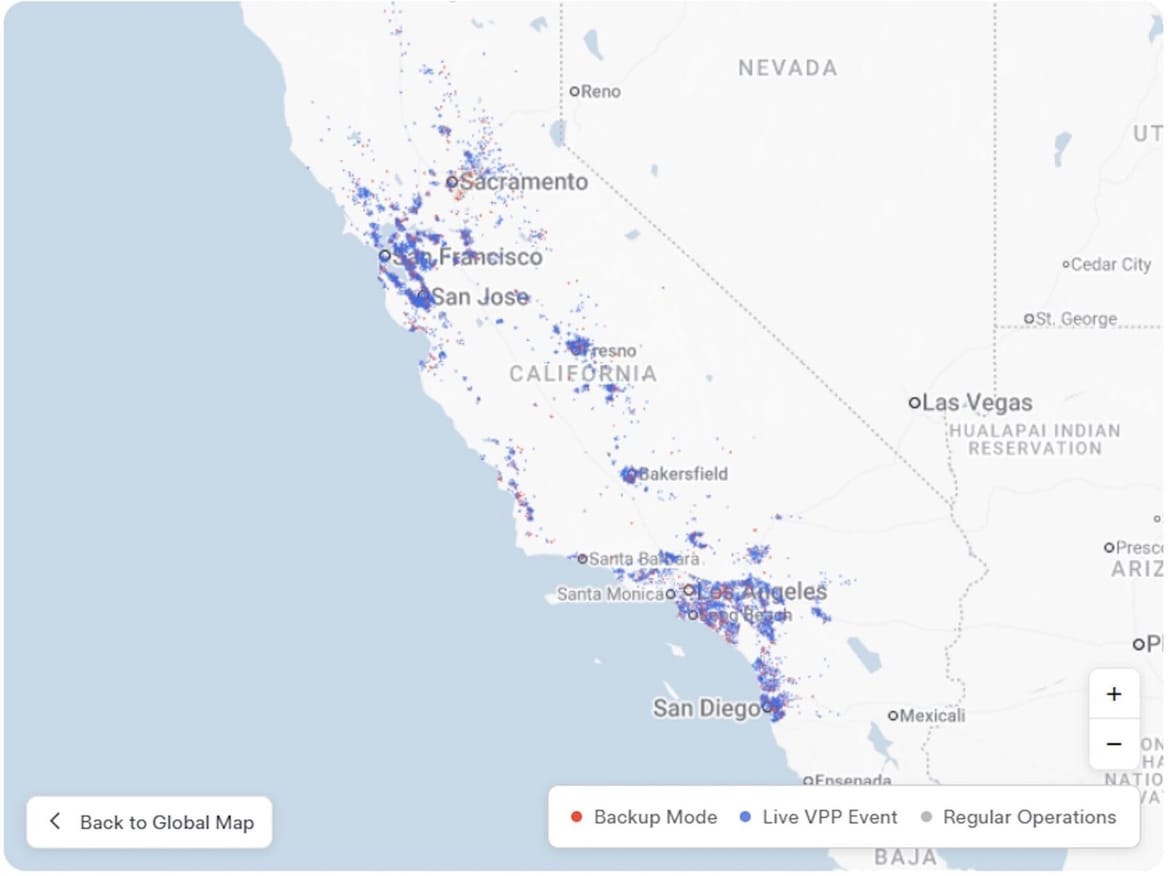
Let’s close this newsletter where we started, with more virtual power plant news — in fact, the biggest VPP news yet. Earlier this month, Tesla and Sunrun broke last year’s record for the largest home-battery VPP dispatch in California history: 580 MW of peak power delivered from more than 110,000 home batteries. Unfortunately, one of the programs that has enrolled these batteries is set to be defunded next year — just in time for what’s expected to be among the hottest summers on record. This map pulled from Tesla’s VPP site shows the scale of grid resources the state might be losing out on as a result — unless California can figure out a way to keep these resources in play.
Tesla’s map of California homes with Powerwall batteries available for VPP service
I’m lucky to work from home, which means that I have as a constant companion my fierce guard dog. Behold Lily, the keeper of the front door.

The utility says too many battery projects will overwhelm its grid and drive up costs. Battery developers say the utility is trying to protect its profits.
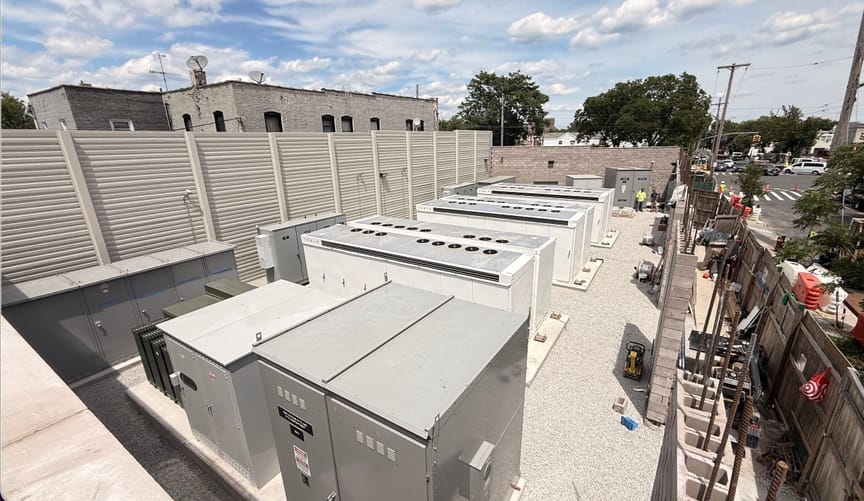
It’s already hard to build grid batteries in New York City. But now, an increasingly hostile dispute between the utility Con Edison and energy-storage developers is making it even harder.
The two sides agree that “community-scale battery projects” — bigger than those that back up a home but smaller than most grid-scale installations — could seriously improve reliability and affordability for New Yorkers.
But they disagree on how those batteries should be managed, and on how the financial rewards for the services they provide to the grid should be parceled out.
Private energy-storage developers who have been cut off from plugging into Con Ed’s grid for the past year say the utility is unfairly tilting the playing field in its own favor.
In August 2025, Con Ed abruptly changed the rules for nearly 600 megawatts of third-party battery projects seeking to interconnect to its grid. Then in November, the utility issued a new interconnection policy that developers say dramatically raised the costs they would have to pay to interconnect, by as much as fourteenfold in some cases.
That’s according to a petition filed in March with the New York Public Service Commission from the New York Battery and Energy Storage Technology Consortium (NY-BEST) and the New York Solar Energy Industries Association (NYSEIA). The groups say Con Ed’s changes have effectively made it impossible to move ahead with roughly $1.5 billion in battery-project investment. They also accuse the utility of circumventing proper regulatory procedure to impose these restrictions and are asking the commission to force the utility to revert to its former rules.
“It’s just unacceptable for a regulated utility to operate like this,” said New York City Council member James Gennaro, a Democrat who chairs its Committee on Environmental Protection and Waterfronts. “We’re looking to get to the bottom of this because we want battery storage to progress. This is good for the grid, it’s good to reduce our dependence on peaker plants, it’s good for everyone.”
In a March letter, environmental groups and city and state elected officials, including Gennaro, called on the commission to force Con Ed to “roll back these unilateral and unwarranted changes.”
Con Ed says the changes are about preserving grid reliability and preventing a flood of third-party batteries operating outside of utility control from driving up costs to its customers. It is asking regulators to approve a plan that it says will better align the way that these batteries charge and discharge with the needs of its increasingly strained grid.
“We think storage is important for the clean energy transition,” said Raghu Sudhakara, Con Ed’s vice president for distributed resource integration. “But it has to be sited in the right location, it has to come online at the right time, and it has to operate under the right operating conditions.”
The dispute is creating roadblocks just when New York City needs all the resources it can get to meet peak electricity demand during heat waves. In fact, the utility’s latest reliability contingency plan, filed with regulators in July, identified the need for 125 MW of “clean and non-emitting” capacity in New York City by 2033. That plan “named energy storage as a primary resource,” said Claudia Villar-Leeman, NY-BEST’s senior director of policy and regulatory affairs.
Environmental justice groups are also pushing for batteries to help replace fossil-fueled power plants that are polluting low-income neighborhoods. In light of those pressures, Con Ed’s actions to block battery developers are “frustrating, because batteries should be able to avoid the need for these infrastructure upgrades rather than causing them,” she said.
Con Ed argues that its new rules and interconnection charges are needed to prevent third-party batteries from overwhelming its grid. In the past two years, the number of interconnection requests for battery projects of 5 MW or less have increased about threefold, and now add up to nearly 2.5 gigawatts, Sudhakara said.
If all those batteries are allowed to plug in and start charging at once, they could pull more power than sections of Con Ed’s grid can handle, the utility warned. And because it doesn’t directly control these third-party batteries, Con Ed argues that it has no way to prevent that from happening.
But battery developers and trade groups say Con Ed’s argument relies on worst-case scenarios and ignores the flexibility of energy storage systems.
“We have utility planners taking our most flexible resource and treating them as if they’re completely inflexible,” said Noah Ginsburg, NYSEIA’s executive director. “If your starting point is false assumptions about the flexibility of the resource you’re dealing with, you’re not going to get a positive outcome.”
Those assumptions bother Adam Cohen, chief technology officer and co-founder of NineDot Energy, a community battery developer that runs six community battery sites and has more than two dozen others in development in New York City.
Con Ed’s analysis “assumes batteries will charge in an inflexible manner, from midnight to 8 a.m., with no day-by-day variation, and at a fixed charging rate,” Cohen said. If all those batteries did charge that way, they could indeed overload certain parts of the grid, he said.
But batteries can be controlled to avoid these kinds of problems, Cohen said. An April study by analysis firm Danovo Energy Solutions, commissioned by NineDot, found that Con Ed could use technical approaches now available to its grid operators to nearly double hosting capacity.
A similar study published in May from NYSEIA, NY-BEST, and the Electric Power Research Institute, a prominent utility research organization, found that active management could significantly increase capacity for community-scale battery projects on Con Ed’s grid.
These aren’t pie-in-the-sky grid management concepts, said Meghan Nutting, vice president of regulatory reform at the nonprofit Interstate Renewable Energy Council. Utilities are using these “flexible interconnection” approaches to streamline the grid interconnection of electric vehicle charging depots in California and community solar projects in Illinois. In fact, Con Ed itself does this with solar and battery-equipped electric bus charging sites in its service territory.
“The assumption that these are stupid resources that all do the worst things at the same time is uninformed,” she said. “You can put rules around when batteries can draw from the grid or discharge to the grid.”
Though this fine-grained control is possible, Con Ed says current state regulations prevent it from exercising that control.
In New York state, community solar and battery developers are able to connect to utility grids under a “value of distributed energy resources” (VDER) structure, which sets the price that project developers are paid by utilities for the energy they provide to the grid. Under the VDER rules, battery developers choose when they charge and discharge to maximize their revenue — and while their choices may align with what local grids need for reliability at times, they may diverge from those grid needs at others, and perhaps in hard-to-predict ways.
Battery developers in New York are prepared to work with Con Ed to revamp these rules to better match grid needs to VDER values, NYSEIA’s Ginsburg said. But so far, the utility has refused to engage in those efforts, he said.
Specifically, Con Ed and other utilities in the state have declined a request from the New York Public Service Commission to propose revisions to the VDER tariff. Such changes could align third-party battery incentives to being dispatched in ways that could defer the need for costly grid upgrades, he said.
“Our state regulatory agency asked the utilities, ‘Give us tariff language to make these VDER resources more valuable from a reliability perspective.’ And the utilities said, ‘We’re not going to do that,’” he said.
Con Ed and other New York utilities dispute that characterization. In a joint filing with the commission, they argued that the changes to the VDER tariff sought by NYSEIA and other parties representing battery developers could end up costing utility customers more than the traditional grid upgrades that battery storage is meant to avoid.
In the meantime, Con Ed is asking regulators to approve an alternative plan to avoid driving up costs for customers. Its idea is to largely replace VDER compensation for third-party battery projects with a more utility-controlled approach called Reliability Asset Dispatch Rights (RADR).
Under RADR, developers wouldn’t operate their batteries to maximize their moneymaking potential. Instead, Con Ed would enter into long-term contracts to reimburse those batteries for the cost of the energy they pull from the grid and for the cost of grid upgrades to enable their projects.
Con Ed predicts that this utility control could avoid the risk that third-party batteries operating on their own schedules will drive up customer costs without delivering benefits. But importantly, Con Ed is asking to earn a regulated rate of return on those RADR expenses, bringing these batteries more closely into the realm of capital assets like poles and wires. VDER’s third-party tariff structure was designed explicitly as part of New York State’s decade-long utility regulatory reform effort to find alternatives to the utility rate-base model.
NYSEIA has yet to issue an official position on the RADR proposal. But Ginsburg said he believes that Con Ed would better serve its customers and the third-party battery developer community by reforming the system already in place rather than launching a new utility-centric alternative.
Meanwhile, New York utilities are lagging well behind on both the state’s recently watered-down renewable energy targets and its goal of building 6 GW of energy storage by 2030, he said.
It’s important to note that third-party battery developers aren’t necessarily incentivized to operate their batteries in a way that minimizes cost impacts to Con Ed customers. “I appreciate that Con Edison is a business, just like the members of my association are businesses,” Ginsburg said.
Still, “the theoretical risk of overbuilding at some point in the future takes second fiddle to the fact that we need deployment, and we’re not getting it at the scale and pace necessary,” he said. “The question for regulators is, is there a better way to align incentives?”
The utility says too many battery projects will overwhelm its grid and drive up costs. Battery developers say the utility is trying to protect its profits.
It’s already hard to build grid batteries in New York City. But now, an increasingly hostile dispute between the utility Con Edison and energy-storage developers is making it even harder.
The two sides agree that “community-scale battery projects” — bigger than those that back up a home but smaller than most grid-scale installations — could seriously improve reliability and affordability for New Yorkers.
But they disagree on how those batteries should be managed, and on how the financial rewards for the services they provide to the grid should be parceled out.
Private energy-storage developers who have been cut off from plugging into Con Ed’s grid for the past year say the utility is unfairly tilting the playing field in its own favor.
In August 2025, Con Ed abruptly changed the rules for nearly 600 megawatts of third-party battery projects seeking to interconnect to its grid. Then in November, the utility issued a new interconnection policy that developers say dramatically raised the costs they would have to pay to interconnect, by as much as fourteenfold in some cases.
That’s according to a petition filed in March with the New York Public Service Commission from the New York Battery and Energy Storage Technology Consortium (NY-BEST) and the New York Solar Energy Industries Association (NYSEIA). The groups say Con Ed’s changes have effectively made it impossible to move ahead with roughly $1.5 billion in battery-project investment. They also accuse the utility of circumventing proper regulatory procedure to impose these restrictions and are asking the commission to force the utility to revert to its former rules.
“It’s just unacceptable for a regulated utility to operate like this,” said New York City Council member James Gennaro, a Democrat who chairs its Committee on Environmental Protection and Waterfronts. “We’re looking to get to the bottom of this because we want battery storage to progress. This is good for the grid, it’s good to reduce our dependence on peaker plants, it’s good for everyone.”
In a March letter, environmental groups and city and state elected officials, including Gennaro, called on the commission to force Con Ed to “roll back these unilateral and unwarranted changes.”
Con Ed says the changes are about preserving grid reliability and preventing a flood of third-party batteries operating outside of utility control from driving up costs to its customers. It is asking regulators to approve a plan that it says will better align the way that these batteries charge and discharge with the needs of its increasingly strained grid.
“We think storage is important for the clean energy transition,” said Raghu Sudhakara, Con Ed’s vice president for distributed resource integration. “But it has to be sited in the right location, it has to come online at the right time, and it has to operate under the right operating conditions.”
The dispute is creating roadblocks just when New York City needs all the resources it can get to meet peak electricity demand during heat waves. In fact, the utility’s latest reliability contingency plan, filed with regulators in July, identified the need for 125 MW of “clean and non-emitting” capacity in New York City by 2033. That plan “named energy storage as a primary resource,” said Claudia Villar-Leeman, NY-BEST’s senior director of policy and regulatory affairs.
Environmental justice groups are also pushing for batteries to help replace fossil-fueled power plants that are polluting low-income neighborhoods. In light of those pressures, Con Ed’s actions to block battery developers are “frustrating, because batteries should be able to avoid the need for these infrastructure upgrades rather than causing them,” she said.
Con Ed argues that its new rules and interconnection charges are needed to prevent third-party batteries from overwhelming its grid. In the past two years, the number of interconnection requests for battery projects of 5 MW or less have increased about threefold, and now add up to nearly 2.5 gigawatts, Sudhakara said.
If all those batteries are allowed to plug in and start charging at once, they could pull more power than sections of Con Ed’s grid can handle, the utility warned. And because it doesn’t directly control these third-party batteries, Con Ed argues that it has no way to prevent that from happening.
But battery developers and trade groups say Con Ed’s argument relies on worst-case scenarios and ignores the flexibility of energy storage systems.
“We have utility planners taking our most flexible resource and treating them as if they’re completely inflexible,” said Noah Ginsburg, NYSEIA’s executive director. “If your starting point is false assumptions about the flexibility of the resource you’re dealing with, you’re not going to get a positive outcome.”
Those assumptions bother Adam Cohen, chief technology officer and co-founder of NineDot Energy, a community battery developer that runs six community battery sites and has more than two dozen others in development in New York City.
Con Ed’s analysis “assumes batteries will charge in an inflexible manner, from midnight to 8 a.m., with no day-by-day variation, and at a fixed charging rate,” Cohen said. If all those batteries did charge that way, they could indeed overload certain parts of the grid, he said.
But batteries can be controlled to avoid these kinds of problems, Cohen said. An April study by analysis firm Danovo Energy Solutions, commissioned by NineDot, found that Con Ed could use technical approaches now available to its grid operators to nearly double hosting capacity.
A similar study published in May from NYSEIA, NY-BEST, and the Electric Power Research Institute, a prominent utility research organization, found that active management could significantly increase capacity for community-scale battery projects on Con Ed’s grid.
These aren’t pie-in-the-sky grid management concepts, said Meghan Nutting, vice president of regulatory reform at the nonprofit Interstate Renewable Energy Council. Utilities are using these “flexible interconnection” approaches to streamline the grid interconnection of electric vehicle charging depots in California and community solar projects in Illinois. In fact, Con Ed itself does this with solar and battery-equipped electric bus charging sites in its service territory.
“The assumption that these are stupid resources that all do the worst things at the same time is uninformed,” she said. “You can put rules around when batteries can draw from the grid or discharge to the grid.”
Though this fine-grained control is possible, Con Ed says current state regulations prevent it from exercising that control.
In New York state, community solar and battery developers are able to connect to utility grids under a “value of distributed energy resources” (VDER) structure, which sets the price that project developers are paid by utilities for the energy they provide to the grid. Under the VDER rules, battery developers choose when they charge and discharge to maximize their revenue — and while their choices may align with what local grids need for reliability at times, they may diverge from those grid needs at others, and perhaps in hard-to-predict ways.
Battery developers in New York are prepared to work with Con Ed to revamp these rules to better match grid needs to VDER values, NYSEIA’s Ginsburg said. But so far, the utility has refused to engage in those efforts, he said.
Specifically, Con Ed and other utilities in the state have declined a request from the New York Public Service Commission to propose revisions to the VDER tariff. Such changes could align third-party battery incentives to being dispatched in ways that could defer the need for costly grid upgrades, he said.
“Our state regulatory agency asked the utilities, ‘Give us tariff language to make these VDER resources more valuable from a reliability perspective.’ And the utilities said, ‘We’re not going to do that,’” he said.
Con Ed and other New York utilities dispute that characterization. In a joint filing with the commission, they argued that the changes to the VDER tariff sought by NYSEIA and other parties representing battery developers could end up costing utility customers more than the traditional grid upgrades that battery storage is meant to avoid.
In the meantime, Con Ed is asking regulators to approve an alternative plan to avoid driving up costs for customers. Its idea is to largely replace VDER compensation for third-party battery projects with a more utility-controlled approach called Reliability Asset Dispatch Rights (RADR).
Under RADR, developers wouldn’t operate their batteries to maximize their moneymaking potential. Instead, Con Ed would enter into long-term contracts to reimburse those batteries for the cost of the energy they pull from the grid and for the cost of grid upgrades to enable their projects.
Con Ed predicts that this utility control could avoid the risk that third-party batteries operating on their own schedules will drive up customer costs without delivering benefits. But importantly, Con Ed is asking to earn a regulated rate of return on those RADR expenses, bringing these batteries more closely into the realm of capital assets like poles and wires. VDER’s third-party tariff structure was designed explicitly as part of New York State’s decade-long utility regulatory reform effort to find alternatives to the utility rate-base model.
NYSEIA has yet to issue an official position on the RADR proposal. But Ginsburg said he believes that Con Ed would better serve its customers and the third-party battery developer community by reforming the system already in place rather than launching a new utility-centric alternative.
Meanwhile, New York utilities are lagging well behind on both the state’s recently watered-down renewable energy targets and its goal of building 6 GW of energy storage by 2030, he said.
It’s important to note that third-party battery developers aren’t necessarily incentivized to operate their batteries in a way that minimizes cost impacts to Con Ed customers. “I appreciate that Con Edison is a business, just like the members of my association are businesses,” Ginsburg said.
Still, “the theoretical risk of overbuilding at some point in the future takes second fiddle to the fact that we need deployment, and we’re not getting it at the scale and pace necessary,” he said. “The question for regulators is, is there a better way to align incentives?”
Company and utility execs called it the nation’s biggest battery, but details are scant. A July satellite image shows 720 Tesla Megapacks at the controversial site.
Elon Musk’s SpaceXAI has built what may be the biggest battery in the U.S. at its controversial Memphis AI computing hub.
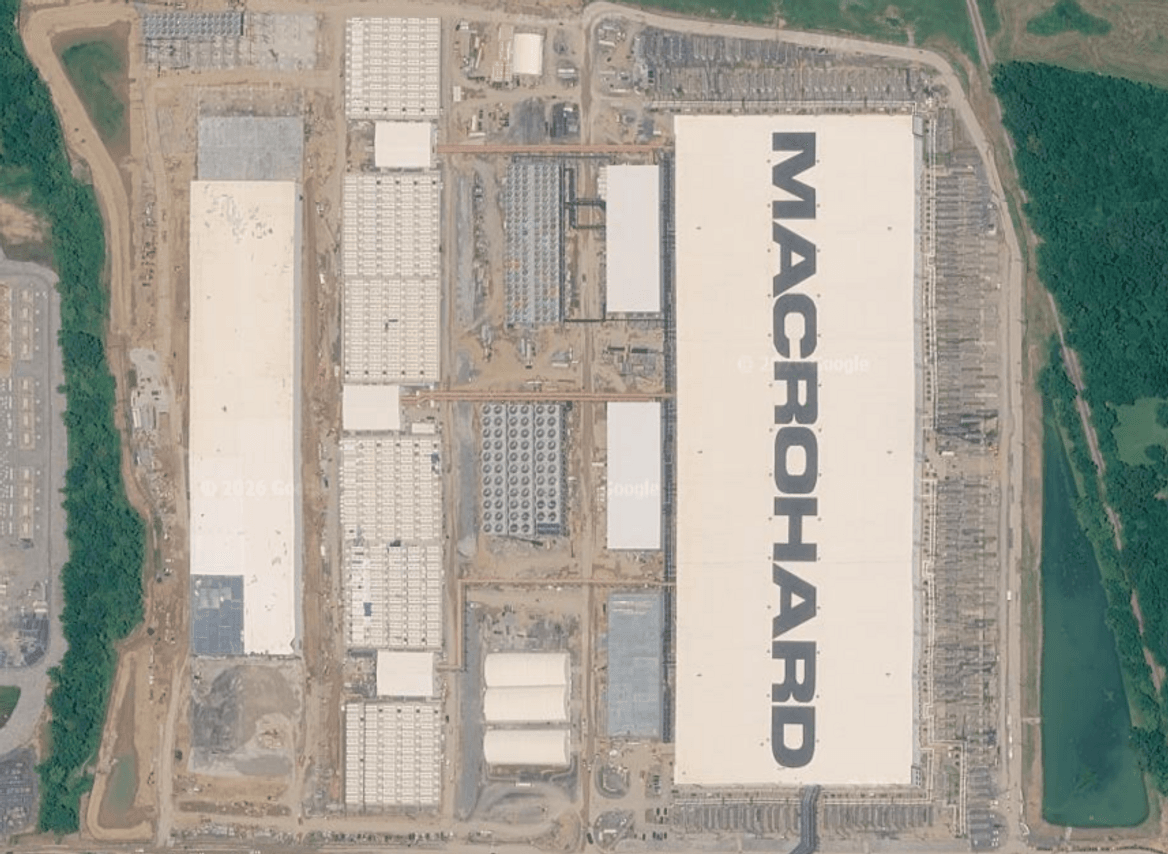
The exact size of the battery is unclear. Canary Media counted 720 Tesla Megapack battery containers visible on the grounds of the Colossus 2 data center in satellite imagery dated July 11. That would equate to 2.8 gigawatt-hours and between 720 megawatts and 1,400 MW, depending on which Megapack model they are.
On Aug. 20 in Memphis, SpaceXAI energy and data center developer Riley Trettel called this battery the biggest in the nation in remarks to the board of the Tennessee Valley Authority, the federal utility that produces power for 10 million people across the Southeast, according to audio of the meeting obtained by Canary Media.
Trettel described the facility as having 3.3 GWh of storage, “enough to power all of Memphis for two hours.” He said it was not yet connected to TVA’s grid, but could be later this year if the TVA board granted approval. The board approved a direct hookup to the TVA grid for SpaceXAI later that day.
Then, on Sept. 2, the CEO of the municipal utility Memphis Light, Gas and Water, Doug McGowan, corroborated the “biggest battery” claim at a solar and storage industry conference in Chattanooga. McGowan is in a position to know, as MLGW supplies utilities to the SpaceXAI facility. But he described the installation somewhat differently.
“It’s the world’s largest supercomputer today, but it’s also got the world’s largest grid-connected battery system,” McGowan said. “I think it’s 2,000 MW of batteries behind the meter that they have to help as a backup when they have to curtail.”
The 720 Megapacks installed at the Southaven site as of July 11 would already put the battery among the largest in the nation. If it has grown since — either to the 2 gigawatts of instant discharge capacity noted by McGowan or to the 3.3 GWh cited by Trettel — it would be the largest of its kind in the country.
Currently, the largest known grid battery operating in the U.S. is at the Edwards & Sanborn solar plant in Kern County, California, with more than 1,066 MW and 3,287 MWh.
The Memphis utility’s communications team declined to clarify the official size of the battery its CEO had described, instead referring inquiries to TVA and SpaceXAI. TVA declined to comment on the battery and referred questions to SpaceXAI. SpaceXAI has not responded to requests for comment.
Musk knows energy storage as well as anyone, since his other company, Tesla, builds some of the most popular grid and home battery products on the market.
XAI bought $430 million worth of Megapacks last year, Tesla acknowledged in a January filing with the Securities and Exchange Commission. XAI was acquired by SpaceX in February, and the combined company bought another $405 million worth of Megapacks in the first half of this year.
A new, more powerful Megapack 3 entered production in early August at Tesla’s Texas factory, after the 720 Megapacks visible in satellite imagery were installed. Tesla redesigned this model to speed up deployment timelines, raising the possibility that significantly more battery capacity could have been installed at Colossus 2 over the last month.
That leaves an unusual vacuum of information surrounding what could well be the largest grid battery installation in the country.
Such projects normally take years to develop, and have to go through a community outreach process to secure permits, not to mention a utility-led contracting process to guarantee revenue for the completed power plant. But SpaceXAI went ahead without any announced utility contract, and regional storage industry leaders heard about the battery for the first time at the August TVA board meeting.
SpaceXAI has demonstrated its willingness to brush aside typical procedures in the headlong rush to “win” the AI arms race. The company previously installed a fleet of mobile gas generators to run its Memphis computing infrastructure before sufficient grid supply became available.
SpaceXAI has been operating temporary gas generators without air permits for Colossus 2, on the grounds that they are mobile; 69 units were active there as of July. These generators, which sit on flatbed trailers but run in the same location day after day, produce harmful air pollutants that especially affect nearby areas, including the predominately Black neighborhood of Whitehaven. The Boxtown neighborhood dealt with this issue earlier as XAI got Colossus 1 up and running.
The Southern Environmental Law Center has sued to stop the unpermitted air pollution on behalf of the community, a lawsuit that is still pending.
Batteries, which are being plugged into the U.S. grid at a record-busting pace, don’t combust fossil fuels; they store electricity when it’s plentiful and deliver it when needed. SpaceXAI may be using them as a kind of filter for the electricity flowing into the computers, so that momentary dips and jumps in AI consumption don’t damage the generators or the local grid system.
But it’s unclear whether the massive battery will lead SpaceXAI to reduce its use of mobile generators. If the batteries don’t have access to sufficient grid power, they also could charge up from the generators in an islanded microgrid setup, which would incur further emissions.
The U.S. grid is struggling to keep up with the expected demand growth from AI computing, and data center developers eager to get online ASAP are increasingly looking to large batteries to help speed up interconnection.
The idea is simple: For most of the year, the power system has ample capacity to meet new demand from data center projects. The problems arise on the days when demand spikes, like during a heat wave or a snowstorm.
Big batteries can help during these demand peaks. When electricity use surges, the facility can tap its batteries for a few hours to alleviate the strain on the grid. That’s part of the plan with SpaceXAI’s battery, which was approved for interconnection through a “power interruption” program run by MLGW, McGowan said at the conference early this month.
“They actually have behind-the-meter … generation and storage that can meet all of their load, so that they can actually successfully come off the grid for four hours in order to curtail, so that nobody else has to,” McGowan said.
This was a precondition for hooking up service to the data center, he said. Other states and grid operators have labored to define new “large load tariffs” in order to silo hyperscalers from other grid customers; some states are looking to curtail power to data centers in moments when the grid is under strain. But in TVA territory, local power companies can swiftly implement solutions to the fast-moving AI demand challenge without waiting for yearslong approvals from state or federal regulatory commissions.
“We kind of proved the model here before the ratepayer protection plan was in place,” McGowan said, referring to the White House–led pact to encourage AI companies to fund their own infrastructure upgrades and avoid pushing costs onto the general public.
Other developers have signed contracts for similar projects. Aligned Data Centers will come online in Oregon several years early by paying the utility to build a battery for peak capacity. Google signed up a whole portfolio of solar, wind, and short- and long-duration batteries to run a Minnesota data center.
SpaceXAI’s massive battery could eventually have a beneficial effect on the broader TVA system. TVA has repeatedly stated its desire for more firm, dispatchable power to meet peak demand for the growing population, manufacturing base, and AI industries. TVA identified battery storage as a growth opportunity in its recently completed long-range energy plan, spokesperson Patrick Cassidy noted; the TVA board approved that plan at its August meeting.
“We’re just beginning to tap the potential of battery storage in the Tennessee Valley,” said Gil Hough, executive director of the Tennessee Solar Energy Industries Association. “A project this large shows what’s possible — and it could be a real catalyst for utilities, solar developers, and other energy companies to think much bigger about how storage can help meet the region’s rapidly growing electricity demand.”
TVA operates a large fleet of nuclear and coal plants, which cannot nimbly ramp up and down in response to demand. They keep producing through the night, when most people are sleeping, creating periods of electrical surplus, in contrast to the energy constraints of afternoons and evenings. Batteries could shift energy between those times, as well as store the region’s growing solar generation for use at high-demand hours.
TVA has begun to seek out batteries to inject power when it’s most needed. In April, it signed a contract with pioneering storage developer Plus Power for a 200-MW/800-MWh battery in Jackson County, Alabama. That project followed the regular order of business, in which the utility signs a contract for its services, and then the developer moves forward with construction, which is expected to wrap up in 2029.
Trettel’s remarks to the TVA board suggest SpaceXAI is open to offering up the massive battery installation as a contracted grid resource — meaning the privately constructed batteries could help deliver peak capacity to the broader TVA network, and get paid for it. Should that offer bear fruit, the unbridled rush of AI infrastructure construction would produce a knock-on effect of vastly accelerating the deployment of batteries on the grid.
Batteries are taking the energy sector by storm, whether to power vehicles or boost the grid. Most are made, and deployed, in China.
Batteries are taking center stage in the energy world.
Battery deployment, both to power electric vehicles and to store electricity for the grid, has skyrocketed in recent years. Last year, more than 1.5 terawatt-hours of batteries were placed into service around the world — about 10 times more than the total in 2020, per a recent International Energy Agency analysis.
It’s astounding growth, made possible in large part because China has scaled up the manufacturing of the tech and driven the price down as a consequence. Lithium-ion batteries in 2025 were 93% cheaper than they were in 2010 and a respectable 36% cheaper than they were even five years earlier, in 2020.
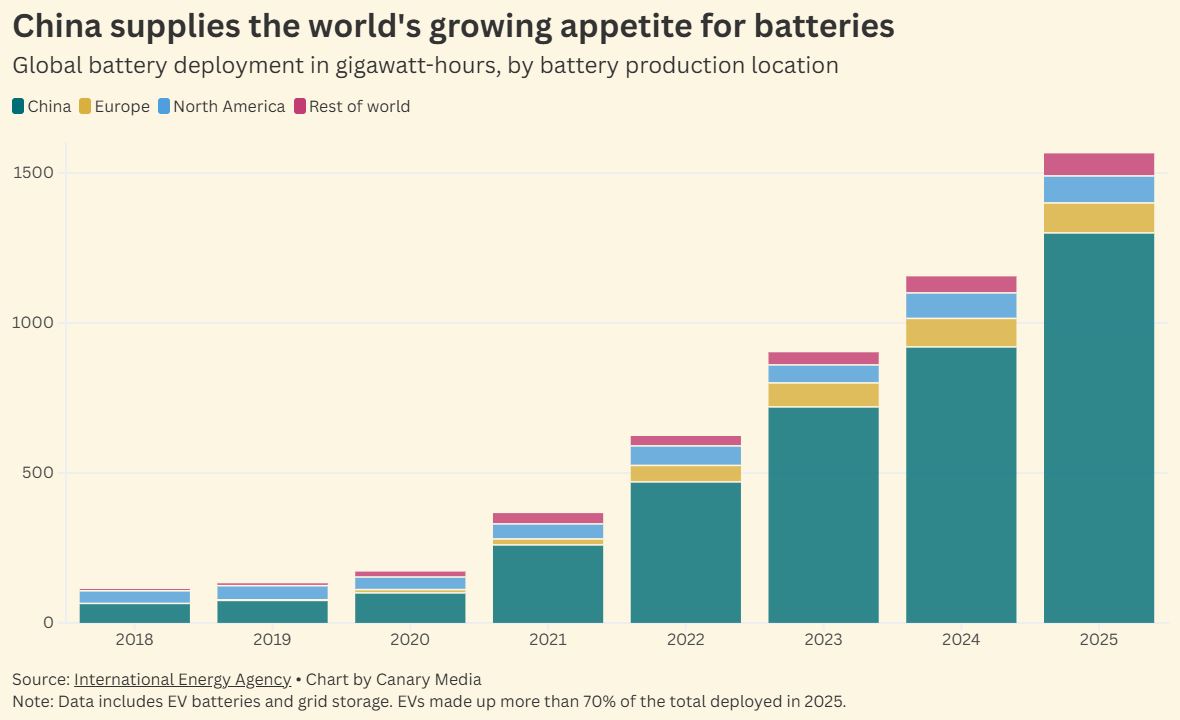
Most of these batteries are deployed within China, and most are used to power electric vehicles. But grid storage is growing particularly fast: Globally, annual deployments grew by a factor of nearly 19 between 2020 and 2025. The trend isn’t stopping; energy research firm BloombergNEF thinks annual deployments will double by the end of the decade.
The fact that China makes such a large percentage of the batteries that increasingly power the cars and grids of the world makes certain governments nervous.
The Inflation Reduction Act tried to mitigate those concerns in the U.S. by incentivizing companies to ramp up home-grown manufacturing, and the domestic batterymaking sector has since begun to flourish. Despite gutting much of that Biden-era climate law, President Donald Trump left incentives for most cleantech manufacturing and for grid storage deployment in place while also making a rash of protectionist moves that could push developers harder toward domestic batteries.
The European Union, perennially concerned about energy security, also wants to shore up its local battery production. It aims to meet 90% of its own domestic battery needs by 2030, but is not on track to hit that target.
Still, it’s hard for either region to compete on price, even with incentives in place. China’s economies of scale — and its accumulated know-how — are potent forces. Plus, the nation plays an outsized role in refining and processing the minerals needed to make batteries.
With that in mind expect two things to remain true: Global battery adoption will keep growing — and China will keep making most of those batteries.
North Plains Connector has earned backing from the Energy Department and utilities, and could deliver huge cost and reliability benefits — if states give it the OK.
Michael Skelly knows it’s hard to build a huge transmission line that connects different regions of the grid. He has spent a decade trying to get one up and running.
But Skelly, now CEO of Grid United, thinks his current attempt to build a first-of-its-kind transmission line is on the right track. And he’s gotten a consortium of utilities from Minnesota to Oregon, and officials in the U.S. Department of Energy through both the Biden and Trump administrations, to back it up.
Grid United’s North Plains Connector will be a 420-mile, 3-gigawatt high-voltage direct current (HVDC) link between Montana and North Dakota. It will require an estimated $6 billion in investment across both states, and won’t be completed until 2032 at the earliest.
When it’s done, North Plains Connector will be able to share power between three grid regions spanning three time zones across the U.S. West, Great Plains, and Upper Midwest. Today, such region-spanning connections are extremely rare. But study after study has shown they can yield major benefits that extend far beyond the states the line transects.
“If you connect two grids whose peak moments are at two different times, you create an ability for the grids to lean on one another,” Skelly said.
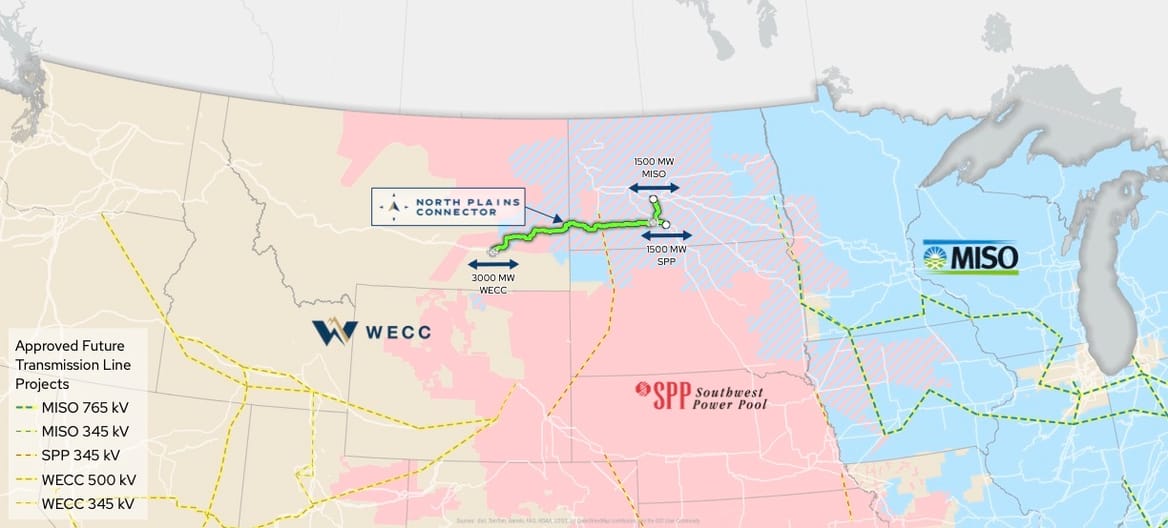
The reliability and cost benefits that could flow from linking entire regions are almost certainly substantial. But it’s hard to quantify all the good that can come from such links when they have never existed before — and utilities and regulators want to be able to clearly define long-term benefits before they approve major investments.
Grid United’s solution is to front the costs for getting the project off the ground while trying to convince utilities to join in paying for a portion. Financing from the DOE is helping immensely with navigating these early costs and risks — and in getting utilities on board.
Back in 2024, the DOE awarded a $700 million grant to the consortium, including Grid United and the Montana Department of Commerce, which is the lead agency for administering the award. And last week, the DOE published a final environmental impact statement for the project, helped along by a federal interagency process launched under the Biden administration.
The Trump administration has continued to work with Grid United, even as it has clawed back or delayed billions of dollars in other Biden-era grants and terminated a $4.9 billion DOE loan for the Grain Belt Express, another massive HVDC line meant to carry wind and solar energy from the Great Plains to states farther east.
For North Plains Connector, having that federal money available “is quite helpful to the utilities that are participating in the project as they go through regulatory approvals,” Skelly said. Regulators “want their states to get their fair share, if you will — and they also want customers whose utilities are paying for the project to not have to pay for the whole thing.”
This combination of the DOE and Grid United taking on the early costs and risks has given a growing list of utilities enough confidence to make at least conditional commitments to pay for a piece of the project once it’s finished.
Some of them are directly involved in the states where it’s being built, such as Minnkota Power Cooperative and NorthWestern Energy. While others — such as Allete Energy and Great River Energy in Minnesota, Portland General Electric in Oregon, and Puget Sound Energy in Washington state — are joining up to earn a share of the reliability and cost benefits that will flow indirectly from the project and across the grid regions it will link.
Those far-off utilities don’t need to draw power directly from the end points of the HVDC line to gain the benefits, said Gretchen Kershaw, chief operating officer at consultancy Grid Strategies, which is not involved in the project. That’s because HVDC lines enable two-way flows of power that can energize and backfill shortfalls across entire regional grid networks.
Being able to tap into generation well beyond their borders makes it easier for utilities to deal with disruption or demand spikes caused by intense weather events like winter storms or heat waves. That’s one of the benefits cited for North Plains Connector in last month’s draft National Transmission Needs Study, the most recent in a series of DOE reports highlighting the value of these kinds of interregional connections.
“The most reliable and resilient system will have diversity in generation supply, both in terms of types of generation and location,” said Kershaw, who previously worked as a senior adviser to the DOE’s Grid Deployment Office, which was the source of the North Plains Connector grant but disbanded by the Trump administration last year. “You’re essentially able to make the system bigger, with generators and customers on both sides, and weather systems that are different at both ends.”
Those are some of the benefits that drew Allete to partner on the North Plains Connector project in 2023.
“We knew this energy transformation happening in our nation is going to require people to go well beyond the boundaries of their previous business and service territories,” said Julie Pierce, vice president of strategy and planning for the utility and energy company.
Allete owns Minnesota Power, a utility serving about 150,000 customers, as well as renewable energy subsidiaries including wind farms in North Dakota, which happen to be connected with a decades-old HVDC line to its Minnesota territory.
Allete is also part of a group of utilities that developed a large-scale, multi-utility grid-expansion plan in the early 2000s, which helped lay the groundwork for billions of dollars in additional regional transmission buildouts in the Midwest, Pierce said.
A key step in convincing other utilities to sign on is figuring out how to measure the new interregional line’s resource adequacy value. That’s the term of art for how utilities ensure they can keep their grids running during times of high demand, power plant outages, severe weather, or other emergencies.
“It’s so massive, it’s hard to put boundaries around what it’s going to enable,” Pierce said. “How do you value the ability to keep lights on in the Upper Midwest when there’s a storm coming through, but you’re able to import that solar from California?”
That work has some clear starting points, she said. Utilities can start to incorporate the reliability value of their share of the line into the integrated resource plans they file with state regulators, which lay out how much new generation and grid investment they need to make over the next decade or more.
North Plains Connector has its work cut out for it beyond measuring resource adequacy. Before it can break ground, it must make agreements with landowners along the path of the line, secure state and local permits, and win final regulatory approvals from both states it passes through.
“These projects take many years to put together,” Skelly said.
Indeed, high-profile transmission lines like the SunZia project from New Mexico to California and the Champlain Hudson Power Express from Canada to New York City have taken more than a decade from inception to completion. Many transmission projects fail to overcome hurdles. Skelly’s previous company, Clean Line Energy Partners, shut down in 2019 after failing to complete five power lines to carry 16.5 GW of wind power across the Midwest.
But if North Plains Connector can get connected, “the project will be online for 30 years,” he said. “What does generation in America look like in 2050? I don’t know. But it’s very likely we have very different demand profiles in each system, and whatever generation we have in that time, we’ll be better able to optimize if we have a great grid to lean on.”
The outlook for storage construction keeps getting brighter as everyone from the Trump White House to clean energy advocates to AI giants clamors for more.
There’s never been a better time to build energy storage in the U.S. than right now.
Grid batteries — which sop up power when it’s abundant and discharge that energy when it’s needed — have been ascendant for a decade, as the price of the underlying lithium-ion cells fell precipitously. Bolstered by plummeting costs and increasing familiarity with the tech, developers started building bigger and in more parts of the country.
Now, the U.S. power sector has added more battery capacity in the second quarter of this year than any quarter ever, according to a report out today from the Solar Energy Industries Association and Benchmark Mineral Intelligence. Even as the wind and solar industries face uncertain futures, the outlook for continued battery growth is so strong that Benchmark Minerals upped the prediction for cumulative installs through 2030 by 11.5% from its previous report, issued just three months ago.
The 20.2 gigawatt-hours of battery capacity built from April through June represents one-tenth of the nation’s entire grid storage capacity. Seven of the new projects mustered at least 1 GWh or more of storage capacity, reflecting developers’ rising appetite for megabatteries.
To contextualize the numbers, the second-quarter installations can inject 6.7 gigawatts of instantaneous power onto the grid — equivalent to nearly seven big old-school nuclear reactors, but without the decade-plus wait time for construction. That comparison has its limits, though, because nuclear plants can generate around the clock, whereas batteries must refill and discharge.
Batteries can make a huge difference in places where the grid is stretched thin, and can be built quickly and closer to centers of energy consumption than new fossil-fuel-burning plants with their smokestacks and emissions.
Those qualities make the tech attractive in places where capacity is scarce, which happens to include California, Texas, the Southeast, the mid-Atlantic, the Northeast, and just about anywhere else. AI data center developers are turning to batteries to ensure they can keep the algorithms running during peak demand hours. And solar developers leverage batteries to turn their clean electrons into a more valuable on-demand resource; 44% of the new storage capacity was built alongside solar plants.
This widespread zeal for batteries extends to the Trump White House, which revoked wind and solar subsidies last year but kept Biden-era tax incentives for batteries. As the executive branch found novel and often legally dubious means to thwart wind and solar construction, it has left battery developers to go about their business.
Recently, the administration has more proactively encouraged the battery industry, loaning $490 million dollars to a battery project in Puerto Rico as well as funding efforts to reshore the supply chain for critical minerals used to make the tech. Energy Secretary Chris Wright, who regularly blasts solar power on his official platforms, recently stopped by the Maine site of a novel iron-air battery that Form Energy plans to build, with help from Department of Energy grant funding.
An observer unencumbered by historical nuance might conclude that Trump is the battery president, and that no president has done more for batteries than he. SEIA even gestures in that direction, noting in its press release that large-scale storage nearly doubled during the first year and a half of the second Trump term, and that 74% of the second-quarter storage additions happened in states that voted for him — like Texas, Utah, and newly minted battery storage powerhouse Arizona.
The reality is these outcomes took years to build up to. Technologists tinkered with batteries in big boxes; California mandated its utilities buy storage and subsidized it for smaller customers; Texas wildcatters took big risks on early battery investments and made windfall profits; and companies like LG and Tesla built huge factories to solidify domestic battery supplies. Now, all that hard work is paying off with installations on a scale we’ve never seen before.
The Demand Side Grid Support program was given no money for next year, though supporters blocked an effort that could have disbanded the VPP altogether.
California Gov. Gavin Newsom’s administration has blocked an effort to keep the state’s most successful virtual power plant program funded through next year.
State budget language finalized last week does not authorize additional money for the Demand Side Grid Support program, one of the biggest VPPs in the country. Friday was the last day for bills to be published before being voted on by the Aug. 31 deadline for this year’s legislative session.
But that budget language also excluded a plan from Newsom, a Democrat, to shift control of the program from the California Energy Commission to the California Public Utilities Commission, which DSGS supporters feared could lead to it being dismantled entirely.
That means that while “there is no guaranteed funding for the program for next year, at the very least it wasn’t outright gutted,” said Brandon García, California policy director for Advance Energy United, a clean energy trade group that reported the outcome of the DSGS negotiations on Friday.
Newsom’s office did not immediately respond to a request for comment.
A spokesperson for Democratic state Sen. Josh Becker, a DSGS supporter and author of several virtual power plant bills that passed both houses of the legislature last week, confirmed that the $70 million “we were hoping to use for DSGS over the next couple of years was not agreed on” in the final budget bills. At the same time, leaving the program under control of the California Energy Commission “does allow us an opportunity to take this issue up early next year, potentially with a new administration,” the spokesperson said.
Still, that’s cold comfort for the companies participating in the program, which pays households and businesses willing to turn down power use or share solar power stored up in batteries at times when California’s grid is under stress.
Since it was launched in 2022, DSGS has grown to include around 130,000 homes equipped with batteries and nearly 75,000 homes with smart thermostats and flexible load devices. The performance of its rooftop solar–charged batteries has been particularly noteworthy; a July 2025 test yielded roughly 476 megawatts of grid capacity over two hours, in what utility Pacific Gas & Electric called “the largest test of its kind ever done in California — and maybe the world.”
All told, DSGS has brought online more than a gigawatt of collective capacity to relieve costly stresses on the state’s power grid, García said.
Absent an intervention from lawmakers and California’s next governor sometime next year, “we don’t anticipate there being any more money for this program,” García said.
And without secure funding, it’s unclear how companies like Sunrun, Tesla, Leap, Renew Home, and others participating in DSGS will be able to pay their customers to help the grid.
That’s unfortunate, because DSGS stands out in a state that’s largely failed to tap into its nation-leading supply of rooftop solar–charged batteries and electric vehicles as an alternative to utility investments in power plants and transmission lines, said Sachu Constantine, executive director of nonprofit advocacy group Vote Solar.
“We should pursue every avenue available to use these resources that customers and companies have already invested in, that are already providing invaluable resources for the grid,” he said.
Similar programs regulated by the CPUC and administered by utilities have largely failed to thrive. That includes the CPUC’s Emergency Load Reduction Program, another approach to enlisting customers to relieve grid stresses that was created alongside DSGS in response to California’s grid emergencies from 2020 to 2022.
Paying customers with solar-charged batteries, smart thermostats, and remote-controllable EV chargers can also help lower utility bills for residents who don’t have those devices.
That’s because a large portion of the costs being passed on to customers of California’s three major utilities, which now charge among the highest rates in the continental U.S., are driven by the need to pay for fossil-fueled power plants and invest in grid infrastructure to meet peaks in grid demand.
By cutting funding for DSGS, California may be undermining a more economical way to defer those costs “at a moment when utilities are earning record profits and bills are going up, reliability is in question, and we’re continuing to prop up old, outmoded resources that don’t make sense for the future,” Constantine said.
Despite the potential cost savings, DSGS had its budget cut in 2024 and 2025, and was allocated no money in Newsom’s January budget proposal, leaving it at risk of being unable to pay participants this year. Early this summer, lawmakers were able to negotiate a transfer of $27 million from another program to keep DSGS running through 2026, García told Canary Media.
But lawmakers couldn’t overcome opposition from the Newsom administration to secure funding to pay DSGS participants in 2027. The final budget bills drafted by the legislature on Friday failed to include a proposal from Senate Democrats that would have shifted $70 million from another California Energy Commission program to cover those costs.
“We’re incredibly disappointed the administration rejected the legislature’s proposal to fund DSGS. It’s baffling,” García said.
García warned that DSGS participants don’t have much time to wait. “Even if the next incoming administration wants to fund DSGS, if they wait until June, I don’t know how many participants will be around to enroll in that program,” he said.


.svg)
