

 Back
Back
Before temperatures plunged to the teens in the wee hours of Feb. 2 in North Carolina, Duke Energy pleaded with customers like me to conserve.
Since electricity supplies would be strained, the utility said in a blanket email, we could help avoid planned blackouts by lowering our thermostats and perhaps putting on a sweater. I got a text, too, asking me to cut back on “nonessential energy use.” In other words: Embrace my inner Jimmy Carter.
The missives worked, in that Duke didn’t have to schedule outages around the state, but they also provoked resentment. At public hearings, some complained that large customers like data centers probably didn’t get the same appeal. On social media, I saw at least one energy policy wonk contend that the utility should be paying customers — not just asking them nicely — to reduce their energy use.
But it turns out that Duke also does that. I should know: Late last year, I joined the throng of Tar Heels who let the company remotely adjust our smart thermostats by a few degrees when needed in exchange for a credit on our bills. It’s just one example of the sort of demand-response program that clean energy advocates say should be expanded not just in North Carolina but also nationwide, as climate change leads to more frequent extreme weather that taxes electricity supplies.
While broad solicitations like the one I received on Feb. 1 can help relieve stress on the grid when every watt counts, paying customers to enroll in ongoing programs can have a more substantial effect. Plus, they offer some much-needed utility-bill relief for households dealing with skyrocketing energy costs in North Carolina and beyond.
A version of the incentive program I participate in has been around for nearly two decades, after a 2007 law required Duke to invest more in energy efficiency. Long an option in the summer for those with central air conditioning, the scheme was recently extended into the winter. Around 500,000 customers are enrolled in the warm months, Duke says, and some 66,000 are signed up in the cold months. (Participation is lower in the winter partly because many customers heat their homes with gas rather than electricity, per the utility.)
Duke hasn’t yet analyzed the precise effectiveness of this one residential incentive program during this year’s unusually frigid temperatures. But it says the combination of this household initiative, similar ones for business customers, and the mass conservation request all made a difference.
“The collective efforts of customers in our demand response programs and those who voluntarily reduced their energy use made a substantial impact during the stretch of extreme cold and unusually high energy demand,” spokesperson Jeff Brooks said in an email. “Across our Carolinas service areas, customers helped reduce demand on the grid by contributing hundreds of megawatts of electric load reduction.”
Hundreds of megawatts is no small matter. It’s the equivalent of the grid getting an additional small gas-fired power plant — but without the associated pollution or cost.
For consumers, there were clear upsides, too.
In Raleigh, where I live, the scheme is called EnergyWise. In other parts of Duke’s territory, it’s called Power Manager. Everywhere, the idea is the same: Customers with electric heat and thermostats connected to the internet get a $150 credit for enrolling, then $50 a year after that, plus whatever money we save by using a little less heat than we might otherwise. It’s not a staggering amount, but since the average Duke household in North Carolina spends about $154 a month on electricity, it’s not nothing, either.
For my part, the savings have been meaningful. I live in a small house powered partly by solar panels, so I’m not a prototypical Duke customer. But since joining the program in early December, I’ve paid the utility all of $6.45, thanks to the sign-up incentive. (My bill due in March, to be fair, is close to $130.) With Duke proposing rate increases of 15% in the coming years — and a 2025 law requiring households to shoulder more of the burden when the company buys power from outside the state — I’ll take the extra dollars where I can.
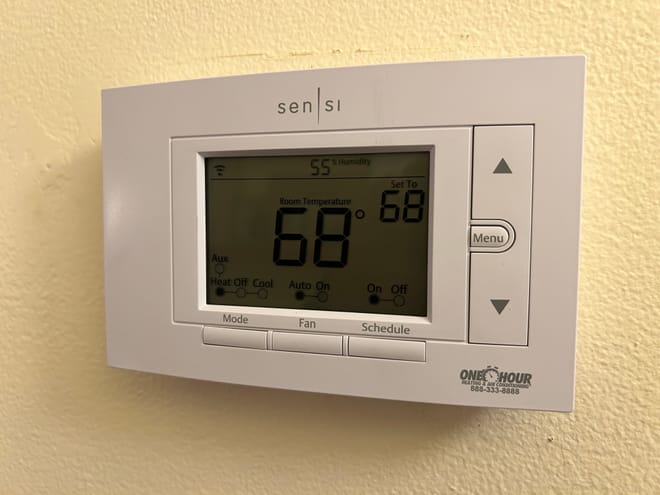
“Active savings events,” whereby Duke lowers my temperature setting a few degrees for one or two hours, happen a few times a month, per the company, or not at all if the weather is mild. A message on my physical thermostat, and on the phone app that controls it, tells me when an event is underway. I can opt out at any time by changing the temperature as I see fit.
A Gen Xer, I grew up in a household where only one person — my father, born in the throes of the Great Depression — could control the thermostat. His rule was kind but firm, with winter settings that never exceeded the high 60s. Sometimes he would cheerfully encourage an extra layer and start a fire. At night, he always set the temperature much lower.
Perhaps that upbringing, together with my career as an energy reporter, explain why I’ve felt the need to override a savings event only once so far. It wasn’t to raise the temperature but to lower it during the recent cold snap: I woke up in the middle of the night and realized I’d accidentally set the thermostat higher than normal. While Duke’s system had adjusted the heat down a few degrees, I wanted it to be colder still — a little bit for the planet, a little bit for bedtime coziness, but mostly for my wallet.
Of course, plenty of people will balk at giving Duke — a monopoly that almost by definition breeds distrust — control over their thermostats. And I can surely see how the entreaty for households to voluntarily conserve left a bitter taste when the company was reporting sky-high profits.
But I suspect there are scores of people like me, who are happy to do their part and save a little money at the same time with basically no risk. As for the half million North Carolinians already enrolled in the program, I know one thing for sure: They aren’t all energy reporters with solar panels.
A correction was made on Feb. 19, 2026: This story originally misstated the date of the Duke Energy email as Feb. 2; it came on Feb. 1.


.svg)
