

 Back
Back
There’s nothing like a common enemy to bring people together. This midterm election year, that enemy may be data centers.
As AI grows more powerful and more popular, tech companies are rushing to build facilities that house all that computing capability — and to secure tons of power to run them. But no one knows exactly how many of those data centers will get constructed, and how much electricity they’ll need. That’s a problem for utility customers, who may be saddled with the costs and climate impacts of an unnecessary gas power and grid infrastructure buildout.
Some states are tackling the problem with what are known as large-load tariffs: essentially, special rates and requirements that force big power users to shoulder the costs of grid buildouts. But this week, a small city in Wisconsin put its foot down. Port Washington, a suburb of Milwaukee, voted by a roughly 2-to-1 margin to require that city leaders get voter approval before awarding tax breaks to data centers and other large development projects. It’s a clear response to the $15 billion OpenAI and Oracle megaproject that’s being built in the city, though this newly approved measure comes too late to affect that project.
At the federal level, Democrats have spearheaded most of the campaigns against data centers, with Sen. Bernie Sanders (I-Vt.) and Rep. Alexandria Ocasio-Cortez (D-N.Y.) even proposing a nationwide moratorium. But Port Washington is part of Ozaukee County, which has voted for Republicans over the past 20-plus years of elections.
Also this week, residents in Festus, Missouri, voted to oust every incumbent on their City Council, in large part because the decision-makers had approved a controversial $6 billion data center in the area. Jefferson County, where the city is situated, voted overwhelmingly for Republicans in the 2024 elections.
Indianapolis, meanwhile, saw a more violent reaction: Someone fired over a dozen bullets at City Council member Ron Gibson’s home on Monday, and left a note reading “No Data Centers” on the legislator’s doorstep. Gibson is a Democrat who has publicly supported a data center project in the city.
Across the U.S., more data center questions are on the ballot. Residents in Monterey Park, California, will determine in June whether to completely ban construction of the facilities. In the fall, Boulder City, Nevada, will vote on whether a municipally owned plot should host a data center, and residents in Janesville, Wisconsin, will decide whether to add more hurdles to a project turning a former General Motors plant into a data center.
At least 11 states are also considering legislation that would pause new data center construction, with a bill in Maine likely to be the first to become law.
City-level data center restrictions like Port Washington’s certainly don’t have the heft of state-level bans or even a nationwide moratorium, as far-fetched as its passage may be. But they do show that data center opposition is on the rise in every nook and cranny of the country — and it may have a massive influence on more than just local elections this November.
Clean Energy Team dominates Arizona utility election
Arizona voters this week selected a slate of candidates known as the Clean Energy Team to run the state’s largest public utility, the Salt River Project.
The winners may have Turning Point USA, the Charlie Kirk–founded conservative organization, to thank. The SRP delivers power and water to more than 1 million customers in the Phoenix area, and its leaders are chosen through an unusual election in which the number of acres a customer owns determines how many votes they can cast. These races typically don’t get much turnout, but this year, Turning Point stepped in to endorse candidates who supported converting retiring coal plants to gas. That prompted clean energy advocates, including the Sierra Club and actor and advocate Jane Fonda, to get involved.
All that attention definitely juiced turnout: This year’s election saw four times as many ballots as 2024’s, The New York Times reports. Two Turning Point–backed candidates did win races for SRP’s board presidency and vice presidency. But candidates who support clean energy swept the remaining races to take majority control of the board and double their representation on SRP’s advisory council.
Here’s where balcony solar is taking off
You’ve probably noticed that electricity bills are on the rise. If only curbing them were as easy as buying a portable solar panel and plugging it into your wall to generate your own clean power.
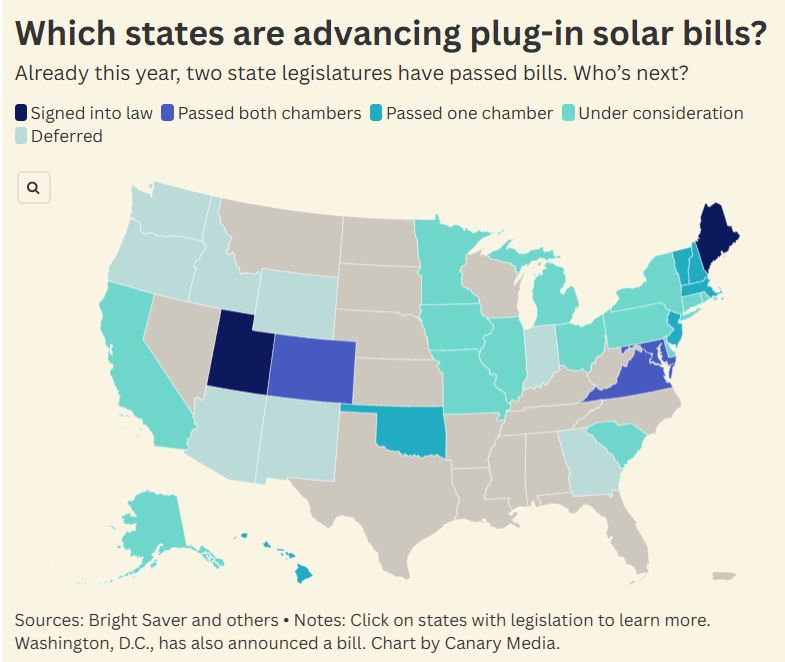
In two states, it pretty much is. This week, Maine joined Utah to become the second state to legalize the use of “balcony solar” panels, which can be plugged into standard outlets to help offset homeowners’ power usage. Other states may soon join them: Canary Media’s Sarah Shemkus has put together a map showing where bills to legalize balcony solar are in the works, with some needing only a governor’s signature to become law.
Whale, whale, whale: The Trump administration struck down Endangered Species Act protections for whales to unleash oil and gas development in the Gulf of Mexico — even though it has used unfounded claims about offshore wind’s risks to the creatures as an excuse to undermine that industry. (Canary Media)
Ceasefire’s energy impacts: Oil prices have fallen since the announcement of a two-week ceasefire between the U.S. and Iran, which analysts say may quickly translate into gasoline price relief for Americans. (The Hill, Axios)
New Jersey goes nuclear: New Jersey lifts its de facto ban on nuclear power construction, becoming the sixth state to reauthorize reactor development in the past decade and the second, after Illinois, to do so this year. (Canary Media)
Winds of change: The U.S. Interior Department quietly fails to appeal court decisions that allowed work to restart on offshore wind projects halted by the administration, an omission that experts say could be an early sign of hope for the industry. (Grist)
Digging clean heat: A geothermal heat pump system that’s heating and cooling a church just outside New York City could pave the way for similar projects in dense urban areas. (Inside Climate News)
Solar soars: A federal report shows rooftop solar now accounts for 20% of Puerto Rico’s energy production, surpassing natural gas to become the island’s second-largest generation source, behind petroleum liquids. (Utility Dive)
Renewables reign: In March, renewables generated more power than gas across a whole month, marking a first for the U.S. grid. (Canary Media)


.svg)
