

 Back
Back
DALLAS — The automated machinery and bright, clean factory floor wouldn’t look out of place in the solar manufacturing hub of Changzhou, China. But every so often, the pristine industrial order was punctuated by, of all things, carrier robots blasting psychedelic rock as they rolled down the aisles.
T1 Energy runs this half-mile-long factory just 15 miles south of Dallas, where seven parallel manufacturing lines produced more than 20,000 photovoltaic modules on the day I visited in October. After ramping up in the early months of 2025, T1 is on track to produce up to 3 gigawatts this year, but with the systems dialed in and workers operating 24/7, the facility has been running fast enough to make 5 gigawatts in a year, said Russell Gold, executive vice president for strategic communications.
The factory is finding its legs just as the Trump administration vaporizes pro–clean energy policies and instead pursues a fossil-heavy vision of “energy dominance.”
“What the manufacturers here really want, and really need, is just certainty,” said MJ Shiao, vice president of supply chain and manufacturing at the trade group American Clean Power. What they got this year was “policy whiplash,” he said, which has caused the Biden-era drumbeat of clean-energy manufacturing announcements to morph into a chorus of cancellations, per data from Atlas Public Policy.
But T1 nonetheless is staking a claim to homegrown American solar energy and making the case that it’s still lucrative. The firm has plowed ahead this year, signing deals for U.S.-made polysilicon and U.S.-made steel frames and preparing to build its own solar-cell fabrication facility.
Gold pointed to the booming demand for solar, which has become the biggest source of new power plant capacity getting built in the U.S. today by a long shot.
“We absolutely believe that it is a great time to be making solar,” said Gold, who came to T1 in May after a career covering energy for The Wall Street Journal. “The main reason is we’re in the middle of this massive trend toward more electricity usage … Solar is the scalable energy resource that can produce the amount of electricity that is demanded today.”
T1’s facility bustles with robots and people working side by side.
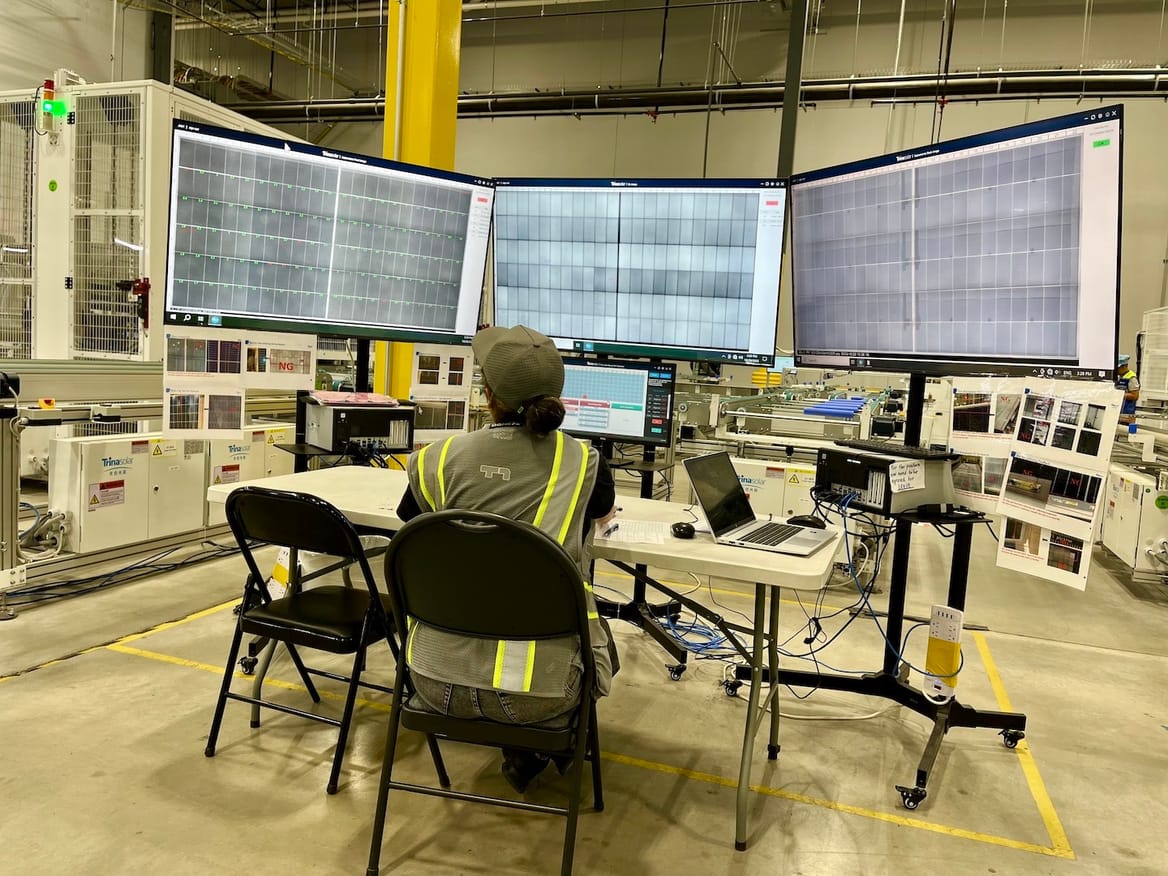
Autonomous units ferry materials around and handle the heavy lifting of pallets stacked high with finished panels. Specialized machines cut cells and string them together with electrically conductive filaments, while others sandwich rows of cells between glass, snap their frames into place, and roll them through a high-temperature curing process.

Today those frames are made out of imported aluminum, but next year T1 will replace them with U.S.-made steel frames from Nextpower, the solar equipment juggernaut formerly known as Nextracker. Dan Shugar, Nextpower’s CEO, had visited T1 shortly before I did; given Shugar’s well-known love for classic guitar rock, technicians reprogrammed the autonomous guided vehicles’ warning sounds with grooves by Santana and AC/DC. (“Because of course, AC/DC — it’s appropriate,” Gold told me.) The sounds stuck around.
The factory was running two 12-hour shifts every day, with workers watching over the robots and stepping in when necessary to correct their work. Signs listed every key notice in English, Mandarin, and Spanish, and the 1,200-person workforce reflected the diversity of the Texas metropolis.
The only production line that wasn’t operating during my visit had been geared toward smaller residential panels. T1 had paused production in response to slack demand, Gold said, and was working to adjust the line to produce panels for the booming utility-scale market instead.
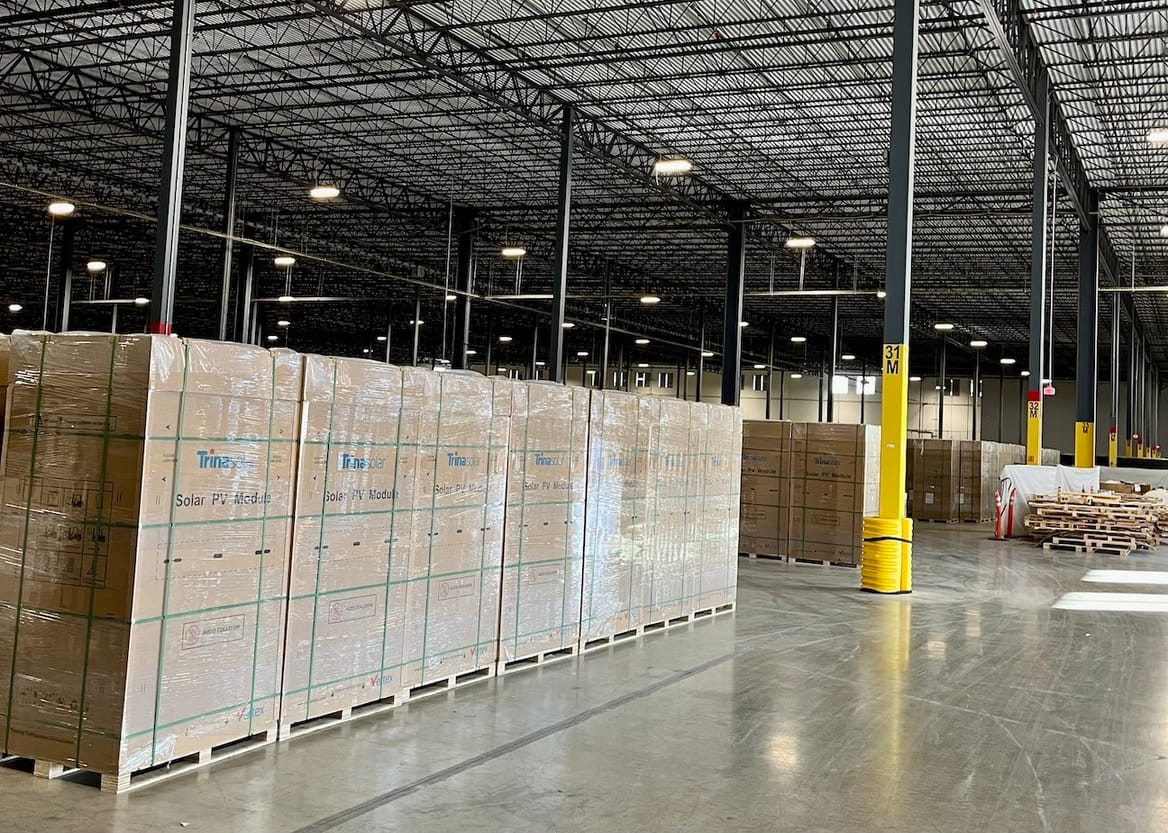
Around the factory, a few clues hinted at a more nuanced backstory than the triumphal, homegrown American solar narrative that T1 leads with. Much of the production machinery sported the logo of Trina Solar, a Chinese company that ranks among the most prolific solar manufacturers in the world. At the end of the tour, we surveyed the warehouse area, where pallets of finished modules awaited shipping in Trina Solar–branded cardboard boxes.
The Chinese company, in fact, built the factory, as part of a wave of foreign investment in U.S. solar panel assembly that kicked off back in 2018, when the first Trump administration levied new tariffs on Chinese imports. Chinese investment in U.S. solar factories accelerated considerably when the Biden administration passed industrial policy that rewarded manufacturers for U.S. production and developers for installing domestically made equipment.
Within two and a half years of Biden signing the Inflation Reduction Act, the U.S. built enough factories to assemble all the panels it needed. The entire supply chain had not been re-shored, but it was well on its way — a remarkable turnaround for a sector long since decimated by cheaper Chinese competition. The lone exception to that collapse was First Solar, which makes a thin-film cadmium-telluride panel, in contrast to the dominant silicon-based photovoltaics; that company, too, has expanded its U.S. footprint, recently completing a factory in Louisiana and announcing a new one in South Carolina.
Even before Trump won his second election, though, bipartisan political sentiment was shifting against Chinese companies’ benefiting from federal incentives, even those that built state-of-the-art factories in the U.S. and staffed them with American workers.
Trina had constructed the Dallas factory and had just begun the laborious process of commissioning the lines when it evidently saw the writing on the wall. Trina sold the factory in December to Freyr Battery, which had tried and failed to build battery gigafactories in Norway and Georgia. The entity officially rebranded as T1 Energy in February and now is headquartered in the U.S. and traded on the New York Stock Exchange.
Gold demurred on the question of who approached whom with an offer. In any case, after the transaction, T1 owned the factory, which it calls G1 Dallas, and Trina retained a 13.2% stake in the company. That arrangement neatly anticipated the “foreign entity of concern” (FEOC) rules that Trump signed into law this summer: Republicans restricted clean energy tax credits from going to companies with too much ownership by Chinese companies.
“FEOC is going to be a challenge for this industry because China has dominated the solar industry for years,” Gold said. But the December transaction took the factory from a level of Chinese ownership that would violate the subsequent FEOC rules to a level “well below the equity cutoff,” Gold noted. “We were doing it before Congress spelled out what people need to do.”
Congress set the FEOC restrictions to kick in at the start of 2026, which means some domestic solar factories will, ironically, cease to qualify for the made-in-America tax credits under their current ownership structures. Santa’s sack just might hold some factories for corporations, like T1, that have made it onto the FEOC “nice list.”
As for the ongoing use of Trina-branded containers for shipping T1 modules, “there was no reason to make extra waste by trashing a bunch of boxes,” Gold said.
Solar panels are the last step of the supply chain, and the one with the lowest barrier to entry: Though highly specialized and automated, the machines at T1, as at Qcells’ facility in Dalton, Georgia, are assembling components produced elsewhere. Making silicon cells requires a step change in capital and technical proficiency, as do the precursor steps of producing wafers and polysilicon ingots.
The U.S. has proved it can make solar panels that, if not economically competitive with those made in China, can get by in a protectionist trade regime that, at least for now, is still buoyed by federal incentives. Cell production is ticking up in the U.S., which currently has factories that can use them — Suniva and ES Foundry each brought about 1 gigawatt of cell capacity on line in the past year. Qcells is finishing up a 3.3-gigawatt cell-production facility in Georgia.
This constitutes an “orderly strategic buildout” for the domestic industry, said Shiao of American Clean Power. “The cell producers aren’t going to come until the module producers come … Right now, we’re starting to see that larger growth of cell production because we’ve had those years for those investment decisions to come to fruition.”
T1 is also getting in on the photovoltaic-cell action. By the end of the year, Gold said, the company expects to break ground on a $400 million cell-fabrication plant, or fab, in Rockdale, Texas, down the road from another silicon-oriented business: a major Samsung chip-fab development. The plan is to ramp up to 2.1 gigawatts of cell production by the end of 2026 and add another 3.2 gigawatts in a subsequent phase.
That’s one angle. This fall T1 also bought a minority equity stake in a fellow upstart solar manufacturer called Talon PV, which is building a 4.8-gigawatt cell fab in Baytown, Texas, and targeting production in early 2027.
Until those factories open, T1 is importing cells from non-FEOC countries, Gold said.
A T1 deal with legacy glass producer Corning signals a further deepening of the U.S. solar supply chain. Corning announced in October that it had opened polysilicon ingot and wafer production in Michigan — the crucial precursor to cell production, and something the U.S. hasn’t had in almost a decade. Business launched on an auspicious note, as Corning has already sold 80% of all its expected production for the next five years to customers including T1.
With that industrial breakthrough, the pieces have fallen into place for a fully American supply of the key silicon solar-panel components. Now the question is whether this fledgling supply chain can survive the tumultuous policy swings of the second Trump presidency.


.svg)
