

 Back
Back
It’s typically depicted as green. It’s loved by some and feared by others. It had a heyday in the 1960s before drawing a political backlash that led to statewide prohibitions. Now, as it grows more popular with Americans than anytime in recent memory, state after state is changing the law to once again legalize it.
I’m talking, of course, about nuclear energy.
The United States is racing to restore the might of its once-great nuclear sector and build new reactors to meet surging electricity demand and compete with China and Russia. It’s been a rapid change: A decade ago, at least 16 states restricted construction of new nuclear power plants, a legacy of the lasting reputational damage from Three Mile Island, America’s only major civilian nuclear accident.
Five states — Wisconsin, Kentucky, Montana, West Virginia, and, most recently, Illinois — have fully lifted their moratoria since 2016. Others are loosening the reins, with Connecticut easing restrictions on small modular reactors and Rhode Island allowing utilities to buy electricity from neighboring states’ nuclear plants. Five more — California, Massachusetts, Minnesota, New Jersey, and Vermont — are now weighing legislation to overturn their bans. Oregon, meanwhile, is considering a bill that would require a feasibility study to look into nuclear power. (In Hawaii, the results of such a study concluded in December that the state should maintain its moratorium on atomic energy.)
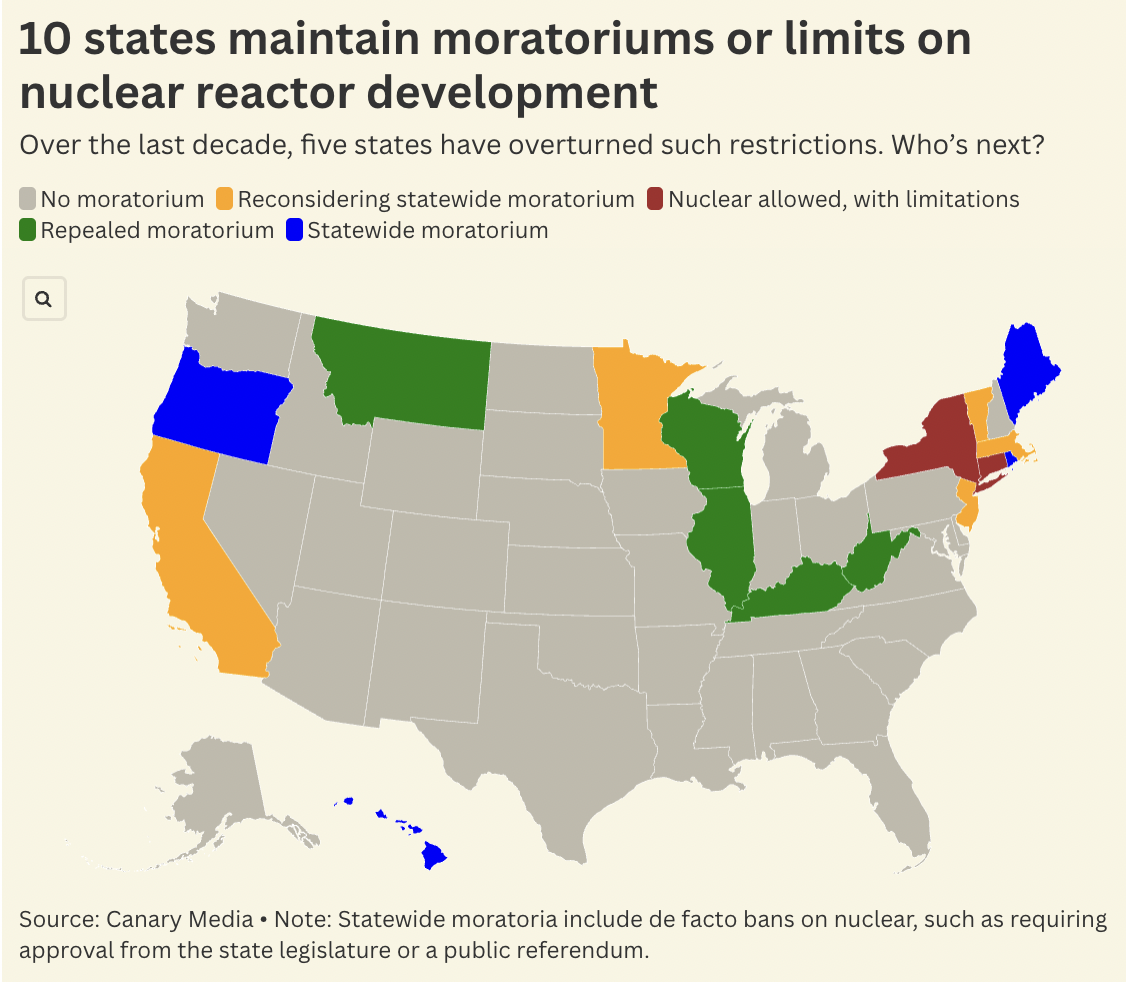
California lawmakers introduced a bill last month to repeal the state’s 50-year ban on new nuclear power. Legislators in New Jersey, where the recently elected Democratic Gov. Mikie Sherrill campaigned on building a new reactor, advanced a bill earlier this month that would de facto overturn the state’s moratorium. Last week, a bipartisan band of lawmakers in Minnesota’s Statehouse vowed to legalize reactor construction again in the state “because we have to.”
The legislative push offers the most significant evidence so far that blue states that once served as bastions of anti-nuclearism are embracing atomic energy. The shift comes amid a deregulatory campaign by the Trump administration that’s meant to clear bottlenecks in the nuclear supply chain and spur a new wave of reactor projects, both big and small. Nuclear power started attracting attention again in recent years as the trade-offs of relying on wind and solar alone grew clearer and demand for electricity soared in the near term from data centers and in the long term from forecasts on electrification of vehicles, heating, and industry.
A global race is now underway that the U.S. and its allies are largely losing. On both sides of the Atlantic, the nuclear industry mostly stalled over the past few decades as flat electricity demand and cheap natural gas from the U.S. and Russia made atomic power plants seem like a 20th-century relic. But the geopolitical risk of relying on a fossil fuel that requires constant replenishing became undeniable as Russia started throttling shipments of gas to Ukraine’s allies after the war kicked off in 2022.
Now American, European, and Japanese companies are scrambling to secure funding and offtake agreements for reactor designs that, in many cases, haven’t yet been built. Soaring oil and gas prices, which the International Energy Agency warned this week will take a long time to stabilize even after the U.S.-Israeli war against Iran ends, are only expected to further drive demand for nuclear power. France’s historic buildout of nuclear reactors, after all, started in response to the 1970s oil embargo.
Meanwhile, Russia’s state-owned Rosatom dominates the nuclear export industry, actively building the first atomic power plants in newcomer countries such as Turkey, Egypt, and Bangladesh. On Monday, the Kremlin announced its latest deal to build Vietnam’s debut nuclear plant. And China is building nearly as many reactors at home as the rest of the world combined, at a relatively rapid clip.
States started banning new nuclear power plants even before the partial meltdown in 1979 at the Three Mile Island nuclear plant in eastern Pennsylvania. The Atomic Energy Commission, the federal regulator in charge of both overseeing commercial reactors and promoting the industry, was increasingly seen as too cozy with the companies under its authority. An anti-war movement with limited options to slow the military’s atomic weapons race instead trained its attention on the civilian power industry, and environmentalists took issue with the relatively small but extremely long-lived volumes of radioactive waste that nuclear plants produce.
California enacted one of the nation’s first major statewide bans on building new nuclear plants in 1976, three years before Three Mile Island. Until then, states and municipalities had only minimal restrictions on nuclear power plants, which fell primarily under federal jurisdiction. But a 1974 law in California reorganized the Golden State’s bureaucracy, centralizing energy regulation for the first time in Sacramento and granting the newly established California Energy Commission powers to restrict permits for atomic energy facilities until a plan to permanently deal with nuclear waste came to fruition. Through its top cultural export, the state broadcast its skepticism of atomic energy: Released just 12 days before the Three Mile Island accident, a Hollywood thriller starring Jane Fonda, “The China Syndrome,” depicts a dangerous cover-up of a problem at a nuclear power plant.
In the years that followed, more states, including Maine and Oregon, adopted California-inspired moratoria predicated on a permanent solution for nuclear waste coming into commercial use, according to data from the National Conference of State Legislatures. Others — including Hawaii, Massachusetts, Rhode Island, and Vermont — effectively banned nuclear construction by making any new reactors subject to politically unattainable approval by the state legislature. A handful of states also rewrote rules to require a statewide referendum on building a new nuclear plant.
Some states enacted only partial bans. New York, for example, just barred construction of nuclear reactors on Long Island, where protesters blocked the Shoreham Nuclear Power Plant from coming online and financially crippled the region’s utility, forcing a state takeover.
Attitudes toward nuclear power have since evolved. Despite a drop in support following the meltdown at the Fukushima-Daiichi nuclear plant in northern Japan in 2011, a majority of Americans in both political parties have come to favor an expansion of nuclear energy. Polls from the Pew Research Center and Gallup show the highest support in years.
In 2016, Wisconsin became the first state to reverse course. Lawmakers in the factory-dense state pitched legislation to repeal the ban as a way to shore up the supply of reliable, clean power for manufacturers whose shareholders increasingly demanded a lower carbon footprint.
Seeking an alternative to fossil fuels that could make use of existing transmission lines and boilers at coal-fired plants, Kentucky followed suit a year later. Montana came next, in 2021, then West Virginia in 2022.
Illinois, by far the largest user of atomic energy of any state, only partially lifted its ban at the end of 2023, legalizing construction of as-yet-unbuilt small modular reactors with an output of 300 megawatts or less. While more than a dozen developers are racing to commercialize various kinds of so-called SMR designs, the promise of cheaply mass-producing identical reactors remains mostly theoretical. The only modern nuclear reactor design in operation in the U.S., the 1,100-megawatt Westinghouse AP1000, remained effectively banned in Illinois until January, when Democrat Gov. JB Pritzker fully repealed the moratorium and called for new plants.
The changing sentiment is a necessary but not sufficient precondition for more nuclear plants to start construction in the U.S. Big questions remain about how to finance projects, train workers, and establish supply chains for novel kinds of reactors.


.svg)
