

 Back
Back
Geothermal energy is on the cusp of a renaissance in the United States. But outdated and piecemeal rules could delay development of the around-the-clock, carbon-free energy source.
Next-generation geothermal is something of a golden child, backed by everyone from climate advocates to leaders in the drilling-obsessed Trump administration. Investors are pouring billions of dollars into the sector. A huge, first-of-a-kind project in Utah will start delivering power this fall, marking a milestone for this new wave of geothermal technologies — and fueling hopes that the energy source can help the U.S. keep pace with skyrocketing demand.
But companies won’t be able to quickly build dozens more of these power plants without updated regulations and standards for developing geothermal projects, industry insiders and experts say.
Today, permitting requirements are fragmented and can vary at the state and local levels, a reflection of the modest role geothermal has historically played in America’s energy sector. However, next-generation technologies are promising to unleash development in areas where harnessing Earth’s heat was previously too difficult or too expensive.
So companies are calling for a more standardized approach to permitting, instead of the bespoke, project-by-project reality they currently face. That will require lawmakers to act, but also the industry itself to develop better systems for defining projects and sharing data.
Meanwhile, pressure is growing within and outside the industry to create more safeguards for preventing accidents and high-profile mistakes that could harm communities and the environment — and could damage the industry’s reputation before it can truly launch.
“We want geothermal to advance as a clean energy solution that can be available anytime that is needed, anywhere that it is needed,” said Angela Seligman, a senior geoscientist at the nonprofit Clean Air Task Force. “But we also want it to stay as a source of clean energy, and we want the good actors … to be the ones who build new projects.”
Here are just a few of the ideas gaining traction for safely accelerating geothermal projects.
An obvious but essential step for creating rules is to establish exactly how next-generation technologies work and what their impacts might be.
The emerging industry has an ever-expanding vocabulary to describe its tools and techniques, but there’s still little consensus about what those terms all mean, said Jamie Beard, executive director of Project InnerSpace, a geothermal research and advocacy organization.
For example, Fervo Energy’s flagship, 500-megawatt Cape Station project is an “enhanced geothermal system” that uses hydraulic fracturing techniques gleaned from the oil and gas industry. Other developers might take a similar approach but use different words to describe it. The same goes for “advanced” and “closed loop” geothermal systems, which broadly include projects that circulate fluids in sealed underground pipes but can still involve intensive drilling methods and encompass a variety of materials.
“Right now, everybody’s kind of calling themselves what they want,” Beard said. “You can’t standardize, and you also can’t build trust about a technology” in this way, she added.
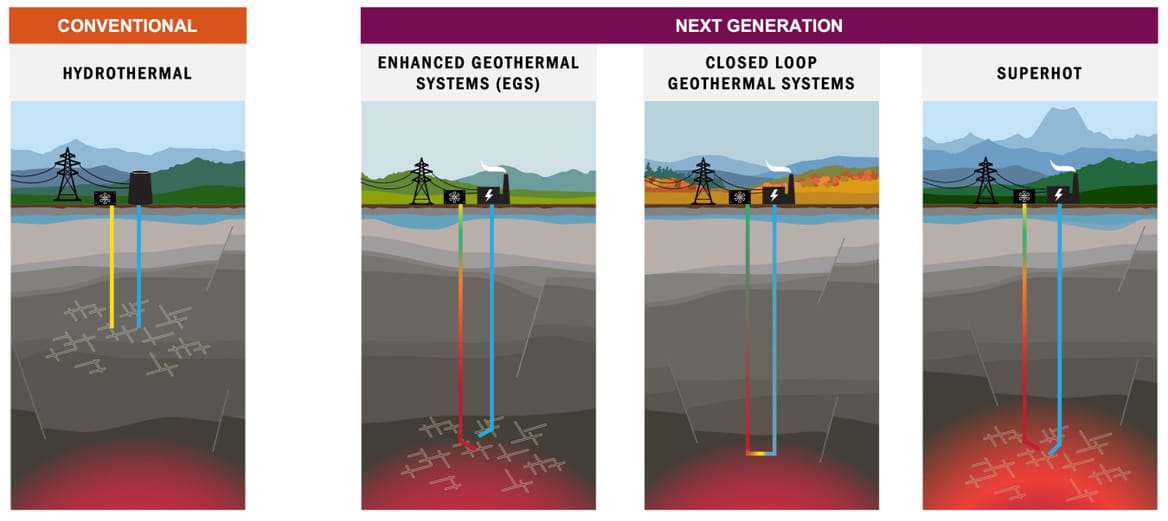
Last month, Project InnerSpace unveiled an initiative to start defining projects in more concrete terms. The Geothermal Resources Management System, which is modeled on the petroleum industry’s system, aims to establish a global framework for classifying and evaluating geothermal reserves. The main idea is to give banks and insurers more clarity and confidence in potential projects. But it would also support larger efforts to establish industry protocols for things like limiting groundwater contamination and avoiding industrial accidents, Beard said.
In the U.S., new bipartisan legislation to accelerate geothermal development is also geared toward creating more public transparency from the sector.
Sens. John Hickenlooper (D-Colorado) and Steve Daines (R-Montana) recently introduced the GEO Power Act, which would require the Department of Energy to help fund geothermal projects in states with limited or no existing geothermal power generation. It also prioritizes data sharing within the industry to “de-risk” future projects and to help regulators, communities, and business partners better understand and address potential impacts, according to the office of Sen. Hickenlooper.
Perhaps no risk looms as large over the next-generation geothermal universe as human-caused earthquakes.
The mistakes made on earlier enhanced geothermal systems are notorious. In France, Switzerland, and South Korea, the process of injecting water at high pressure to fracture rocks underground triggered seismic activity that was strong enough to damage buildings, rattle surrounding cities, and create public backlash.
In response to such events, in 2012, the U.S. Department of Energy revised its induced seismicity protocol, which describes a “traffic light” system for the real-time monitoring and measuring of vibrations caused by geothermal development. Any U.S. geothermal project that receives federal funding — which is virtually all of them today — is required to set up seismicity monitoring stations and follow the DOE’s guidance.
But as the industry matures, projects will likely no longer need government support, meaning they won’t have to follow the system of red, amber, and green lights in their operations. Seligman said that the Clean Air Task Force is pushing for the federal government to require all geothermal projects to adhere to the protocol.
“We want to be really careful about induced seismicity, so that it’s not something that will hinder the advancement of the geothermal industry,” she said.
The startups Eavor Technologies and XGS Energy told Canary Media they would have no issue adhering to a universal protocol. Both firms claim their systems are designed to mitigate such risks from the start. They say their closed-loop technologies don’t require fracking or injecting and withdrawing fluids from the ground — the main drivers of seismicity in geothermal wells.
“Maintaining public trust is vital for the entire geothermal sector,” said Neil Ethier, Eavor’s vice president of commercial and business development. In December, the Canadian startup began delivering power to the grid from its flagship operation in Germany, which is slated to produce over 8 MW of electricity and 64 MW of district heating when fully completed.
XGS is developing a 150-MW closed-loop system in New Mexico that’s expected to provide clean power for Meta’s data centers by 2029. Last week, the Houston-based firm said it was partnering with oil-and-gas services giant Baker Hughes on the exploration and engineering phases of the geothermal project.
Lucy Darago, the chief commercial officer for XGS, said that blanket requirements run the risk of adding “superfluous” rules for companies like hers, and that regulators should instead adopt measures that are “fit to purpose” and reflect the nuances in next-generation systems. She said that XGS is active in ongoing discussions with policymakers in states such as Colorado and New Mexico, which are revising permitting structures to accelerate geothermal development.
“Should we be required to drill a monitoring well and maintain a seismic program that could add millions of dollars to overall project costs?” Darago asked. “We probably will, especially for early projects. But should that be a perpetual part of our regulatory regime? I think that’s an open question, and one that we’d ultimately like our regulators to decide.”
As state and federal agencies work to revise rules for geothermal projects, industry leaders in the U.S. and other countries are also looking to show a token of good faith by proactively committing to certain standards.
Last fall, for instance, Fervo released the Geothermal Sustainable Development Pact, a voluntary framework meant to guide the industry’s growth. The 37-point plan includes steps like adopting DOE’s protocol for reducing seismic risk, prioritizing efficient water use, minimizing land disruption, and engaging with communities.
“As geothermal scales to meet rising energy demand, we have a responsibility to raise the bar on how these multi-decade projects are developed, and not just exclusively focus on the technology itself,” Tim Latimer, Fervo’s CEO and co-founder, said by email.
“Geothermal benefits from decades of lessons across energy: what worked in oil and gas, what worked in renewables, and where both fell short,” he added. “We don’t see it as an either-or situation. It’s not growth or responsibility. It’s both.”
No other companies have signed Fervo’s pact so far, though Latimer said the startup is inviting others across the industry to adopt and build on its principles. The environmental groups Sierra Club and NW Energy Coalition, an alliance of over 100 organizations and businesses in the Pacific Northwest, have said they fully endorse the pact.
“I think everybody will benefit from it, especially at this early stage of an exciting new era,” said Fred Heutte, a senior policy associate for the NW Energy Coalition.
He said that in his home state of Oregon, the startups Mazama Energy and Quaise Energy are working to build novel geothermal projects near the Newberry Volcano. Oregon currently has one large-scale conventional geothermal project — the 33-MW Neal Hot Springs plant — but most states have no geothermal development at all, given the industry’s traditional limitations.
With next-generation systems, “there’s going to be a lot more places that will be looked at for geothermal development … and that’s going to raise issues about land impact, community impact,” Heutte said. “I think the industry is well aware of the risks of problems like that and is trying to get out in front of it.”


.svg)
