

 Back
Back
With gas prices up and more affordable options hitting lots, used EVs are looking like a sweet deal. We offer some useful tips to help you make the best purchase.
A year ago, Crystal Bright was freaking out. The Charlotte, North Carolina–based interior designer had just separated from her partner and needed to figure out how to stay afloat financially.
She could have taken on more work, Bright said, but that would have meant spending less time with her son, who’s now 8 years old. So she reasoned, “Let me just save money instead of figure out how to make money.”
A used electric vehicle turned out to be the key to solving her financial woes.
Last May, she bought a 2013 Nissan Leaf for $3,000 outright. That let her cut her $400 monthly payment on her previous car and liberated her from the $200 a month she used to pay for gas. The lower maintenance cost of owning an EV has also put another $200 back in her pocket each month. With $800 total per month in savings, Bright has been able to move with her son from an apartment in which she didn’t feel safe to a “beautiful townhouse.”
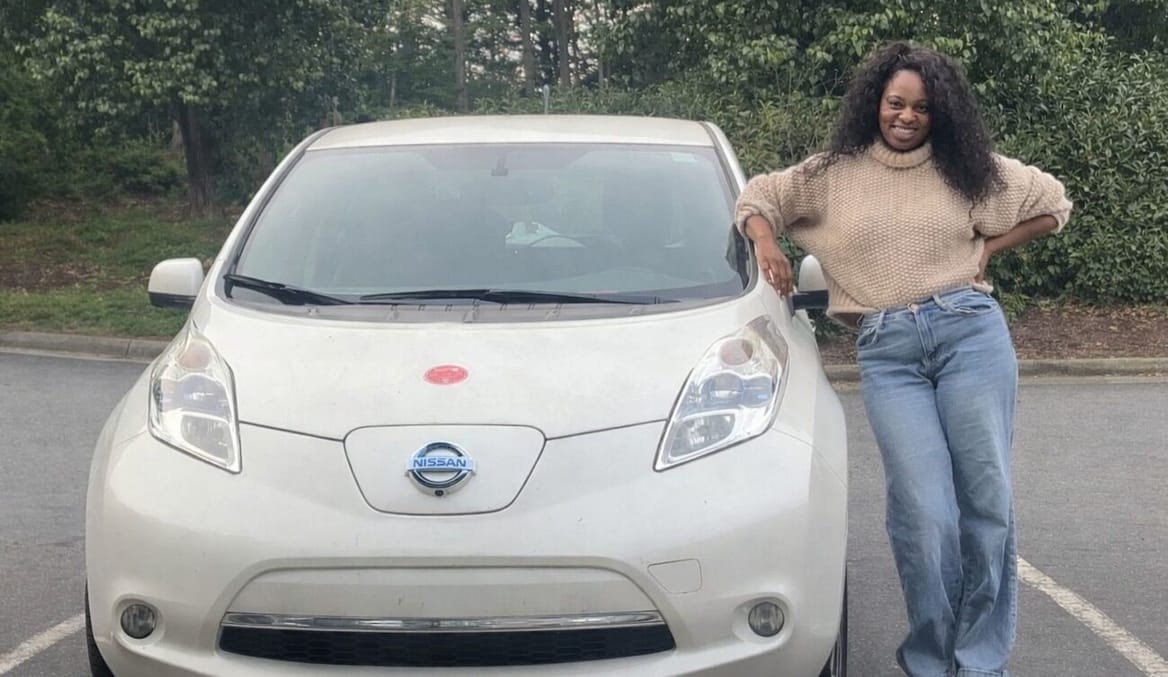
Across the U.S., gasoline prices have spiked to $4.50 per gallon on average because of the war in the Middle East. But Bright is able to recharge mostly using the copious free public charging available locally, and she can top off at home with her 100-foot extension cord if she needs to. “I have no idea what gas costs, thank goodness,” she said.
More drivers want to be insulated like that. The market for used EVs is surging; their average cost of $35,895 is now competitive with that of used gas cars (average $34,799).
If you’re interested in buying a used EV for the financial savings — not to mention reduced air and climate pollution — here’s how to make sure you get one that’s right for you.
Figure out what range you actually need, based on how much you typically drive and how frequently you’ll charge, recommends Desiree Moore, program manager at Drive Clean Colorado, a state program that aims to reduce greenhouse gas pollution from vehicles.
On average, Americans are on the road less than 30 miles a day. But Moore often drives long distances for work, so she’s eyeing a newer Leaf or Ford Mach-E to get at least 200 miles to 300 miles on a single charge, she said. InsideEVs, U.S. News & World Report, and Recurrent, a company that aggregates data on vehicle battery health, are a few of the sources that list their top used EV picks, which will give you a sense of the best range for your buck.
Also get familiar with the discounts available in your area. While the Trump administration vaporized federal tax credits for new and used EVs, nonprofits Veloz and Rewiring America have tools to help you look up local incentives.
But the most important EV research might be what you do in person. “Drive as many as you possibly can, because there’s such a difference in driving style and acceleration and turning radius — all of the things that you would expect from any used car,” said Andrew Garberson, Recurrent’s head of growth and research.
Potentially hundreds of dollars a year or more, depending on several factors, including your current car, how much you drive, shifting gas prices, and whether you can charge on the cheap, like at home with a discounted EV rate from your utility — or, less commonly, for free like Bright does. Filling up at home in 2026 can be like buying gas at $1.60 per gallon.
You can play around with different online tools to get a sense of the savings that come with switching to an EV. For example, the U.S. Department of Energy’s Vehicle Cost Calculator lets you compare the total cost of ownership for specific vehicle makes and models. And while the AFLEET TCO Calculator from DOE’s Argonne National Laboratory doesn’t have that capability, it allows you to toggle the cost of electricity. (The Vehicle Cost Calculator auto-sets power prices based on your state, though you may be able to get a better rate with your utility.) Both tools let you input the current price of gas.
Here’s an example from giving the AFLEET tool a spin: Under the assumptions of driving 12,400 miles per year, $3.50-per-gallon gas, and Xcel Energy Colorado’s best time-of-use rate of about $0.08 per kilowatt-hour, the calculator estimated that over 10 years an EV would save more than $11,000 in fuel costs and more than $8,000 in maintenance.
Beyond running an Internet search for “used EVs near me,” look to local dealers, many of which have upped their EV game. Bright scoped out listings on Carvana, and ultimately went with a car she found on Facebook.
You can also check out online marketplaces such as Edmunds and Cars.com. These platforms include Recurrent’s forecasts on vehicles’ remaining range, which are based on real-world driving data shared by more than 30,000 vehicle owners.
The heart of an EV is its battery. Info on its condition might be available in an online listing, as mentioned above.
But you can do a live check, too. When you turn the EV on, take a look at its current charge and estimated range and compare that with the predicted range on a full charge, Recurrent’s Garberson said. As you take it for a test drive, make sure the figures on the dash don’t nosedive.
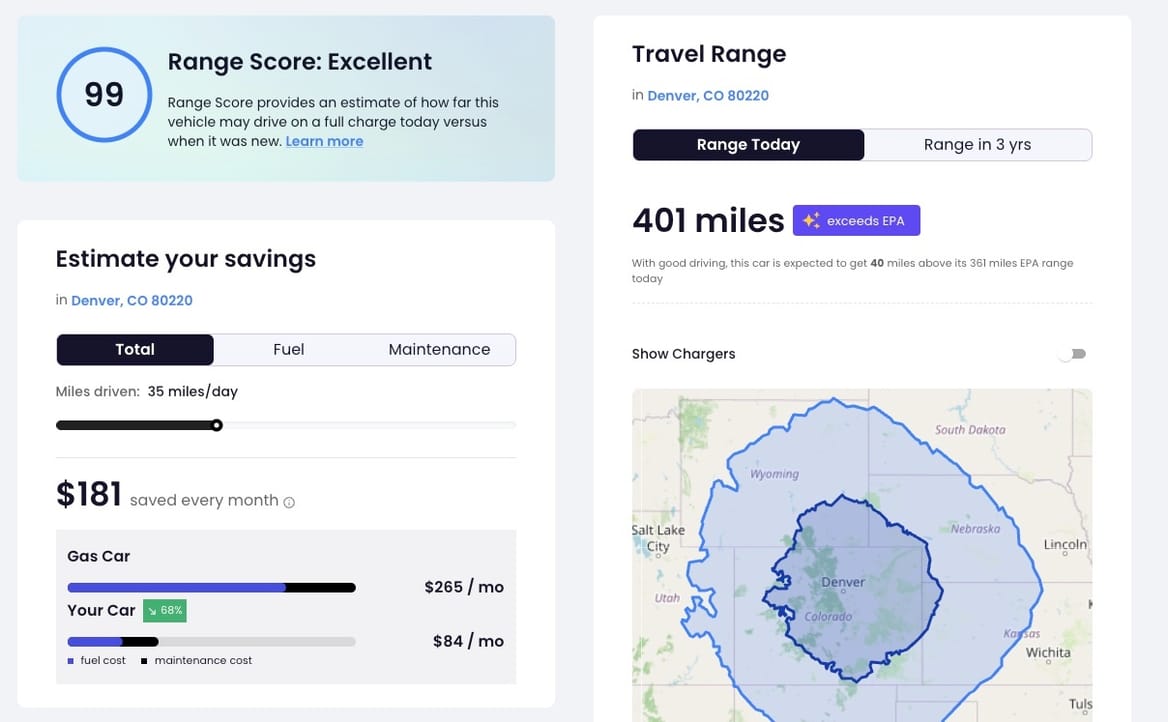
Battery replacements, while rare, typically cost $5,000 to $16,000. So it’s worth taking the time to ask the dealer for relevant information. Drive Clean Colorado has a handy checklist of questions: “Has the battery ever been serviced or replaced?” “What’s the remaining battery warranty?” “Is the warranty transferable to a second owner?”
Be sure to ask for a copy of the battery’s health report, which includes a “State of Health” metric that clarifies loss of capacity. For example, a score of 95% means that if the original range was 300 miles, it’s now 285 miles.
Warranties usually cover the battery and drive train for at least eight years or 100,000 miles. Verify in the contract what’s covered for the car you’re eyeing.
Vehicles that are 2 years to 4 years old are an especially good bet, according to Ingrid Malmgren, senior policy director at EV advocacy nonprofit Plug In America. “Those are the vehicles that are going to be coming off of leases. They tend to be lower mileage [and] have lots of remaining life left in them.”
EVs can last 150,000 miles to more than 300,000 miles; and the batteries, losing on average about 2% of their original mileage annually, have a typical lifespan of about 13 years. And the technology keeps improving.
“Mileage has less of an impact than battery health on longevity,” Malmgren said. “So if you wouldn’t buy a gas car with 100,000 miles, an EV with good battery health still could have hundreds of thousands of miles left, because [it has] fewer moving parts.”
Check the EV charging port. Older vehicles might have a J1772 port, which is compatible only with Level 1 and Level 2 chargers, instead of a CCS or NACS port that can accommodate direct-current fast-charging, too. DC fast charging can be 10 times as quick as Level 2 charging.
If you’re planning to plug in at home, you might want to install a Level 2 charger before you drive the car off the lot. Some of the best-reviewed options retail for about $200 to $900. A 120-volt outlet will provide a trickle of about 2 miles to 5 miles of charge per hour, depending on the vehicle.
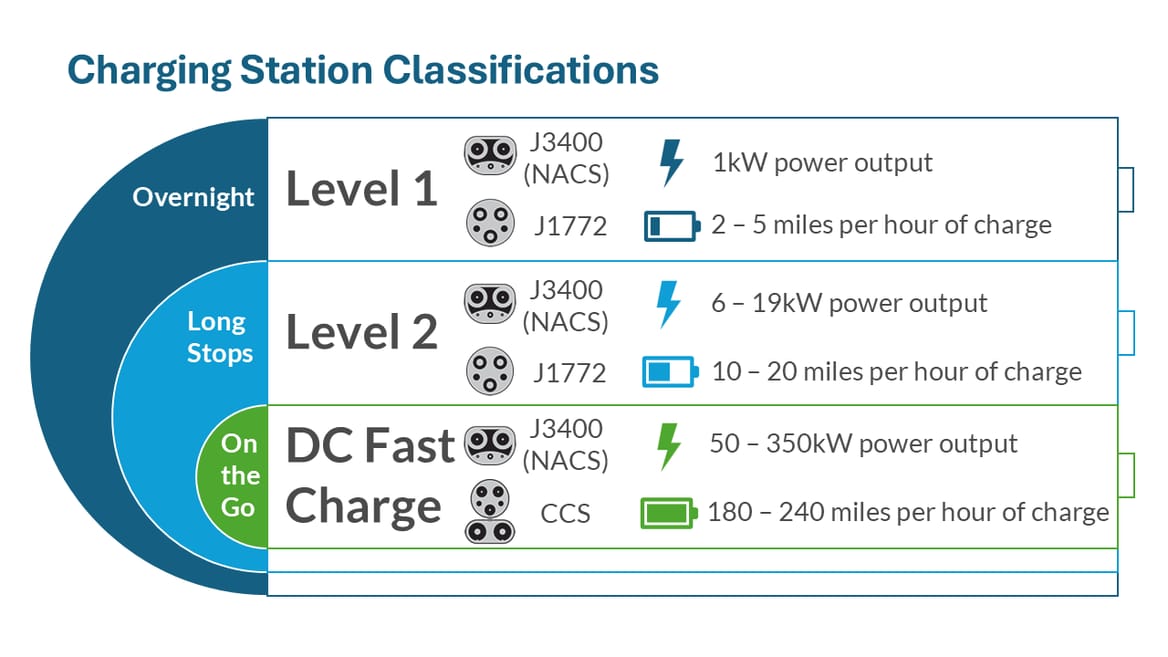
Each EV make and model will also have its own max charging speed, which could influence how you road-trip. An old Chevy Bolt that taps out at 50 kilowatts will take more than an hour to fully recharge even at the fastest charger, whereas the newer model could do that in less than 20 minutes.
Bright, whose Leaf gets a max of about 68 miles of range, would love to go farther. So now she’s saving up for her next EV: a 2025 Nissan Leaf with 149 miles on a full charge. Bright plans to shop used because it’s so much more affordable; she has seen prices for secondhand models around $18,000, deeply discounted from the roughly $30,000 sticker price of a new one.
Bright’s bank account steadily grew after she switched to a used EV. “I felt so much relief,” she said. “I recommend it for anybody [who’s] struggling.”


.svg)
